Exceptional points in diamond optomechanics
Pith reviewed 2026-06-29 15:23 UTC · model grok-4.3
The pith
Diamond optomechanical crystals reach an exceptional point where two mechanical modes coalesce with asymmetric damping redistribution.
A machine-rendered reading of the paper's core claim, the machinery that carries it, and where it could break.
Core claim
In a diamond optomechanical crystal, structural symmetry breaking produces two high-frequency mechanical resonances that couple to a single optical cavity. By adjusting system parameters the eigenfrequencies and eigenvectors of the two modes coalesce at an exceptional point. This coalescence is reached inside a stable operating window below the phonon-lasing threshold. The experiment records an asymmetric redistribution of optomechanical damping and anti-damping between the resulting hybridized modes.
What carries the argument
Tuning two symmetry-broken mechanical resonances to coalescence at an exceptional point through their shared optomechanical coupling to one optical cavity.
If this is right
- Chiral mode dynamics and topological state transfer become accessible in the mechanical degree of freedom.
- Non-Hermitian optomechanics can be combined with existing strain-coupled spin defects in the same diamond platform.
- Diamond optomechanical crystals are established as a working platform for multimode non-Hermitian physics.
- Hybrid spin-phonon interfaces gain a route to topological mechanical dynamics.
Where Pith is reading between the lines
- Symmetry-breaking designs for reaching exceptional points could be transferred to other material systems that host strong optomechanical coupling.
- The observed asymmetric damping may be exploitable for directional mechanical amplification or isolation schemes.
- Placing a spin defect at the exceptional point could allow tests of whether non-Hermitian topology protects or modifies spin-phonon interactions.
Load-bearing premise
Structural symmetry breaking in the diamond device creates two distinct mechanical resonances that remain tunable to coalescence while staying below the phonon-lasing threshold.
What would settle it
A measurement at the predicted coalescence point that shows symmetric rather than asymmetric damping redistribution, or that shows coalescence is impossible without crossing the phonon-lasing threshold, would falsify the central claim.
Figures
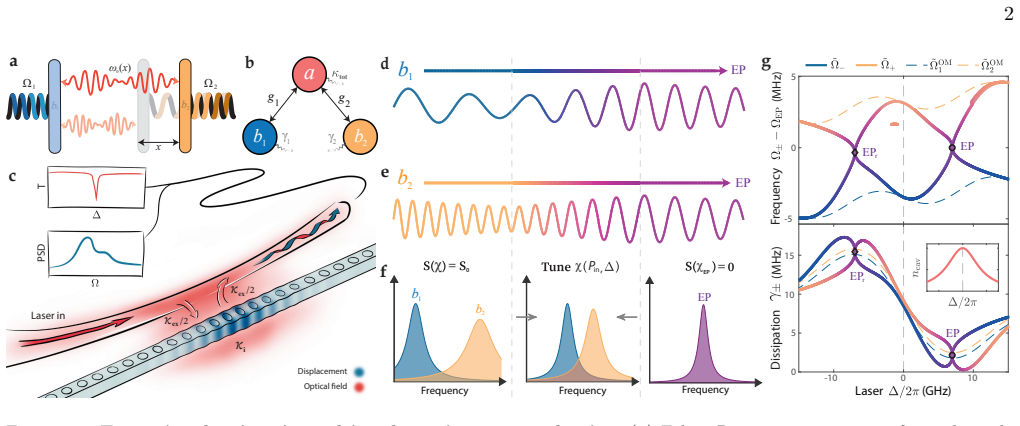
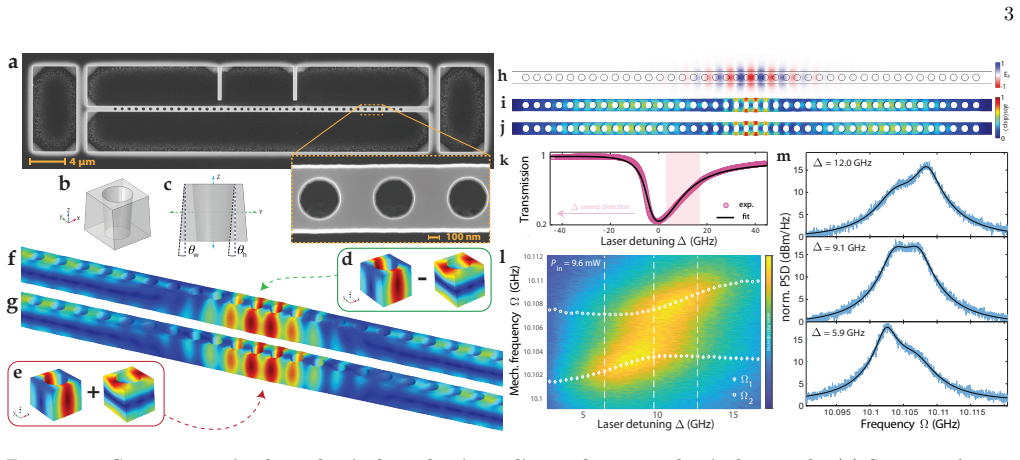
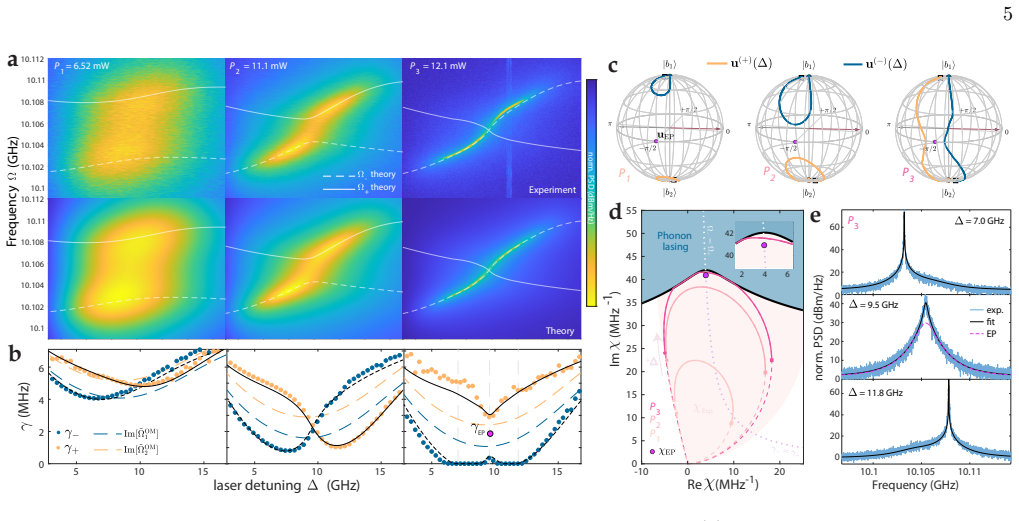
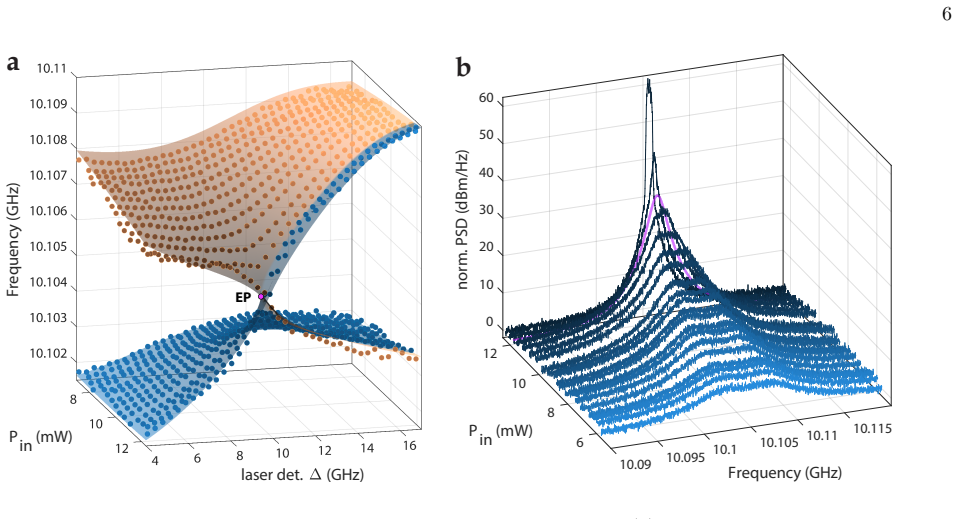
read the original abstract
Multimode cavity optomechanical systems allow light to couple otherwise non-interacting mechanical resonators, enabling non-Hermitian phenomena such as exceptional points, where eigenfrequencies and eigenvectors of coupled modes coalesce. Accessing an exceptional point and its nearby parameter space is a first step towards chiral mode dynamics and topological state transfer. Diamond optomechanical devices support strong coherent optomechanical coupling required to tune resonances to an exceptional point, as well as strain-coupling to spin-defects for hybrid quantum technologies, but have not yet been used for multimode non-Hermitian physics. Here we tune to an exceptional point in a diamond optomechanical crystal, which uses structural symmetry breaking to produce two high-frequency mechanical resonances coupled to an optical cavity. The exceptional point is reached within a stable operating window below the phonon-lasing threshold, and we observe asymmetric redistribution of optomechanical damping and anti-damping between hybridized modes. These results establish diamond optomechanical crystals as a platform for non-Hermitian optomechanics, opening routes to topological mechanical dynamics in hybrid spin-phonon interfaces.
Editorial analysis
A structured set of objections, weighed in public.
Referee Report
Summary. The manuscript reports an experimental demonstration in which structural symmetry breaking in a diamond optomechanical crystal produces two distinct high-frequency mechanical resonances that are coupled to a single optical cavity. The system is tuned to an exceptional point (eigenfrequency and eigenvector coalescence) within a stable operating window below the phonon-lasing threshold, with the observation of asymmetric redistribution of optomechanical damping and anti-damping between the hybridized modes. This is presented as establishing diamond optomechanical crystals as a platform for non-Hermitian optomechanics with potential for topological dynamics in hybrid spin-phonon systems.
Significance. If the central experimental claim holds, the work would provide the first demonstration of exceptional-point physics in diamond optomechanics, combining strong coherent coupling with access to spin defects. This could enable new routes to chiral mode dynamics and topological state transfer in hybrid quantum systems, extending non-Hermitian phenomena beyond existing platforms.
major comments (1)
- [Abstract] Abstract: The abstract states the observation of asymmetric redistribution at the exceptional point but provides no data, figures, error analysis, or detailed tuning procedure. This prevents verification that the measured behavior corresponds to eigenfrequency and eigenvector coalescence rather than a conventional avoided crossing or other effect.
Simulated Author's Rebuttal
We thank the referee for their review of our manuscript. We address the single major comment below.
read point-by-point responses
-
Referee: [Abstract] Abstract: The abstract states the observation of asymmetric redistribution at the exceptional point but provides no data, figures, error analysis, or detailed tuning procedure. This prevents verification that the measured behavior corresponds to eigenfrequency and eigenvector coalescence rather than a conventional avoided crossing or other effect.
Authors: Abstracts are concise summaries by design and do not contain figures, raw data, or detailed procedures. The full manuscript provides the experimental tuning procedure to the exceptional point, measured spectra and eigenvector data demonstrating coalescence, the observed asymmetric redistribution of optomechanical damping rates between hybridized modes, and associated error analysis. These elements, presented in the results section with supporting figures, distinguish the exceptional-point behavior from an avoided crossing. revision: no
Circularity Check
No significant circularity in experimental report
full rationale
This paper is a direct experimental report of tuning to an exceptional point in a diamond optomechanical crystal and observing asymmetric damping redistribution. No derivations, equations, fitted parameters, or predictions are present that could reduce to inputs by construction. The central claims rest on measured device behavior within a stated stable operating window, with no self-citation load-bearing steps or ansatz smuggling. The result is self-contained against external benchmarks as an observation rather than a theoretical derivation.
Axiom & Free-Parameter Ledger
axioms (1)
- domain assumption Standard multimode cavity optomechanics theory applies, allowing light to couple non-interacting mechanical resonators and produce exceptional points.
Reference graph
Works this paper leans on
-
[1]
Xiang, S
Z.-L. Xiang, S. Ashhab, J. Q. You, and F. Nori, Reviews of Modern Physics85, 623 (2013)
2013
-
[2]
D. Lee, K. W. Lee, J. V. Cady, P. Ovartchaiyapong, and A. C. B. Jayich, Journal of Optics19, 33001 (2017)
2017
-
[3]
Wang and I
H. Wang and I. Lekavicius, Applied Physics Letters117, 230501 (2020)
2020
-
[4]
Janitz, M
E. Janitz, M. K. Bhaskar, and L. Childress, Optica7, 1232 (2020)
2020
-
[5]
Barzanjeh, A
S. Barzanjeh, A. Xuereb, S. Gr¨ oblacher, M. Paternostro, C. A. Regal, and E. M. Weig, Nature Physics18, 15 (2022)
2022
-
[6]
W. P. Bowen and G. J. Milburn,Quantum Optomechan- ics(CRC Press, Boca Raton, FL, 2015)
2015
-
[7]
Aspelmeyer, T
M. Aspelmeyer, T. J. Kippenberg, and F. Marquardt, Reviews of Modern Physics86, 1391 (2014)
2014
-
[8]
H. Xu, D. Mason, L. Jiang, and J. G. E. Harris, Nature 537, 80 (2016)
2016
-
[9]
H. Xu, L. Jiang, A. A. Clerk, and J. G. E. Harris, Nature 568, 65 (2019). 8
2019
-
[10]
H. Ren, T. Shah, H. Pfeifer, C. Brendel, V. Peano, F. Marquardt, and O. Painter, Nature Communications 13, 3476 (2022)
2022
-
[11]
Guria, Q
C. Guria, Q. Zhong, S. K. Ozdemir, Y. S. S. Patil, R. El- Ganainy, and J. G. E. Harris, Nature Communications 15, 1369 (2024)
2024
-
[12]
D.-G. Lai, A. Miranowicz, and F. Nori, Physical Review Letters132, 243602 (2024)
2024
-
[13]
del Pino, J
J. del Pino, J. J. Slim, and E. Verhagen, Nature606, 82 (2022)
2022
-
[14]
J. J. Slim, C. C. Wanjura, M. Brunelli, J. del Pino, A. Nunnenkamp, and E. Verhagen, Nature627, 767 (2024)
2024
-
[15]
D. Lee, S. Lee, J. Park, S. Jang, C. Park, S. Choe, P. Ovartchaiyapong, A. C. Bleszynski Jayich, and D. Lee, APL Quantum2, 046107 (2025)
2025
-
[16]
W. D. Heiss, Journal of Physics A: Mathematical and Theoretical45, 444016 (2012)
2012
-
[17]
Miri and A
M.-A. Miri and A. Al` u, Science363, eaar7709 (2019)
2019
-
[18]
El-Ganainy, K
R. El-Ganainy, K. G. Makris, M. Khajavikhan, Z. H. Musslimani, S. Rotter, and D. N. Christodoulides, Nature Physics14, 11 (2018)
2018
-
[19]
Zhong, M
Q. Zhong, M. Khajavikhan, D. N. Christodoulides, and et al., Nature Communications9, 4808 (2018)
2018
-
[20]
Doppler, A
J. Doppler, A. A. Mailybaev, J. B¨ ohm, U. Kuhl, A. Girschik, F. Libisch, T. J. Milburn, P. Rabl, N. Moi- seyev, and S. Rotter, Nature537, 76 (2016)
2016
-
[21]
W. Mao, Z. Fu, Y. Li, F. Li, and L. Yang, Science Ad- vances10, eadl5037 (2024)
2024
-
[22]
Kononchuk, J
R. Kononchuk, J. Cai, F. Ellis, R. Thevamaran, and T. Kottos, Nature607, 697 (2022)
2022
-
[24]
Q. Lin, J. Rosenberg, D. Chang, R. Camacho, M. Eichen- field, K. J. Vahala, and O. Painter, Nature Photonics4, 236 (2010)
2010
-
[26]
P. K. Shandilya, S. Fl˚ agan, N. C. Carvalho, E. Zohari, V. K. Kavatamane, J. E. Losby, and P. E. Barclay, Jour- nal of Lightwave Technology40, 7538 (2022)
2022
-
[27]
Teissier, A
J. Teissier, A. Barfuss, P. Appel, E. Neu, and P. Maletinsky, Physical Review Letters113, 020503 (2014)
2014
-
[28]
Ovartchaiyapong, K
P. Ovartchaiyapong, K. W. Lee, B. A. Myers, and A. C. B. Jayich, Nature Communications5, 4429 (2014)
2014
-
[29]
E. R. MacQuarrie, T. A. Gosavi, N. R. Jungwirth, S. A. Bhave, and G. D. Fuchs, Physical Review Letters111, 227602 (2013)
2013
-
[30]
Maity, L
S. Maity, L. Shao, S. Bogdanovi´ c, S. Meesala, Y.-I. Sohn, N. Sinclair, B. Pingault, M. Chalupnik, C. Chia, L. Zheng, K. Lai, and M. Lonˇ car, Nature Communica- tions11, 193 (2020)
2020
-
[31]
G. Joe, C. Chia, B. Pingault, M. Haas, M. Chalup- nik, E. Cornell, K. Kuruma, B. Machielse, N. Sinclair, S. Meesala, and M. Lonˇ car, Nano Letters24, 6831 (2024)
2024
-
[32]
H. Oh, V. Dharod, C. Padgett, L. B. Hughes, J. Venka- traman, S. Parthasarathy, E. Osipova, I. Hedgepeth, J. V. Cady, L. Basso, Y. Wang, M. Titze, E. S. Bielejec, A. M. Mounce, D. Bouwmeester, A. C. Bleszynski Jayich, et al., Optica13, 485 (2026)
2026
-
[34]
T. J. Kippenberg, H. Rokhsari, T. Carmon, A. Scherer, and K. J. Vahala, Physical Review Letters95, 033901 (2005)
2005
-
[35]
Rokhsari, T
H. Rokhsari, T. J. Kippenberg, T. Carmon, and K. J. Vahala, Optics Express13, 5293 (2005)
2005
-
[36]
A. G. Krause, J. T. Hill, M. Ludwig, A. H. Safavi-Naeini, J. Chan, F. Marquardt, and O. Painter, Physical Review Letters115, 233601 (2015)
2015
-
[37]
X. Li, I. Lekavicius, J. Noeckel, and H. Wang, Nano Let- ters24, 10995 (2024)
2024
-
[38]
J. P. Mathew, J. del Pino, and E. Verhagen, Nature Nan- otechnology15, 198 (2020)
2020
- [39]
-
[40]
Lodde, R
M. Lodde, R. P. J. van Veldhoven, E. Verhagen, and A. Fiore, Optical Materials Express14, 2321 (2024)
2024
-
[41]
El-Sayed and S
A.-W. El-Sayed and S. Hughes, Physical Review Research 2, 043290 (2020)
2020
-
[42]
Moraes, G
F. Moraes, G. H. M. de Aguiar, E. G. de Melo, G. S. Wiederhecker, and T. P. M. Alegre, J. Opt. Soc. Am. B 39, 2735 (2022). 9 Supplementary Information
2022
-
[43]
[1–3]; the key steps are outlined below
Derivation of the effective mechanical Hamiltonian The effective HamiltonianH eff governing the two coupled mechanical modes is derived following similar treatments in Refs. [1–3]; the key steps are outlined below. The optomechanical system consists of a single optical cavity mode ˆadispersively coupled to two mechanical modes, ˆb1 and ˆb2. In a frame rot...
-
[44]
Projected optomechanical coupling The right eigenvectors associated with ˜Ω± satisfyH effu(±) = ˜Ω±u(±), with normalization|u (±) 1 |2 +|u (±) 2 |2 = 1. Their components are u(±) 1 = 1p 1 +|r ±|2 , u (±) 2 = r±p 1 +|r ±|2 ,(19) with r± = ˜Ω± − ˜ΩOM 1 g1g2χ .(20) The overall complex phase ofu (±) is arbitrary and does not affect the projected couplings def...
-
[45]
Shaded regions indicate the unstable regions where Im[ ˜Ω±]>0
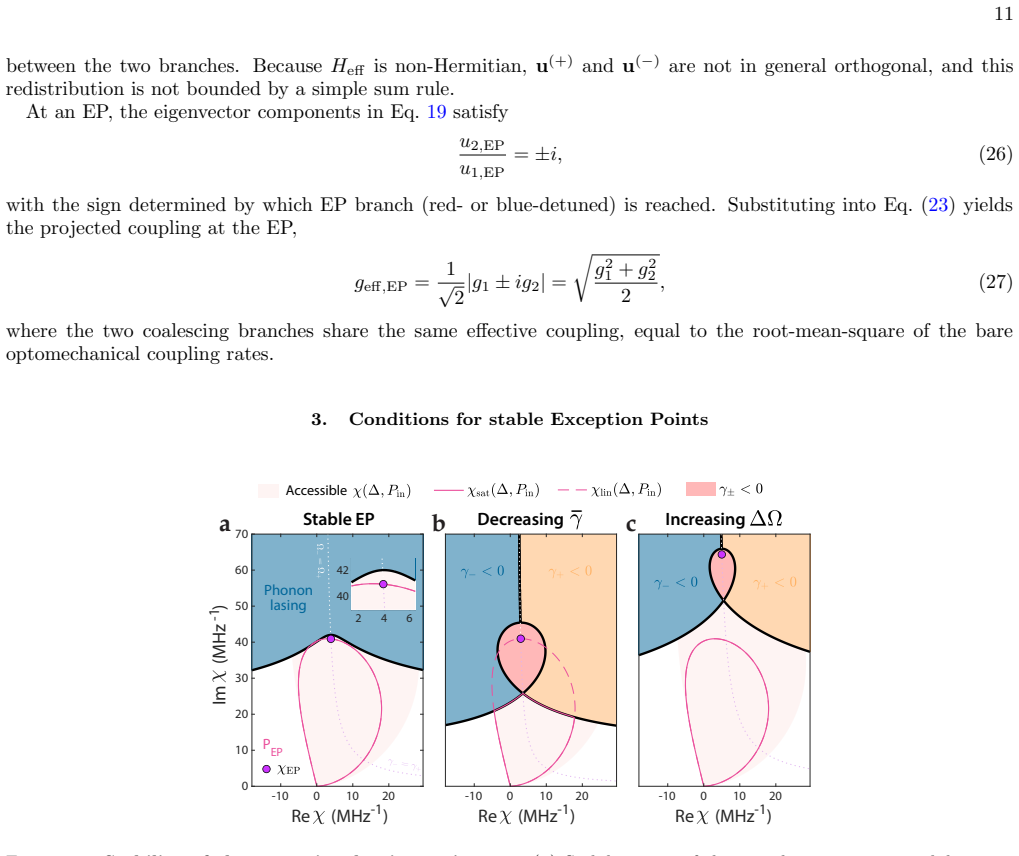
Conditions for stable Exception Points Phonon lasing PEP -10 0 10 200 10 20 30 40 50 60 70 -10 0 10 20 -10 0 10 20 2 4 6 40 42 -Stable EP Decreasing Increasing Re (MHz-1) Re (MHz-1) Re (MHz-1) Im (MHz -1) a b c Accessible Figure 5.Stability of the exceptional-point trajectory.(a) Stability map of the complex cavity susceptibilityχ= Re[χ]+iIm[χ] for the sa...
-
[46]
+ 1 2(g2 2 −g 2 1)∆γ >|2g 1g2 ∆Ω|,(32) which expresses the competition between the intrinsic mechanical damping, which stabilizes the blue-detuned system against phonon lasing, and the optically mediated coupling strength required to reach the EP. In the balanced limit g1 ≃g 2 and ∆γ≃0, the condition reduces to ¯γ >|∆Ω|, showing that stable EP access requ...
-
[47]
The hole sidewalls have an angle ofθ h = 2◦ while the beam’s outer walls have an angle of θw = 3 ◦
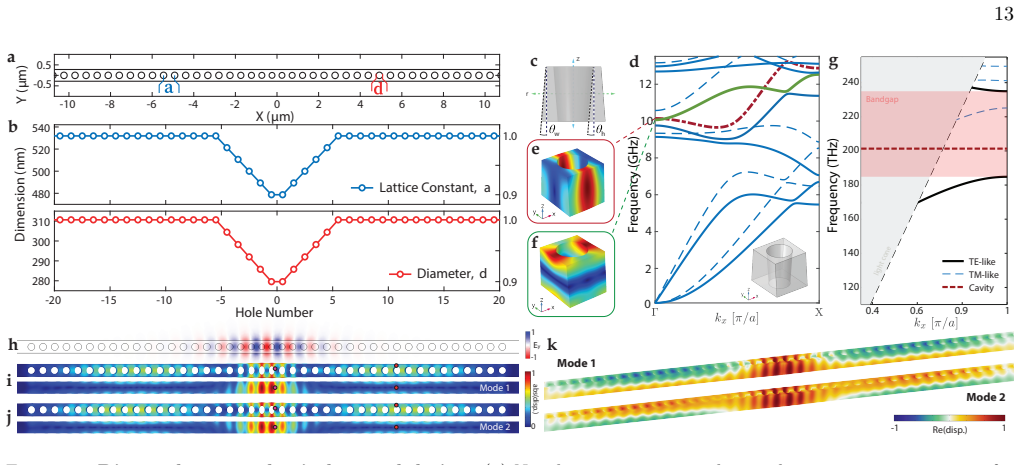
Diamond optomechanical crystal design and simulation The diamond optomechanical crystal studied consists of a suspended nanobeam perforated by a one-dimensional lattice of circular holes. The hole sidewalls have an angle ofθ h = 2◦ while the beam’s outer walls have an angle of θw = 3 ◦. The lattice constant and hole diameter of nominal unit cell in the mi...
-
[48]
Nanofabrication and sidewall angle The fabrication of the diamond devices follows a quasi-isotropic inductively coupled plasma reactive ion etching (ICP-RIE) process described in detail elsewhere [10–12]. The sidewall angle is inherently introduced during the two sequential anisotropic etch steps—the Si3N4 hard mask etch (C4F8/SF6) and the directional dia...
-
[49]
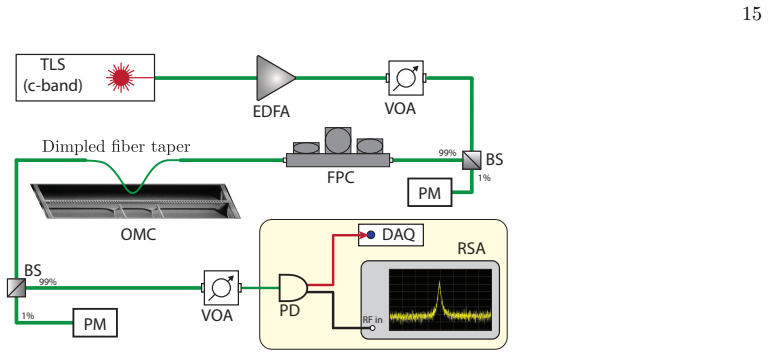
Measurement Setup The experimental setup used to characterize the diamond OMC is shown in Fig. 7. Measurements were performed under ambient conditions using a dimpled fiber taper waveguide to evanescently couple light into and out of the optical cavity. Light from a widely tunable continuous-wave laser (Santec TSL-710, 1480–1640 nm) was amplified by an er...
-
[50]
The total cavity decay rateκ=κ i +κ ex consists of intrinsic and extrinsic loss channels
Fitting experimental measurements The normalized optical transmission spectrum of the fiber taper waveguide evanescently coupled to the OMC nanobeam cavity can be described by [14, 15]: T(∆) = eiϕ − κex/2 κ/2−i∆ 2 ,(36) whereϕaccounts for Fano interference effects. The total cavity decay rateκ=κ i +κ ex consists of intrinsic and extrinsic loss channels. T...
-
[51]
Mechanical thermal effects In addition to the thermo-optic effect, we also observe a thermal shift in the intrinsic mechanical frequencies due to laser-induced absorption. In our analytical fitting of the power-dependent mechanical frequency trajectories, we approximate the heating induced shift to the intrinsic frequencies Ω j (forj= 1,2) of the two mech...
-
[52]
A. B. Shkarin, N. E. Flowers-Jacobs, S. W. Hoch, A. D. Kashkanova, C. Deutsch, J. Reichel, and J. G. E. Harris, Physical Review Letters112, 013602 (2014)
2014
-
[53]
H. Xu, D. Mason, L. Jiang, and J. G. E. Harris, Nature537, 80 (2016)
2016
-
[54]
N. Wu, K. Cui, Q. Xu, X. Feng, F. Liu, W. Zhang, and Y. Huang, Science Advances9, eabp8892 (2023)
2023
-
[55]
J. Chan, A. H. Safavi-Naeini, J. T. Hill, S. Meenehan, and O. Painter, Applied Physics Letters101, 081115 (2012)
2012
-
[56]
El-Sayed and S
A.-W. El-Sayed and S. Hughes, Physical Review Research2, 043290 (2020)
2020
-
[57]
Eichenfield, J
M. Eichenfield, J. Chan, A. H. Safavi-Naeini, K. J. Vahala, and O. Painter, Optics Express17, 20078 (2009)
2009
-
[58]
Moraes, G
F. Moraes, G. H. M. de Aguiar, E. G. de Melo, G. S. Wiederhecker, and T. P. M. Alegre, J. Opt. Soc. Am. B39, 2735 (2022)
2022
-
[59]
Raniwala, P
H. Raniwala, P. Anand, S. Krastanov, M. Eichenfield, M. Trusheim, and D. R. Englund, npj Quantum Information11, 120 (2025)
2025
-
[60]
G. Joe, M. Haas, K. Kuruma, and et al., Nature 10.1038/s41586-026-10495-7 (2026)
-
[61]
Surpassing the en- ergy resolution limit with ferromagnetic torque sensors,
B. Khanaliloo, H. Jayakumar, A. C. Hryciw, D. P. Lake, H. Kaviani, and P. E. Barclay, Physical Review X5, 10.1103/Phys- RevX.5.041051 (2015). 17
-
[62]
Mitchell, D
M. Mitchell, D. P. Lake, and P. E. Barclay, APL Photonics4, 016101 (2019)
2019
-
[63]
Zohari, J
E. Zohari, J. E. Losby, W. El-Sayed, P. Behjat, G. de Oliveira Luiz, J. P. Davis, and P. E. Barclay, in2022 IEEE Photonics Conference (IPC)(IEEE, 2022) pp. 1–2
2022
-
[64]
M. J. Burek, J. D. Cohen, S. M. Meenehan, and et al., Optica3, 1404 (2016)
2016
-
[65]
Mitchell,Coherent Cavity Optomechanics in Wide-Band Gap Materials, Doctoral thesis, University of Calgary, Calgary, Alberta, Canada (2019)
M. Mitchell,Coherent Cavity Optomechanics in Wide-Band Gap Materials, Doctoral thesis, University of Calgary, Calgary, Alberta, Canada (2019)
2019
-
[66]
J. Itoi, E. Zohari, N. J. Sorensen, W. El-Sayed, J. E. Losby, G. O. Luiz, S. Fl˚ agan, and P. E. Barclay, Non-volatile photorefractive tuning and green light generation in a diamond cavity (2025), arXiv:2507.19583 [physics.optics]
work page internal anchor Pith review Pith/arXiv arXiv 2025
-
[67]
M. L. Gorodetsky, A. Schliesser, G. Anetsberger, S. Deleglise, and T. J. Kippenberg, Optics Express18, 23236 (2010)
2010
discussion (0)
Sign in with ORCID, Apple, or X to comment. Anyone can read and Pith papers without signing in.