Raman spectroscopy at metal interfaces: A numerical study of the strong coupling regime
Pith reviewed 2026-06-29 15:16 UTC · model grok-4.3
The pith
Near metal mirrors or in cavities, Raman signals are modified by local fields, relaxation channels, and interference effects including Rabi contraction.
A machine-rendered reading of the paper's core claim, the machinery that carries it, and where it could break.
Core claim
The central claim is that proximity to metal interfaces, especially in cavities, shapes Raman signals through several mechanisms: altered local fields with cavity enhancement of excited state population, relaxation channels causing yield loss but broader absorption, and interference leading to complex spectra where Rabi contraction interferes with Raman at the same order.
What carries the argument
The full-scale FDTD simulation of electromagnetic fields near metal mirrors and in cavities to model their effect on molecular Raman signals.
If this is right
- Local electromagnetic fields near or between mirrors differ from vacuum, enhancing excited state population in cavities.
- Metal surfaces provide relaxation channels and lineshape broadening inherited by cavity polaritons.
- Interference between incident and reflected light leads to richly structured Raman spectra.
- Rabi contraction from ground state depopulation interferes with Raman signals at comparable magnitude.
Where Pith is reading between the lines
- These cavity effects suggest potential for engineering Raman responses by adjusting cavity geometry or mirror properties.
- Similar numerical approaches could be applied to study other optical processes like fluorescence near metals.
- The results highlight the need to account for photonic environment in interpreting experimental Raman data in strong coupling setups.
Load-bearing premise
The classical electromagnetic FDTD simulation is sufficient to capture the quantum effects on vibronic Raman signals without additional quantum corrections or explicit molecular Hamiltonians.
What would settle it
Experimental observation of Raman spectra in a metal cavity where the Rabi contraction interference is not present or is much smaller than the Raman signal itself.
Figures
read the original abstract
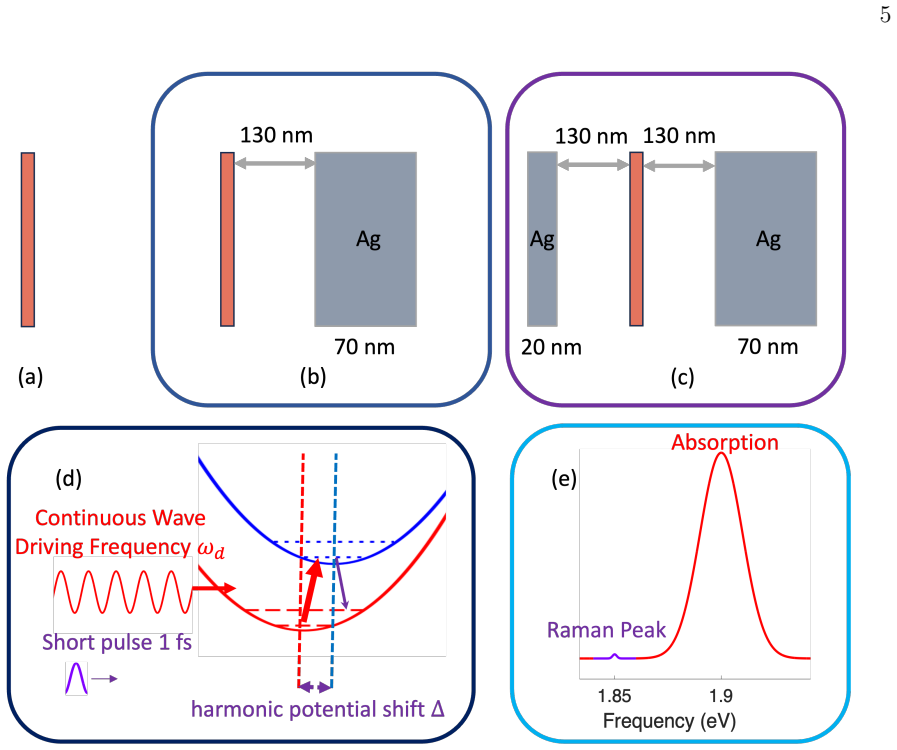
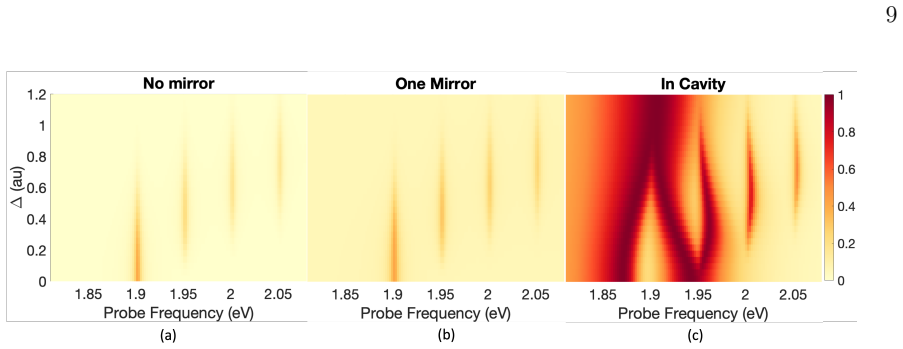
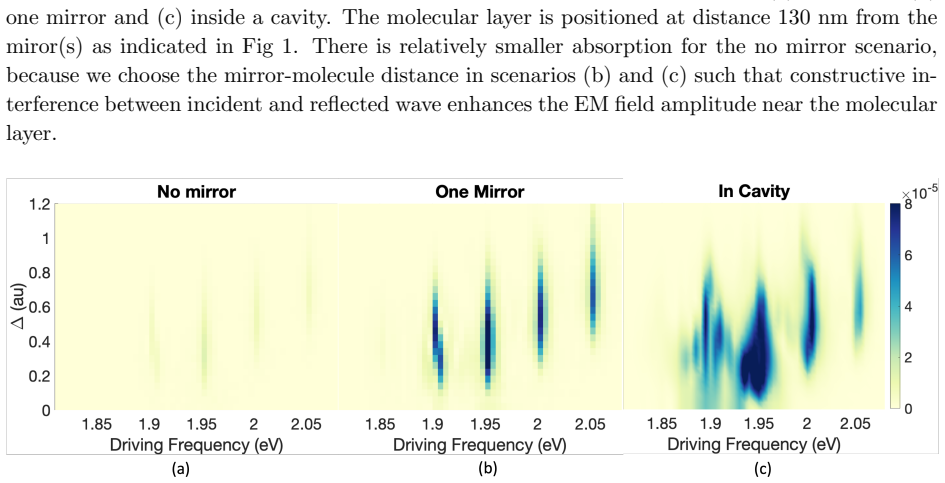
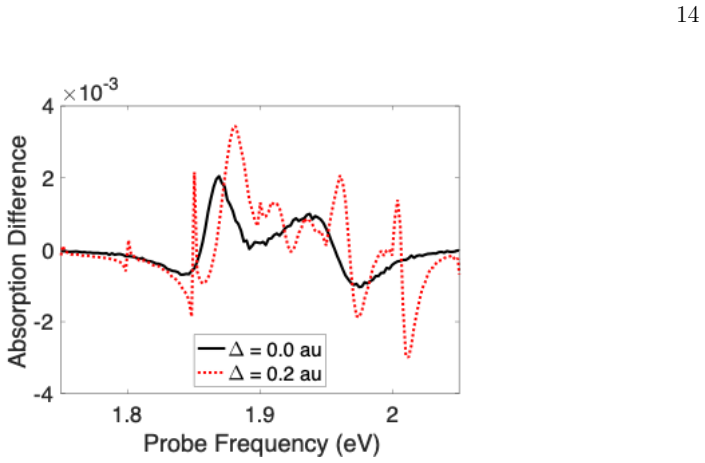
We investigate how proximity to a metal nanostructure, particularly to a flat mirror or a cavity confined between two mirrors, affects the vibronic structure of Raman scattering signals. We find that such proximity, particularly for the strong-coupling situation encountered in cavity environments, plays multiple roles in shaping Raman signals beyond the now-familiar signal enhancement known as surface-enhanced Raman scattering (SERS). First, in analogy to the electromagnetic SERS mechanism, near or between mirrors, the local field experienced by a molecule differ from that in vacuum. In particular, between mirrors, the cavity enhances the effective excited state population by trapping the EM field inside it. Second, the nearby metal surface provides a relaxation channel and a lineshape broadening mechanism, and inside a cavity this lineshape is inherited by the cavity polaritons. This relaxation results in a loss of yield but the associated broadening also leads to significant absorption over a larger frequency range. Third, near metallic interfaces interference between incident and reflected light can lead to a richly structured Raman spectrum. For instance, we find that the Rabi contraction (that results from depopulating the ground state) can interfere with Raman signals (and the effect appears to be the same order as Raman itself). These cavity effects are calculated by a full-scale FDTD simulation and highlight the convoluted but fascinating roles of photonic materials on optical signals.
Editorial analysis
A structured set of objections, weighed in public.
Referee Report
Summary. The manuscript claims that proximity to metal nanostructures or cavities modifies Raman signals beyond standard SERS enhancement through local-field effects, relaxation-induced broadening inherited by polaritons, and interference phenomena; in particular, it asserts that Rabi contraction arising from ground-state depopulation interferes with Raman signals at comparable magnitude, with all effects obtained from full-scale classical FDTD simulations.
Significance. If the numerical approach were shown to faithfully reproduce the stated quantum signatures, the work would contribute to understanding cavity QED influences on molecular spectroscopy. The explicit use of FDTD for multi-role cavity effects is a potential strength, but the absence of any hybrid quantum-classical formulation or validation against analytic limits reduces the immediate significance.
major comments (2)
- [Abstract] Abstract: the claim that FDTD simulations capture 'Rabi contraction (that results from depopulating the ground state)' and its interference with Raman signals at 'the same order as Raman itself' cannot be supported by classical Maxwell solvers, which contain no molecular Hamiltonian, density-matrix evolution, or spontaneous-emission channels; this assumption is load-bearing for the central multi-role cavity-effect narrative.
- [Abstract] Abstract and implied Methods: no description is given of how the vibronic structure, relaxation channels, or effective polarizability are mapped onto the FDTD grid (material permittivities, source terms, or post-processing), nor are convergence checks or comparisons to analytic cavity-QED limits reported; without these the reported lineshape inheritance by polaritons and interference structures remain unverified.
Simulated Author's Rebuttal
We thank the referee for the detailed reading and for highlighting the need for greater clarity on the classical nature of the simulations and the mapping of physical effects. We address each point below and will revise the manuscript accordingly.
read point-by-point responses
-
Referee: [Abstract] Abstract: the claim that FDTD simulations capture 'Rabi contraction (that results from depopulating the ground state)' and its interference with Raman signals at 'the same order as Raman itself' cannot be supported by classical Maxwell solvers, which contain no molecular Hamiltonian, density-matrix evolution, or spontaneous-emission channels; this assumption is load-bearing for the central multi-role cavity-effect narrative.
Authors: We agree that a purely classical FDTD solver cannot explicitly evolve a molecular density matrix or implement ground-state depopulation. The Rabi-contraction feature reported in the manuscript arises from classical interference between the incident field, the reflected field, and the cavity-modified local field, which produces a spectral dip whose magnitude is comparable to the Raman peak. In the revised manuscript we will rephrase the abstract and relevant sections to present this as an electromagnetic interference effect whose lineshape and strength are analogous to the quantum Rabi contraction, while explicitly noting the absence of a quantum Hamiltonian. We will also add a short discussion of the interpretive limits of the classical approach. revision: partial
-
Referee: [Abstract] Abstract and implied Methods: no description is given of how the vibronic structure, relaxation channels, or effective polarizability are mapped onto the FDTD grid (material permittivities, source terms, or post-processing), nor are convergence checks or comparisons to analytic cavity-QED limits reported; without these the reported lineshape inheritance by polaritons and interference structures remain unverified.
Authors: We acknowledge that the mapping procedure was insufficiently documented. In the revised version we will insert a dedicated Methods subsection that (i) specifies how the vibronic linewidth and relaxation rate are encoded via the imaginary part of the molecular permittivity, (ii) describes the auxiliary source term used to inject the Raman polarization, and (iii) details the post-processing step that extracts the effective polarizability from the far-field spectrum. We will also report grid-convergence tests (spatial and temporal) and a comparison of the simulated polariton linewidth against the analytic weak-coupling cavity-QED expression for a Lorentzian emitter. revision: yes
Circularity Check
No significant circularity; claims rest on direct numerical FDTD simulation
full rationale
The paper's central results are obtained via forward full-scale FDTD discretization of classical Maxwell equations applied to explicit metal-mirror and cavity geometries. Local-field enhancement, interference patterns, relaxation channels, and lineshape inheritance are computed directly from the simulated electromagnetic boundary conditions and material permittivities without any parameter fitting to the target Raman spectra or Rabi-contraction observables. No self-citations are invoked to establish uniqueness theorems or to smuggle in ansatzes; the derivation chain consists entirely of independent numerical propagation from geometry and constitutive relations. Because the method is a self-contained computational experiment rather than a closed algebraic reduction or a fitted-input prediction, the reported cavity effects on Raman signals do not reduce to the paper's own inputs by construction.
Axiom & Free-Parameter Ledger
axioms (1)
- domain assumption FDTD electromagnetic simulation accurately models the local fields, relaxation, and interference effects on molecular Raman response near metal interfaces.
Reference graph
Works this paper leans on
-
[1]
Surface-enhanced raman spectroscopy,
1C. L. Haynes, A. D. McFarland, and R. P. Van Duyne, “Surface-enhanced raman spectroscopy,” Analytical Chemistry77, 338 A–346 A (2005). 2P. L. Stiles, J. A. Dieringer, N. C. Shah, and R. P. Van Duyne, “Surface-enhanced raman spectroscopy,” Annu. Rev. Anal. Chem.1, 601–626 (2008). 15 TABLE I. Parameters for Maxwell-Bloch simulation. Name Value † Molecules ...
discussion (0)
Sign in with ORCID, Apple, or X to comment. Anyone can read and Pith papers without signing in.