Sampling Triangulations and Calabi-Yau Threefolds with Autoregressive GNNs
Pith reviewed 2026-06-29 15:12 UTC · model grok-4.3
The pith
A graph neural network using signed circuits from oriented matroids samples uniform fine regular triangulations of lattice polytopes.
A machine-rendered reading of the paper's core claim, the machinery that carries it, and where it could break.
Core claim
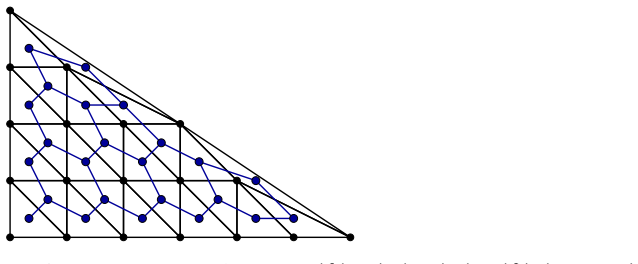
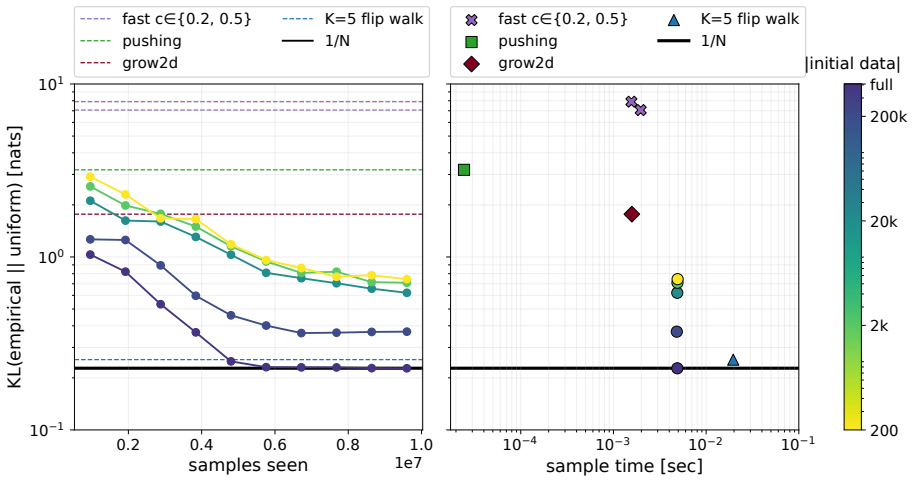
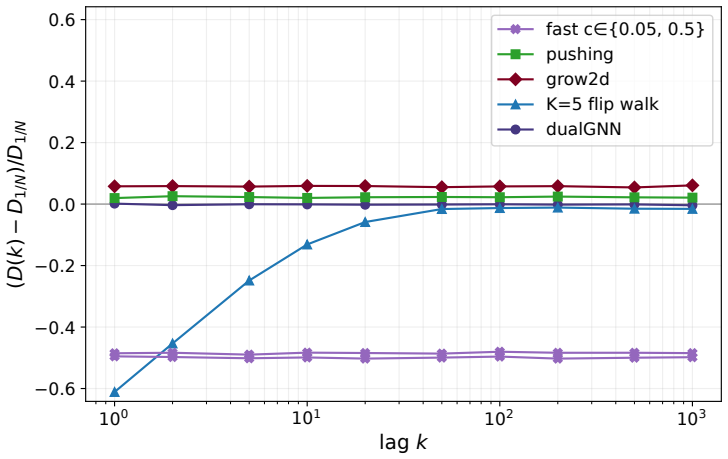
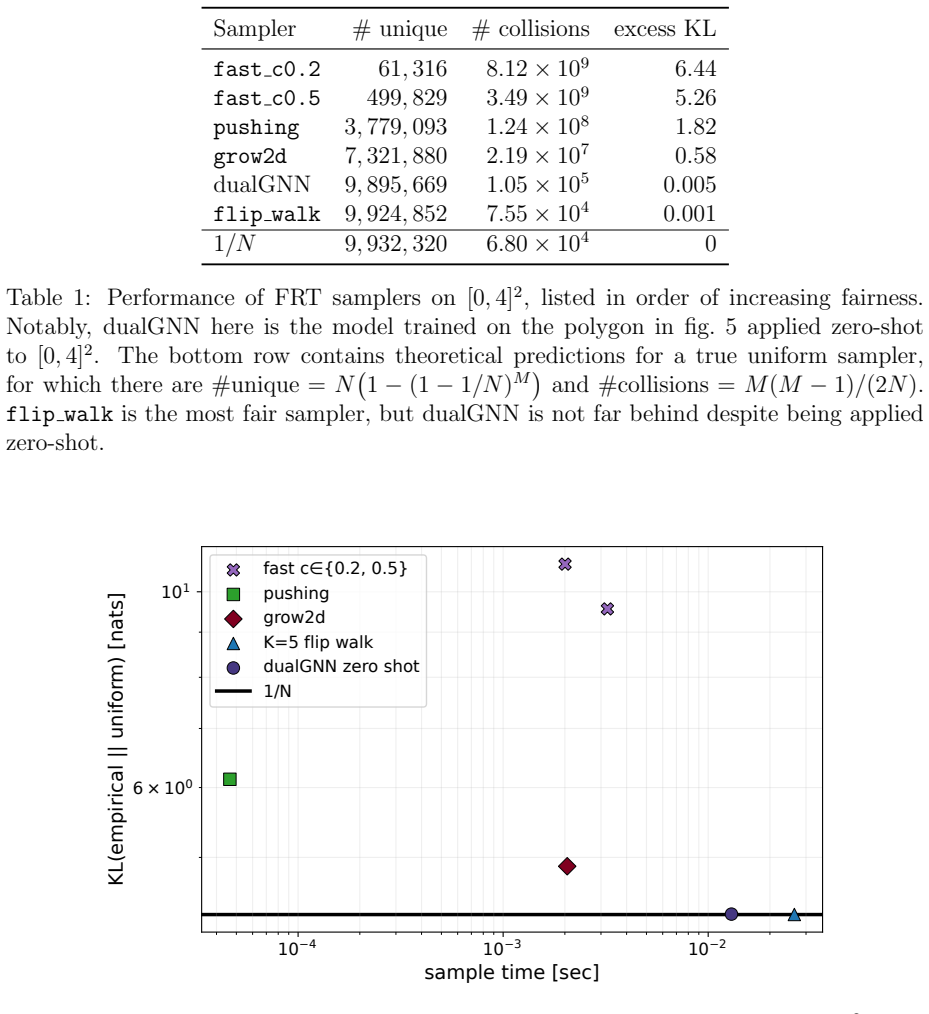
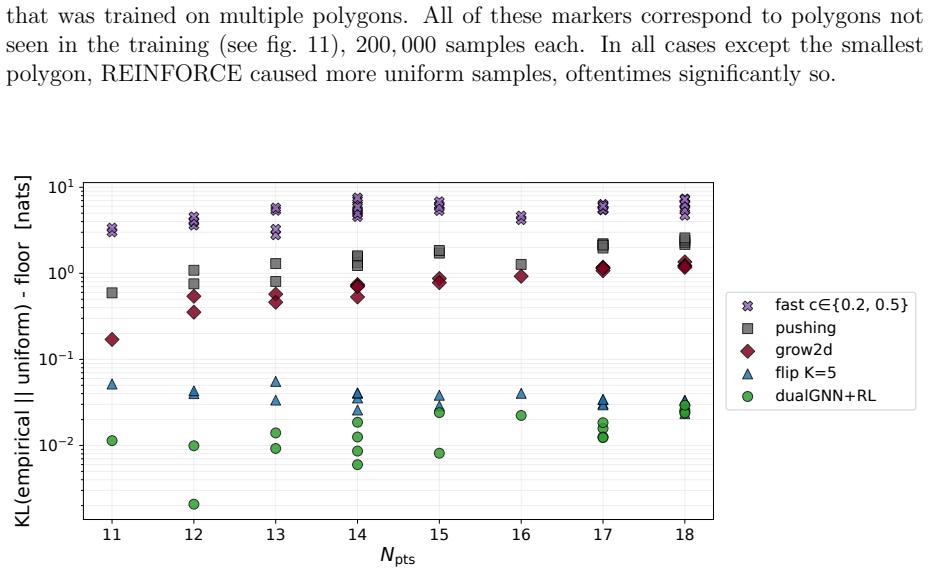
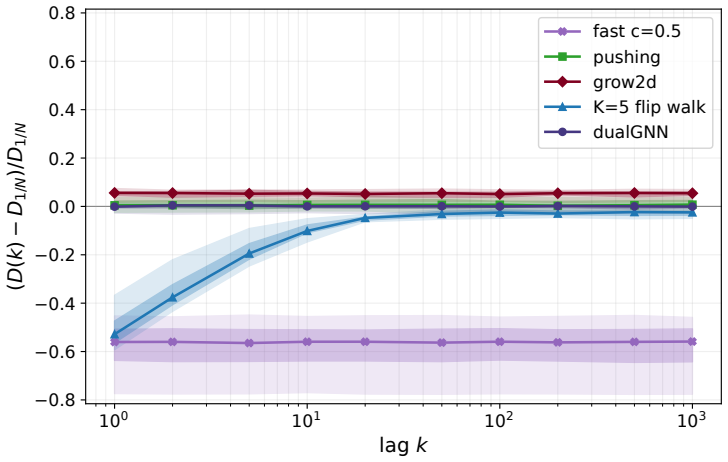
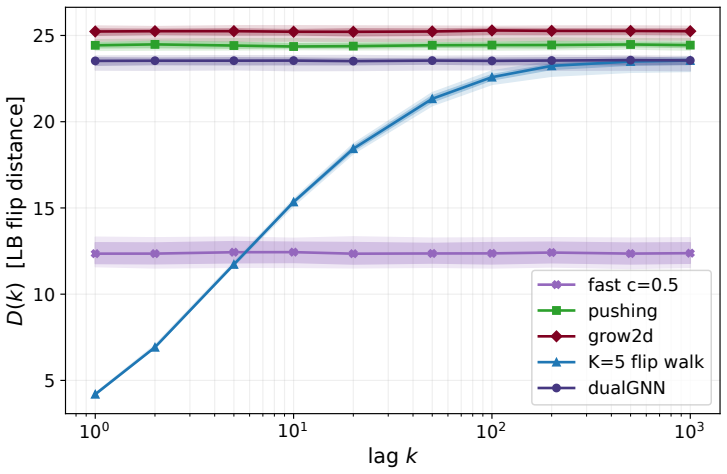
dualGNN is an autoregressive message-passing graph neural network that samples fine, regular triangulations of lattice polytopes. It operates on a generalization of the dual graph where edges are labeled by signed circuits from oriented matroids. These signed circuits are necessary and sufficient, with retained magnitude information, to determine regularity from the dual graph. The model guarantees fine triangulations in 2D via masking, is independent of point count, and invariant under orientation-preserving symmetries. On unseen polygons with at most 40 points, it is the only sampler consistent with uniform sampling across all diagnostics.
What carries the argument
dualGNN, an autoregressive message-passing GNN operating on dual graphs labeled by signed circuits from oriented matroids, which encodes the combinatorial data needed to enforce regularity.
If this is right
- Every generated sample is guaranteed to be a fine triangulation in two dimensions.
- The model size remains fixed at about 92,000 parameters regardless of the polytope's point count.
- Training completes in roughly 7.5 hours on a single consumer GPU.
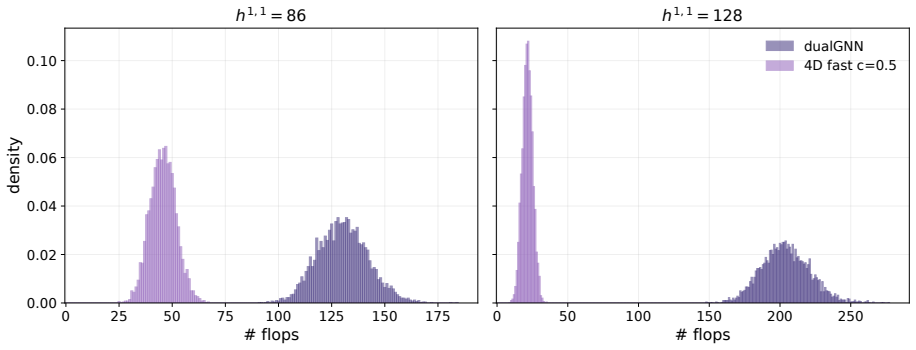
- Uniform samples of Calabi-Yau threefolds are produced at h^{1,1}=86, with no observed deviations at h^{1,1}=128.
- The approach integrates into CYTools for string theory applications.
Where Pith is reading between the lines
- Extending the method to three-dimensional polytopes could enable sampling of higher-dimensional Calabi-Yau manifolds.
- The invariance under lattice symmetries suggests applicability to other symmetry-constrained combinatorial generation tasks.
- Using the same signed circuit representation might allow verification of regularity without full geometric embedding.
- Small model size opens the possibility of ensemble sampling or integration with other machine learning pipelines for vacuum counting.
Load-bearing premise
Signed circuits from oriented matroids together with retained magnitude information are necessary and sufficient to determine a triangulation's regularity directly from the dual graph.
What would settle it
Finding a triangulation sample set from dualGNN on polygons with 40 or fewer points that shows statistically significant deviation from uniformity in KL divergence, collision rate, or autocorrelation compared to other samplers.
Figures
read the original abstract
We introduce `dualGNN', an autoregressive message-passing GNN for sampling fine, regular triangulations of lattice polytopes. dualGNN operates on a generalization of the dual graph of a triangulation, with edges labeled by `signed circuits' -- combinatorial invariants from the theory of oriented matroids. We show that these circuits are necessary and sufficient to determine a triangulation's regularity from the graph, provided certain magnitude information is retained. The model is independent of the polytope's point count and invariant under its orientation-preserving symmetries ($\mathrm{SL}(d,\mathbb{Z}) \ltimes \mathbb{Z}^d$), and our masking procedure further guarantees that every rollout produces a fine triangulation (in 2D). On unseen polygons with $N_\mathrm{pts} \leq 40$, dualGNN is the only sampler we tested that is consistent with uniform sampling across all our diagnostics (KL divergence from uniformity, collision counts, and sample autocorrelation). The model is small ($\sim92$k parameters) and trains in $\sim7.5$ hours on a single consumer GPU. We apply dualGNN to string theory, sampling Calabi-Yau threefolds uniformly at $h^{1,1}=86$; we also sample CYs at $h^{1,1}=128$, observing no deviations from uniformity, but our diagnostics are weaker here. Code, training scripts, and pretrained models are available at https://github.com/natemacfadden/dualGNN (pip install dualgnn), and dualGNN is integrated into CYTools.
Editorial analysis
A structured set of objections, weighed in public.
Referee Report
Summary. The paper introduces dualGNN, an autoregressive message-passing GNN operating on a generalized dual graph with edges labeled by signed circuits from oriented matroids. It claims these circuits (with retained magnitude information) are necessary and sufficient to determine regularity from the graph, that the model is independent of point count and invariant under SL(d,Z) ⋉ Z^d symmetries, that a masking procedure guarantees fine triangulations in 2D, and that on unseen polygons with N_pts ≤ 40 dualGNN is the only tested sampler consistent with uniform sampling according to KL divergence from uniformity, collision counts, and sample autocorrelation. The model (~92k parameters) is applied to uniform sampling of Calabi-Yau threefolds at h^{1,1}=86 (and 128 with weaker diagnostics), with code and pretrained models released.
Significance. If the uniformity claim holds, the work provides a scalable, symmetry-invariant method for sampling combinatorially large spaces of fine regular triangulations, directly relevant to enumerative problems in algebraic geometry and string theory. Credit is due for the open release of code, training scripts, and pretrained models at the cited GitHub repository, the small model size, and the ~7.5-hour training time on consumer hardware; these lower the barrier for reproducibility and extension.
major comments (1)
- [Abstract] Abstract (diagnostics paragraph): The central claim that dualGNN is the only sampler 'consistent with uniform sampling across all our diagnostics' rests on KL divergence, collision counts, and autocorrelation. These three statistics can be satisfied by biased samplers that deviate on higher-order marginals (e.g., signed-circuit multiplicity distributions, f-vector statistics, or Ehrhart coefficients of the triangulated polytope). For N_pts=40 the space is already super-exponential, so finite samples passing the reported tests do not yet establish uniformity; additional invariants or larger-scale tests are needed to support the claim.
minor comments (2)
- [Abstract] The abstract states that signed circuits 'are necessary and sufficient to determine a triangulation's regularity directly from the dual graph, provided certain magnitude information is retained,' but the precise form of the retained magnitude data and the proof of sufficiency are not summarized; a brief statement or reference to the relevant theorem would improve clarity.
- The application to h^{1,1}=128 reports 'no deviations from uniformity, but our diagnostics are weaker here'; specifying which diagnostics were weakened and why would help readers assess the strength of that result.
Simulated Author's Rebuttal
We thank the referee for the careful reading and the constructive major comment. We address it directly below.
read point-by-point responses
-
Referee: [Abstract] Abstract (diagnostics paragraph): The central claim that dualGNN is the only sampler 'consistent with uniform sampling across all our diagnostics' rests on KL divergence, collision counts, and autocorrelation. These three statistics can be satisfied by biased samplers that deviate on higher-order marginals (e.g., signed-circuit multiplicity distributions, f-vector statistics, or Ehrhart coefficients of the triangulated polytope). For N_pts=40 the space is already super-exponential, so finite samples passing the reported tests do not yet establish uniformity; additional invariants or larger-scale tests are needed to support the claim.
Authors: We agree that the three reported diagnostics are necessary but not sufficient to establish uniformity, and that biased samplers could pass them while differing on higher-order marginals. The manuscript's phrasing is already limited to 'consistent with uniform sampling across all our diagnostics' rather than claiming a proof of uniformity. Nevertheless, the referee's observation is correct and we will revise the abstract to make the limitation explicit (e.g., 'the only tested sampler consistent with uniformity under the three diagnostics we employed'). We will also insert a short paragraph in Section 4.2 acknowledging that these tests do not rule out deviations on f-vectors, circuit multiplicities, or Ehrhart coefficients, and noting that exhaustive verification is infeasible for N_pts=40. No new experiments are added at this stage. revision: yes
Circularity Check
No circularity: model trained on data and evaluated out-of-sample on independent diagnostics
full rationale
The paper trains dualGNN on triangulations of lattice polytopes and evaluates sampling behavior on unseen polygons (N_pts ≤ 40) using KL divergence, collision counts, and autocorrelation. These are standard out-of-sample checks on a learned model; the uniformity claim does not reduce to any fitted input by construction. The statement that signed circuits plus magnitude information determine regularity is presented as a result shown in the paper rather than imported via self-citation or defined circularly. No ansatz smuggling, renaming of known results, or load-bearing self-citations appear in the provided text. The derivation chain is therefore self-contained against external benchmarks.
Axiom & Free-Parameter Ledger
axioms (1)
- domain assumption Signed circuits with magnitude information are necessary and sufficient to determine regularity from the dual graph
Forward citations
Cited by 1 Pith paper
-
Calabi-Yau Orientifold Hypersurfaces and their F-theory Uplifts
An algorithm builds Calabi-Yau orientifolds and F-theory fourfold uplifts from 6d reflexive polytopes derived from orientifold data, with code in CYTools and GitHub.
Reference graph
Works this paper leans on
-
[1]
Further bounding the kreuzer-skarke landscape,
N. MacFadden, S. Y. Orevkov, and M. Stepniczka, “Further bounding the kreuzer-skarke landscape,” 2026.https://arxiv.org/abs/2602.16909
-
[2]
Bounding the kreuzer-skarke landscape,
M. Demirtas, L. McAllister, and A. Rios-Tascon, “Bounding the kreuzer-skarke landscape,”Fortschritte der Physik68no. 11-12, (Oct., 2020) . http://dx.doi.org/10.1002/prop.202000086
-
[3]
Transforming calabi-yau constructions: Generating new calabi-yau manifolds with transformers,
J. H. T. Yip, C. Arnal, F. Charton, and G. Shiu, “Transforming calabi-yau constructions: Generating new calabi-yau manifolds with transformers,” 2025. https://arxiv.org/abs/2507.03732. 36
-
[4]
Neural message passing for quantum chemistry,
J. Gilmer, S. S. Schoenholz, P. F. Riley, O. Vinyals, and G. E. Dahl, “Neural message passing for quantum chemistry,” inProceedings of the 34th International Conference on Machine Learning - Volume 70, ICML’17, p. 1263–1272. JMLR.org, 2017
2017
-
[5]
J. A. De Loera, J. Rambau, and F. Santos,Triangulations. Springer Berlin Heidelberg, 2010.http://dx.doi.org/10.1007/978-3-642-12971-1
-
[6]
Efficient algorithm for generating homotopy inequivalent calabi-yaus,
N. MacFadden, “Efficient algorithm for generating homotopy inequivalent calabi-yaus,” 2023.https://arxiv.org/abs/2309.10855
-
[7]
Counting Lattice Triangulations
Kaibel, V. and Ziegler, G.M.,Counting Lattice Triangulations, p. 277–308. London Mathematical Society Lecture Note Series. Cambridge University Press, 2003. arXiv:math/0211268 [math.CO]
work page internal anchor Pith review Pith/arXiv arXiv 2003
-
[8]
L. McAllister, J. Moritz, R. Nally, and A. Schachner, “Candidate de sitter vacua,” 2024.https://arxiv.org/abs/2406.13751
-
[9]
Three-family supersymmetric standardlike models from intersecting brane worlds,
M. Cvetic, G. Shiu, and A. M. Uranga, “Three-family supersymmetric standardlike models from intersecting brane worlds,”Physical Review Letters87no. 20, (Oct.,
-
[10]
http://dx.doi.org/10.1103/PhysRevLett.87.201801
-
[11]
D-branes at singularities: a bottom-up approach to the string embedding of the standard model,
G. Aldazabal, L. E. Ib´ a˜ nez, F. Quevedo, and A. M. Uranga, “D-branes at singularities: a bottom-up approach to the string embedding of the standard model,”Journal of High Energy Physics2000no. 08, (Aug., 2000) 002–002. http://dx.doi.org/10.1088/1126-6708/2000/08/002
-
[12]
QuadrillionF-theory compactifications with the exact chiral spectrum of the standard model,
M. Cvetic, J. Halverson, L. Lin, M. Liu, and J. Tian, “QuadrillionF-theory compactifications with the exact chiral spectrum of the standard model,”Physical Review Letters123no. 10, (2019) . http://dx.doi.org/10.1103/PhysRevLett.123.101601
-
[13]
GUTs in type IIB orientifold compactifications,
R. Blumenhagen, V. Braun, T. W. Grimm, and T. Weigand, “GUTs in type IIB orientifold compactifications,”Nuclear Physics B815no. 1-2, (2009) 1–94. http://dx.doi.org/10.1016/j.nuclphysb.2009.02.011
-
[14]
Dual Polyhedra and Mirror Symmetry for Calabi-Yau Hypersurfaces in Toric Varieties
V. V. Batyrev, “Dual Polyhedra and Mirror Symmetry for Calabi-Yau Hypersurfaces in Toric Varieties,”J. Alg. Geom.3(1994) 493–545,arXiv:alg-geom/9310003. 37
work page internal anchor Pith review Pith/arXiv arXiv 1994
-
[15]
Bj¨ orner, M
A. Bj¨ orner, M. Las Vergnas, B. Sturmfels, N. White, and G. M. Ziegler,Oriented Matroids. Encyclopedia of Mathematics and its Applications. Cambridge University Press, 2 ed., 1999
1999
-
[16]
Pointer networks,
O. Vinyals, M. Fortunato, and N. Jaitly, “Pointer networks,” inAdvances in Neural Information Processing Systems, C. Cortes, N. Lawrence, D. Lee, M. Sugiyama, and R. Garnett, eds., vol. 28. Curran Associates, Inc., 2015. https://proceedings.neurips.cc/paper_files/paper/2015/file/ 29921001f2f04bd3baee84a12e98098f-Paper.pdf
2015
-
[17]
Simple statistical gradient-following algorithms for connectionist reinforcement learning,
R. J. Williams, “Simple statistical gradient-following algorithms for connectionist reinforcement learning,”Machine Learning8no. 3-4, (May, 1992) 229–256. http://dx.doi.org/10.1007/BF00992696
-
[18]
D. E. Knuth,Art of computer programming, volume 2. Addison Wesley, Boston, MA, 3 ed., Nov., 1997
1997
-
[19]
Discrete flows: Invertible generative models of discrete data,
D. Tran, K. Vafa, K. Agrawal, L. Dinh, and B. Poole, “Discrete flows: Invertible generative models of discrete data,” inAdvances in Neural Information Processing Systems, H. Wallach, H. Larochelle, A. Beygelzimer, F. d'Alch´ e-Buc, E. Fox, and R. Garnett, eds., vol. 32. Curran Associates, Inc., 2019. https://proceedings.neurips.cc/paper_files/paper/2019/f...
2019
-
[20]
Integer discrete flows and lossless compression,
E. Hoogeboom, J. W. Peters, R. van den Berg, and M. Welling, “Integer discrete flows and lossless compression,” inProceedings of the 33rd International Conference on Neural Information Processing Systems. Curran Associates Inc., Red Hook, NY, USA, 2019
2019
-
[21]
Flow network based generative models for non-iterative diverse candidate generation,
E. Bengio, M. Jain, M. Korablyov, D. Precup, and Y. Bengio, “Flow network based generative models for non-iterative diverse candidate generation,” inProceedings of the 35th International Conference on Neural Information Processing Systems, NIPS ’21. Curran Associates Inc., Red Hook, NY, USA, 2021
2021
-
[22]
CYTools: A Software Package for Analyzing Calabi-Yau Manifolds,
M. Demirtas, A. Rios-Tascon, and L. McAllister, “CYTools: A Software Package for Analyzing Calabi-Yau Manifolds,”arXiv:2211.03823 [hep-th]
-
[23]
Generating triangulations and fibrations with reinforcement learning,
P. Berglund, G. Butbaia, Y.-H. He, E. Heyes, E. Hirst, and V. Jejjala, “Generating triangulations and fibrations with reinforcement learning,”Physics Letters B860 38 (2025) 139158. https://www.sciencedirect.com/science/article/pii/S0370269324007160
2025
-
[24]
The dna of calabi–yau hypersurfaces: A genetic algorithm for polytope triangulations,
N. MacFadden, A. Schachner, and E. Sheridan, “The dna of calabi–yau hypersurfaces: A genetic algorithm for polytope triangulations,”Fortschritte der Physik74no. 2, (Nov., 2025) .http://dx.doi.org/10.1002/prop.70060
-
[25]
Geometric Deep Learning: Grids, Groups, Graphs, Geodesics, and Gauges
M. M. Bronstein, J. Bruna, T. Cohen, and P. Velickovi´ c, “Geometric deep learning: Grids, groups, graphs, geodesics, and gauges,” 2021. https://arxiv.org/abs/2104.13478
work page internal anchor Pith review Pith/arXiv arXiv 2021
-
[26]
Weisfeiler and lehman go topological: Message passing simplicial networks,
C. Bodnar, F. Frasca, Y. Wang, N. Otter, G. F. Montufar, P. Li´ o, and M. Bronstein, “Weisfeiler and lehman go topological: Message passing simplicial networks,” in Proceedings of the 38th International Conference on Machine Learning, M. Meila and T. Zhang, eds., vol. 139 ofProceedings of Machine Learning Research, pp. 1026–1037. PMLR, 18–24 jul, 2021.htt...
2021
-
[27]
Decoupled weight decay regularization,
I. Loshchilov and F. Hutter, “Decoupled weight decay regularization,” in International Conference on Learning Representations. 2019. https://openreview.net/forum?id=Bkg6RiCqY7
2019
-
[28]
¨Uber die zerlegung von dreieckspolyedern in tetraeder,
E. Sch¨ onhardt, “¨Uber die zerlegung von dreieckspolyedern in tetraeder,” Mathematische Annalen98no. 1, (Mar., 1928) 309–312. http://dx.doi.org/10.1007/BF01451597
-
[29]
Do transformers really perform bad for graph representation?
C. Ying, T. Cai, S. Luo, S. Zheng, G. Ke, D. He, Y. Shen, and T.-Y. Liu, “Do transformers really perform bad for graph representation?” inProceedings of the 35th International Conference on Neural Information Processing Systems, NIPS ’21. Curran Associates Inc., Red Hook, NY, USA, 2021
2021
-
[30]
TOPCOM: Triangulations of Point Configurations and Oriented Matroids,
J. Rambau, “TOPCOM: Triangulations of Point Configurations and Oriented Matroids,” Tech. Rep. 02-17, ZIB, Takustr. 7, 14195 Berlin, 2002
2002
-
[31]
An upper bound for the number of planar lattice triangulations,
E. E. Anclin, “An upper bound for the number of planar lattice triangulations,” Journal of Combinatorial Theory, Series A103no. 2, (2003) 383–386
2003
-
[32]
Complete classification of reflexive polyhedra in four dimensions,
M. Kreuzer and H. Skarke, “Complete classification of reflexive polyhedra in four dimensions,”Advances in Theoretical and Mathematical Physics4no. 6, (2000) 1209–1230.http://dx.doi.org/10.4310/ATMP.2000.v4.n6.a2. 39
-
[33]
Counting calabi-yau threefolds,
N. Gendler, N. MacFadden, L. McAllister, J. Moritz, R. Nally, A. Schachner, and M. Stillman, “Counting calabi-yau threefolds,” 2023. https://arxiv.org/abs/2310.06820
-
[34]
A. Chandra, A. Constantin, C. S. Fraser-Taliente, T. R. Harvey, and A. Lukas, “Enumerating calabi-yau manifolds: Placing bounds on the number of diffeomorphism classes in the kreuzer-skarke list,”Fortschritte der Physik72no. 5, (Mar., 2024) .http://dx.doi.org/10.1002/prop.202300264
-
[35]
N. MacFadden, “regfans,” 2026. https://zenodo.org/doi/10.5281/zenodo.19406101
-
[36]
Calabi-Yau Threefolds from Vex Triangulations
N. MacFadden and E. Sheridan, “Calabi-yau threefolds from vex triangulations,” 2025.https://arxiv.org/abs/2512.14817
work page internal anchor Pith review Pith/arXiv arXiv 2025
-
[37]
Attention is all you need,
A. Vaswani, N. Shazeer, N. Parmar, J. Uszkoreit, L. Jones, A. N. Gomez, L. u. Kaiser, and I. Polosukhin, “Attention is all you need,” inAdvances in Neural Information Processing Systems, I. Guyon, U. V. Luxburg, S. Bengio, H. Wallach, R. Fergus, S. Vishwanathan, and R. Garnett, eds., vol. 30. Curran Associates, Inc., 2017.https://proceedings.neurips.cc/pa...
2017
-
[38]
Szegedy, C., Vanhoucke, V ., Ioffe, S., Shlens, J., and Wojna, Z
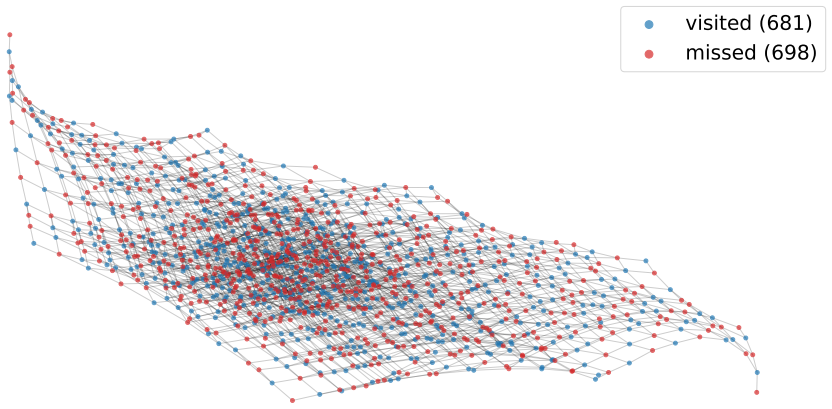
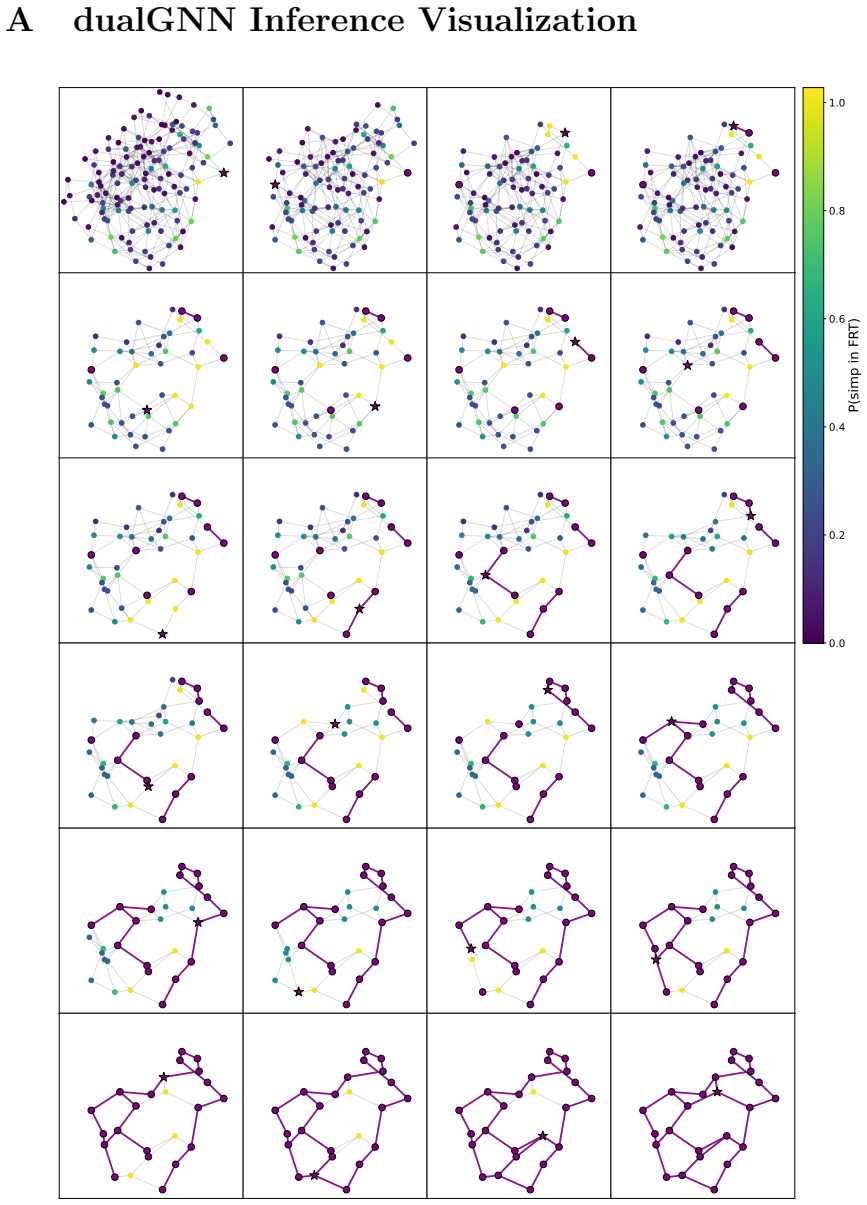
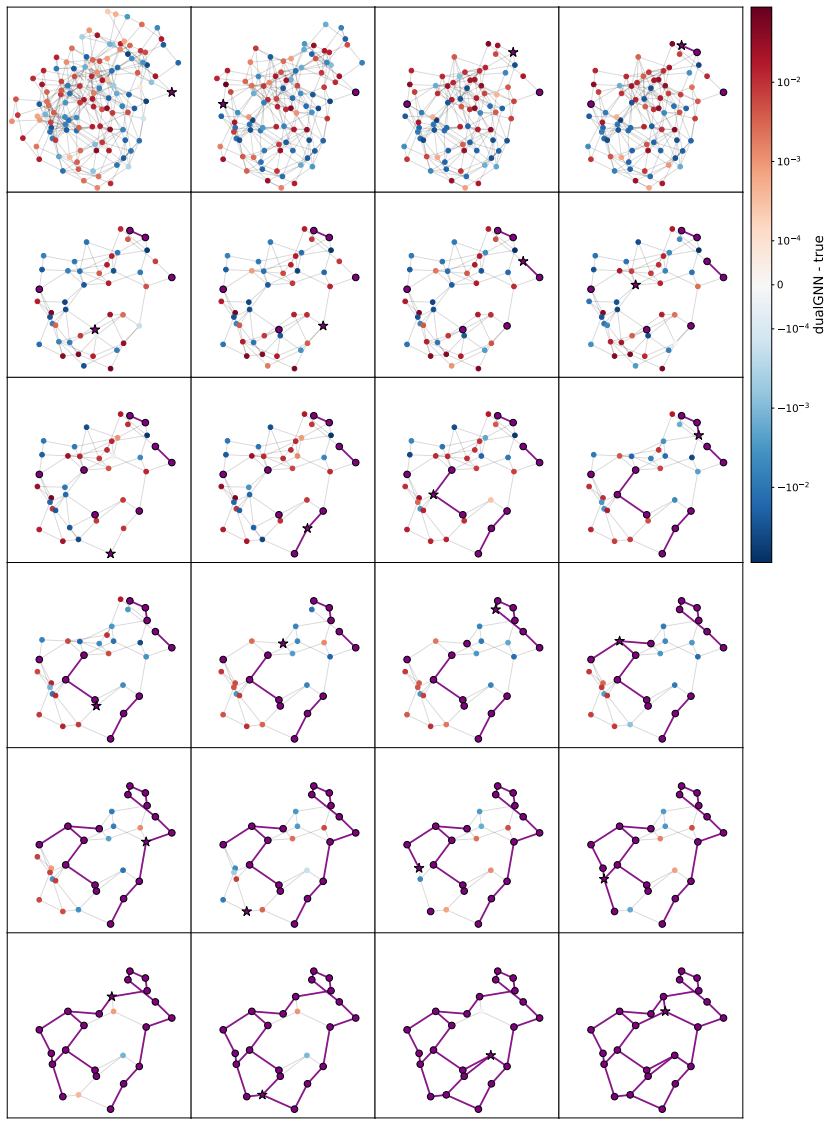
J. Su, M. Ahmed, Y. Lu, S. Pan, W. Bo, and Y. Liu, “Roformer: Enhanced transformer with rotary position embedding,”Neurocomput.568no. C, (Feb., 2024) .https://doi.org/10.1016/j.neucom.2023.127063. 40 41 A dualGNN Inference Visualization 0.0 0.2 0.4 0.6 0.8 1.0 P(simp in FRT) Figure 22: The inference rollout of dualGNN applied to the polygon in fig. 5. Nod...
discussion (0)
Sign in with ORCID, Apple, or X to comment. Anyone can read and Pith papers without signing in.