REVIEW 1 major objections 37 references
ChildEval: When large language models meet children's personalities
T0 review · 1 major / 0 minor · reviewed 2026-06-29 · grok-4.3
Pith's one-line read ChildEval benchmark with 29K child personas tests how LLMs infer and follow preferences in conversations.
desk verdict ChildEval adds a benchmark for 3-6 year old personas with explicit vs implicit preferences, but the 29K profiles are unvalidated LLM synthesis so the results rest on artificial data. read the letter →
The pith
A machine-rendered reading of the paper's core claim, the machinery that carries it, and where it could break.
The reading
What carries the argument
The ChildEval benchmark: a dataset of 29K child persona profiles paired with explicit single-sentence or implicit multi-turn preferences across five top-level daily-life categories.
What would settle it
Run the same LLMs on a parallel set of preferences drawn from actual children and check whether the performance ordering and fine-tuning gains match those observed on ChildEval.
Extended reading notes
Core claim
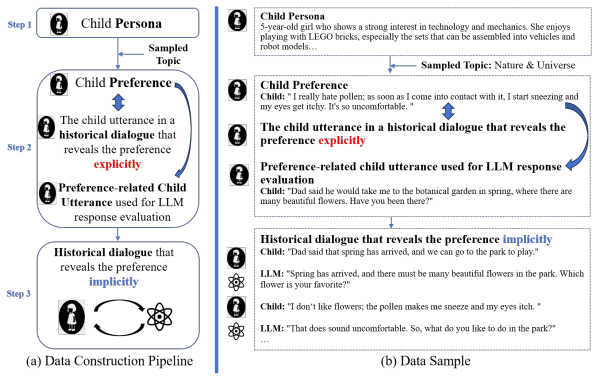
ChildEval supplies 29K synthesized persona profiles of children aged 3-6 together with associated preferences expressed explicitly or implicitly, plus child-centric evaluation protocols, to measure LLMs' ability to infer and follow those preferences; results show that representation format alters responses and that fine-tuning on the benchmark raises child-centered performance.
Load-bearing premise
The synthesized 29K persona profiles and their preferences accurately stand in for real children's static backgrounds and dynamic expressions.
Editorial extensions
If this is right
- Different formats for presenting personalized information produce measurably different LLM responses.
- Fine-tuning open-source models on ChildEval data raises accuracy on child-centered preference tasks.
- The benchmark allows separate scoring of explicit versus implicit preference handling.
- The five top-level and fourteen sub-level categories cover the main domains of children's daily lives and development.
Reading between the lines
- The same construction could be adapted to test personalization for other age groups whose preferences also shift between explicit and implicit forms.
- Safety filters for child-AI chat could be calibrated against the explicit-implicit mismatch cases identified here.
- Long-context handling improvements measured on ChildEval may transfer to other multi-turn preference scenarios outside the child domain.
Signed reviews
Editorial analysis
A structured set of objections, weighed in public.
Referee Report
Summary. The paper introduces ChildEval, a benchmark of 29K LLM-synthesized persona profiles for children aged 3-6, each paired with explicit (single-sentence) or implicit (6-10 turn dialogue) preferences that are designed to reflect the same underlying preference but differ in expression. The benchmark covers five top-level and fourteen sub-level categories of children's daily lives and development. It proposes child-centric evaluation protocols, reports experiments showing how different personalized representations affect LLM responses, and suggests that finetuning on ChildEval improves child-centered performance. Code and dataset are released.
Significance. If the synthesized personas and preference pairs faithfully capture real children's static backgrounds and dynamic expressions, ChildEval would address a clear gap in systematic, child-specific evaluation of LLMs and could support development of safer personalized systems. The public release of code and data is a concrete strength that enables reproducibility and follow-up work.
major comments (1)
- [Section 3] Section 3: The 29K persona profiles and associated preference pairs are generated via LLM synthesis with no reported human validation, parent/expert ratings, inter-rater agreement, or comparison against real child data or established developmental psychology sources. This is load-bearing for the central claim, because both the experimental results on personalized representations and the suggestion that finetuning enhances child-centered performance presuppose that the benchmark measures behavior on authentic child preferences rather than synthesis artifacts (e.g., adult-centric assumptions or limited diversity within the five top-level categories).
Simulated Author's Rebuttal
We thank the referee for the constructive feedback on ChildEval. We address the concern regarding validation of the synthesized personas point-by-point below.
read point-by-point responses
-
Referee: [Section 3] Section 3: The 29K persona profiles and associated preference pairs are generated via LLM synthesis with no reported human validation, parent/expert ratings, inter-rater agreement, or comparison against real child data or established developmental psychology sources. This is load-bearing for the central claim, because both the experimental results on personalized representations and the suggestion that finetuning enhances child-centered performance presuppose that the benchmark measures behavior on authentic child preferences rather than synthesis artifacts (e.g., adult-centric assumptions or limited diversity within the five top-level categories).
Authors: We agree this is a substantive limitation. The 29K profiles were generated via LLM synthesis guided by five top-level categories (Daily Routines, Social Interactions, Learning Activities, Health and Safety, Creative Expression) and fourteen sub-categories commonly referenced in early childhood frameworks, though specific source citations were not included in the initial draft. The benchmark's core contribution is a controlled test of how LLMs handle explicit versus implicit expressions of the same underlying preference, rather than a claim that the profiles are authentic real-child data. We will revise Section 3 to (1) cite the developmental sources used for category design, (2) include the synthesis prompts and any internal consistency checks performed, and (3) add a Limitations section explicitly discussing the synthetic nature, absence of human/expert ratings, potential for adult-centric artifacts, and the ethical/practical barriers to large-scale real-child validation. The reported experiments and finetuning results should be interpreted as measuring LLM behavior on these constructed preference pairs; we will clarify this scope in the text and abstract. revision: partial
Circularity Check
No significant circularity in derivation chain
full rationale
The paper introduces ChildEval as a new benchmark consisting of 29K LLM-synthesized child persona profiles (ages 3-6) with explicit and implicit preference pairs across five top-level categories, then reports experimental results on how personalized representations affect LLM responses and suggests finetuning benefits. No equations, fitted parameters, predictions, or derivation steps appear in the provided text. No self-citations are invoked as load-bearing uniqueness theorems, ansatzes, or external justifications that reduce the central claims to prior author work by construction. The contribution is the creation and application of the synthetic benchmark itself, which is self-contained without reducing any result to its inputs via the enumerated circularity patterns.
Assumptions & free parameters
assumptions (1)
- domain assumption Synthesized persona profiles can serve as valid proxies for evaluating LLM behavior with real children
Cite this review
Pith. "Pith review of ChildEval: When large language models meet children's personalities." pith.science (2026). https://pith.science/paper/DUKBT45Z
@misc{pith2026260527805,
  author       = {Pith},
  title        = {Pith review of: ChildEval: When large language models meet children's personalities},
  year         = {2026},
  howpublished = {\url{https://pith.science/paper/DUKBT45Z}},
  note         = {Machine review of arXiv:2605.27805}
}
read the original abstract
While LLMs enable personalized chatbots, their effectiveness in child-centered personalization remains unclear, as systematic evaluation of child-specific preferences is still lacking. To address this gap, we introduce ChildEval, a benchmark for evaluating LLMs' ability to infer and follow child-centered preferences in long-context conversations. ChildEval contains 29K synthesized persona profiles of children aged 3-6, providing relatively static background information. Each persona is associated with a child preference-which may align with, conflict with, or be independent of the persona-expressed either explicitly in a single sentence or implicitly through 6-10 turn dialogues. Explicit and implicit preferences are designed to reflect the same underlying preference but differ in expression, capturing dynamic aspects of preference expression rather than changes in the static persona. The benchmark spans five top-level and fourteen sub-level categories covering children's daily lives and development. We further propose fine-grained, child-centric evaluation protocols to systematically assess open-source LLMs. Experimental results demonstrate how different personalized representations affect LLM responses and suggest that finetuning on ChildEval can enhance child-centered performance. Our code and dataset are available at https://github.com/ziyanluo/ChildEval.
Figures


Figures from the paper (15 more)


Reference graph
Works this paper leans on
-
[1]
The faiss library.Preprint, arXiv:2401.08281. Arafat Md Easin, Saha Sourav, and Orosz Tamás. 2024. An intelligent llm-powered personalized assistant for digital banking using langgraph and chain of thoughts. In2024 IEEE 22nd Jubilee International Symposium on Intelligent Systems and Informatics (SISY), pages 625–630. IEEE. Tiantian Feng, Anfeng Xu, Rimita...
work page Pith review arXiv 2024
-
[2]
Gemini: A Family of Highly Capable Multimodal Models
Gemini: A family of highly capable multi- modal models.Preprint, arXiv:2312.11805. Daya Guo, Dejian Yang, Haowei Zhang, Junxiao Song, Ruoyu Zhang, Runxin Xu, Qihao Zhu, Shi- rong Ma, Peiyi Wang, Xiao Bi, and 1 others. 2025. Deepseek-r1: Incentivizing reasoning capability in llms via reinforcement learning.arXiv preprint arXiv:2501.12948. Xue Han, Yi-Tong ...
work page Pith review arXiv 2025
-
[3]
https://arxiv.org/abs/2406.17803
MultiPL-MoE: Multi-programming-lingual extension of large language models through hybrid mixture-of-experts. InFindings of the Association for Computational Linguistics: EMNLP 2025, pages 12817–12828, Suzhou, China. Association for Com- putational Linguistics. Bin Wu, Zhengyan Shi, Hossein A Rahmani, Varsha Ramineni, and Emine Yilmaz. 2024. Understanding ...
-
[4]
Association for Computational Linguistics. Siyan Zhao, Mingyi Hong, Yang Liu, Devamanyu Haz- arika, and Kaixiang Lin. 2025a. Do llms recognize your preferences? evaluating personalized preference following in llms. InThe Thirteenth International Conference on Learning Representations, ICLR 2025, Singapore, April 24-28, 2025. OpenReview.net. Weixiang Zhao,...
-
[5]
I like xx more than xx,
This decomposition maintains the transforma- tion’s expressive power while allowing efficient integration of personalized information, seamlessly merging it into the LLM’s representations to facili- tate effective user adaptation and stable generation. Additionally, it opens possibilities for incorporat- ing more sophisticated personalized models into LLM...
2025
-
[6]
forgetting-prevention self-check,
An analysis of the “forgetting-prevention self-check,” following the required checking order (written inside <explain> tags)
-
[7]
Forgetting-prevention self-check requirements (must be checked in this order and written in <explain> tags):
An {n}-turn dialogue between a 3-6-year-old child and the intelligent assistant (written inside <conversations> tags). Forgetting-prevention self-check requirements (must be checked in this order and written in <explain> tags):
-
[8]
Whether names were mistakenly added: remove all specific personal names
Show all 37 references
-
[9]
Whether the last turn includes: remove all closing phrases or polite endings
-
[10]
Whether the dialogue addresses a child user: limit filler words appropriately
-
[11]
Whether the intelligent assistant is described with human actions: the assistant can only provide suggestions
-
[12]
Whether the dialogue is exactly {n} turns: if fewer than {n}, extend the topic (through questions or additional information)
-
[13]
Whether the generation format tags are complete: check that all tags are correctly closed
-
[14]
Multi-turn dialogue requirements (written inside <conversations> tags): Strictly follow the rules below
Whether the dialogue allows the explicit preference {preference} to be inferred naturally. Multi-turn dialogue requirements (written inside <conversations> tags): Strictly follow the rules below. Before each response, re-check compliance
-
[15]
la,” “ne,
The dialogue must revolve around the theme, match the persona, and align with the speaking style of 3-6-year-old children: - Oral style, frequently using particles like “la,” “ne,” “ya,” “ma,” etc., to show a child’s identity. For example: “I don’t like noisy ne” instead of th...
-
[16]
Use concise, friendly, conversational expressions and avoid mechanical tone
-
[17]
The dialogue must not explicitly mention the input’s explicit preference, but the child–assistant conversation should make the preference inferable
-
[18]
Dad said…
The dialogue is strictly between the child and the intelligent assistant, following these rules: - Objective mentions are allowed: e.g., “Dad said…” “Mom said…,” but the child cannot speak directly to parents (e.g., “Dad, let’s go play”). - Interaction restriction: the child c...
-
[19]
{n} turns = {n} <user> and {n} <assistant>
The dialogue must have exactly {n} turns, where 1 turn = 1 <user> + 1 <assistant>. {n} turns = {n} <user> and {n} <assistant>
-
[20]
Xiao An”) or role names (like “little assistant,
No specific personal names (like “Xiao An”) or role names (like “little assistant,” “smart helper”) should appear. <user> and <assistant> already indicate roles, no repetition needed. Figure 9: Prompt used for generating child–LLM dialogue to infer the implicit preference: Par...
-
[21]
The assistant must always remain non-embodied, only providing content
The assistant’s responses must not include human behaviors (e.g., attending activities, eating, walking). The assistant must always remain non-embodied, only providing content
-
[22]
Goodbye,
The last turn of the assistant’s reply must not contain a closing phrase (e.g., “Goodbye,” “Ask me anytime”). The ending should feel naturally continuous. Output must strictly follow the fixed format below, without modifying tag names, order, or nesting. <explain>
-
[23]
Name check: No personal names used, compliant
-
[24]
Closing phrase check: No closing phrase in the last turn, compliant
-
[25]
Tone check: Language is mild and natural, matching the style of 3-6-year-old children
-
[26]
Assistant behavior check: Assistant is not personified and contains no self-involvement in activities
-
[27]
Turn count check: Exactly {n} turns (i.e., {n} <user> and {n} <assistant>)
-
[28]
Tag check: All tags spelled correctly and fully closed
-
[29]
</explain> <conversations> <!-- Turn 1 --> <user>...</user> <assistant>...</assistant>
Preference inference check: From the dialogue, the child’s attitude toward “xxx” can naturally reveal the explicit preference. </explain> <conversations> <!-- Turn 1 --> <user>...</user> <assistant>...</assistant> ... <!-- Turn {n} --> <user>...</user> <assistant>...</assistan...
-
[30]
I can see you are feeling sad, let me cheer you up with a story
The response explicitly refers to the child’s emotion. Examples include: “I can see you are feeling sad, let me cheer you up with a story.”; “Since you are excited about dinosaurs, let’s play a dinosaur game!”; “You seem worried, don’t worry, I will stay with you.”
-
[31]
I’m scared of the dark
The response implicitly adapts to the child’s emotion by mirroring or matching tone, even without naming it.Example:Child says “I’m scared of the dark.” Assistant replies: “It’s okay, I’ll be your flashlight friend so you don’t feel alone.” Answer "No" if the response does not...
-
[32]
Can you think of another animal that lives in the ocean?
The assistant explicitly encourages the child to take part. Examples include: “Can you think of another animal that lives in the ocean?”; “Let’s try this step by step: first, can you name the colors you see?”; “Do you want to hear a harder riddle or an easier one?”
-
[33]
Why is the sky blue?
The assistant implicitly scaffolds the interaction by providing structured choices or gradual hints instead of just giving a direct answer. Example: Child asks “Why is the sky blue?” Assistant replies: “That’s a great question! Do you remember what happens when light passes th...
-
[34]
The sun is like a big lamp in the sky that keeps us warm
The assistant uses simple words, short sentences, or familiar examples instead of advanced technical terms. Examples include: “The sun is like a big lamp in the sky that keeps us warm.”; “A volcano is like a mountain that can burp hot lava.”; “Let’s count together how many sta...
-
[35]
What is electricity?
The assistant adjusts explanations or provides analogies that fit a child’s world. Example: Child asks: “What is electricity?” Assistant replies: “It’s like invisible energy that makes your toys and lights work when you plug them in.” Answer "No" if the response uses adult-lev...
-
[36]
Wow, that’s a great question! Do you want to imagine we are astronauts and fly to space together?
The assistant explicitly uses playful or inviting language to keep the child engaged. Examples include:“Wow, that’s a great question! Do you want to imagine we are astronauts and fly to space together?”; “Haha, dinosaurs are awesome! Which one do you like best?”; “Let’s play a...
-
[37]
I like cats
The assistant implicitly encourages continued interaction by showing excitement, enthusiasm, or curiosity. Example: Child: “I like cats.” Assistant: “Me too! Cats are so soft and playful. Do you have a favorite color for a cat?” Answer "No" if the response is purely factual or...
Reviewed June 29, 2026 · model on record in the stance chip above.
Discussion (0). Continue with ORCID to comment.