Magneto-Optical Detection of Anisotropic Spin Currents in Altermagnetic RuO2
Pith reviewed 2026-06-29 11:46 UTC · model grok-4.3
The pith
In 12-nm RuO2, applied current generates strong spin polarization only along [010] and none along [-101], matching altermagnetic spin-splitter symmetry.
A machine-rendered reading of the paper's core claim, the machinery that carries it, and where it could break.
Core claim
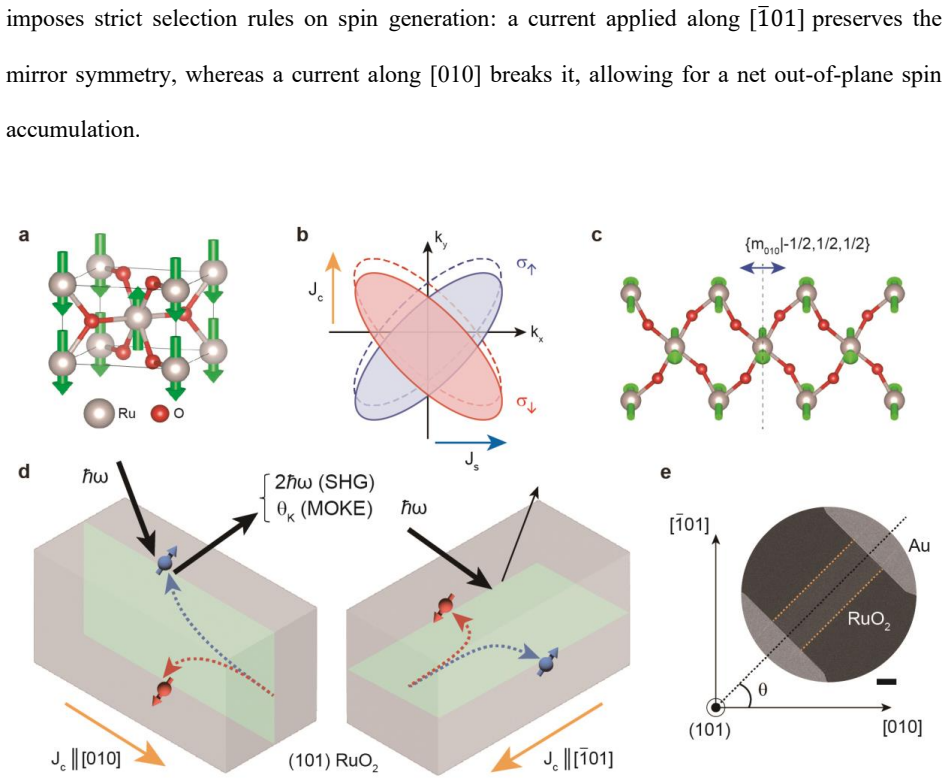
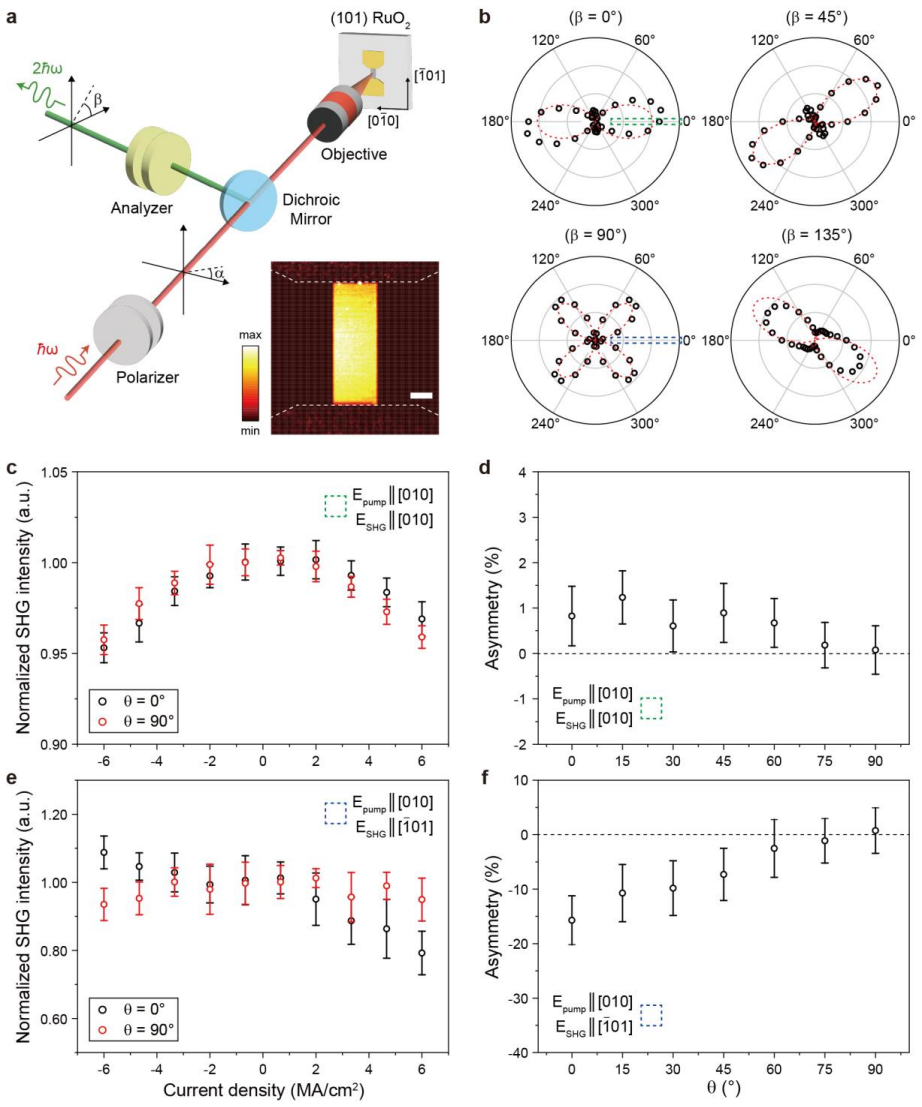
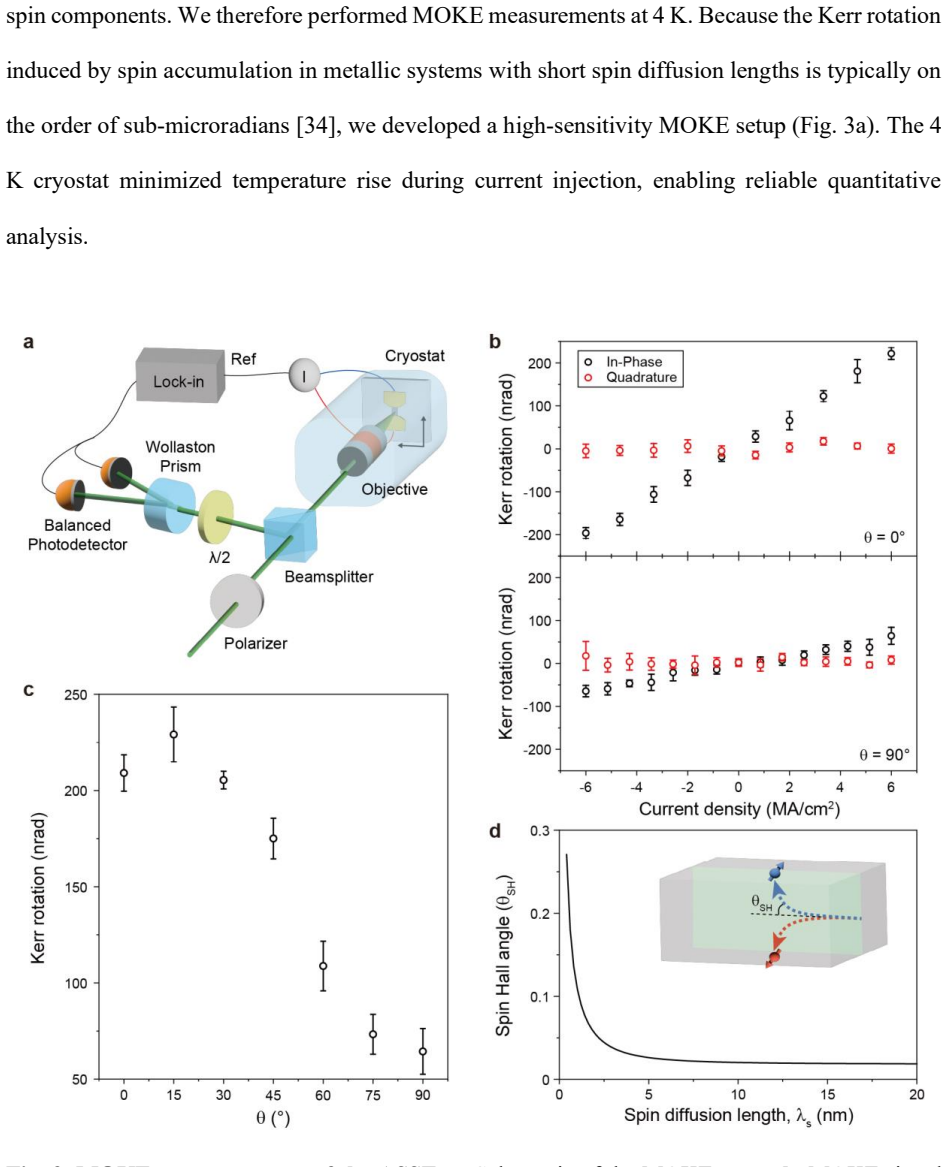
Under an applied current, both second-harmonic generation and polar magneto-optical Kerr effect measurements detect a pronounced, directionally anisotropic spin polarization in the 12-nm (101)-oriented RuO2 film, exhibiting enhanced signals for current along [010] and strongly suppressed responses for current along [-101], in agreement with the symmetry of the altermagnetic spin-splitter effect.
What carries the argument
Altermagnetic spin-splitter effect, the mechanism by which collinear antiferromagnetic order with specific crystal symmetry converts charge current into spin current whose polarization direction depends on the current axis relative to the Néel vector.
If this is right
- RuO2 functions as an efficient metallic spin source at thicknesses compatible with device fabrication.
- Altermagnets enable field-free spintronic operation because the generated spin current is set by crystal symmetry alone.
- Optical second-harmonic generation and Kerr effect can serve as non-contact probes of current-induced spin accumulation in altermagnetic films.
- Persistent strain in relatively thick RuO2 films can stabilize the magnetic order needed for the spin-splitter effect.
Where Pith is reading between the lines
- The same optical methods could be applied to other predicted altermagnets to test whether their spin-splitter response survives at device-relevant thicknesses.
- If the strain-stabilized order proves general, altermagnetic layers could be integrated into heterostructures without requiring epitaxial matching to ultrathin limits.
- The directional selectivity implies that device layouts can be engineered to turn spin injection on or off simply by rotating the current direction relative to the crystal axes.
Load-bearing premise
The 12-nm film sustains robust Néel order with the predicted altermagnetic spin splitting, and the observed symmetry-selective response cannot be produced by non-magnetic or Rashba-type mechanisms.
What would settle it
Detection of isotropic or direction-independent spin polarization under current, or a response whose angular dependence matches Rashba rather than altermagnetic symmetry, would falsify the central claim.
Figures
read the original abstract
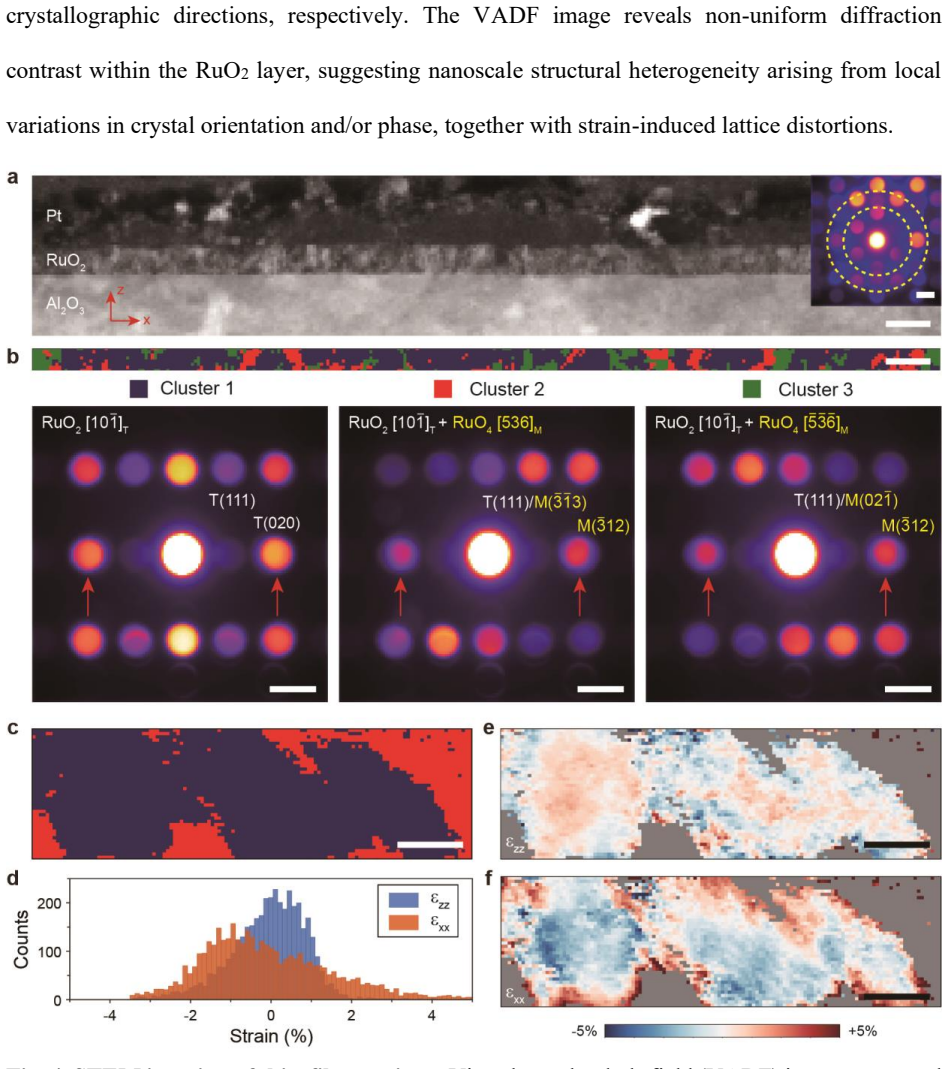
Altermagnets are a recently identified class of collinear antiferromagnets that host large spin-split electronic bands, offering a promising platform for efficient spin-current generation. Among proposed candidates, the metallic oxide RuO2 is predicted to exhibit strong altermagnetic spin splitting; however, whether it sustains robust magnetic order beyond the ultrathin thickness limit remains unresolved. Here, we employ optical probes to investigate charge-to-spin conversion in a 12-nm-thick (101)-oriented RuO2 film grown on sapphire. Polarization-resolved second-harmonic generation reveals nonlinear optical responses consistent with the surface symmetry and N\'eel order of RuO2. Under an applied current, both second-harmonic generation and polar magneto-optical Kerr effect measurements detect a pronounced, directionally anisotropic spin polarization, exhibiting enhanced signals for current along [010] and strongly suppressed responses for current along [-101], in agreement with the symmetry of the altermagnetic spin-splitter effect. Non-magnetic or Rashba-type mechanisms cannot explain this symmetry-selective response. Scanning transmission electron microscopy further reveals that substantial strain persists even in relatively thick films, providing a possible explanation for the observed behavior. Therefore, these results establish RuO2 as an efficient spin source and demonstrate the potential of altermagnets for field-free spintronic devices.
Editorial analysis
A structured set of objections, weighed in public.
Referee Report
Summary. The manuscript reports that polarization-resolved second-harmonic generation (SHG) and current-induced polar magneto-optical Kerr effect (MOKE) measurements on a 12-nm-thick (101)-oriented RuO2 film on sapphire detect a pronounced, directionally anisotropic spin polarization under applied current, with enhanced signals for J ∥ [010] and suppressed responses for J ∥ [-101]. This anisotropy is attributed to the altermagnetic spin-splitter effect, with scanning transmission electron microscopy (STEM) showing persistent strain as a possible stabilizer of Néel order beyond the ultrathin limit. The authors conclude that non-magnetic or Rashba mechanisms cannot account for the symmetry-selective response, positioning RuO2 as an efficient spin source for field-free spintronics.
Significance. If the central claim holds, the work would provide optical evidence for altermagnetic spin splitting and charge-to-spin conversion in relatively thick RuO2 films, extending prior ultrathin-limit results and demonstrating a practical route to anisotropic spin sources. The symmetry-selective optical detection method itself is a potentially useful addition to the toolkit for probing altermagnets.
major comments (3)
- [Abstract and discussion of film thickness and strain] The central claim that the 12-nm film sustains robust Néel order with the predicted altermagnetic spin splitting rests on qualitative symmetry matching of the SHG/MOKE signals plus observation of strain in STEM; no direct probe of the order parameter (XMLD, neutron diffraction) or temperature dependence through the putative TN is described, leaving the magnetic origin as an inference rather than a measurement.
- [Results on current-induced signals] The statement that non-magnetic or Rashba-type mechanisms cannot produce the observed directional selectivity (enhanced for [010], suppressed for [-101]) is asserted without quantitative modeling of expected Kerr rotation or SHG intensity from altermagnetic bands versus alternative mechanisms, making it difficult to assess whether the symmetry match is unique.
- [Experimental methods and figures] No error bars, raw data traces, or detailed methods for the SHG and MOKE measurements are referenced in the provided text, preventing assessment of signal-to-noise or reproducibility of the anisotropy.
minor comments (1)
- Notation for crystal directions (e.g., [010], [-101]) should be consistently defined with respect to the (101) film orientation early in the text.
Simulated Author's Rebuttal
We thank the referee for the constructive comments. We respond point by point to the major comments and indicate where revisions will be made.
read point-by-point responses
-
Referee: [Abstract and discussion of film thickness and strain] The central claim that the 12-nm film sustains robust Néel order with the predicted altermagnetic spin splitting rests on qualitative symmetry matching of the SHG/MOKE signals plus observation of strain in STEM; no direct probe of the order parameter (XMLD, neutron diffraction) or temperature dependence through the putative TN is described, leaving the magnetic origin as an inference rather than a measurement.
Authors: We agree that the presence of Néel order is inferred from the symmetry of the optical signals and the persistence of strain in STEM rather than from direct probes such as XMLD or neutron diffraction, and that temperature dependence across TN is not reported. This is a genuine limitation of the present optical-focused study. We will revise the discussion section to state explicitly that the magnetic order is inferred and to note the absence of direct probes as an avenue for future confirmation. revision: yes
-
Referee: [Results on current-induced signals] The statement that non-magnetic or Rashba-type mechanisms cannot produce the observed directional selectivity (enhanced for [010], suppressed for [-101]) is asserted without quantitative modeling of expected Kerr rotation or SHG intensity from altermagnetic bands versus alternative mechanisms, making it difficult to assess whether the symmetry match is unique.
Authors: The directional selectivity follows directly from the altermagnetic spin-splitter symmetry and is incompatible with Rashba or non-magnetic mechanisms on symmetry grounds alone. While we have not performed quantitative modeling of Kerr rotation magnitudes, the observed pattern (enhanced for J ∥ [010], suppressed for J ∥ [-101]) is a qualitative symmetry signature. We will add a supplementary note providing the group-theoretical reasoning that demonstrates why alternative mechanisms cannot reproduce this anisotropy. revision: yes
-
Referee: [Experimental methods and figures] No error bars, raw data traces, or detailed methods for the SHG and MOKE measurements are referenced in the provided text, preventing assessment of signal-to-noise or reproducibility.
Authors: The full manuscript includes error bars on the plotted data, raw traces, and detailed experimental methods in the supplementary information. We will revise the main text to add explicit references to these elements so that signal-to-noise and reproducibility can be evaluated directly from the manuscript. revision: yes
Circularity Check
No circularity: experimental observations compared to external predictions
full rationale
This is an experimental report presenting SHG and polar MOKE measurements on a 12-nm RuO2 film. The central claims rest on observed directional anisotropy (enhanced for J ∥ [010], suppressed for J ∥ [-101]) matching the symmetry of altermagnetic spin-splitter effect from prior external theory. No mathematical derivation chain, fitted parameters, or self-defined quantities exist within the paper; symmetry matching is to independent predictions rather than reducing to inputs defined here. No self-citation load-bearing steps or ansatz smuggling are present. The result is self-contained against external benchmarks.
Axiom & Free-Parameter Ledger
axioms (1)
- standard math Standard assumptions about crystal symmetry, optical selection rules, and distinction between altermagnetic, Rashba, and non-magnetic spin effects hold for the (101) RuO2 surface.
Reference graph
Works this paper leans on
-
[1]
Šmejkal, J
L. Šmejkal, J. Sinova, and T. Jungwirth, Beyond Conventional Ferromagnetism and Antiferromagnetism: A Phase with Nonrelativistic Spin and Crystal Rotation Symmetry, Phys. Rev. X 12, 031042 (2023)
2023
-
[2]
Šmejkal, J
L. Šmejkal, J. Sinova, and T. Jungwirth, Emerging Research Landscape of Altermagnetism, Phys. Rev. X 12, 040501 (2022)
2022
-
[3]
Gomonay, V
O. Gomonay, V. P. Kravchuk, R. Jaeschke-Ubiergo, K. V. Yershov, T. Jungwirth, L. Šmejkal, J. van den Brink, and J. Sinova, Structure, Control, and Dynamics of Altermagnetic Textures, npj Spintron. 2, 35 (2024)
2024
-
[4]
Berlijn, P
T. Berlijn, P. Snijders, O. Delaire, H. -D. Zhou, T. Maier, H. -B. Cao, S.-X. Chi, M. Matsuda, Y. Wang, M. Koehler, P. C. Kent, and H.Weitering, Itinerant Antiferromagnetism in RuO 2, Phys. Rev. Lett. 118, 077201 (2017)
2017
-
[5]
Z. H. Zhu, J. Strempfer, R. R. Rao, C. A. Occhialini, J. Pelliciari, Y. Choi, T. Kawaguchi, H. You, J. F. Mitchell, Y. Shao- Horn, and R. Comin, Anomalous Antiferromagnetism in Metallic RuO2 Determined by Resonant X-ray Scattering, Phys. Rev. Lett. 122, 017202 (2019)
2019
-
[6]
Šmejkal, R
L. Šmejkal, R. Gonzalez -Hernandez, T. Jungwirth, and J. Sinova, Crystal Time-reversal Symmetry Breaking and Spontaneous Hall Effect in Collinear Antiferromagnets, Sci. Adv. 6, eeaz8809 (2020)
2020
-
[7]
Ryden, and A
W. Ryden, and A. Lawson, Electrical Transport Properties of IrO2 and RuO2, Phys. Rev. B 1, 1494 (1970)
1970
-
[8]
Karube, T
S. Karube, T. Tanaka, D. Sugawara, N. Kadoguchi, M. Kohda, and J. Nitta, Observation and Spin-Splitter Torque in Collinear Antiferromagnetic RuO 2, Phys. Rev. Lett. 129, 137201 (2022)
2022
-
[9]
S. G. Jeong, I. H. Choi, S. Nair, L. Buiaelli, B. Pourbahari, J. Y. Oh, B. Y. X. Lin, J. M. LeBeau, N. Bassim, D. Hirai, A. Seo, W. S. Choi, R. M. Fernandes, T. Birol, L. Zhao, J. S. Lee, and B. Jalan, Altermagnetic Polar Metallic Phase in Ultrathin Epitaxially Strained RuO2 Films, Proc. Natl. Acad. Sci. U.S.A. 123, e2526641123 (2026)
2026
-
[10]
K.-H. Ahn, A. Ariki, K. -W. Lee, and J. Kuneš, Antiferromagnetism in RuO 2 as d -wave Pomeranchuck instability, Phys. Rev. B 99, 184432 (2019). 21
2019
-
[11]
A. Bose, N. J. Schreiber, R. Jain, D.-F. Shao, H. P. Nair, J. Sun, X. S. Zhang, D. A. Muller, E. Y. Tsymbal, D. G. Schlom, and D. C. Ralph, Tilted Spin Current Generated by the Collinear Antiferromagnet Ruthenium Dioxide, Nat. Electron. 5, 267 (2022)
2022
-
[12]
Gonzalez-Hernandez, L
R. Gonzalez-Hernandez, L. Šmejkal, K. Vyborny, Y. Yahagi, J. Sinova, T. Jungwirth, and J. Želenzny, Efficient Electrical Spin Splitter Based on Nonrelativistic Collinear Antiferromagnetism, Phys. Rev. Lett. 126, 127701 (2021)
2021
-
[13]
J. Liu, J. Zhan, T. Li, J. Liu, S. Cheng, Y. Shi, L. Deng, M. Zhang, C. Li, J. Ding, Q. Jiang, M. Ye, Z. Liu, Z. Jiang, S. Wang, Q. Li, Y. Xie, Y. Wang, S. Qiao, J. Wen, Y. Sun, and D. Shen, Absence of Altermagnetic Spin Splitting Character in Rutile Oxide RuO2. Phys. Rev. Lett. 133, 176401 (2024)
2024
-
[14]
Keßler, L
P. Keßler, L. Garcia-Gassull, A. Suter, T. Prokscha, Z. Salman, D. Khalyavin, P. Manuel, F. Orlandi, I. I. Mazin, R. Valentí, and S. Moser, Absence of Magnetic Order in RuO2: Insights from μSR Spectroscopy and Neutron Diffraction. npj Spintron. 2, 50 (2024)
2024
-
[15]
Y. Zhang, S. G. Jeong, L. Buiarelli, S. Lee, Y. Guo, J. Wen, H. Li, S. Nair, I. H. Choi, Z. Ren, Z. Yue, A. Fedorov, S -K. Mo, J. Kono, J. S. Lee, T. Low, T. Birol, R. M. Fernandes, M. Radovic, B. Jalan, and M. Yi, Observation of Mirror -Odd and Mirror -Even Spin Texture in Ultra-Thin Epitaxially-Strained RuO2 films, arXiv:2509.16361 (2026)
- [16]
-
[17]
H. Bai, L. Han, X. Y. Feng, Y. J. Zhou, R. X. Su, Q.Wang, L. Y. Liao, W. X. Zhu, X. Z. Chen, F. Pan, X. L. Fan, and C. Song, Observation and Spin Splitting Torque in a Collinear Antiferromagnet RuO2, Phys. Rev. Lett. 128, 197202 (2022)
2022
-
[18]
H. Bai, Y. C. Chang, Y. J. Zhou, P. Chen, C. H. Wan, L. Han, W. X. Zhu, S. X. Liang, Y. C. Su, X. F. Han, F. Pan, and C. Song, Efficient Spin -to-Charge Conversion via Altermagnetic Spin Splitting Effect in Antiferromagnet RuO2, Phys. Rev. Lett. 130, 216701 (2023)
2023
-
[19]
Y. Liu, H. Bai, Y. Song, Z. Ji, S. Lou, Z. Zhang, C. Song, and Q. Jin, Inverse Altermagnetic Spin Splitting Effect -Induced Terahertz Emission in RuO 2, Adv. Opt . Mater. 11, 230017 (2023). 22
2023
-
[20]
H. Jung, G. So, S. Noh, G-H. Kim, J. Lee, J. Lee, S. Lee, U. Seo, D -S. Han, Y. S. Oh, H. Jin, C. Sohn, and J-W. Yoo, Reversible Spin Splitting Effect in Altermagnetic RuO 2 Thin Films, Nano Lett. 25, 16985-16991 (2025)
2025
-
[21]
S. G. Jeong, S. Lee, B. Lin. Z. Yang, I. H. Choi, J. Y. Oh, S. Song, S. Lee, S. Nair, R. Choudhary, J. Parikh, S. Park, W. S. Choi, J. S. Lee, J. M. LeBeau, T. Low , and B. Jalan, Metallicity and Anomalous Hall Effect in Epitaxially Strained, Atomically Thin RuO2 Films, Proc. Natl. Acad. Sci. U.S.A. 122, e2500831122 (2025)
2025
-
[22]
I. H. Choi, S. G. Jeong, B. Jalan, and J. S. Lee, Exploring Altermagnetism in RuO 2: From Conflicting Experiments To Emerging Consensus, Nano Convergence 13, 1 (2026)
2026
-
[23]
J. D. S. Forte, S. G. Jeong, A. Santhosh, S . Lee, B. Jalan, and T. Low, Strain Engineering of Altermagnetic Symmetry in Epitaxial RuO2 Films, arXiv:2510.26581 (2026)
work page internal anchor Pith review Pith/arXiv arXiv 2026
- [24]
-
[25]
Zhang, H
Y. Zhang, H. Bai, L. Han, C. Chen, Y. Zhou, C. H. Back, F. Pan, Y. Wang , and C. Song, Simultaneously High Chage-Spin Conversion Efficiency and Large Spin Diffusion Length in Altermagnetic RuO2, Adv. Func. Mater. 34, 2313332 (2024)
2024
-
[27]
W. H. Strehlow, and E. L. Cook, Compilation of Energy Band Gaps in Elemental and Binary Compound Semiconductors and Insulators, J. Phys. Chem. Ref. Data 2, 163-200 (1973)
1973
-
[28]
J. Lee, Z. Zhang, H. G. Xing, D. Jena, and F. Rana, Antiferromagnetic Spin Orientation and Magnetic Domain Structure in Eptiaxially Grown MnN Studied Using Optical Second - Harmonic Generation, Phys. Rev. Applied 18, 034020 (2022)
2022
-
[29]
K. Lee, A. H. Dismukes, E. J. Telford, R. A. Wiscons, J. Wang, X. Xu, C. Nuckolls, C. R. Dean, X. Roy, and X. Zhu, Magnetic Order and Symmetry in the 2D Semiconductor CrSBr, Nano Lett. 21, 3511-3517 (2021)
2021
-
[30]
Fiebig, D
M. Fiebig, D. Fröhlich, Th. Lottermoser, V. V. Pavlov, R. V. Pisarev, and H.-J. Weber, Second Harmonic Generation in the Centrosymmetric Antiferromagnet NiO, Phys. Rev. Lett. 87, 137202 (2001) 23
2001
-
[31]
Kirilyuk , and T
A. Kirilyuk , and T. Rasing, Magnetization -induced-second-harmonic-generation from Surfaces and Interfaces, J. Opt. Soc. Am. B 22, 148-167 (2005)
2005
-
[32]
Pattabi, Z
A. Pattabi, Z. Gu, J. Gorchon, Y. Yang, J. Finley, O. J. Lee, H. A. Raziq, S. Salahuddin, and J. Bokor, Direct Optical Detection of Current Induced Spin Accumulation in Metals by Magnetization-induced Second Harmonic Generation, Appl. Phys. Lett. 107, 152404 (2015)
2015
-
[33]
Sinova, S
J. Sinova, S. O. Valenzuela, J. Wunderlich, C. H. Back , and T. Jungwirth, Spin Hall Effects, Rev. Mod. Phys. 87, 1213 (2015)
2015
-
[35]
V. Sih, R. C. Myers, Y. K. Kato, W. H. Lau, A. C. Gossard, and D. D. Awschalom, Spatial Imaging of the Spin Hall Effect and Current-induced Polarization in Two-dimensional Electron Gases, Nat. Phys. 1, 31 (2005)
2005
-
[36]
Y. K. Kato, R. C. Myers, A. C. Gossard, and D. D. Awschalom, Observation of the Spin Hall Effect in Semiconductors, Science 306, 1910 (2004)
1910
-
[38]
Valet, and A
T. Valet, and A. Fert, Theory of the Perpendicular Magnetoresistance in Magnetic Multilayers, Phys. Rev. B 48, 7099 (1993)
1993
-
[39]
I. Gray, T. Moriyama, N. Sivadas, G. M. Stiehl, J. T. Heron, R. Need, B. J. Kirby, D. H. Low, K. C. Nowack, D. G. Schlom, D. C. Ralph, T. Ono, and G. D. Fuchs, Spin Seebeck Imaging of Spin -Torque Switching in Antiferromagnetic Pt/NiO Heterostructures. Phys. Rev. X 9, 041016 (2019)
2019
-
[40]
Sorn, and Y
S. Sorn, and Y. Mokrousov, Activation of Anomalous Hall Effect and Orbital Magnetization by Domain Walls in Altermagnets, Phys. Rev. B 112, 245115 (2025)
2025
-
[41]
W. Nunn, S. Nair, H. Yun, A. K. Manjeshwar, A. Rajapitamahuni, D. Lee, K. A. Mkhoyan, and B. Jalan, Solid -source Metal-organic Molecular Beam Epitaxy of Epitaxial RuO 2, APL Mater. 9, 091112 (2021)
2021
-
[42]
M. W. Tate, P. Purohit, D. Chamberlain, K. X. Nguyen, R. Hovden, C. S. Chang, P. Deb, E. Turgut, J. T. Heron, D. G. Schlom, D. C. Ralph, G. D. Fuchs, K. S. Shanks, H. T. Philipp, D. 24 A. Muller, and S. M. Gruner, High Dynamic Range Pixel Array Detector for Scanning Transmission Electron Microscopy, Microsc. Microanal. 22, 237 (2016)
2016
-
[43]
B. H. Savitzky, S. E. Zeltmann, L. A. Hughes, H. G. Brown, S. Zhao, P. M. Pelz, T. C. Pekin, E. S. Barnard, J. Donohue, L. R. DaCosta, E. Kennedy, Y. Xie, M. T. Janish, M. M. Schneider, P. Herring, C. Gopal, A. Anapolsky, R. Dhall, K. C. Bustillo, P. Ercius, M. C. Scott, J. Ciston, A. M. Minor, and C. Ophus, py4DSTEM: A Software Package for Four-Dimension...
2021
-
[44]
Structural characterization Fig. S1. Structural characterization of the RuO2 film. a, θ–2θ X-ray diffraction (XRD) scan of a RuO 2 film grown on an r-plane sapphire substrate. b, Cross-sectional high -resolution transmission electron microscopy (HRTEM) image of the heterostructure. c-e, Fast Fourier transform (FFT) patterns corresponding to the color-code...
-
[45]
SHG and MOKE tensors for surface-normal incidence In isotropic materials possessing C2v symmetry, the linear and nonlinear magneto -optical responses are governed by 𝑃⃗ (𝜔)= 𝜀0 ( 𝜀𝑥𝑥 𝑖𝑄𝑀𝑧 −𝑖𝑄𝑀𝑦 −𝑖𝑄𝑀𝑧 𝜀𝑦𝑦 −𝑖𝑄𝑀𝑥 𝑖𝑄𝑀𝑦 −𝑖𝑄𝑀𝑥 𝜀𝑧𝑧 )𝐸⃗ , 𝑃⃗ (2𝜔)= 𝜀0( 𝜂𝑥𝑥𝑥𝑦𝑀𝑦 𝜂𝑥𝑦𝑦𝑦𝑀𝑦 𝜂𝑥𝑧𝑧𝑦𝑀𝑦 𝜂𝑥𝑦𝑧𝑧𝑀𝑧 𝜒𝑥𝑥𝑧 𝜂𝑥𝑥𝑦𝑥𝑀𝑥 𝜂𝑦𝑥𝑥𝑥𝑀𝑥 𝜂𝑦𝑦𝑦𝑥𝑀𝑥 𝜂𝑦𝑧𝑧𝑥𝑀𝑥 𝜒𝑦𝑦𝑧 𝜂𝑦𝑥𝑧𝑧𝑀𝑧 𝜂𝑦𝑥𝑦𝑦𝑀𝑦 𝜒𝑧𝑥𝑥 𝜒𝑧𝑦𝑦 𝜒𝑧𝑧𝑧 𝜂𝑧𝑦𝑧𝑥𝑀𝑥 ...
-
[46]
Static SHG characterization and symmetry analysis Fig. S2. Static SHG response. a, Power-dependent SHG intensity. Inset: SHG spectrum. b, SHG polar patterns for analyzer angles of 0°, 45°, 90°, and 135° with respect to the [010] axis of RuO2. The azimuthal angle corresponds to the polarizer angle. Black circles represent the measured data, and the red das...
-
[47]
Current-polarity dependence of SHG response 34 Fig. S 3. Polarity-dependent SHG response . a,b, Normalized SHG intensity (a) and SHG asymmetry A (b) measured under two opposite current polarities (positive and negative). Black and red circles represent the positive and negative polarities, respectively. In this section, we demonstrate that the observed as...
-
[48]
Lock-in measurements to isolate intrinsic MOKE signals from Joule heating effects Fig. S4. Lock-in detection of MOKE signals and separation of thermal contributions . a,b, Measured first-harmonic (f) (a) and second-harmonic (2f) (b) lock-in voltage signals as a function of the applied charge current density (Jc). The primary y-axes show the raw lock-in ou...
-
[49]
Raw MOKE signals from devices with various orientations The full current-dependent in-phase and quadrature components for each angle are shown in Fig. S5. While ASSE predicts no spin accumulation for current applied along the [1̅01] direction, we observe a suppressed yet nonzero signal f or the [1̅01] direction (θ = 90°). This may partially stem from the ...
-
[50]
Estimation of spin accumulation from MOKE measurements Fig. S6. Band structure and Kerr rotation . a, Spin-resolved band structure of RuO2. Red and blue lines represent energy band s for spin-up and spin-down electrons, respectively. Black lines indicate spin-degenerate bands. b, Estimated spin Hall angle for currents along the [010] and [1̅01] directions...
-
[51]
4D-STEM analysis of structural heterogeneity of (101) RuO2 film 43 Fig. S7. 4D-STEM analysis of structural heterogeneity. a-c, Averaged NBED patterns acquired from Clusters 1 ( a), 2 ( b), and 3 ( c). Scale bar, 2 nm -1. d, Averaged line profiles of the NBED intensity for each cluster, extracted from the highlighted regions in a-c. e-g, Simulated NBED pat...
-
[52]
O. M. J. van ’t Erve, A. T. Hanbicki, K. M. McCreary, C. H. Li, and B. T. Jonker, Optical Detection of Spin Hall Effect in Metals, Appl. Phys. Lett. 104, 174402 (2014)
2014
-
[53]
Y. Su, H. Wang, J. Li, C. Tian, R. Wu, X. Jin, and Y. R. Shen, Absence of Detectable MOKE Signals from Spin Hall Effects in Metals, Appl. Phys. Lett. 110, 042401 (2017)
2017
-
[54]
Riego, S
P. Riego, S. Velez, J. M. Gomez-Perez, J. A. Arregi, L. E. Hueso, F. Casanova, and A. Berger, Absence of Detectable Current-induced Magneto-optical Kerr Effects in Pt, Ta, and W, Appl. Phys. Lett. 109, 172402 (2016)
2016
-
[55]
Y. K. Kato, R. C. Myers, A. C. Gossard, and D. D. Awschalom, Observation of the Spin Hall Effect in Semiconductors, Science 306, 1910 (2004). 45
1910
-
[56]
Stamm, C
C. Stamm, C. Murer, M. Berritta, J. Feng, M. Gabureac, P. M. Oppeneer, and P. Gambardella, Magneto-Optical Detection of the Spin Hall Effect in Pt and W Thin Films, Phys. Rev. Lett. 119, 087203 (2017)
2017
-
[57]
Y. S. Touloukian, R. W. Powell, C. Y. Ho , and P. G. Klemens, Thermophysical Properties of Matter – The TRPC Data Series. Volume 2. Thermal Conductivity – Nonmetallic Solids, IFI/Plenum, New York (1970)
1970
-
[58]
M. Roig, A. Kreisel, Y. Yu, B. M. Anderson, and D. F. Agterberg, Minimal Models for Altermagnetism, Phys. Rev. B 110, 144412 (2024)
2024
discussion (0)
Sign in with ORCID, Apple, or X to comment. Anyone can read and Pith papers without signing in.