CP phase structure of QCD from functional renormalization group
Pith reviewed 2026-06-29 11:52 UTC · model grok-4.3
The pith
A running gauge coupling makes the CP-violating four-fermion operator relevant in the chirally broken phase of QCD-like theories while finite quark mass suppresses theta-parameter running to the infrared.
A machine-rendered reading of the paper's core claim, the machinery that carries it, and where it could break.
Core claim
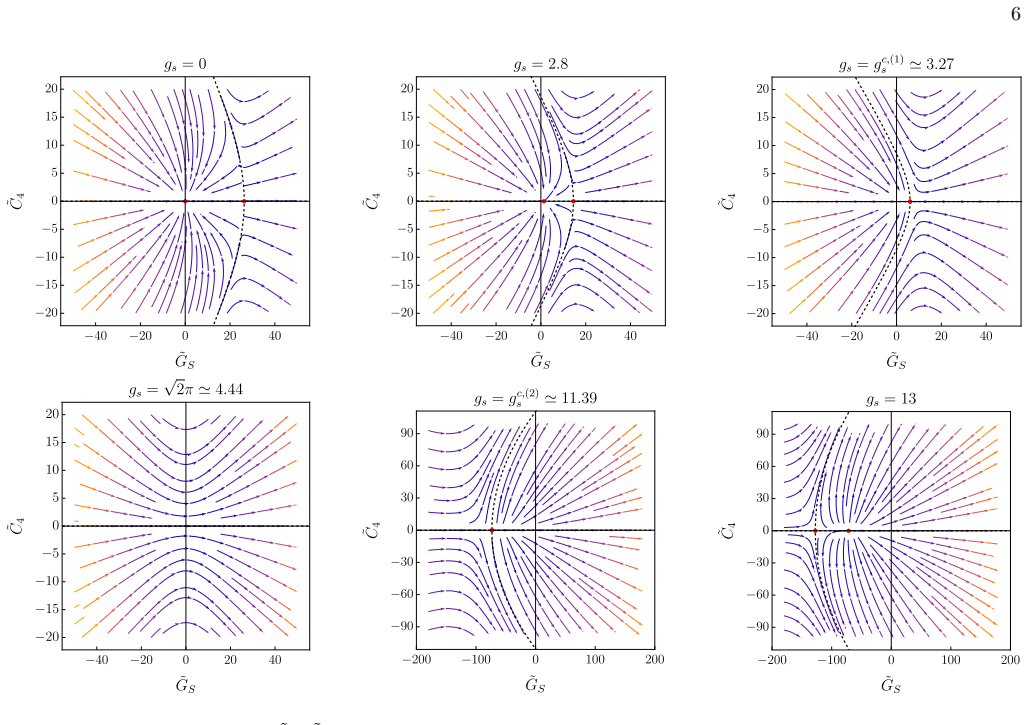
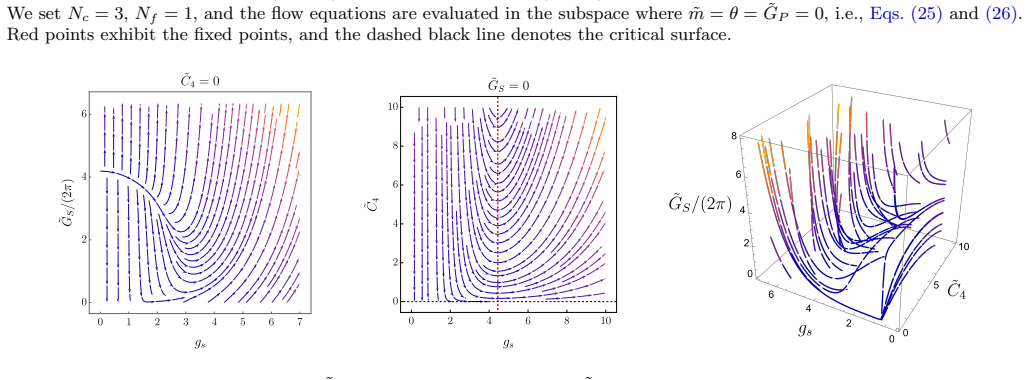
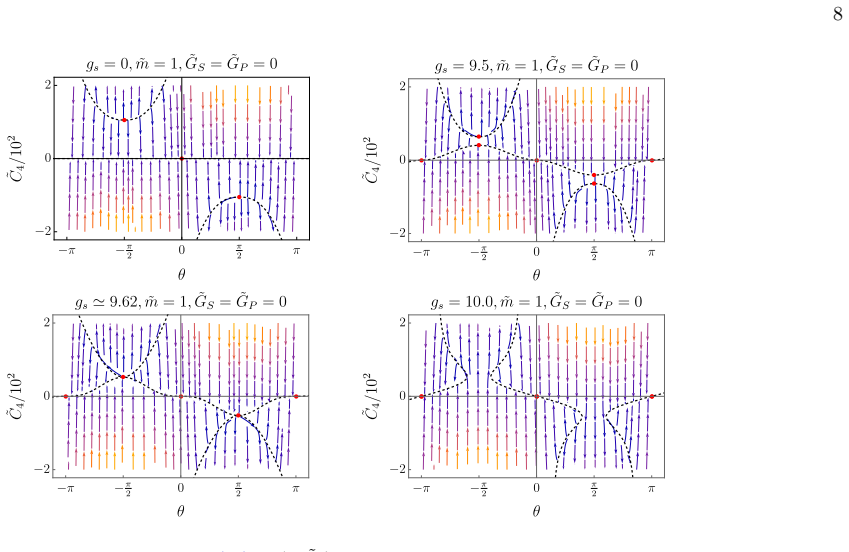
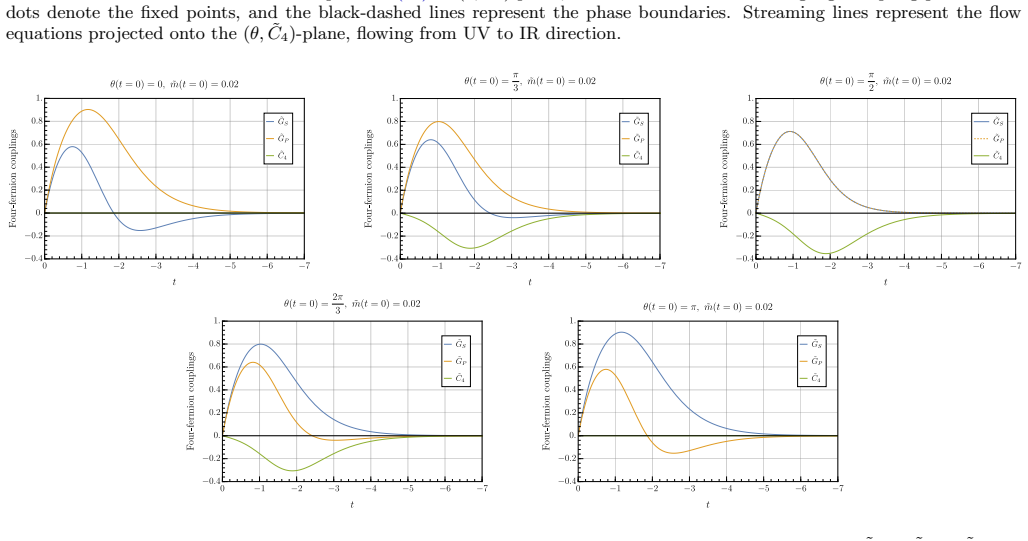
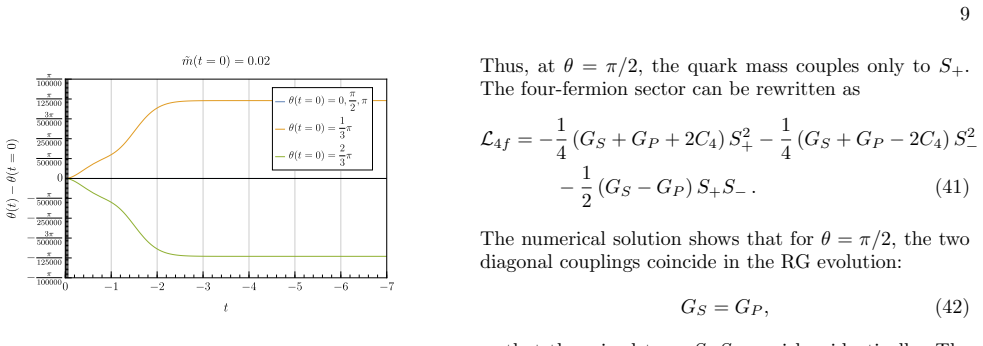
Allowing for the running gauge coupling, the CP-violating four-fermion interaction becomes relevant in the chirally broken phase. In the presence of a finite quark mass, the RG running of the θ-parameter is shown to be strongly suppressed toward the infrared. The present work clarifies how strong-CP effects generated at UV can non-trivially be transferred to the infrared physics in QCD-like theories.
What carries the argument
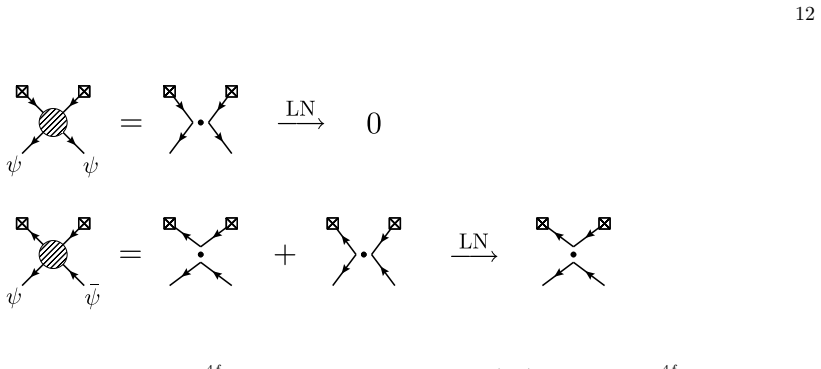
The functional renormalization group flow equations for an effective theory truncated to the CP-odd four-fermion operator (ψ-bar ψ)(ψ-bar i γ5 ψ) together with a running gauge coupling; these equations determine the scale dependence that fixes operator relevance and theta suppression.
If this is right
- The CP-violating four-fermion interaction influences the chirally broken phase once the gauge coupling runs.
- Finite quark mass produces strong suppression of the theta-parameter renormalization-group running at low energies.
- Strong-CP effects that originate in the ultraviolet reach the infrared through the identified transfer mechanism.
- Low-energy observables in QCD-like theories receive non-trivial corrections from the P-odd operator inside the broken phase.
Where Pith is reading between the lines
- Lattice calculations of QCD with explicit CP violation could search for enhanced effects near the chiral transition if the truncation holds.
- Varying quark masses in effective models would provide a direct test of the predicted damping of theta flow.
- The same renormalization-group setup could be applied to other high-scale CP-violating operators in extensions of the Standard Model.
Load-bearing premise
The low-energy effective theory truncated to the specified four-fermion operator plus running gauge coupling faithfully represents the relevant dynamics of QCD-like theories at the scales of interest.
What would settle it
An explicit computation of the beta function for the CP-violating coupling inside the chirally broken phase, performed with a running gauge coupling, that shows the coupling remains irrelevant would falsify the reported relevance.
Figures
read the original abstract
We study the low-energy properties of QCD-like theories in the presence of a $P$-odd and $U(1)$ axial breaking four-fermion operator $\left( \bar{\psi} \psi \right) \left( \bar{\psi} i \gamma_5 \psi \right)$. We apply the functional renormalization group for a low-energy effective theory involving the $CP$-violating operator. We find that allowing for the running gauge coupling, the $CP$-violating four-fermion interaction becomes relevant in the chirally broken phase. In the presence of a finite quark mass, the RG running of the $\theta$-parameter is shown to be strongly suppressed toward the infrared. The present work clarifies how strong-$CP$ effects generated at UV can non-trivially be transferred to the infrared physics in QCD-like theories.
Editorial analysis
A structured set of objections, weighed in public.
Circularity Check
No circularity: results are dynamical outputs of the truncated fRG flow
full rationale
The derivation consists of applying the functional renormalization group to a low-energy effective action containing the specified CP-odd four-fermion operator plus a running gauge coupling. The reported relevance of the operator in the chirally broken phase and the infrared suppression of the theta parameter are obtained by solving the resulting flow equations; they are not equivalent to the input truncation or any fitted parameter by construction. No self-citations, self-definitional steps, or renamings of known results are invoked as load-bearing for the central claims. The truncation itself is an explicit modeling choice whose consequences are computed rather than presupposed.
Axiom & Free-Parameter Ledger
Reference graph
Works this paper leans on
-
[1]
C. Abel et al., Measurement of the Permanent Electric Dipole Moment of the Neutron , https://doi.org/10.1103/PhysRevLett.124.081803 Phys. Rev. Lett. 124 (2020) 081803 [ https://arxiv.org/abs/2001.11966 2001.11966 ]
-
[2]
QCD collaboration, J. Liang, A. Alexandru, T. Draper, K.-F. Liu, B. Wang, G. Wang et al., Nucleon electric dipole moment from the term with lattice chiral fermions , https://doi.org/10.1103/PhysRevD.108.094512 Phys. Rev. D 108 (2023) 094512 [ https://arxiv.org/abs/2301.04331 2301.04331 ]
-
[3]
E. E. Jenkins, A. V. Manohar and P. Stoffer, Low-Energy Effective Field Theory below the Electroweak Scale: Anomalous Dimensions , https://doi.org/10.1007/JHEP01(2018)084 JHEP 01 (2018) 084 [ https://arxiv.org/abs/1711.05270 1711.05270 ]
-
[4]
QCD Corrections to Neutron Electric Dipole Moment from Dimension-six Four-Quark Operators
J. Hisano, K. Tsumura and M. J. S. Yang, QCD Corrections to Neutron Electric Dipole Moment from Dimension-six Four-Quark Operators , https://doi.org/10.1016/j.physletb.2012.06.038 Phys. Lett. B 713 (2012) 473 [ https://arxiv.org/abs/1205.2212 1205.2212 ]
work page internal anchor Pith review Pith/arXiv arXiv doi:10.1016/j.physletb.2012.06.038 2012
-
[5]
J. de Vries, P. Draper, K. Fuyuto, J. Kozaczuk and B. Lillard, Uncovering an axion mechanism with the EDM portfolio , https://doi.org/10.1103/PhysRevD.104.055039 Phys. Rev. D 104 (2021) 055039 [ https://arxiv.org/abs/2107.04046 2107.04046 ]
-
[6]
T. Banno, J. Hisano, T. Kitahara and N. Osamura, Closer look at the matching condition for radiative QCD parameter , https://doi.org/10.1007/JHEP02(2024)195 JHEP 02 (2024) 195 [ https://arxiv.org/abs/2311.07817 2311.07817 ]
-
[7]
Non-Perturbative Renormalization Group Analysis of the Chiral Critical Behaviors in QED
K.-I. Aoki, K.-i. Morikawa, J.-I. Sumi, H. Terao and M. Tomoyose, Nonperturbative renormalization group analysis of the chiral critical behaviors in QED , https://doi.org/10.1143/PTP.97.479 Prog. Theor. Phys. 97 (1997) 479 [ https://arxiv.org/abs/hep-ph/9612459 hep-ph/9612459 ]
work page internal anchor Pith review Pith/arXiv arXiv doi:10.1143/ptp.97.479 1997
-
[8]
K.-I. Aoki, K. Takagi, H. Terao and M. Tomoyose, Nonladder extended renormalization group analysis of the dynamical chiral symmetry breaking , https://doi.org/10.1143/PTP.103.815 Prog. Theor. Phys. 103 (2000) 815 [ https://arxiv.org/abs/hep-th/0002038 hep-th/0002038 ]
work page internal anchor Pith review Pith/arXiv arXiv doi:10.1143/ptp.103.815 2000
-
[9]
K.-I. Aoki and D. Sato, Solving the QCD non-perturbative flow equation as a partial differential equation and its application to the dynamical chiral symmetry breaking , https://doi.org/10.1093/ptep/ptt018 PTEP 2013 (2013) 043B04 [ https://arxiv.org/abs/1212.0063 1212.0063 ]
work page internal anchor Pith review Pith/arXiv arXiv doi:10.1093/ptep/ptt018 2013
-
[10]
L. Huang, M. Kawaguchi, Y. Maitiniyazi, S. Matsuzaki, A. Tomiya and M. Yamada, Functional renormalization group study of a four-fermion model with CP violation , https://doi.org/10.1103/PhysRevD.111.074015 Phys. Rev. D 111 (2025) 074015 [ https://arxiv.org/abs/2411.07027 2411.07027 ]
-
[11]
Exact evolution equation for the effective potential
C. Wetterich, Exact evolution equation for the effective potential , https://doi.org/10.1016/0370-2693(93)90726-X Phys. Lett. B 301 (1993) 90 [ https://arxiv.org/abs/1710.05815 1710.05815 ]
work page internal anchor Pith review Pith/arXiv arXiv doi:10.1016/0370-2693(93)90726-x 1993
-
[12]
Flow Equations for N Point Functions and Bound States
U. Ellwanger, Flow equations for N point functions and bound states , https://doi.org/10.1007/BF01555911 Z. Phys. C62 (1994) 503 [ https://arxiv.org/abs/hep-ph/9308260 hep-ph/9308260 ]
work page internal anchor Pith review Pith/arXiv arXiv doi:10.1007/bf01555911 1994
-
[13]
T. R. Morris, The Exact renormalization group and approximate solutions , https://doi.org/10.1142/S0217751X94000972 Int. J. Mod. Phys. A9 (1994) 2411 [ https://arxiv.org/abs/hep-ph/9308265 hep-ph/9308265 ]
work page internal anchor Pith review Pith/arXiv arXiv doi:10.1142/s0217751x94000972 1994
-
[14]
D. F. Litim, Optimized renormalization group flows , https://doi.org/10.1103/PhysRevD.64.105007 Phys. Rev. D 64 (2001) 105007 [ https://arxiv.org/abs/hep-th/0103195 hep-th/0103195 ]
work page internal anchor Pith review Pith/arXiv arXiv doi:10.1103/physrevd.64.105007 2001
-
[15]
K.-I. Aoki and K. Miyashita, Evaluation of the spontaneous chiral symmetry breaking scale in general gauge theories with non-perturbative renormalization group , https://doi.org/10.1143/PTP.121.875 Prog. Theor. Phys. 121 (2009) 875
-
[16]
Fierz-complete NJL model study: fixed points and phase structure at finite temperature and density
J. Braun, M. Leonhardt and M. Pospiech, Fierz-complete NJL model study: Fixed points and phase structure at finite temperature and density , https://doi.org/10.1103/PhysRevD.96.076003 Phys. Rev. D 96 (2017) 076003 [ https://arxiv.org/abs/1705.00074 1705.00074 ]
work page internal anchor Pith review Pith/arXiv arXiv doi:10.1103/physrevd.96.076003 2017
-
[17]
J. Braun, M. Leonhardt and M. Pospiech, Fierz-complete NJL model study. II. Toward the fixed-point and phase structure of hot and dense two-flavor QCD , https://doi.org/10.1103/PhysRevD.97.076010 Phys. Rev. D 97 (2018) 076010 [ https://arxiv.org/abs/1801.08338 1801.08338 ]
work page internal anchor Pith review Pith/arXiv arXiv doi:10.1103/physrevd.97.076010 2018
-
[18]
J. Braun, M. Leonhardt and M. Pospiech, Fierz-complete NJL model study III: Emergence from quark-gluon dynamics , https://doi.org/10.1103/PhysRevD.101.036004 Phys. Rev. D 101 (2020) 036004 [ https://arxiv.org/abs/1909.06298 1909.06298 ]
-
[19]
K.-I. Aoki, K. Morikawa, J.-I. Sumi, H. Terao and M. Tomoyose, Wilson renormalization group equations for the critical dynamics of chiral symmetry , https://doi.org/10.1143/PTP.102.1151 Prog. Theor. Phys. 102 (1999) 1151 [ https://arxiv.org/abs/hep-th/9908042 hep-th/9908042 ]
work page internal anchor Pith review Pith/arXiv arXiv doi:10.1143/ptp.102.1151 1999
-
[20]
G. 't Hooft, Naturalness, chiral symmetry, and spontaneous chiral symmetry breaking , https://doi.org/10.1007/978-1-4684-7571-5_9 NATO Sci. Ser. B 59 (1980) 135
-
[21]
J. D. Wells, The Utility of Naturalness, and how its Application to Quantum Electrodynamics envisages the Standard Model and Higgs Boson , https://doi.org/10.1016/j.shpsb.2015.01.002 Stud. Hist. Phil. Sci. B 49 (2015) 102 [ https://arxiv.org/abs/1305.3434 1305.3434 ]
work page internal anchor Pith review Pith/arXiv arXiv doi:10.1016/j.shpsb.2015.01.002 2015
-
[22]
Renormalization Flow of Bound States
H. Gies and C. Wetterich, Renormalization flow of bound states , https://doi.org/10.1103/PhysRevD.65.065001 Phys. Rev. D 65 (2002) 065001 [ https://arxiv.org/abs/hep-th/0107221 hep-th/0107221 ]
work page internal anchor Pith review Pith/arXiv arXiv doi:10.1103/physrevd.65.065001 2002
-
[23]
Universality of spontaneous chiral symmetry breaking in gauge theories
H. Gies and C. Wetterich, Universality of spontaneous chiral symmetry breaking in gauge theories , https://doi.org/10.1103/PhysRevD.69.025001 Phys. Rev. D 69 (2004) 025001 [ https://arxiv.org/abs/hep-th/0209183 hep-th/0209183 ]
work page internal anchor Pith review Pith/arXiv arXiv doi:10.1103/physrevd.69.025001 2004
-
[24]
J. M. Pawlowski, Aspects of the functional renormalisation group , https://doi.org/10.1016/j.aop.2007.01.007 Annals Phys. 322 (2007) 2831 [ https://arxiv.org/abs/hep-th/0512261 hep-th/0512261 ]
work page internal anchor Pith review Pith/arXiv arXiv doi:10.1016/j.aop.2007.01.007 2007
-
[25]
Exact flow equation for composite operators
S. Floerchinger and C. Wetterich, Exact flow equation for composite operators , https://doi.org/10.1016/j.physletb.2009.09.014 Phys. Lett. B 680 (2009) 371 [ https://arxiv.org/abs/0905.0915 0905.0915 ]
work page internal anchor Pith review Pith/arXiv arXiv doi:10.1016/j.physletb.2009.09.014 2009
-
[26]
From Quarks and Gluons to Hadrons: Chiral Symmetry Breaking in Dynamical QCD
J. Braun, L. Fister, J. M. Pawlowski and F. Rennecke, From Quarks and Gluons to Hadrons: Chiral Symmetry Breaking in Dynamical QCD , https://doi.org/10.1103/PhysRevD.94.034016 Phys. Rev. D 94 (2016) 034016 [ https://arxiv.org/abs/1412.1045 1412.1045 ]
work page internal anchor Pith review Pith/arXiv arXiv doi:10.1103/physrevd.94.034016 2016
-
[27]
Chiral symmetry breaking in continuum QCD
M. Mitter, J. M. Pawlowski and N. Strodthoff, Chiral symmetry breaking in continuum QCD , https://doi.org/10.1103/PhysRevD.91.054035 Phys. Rev. D 91 (2015) 054035 [ https://arxiv.org/abs/1411.7978 1411.7978 ]
work page internal anchor Pith review Pith/arXiv arXiv doi:10.1103/physrevd.91.054035 2015
-
[28]
A. K. Cyrol, M. Mitter, J. M. Pawlowski and N. Strodthoff, Nonperturbative finite-temperature Yang-Mills theory , https://doi.org/10.1103/PhysRevD.97.054015 Phys. Rev. D 97 (2018) 054015 [ https://arxiv.org/abs/1708.03482 1708.03482 ]
work page internal anchor Pith review Pith/arXiv arXiv doi:10.1103/physrevd.97.054015 2018
-
[29]
A. K. Cyrol, M. Mitter, J. M. Pawlowski and N. Strodthoff, Nonperturbative quark, gluon, and meson correlators of unquenched QCD , https://doi.org/10.1103/PhysRevD.97.054006 Phys. Rev. D 97 (2018) 054006 [ https://arxiv.org/abs/1706.06326 1706.06326 ]
work page internal anchor Pith review Pith/arXiv arXiv doi:10.1103/physrevd.97.054006 2018
-
[30]
Bound state properties from the Functional Renormalisation Group
R. Alkofer, A. Maas, W. A. Mian, M. Mitter, J. Par \' s-L \'o pez, J. M. Pawlowski et al., Bound state properties from the functional renormalization group , https://doi.org/10.1103/PhysRevD.99.054029 Phys. Rev. D 99 (2019) 054029 [ https://arxiv.org/abs/1810.07955 1810.07955 ]
work page internal anchor Pith review Pith/arXiv arXiv doi:10.1103/physrevd.99.054029 2019
-
[31]
T. Denz, M. Mitter, J. M. Pawlowski, C. Wetterich and M. Yamada, Partial bosonization for the two-dimensional Hubbard model , https://doi.org/10.1103/PhysRevB.101.155115 Phys. Rev. B 101 (2020) 155115 [ https://arxiv.org/abs/1910.08300 1910.08300 ]
-
[32]
W.-j. Fu, J. M. Pawlowski and F. Rennecke, QCD phase structure at finite temperature and density , https://doi.org/10.1103/PhysRevD.101.054032 Phys. Rev. D 101 (2020) 054032 [ https://arxiv.org/abs/1909.02991 1909.02991 ]
-
[33]
F. Goertz, \'A . Pastor-Guti \'e rrez and J. M. Pawlowski, Gauge-fermion cartography: From confinement and chiral symmetry breaking to conformality , https://doi.org/10.1103/7dzj-k6k8 Phys. Rev. D 112 (2025) 034029 [ https://arxiv.org/abs/2412.12254 2412.12254 ]
-
[34]
Y. Nakamura and G. Schierholz, The strong CP problem solved by itself due to long-distance vacuum effects , https://doi.org/10.1016/j.nuclphysb.2022.116063 Nucl. Phys. B 986 (2023) 116063 [ https://arxiv.org/abs/2106.11369 2106.11369 ]
-
[35]
M. Reuter and C. Wetterich, Effective average action for gauge theories and exact evolution equations , https://doi.org/10.1016/0550-3213(94)90543-6 Nucl. Phys. B 417 (1994) 181
-
[36]
T. R. Morris, Elements of the continuous renormalization group , https://doi.org/10.1143/PTPS.131.395 Prog. Theor. Phys. Suppl. 131 (1998) 395 [ https://arxiv.org/abs/hep-th/9802039 hep-th/9802039 ]
work page internal anchor Pith review Pith/arXiv arXiv doi:10.1143/ptps.131.395 1998
-
[37]
Non-Perturbative Renormalization Flow in Quantum Field Theory and Statistical Physics
J. Berges, N. Tetradis and C. Wetterich, Nonperturbative renormalization flow in quantum field theory and statistical physics , https://doi.org/10.1016/S0370-1573(01)00098-9 Phys. Rept. 363 (2002) 223 [ https://arxiv.org/abs/hep-ph/0005122 hep-ph/0005122 ]
work page internal anchor Pith review Pith/arXiv arXiv doi:10.1016/s0370-1573(01)00098-9 2002
-
[38]
K. Aoki, Introduction to the nonperturbative renormalization group and its recent applications , https://doi.org/10.1016/S0217-9792(00)00092-3 Int. J. Mod. Phys. B 14 (2000) 1249
-
[39]
Exact Renormalization Group Equations. An Introductory Review
C. Bagnuls and C. Bervillier, Exact renormalization group equations. An Introductory review , https://doi.org/10.1016/S0370-1573(00)00137-X Phys. Rept. 348 (2001) 91 [ https://arxiv.org/abs/hep-th/0002034 hep-th/0002034 ]
work page internal anchor Pith review Pith/arXiv arXiv doi:10.1016/s0370-1573(00)00137-x 2001
-
[40]
Lectures on the functional renormalization group method
J. Polonyi, Lectures on the functional renormalization group method , https://doi.org/10.2478/BF02475552 Central Eur. J. Phys. 1 (2003) 1 [ https://arxiv.org/abs/hep-th/0110026 hep-th/0110026 ]
work page internal anchor Pith review Pith/arXiv arXiv doi:10.2478/bf02475552 2003
-
[41]
Introduction to the functional RG and applications to gauge theories
H. Gies, Introduction to the functional RG and applications to gauge theories , https://doi.org/10.1007/978-3-642-27320-9_6 Lect. Notes Phys. 852 (2012) 287 [ https://arxiv.org/abs/hep-ph/0611146 hep-ph/0611146 ]
work page internal anchor Pith review Pith/arXiv arXiv doi:10.1007/978-3-642-27320-9_6 2012
-
[42]
An Introduction to the Nonperturbative Renormalization Group
B. Delamotte, An Introduction to the nonperturbative renormalization group , https://doi.org/10.1007/978-3-642-27320-9_2 Lect. Notes Phys. 852 (2012) 49 [ https://arxiv.org/abs/cond-mat/0702365 cond-mat/0702365 ]
work page internal anchor Pith review Pith/arXiv arXiv doi:10.1007/978-3-642-27320-9_2 2012
-
[43]
H. Sonoda, The Exact Renormalization Group: Renormalization theory revisited , in The Feza Gursey Institute, Istanbul, Turkey in 10-21 September 2007, 9, 2007, https://arxiv.org/abs/0710.1662 0710.1662
work page internal anchor Pith review Pith/arXiv arXiv 2007
-
[44]
Realization of symmetry in the ERG approach to quantum field theory
Y. Igarashi, K. Itoh and H. Sonoda, Realization of Symmetry in the ERG Approach to Quantum Field Theory , https://doi.org/10.1143/PTPS.181.1 Prog. Theor. Phys. Suppl. 181 (2010) 1 [ https://arxiv.org/abs/0909.0327 0909.0327 ]
work page internal anchor Pith review Pith/arXiv arXiv doi:10.1143/ptps.181.1 2010
-
[45]
O. J. Rosten, Fundamentals of the Exact Renormalization Group , https://doi.org/10.1016/j.physrep.2011.12.003 Phys. Rept. 511 (2012) 177 [ https://arxiv.org/abs/1003.1366 1003.1366 ]
work page internal anchor Pith review Pith/arXiv arXiv doi:10.1016/j.physrep.2011.12.003 2011
-
[46]
Fermion Interactions and Universal Behavior in Strongly Interacting Theories
J. Braun, Fermion Interactions and Universal Behavior in Strongly Interacting Theories , https://doi.org/10.1088/0954-3899/39/3/033001 J. Phys. G 39 (2012) 033001 [ https://arxiv.org/abs/1108.4449 1108.4449 ]
work page internal anchor Pith review Pith/arXiv arXiv doi:10.1088/0954-3899/39/3/033001 2012
-
[47]
N. Dupuis, L. Canet, A. Eichhorn, W. Metzner, J. M. Pawlowski, M. Tissier et al., The nonperturbative functional renormalization group and its applications , https://doi.org/10.1016/j.physrep.2021.01.001 Phys. Rept. 910 (2021) 1 [ https://arxiv.org/abs/2006.04853 2006.04853 ]
-
[48]
write newline
" write newline "" before.all 'output.state := FUNCTION blank.sep after.quote 'output.state := FUNCTION fin.entry output.state after.quoted.block = 'skip 'add.period if write newline FUNCTION new.block output.state before.all = 'skip output.state after.quote = after.quoted.block 'output.state := after.block 'output.state := if if FUNCTION new.sentence out...
discussion (0)
Sign in with ORCID, Apple, or X to comment. Anyone can read and Pith papers without signing in.