Search for light scalar particles produced in Higgs boson decays in exclusive final states with two muons and two hadrons in proton-proton collisions at sqrt{s} = 13 TeV
Pith reviewed 2026-06-29 09:46 UTC · model grok-4.3
The pith
The CMS Collaboration reports upper limits of order 10^{-4} on the branching fraction of the Higgs boson to pairs of light scalar particles.
A machine-rendered reading of the paper's core claim, the machinery that carries it, and where it could break.
Core claim
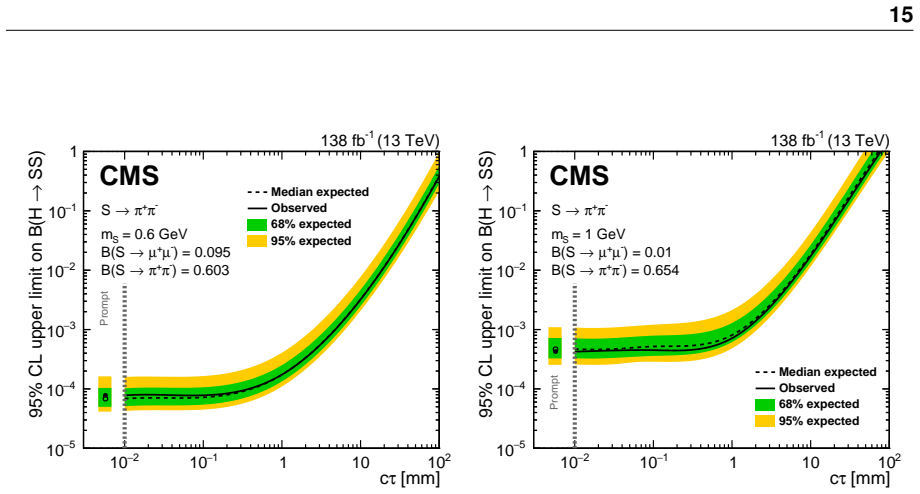
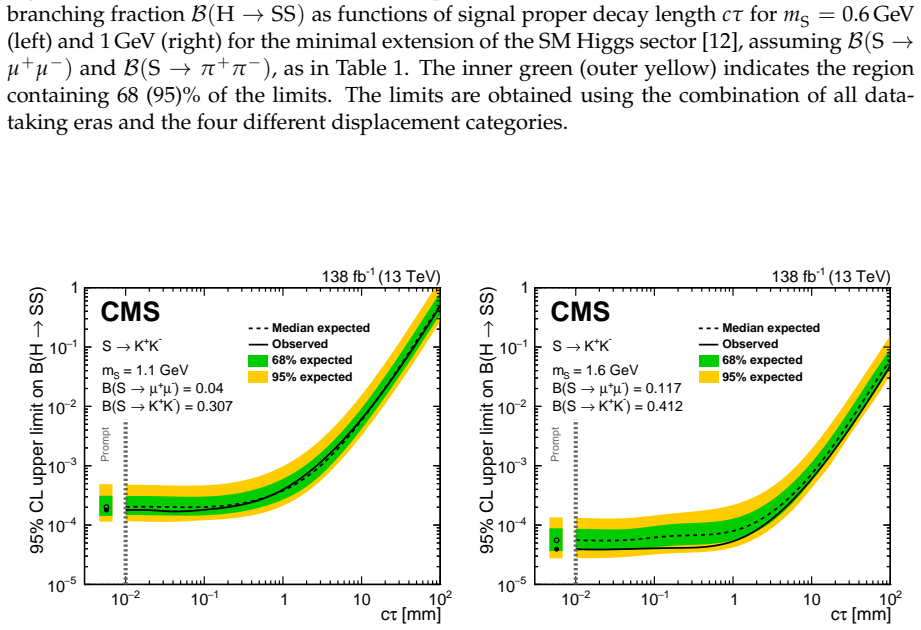
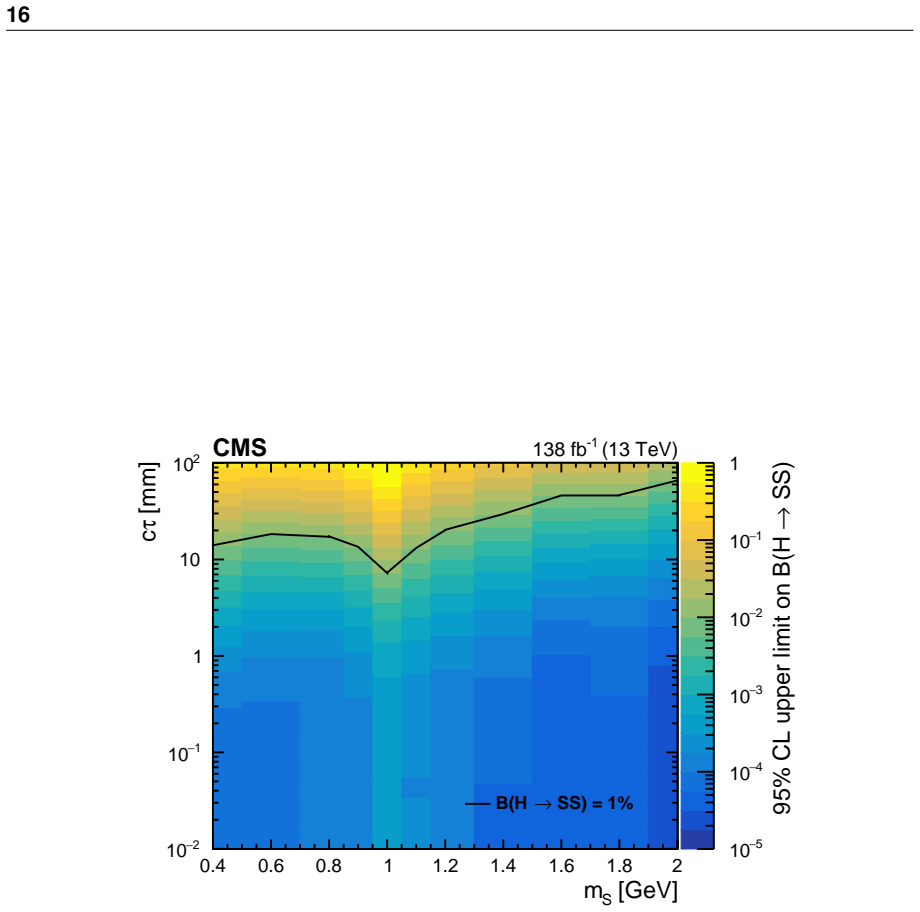
The analysis targets Higgs boson decays to pairs of identical scalar particles that each decay to a muon pair or a pair of charged hadrons. With no observed signal in the exclusive final states, the paper establishes upper limits on the branching fraction at O(10^{-4}) for scalar masses from 0.4 to 2.0 GeV and proper decay lengths up to approximately 1 mm.
What carries the argument
The central mechanism is the identification of collimated pairs of muons and hadrons from the decays of the scalar particles, allowing separation of signal from background in both prompt and displaced vertex scenarios.
If this is right
- Constrains the parameter space for models with light scalars produced in Higgs decays.
- Provides limits for both prompt and long-lived scalars with decay lengths up to 1 mm.
- Improves sensitivity to very light scalar masses where hadronic decays are prominent.
- Shows the viability of using mixed muon-hadron final states for such searches.
Where Pith is reading between the lines
- Future data taking could tighten these limits further by increasing the integrated luminosity.
- Similar techniques might apply to searches for other light particles in Higgs decays at the LHC.
- The results could inform theoretical models of extended scalar sectors or hidden sector particles.
Load-bearing premise
The limits rely on the accurate modeling and subtraction of standard model background processes in the regions defined by the collimated muon and hadron pairs.
What would settle it
Detection of a significant number of events above the predicted background in the signal regions would indicate the production of the scalar particles.
Figures

read the original abstract
A search for new scalar particles of $\mathcal{O}$(GeV) mass in exclusive final states with muons and light hadrons is presented. The analysis uses proton-proton collision data produced at a center-of-mass energy of 13 TeV collected by the CMS experiment at the CERN LHC in 201$-$2018, corresponding to an integrated luminosity of 138 fb$^{-1}$. The search targets exotic decays of the Higgs boson to a pair of prompt or long-lived identical scalar particles with proper decay lengths $c\tau$ up to 100 mm and masses within the range of 0.4$-$2.0 GeV. This mass window corresponds to a unique parameter space where hadronic decays of these particles mostly result in a pair of light hadrons. The considered experimental signature is a collimated pair of muons and another pair of charged kaons or pions, each of which may be prompt or displaced. The analysis improves the sensitivity to very light scalar boson masses and demonstrates a novel approach to probe hadronic decays of light scalar bosons. Upper limits on the branching fraction of the Higgs boson to scalar bosons at the level of $\mathcal{O}$(10$^{-4}$) are obtained for several scalar boson masses between 0.4 and 2.0 GeV, with proper decay lengths of up to $\sim$1 mm.
Editorial analysis
A structured set of objections, weighed in public.
Referee Report
Summary. The manuscript presents a search for light scalar particles produced in Higgs boson decays to pairs of identical scalars, using exclusive final states consisting of two muons and two charged hadrons (kaons or pions) in CMS proton-proton collision data at 13 TeV with 138 fb^{-1} integrated luminosity. The analysis targets scalar masses in 0.4-2.0 GeV and proper decay lengths cτ up to 100 mm, setting upper limits on the Higgs branching fraction to these scalars at the O(10^{-4}) level for several masses with cτ up to ~1 mm.
Significance. If the central result holds after validation, the work would constrain light scalar models in a mass window where hadronic decays dominate, using a novel collimated muon-hadron signature that improves sensitivity at very low masses. The large dataset and inclusion of displaced vertices contribute to the reach.
major comments (1)
- [Abstract (background estimation and results sections)] The abstract states that limits are obtained after background subtraction in the collimated muon-hadron regions, but provides no quantitative details on background modeling (e.g., QCD multijet or Drell-Yan contributions), data/MC agreement, or control-region validation. Since the O(10^{-4}) limits scale directly with the accuracy of this subtraction, the absence of such validation makes it impossible to confirm that the background uncertainty is sub-dominant to the claimed sensitivity.
minor comments (1)
- [Abstract] The abstract reports limits only up to cτ ~1 mm while the search targets up to 100 mm; a brief clarification of the effective coverage after selections would improve clarity.
Simulated Author's Rebuttal
We thank the referee for the careful review. We address the single major comment below.
read point-by-point responses
-
Referee: [Abstract (background estimation and results sections)] The abstract states that limits are obtained after background subtraction in the collimated muon-hadron regions, but provides no quantitative details on background modeling (e.g., QCD multijet or Drell-Yan contributions), data/MC agreement, or control-region validation. Since the O(10^{-4}) limits scale directly with the accuracy of this subtraction, the absence of such validation makes it impossible to confirm that the background uncertainty is sub-dominant to the claimed sensitivity.
Authors: The abstract is necessarily concise. The full manuscript contains a dedicated Background Estimation section describing the data-driven modeling of QCD multijet and Drell-Yan backgrounds, together with explicit data/MC comparisons and control-region validations shown in the Results section. These studies confirm that the background uncertainty is sub-dominant to the statistical component in the signal regions used for the limit extraction. We are prepared to add one sentence to the abstract summarizing the data-driven subtraction approach if the editor considers it appropriate. revision: partial
Circularity Check
No circularity in experimental limit-setting analysis
full rationale
This is a standard CMS experimental search paper that extracts upper limits on Higgs branching fractions from 138 fb^{-1} of 13 TeV data by comparing observed events in signal regions (collimated muon-hadron pairs, mass windows 0.4-2.0 GeV, cτ up to ~1 mm) against modeled SM backgrounds. No equations, fits, or ansatzes are presented as 'predictions' that reduce to the inputs by construction; the result is data-driven and externally falsifiable via the observed counts. No self-citation chains or uniqueness theorems are invoked as load-bearing steps. The analysis is self-contained against external benchmarks (data/MC comparisons and control regions), yielding a normal non-finding of circularity.
Axiom & Free-Parameter Ledger
Reference graph
Works this paper leans on
-
[1]
ATLAS Collaboration, “Observation of a new particle in the search for the Standard Model Higgs boson with the ATLAS detector at the LHC”,Phys. Lett. B716(2012) 1, doi:10.1016/j.physletb.2012.08.020,arXiv:1207.7214
work page internal anchor Pith review Pith/arXiv arXiv doi:10.1016/j.physletb.2012.08.020 2012
-
[2]
Observation of a new boson at a mass of 125 GeV with the CMS experiment at the LHC
CMS Collaboration, “Observation of a new boson at a mass of 125 GeV with the CMS Experiment at the LHC”,Phys. Lett. B716(2012) 30, doi:10.1016/j.physletb.2012.08.021,arXiv:1207.7235
work page internal anchor Pith review Pith/arXiv arXiv doi:10.1016/j.physletb.2012.08.021 2012
-
[3]
Broken symmetry and the mass of gauge vector mesons
F. Englert and R. Brout, “Broken symmetry and the mass of gauge vector mesons”,Phys. Rev. Lett.13(1964) 321,doi:10.1103/PhysRevLett.13.321
-
[4]
Broken symmetries, massless particles and gauge fields
P . W. Higgs, “Broken symmetries, massless particles and gauge fields”,Phys. Lett.12 (1964) 132,doi:10.1016/0031-9163(64)91136-9. References 19
-
[5]
Broken symmetries and the masses of gauge bosons
P . W. Higgs, “Broken symmetries and the masses of gauge bosons”,Phys. Rev. Lett.13 (1964) 508,doi:10.1103/PhysRevLett.13.508
-
[6]
Global conservation laws and massless particles
G. S. Guralnik, C. R. Hagen, and T. W. B. Kibble, “Global conservation laws and massless particles”,Phys. Rev. Lett.13(1964) 585,doi:10.1103/PhysRevLett.13.585
-
[7]
A detailed map of Higgs boson interactions by the ATLAS experiment ten years after the discovery
ATLAS Collaboration, “A detailed map of Higgs boson interactions by the ATLAS experiment ten years after the discovery”,Nature607(2022) 52, doi:10.1038/s41586-022-04893-w,arXiv:2207.00092. [Erratum: doi:10.1038/s41586-022-05581-5]
-
[8]
A portrait of the Higgs boson by the CMS experiment ten years after the discovery
CMS Collaboration, “A portrait of the Higgs boson by the CMS experiment ten years after the discovery.”,Nature607(2022) 60,doi:10.1038/s41586-022-04892-x, arXiv:2207.00043. [Erratum:doi:10.1038/s41586-023-06164-8]
-
[9]
ATLAS Collaboration, “Combination of searches for invisible decays of the Higgs boson using 139 fb−1 of proton-proton collision data at √s=13 TeV collected with the ATLAS experiment”,Phys. Lett. B842(2023) 137963, doi:10.1016/j.physletb.2023.137963,arXiv:2301.10731
-
[10]
CMS Collaboration, “A search for decays of the Higgs boson to invisible particles in events with a top-antitop quark pair or a vector boson in proton-proton collisions at√s=13 TeV”,Eur. Phys. J. C83(2023) 933, doi:10.1140/epjc/s10052-023-11952-7,arXiv:2303.01214
-
[11]
Phenomenology of a very light scalar (100 MeV $<m_h<$ 10 GeV) mixing with the SM Higgs
J. D. Clarke, R. Foot, and R. R. Volkas, “Phenomenology of a very light scalar (100 MeV< mh <10 GeV) mixing with the SM Higgs”,JHEP02(2014) 123, doi:10.1007/JHEP02(2014)123,arXiv:1310.8042
work page internal anchor Pith review Pith/arXiv arXiv doi:10.1007/jhep02(2014)123 2014
-
[12]
Decay and Detection of a Light Scalar Boson Mixing with the Higgs
M. W. Winkler, “Decay and detection of a light scalar boson mixing with the Higgs boson”,Phys. Rev. D99(2019) 015018,doi:10.1103/PhysRevD.99.015018, arXiv:1809.01876
work page internal anchor Pith review Pith/arXiv arXiv doi:10.1103/physrevd.99.015018 2019
-
[13]
Phenomenology of GeV-scale scalar portal
I. Boiarska et al., “Phenomenology of GeV-scale scalar portal”,JHEP11(2019) 162, doi:10.1007/JHEP11(2019)162,arXiv:1904.10447
-
[14]
The $\nu$MSM, Inflation, and Dark Matter
M. Shaposhnikov and I. Tkachev, “The nuMSM, inflation, and dark matter”,Phys. Lett. B 639(2006) 414,doi:10.1016/j.physletb.2006.06.063, arXiv:hep-ph/0604236
work page internal anchor Pith review Pith/arXiv arXiv doi:10.1016/j.physletb.2006.06.063 2006
-
[15]
F. Bezrukov and D. Gorbunov, “Light inflaton hunter’s guide”,JHEP05(2010) 010, doi:10.1007/JHEP05(2010)010,arXiv:0912.0390
work page internal anchor Pith review Pith/arXiv arXiv doi:10.1007/jhep05(2010)010 2010
-
[16]
Light inflaton after LHC8 and WMAP9 results
F. Bezrukov and D. Gorbunov, “Light inflaton after LHC8 and WMAP9 results”,JHEP 07(2013) 140,doi:10.1007/JHEP07(2013)140,arXiv:1303.4395
work page internal anchor Pith review Pith/arXiv arXiv doi:10.1007/jhep07(2013)140 2013
-
[17]
Supergauge invariant extension of the Higgs mechanism and a model for the electron and its neutrino
P . Fayet, “Supergauge invariant extension of the Higgs mechanism and a model for the electron and its neutrino”,Nucl. Phys. B90(1975) 104, doi:10.1016/0550-3213(75)90636-7
-
[18]
The Next-to-Minimal Supersymmetric Standard Model
U. Ellwanger, C. Hugonie, and A. M. Teixeira, “The Next-to-Minimal Supersymmetric Standard Model”,Phys. Rept.496(2010) 1,doi:10.1016/j.physrep.2010.07.001, arXiv:0910.1785. 20
work page internal anchor Pith review Pith/arXiv arXiv doi:10.1016/j.physrep.2010.07.001 2010
-
[19]
M. Pospelov, A. Ritz, and M. B. Voloshin, “Secluded WIMP Dark Matter”,Phys. Lett. B 662(2008) 53,doi:10.1016/j.physletb.2008.02.052,arXiv:0711.4866
work page internal anchor Pith review Pith/arXiv arXiv doi:10.1016/j.physletb.2008.02.052 2008
-
[20]
Probing light thermal dark matter with a Higgs portal mediator
G. Krnjaic, “Probing light thermal dark matter with a Higgs portal mediator”,Phys. Rev. D94(2016) 073009,doi:10.1103/PhysRevD.94.073009
-
[21]
Cosmological relaxation of the electroweak scale
P . W. Graham, D. E. Kaplan, and S. Rajendran, “Cosmological relaxation of the electroweak scale”,Phys. Rev. Lett.115(2015) 221801, doi:10.1103/PhysRevLett.115.221801
-
[22]
Dark Higgs bosons at colliders
T. Ferber, A. Grohsjean, and F. Kahlhoefer, “Dark Higgs bosons at colliders”,Prog. Part. Nucl. Phys.136(2024) 104105,doi:10.1016/j.ppnp.2024.104105, arXiv:2305.16169
-
[23]
Dark sector searches with the CMS experiment
CMS Collaboration, “Dark sector searches with the CMS experiment”,Phys. Rept.1115 (2025) 448,doi:10.1016/j.physrep.2024.09.013,arXiv:2405.13778
-
[24]
Exclusive displaced hadronic signatures in the LHC forward region
X. Cid Vidal, Y. Tsai, and J. Zurita, “Exclusive displaced hadronic signatures in the LHC forward region”,JHEP01(2020) 115,doi:10.1007/JHEP01(2020)115, arXiv:1910.05225
-
[25]
Probing naturally light singlets with a displaced vertex trigger
Y. Gershtein, S. Knapen, and D. Redigolo, “Probing naturally light singlets with a displaced vertex trigger”,Phys. Lett. B823(2021) 136758, doi:10.1016/j.physletb.2021.136758,arXiv:2012.07864
-
[26]
CMS Collaboration, “Search for long-lived particles decaying into muon pairs in proton-proton collisions at √s= 13 TeV collected with a dedicated high-rate data stream”, JHEP04(2022) 062,doi:10.1007/JHEP04(2022)062,arXiv:2112.13769
-
[27]
CMS Collaboration, “Model-independent search for pair production of new bosons decaying into muons in proton-proton collisions at √s= 13 TeV”,JHEP12(2024) 172, doi:10.1007/JHEP12(2024)172,arXiv:2407.20425
-
[28]
CMS Collaboration, “Search for long-lived particles decaying in the CMS muon detectors in proton-proton collisions at √s= 13 TeV”,Phys. Rev. D110(2024) 032007, doi:10.1103/PhysRevD.110.032007,arXiv:2402.01898
-
[29]
ATLAS Collaboration, “Search for light long-lived neutral particles that decay to collimated pairs of leptons or light hadrons in pp collisions at √s= 13 TeV with the ATLAS detector”,JHEP06(2023) 153,doi:10.1007/JHEP06(2023)153, arXiv:2206.12181
-
[30]
ATLAS Collaboration, “Search for light long-lived neutral particles from Higgs boson decays via vector-boson-fusion production from pp collisions at √s=13 TeV with the ATLAS detector”,Eur. Phys. J. C84(2024) 719, doi:10.1140/epjc/s10052-024-12902-7,arXiv:2311.18298
-
[31]
Search for hidden-sector bosons in $B^0 \!\to K^{*0}\mu^+\mu^-$ decays
LHCb Collaboration, “Search for hidden-sector bosons inB 0 →K ∗0µ+µ− decays”,Phys. Rev. Lett.115(2015) 161802,doi:10.1103/PhysRevLett.115.161802, arXiv:1508.04094
work page internal anchor Pith review Pith/arXiv arXiv doi:10.1103/physrevlett.115.161802 2015
-
[32]
Search for long-lived scalar particles in $B^+ \to K^+ \chi (\mu^+\mu^-)$ decays
LHCb Collaboration, “Search for long-lived scalar particles inB + →K +χ(µ+µ−) decays”,Phys. Rev. D95(2017) 071101,doi:10.1103/PhysRevD.95.071101, arXiv:1612.07818. References 21
work page internal anchor Pith review Pith/arXiv arXiv doi:10.1103/physrevd.95.071101 2017
-
[33]
HEPData record for this analysis
“HEPData record for this analysis”, 2026.doi:10.17182/hepdata.166215
-
[34]
The CMS experiment at the CERN LHC
CMS Collaboration, “The CMS experiment at the CERN LHC”,JINST3(2008) S08004, doi:10.1088/1748-0221/3/08/S08004
-
[35]
Development of the CMS detector for the CERN LHC Run 3
CMS Collaboration, “Development of the CMS detector for the CERN LHC Run 3”, JINST19(2024) P05064,doi:10.1088/1748-0221/19/05/P05064
-
[36]
Performance of the CMS Level-1 trigger in proton-proton collisions at √s=13 TeV
CMS Collaboration, “Performance of the CMS Level-1 trigger in proton-proton collisions at √s=13 TeV”,JINST15(2020) P10017, doi:10.1088/1748-0221/15/10/P10017,arXiv:2006.10165
-
[37]
CMS Collaboration, “The CMS trigger system”,JINST12(2017) P01020, doi:10.1088/1748-0221/12/01/P01020,arXiv:1609.02366
work page internal anchor Pith review Pith/arXiv arXiv doi:10.1088/1748-0221/12/01/p01020 2017
-
[38]
Performance of the CMS high-level trigger during LHC Run 2
CMS Collaboration, “Performance of the CMS high-level trigger during LHC Run 2”, JINST19(2024) P11021,doi:10.1088/1748-0221/19/11/P11021, arXiv:2410.17038
-
[39]
Electron and photon reconstruction and identification with the CMS experiment at the CERN LHC
CMS Collaboration, “Electron and photon reconstruction and identification with the CMS experiment at the CERN LHC”,JINST16(2021) P05014, doi:10.1088/1748-0221/16/05/P05014,arXiv:2012.06888
-
[40]
CMS Collaboration, “Performance of the CMS muon detector and muon reconstruction with proton-proton collisions at √s=13 TeV”,JINST13(2018) P06015, doi:10.1088/1748-0221/13/06/P06015,arXiv:1804.04528
work page internal anchor Pith review Pith/arXiv arXiv doi:10.1088/1748-0221/13/06/p06015 2018
-
[41]
Description and performance of track and primary-vertex reconstruction with the CMS tracker
CMS Collaboration, “Description and performance of track and primary-vertex reconstruction with the CMS tracker”,JINST9(2014) P10009, doi:10.1088/1748-0221/9/10/P10009,arXiv:1405.6569
work page internal anchor Pith review Pith/arXiv arXiv doi:10.1088/1748-0221/9/10/p10009 2014
-
[42]
The CMS phase-1 pixel detector upgrade
CMS Tracker Group Collaboration, “The CMS phase-1 pixel detector upgrade”,JINST 16(2021) P02027,doi:10.1088/1748-0221/16/02/P02027,arXiv:2012.14304
-
[43]
Track impact parameter resolution for the full pseudorapidity coverage in the 2017 dataset with the CMS phase-1 pixel detector
CMS Collaboration, “Track impact parameter resolution for the full pseudorapidity coverage in the 2017 dataset with the CMS phase-1 pixel detector”, CMS Detector Performance Summary CMS-DP-2020-049, 2020
2017
-
[44]
2017 tracking performance plots
CMS Collaboration, “2017 tracking performance plots”, CMS Detector Performance Summary CMS-DP-2017-015, 2017
2017
-
[45]
Particle-flow reconstruction and global event description with the CMS detector
CMS Collaboration, “Particle-flow reconstruction and global event description with the CMS detector”,JINST12(2017) P10003,doi:10.1088/1748-0221/12/10/P10003, arXiv:1706.04965
work page internal anchor Pith review Pith/arXiv arXiv doi:10.1088/1748-0221/12/10/p10003 2017
-
[46]
Technical proposal for the Phase-II upgrade of the Compact Muon Solenoid
CMS Collaboration, “Technical proposal for the Phase-II upgrade of the Compact Muon Solenoid”, CMS Technical Proposal CMS-TDR-15-02, 2015
2015
-
[47]
A New Method for Combining NLO QCD with Shower Monte Carlo Algorithms
P . Nason, “A new method for combining NLO QCD with shower Monte Carlo algorithms”,JHEP11(2004) 040,doi:10.1088/1126-6708/2004/11/040, arXiv:hep-ph/0409146
work page internal anchor Pith review Pith/arXiv arXiv doi:10.1088/1126-6708/2004/11/040 2004
-
[48]
Matching NLO QCD computations with Parton Shower simulations: the POWHEG method
S. Frixione, P . Nason, and C. Oleari, “Matching NLO QCD computations with Parton Shower simulations: the POWHEG method”,JHEP11(2007) 070, doi:10.1088/1126-6708/2007/11/070,arXiv:0709.2092. 22
work page internal anchor Pith review Pith/arXiv arXiv doi:10.1088/1126-6708/2007/11/070 2007
-
[49]
A general framework for implementing NLO calculations in shower Monte Carlo programs: the POWHEG BOX
S. Alioli, P . Nason, C. Oleari, and E. Re, “A general framework for implementing NLO calculations in shower Monte Carlo programs: the POWHEG BOX”,JHEP06(2010) 043, doi:10.1007/JHEP06(2010)043,arXiv:1002.2581
work page internal anchor Pith review Pith/arXiv arXiv doi:10.1007/jhep06(2010)043 2010
-
[50]
Higgs production via gluon fusion in the POWHEG approach in the SM and in the MSSM
E. Bagnaschi, G. Degrassi, P . Slavich, and A. Vicini, “Higgs production via gluon fusion in the POWHEG approach in the SM and in the MSSM”,JHEP02(2012) 088, doi:10.1007/JHEP02(2012)088,arXiv:1111.2854
work page internal anchor Pith review Pith/arXiv arXiv doi:10.1007/jhep02(2012)088 2012
-
[51]
T. Sj ¨ostrand et al., “An introduction to PYTHIA 8.2”,Comput. Phys. Commun.191(2015) 159,doi:10.1016/j.cpc.2015.01.024,arXiv:1410.3012
work page internal anchor Pith review Pith/arXiv arXiv doi:10.1016/j.cpc.2015.01.024 2015
-
[52]
Extraction and validation of a new set of CMS PYTHIA8 tunes from underlying-event measurements
CMS Collaboration, “Extraction and validation of a new set of CMS PYTHIA8 tunes from underlying-event measurements”,Eur. Phys. J. C80(2020) 4, doi:10.1140/epjc/s10052-019-7499-4,arXiv:1903.12179
-
[53]
Parton distributions from high-precision collider data
NNPDF Collaboration, “Parton distributions from high-precision collider data”,Eur. Phys. J. C77(2017) 663,doi:10.1140/epjc/s10052-017-5199-5, arXiv:1706.00428
work page internal anchor Pith review Pith/arXiv arXiv doi:10.1140/epjc/s10052-017-5199-5 2017
-
[54]
GEANT4 Collaboration, “GEANT4—a simulation toolkit”,Nucl. Instrum. Meth. A506 (2003) 250,doi:10.1016/S0168-9002(03)01368-8
-
[55]
Simulation of the Silicon Strip Tracker pre-amplifier in early 2016 data
CMS Collaboration, “Simulation of the Silicon Strip Tracker pre-amplifier in early 2016 data”, CMS Detector Performance Summary CMS-DP-2020-045, 2020
2016
-
[56]
Handbook of LHC Higgs Cross Sections: 4. Deciphering the Nature of the Higgs Sector
LHC Higgs Cross Section Working Group, “Handbook of LHC Higgs cross sections: 4. Deciphering the nature of the Higgs sector”, CERN Report CERN-2017-002-M, 2016. doi:10.23731/CYRM-2017-002,arXiv:1610.07922
work page internal anchor Pith review Pith/arXiv arXiv doi:10.23731/cyrm-2017-002 2017
-
[57]
Displaced tracking and vertexing calibration using neutral K mesons
CMS Collaboration, “Displaced tracking and vertexing calibration using neutral K mesons”, CMS Detector Performance Summary CMS-DP-2024-010, 2024
2024
-
[58]
Tracking performances for charged pions with Run2 Legacy data
CMS Collaboration, “Tracking performances for charged pions with Run2 Legacy data”, CMS Detector Performance Summary CMS-DP-2022-012, 2022
2022
-
[59]
CMS Collaboration, “Search for long-lived particles decaying to a pair of muons in proton-proton collisions at √s= 13 TeV”,JHEP05(2023) 228, doi:10.1007/JHEP05(2023)228,arXiv:2205.08582
-
[60]
Measurements of Inclusive W and Z Cross Sections in pp Collisions at sqrt(s)=7 TeV
CMS Collaboration, “Measurements of InclusiveWandZCross Sections inppCollisions at √s=7 TeV”,JHEP01(2011) 080,doi:10.1007/JHEP01(2011)080, arXiv:1012.2466
work page internal anchor Pith review Pith/arXiv arXiv doi:10.1007/jhep01(2011)080 2011
-
[61]
Precision luminosity measurement in proton-proton collisions at√s=13 TeV in 2015 and 2016 at CMS
CMS Collaboration, “Precision luminosity measurement in proton-proton collisions at√s=13 TeV in 2015 and 2016 at CMS”,Eur. Phys. J. C81(2021) 800, doi:10.1140/epjc/s10052-021-09538-2,arXiv:2104.01927
-
[62]
CMS luminosity measurement for the 2017 data-taking period at√s=13 TeV
CMS Collaboration, “CMS luminosity measurement for the 2017 data-taking period at√s=13 TeV”, CMS Physics Analysis Summary CMS-PAS-LUM-17-004, 2018
2017
-
[63]
CMS luminosity measurement for the 2018 data-taking period at√s=13 TeV
CMS Collaboration, “CMS luminosity measurement for the 2018 data-taking period at√s=13 TeV”, CMS Physics Analysis Summary CMS-PAS-LUM-18-002, 2019
2018
-
[64]
Confidence Level Computation for Combining Searches with Small Statistics
T. Junk, “Confidence level computation for combining searches with small statistics”, Nucl. Instrum. Meth. A434(1999) 435,doi:10.1016/S0168-9002(99)00498-2, arXiv:hep-ex/9902006. References 23
work page internal anchor Pith review Pith/arXiv arXiv doi:10.1016/s0168-9002(99)00498-2 1999
-
[65]
CMS Collaboration, “Precise determination of the mass of the Higgs boson and tests of compatibility of its couplings with the standard model predictions using proton collisions at 7 and 8 TeV”,Eur. Phys. J. C75(2015) 212, doi:10.1140/epjc/s10052-015-3351-7,arXiv:1412.8662
work page internal anchor Pith review Pith/arXiv arXiv doi:10.1140/epjc/s10052-015-3351-7 2015
-
[66]
The CMS statistical analysis and combination tool: Combine
CMS Collaboration, “The CMS statistical analysis and combination tool: Combine”, Comput. Softw. Big Sci.8(2024) 19,doi:10.1007/s41781-024-00121-4, arXiv:2404.06614
-
[67]
The RooFit toolkit for data modeling
W. Verkerke and D. Kirkby, “The ROOFITtoolkit for data modeling”, inProc. 13th International Conference on Computing in High Energy and Nuclear Physics (CHEP 2003). 2003.arXiv:physics/0306116. [eConf C0303241, MOLT007]
work page internal anchor Pith review Pith/arXiv arXiv 2003
-
[68]
L. Moneta et al., “The RooStats project”,PoSACAT2010(2010) 057, doi:10.22323/1.093.0057,arXiv:1009.1003. 24 25 A The CMS Collaboration Yerevan Physics Institute, Yerevan, Armenia A. Hayrapetyan, V . Makarenko , A. Tumasyan1 Institut f ¨ ur Hochenergiephysik, Vienna, Austria W. Adam , L. Benato , T. Bergauer , M. Dragicevic , P .S. Hussain , M. Jeitler 2 ,...
work page internal anchor Pith review Pith/arXiv arXiv doi:10.22323/1.093.0057 2010
discussion (0)
Sign in with ORCID, Apple, or X to comment. Anyone can read and Pith papers without signing in.