Problem-Specific Basis Quantum State Readout via Proper Orthogonal Decomposition
Pith reviewed 2026-06-29 12:09 UTC · model grok-4.3
The pith
Proper orthogonal decomposition builds a reduced basis offline so quantum readout needs only minimal measurements for varying-parameter PDE problems.
A machine-rendered reading of the paper's core claim, the machinery that carries it, and where it could break.
Core claim
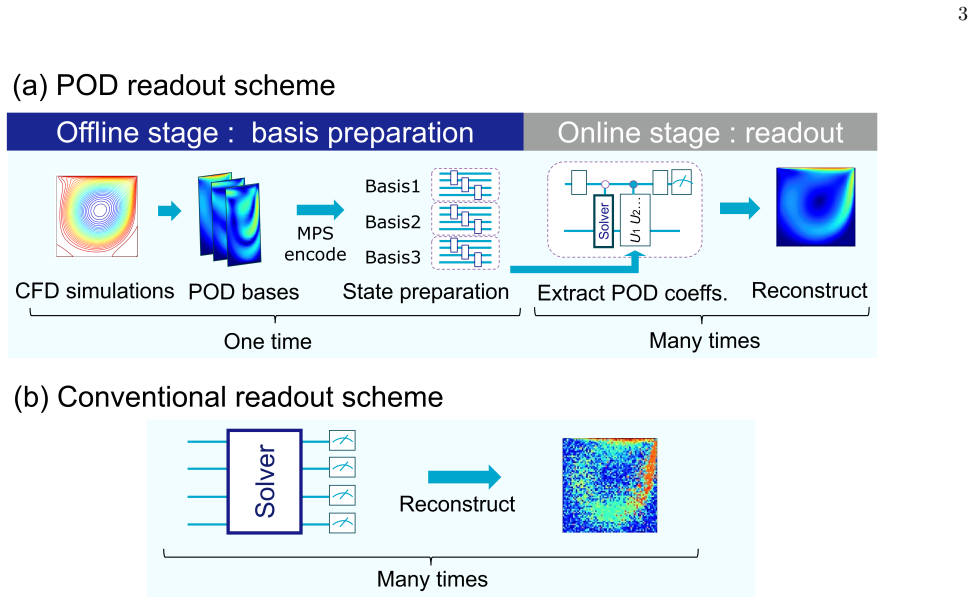
The PODR method consists of an offline stage that constructs basis functions representing dominant features of the target problem from representative classical solution data, and an online stage that projects the quantum state onto this reduced basis and extracts only the minimal weight coefficients needed for reconstruction. Because the offline stage occurs only once, the method reduces both the number of measurements and the computational resources required in the online stage relative to conventional readout methods when parameters vary.
What carries the argument
The proper orthogonal decomposition-based readout (PODR) method, which precomputes a reduced basis from classical data to enable projection and extraction of minimal coefficients from the quantum state.
If this is right
- The offline stage is performed only once, so the method scales efficiently for families of simulations that differ only in parameter values.
- Only the minimal set of weight coefficients must be measured in the online stage, lowering both measurement count and post-processing cost.
- Benchmark applications to fluid-dynamics problems show the method outperforms conventional readout in resource use.
- The separation of stages makes the approach suitable for hybrid quantum-classical workflows that repeat the same PDE at many parameter points.
Where Pith is reading between the lines
- The same reduced-basis idea could be tested on other quantum algorithms that solve linear systems or evolve PDEs, not just fluid models.
- If the representative data set is chosen adaptively rather than fixed in advance, the method might extend to broader or unknown parameter ranges.
- Hardware experiments could measure how the required number of shots scales with basis size on current quantum devices.
Load-bearing premise
Representative classical solution data can be used to construct a reduced basis that accurately captures the dominant features of the target problem for varying parameters.
What would settle it
If reconstruction error stays high for solutions whose parameters lie outside the range of the representative data used to build the basis, the claimed reduction in online measurements would not hold.
Figures
read the original abstract
Quantum computing is a promising technology for accelerating partial differential equation solvers applied to large-scale real-world problems. However, reconstructing a classical representation of the solution from the quantum state remains a significant bottleneck. We propose a problem-specific method, called proper orthogonal decomposition-based readout (PODR), to improve readout efficiency by precomputing characteristic features of the solution. The present method consists of an offline stage and an online stage. In the offline stage, a set of basis functions representing the dominant features of the target problem is constructed from representative solution data using classical computations. In the online stage, the quantum state is projected onto this reduced basis, and only the minimal set of weight coefficients is extracted to reconstruct the solution. Since the offline stage is carried out only once, the proposed PODR method is especially advantageous for simulations with varying parameters, which are common in computational fluid dynamics (CFD). Futhermore, we apply the proposed method to benchmark problems in fluid dynamics and demonstrate that PODR significantly reduces both the number of measurements and the computational resources in the online stage compared with conventional readout methods.
Editorial analysis
A structured set of objections, weighed in public.
Referee Report
Summary. The manuscript proposes a Proper Orthogonal Decomposition-based Readout (PODR) method for quantum state readout in PDE solvers. It consists of an offline stage that constructs a reduced basis from representative classical solution data via POD, and an online stage that projects the quantum state onto this basis to extract a minimal set of coefficients for reconstruction. The approach is claimed to significantly reduce the number of measurements and computational resources in the online stage relative to conventional methods, with particular advantage for parameter-varying problems such as CFD, and is demonstrated on fluid dynamics benchmark problems.
Significance. If the reduced basis generalizes across parameters with controlled projection error, the method could meaningfully address the readout bottleneck in quantum-accelerated scientific computing by importing standard reduced-order modeling techniques from classical CFD. The offline-online split is a standard and potentially effective structure for repeated simulations.
major comments (2)
- [Method description (offline/online stages)] The central claim that PODR reduces online measurements rests on the assumption that a fixed POD basis from a finite set of representative classical solutions spans the solution manifold for unseen parameters. No a-priori bound on truncation error (or reconstruction error) as a function of parameter distance from the training set is provided, which is load-bearing for the claimed savings; without it, additional measurements may be required to control error, erasing the advantage over conventional readout.
- [Abstract] The abstract asserts that the method 'significantly reduces both the number of measurements and the computational resources in the online stage' and demonstrates this on benchmarks, but the provided description contains no equations, quantitative comparisons, error metrics, or benchmark results; the soundness of the reduction claim cannot be assessed from the given material.
minor comments (1)
- [Abstract] Typo: 'Futhermore' should be 'Furthermore'.
Simulated Author's Rebuttal
We thank the referee for the detailed and constructive report. We address the two major comments point by point below, indicating where revisions will be made.
read point-by-point responses
-
Referee: [Method description (offline/online stages)] The central claim that PODR reduces online measurements rests on the assumption that a fixed POD basis from a finite set of representative classical solutions spans the solution manifold for unseen parameters. No a-priori bound on truncation error (or reconstruction error) as a function of parameter distance from the training set is provided, which is load-bearing for the claimed savings; without it, additional measurements may be required to control error, erasing the advantage over conventional readout.
Authors: We acknowledge that the manuscript does not derive an a-priori error bound on the POD truncation or reconstruction error as a function of parameter distance. In reduced-order modeling practice for CFD, such rigorous bounds are rarely available and the approach instead relies on empirical verification that the training snapshots adequately sample the solution manifold. The full manuscript demonstrates this empirically on the chosen fluid-dynamics benchmarks, showing that the online projection error remains small for test parameters drawn from the same range. We will add an explicit limitations paragraph discussing the dependence on representative training data and the absence of a general a-priori bound, together with guidance on how to select the offline snapshot set. revision: partial
-
Referee: [Abstract] The abstract asserts that the method 'significantly reduces both the number of measurements and the computational resources in the online stage' and demonstrates this on benchmarks, but the provided description contains no equations, quantitative comparisons, error metrics, or benchmark results; the soundness of the reduction claim cannot be assessed from the given material.
Authors: The abstract is a concise summary; the equations, offline/online procedure, error metrics, and quantitative benchmark comparisons appear in Sections 3–5 of the manuscript. To improve clarity we will revise the abstract to include one or two concrete figures of merit (e.g., measurement reduction factor and wall-clock savings) obtained on the reported test cases. revision: yes
Circularity Check
No significant circularity; standard POD method with no self-referential derivations or fitted predictions
full rationale
The paper outlines an offline stage that builds a reduced basis via proper orthogonal decomposition from representative classical solution data, followed by an online stage that projects the quantum state onto this basis to extract coefficients. No equations, derivations, or predictions are presented that reduce the claimed measurement savings to a quantity defined by the same data or inputs by construction. No self-citations, uniqueness theorems, or ansatzes are invoked as load-bearing elements. The approach is a direct application of a known dimensionality-reduction technique to quantum readout, with the central benefit resting on the (non-circular) assumption that the precomputed basis spans the relevant solution features for the target problem class.
Axiom & Free-Parameter Ledger
Reference graph
Works this paper leans on
-
[1]
Problem-Specific Basis Quantum State Readout via Proper Orthogonal Decomposition
and quantum amplitude estimations (QAEs)[26–28] can be directly applied in general. For simplicity, we denote the most fundamental readout method (without QAEs) that executes Z-basis measurements for all the qubits by the real-space readout (RSR) method. Unless the solution state has sparse nonzero amplitudes [29], the readout costs are proportional to th...
work page internal anchor Pith review Pith/arXiv arXiv 2026
-
[2]
A detailed derivation is provided in Appendix A 1
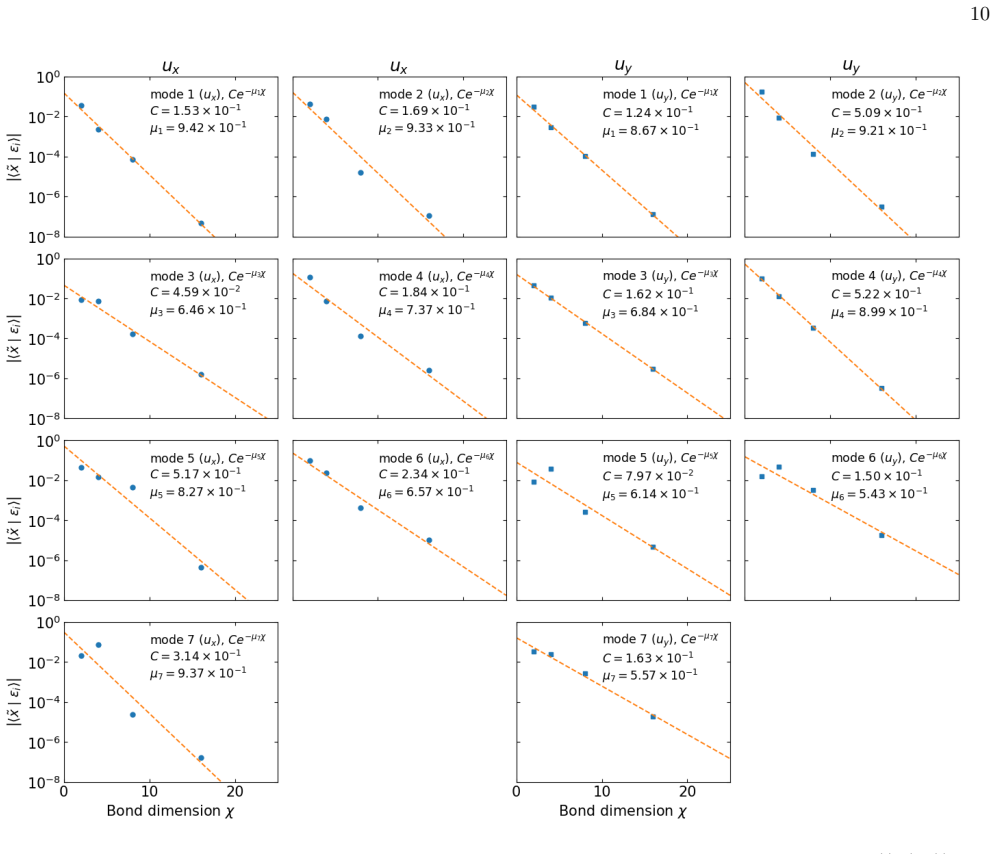
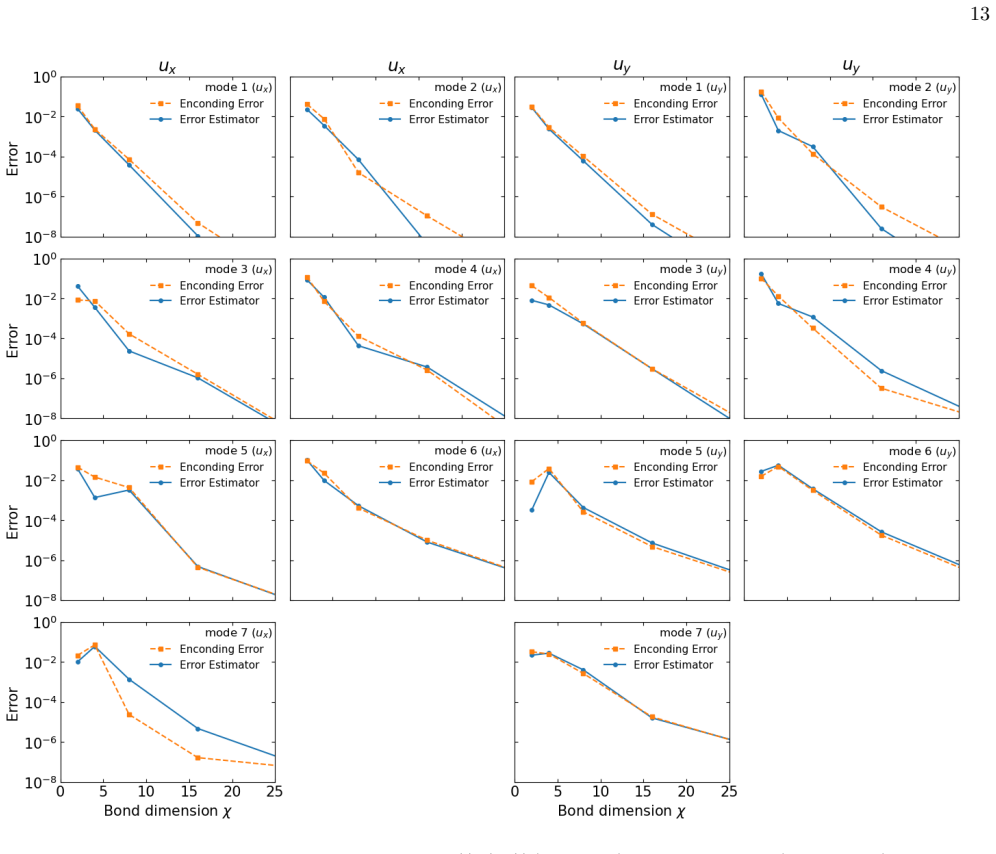
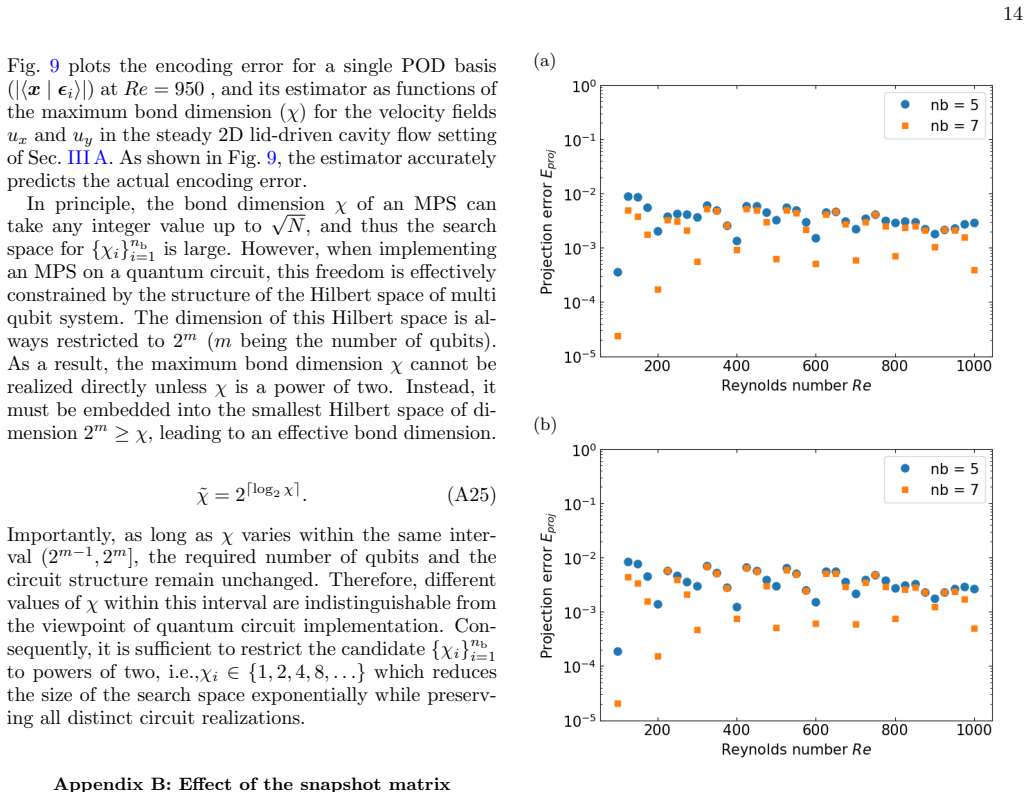
in the PODR method can be decomposed into three components: a projection errorE proj, a encoding errorE enc, and a sampling error Esam: ε≤E proj +E enc +E sam,(9) Eproj =∥x−U nbU ⊤ nbx∥2, Eenc = vuut nbX i=1 |⟨x|ϵ i⟩|2, Esam =β r nb N basis shot . A detailed derivation is provided in Appendix A 1. Here, Eproj is the projection error due to using the insuf...
-
[3]
The snapshot data used in this analysis are computed using OpenFOAM [57]
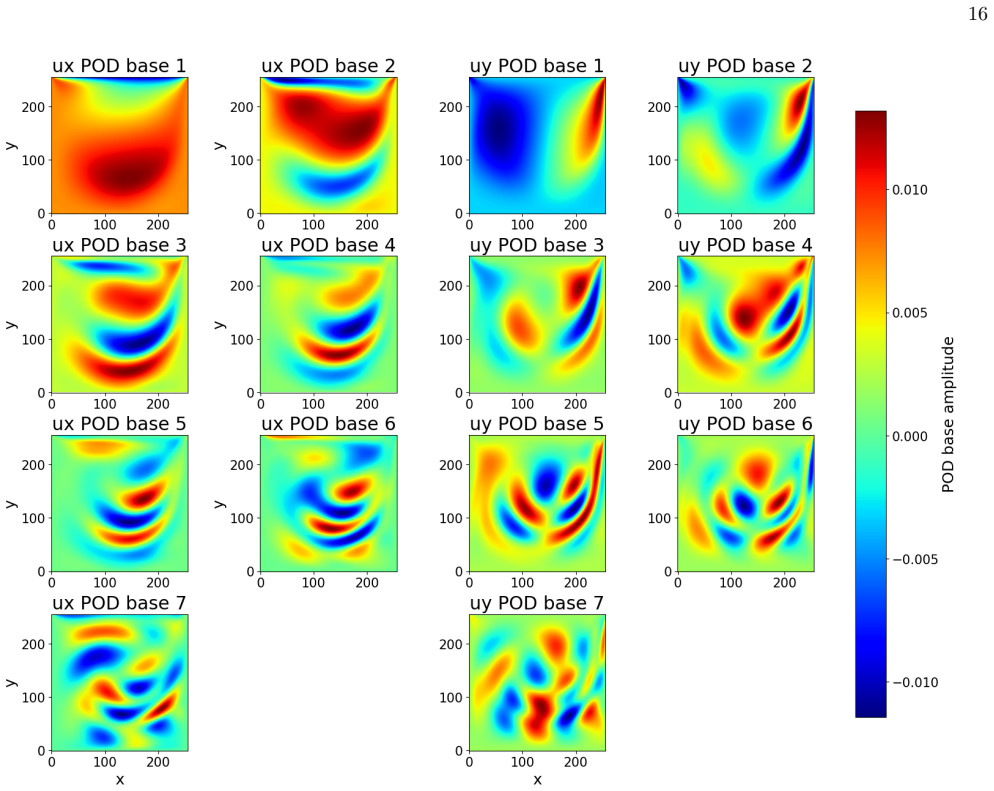
Steady 2D lid-driven cavity flow We consider the velocity field (ux, uy) of the steady 2D lid-driven cavity flow [56] on a uniform grid of size 28×28, i.e.,N= 2 16. The snapshot data used in this analysis are computed using OpenFOAM [57]. In this experiment, the Reynolds number (Re) represents the external phys- ical parameter varied to generate the snaps...
-
[4]
This flow ex- hibits periodic behavior with a period of approximately 50 time steps
2D K´ arm´ an vortex street We also study the time-dependent velocity field (ux, uy) of the 2D K´ arm´ an vortex street generated by flow past a circular cylinder atRe= 100 [58] using a uniform grid of size 2 8 ×2 7, i.e.,N= 2 15. This flow ex- hibits periodic behavior with a period of approximately 50 time steps. Also, the authors used the PhiFlow [59] t...
-
[5]
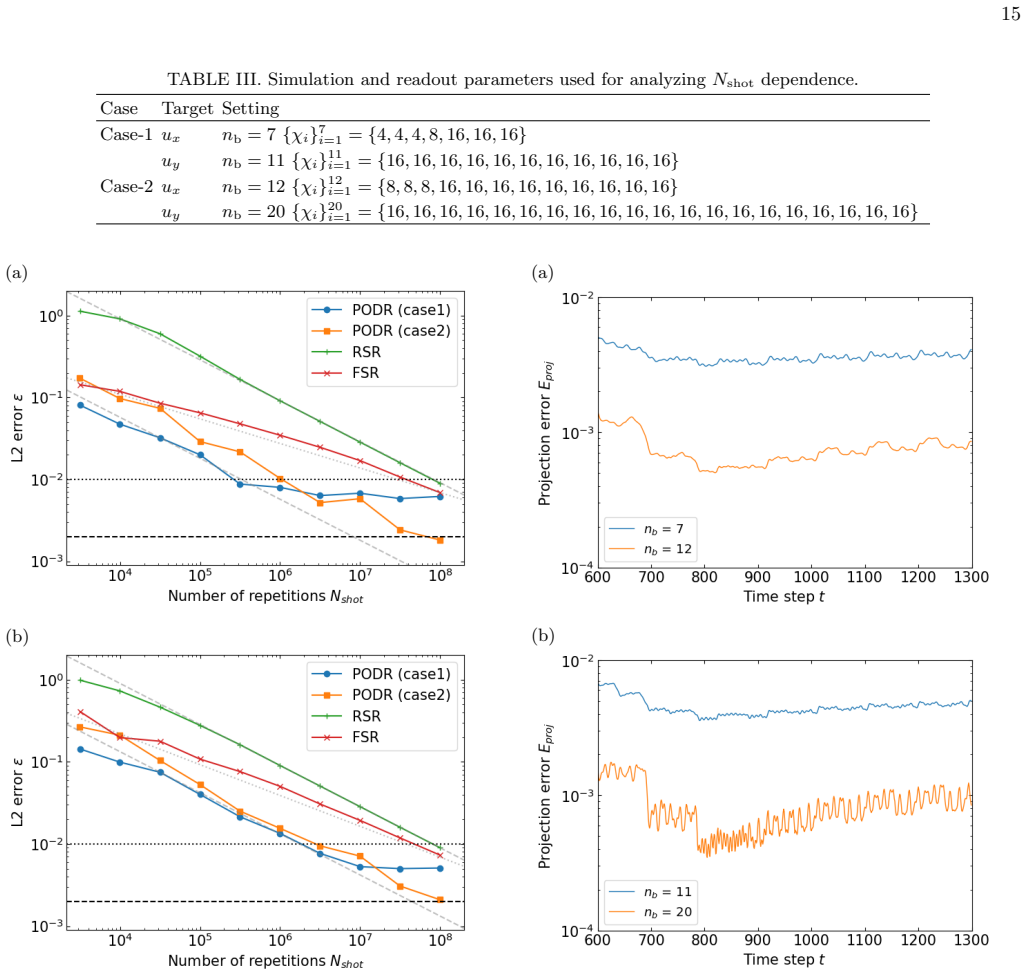
In Case-1, the parametersn b and{χ i}nb i=1 are selected to achieve an accuracy ofε= 10 −2 by impos- ing the conditionsE est proj ≤5×10 −3 andE est enc ≤5×10 −3
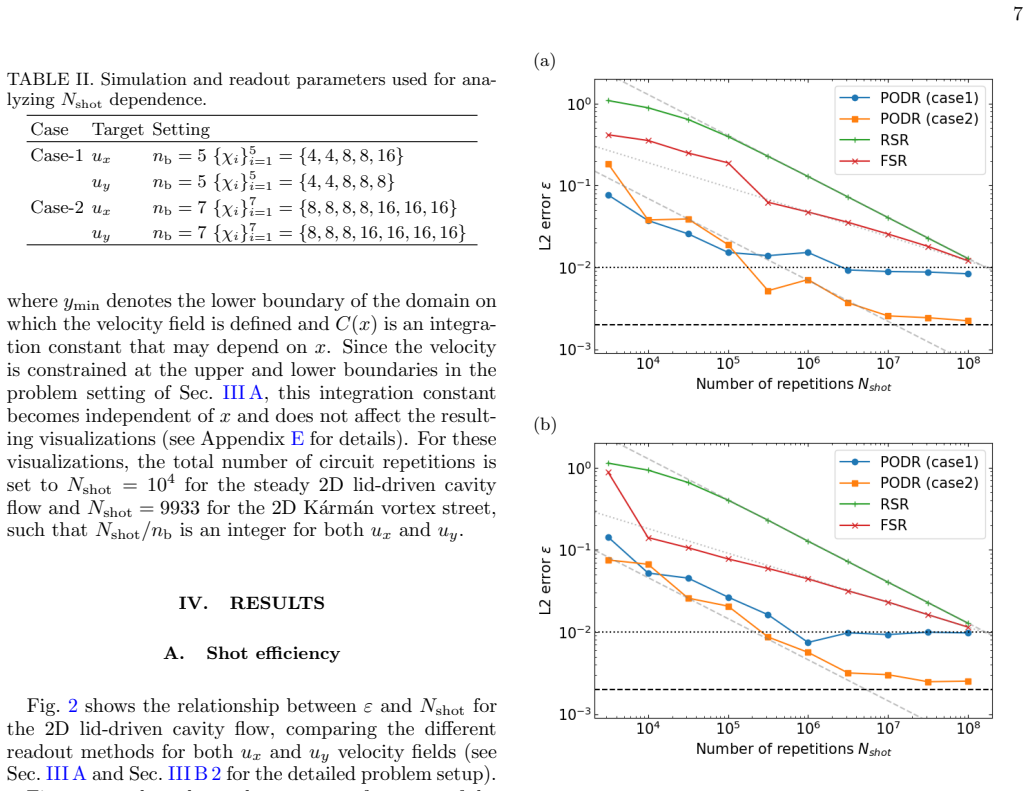
Estimator Setting We consider two prescribed accuracy based on the readout errorε= x− ˜x 2, which we denote as Case-1 and Case-2. In Case-1, the parametersn b and{χ i}nb i=1 are selected to achieve an accuracy ofε= 10 −2 by impos- ing the conditionsE est proj ≤5×10 −3 andE est enc ≤5×10 −3. This threshold is specifically picked so that the resulting solut...
-
[6]
Shot-efficiency evaluation metric We evaluate the performance of the online stage read- out by analyzing howεdepends onN shot. The value Nshot is defined as the total number of repetitions of the Hadamard test, assuming that the repetitions are dis- tributed equally across each POD basis (i.e.,N shot,i = N basis shot =N shot/nb for all POD bases). We furt...
-
[7]
The evaluation is performed on Case-2 for the steady 2D lid- driven cavity flow, which requires a deeper circuit com- pared to Case-1
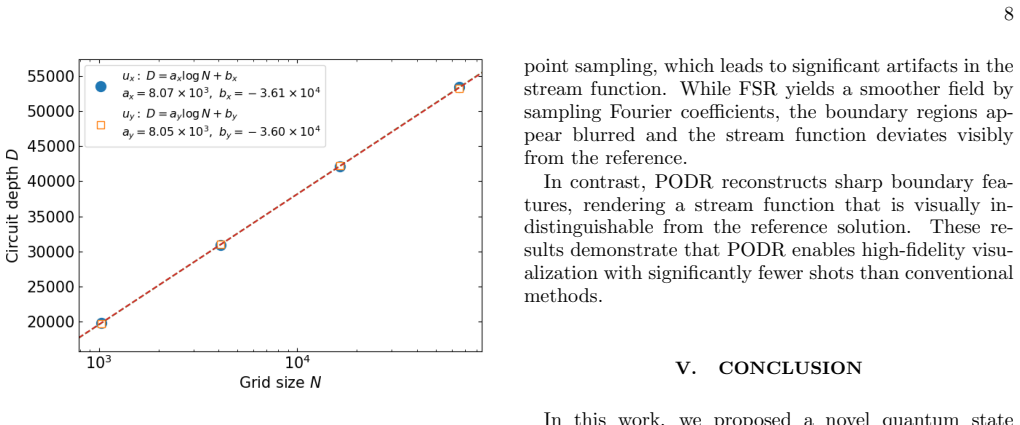
Depth evaluation metric We investigate the efficiency of the online stage by eval- uating the relationship between the circuit depthDof POD basis encoding circuit and the grid sizeN. The evaluation is performed on Case-2 for the steady 2D lid- driven cavity flow, which requires a deeper circuit com- pared to Case-1. In this evaluation,Dis defined as the n...
-
[8]
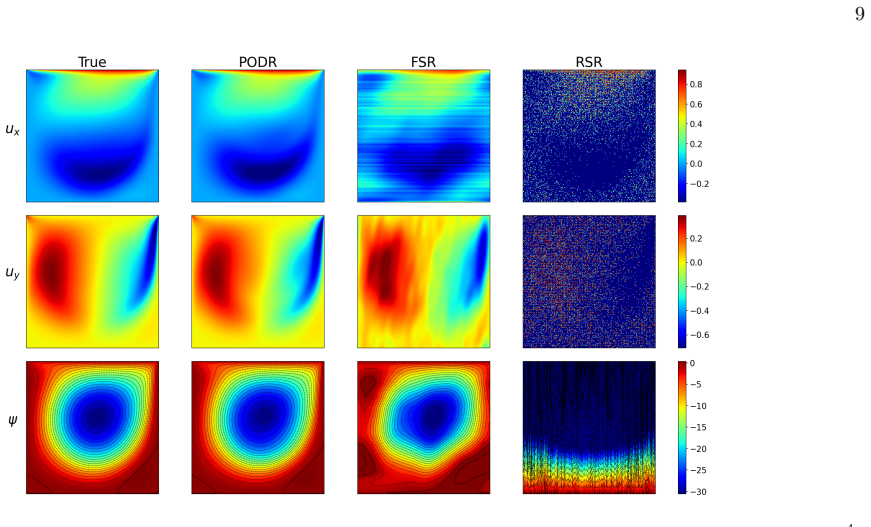
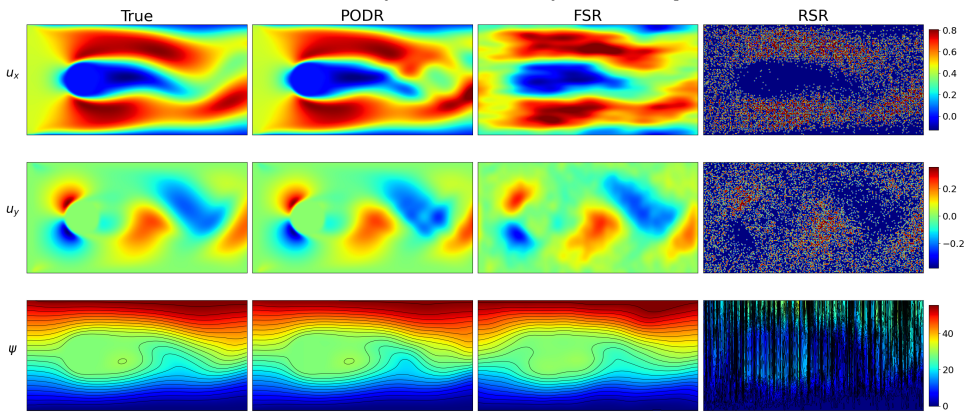
Visualization setting We visualize the readout results obtained using RSR, FSR [37, 38], and PODR for the problem settings intro- duced in Sec. III A. These results are based on Case-1 conditions, where the reconstructed solution field is in- tended to be nearly indistinguishable from the true one. In addition to the velocity fieldu= (u x, uy), we visual-...
-
[9]
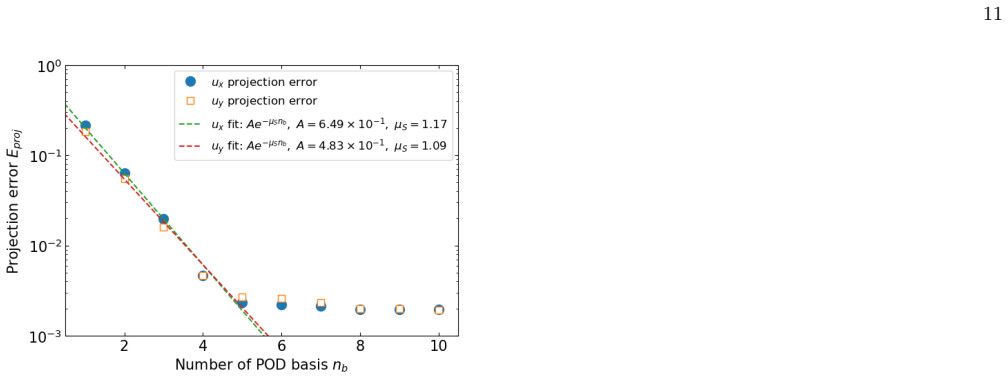
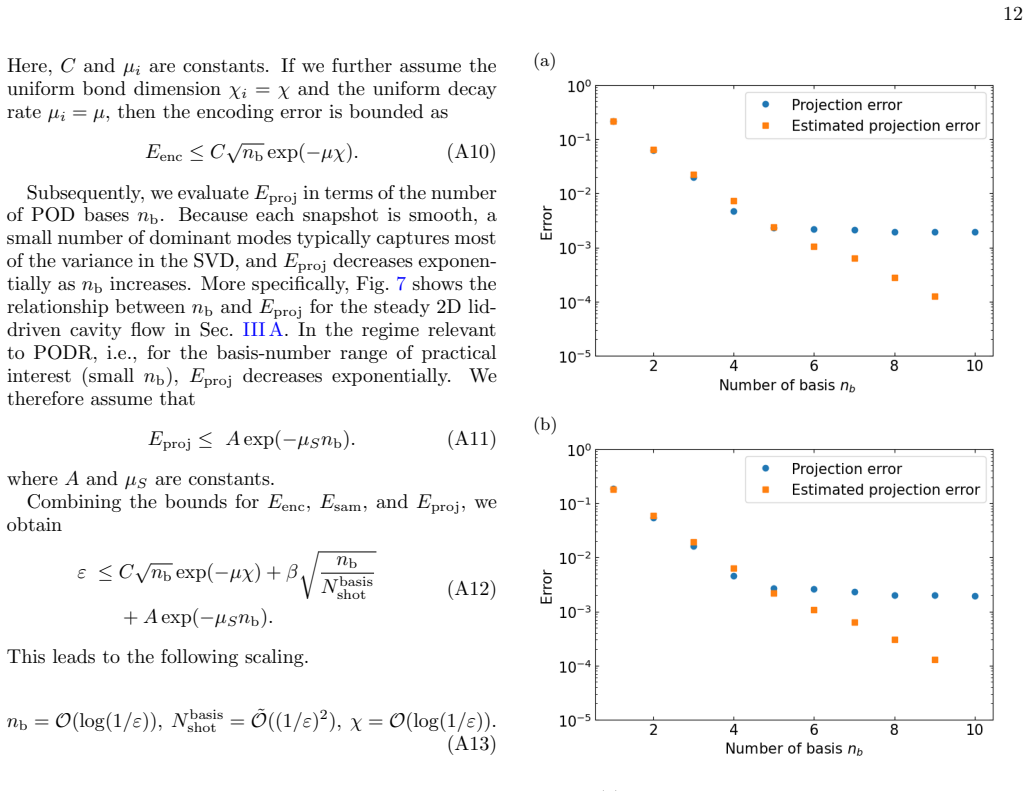
Error-bound inequality We derive the scaling of the number of repetitions per basis (N basis shot ),n b, and{χ i}nb i=1 with respect to the target readout errorε, as shown in Sec. II C. We first expand the solution statexusing a com- plete orthonormal basis that includes POD bases. Let the snapshot matrixS∈R N×M be decomposed as S=UΣV ⊤, and denote by{u i...
-
[10]
Derivation of the error estimators We derive the error estimators introduced in Sec. II. To this end, we first compute the mean squared amplitude of each snapshot in POD basis. We consider the snapshot matrix S= x1 x2 · · ·x M ,(A14) and its SVD S=UΣV ⊤.(A15) Here,UandVare the matrices of left and right singular vectors, respectively, andΣ= diag(σ 1, . . ...
-
[11]
Substituting this into Eq
Moreover, sinceVis an orthogonal matrix, we have ∥e⊤ i V ⊤∥2 2 = 1. Substituting this into Eq. (A18) yields, ∥u⊤ i S∥2 2 =σ 2 i .(A19) Therefore, E |ai|2 = σ2 i M .(A20) This completes the evaluation of the mean squared am- plitude of each snapshot in POD basis. To derive the error estimators, we assume that the so- lution state is well represented by the...
-
[12]
A. W. Harrow, A. Hassidim, and S. Lloyd, Quantum al- gorithm for linear systems of equations, Phys. Rev. Lett. 103, 150502 (2009)
2009
-
[13]
A. Ambainis, Variable time amplitude amplification and quantum algorithms for linear algebra problems, in29th International Symposium on Theoretical Aspects of Com- puter Science (STACS 2012), Leibniz International Pro- ceedings in Informatics (LIPIcs), Vol. 14, edited by C. D¨ urr and T. Wilke (Schloss Dagstuhl – Leibniz- Zentrum f¨ ur Informatik, Dagstu...
2012
-
[14]
D. W. Berry, High-order quantum algorithm for solv- ing linear differential equations, J. Phys. A47, 105301 (2014)
2014
-
[15]
D. W. Berry, A. M. Childs, A. Ostrander, and G. Wang, Quantum Algorithm for Linear Differential Equations with Exponentially Improved Dependence on Precision, Commun. Math. Phys.356, 1057 (2017)
2017
-
[16]
Andrew M., K
C. Andrew M., K. Robin, and S. Rolando D., Quantum Algorithm for Systems of Linear Equations with Expo- nentially Improved Dependence on Precision, SIAM J. Comput.46, 1920 (2017)
1920
-
[17]
A. M. Childs and J.-P. Liu, Quantum Spectral Methods for Differential Equations, Commun. Math. Phys.375, 1427 (2020)
2020
-
[18]
Lin and Y
L. Lin and Y. Tong, Optimal polynomial based quantum eigenstate filtering with application to solving quantum linear systems, Quantum4, 361 (2020)
2020
-
[19]
A. M. Childs, J.-P. Liu, and A. Ostrander, High-precision quantum algorithms for partial differential equations, Quantum5, 574 (2021)
2021
-
[20]
Wang and Z
Q. Wang and Z. Zhang, Tight quantum depth lower bound for solving systems of linear equations, Phys. Rev. A110, 012422 (2024)
2024
-
[21]
P. C. S. Costa, D. An, Y. R. Sanders, Y. Su, R. Babbush, and D. W. Berry, Optimal Scaling Quantum Linear- Systems Solver via Discrete Adiabatic Theorem, PRX Quantum3, 040303 (2022)
2022
-
[22]
B. D. Clader, B. C. Jacobs, and C. R. Sprouse, Precon- ditioned quantum linear system algorithm, Phys. Rev. Lett.110, 250504 (2013)
2013
-
[23]
M. Bagherimehrab, K. Nakaji, N. Wiebe, G. K. Brennen, B. C. Sanders, and A. Aspuru-Guzik, Fast quantum al- gorithm for differential equations, arXiv preprint (2023), arXiv:2306.11802 [quant-ph]
-
[24]
X. Huang, H. Nishi, T. Kosugi, Y. Kawada, and Y.- i. Matsushita, A probabilistic imaginary-time evolu- tion quantum algorithm for advection-diffusion equa- tion: Explicit gate-level implementation and comparisons to quantum linear system algorithms, arXiv preprint (2024), arXiv:2409.18559 [quant-ph]
-
[25]
An, J.-P
D. An, J.-P. Liu, and L. Lin, Linear combination of hamil- tonian simulation for nonunitary dynamics with opti- mal state preparation cost, Phys. Rev. Lett.131, 150603 (2023)
2023
-
[26]
Gonzalez-Conde, A
J. Gonzalez-Conde, A. Rodr´ ıguez-Rozas, E. Solano, and M. Sanz, Efficient hamiltonian simulation for solving op- tion price dynamics, Phys. Rev. Res.5, 043220 (2023)
2023
-
[27]
Kieferov´ a, A
M. Kieferov´ a, A. Scherer, and D. W. Berry, Simulat- ing the dynamics of time-dependent Hamiltonians with a truncated Dyson series, Phys. Rev. A99, 042314 (2019)
2019
-
[28]
D. Fang, L. Lin, and Y. Tong, Time-marching based quantum solvers for time-dependent linear differential equations, Quantum7, 955 (2023)
2023
-
[29]
S. Jin, N. Liu, and Y. Yu, Quantum simulation of partial differential equations: Applications and detailed analy- sis, Phys. Rev. A108, 032603 (2023)
2023
-
[30]
S. Jin, N. Liu, and Y. Yu, Quantum simulation of partial differential equations via schr¨ odingerization, Phys. Rev. Lett.133, 230602 (2024)
2024
-
[31]
Y. Sato, R. Kondo, I. Hamamura, T. Onodera, and N. Yamamoto, Hamiltonian simulation for hyperbolic partial differential equations by scalable quantum cir- cuits, Phys. Rev. Res.6, 033246 (2024)
2024
-
[32]
Y. Sato, H. Tezuka, R. Kondo, and N. Yamamoto, Quan- tum algorithm for partial differential equations of non- conservative systems with spatially varying parameters, Phys. Rev. Appl.23, 014063 (2025)
2025
-
[33]
T. Kadowaki, Quantum Computing and AI: Perspectives on Advanced Automation in Science and Engineering, arXiv preprint (2025), arXiv:2505.10012 [quant-ph]
- [34]
-
[35]
Luckow, J
A. Luckow, J. Klepsch, and J. Pichlmeier, Quantum com- puting: Towards industry reference problems, Digitale Welt5, 38 (2021)
2021
-
[36]
Vogel and H
K. Vogel and H. Risken, Determination of quasiproba- bility distributions in terms of probability distributions for the rotated quadrature phase, Phys. Rev. A40, 2847 (1989)
1989
-
[37]
Brassard, P
G. Brassard, P. Hoyer, M. Mosca, and A. Tapp, Quan- tum amplitude amplification and estimation, inQuantum Computation and Quantum Information, AMS Contem- porary Mathematics, Vol. 305, edited by S. J. Lomonaco (American Mathematical Society, 2002) pp. 53–74
2002
-
[38]
A. Manzano, D. Musso, and ´A. Leitao, Real quantum amplitude estimation, EPJ Quantum Technology10, 10.1140/epjqt/s40507-023-00159-0 (2023)
-
[39]
Maronese, M
M. Maronese, M. Incudini, L. Asproni, and E. Prati, The quantum amplitude estimation algorithms on near-term devices: A practical guide, Quantum Reports6, 1 (2024)
2024
-
[40]
Chen, T.-Y
Z.-Y. Chen, T.-Y. Ma, C.-C. Ye, L. Xu, W. Bai, L. Zhou, M.-Y. Tan, X.-N. Zhuang, X.-F. Xu, Y.-J. Wang, T.-P. Sun, Y. Chen, L. Du, L.-L. Guo, H.-F. Zhang, H.-R. Tao, T.-L. Wang, X.-Y. Yang, Z.-A. Zhao, P. Wang, S. Zhang, R.-Z. Zhao, C. Zhang, Z.-L. Jia, W.-C. Kong, M.-H. Dou, J.-C. Wang, H.-Y. Liu, C. Xue, P.-J.-Y. Zhang, S.-H. Huang, P. Duan, Y.-C. Wu, an...
2024
- [41]
-
[42]
Kosugi, S
T. Kosugi, S. Daimon, H. Nishi, S. Tsuneyuki, and Y.- i. Matsushita, Qubit encoding for a mixture of localized functions, Phys. Rev. A110, 062407 (2024)
2024
-
[43]
Kosugi, X
T. Kosugi, X. Huang, H. Nishi, and Y.-i. Matsushita, Tensor-decomposition technique for qubit encoding of maximal-fidelity Lorentzian orbitals in real-space quan- 19 tum chemistry, Phys. Rev. A111, 052615 (2025)
2025
-
[44]
Miyamoto and H
K. Miyamoto and H. Ueda, Extracting a function en- coded in amplitudes of a quantum state by tensor net- work and orthogonal function expansion, Quantum In- formation Processing22(2023)
2023
- [45]
- [46]
-
[47]
Y. Fanget al., PolyQROM: Orthogonal-Polynomial- Based Quantum Reduced-Order Model for Flow Field Analysis, arXiv preprint (2025), arXiv:2504.21567 [quant-ph]
- [48]
- [49]
-
[50]
Rozza, D
G. Rozza, D. B. P. Huynh, and A. T. Patera, Reduced basis approximation and a posteriori error estimation for affinely parametrized elliptic coercive partial differential equations, Archives of Computational Methods in Engi- neering15, 229 (2008)
2008
-
[51]
Taira, S
K. Taira, S. L. Brunton, S. T. M. Dawson, C. W. Rowley, T. Colonius, B. J. McKeon, O. T. Schmidt, S. Gordeyev, V. Theofilis, and L. S. Ukeiley, Modal analysis of fluid flows: An overview, AIAA Journal55, 4013 (2017)
2017
-
[52]
C. W. Rowley and S. T. M. Dawson, Model reduction for flow analysis and control, Annual Review of Fluid Mechanics49, 387 (2017)
2017
-
[53]
Benner, S
P. Benner, S. Gugercin, and K. E. Willcox, A survey of projection-based model reduction methods for paramet- ric dynamical systems, SIAM Rev.57, 483 (2015)
2015
-
[54]
Peherstorfer, Model reduction for transport- dominated problems via online adaptive bases and adaptive sampling, SIAM Journal on Scientific Comput- ing42, A2803 (2020)
B. Peherstorfer, Model reduction for transport- dominated problems via online adaptive bases and adaptive sampling, SIAM Journal on Scientific Comput- ing42, A2803 (2020)
2020
-
[55]
Ostrowski, R
Z. Ostrowski, R. A. Bia lecki, and A. J. Kassab, Solving inverse heat conduction problems using trained pod-rbf network inverse method, Inverse Problems in Science and Engineering16, 39 (2008)
2008
-
[56]
Huayamave, A
V. Huayamave, A. Ceballos, C. Barriento, H. Seigneur, S. Barkaszi, E. Divo, and A. Kassab, Rbf-trained pod- accelerated cfd analysis of wind loads on pv systems, In- ternational Journal of Numerical Methods for Heat & Fluid Flow27, 660 (2017)
2017
-
[57]
A. Das, A. Khoury, E. Divo, V. Huayamave, A. Ce- ballos, R. Eaglin, A. Kassab, A. Payne, V. Yelundur, and H. Seigneur, Real-time thermomechanical modeling of pv cell fabrication via a pod-trained rbf interpolation network, Computer Modeling in Engineering & Sciences 122, 757 (2020)
2020
-
[58]
Dehghan and M
M. Dehghan and M. Abbaszadeh, The use of proper or- thogonal decomposition (pod) meshless rbf-fd technique to simulate the shallow water equations, Journal of Com- putational Physics351, 478 (2017)
2017
-
[59]
C. A. Rogers, A. J. Kassab, E. A. Divo, Z. Ostrowski, and R. A. Bialecki, An inverse pod-rbf network approach to parameter estimation in mechanics, Inverse Problems in Science and Engineering20, 749 (2012)
2012
-
[60]
Dutta, M
S. Dutta, M. W. Farthing, E. Perracchione, G. Savant, and M. Putti, A greedy non-intrusive reduced order model for shallow water equations, Journal of Compu- tational Physics439, 110378 (2021)
2021
-
[61]
Berkooz, P
G. Berkooz, P. Holmes, and J. L. Lumley, The proper or- thogonal decomposition in the analysis of turbulent flows, Annual Review of Fluid Mechanics25, 539 (1993)
1993
-
[62]
I. V. Oseledets, Tensor-train decomposition, SIAM Jour- nal on Scientific Computing33, 2295 (2011)
2011
-
[63]
Oseledets and E
I. Oseledets and E. Tyrtyshnikov, Tt-cross approxima- tion for multidimensional arrays, Linear Algebra and its Applications432, 70 (2010)
2010
-
[64]
S.-H. Lin, R. Dilip, A. G. Green, A. Smith, and F. Poll- mann, Real- and imaginary-time evolution with com- pressed quantum circuits, PRX Quantum2, 010342 (2021)
2021
-
[65]
Huang, T
X. Huang, T. Kosugi, H. Nishi, and Y.-i. Matsushita, Ap- proximate real-time evolution operator for potential with one ancillary qubit and application to first-quantized Hamiltonian simulation, Quant. Inf. Proc.24, 85 (2025)
2025
-
[66]
Shende, S
V. Shende, S. Bullock, and I. Markov, Synthesis of quantum-logic circuits, IEEE Transactions on Computer- Aided Design of Integrated Circuits and Systems25, 1000 (2006)
2006
-
[67]
U. Ghia, K. Ghia, and C. Shin, High-re solutions for in- compressible flow using the navier-stokes equations and a multigrid method, Journal of Computational Physics 48, 387 (1982)
1982
-
[68]
Jasak, Openfoam: Open source cfd in research and industry, International Journal of Naval Architecture and Ocean Engineering1, 89 (2009)
H. Jasak, Openfoam: Open source cfd in research and industry, International Journal of Naval Architecture and Ocean Engineering1, 89 (2009)
2009
-
[69]
G. Kohl, L.-W. Chen, and N. Thuerey, Benchmarking autoregressive conditional diffusion models for turbulent flow simulation, arXiv preprint (2024), arXiv:2309.01745 [cs.LG]
- [70]
-
[71]
A. Javadi-Abhariet al., Quantum computing with Qiskit, arXiv preprint (2024), arXiv:2405.08810 [quant-ph]
work page internal anchor Pith review Pith/arXiv arXiv 2024
- [72]
-
[73]
N. Gourianov, M. Lubasch, S. Dolgov, Q. Y. v. d. Berg, H. Babaee, P. Givi, M. Kiffner, and D. Jaksch, A quantum-inspired approach to exploit turbulence structures, Nature Computat. Sci.2, 30 (2022), arXiv:2106.05782 [physics.flu-dyn]
discussion (0)
Sign in with ORCID, Apple, or X to comment. Anyone can read and Pith papers without signing in.