Finite-size occupancy scaling of apparent fractal dimensions in stochastic trajectories
Pith reviewed 2026-06-29 10:13 UTC · model grok-4.3
The pith
Finite stochastic trajectories produce biased apparent fractal dimensions that an inverted balls-in-boxes occupancy model corrects across processes.
A machine-rendered reading of the paper's core claim, the machinery that carries it, and where it could break.
Core claim
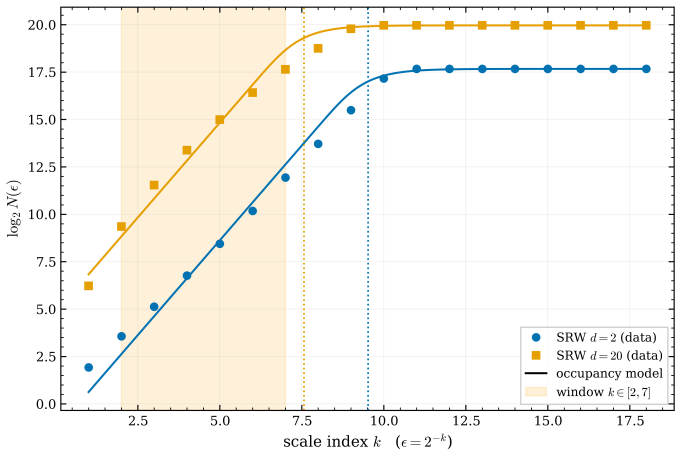
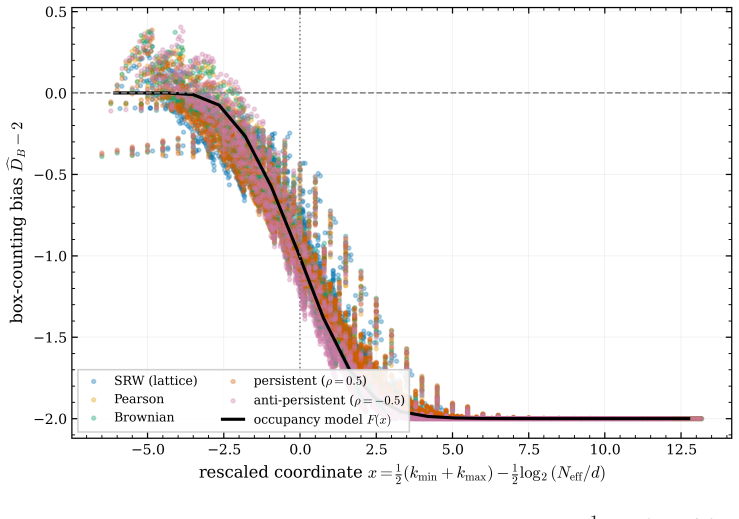
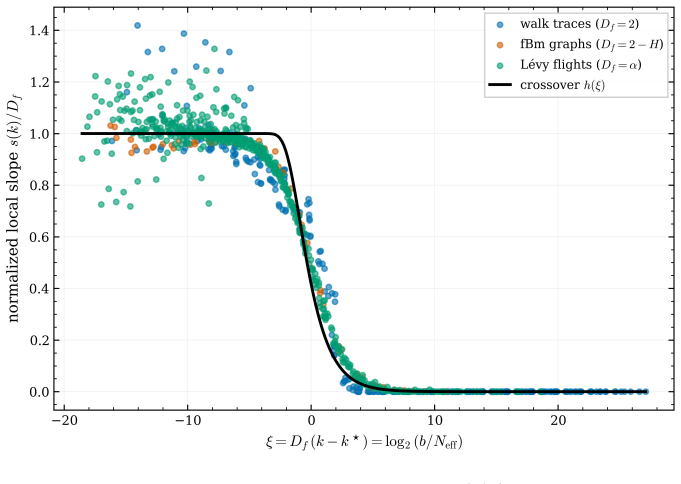
Estimating a fractal dimension from a finite stochastic trajectory is a finite-size scaling problem: the apparent box-counting exponent is shaped by an occupancy crossover between the resolved range of scales and the finite number of sampled points, and need not equal the dimension of the limiting process. We model this crossover with a balls-in-boxes occupancy law, which predicts the box-count curve, the finite-size saturation scale, and a scaling function for the normalized local slope. Across random-walk traces, fractional Brownian graphs, and Levy flights, the normalized local slope collapses onto a single crossover curve, while the windowed box-counting bias collapses when the regressio
What carries the argument
balls-in-boxes occupancy law, which predicts how trajectory points occupy boxes at different scales and thereby governs the crossover from resolved to saturated regimes
If this is right
- The normalized local slope collapses onto a single crossover curve for random walks, fractional Brownian graphs, and Levy flights.
- Windowed box-counting bias collapses when the regression window is positioned relative to the saturation scale.
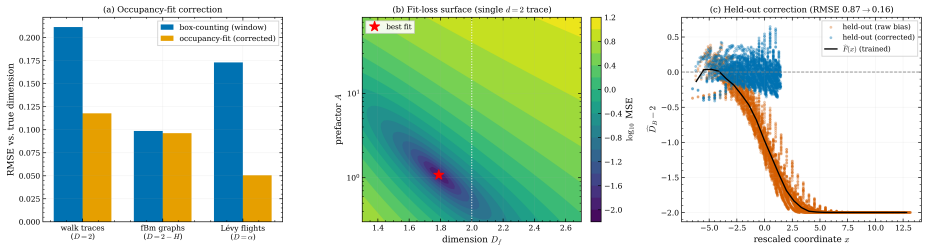
- The bias correction reduces error on controlled stochastic trajectories and transfers across held-out model classes.
- Local-slope stability alone is not a reliable diagnostic of the true dimension.
- The dominant bias is specific to point-sampled box-counting over finite scale windows.
Where Pith is reading between the lines
- The occupancy correction could be tested on experimental trajectories beyond the DNA-walk case to check whether the same saturation positioning works on real measurements.
- If the collapse onto a universal curve persists for additional processes, the model would set a minimum sampling density needed for reliable dimension estimates.
- The approach might be adapted to adjust other finite-sample estimators if they share analogous occupancy crossovers.
Load-bearing premise
The balls-in-boxes occupancy law accurately captures the crossover between resolved scales and the finite number of sampled points for the stochastic processes examined.
What would settle it
Applying the inverted occupancy correction to a new class of stochastic trajectories and finding that it does not reduce estimation error relative to uncorrected box-counting would falsify the transferability of the bias correction.
Figures
read the original abstract
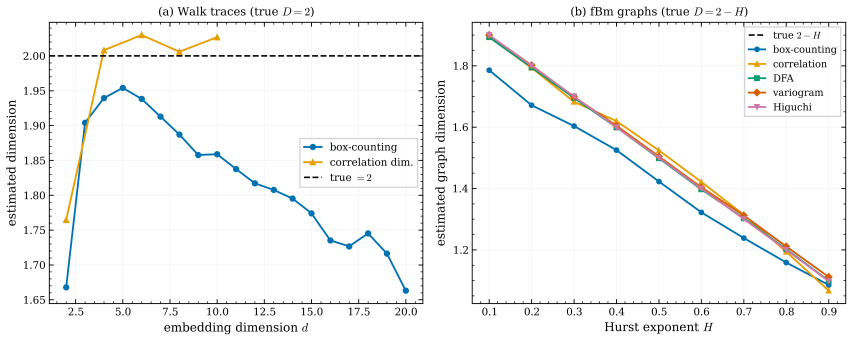
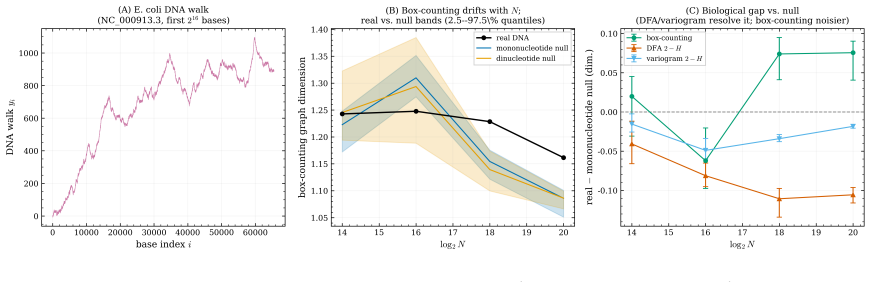
Estimating a fractal dimension from a finite stochastic trajectory is a finite-size scaling problem: the apparent box-counting exponent is shaped by an occupancy crossover between the resolved range of scales and the finite number of sampled points, and need not equal the dimension of the limiting process. We model this crossover with a balls-in-boxes occupancy law, which predicts the box-count curve, the finite-size saturation scale, and a scaling function for the normalized local slope. Across random-walk traces, fractional Brownian graphs, and Levy flights, the normalized local slope collapses onto a single crossover curve, while the windowed box-counting bias collapses when the regression window is positioned relative to the saturation scale. Inverting the occupancy model gives a finite-size bias correction that reduces error on controlled stochastic trajectories and transfers across held-out model classes. Comparisons with correlation dimension, detrended fluctuation analysis, the variogram, and Higuchi's method show that the dominant bias is specific to point-sampled box-counting over finite scale windows, and that local-slope stability alone is not a reliable diagnostic. A DNA-walk example illustrates the workflow on measured data, and all figures, tables, and in-text numbers are regenerated from released single-seed code.
Editorial analysis
A structured set of objections, weighed in public.
Referee Report
Summary. The paper claims that finite-size effects in box-counting fractal dimension estimates on stochastic trajectories arise from an occupancy crossover between resolved scales and finite sample points, which can be modeled by a balls-in-boxes occupancy law. This law predicts the box-count curve, saturation scale, and a scaling function for the normalized local slope. The normalized local slope collapses onto a single curve across random walks, fBm graphs, and Lévy flights; windowed bias collapses when the regression window is positioned relative to the saturation scale. Inverting the occupancy model yields a bias correction that reduces error on controlled trajectories and transfers to held-out model classes. Comparisons with correlation dimension, DFA, variogram, and Higuchi's method indicate the bias is specific to point-sampled box-counting, and local-slope stability is not a reliable diagnostic. A DNA-walk example is provided, with all results regenerated from released single-seed code.
Significance. If the occupancy law adequately captures the crossover for the examined processes, the work supplies a practical, invertible correction for finite-size bias in box-counting on trajectories, supported by explicit data collapse, transfer tests on independent simulation classes, and full reproducibility via released code. This addresses a common source of error in estimating dimensions from finite stochastic data in statistical mechanics, with the transferability across model classes and comparisons to other estimators strengthening its utility over ad-hoc window choices.
minor comments (2)
- The abstract and text refer to 'the occupancy law' without an explicit equation number or derivation sketch in the provided summary; adding a short inline statement of the balls-in-boxes formula (e.g., the expected occupancy as function of scale and point count) would aid readers unfamiliar with the standard model.
- The DNA-walk example is mentioned but no figure or table reference is given in the abstract; ensure the workflow illustration is clearly labeled with the specific saturation scale used.
Simulated Author's Rebuttal
We thank the referee for the positive assessment and the recommendation to accept. The referee summary accurately captures the scope and results of the work.
Circularity Check
No significant circularity identified
full rationale
The derivation models the occupancy crossover with a pre-existing balls-in-boxes law (standard in the literature), inverts it to produce an explicit bias correction, and validates via data collapse plus transfer on held-out simulation classes regenerated from released code. No step reduces by construction to a fitted input, self-definition, or self-citation chain; the central result is benchmarked externally rather than forced internally.
Axiom & Free-Parameter Ledger
axioms (1)
- domain assumption Balls-in-boxes occupancy law models the point distribution and crossover in box-counting of stochastic trajectories.
Reference graph
Works this paper leans on
-
[1]
Privman (Ed.), Finite Size Scaling and Numerical Simulation of Statistical Systems, World Scientific, 1990
V. Privman (Ed.), Finite Size Scaling and Numerical Simulation of Statistical Systems, World Scientific, 1990
1990
-
[2]
Falconer, Fractal Geometry: Mathematical Foundations and Applications, 2nd Edition, Wiley, 2003
K. Falconer, Fractal Geometry: Mathematical Foundations and Applications, 2nd Edition, Wiley, 2003
2003
-
[3]
B. B. Mandelbrot, The Fractal Geometry of Nature, W. H. Freeman, 1983. 14
1983
-
[4]
Theiler, Estimating fractal dimension, Journal of the Optical Society of America A 7 (6) (1990) 1055–1073
J. Theiler, Estimating fractal dimension, Journal of the Optical Society of America A 7 (6) (1990) 1055–1073
1990
-
[5]
Buczkowski, P
S. Buczkowski, P. Hildgen, L. Cartilier, Measurements of fractal dimension by box-counting: a critical analysis of data scatter, Physica A 252 (1–2) (1998) 23–34
1998
-
[6]
Gonzato, F
G. Gonzato, F. Mulargia, M. Ciccotti, Measuring the fractal dimensions of ideal and actual objects: implications for application in geology and geophysics, Geophysical Journal Interna- tional 142 (1) (2000) 108–116
2000
-
[7]
P. Hall, A. Wood, On the performance of box-counting estimators of fractal dimension, Biometrika 80 (1) (1993) 246–251
1993
-
[8]
Gneiting, H
T. Gneiting, H. Ševčíková, D. B. Percival, Estimators of fractal dimension: Assessing the roughness of time series and spatial data, Statistical Science 27 (2) (2012) 247–277
2012
-
[9]
Tsurumi, H
S. Tsurumi, H. Takayasu, The fractal dimension in computer-simulated random walks, Physics Letters A 113 (9) (1986) 449–450
1986
-
[10]
N. C. Kenkel, Sample size requirements for fractal dimension estimation, Community Ecology 14 (2) (2013) 144–152
2013
-
[11]
Grassberger, Finite sample corrections to entropy and dimension estimates, Physics Letters A 128 (6–7) (1988) 369–373
P. Grassberger, Finite sample corrections to entropy and dimension estimates, Physics Letters A 128 (6–7) (1988) 369–373
1988
-
[12]
Borgani, G
S. Borgani, G. Murante, Box-counting clustering analysis: Corrections for finite sample effects, Physical Review E 49 (6) (1994) 4907–4917
1994
-
[13]
Pearson, The problem of the random walk, Nature 72 (1905) 294
K. Pearson, The problem of the random walk, Nature 72 (1905) 294
1905
-
[14]
M. D. Donsker, An invariance principle for certain probability limit theorems, Mem. Amer. Math. Soc. 6 (1951)
1951
-
[15]
Billingsley, Convergence of Probability Measures, 2nd Edition, Wiley, 1999
P. Billingsley, Convergence of Probability Measures, 2nd Edition, Wiley, 1999
1999
-
[16]
S. J. Taylor, The Hausdorffα-dimensional measure of Brownian paths inn-space, Proc. Cam- bridge Philos. Soc. 49 (1953) 31–39
1953
-
[17]
Mörters, Y
P. Mörters, Y. Peres, Brownian Motion, Cambridge University Press, 2010
2010
-
[18]
R. M. Blumenthal, R. K. Getoor, Some theorems on stable processes, Transactions of the American Mathematical Society 95 (2) (1960) 263–273
1960
-
[19]
W. E. Pruitt, S. J. Taylor, Sample path properties of processes with stable components, Zeitschrift für Wahrscheinlichkeitstheorie und Verwandte Gebiete 12 (1969) 267–289
1969
-
[20]
Metzler, J
R. Metzler, J. Klafter, The random walk’s guide to anomalous diffusion: a fractional dynamics approach, Physics Reports 339 (1) (2000) 1–77
2000
-
[21]
J. M. Chambers, C. L. Mallows, B. W. Stuck, A method for simulating stable random variables, Journal of the American Statistical Association 71 (354) (1976) 340–344
1976
-
[22]
R. B. Davies, D. S. Harte, Tests for Hurst effect, Biometrika 74 (1) (1987) 95–101. 15
1987
-
[23]
Grassberger, I
P. Grassberger, I. Procaccia, Measuring the strangeness of strange attractors, Physica D 9 (1–
-
[24]
C.-K. Peng, S. V. Buldyrev, S. Havlin, M. Simons, H. E. Stanley, A. L. Goldberger, Mosaic organization of DNA nucleotides, Physical Review E 49 (2) (1994) 1685–1689
1994
-
[25]
J. W. Kantelhardt, E. Koscielny-Bunde, H. H. A. Rego, S. Havlin, A. Bunde, Detecting long- range correlations with detrended fluctuation analysis, Physica A 295 (3–4) (2001) 441–454
2001
-
[26]
Higuchi, Approach to an irregular time series on the basis of the fractal theory, Physica D 31 (2) (1988) 277–283
T. Higuchi, Approach to an irregular time series on the basis of the fractal theory, Physica D 31 (2) (1988) 277–283
1988
-
[27]
A. Eke, P. Hermán, J. B. Bassingthwaighte, G. M. Raymond, D. B. Percival, M. Cannon, I. Balla, C. Ikrényi, Physiological time series: distinguishing fractal noises from motions, Pflügers Archiv – European Journal of Physiology 439 (4) (2000) 403–415
2000
-
[28]
C.-K. Peng, S. V. Buldyrev, A. L. Goldberger, S. Havlin, F. Sciortino, M. Simons, H. E. Stanley, Long-range correlations in nucleotide sequences, Nature 356 (1992) 168–170. 16 Supplementary Material This appendix reports three robustness analyses referenced in the main text: an ablation separat- ing the no-regression collapse from fitted variants (Section...
1992
discussion (0)
Sign in with ORCID, Apple, or X to comment. Anyone can read and Pith papers without signing in.