Filter-assisted quantum subspace diagonalization via wavefunction sparsity engineering
Pith reviewed 2026-06-29 11:43 UTC · model grok-4.3
The pith
A quantum filter concentrates ground-state weight onto fewer basis states to improve SQD accuracy and cut sampling costs.
A machine-rendered reading of the paper's core claim, the machinery that carries it, and where it could break.
Core claim
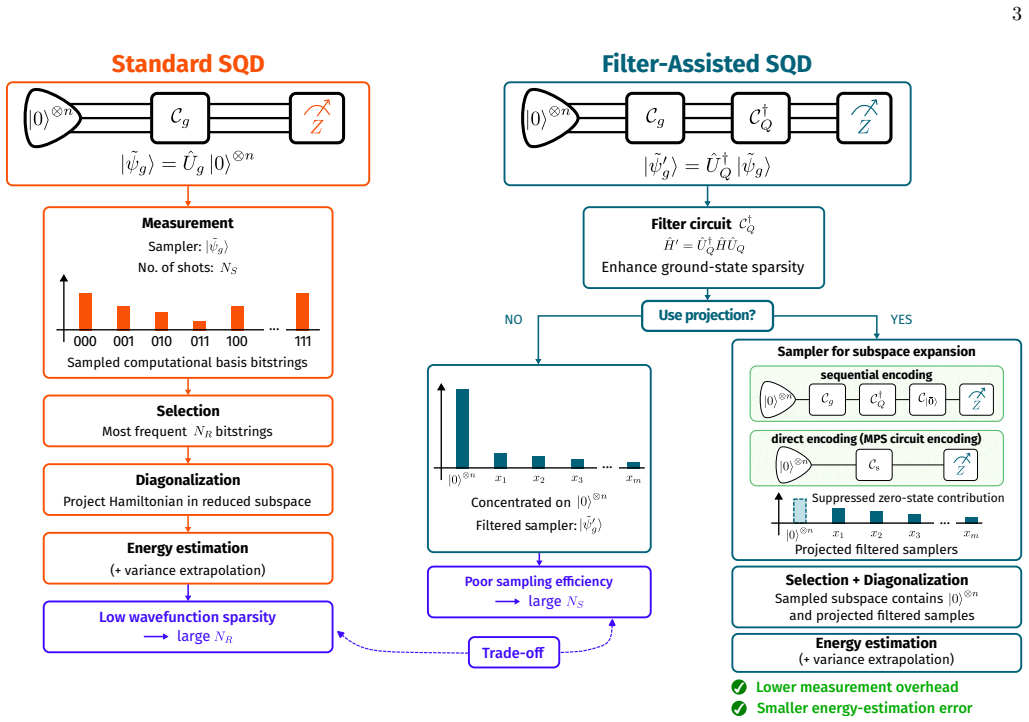
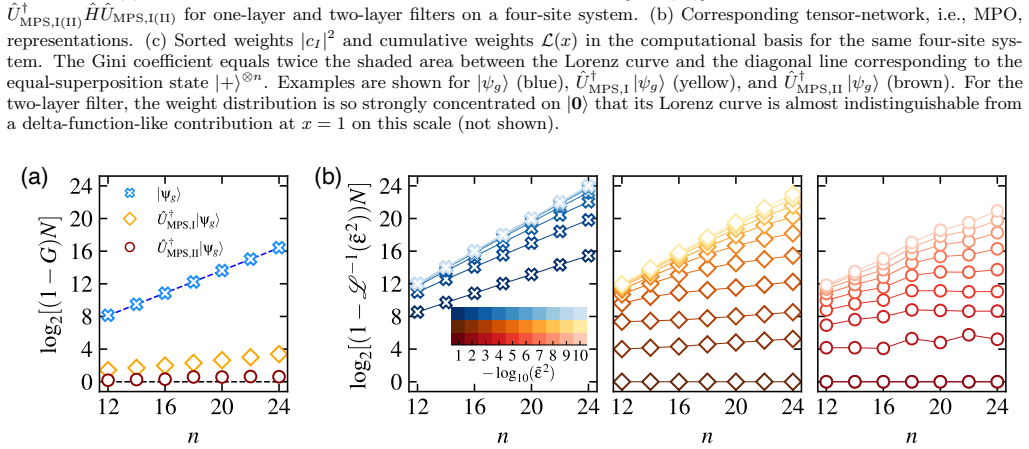
By applying a unitary transformation to the Hamiltonian that concentrates the ground-state weight onto fewer computational basis states, the filter-assisted SQD protocol enhances wavefunction sparsity as measured by the Gini coefficient, which in turn reduces the required subspace dimension and sampling overhead for accurate energy estimation.
What carries the argument
The quantum filter: a unitary transformation of the Hamiltonian designed to concentrate ground-state weight onto a small number of computational basis states.
If this is right
- The subspace dimension needed for a target accuracy becomes smaller.
- Sampling overhead for ground-state energy estimation is substantially reduced.
- The method applies to strongly correlated regimes where standard SQD suffers from low sparsity.
- Tensor-network circuit encoding supplies the filter with adjustable fidelity.
Where Pith is reading between the lines
- The same sparsity-engineering step could be inserted into other sampling-based quantum algorithms that rely on configuration interaction.
- If the tensor-network encoder scales, the approach might extend to system sizes beyond those reachable by direct state preparation.
- Gini-coefficient bounds on sampling cost may generalize to other sparsity measures used in quantum chemistry.
Load-bearing premise
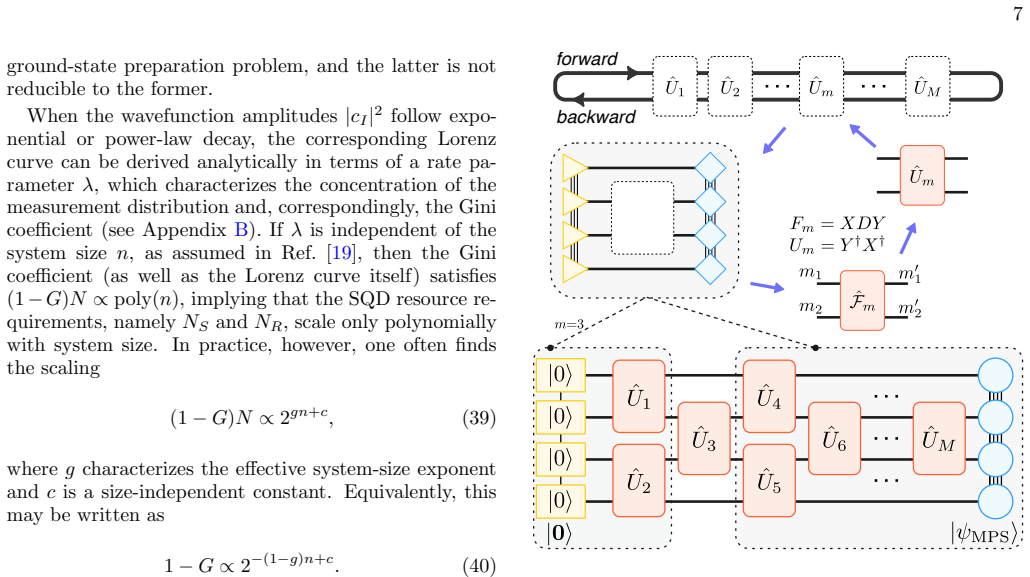
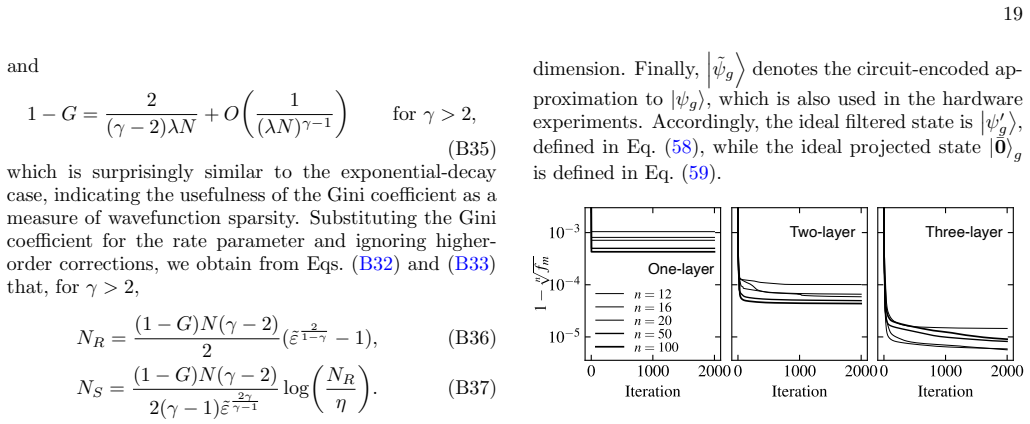
A tensor-network-based circuit-encoding algorithm can map the target filtered states to quantum circuits with controllable fidelity while remaining implementable on current hardware.
What would settle it
Executing the filter-assisted protocol on the quantum Ising model and measuring that the ground-state energy error does not drop by orders of magnitude relative to standard SQD would falsify the performance improvement.
Figures

read the original abstract
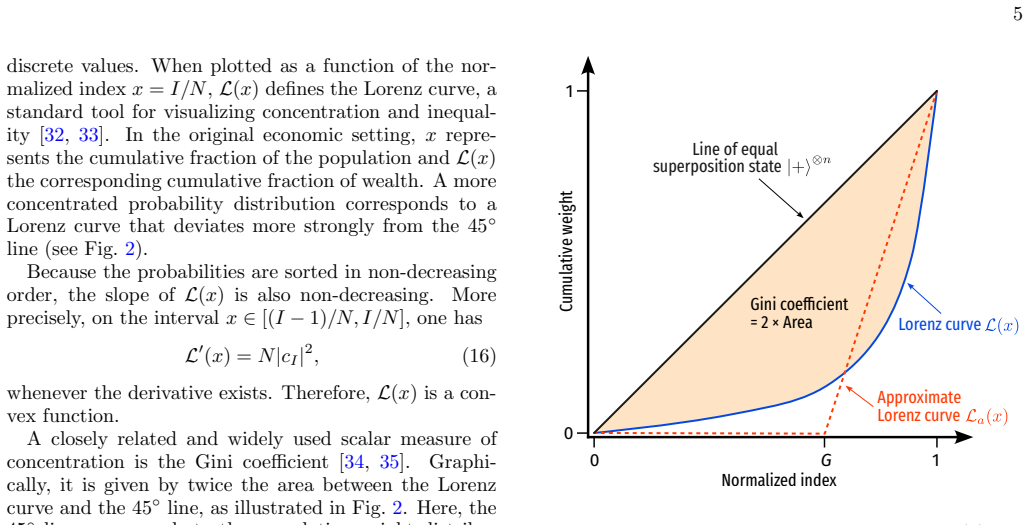
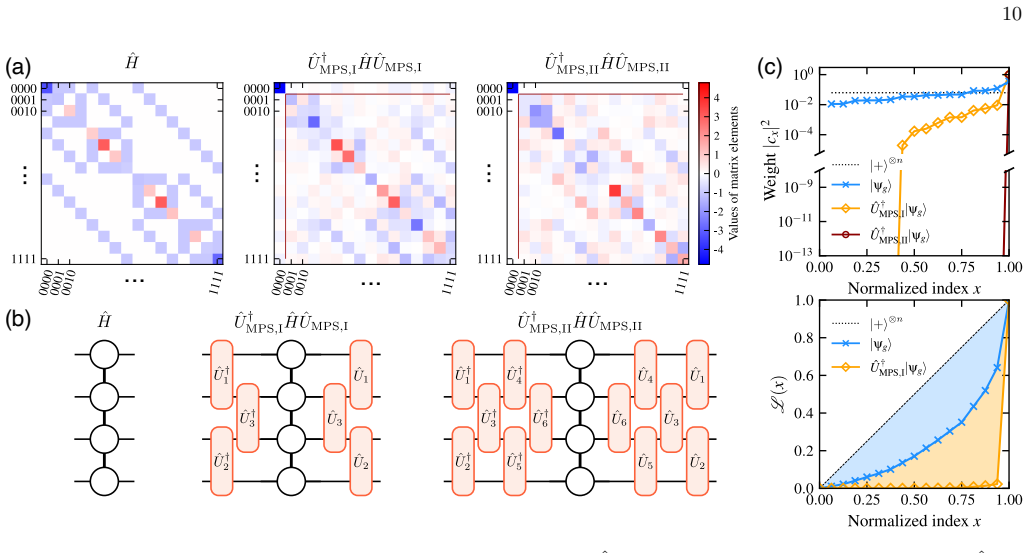
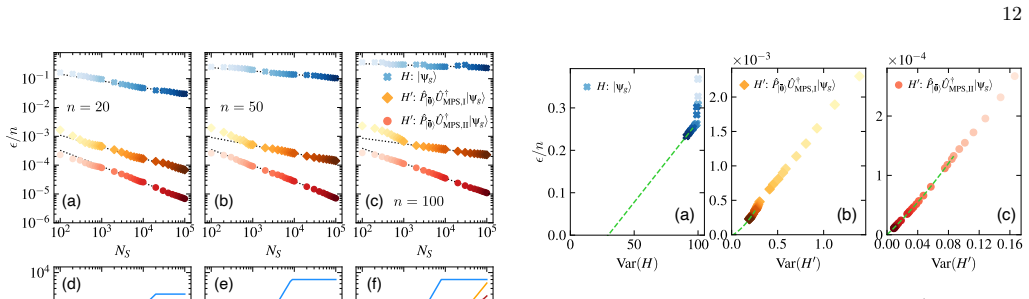
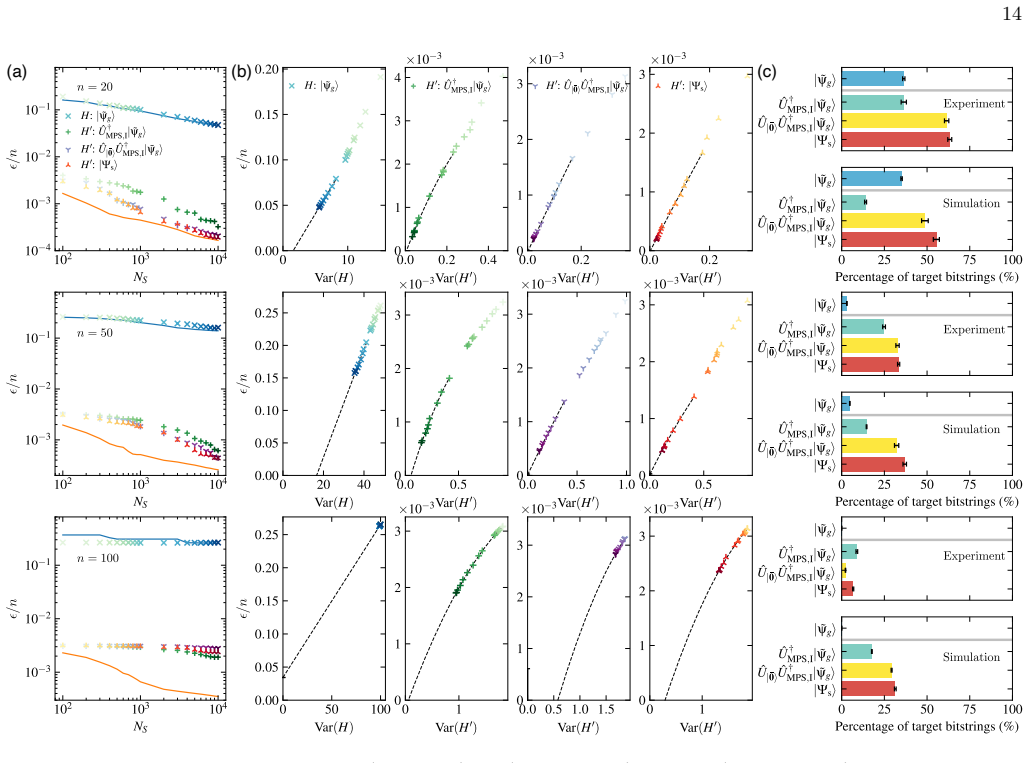
Subspace diagonalization techniques based on quantum sampling, such as quantum selected configuration interaction (QSCI) and sample-based quantum diagonalization (SQD), have recently emerged as promising quantum-centric approaches for approximating ground-state energies of many-body systems. However, their performance is fundamentally limited by an intrinsic trade-off between sampling efficiency and the sparsity of the ground-state wavefunction, which becomes particularly severe in strongly correlated systems. Here, we introduce a filter-assisted SQD protocol that engineers wavefunction sparsity via a quantum filter, i.e., a unitary transformation of the Hamiltonian designed to concentrate the ground-state weight onto a small number of computational basis states. Using the Gini coefficient as a robust sparsity measure, we establish a quantitative relationship between wavefunction sparsity and the resource requirements of SQD, providing theoretical bounds on the required subspace dimension and sampling cost. To realize the quantum filter, we employ a tensor-network-based circuit-encoding algorithm that maps target states to quantum circuits with controllable fidelity. We benchmark our approach on the quantum Ising model with transverse and longitudinal fields using both numerical simulations and quantum hardware experiments. Our results demonstrate that, compared with standard SQD, the proposed protocol significantly enhances wavefunction sparsity, reduces ground-state energy estimation errors by orders of magnitude, and substantially lowers sampling overhead. These findings establish filter-assisted subspace diagonalization as a powerful and scalable framework for quantum many-body calculations in the strongly correlated regime.
Editorial analysis
A structured set of objections, weighed in public.
Referee Report
Summary. The paper proposes a filter-assisted sample-based quantum diagonalization (SQD) protocol that applies a unitary quantum filter, realized via a tensor-network circuit-encoding algorithm, to concentrate ground-state weight and thereby increase wavefunction sparsity as measured by the Gini coefficient. Theoretical bounds are derived relating this sparsity to reduced subspace dimension and sampling overhead in SQD; the approach is benchmarked on the transverse-plus-longitudinal-field quantum Ising model via both classical simulations and quantum hardware runs, with claims of orders-of-magnitude lower ground-state energy errors and sampling costs relative to unfiltered SQD.
Significance. If the tensor-network encoding can be shown to deliver the required controllable fidelity on hardware without eroding the engineered sparsity, the protocol would offer a concrete route to mitigating the sparsity-sampling trade-off that currently limits quantum subspace methods in strongly correlated regimes, potentially enabling larger-scale quantum-centric calculations.
major comments (1)
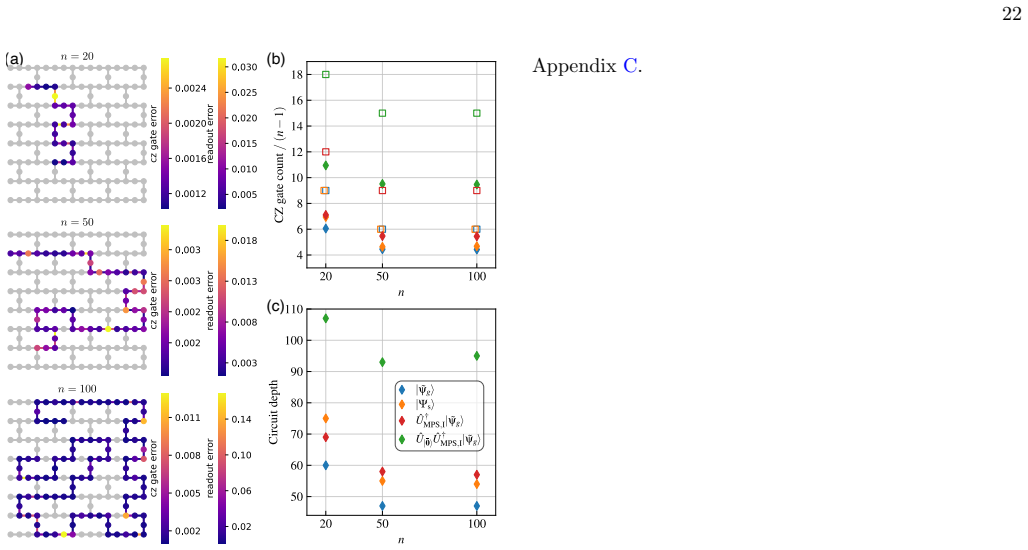
- [Hardware experiments section (Ising-model benchmarks)] The central claim of orders-of-magnitude error reduction and overhead savings is conditional on the tensor-network-based circuit-encoding algorithm producing shallow, high-fidelity circuits for the filtered states. The hardware experiments on the Ising model must explicitly quantify how the reported gate counts and circuit depths affect the achieved sparsity (Gini coefficient) and energy accuracy; without such data the theoretical bounds do not translate to practical advantage.
Simulated Author's Rebuttal
We thank the referee for the constructive feedback on the hardware experiments. We address the major comment below and will revise the manuscript accordingly.
read point-by-point responses
-
Referee: [Hardware experiments section (Ising-model benchmarks)] The central claim of orders-of-magnitude error reduction and overhead savings is conditional on the tensor-network-based circuit-encoding algorithm producing shallow, high-fidelity circuits for the filtered states. The hardware experiments on the Ising model must explicitly quantify how the reported gate counts and circuit depths affect the achieved sparsity (Gini coefficient) and energy accuracy; without such data the theoretical bounds do not translate to practical advantage.
Authors: We agree that an explicit quantification of how gate counts and circuit depths influence the achieved sparsity and energy accuracy is necessary to connect the hardware results to the theoretical bounds. The current manuscript reports gate counts, depths, Gini coefficients, and energy errors from the hardware runs, but does not include a dedicated analysis or visualization of their interdependencies. In the revised version we will add a supplementary table and accompanying discussion that tabulates these quantities for each Ising instance, together with the tensor-network encoding fidelity, and will comment on how deviations from ideal sparsity arise from finite circuit depth and noise. revision: yes
Circularity Check
No circularity: derivation chain is self-contained and independent of fitted inputs or self-referential definitions.
full rationale
The paper defines a new filter-assisted SQD protocol, introduces the Gini coefficient as an external sparsity metric, derives theoretical bounds on subspace dimension and sampling cost from that metric, and specifies a tensor-network circuit-encoding algorithm to implement the filter. None of these elements reduce by construction to parameters fitted from the target data, self-citations that carry the central claim, or ansatzes smuggled from prior author work. The Ising-model benchmarks are presented as separate numerical and hardware validation. The derivation therefore stands on its own stated assumptions and external measures without the forbidden patterns.
Axiom & Free-Parameter Ledger
axioms (1)
- domain assumption The Gini coefficient provides a robust quantitative measure of wavefunction sparsity that directly bounds SQD resource requirements.
Reference graph
Works this paper leans on
-
[1]
Sachdev,Quantum Phase Transitions, 2nd ed
S. Sachdev,Quantum Phase Transitions, 2nd ed. (Cam- bridge University Press, 2011)
2011
-
[2]
J. Wang, J. Surace, I. Fr´ erot, B. Legat, M.-O. Renou, V. Magron, and A. Ac´ ın, Certifying ground-state prop- erties of many-body systems, Phys. Rev. X14, 031006 (2024)
2024
-
[3]
B. P. Lanyon, J. D. Whitfield, G. G. Gillett, M. E. Goggin, M. P. Almeida, I. Kassal, J. D. Biamonte, M. Mohseni, B. J. Powell, M. Barbieri,et al., Towards quantum chemistry on a quantum computer, Nature Chem.2, 106 (2010)
2010
-
[4]
S. Lee, J. Lee, H. Zhai, Y. Tong, A. M. Dalzell, A. Ku- mar, P. Helms, J. Gray, Z.-H. Cui, W. Liu,et al., Eval- uating the evidence for exponential quantum advantage in ground-state quantum chemistry, Nat. Commun.14, 1952 (2023)
1952
-
[5]
W. J. Huggins, J. Lee, U. Baek, B. O’Gorman, and K. B. Whaley, A non-orthogonal variational quantum eigen- solver, New J. Phys.22, 073009 (2020)
2020
-
[6]
Lanczos, An iteration method for the solution of the eigenvalue problem of linear differential and integral op- erators, J
C. Lanczos, An iteration method for the solution of the eigenvalue problem of linear differential and integral op- erators, J. Res. Natl. Bur. Stand.45, 255 (1950)
1950
-
[7]
Koch, The Lanczos method, The LDA+DMFT ap- proach to strongly correlated materials (2011)
E. Koch, The Lanczos method, The LDA+DMFT ap- proach to strongly correlated materials (2011)
2011
-
[8]
Seki and S
K. Seki and S. Yunoki, Quantum power method by a superposition of time-evolved states, PRX Quantum2, 010333 (2021)
2021
-
[9]
N. H. Stair, R. Huang, and F. A. Evangelista, A multiref- erence quantum Krylov algorithm for strongly correlated electrons, J. Chem. Theory Comput.16, 2236 (2020)
2020
-
[10]
C. L. Cortes and S. K. Gray, Quantum Krylov subspace algorithms for ground- and excited-state energy estima- tion, Phys. Rev. A105, 022417 (2022)
2022
-
[11]
R. M. Parrish and P. L. McMahon, Quantum filter diagonalization: Quantum eigendecomposition without full quantum phase estimation (2019), arXiv:1909.08925 23 TABLE II. Single- and two-qubit properties ofibm kobeused in this study, including the qubit relaxation timeT 1, qubit dephasing timeT 2, readout error, and CZ error. Property Min. Max. Median Avg. n...
-
[12]
J. Cohn, M. Motta, and R. M. Parrish, Quantum filter di- agonalization with compressed double-factorized hamil- tonians, PRX Quantum2, 040352 (2021)
2021
-
[13]
T. A. Bespalova and O. Kyriienko, Hamiltonian operator approximation for energy measurement and ground-state preparation, PRX Quantum2, 030318 (2021)
2021
-
[14]
Motta, C
M. Motta, C. Sun, A. T. Tan, M. J. O’Rourke, E. Ye, A. J. Minnich, F. G. Brandao, and G. K.-L. Chan, De- termining eigenstates and thermal states on a quantum computer using quantum imaginary time evolution, Nat. Phys.16, 205 (2020)
2020
-
[15]
Yeter-Aydeniz, R
K. Yeter-Aydeniz, R. C. Pooser, and G. Siopsis, Practi- cal quantum computation of chemical and nuclear energy levels using quantum imaginary time evolution and lanc- zos algorithms, npj Quantum Inf.6, 63 (2020)
2020
-
[16]
Frame, R
D. Frame, R. He, I. Ipsen, D. Lee, D. Lee, and E. Rrapaj, Eigenvector continuation with subspace learning, Phys. Rev. Lett.121, 032501 (2018)
2018
-
[17]
A. Francis, A. A. Agrawal, J. H. Howard, E. K¨ okc¨ u, and A. F. Kemper, Subspace diagonalization on quan- tum computers using eigenvector continuation (2022), arXiv:2209.10571 [quant-ph]
-
[18]
K. Kanno, M. Kohda, R. Imai, S. Koh, K. Mitarai, W. Mizukami, and Y. O. Nakagawa, Quantum-selected configuration interaction: classical diagonalization of Hamiltonians in subspaces selected by quantum comput- ers (2023), arXiv:2302.11320 [quant-ph]
work page internal anchor Pith review Pith/arXiv arXiv 2023
-
[19]
Robledo-Moreno, M
J. Robledo-Moreno, M. Motta, H. Haas, A. Javadi- Abhari, P. Jurcevic, W. Kirby, S. Martiel, K. Sharma, S. Sharma, T. Shirakawa, I. Sitdikov, R.-Y. Sun, K. J. Sung, M. Takita, M. C. Tran, S. Yunoki, and A. Mezza- capo, Chemistry beyond the scale of exact diagonaliza- tion on a quantum-centric supercomputer, Sci. Adv.11, eadu9991 (2025)
2025
-
[20]
J. Yu, J. R. Moreno, J. T. Iosue, L. Bertels, D. Claudino, B. Fuller, P. Groszkowski, T. S. Humble, P. Jurce- vic, W. Kirby, T. A. Maier, M. Motta, B. Pokharel, A. Seif, A. Shehata, K. J. Sung, M. C. Tran, V. Tripathi, A. Mezzacapo, and K. Sharma, Quantum-centric algo- rithm for sample-based Krylov diagonalization (2025), arXiv:2501.09702 [quant-ph]
-
[21]
K. Sugisaki, S. Kanno, T. Itoko, R. Sakuma, and N. Yamamoto, Hamiltonian simulation-based quantum- selected configuration interaction for large-scale elec- tronic structure calculations with a quantum computer (2025), arXiv:2412.07218 [quant-ph]
-
[22]
M. Mikkelsen and Y. O. Nakagawa, Quantum-selected configuration interaction with time-evolved state (2024), arXiv:2412.13839 [quant-ph]
- [23]
-
[24]
D. Danilov, J. Robledo-Moreno, K. J. Sung, M. Motta, and J. Shee, Enhancing the accuracy and effi- ciency of sample-based quantum diagonalization with phaseless auxiliary-field quantum Monte Carlo (2025), arXiv:2503.05967 [quant-ph]
-
[25]
Barison, J
S. Barison, J. R. Moreno, and M. Motta, Quantum- centric computation of molecular excited states with ex- tended sample-based quantum diagonalization, QST10, 025034 (2025)
2025
- [26]
- [27]
-
[28]
T. Shirakawa, J. Robledo-Moreno, T. Itoko, V. Tripathi, K. Ueda, Y. Kawashima, L. Broers, W. Kirby, H. Pathak, H. Paik, M. Tsuji, Y. Kodama, M. Sato, C. Evangelinos, S. Seelam, R. Walkup, S. Yunoki, M. Motta, P. Jurce- vic, H. Horii, and A. Mezzacapo, Closed-loop calcula- tions of electronic structure on a quantum processor and a classical supercomputer a...
-
[29]
K. M. Merz, Jr., A. Shajan, D. Kaliakin, F. Liang, Y. Otsuka, T. Shirakawa, L. Broers, H. Xu, M. Tsuji, M. Sato, S. Yunoki, R. Wakizaka, Y. Kawashima, J. Doi, T. Itoko, H. Horii, T. Pellegrini, J. Robledo Moreno, K. J. Sung, E. Fejer, R. Walkup, S. Seelam, and M. Motta, Crossing the 12,000-atom barrier with het- erogeneous quantum-classical supercomputing...
work page internal anchor Pith review Pith/arXiv arXiv 2026
-
[30]
Reinholdt, K
P. Reinholdt, K. M. Ziems, E. R. Kjellgren, S. Coriani, S. P. A. Sauer, and J. Kongsted, Critical limitations in quantum-selected configuration interaction methods, J. Chem. Theory Comput.21, 6811 (2025)
2025
-
[31]
L. Lin, Lecture notes on quantum algorithms for scientific computation, arXiv:2201.08309 (2022)
-
[32]
M. O. Lorenz, Methods of measuring the concentration of wealth, J. Am. Stat. Assoc.9, 209 (1905)
1905
-
[33]
J. L. Gastwirth, A general definition of the lorenz curve, Econometrica39, 1037 (1971)
1971
-
[34]
Gini, Measurement of inequality of incomes, Econ
C. Gini, Measurement of inequality of incomes, Econ. J. 31, 124 (1921). 24
1921
-
[35]
Dalton, The measurement of the inequality of incomes, Econ
H. Dalton, The measurement of the inequality of incomes, Econ. J.30, 348 (1920)
1920
-
[36]
Hurley and S
N. Hurley and S. Rickard, Comparing measures of spar- sity, IEEE Trans. Inf. Theory55, 4723 (2009)
2009
-
[37]
A note on the coupon - collector's problem with multiple arrivals and the random sampling
M. Ferrante and N. Frigo, A note on the coupon - col- lector’s problem with multiple arrivals and the random sampling (2012), arXiv:1209.2667 [math.PR]
work page internal anchor Pith review Pith/arXiv arXiv 2012
-
[38]
Shirakawa, H
T. Shirakawa, H. Ueda, and S. Yunoki, Automatic quan- tum circuit encoding of a given arbitrary quantum state, Phys. Rev. Res.6, 043008 (2024)
2024
-
[39]
Ran, Encoding of matrix product states into quan- tum circuits of one- and two-qubit gates, Phys
S.-J. Ran, Encoding of matrix product states into quan- tum circuits of one- and two-qubit gates, Phys. Rev. A 101, 032310 (2020)
2020
-
[40]
D. Malz, G. Styliaris, Z.-Y. Wei, and J. I. Cirac, Prepa- ration of matrix product states with log-depth quantum circuits, Phys. Rev. Lett.132, 040404 (2024)
2024
-
[41]
K. C. Smith, A. Khan, B. K. Clark, S. Girvin, and T.- C. Wei, Constant-depth preparation of matrix product states with adaptive quantum circuits, PRX Quantum 5, 030344 (2024)
2024
-
[42]
Pfeuty, The one-dimensional ising model with a trans- verse field, Ann
P. Pfeuty, The one-dimensional ising model with a trans- verse field, Ann. Phys.57, 79 (1970)
1970
-
[43]
E. Lieb, T. Schultz, and D. Mattis, Two soluble models of an antiferromagnetic chain, Ann. Phys.16, 407 (1961)
1961
-
[44]
Sachdev, Quantum phase transitions, Physics world 12, 33 (1999)
S. Sachdev, Quantum phase transitions, Physics world 12, 33 (1999)
1999
-
[45]
Coldea, D
R. Coldea, D. A. Tennant, E. M. Wheeler, E. Wawrzyn- ska, D. Prabhakaran, M. Telling, K. Habicht, P. Smeibidl, and K. Kiefer, Quantum criticality in an ising chain: Ex- perimental evidence for emergent e8 symmetry, Science 327, 177 (2010)
2010
-
[46]
Bezanson, A
J. Bezanson, A. Edelman, S. Karpinski, and V. B. Shah, Julia: A fresh approach to numerical computing, SIAM Review59, 65 (2017)
2017
-
[47]
Fishman, S
M. Fishman, S. R. White, and E. M. Stoudenmire, The ITensor Software Library for Tensor Network Calcula- tions, SciPost Phys. Codebases , 4 (2022)
2022
-
[48]
Sorella, Generalized lanczos algorithm for variational quantum monte carlo, Phys
S. Sorella, Generalized lanczos algorithm for variational quantum monte carlo, Phys. Rev. B64, 024512 (2001)
2001
-
[49]
Mizusaki and M
T. Mizusaki and M. Imada, Precise estimation of shell model energy by second-order extrapolation method, Phys. Rev. C67, 041301 (2003)
2003
-
[50]
Qiskit contributors, Qiskit: An open-source framework for quantum computing (2023)
2023
-
[51]
M. A. Nielsen and I. L. Chuang,Quantum Computation and Quantum Information(Cambridge University Press, 2010)
2010
-
[52]
Li and S
Y. Li and S. C. Benjamin, Efficient variational quantum simulator incorporating active error minimization, Phys. Rev. X7, 021050 (2017)
2017
discussion (0)
Sign in with ORCID, Apple, or X to comment. Anyone can read and Pith papers without signing in.