Molecular Similarity and Water Diversity in Coeval Binary Disks: JWST/MIRI Observations of Sz 65 and Sz 66
Pith reviewed 2026-06-29 10:17 UTC · model grok-4.3
The pith
A wide binary pair of protoplanetary disks shows excess cold water vapor in the secondary because its dust lacks gaps.
A machine-rendered reading of the paper's core claim, the machinery that carries it, and where it could break.
Core claim
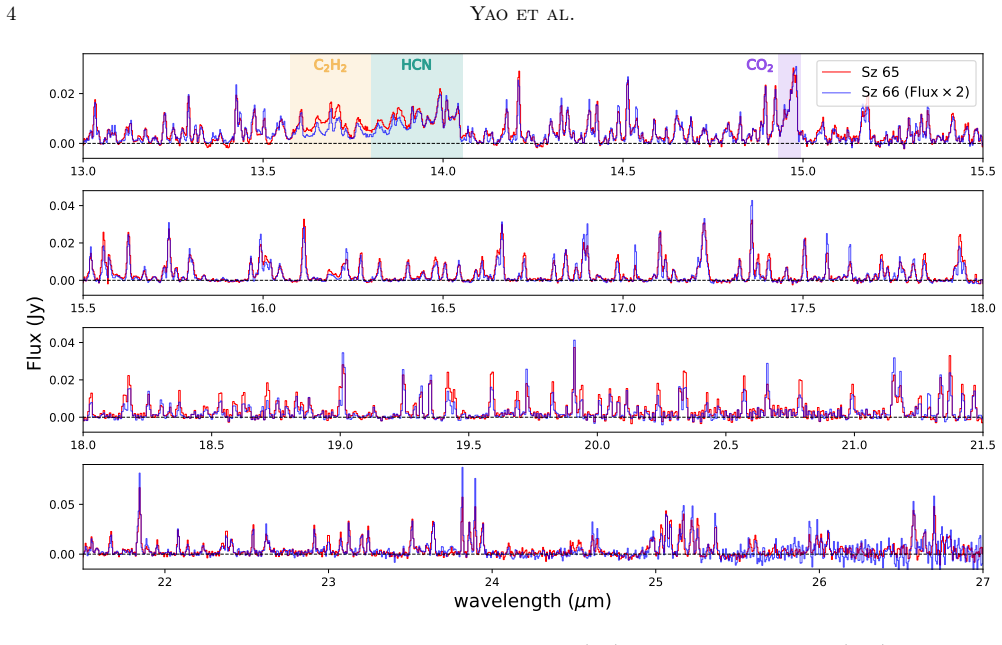
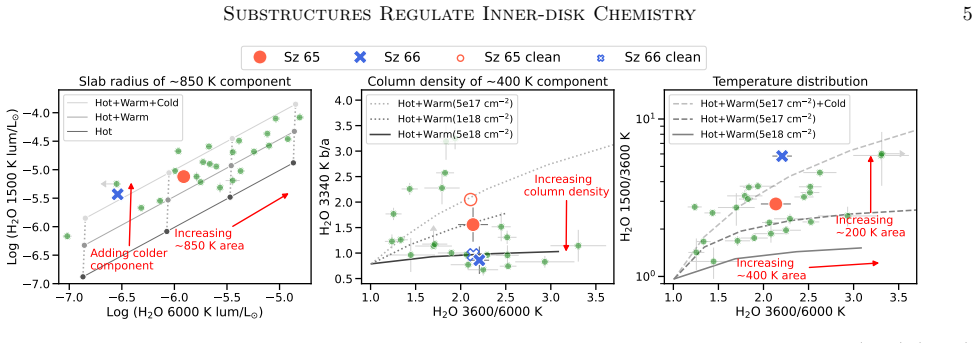
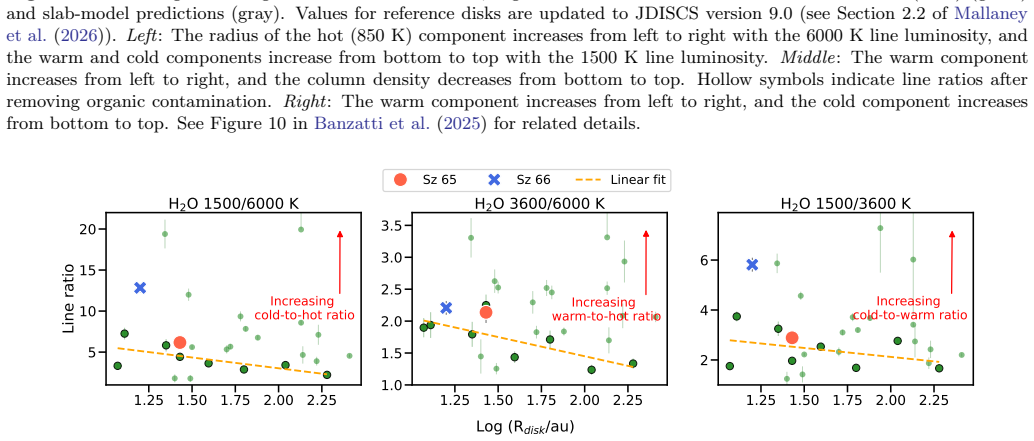
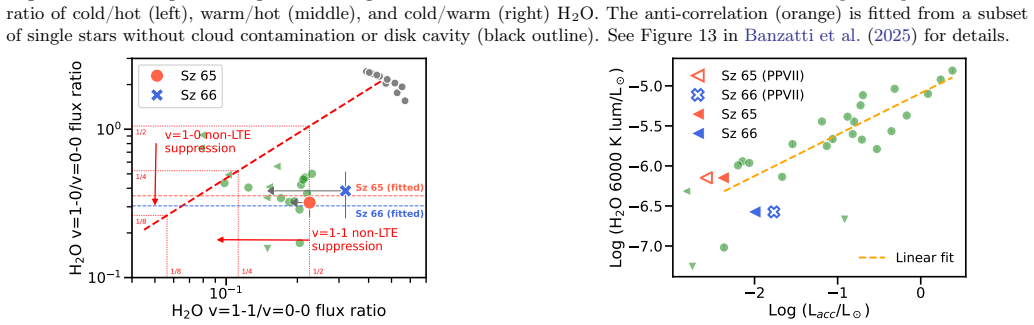
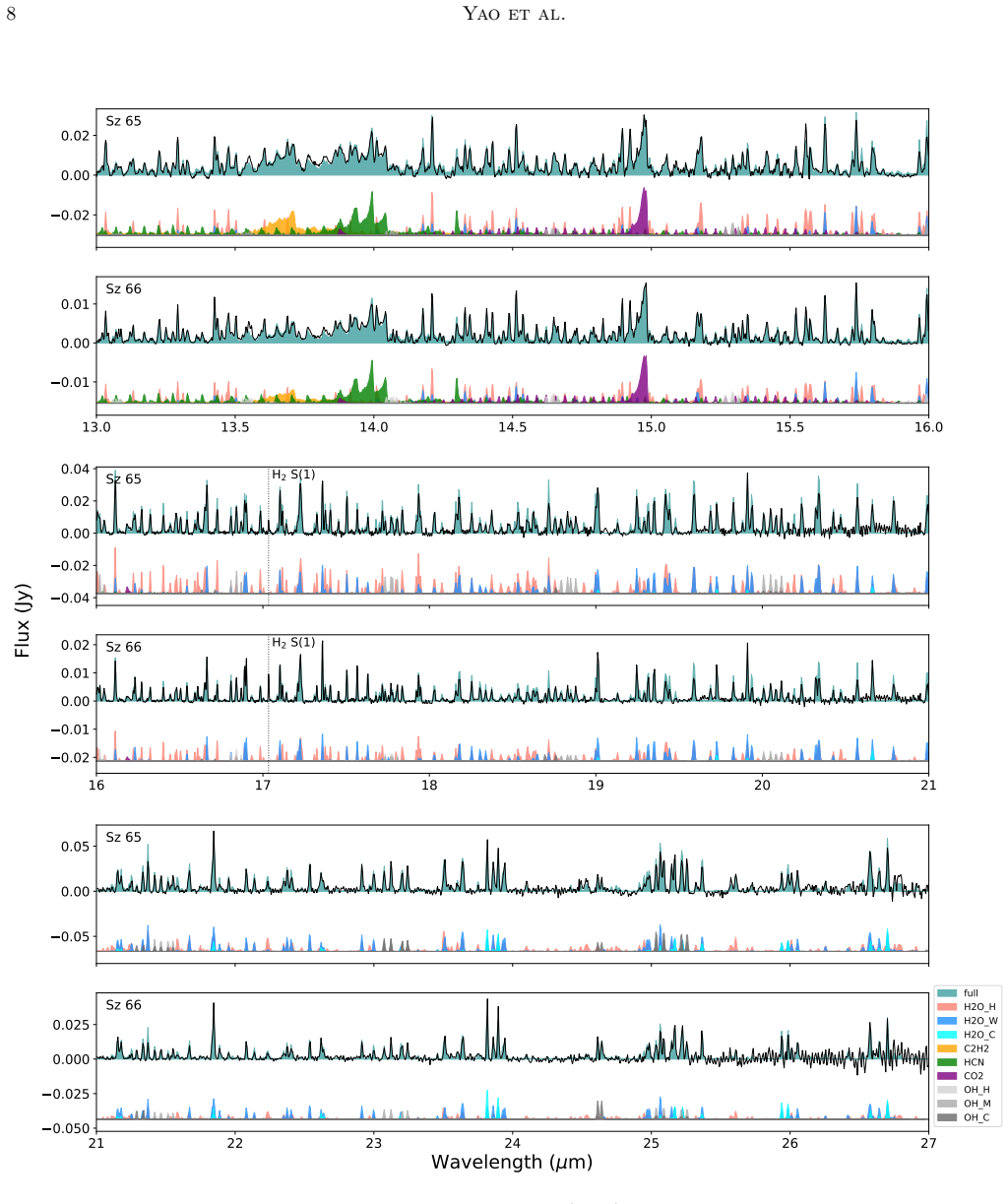
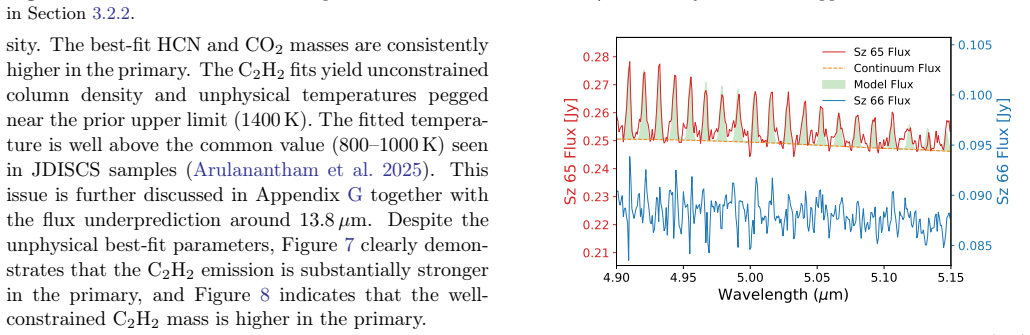
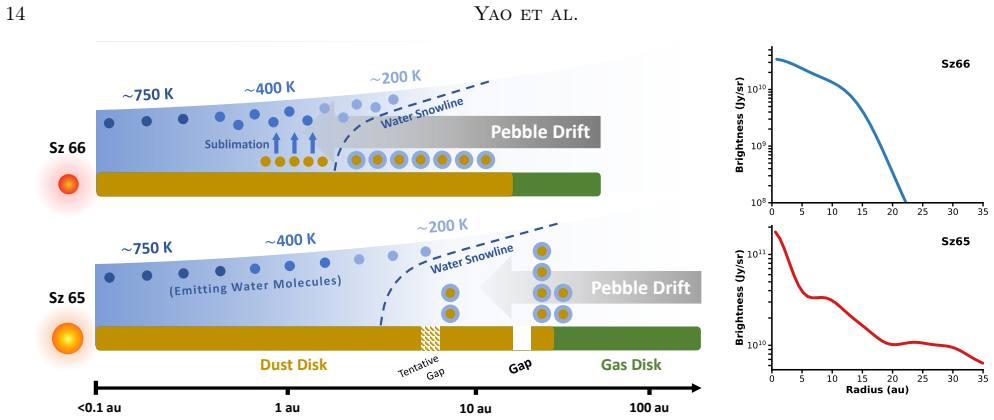
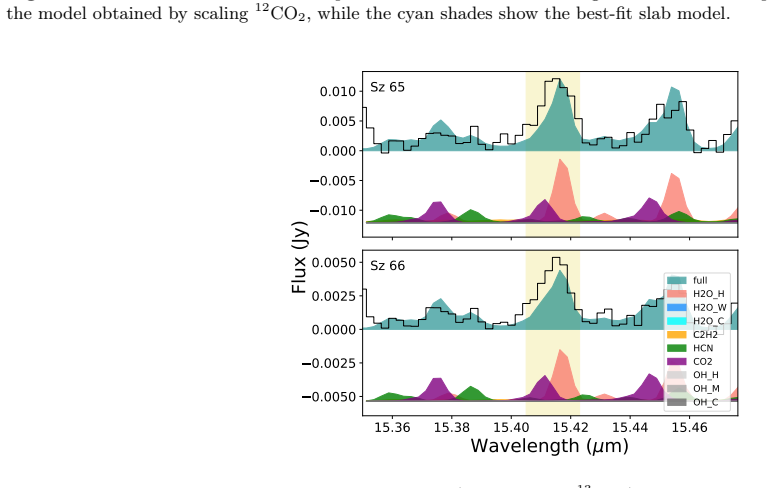
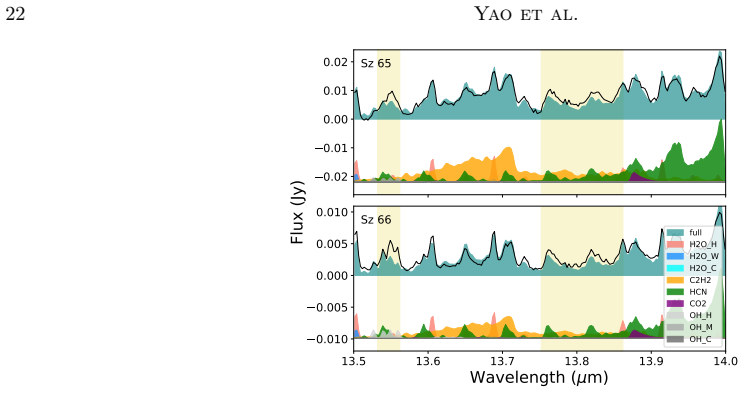
The scaled spectra of Sz 65 and Sz 66 are nearly identical in H2O, CO2, and HCN between 13 and 18 microns, with only stronger C2H2 in the primary; beyond 18 microns the secondary shows higher cold-to-hot and warm-to-hot H2O mass ratios. Because the stars share age and metallicity and both disks are compact in millimeter continuum, the excess cold water is explained by the secondary's lack of dust gaps, which allows more pebbles to drift across the water snow line and sublimate their icy mantles.
What carries the argument
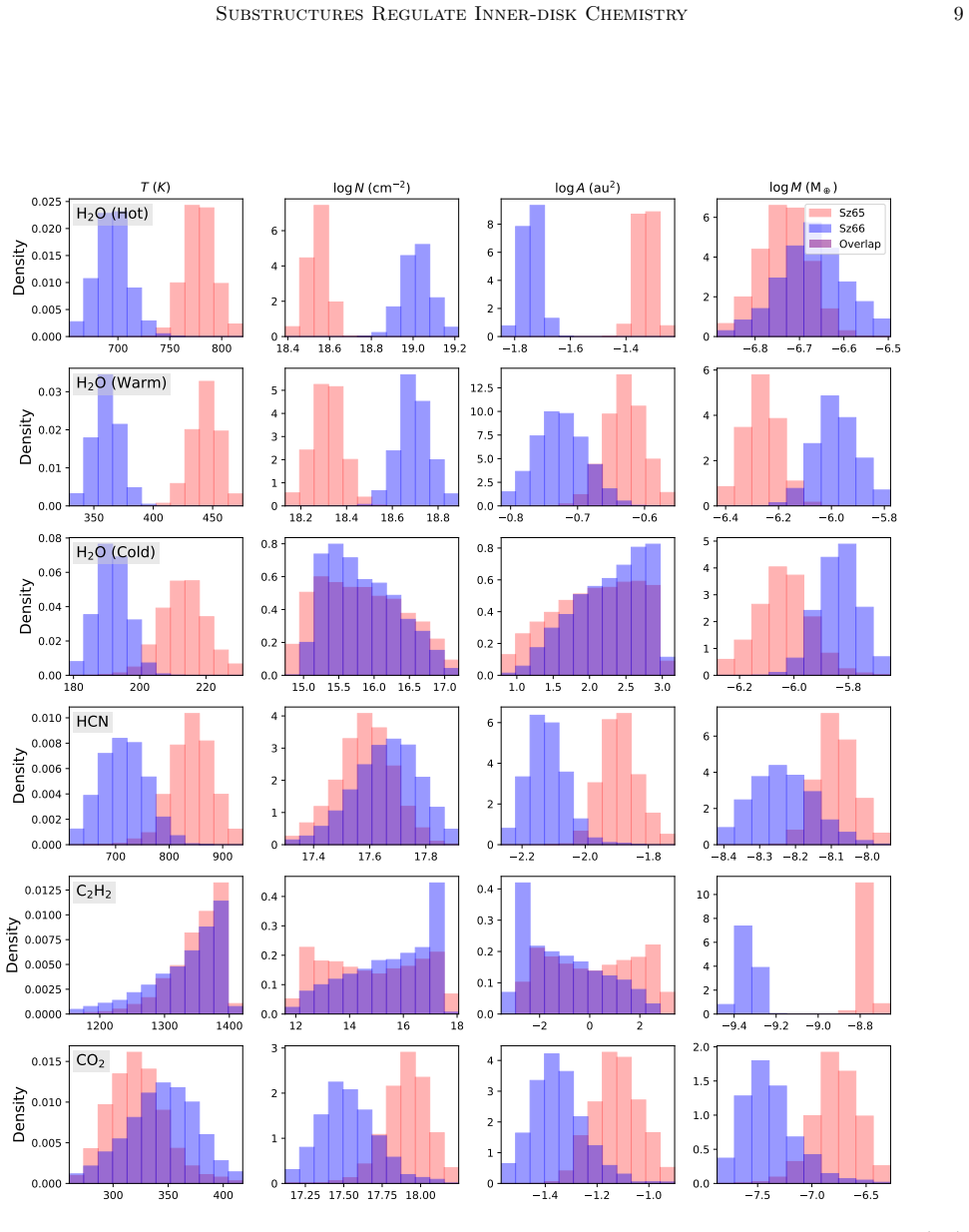
Comparison of cold-to-hot H2O line flux and slab-model mass ratios between the two disks, linked to the presence or absence of millimeter dust gaps.
If this is right
- Wide-separation binaries can isolate the effect of dust-disk structure on inner-disk molecular chemistry.
- Gaps at a few tens of au can suppress cold water vapor by interrupting pebble delivery to the snow line.
- Unstructured compact disks may retain higher inner-disk water abundances available for planetesimal formation.
- Molecular line ratios measured at 13-28 microns can serve as diagnostics of outer-disk pebble transport.
Where Pith is reading between the lines
- The same binary-control approach could test whether gap presence also alters carbon-bearing species or nitrogen chemistry in other systems.
- If pebble drift is the dominant mechanism, cold-water excess should correlate with disk size and smoothness across a larger sample of binaries.
- Planet-formation models that include gap opening may need to predict lower water delivery to inner regions when gaps appear early.
Load-bearing premise
The only relevant difference between the two disks is the presence of gaps in one and their absence in the other.
What would settle it
A millimeter image of Sz 66 that reveals gaps at radii comparable to those in Sz 65, or a binary pair with matched dust structure but mismatched cold-water ratios.
Figures
read the original abstract
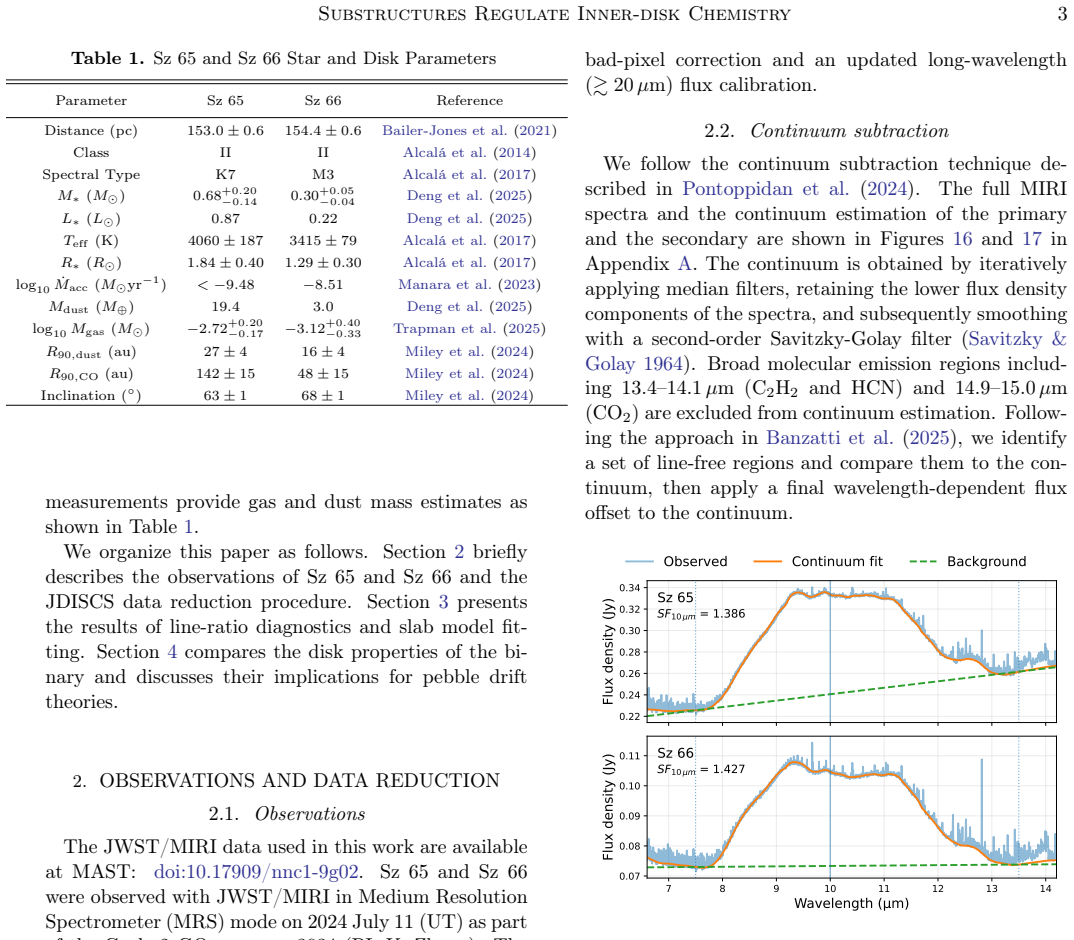
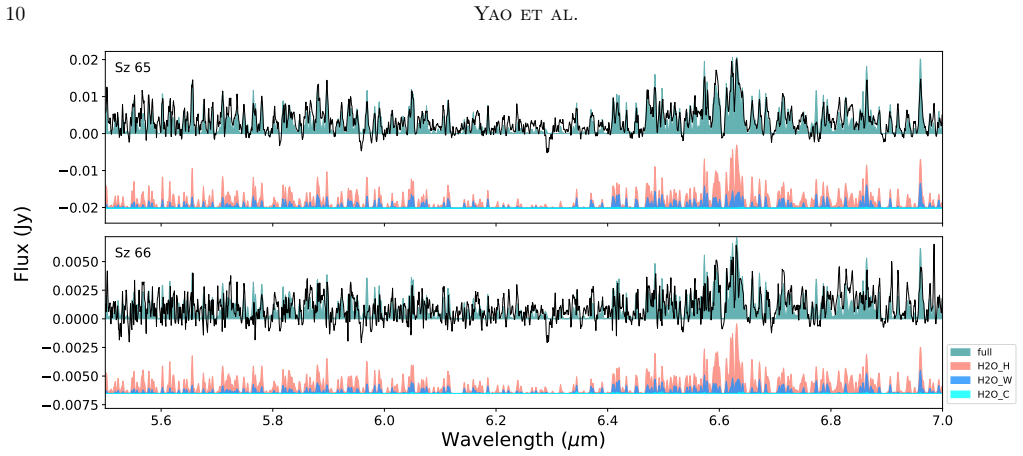
We present JWST/MIRI Medium Resolution Spectrometer spectra of the wide-separation (projected separation $= 980$ au) binary protoplanetary disks Sz 65 (K7; $0.68~M_{\odot}$) and Sz 66 (M3; $0.30~M_{\odot}$), reduced using the uniform pipeline of the JWST Disk Infrared Spectral Chemistry Survey. Both disks show rich molecular emission, including H$_2$O, CO$_2$, HCN, C$_2$H$_2$, and OH. The scaled spectra of the two disks exhibit remarkably similar H$_2$O, CO$_2$, and HCN line emission in the 13--18 $\mu$m region, with the only notable difference being stronger C$_2$H$_2$ emission in the primary (Sz 65). Beyond 18 $\mu$m, the difference in H$_2$O line emission between the two disks increases. Both the flux ratios and the slab-model-derived mass ratios of cold to hot H$_2$O ($\sim$200 K to $\sim$750 K) and warm to hot H$_2$O ($\sim$450 K to $\sim$750 K) are significantly higher in the secondary (Sz 66). Because binary stars share nearly the same age and metallicity, and as both disks appear compact in millimeter emission ($<30$ au), we suggest that the excess cold H$_2$O in the secondary is best explained by its unstructured dust disk, in contrast to the primary, which shows gaps at 6 and 20 au. The enhanced cold water in the secondary is consistent with efficient pebble drift across the water snow line and increased H$_2$O vapor from the sublimation of icy mantles. Our results demonstrate that wide-separation binaries can serve as powerful control samples for isolating the impact of individual disk properties on inner-disk chemistry and evolution.
Editorial analysis
A structured set of objections, weighed in public.
Referee Report
Summary. The manuscript reports JWST/MIRI MRS spectra of the wide binary protoplanetary disks Sz 65 (K7, 0.68 M⊙) and Sz 66 (M3, 0.30 M⊙), reduced via the uniform JWST Disk Infrared Spectral Chemistry Survey pipeline. The scaled spectra are similar in H₂O, CO₂, and HCN emission between 13–18 μm (with stronger C₂H₂ in the primary), but show enhanced H₂O emission beyond 18 μm in the secondary. Slab-model fits yield higher cold-to-hot (~200 K / ~750 K) and warm-to-hot (~450 K / ~750 K) H₂O mass ratios in Sz 66. The authors attribute the excess cold H₂O to the secondary’s unstructured dust disk (versus gaps at 6 and 20 au in the primary), consistent with efficient pebble drift across the snow line, given shared age, metallicity, and compact (<30 au) mm emission.
Significance. If the attribution to dust structure holds after controlling for other variables, the result provides a concrete observational demonstration that wide-separation binaries can isolate the effects of disk substructure on inner-disk molecular chemistry. The uniform pipeline strengthens the direct spectral comparison, and the work supplies a falsifiable prediction that gap-free disks should exhibit systematically higher cold-H₂O ratios under otherwise similar conditions.
major comments (2)
- [Abstract] Abstract: the central claim isolates dust-disk structure (gaps vs. unstructured) as the driver of the higher cold-to-hot H₂O mass ratio in Sz 66 after controlling for age and metallicity. However, the stellar masses differ by a factor of >2 (0.68 vs. 0.30 M⊙), implying different luminosities, temperature gradients, and snow-line locations that are not discussed or corrected for; these could independently alter pebble-drift efficiency and the slab-model ratios.
- [Abstract] Abstract: the statement that “flux ratios and the slab-model-derived mass ratios … are significantly higher” supplies no numerical values, uncertainties, or details on the temperature components, column densities, or fitting procedure used to obtain the ~200 K / ~450 K / ~750 K components, preventing assessment of whether the reported difference is statistically robust or sensitive to model assumptions.
minor comments (1)
- The manuscript would benefit from an explicit paragraph (perhaps in §4 or the discussion) addressing how stellar-mass and luminosity differences were evaluated as potential confounders before attributing the H₂O excess solely to dust structure.
Simulated Author's Rebuttal
We thank the referee for their thoughtful and constructive report. The comments highlight important points regarding stellar mass differences and the level of detail in the abstract. We address each below and will revise the manuscript accordingly to strengthen the presentation.
read point-by-point responses
-
Referee: [Abstract] Abstract: the central claim isolates dust-disk structure (gaps vs. unstructured) as the driver of the higher cold-to-hot H₂O mass ratio in Sz 66 after controlling for age and metallicity. However, the stellar masses differ by a factor of >2 (0.68 vs. 0.30 M⊙), implying different luminosities, temperature gradients, and snow-line locations that are not discussed or corrected for; these could independently alter pebble-drift efficiency and the slab-model ratios.
Authors: We agree that the factor of ~2.3 difference in stellar mass is relevant and should be explicitly addressed. In the revised manuscript we will add a dedicated paragraph in the discussion section that estimates the stellar luminosities from the given spectral types, computes approximate snow-line locations for each star, and evaluates how these might affect pebble-drift efficiency. We will also note that both disks remain compact (<30 au) in millimeter continuum and that the primary exhibits resolved gaps at 6 and 20 au while the secondary does not; these structural differences are still the most direct explanation for the observed cold-to-hot water ratio contrast. The revision will therefore retain the central claim while providing the missing quantitative context on stellar-mass effects. revision: yes
-
Referee: [Abstract] Abstract: the statement that “flux ratios and the slab-model-derived mass ratios … are significantly higher” supplies no numerical values, uncertainties, or details on the temperature components, column densities, or fitting procedure used to obtain the ~200 K / ~450 K / ~750 K components, preventing assessment of whether the reported difference is statistically robust or sensitive to model assumptions.
Authors: The abstract is written as a concise summary; the full slab-model results (temperature components, column densities, uncertainties, and fitting methodology) are presented in Section 3.2 and Table 2 of the manuscript. To address the referee’s concern we will revise the abstract to include the approximate cold-to-hot and warm-to-hot mass ratios with their 1σ uncertainties, thereby allowing readers to assess the magnitude and robustness of the difference without immediately consulting the main text. revision: yes
Circularity Check
No circularity: purely observational spectral comparison with slab-model fits
full rationale
The paper reports JWST/MIRI spectra of Sz 65 and Sz 66, notes similar 13-18 μm emission and stronger >18 μm cold H2O in the secondary, then derives cold/hot and warm/hot H2O mass ratios via slab models at fixed temperatures (~200 K / ~450 K / ~750 K). The central attribution to dust structure (gaps vs unstructured) rests on the observational premise of shared age/metallicity and compact mm disks; this is an interpretive inference, not a derivation that reduces to fitted inputs or self-citations by construction. No equations, predictions, or uniqueness theorems appear that would trigger any of the enumerated circularity patterns. The stellar-mass difference is a potential uncontrolled variable for correctness but does not create circularity.
Axiom & Free-Parameter Ledger
free parameters (3)
- cold H2O temperature component =
~200 K
- warm H2O temperature component =
~450 K
- hot H2O temperature component =
~750 K
axioms (2)
- domain assumption Binary stars share nearly the same age and metallicity
- domain assumption Both disks are compact in millimeter emission (<30 au)
Reference graph
Works this paper leans on
-
[1]
Akeson, R. L., Jensen, E. L. N., Carpenter, J., et al. 2019, ApJ, 872, 158, doi: 10.3847/1538-4357/aaff6a Alcalá, J. M., Natta, A., Manara, C. F., et al. 2014, A&A, 561, A2, doi: 10.1051/0004-6361/201322254 Alcalá, J. M., Manara, C. F., Natta, A., et al. 2017, A&A, 600, A20, doi: 10.1051/0004-6361/201629929
-
[2]
Anderson, D. E., Blake, G. A., Cleeves, L. I., et al. 2021, ApJ, 909, 55, doi: 10.3847/1538-4357/abd9c1
-
[3]
M., Kamp, I., Henning, T., et al
Arabhavi, A. M., Kamp, I., Henning, T., et al. 2024, Science, 384, 1086, doi: 10.1126/science.adi8147
-
[4]
Arabhavi, A. M., Kamp, I., van Dishoeck, E. F., et al. 2025, ApJL, 984, L62, doi: 10.3847/2041-8213/adc692
-
[5]
Argyriou, I., Glasse, A., Law, D. R., et al. 2023, A&A, 675, A111, doi: 10.1051/0004-6361/202346489
-
[6]
2025, AJ, 170, 67, doi: 10.3847/1538-3881/addd01 Astropy Collaboration, Price-Whelan, A
Arulanantham, N., Salyk, C., Pontoppidan, K., et al. 2025, AJ, 170, 67, doi: 10.3847/1538-3881/addd01 Astropy Collaboration, Price-Whelan, A. M., Lim, P. L., et al. 2022, ApJ, 935, 167, doi: 10.3847/1538-4357/ac7c74
-
[7]
2021, AJ, 161, 147, doi: 10.3847/1538-3881/abd806
Demleitner, M., & Andrae, R. 2021, AJ, 161, 147, doi: 10.3847/1538-3881/abd806
work page internal anchor Pith review doi:10.3847/1538-3881/abd806 2021
-
[8]
S., Pascucci, I., Gorti, U., et al
Bajaj, N. S., Pascucci, I., Gorti, U., et al. 2024, AJ, 167, 127, doi: 10.3847/1538-3881/ad22e1
-
[9]
Bajaj, N. S., Pascucci, I., Beck, T. L., et al. 2025, AJ, 169, 296, doi: 10.3847/1538-3881/adc73c
-
[10]
Banzatti, A., & Pontoppidan, K. M. 2015, ApJ, 809, 167, doi: 10.1088/0004-637X/809/2/167
-
[11]
Banzatti, A., Pontoppidan, K. M., Salyk, C., et al. 2017, ApJ, 834, 152, doi: 10.3847/1538-4357/834/2/152
-
[12]
Banzatti, A., Pascucci, I., Bosman, A. D., et al. 2020, ApJ, 903, 124, doi: 10.3847/1538-4357/abbc1a
-
[13]
Banzatti, A., Abernathy, K. M., Brittain, S., et al. 2022, AJ, 163, 174, doi: 10.3847/1538-3881/ac52f0
-
[14]
Banzatti, A., Pontoppidan, K. M., Carr, J. S., et al. 2023a, ApJL, 957, L22, doi: 10.3847/2041-8213/acf5ec
-
[15]
Banzatti, A., Pontoppidan, K. M., Pére Chávez, J., et al. 2023b, AJ, 165, 72, doi: 10.3847/1538-3881/aca80b
-
[16]
Banzatti, A., Salyk, C., Pontoppidan, K. M., et al. 2025, AJ, 169, 165, doi: 10.3847/1538-3881/ada962
-
[17]
Bohn, A. J., Ginski, C., Kenworthy, M. A., et al. 2022, A&A, 657, A53, doi: 10.1051/0004-6361/202039917
-
[18]
Bosman, A. D., Bergin, E. A., Calahan, J., & Duval, S. E. 2022, ApJL, 930, L26, doi: 10.3847/2041-8213/ac66ce Substructures Regulate Inner-disk Chemistry 23
-
[19]
2025, JWST Calibration Pipeline, 1.18.1, Zenodo, doi: 10.5281/zenodo.6984365
Bushouse, H., Eisenhamer, J., Dencheva, N., et al. 2025, JWST Calibration Pipeline, 1.18.1, Zenodo, doi: 10.5281/zenodo.6984365
-
[20]
Carr, J. S., & Najita, J. R. 2008, Science, 319, 1504, doi: 10.1126/science.1153807 —. 2011, ApJ, 733, 102, doi: 10.1088/0004-637X/733/2/102
-
[21]
Ciesla, F. J., & Cuzzi, J. N. 2006, Icarus, 181, 178, doi: 10.1016/j.icarus.2005.11.009
-
[22]
Colmenares, M. J., Bergin, E. A., Salyk, C., et al. 2024, ApJ, 977, 173, doi: 10.3847/1538-4357/ad8b4f
-
[23]
2025, ApJ, 989, 3, doi: 10.3847/1538-4357/add43a Drążkowska, J., Bitsch, B., Lambrechts, M., et al
Deng, D., Vioque, M., Pascucci, I., et al. 2025, ApJ, 989, 3, doi: 10.3847/1538-4357/add43a Drążkowska, J., Bitsch, B., Lambrechts, M., et al. 2023, in Astronomical Society of the Pacific Conference Series, Vol. 534, Protostars and Planets VII, ed. S. Inutsuka, Y. Aikawa, T. Muto, K. Tomida, & M. Tamura, 717, doi: 10.48550/arXiv.2203.09759
-
[24]
Dullemond, C. P., & Dominik, C. 2004, A&A, 421, 1075, doi: 10.1051/0004-6361:20040284
-
[25]
2024, ApJ, 977, 21, doi: 10.3847/1538-4357/ad891d
Easterwood, W., Kalyaan, A., & Banzatti, A. 2024, ApJ, 977, 21, doi: 10.3847/1538-4357/ad891d
-
[26]
Foreman-Mackey, D., Hogg, D. W., Lang, D., & Goodman, J. 2013, PASP, 125, 306, doi: 10.1086/670067
-
[27]
Gasman, D., van Dishoeck, E. F., Grant, S. L., et al. 2023, A&A, 679, A117, doi: 10.1051/0004-6361/202347005
-
[28]
Gordon, I. E., Rothman, L. S., Hargreaves, R. J., et al. 2022, JQSRT, 277, 107949, doi: 10.1016/j.jqsrt.2021.107949
-
[29]
Grant, S. L., van Dishoeck, E. F., Tabone, B., et al. 2023, ApJL, 947, L6, doi: 10.3847/2041-8213/acc44b
-
[30]
Grant, S. L., Kurtovic, N. T., van Dishoeck, E. F., et al. 2024, A&A, 689, A85, doi: 10.1051/0004-6361/202450768
-
[31]
Guadarrama, R., Vorobyov, E. I., Rab, C., & Güdel, M. 2022, A&A, 667, A28, doi: 10.1051/0004-6361/202140995
-
[32]
Harris, R. J., Andrews, S. M., Wilner, D. J., & Kraus, A. L. 2012, ApJ, 751, 115, doi: 10.1088/0004-637X/751/2/115
-
[33]
H., Barman, T., Baron, E., Aufdenberg, J
Hauschildt, P. H., Barman, T., Baron, E., Aufdenberg, J. P., & Schweitzer, A. 2025, A&A, 698, A47, doi: 10.1051/0004-6361/202554171
-
[34]
2024, PASP, 136, 054302, doi: 10.1088/1538-3873/ad3455
Henning, T., Kamp, I., Samland, M., et al. 2024, PASP, 136, 054302, doi: 10.1088/1538-3873/ad3455
-
[35]
2025, MNRAS, 537, 691, doi: 10.1093/mnras/staf057
Houge, A., Krijt, S., Banzatti, A., et al. 2025, MNRAS, 537, 691, doi: 10.1093/mnras/staf057
-
[36]
Hunter, J. D. 2007, Computing in Science & Engineering, 9, 90, doi: 10.1109/MCSE.2007.55
-
[37]
Jellison, E. G., Banzatti, A., Johnson, M. B., & Bruderer, S. 2024, AJ, 168, 99, doi: 10.3847/1538-3881/ad6142
-
[38]
Clarke, C. J. 2020, MNRAS, 495, 3209, doi: 10.1093/mnras/staa1365
-
[39]
Johnson, M. B., Banzatti, A., Jellison, E. G., & Bruderer, S. 2024, spexod/iSLAT: First release, v3.12, Zenodo, doi: 10.5281/zenodo.12167854
-
[40]
2021, ApJ, 921, 84, doi: 10.3847/1538-4357/ac1e96
Banzatti, A. 2021, ApJ, 921, 84, doi: 10.3847/1538-4357/ac1e96
-
[41]
2023, ApJ, 954, 66, doi: 10.3847/1538-4357/ace535
Kalyaan, A., Pinilla, P., Krijt, S., et al. 2023, ApJ, 954, 66, doi: 10.3847/1538-4357/ace535
-
[42]
Kessler-Silacci, J., Augereau, J.-C., Dullemond, C. P., et al. 2006, ApJ, 639, 275, doi: 10.1086/499330
-
[43]
2025, ApJL, 990, L72, doi: 10.3847/2041-8213/adfbe3
Krijt, S., Banzatti, A., Zhang, K., et al. 2025, ApJL, 990, L72, doi: 10.3847/2041-8213/adfbe3
-
[44]
Kurtovic, N. T., Grant, S. L., Temmink, M., et al. 2025, arXiv e-prints, arXiv:2508.02576, doi: 10.48550/arXiv.2508.02576
-
[45]
Lommen, D. J. P., van Dishoeck, E. F., Wright, C. M., et al. 2010, A&A, 515, A77, doi: 10.1051/0004-6361/200913150
-
[46]
2024, A&A, 686, L17, doi: 10.1051/0004-6361/202450322
Mah, J., Savvidou, S., & Bitsch, B. 2024, A&A, 686, L17, doi: 10.1051/0004-6361/202450322
-
[47]
Majidi, F. Z., Alcalá, J. M., Frasca, A., et al. 2023, A&A, 671, A46, doi: 10.1051/0004-6361/202245261
-
[48]
2026, ApJ, 998, 255, doi: 10.3847/1538-4357/ae32f1
Mallaney, P., Banzatti, A., Salyk, C., et al. 2026, ApJ, 998, 255, doi: 10.3847/1538-4357/ae32f1
-
[49]
Manara, C. F., Ansdell, M., Rosotti, G. P., et al. 2023, in Astronomical Society of the Pacific Conference Series, Vol. 534, Protostars and Planets VII, ed. S. Inutsuka, Y. Aikawa, T. Muto, K. Tomida, & M. Tamura, 539, doi: 10.48550/arXiv.2203.09930
-
[50]
F., Tazzari, M., Long, F., et al
Manara, C. F., Tazzari, M., Long, F., et al. 2019, A&A, 628, A95, doi: 10.1051/0004-6361/201935964
-
[51]
Meijerink, R., Pontoppidan, K. M., Blake, G. A., Poelman, D. R., & Dullemond, C. P. 2009, ApJ, 704, 1471, doi: 10.1088/0004-637X/704/2/1471
-
[52]
2005, ApJ, 634, 1126, doi: 10.1086/497123
Wyckoff, S. 2005, ApJ, 634, 1126, doi: 10.1086/497123
-
[53]
M., Carpenter, J., Booth, R., et al
Miley, J. M., Carpenter, J., Booth, R., et al. 2024, A&A, 682, A55, doi: 10.1051/0004-6361/202347135
-
[54]
Mulders, G. D., Ciesla, F. J., Min, M., & Pascucci, I. 2015, ApJ, 807, 9, doi: 10.1088/0004-637X/807/1/9
-
[55]
Najita, J. R., Carr, J. S., Pontoppidan, K. M., et al. 2013, ApJ, 766, 134, doi: 10.1088/0004-637X/766/2/134
-
[56]
Newville, M., Otten, R., Nelson, A., et al. 2025, LMFIT: Non-Linear Least-Squares Minimization and Curve-Fitting for Python, 1.3.4, Zenodo, doi: 10.5281/zenodo.16175987 Öberg, K. I., & Bergin, E. A. 2021, PhR, 893, 1, doi: 10.1016/j.physrep.2020.09.004 Panić, O., Haworth, T. J., Petr-Gotzens, M. G., et al. 2021, MNRAS, 501, 4317, doi: 10.1093/mnras/staa38...
-
[57]
2023, in Astronomical Society of the Pacific Conference Series, Vol
Pascucci, I., Cabrit, S., Edwards, S., et al. 2023, in Astronomical Society of the Pacific Conference Series, Vol. 534, Protostars and Planets VII, ed. S. Inutsuka, Y. Aikawa, T. Muto, K. Tomida, & M. Tamura, 567, doi: 10.48550/arXiv.2203.10068
-
[58]
Pascucci, I., Herczeg, G., Carr, J. S., & Bruderer, S. 2013, ApJ, 779, 178, doi: 10.1088/0004-637X/779/2/178
-
[59]
2009, ApJ, 702, 724, doi: 10.1088/0004-637X/702/1/724
Pascucci, I., & Sterzik, M. 2009, ApJ, 702, 724, doi: 10.1088/0004-637X/702/1/724
-
[60]
Pascucci, I., Testi, L., Herczeg, G. J., et al. 2016, ApJ, 831, 125, doi: 10.3847/0004-637X/831/2/125
-
[61]
Pascucci, I., Beck, T. L., Cabrit, S., et al. 2025, Nature Astronomy, 9, 81, doi: 10.1038/s41550-024-02385-7
-
[62]
2022, European Physical Journal Plus, 137, 1206, doi: 10.1140/epjp/s13360-022-03384-1
Pinilla, P. 2022, European Physical Journal Plus, 137, 1206, doi: 10.1140/epjp/s13360-022-03384-1
-
[63]
2013, A&A, 554, A95, doi: 10.1051/0004-6361/201220875
Pinilla, P., Birnstiel, T., Benisty, M., et al. 2013, A&A, 554, A95, doi: 10.1051/0004-6361/201220875
-
[64]
Pontoppidan, K. M., Salyk, C., Blake, G. A., et al. 2010, ApJ, 720, 887, doi: 10.1088/0004-637X/720/1/887
-
[65]
M., Salyk, C., Banzatti, A., et al
Pontoppidan, K. M., Salyk, C., Banzatti, A., et al. 2024, ApJ, 963, 158, doi: 10.3847/1538-4357/ad20f0
-
[66]
Romero-Mirza, C. E., Banzatti, A., Öberg, K. I., et al. 2024, ApJ, 975, 78, doi: 10.3847/1538-4357/ad769e
-
[67]
2022, csalyk/spectools_ir: First release, v1.0.0, Zenodo, doi: 10.5281/zenodo.5818682
Salyk, C. 2022, csalyk/spectools_ir: First release, v1.0.0, Zenodo, doi: 10.5281/zenodo.5818682
-
[68]
Salyk, C., Pontoppidan, K. M., Blake, G. A., Najita, J. R., & Carr, J. S. 2011, ApJ, 731, 130, doi: 10.1088/0004-637X/731/2/130
-
[69]
Salyk, C., Pontoppidan, K. M., Banzatti, A., et al. 2025, AJ, 169, 184, doi: 10.3847/1538-3881/adb397
-
[70]
Salyk, C., Pontoppidan, K. M., Zhang, K., et al. 2026, ApJ, 999, 92, doi: 10.3847/1538-4357/ae3db1
-
[71]
2021, A&A, 649, A19, doi: 10.1051/0004-6361/202039733
Sanchis, E., Testi, L., Natta, A., et al. 2021, A&A, 649, A19, doi: 10.1051/0004-6361/202039733
-
[72]
Savitzky, A., & Golay, M. J. E. 1964, Analytical Chemistry, 36, 1627, doi: 10.1021/ac60214a047
-
[73]
D., Vlasblom, M., & van Dishoeck, E
Sellek, A. D., Vlasblom, M., & van Dishoeck, E. F. 2025, A&A, 694, A79, doi: 10.1051/0004-6361/202451137
-
[74]
Smith, S. A., Romero-Mirza, C. E., Banzatti, A., et al. 2025, ApJL, 984, L51, doi: 10.3847/2041-8213/adcab8
-
[75]
Tabone, B., van Dishoeck, E. F., & Black, J. H. 2024, A&A, 691, A11, doi: 10.1051/0004-6361/202348487
-
[76]
Tabone, B., Bettoni, G., van Dishoeck, E. F., et al. 2023, Nature Astronomy, 7, 805, doi: 10.1038/s41550-023-01965-3
-
[77]
Tabone, B., Temmink, M., Waters, L. B. F. M., et al. 2026, arXiv e-prints, arXiv:2604.21803, doi: 10.48550/arXiv.2604.21803
work page internal anchor Pith review Pith/arXiv arXiv doi:10.48550/arxiv.2604.21803 2026
-
[78]
Temmink, M., van Dishoeck, E. F., Grant, S. L., et al. 2024, A&A, 686, A117, doi: 10.1051/0004-6361/202348911
-
[79]
Temmink, M., Sellek, A. D., Gasman, D., et al. 2025, A&A, 699, A134, doi: 10.1051/0004-6361/202554213
-
[80]
Tofflemire, B. M., Manara, C. F., Banzatti, A., et al. 2025, ApJ, 985, 224, doi: 10.3847/1538-4357/adcc23
discussion (0)
Sign in with ORCID, Apple, or X to comment. Anyone can read and Pith papers without signing in.