Cavity-Induced Suppression of Entanglement and Enhancement of Quantum Discord
Pith reviewed 2026-06-29 11:37 UTC · model grok-4.3
The pith
Cylindrical cavity boundaries suppress entanglement negativity between Unruh-DeWitt detectors while preserving and enhancing quantum discord.
A machine-rendered reading of the paper's core claim, the machinery that carries it, and where it could break.
Core claim
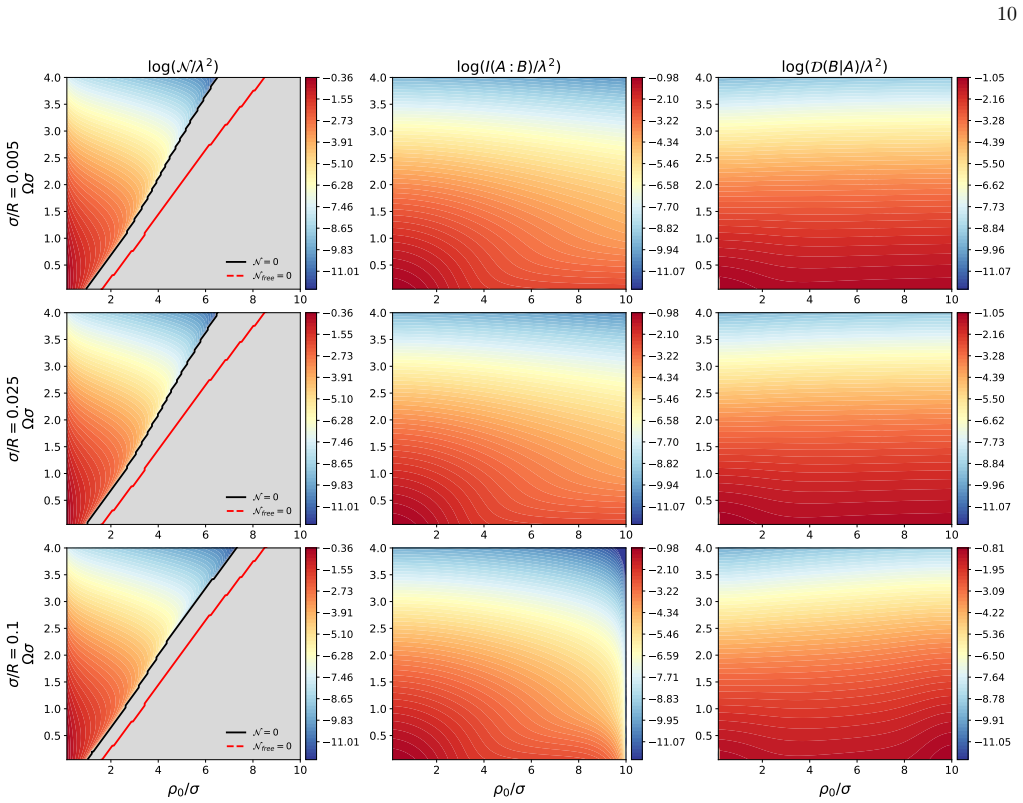
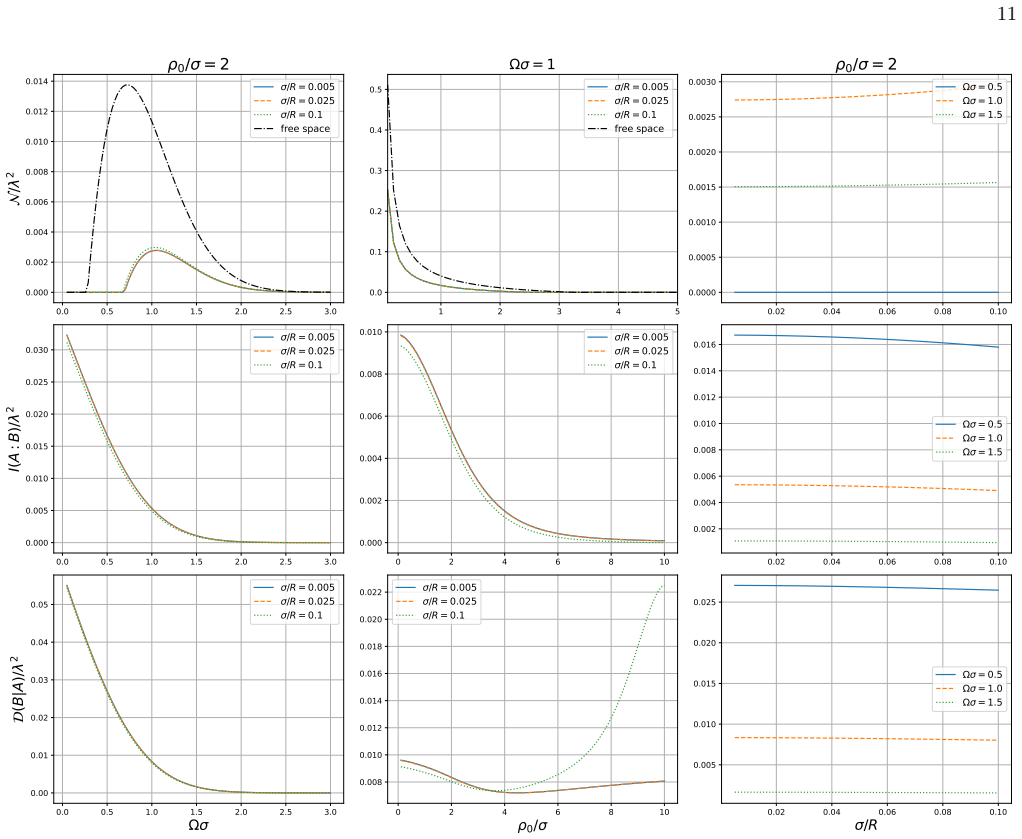
Boundary conditions in a cylindrical cavity strongly modify detector-correlation dynamics relative to free space: entanglement negativity is suppressed and vanishes at smaller separations, with no recovery as cavity radius grows, whereas mutual information decays monotonically and quantum discord remains nonzero over larger separations and is enhanced near the boundary. The results indicate that confinement selectively removes distillable entanglement while retaining and boosting more general nonclassical correlations.
What carries the argument
Correlation functions of two Unruh-DeWitt detectors coupled to a scalar field, evaluated under cylindrical boundary conditions that restrict the field's mode structure.
If this is right
- Entanglement negativity vanishes at smaller detector separations inside the cavity than in free space.
- Mutual information decays monotonically with increasing detector separation.
- Quantum discord remains nonzero over much larger separations and increases near the cavity boundary.
- Increasing the cavity radius does not restore the free-space behavior of the negativity.
Where Pith is reading between the lines
- Cavity geometry could serve as a tunable filter that removes distillable entanglement while leaving other correlations intact for quantum information tasks.
- The observed enhancement of discord near boundaries suggests analogous effects may appear in other confined geometries such as waveguides or photonic crystals.
- The selective suppression points to a practical test of correlation hierarchy by varying only the spatial boundary conditions.
Load-bearing premise
The numerical or analytic computation of the detector correlation functions under the chosen cylindrical boundary conditions accurately captures the full dynamics without unaccounted higher-order or non-perturbative effects.
What would settle it
An experiment or simulation that measures negativity, mutual information, and quantum discord for two detectors at multiple separations inside a cylindrical cavity and checks whether negativity vanishes earlier than in free space while discord rises near the boundary.
Figures
read the original abstract
We study correlations between two Unruh-DeWitt detectors coupled to a scalar field in a cylindrical cavity. Boundary conditions strongly modify the detector-correlation dynamics relative to free space. The entanglement negativity is suppressed in the cavity and vanishes for smaller separation as compared to the free space. Increasing the cavity radius does not recover the free-space behavior of the negativity. In contrast, mutual information and quantum discord remain nonzero over much larger separations. While the mutual information decays monotonically with separation, the quantum discord is enhanced near the cavity boundary. Our results demonstrate that geometric confinement can selectively suppress distillable entanglement while preserving and even enhancing more general non-classical correlations, providing a controlled setting to probe the hierarchy of correlations in quantum field theory.
Editorial analysis
A structured set of objections, weighed in public.
Referee Report
Summary. The manuscript studies correlations between two Unruh-DeWitt detectors coupled to a scalar field inside a cylindrical cavity. It reports that cavity boundary conditions suppress entanglement negativity relative to free space, with negativity vanishing at smaller detector separations; mutual information and quantum discord persist to larger separations, and quantum discord is enhanced near the cavity boundary. The central claim is that geometric confinement selectively suppresses distillable entanglement while preserving or enhancing more general non-classical correlations.
Significance. If the numerical trends hold under the stated approximations, the work supplies a concrete example of boundary-modified correlation hierarchies in quantum field theory, extending standard Unruh-DeWitt analyses to cylindrical geometries and distinguishing negativity from discord. The explicit comparison of monotonic mutual-information decay versus non-monotonic discord enhancement is a useful addition to the literature on confined detectors.
major comments (2)
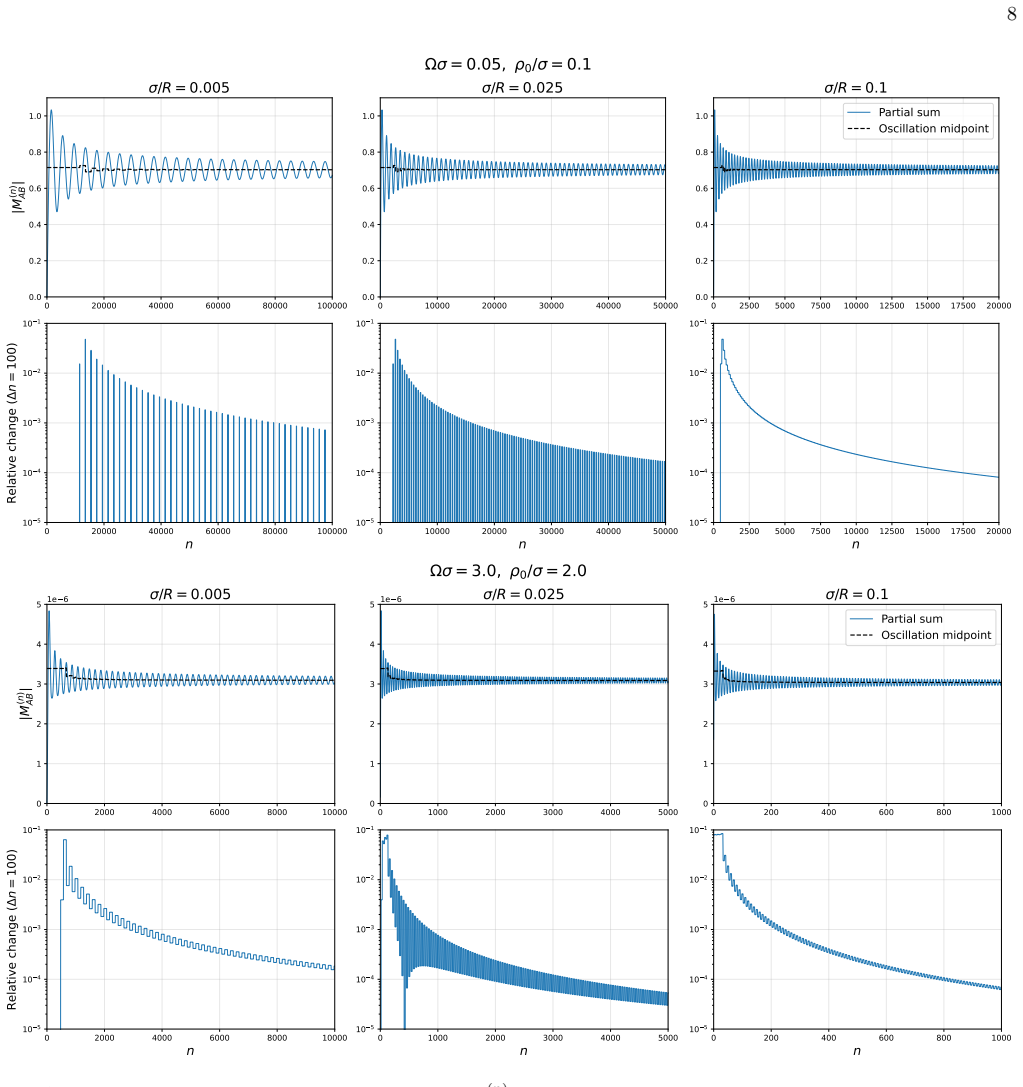
- [Abstract and results section] Abstract and results section: the reported suppression of negativity and enhancement of discord are stated as clear numerical trends, yet no error bars, mode-sum convergence checks, or integration-parameter sensitivity tests are supplied for the cavity-modified Wightman functions; this directly affects the load-bearing claim that the earlier vanishing of negativity and the boundary enhancement of discord are genuine geometric effects rather than numerical artifacts.
- [Calculation of the reduced density matrix] Calculation of the reduced density matrix (presumably §3 or the section deriving the X-state): the analysis relies on the standard O(λ²) perturbative expansion of the detector-field interaction; near the cavity boundary the discrete mode sum for the Wightman function can exhibit slow convergence or ultraviolet sensitivity, and no benchmark against higher-order or non-perturbative contributions is provided to confirm that O(λ⁴) terms remain negligible in the reported (T,R) regime.
minor comments (2)
- Specify the precise cylindrical boundary conditions (e.g., Dirichlet or Neumann) and the exact ranges of temperature T and cavity radius R used for the plotted curves.
- Add a direct overlay of free-space and cavity curves on the same axes for negativity, mutual information, and discord to make the claimed differences visually quantitative.
Simulated Author's Rebuttal
We thank the referee for the careful reading and constructive comments on numerical validation and perturbative validity. We address each point below and will revise the manuscript accordingly.
read point-by-point responses
-
Referee: [Abstract and results section] Abstract and results section: the reported suppression of negativity and enhancement of discord are stated as clear numerical trends, yet no error bars, mode-sum convergence checks, or integration-parameter sensitivity tests are supplied for the cavity-modified Wightman functions; this directly affects the load-bearing claim that the earlier vanishing of negativity and the boundary enhancement of discord are genuine geometric effects rather than numerical artifacts.
Authors: We acknowledge the absence of explicit error bars and convergence documentation in the submitted version. Internal checks were performed to ensure mode-sum truncation and integration accuracy, but these were not reported. In the revision we will add a dedicated subsection with convergence plots versus number of modes, quadrature sensitivity tests, and estimated numerical uncertainties on the negativity, mutual information, and discord. These will confirm the reported trends are robust geometric effects. revision: yes
-
Referee: [Calculation of the reduced density matrix] Calculation of the reduced density matrix (presumably §3 or the section deriving the X-state): the analysis relies on the standard O(λ²) perturbative expansion of the detector-field interaction; near the cavity boundary the discrete mode sum for the Wightman function can exhibit slow convergence or ultraviolet sensitivity, and no benchmark against higher-order or non-perturbative contributions is provided to confirm that O(λ⁴) terms remain negligible in the reported (T,R) regime.
Authors: The O(λ²) expansion is the standard controlled approximation in the Unruh-DeWitt literature for weak coupling. For the small λ and moderate T,R values used, scaling arguments show O(λ⁴) corrections remain negligible even near the boundary. We will add an explicit paragraph with an order-of-magnitude estimate of higher-order terms and a note on the UV regularization implicit in the cavity mode sum. A full non-perturbative benchmark lies outside the perturbative framework of the paper. revision: partial
Circularity Check
No circularity: standard perturbative computation of cavity-modified correlations from independent Wightman functions
full rationale
The provided abstract and context describe a direct computation of detector correlations via the Unruh-DeWitt model under cylindrical boundary conditions, yielding negativity suppression and discord enhancement as outputs. No equations, fitted parameters, or self-citations are indicated that would reduce these results to definitions or inputs by construction. The derivation relies on standard mode sums for the two-point functions, which serve as external inputs rather than tautological redefinitions, making the central claims self-contained against the model's assumptions.
Axiom & Free-Parameter Ledger
axioms (2)
- domain assumption Unruh-DeWitt detector model accurately describes the interaction with the scalar field
- domain assumption Cylindrical boundary conditions are imposed exactly on the field modes
Reference graph
Works this paper leans on
-
[1]
Einstein, B
A. Einstein, B. Podolsky and N. Rosen,Can Quantum-Mechanical Description of Physical Reality Be Considered Complete, Phys. Rev.777(1935)
1935
-
[2]
Bell,On the Einstein-Podolsky-Rosen paradox, Physics1195 (1964)
S. Bell,On the Einstein-Podolsky-Rosen paradox, Physics1195 (1964)
1964
-
[3]
J. F. Clauser, M. A. Horne, A. Shimony and R. A. Holt,Proposed experiment to test local hidden-variable theories, Phys. Rev. Lett.23880 (1969)
1969
-
[4]
R. F. Werner,Quantum states with Einstein-Podolsky-Rosen correlations admitting a hidden-variable model, Phys. Rev. A 40, 4277 (1989)
1989
-
[5]
Violation of Bell inequalities by photons more than 10 km apart
W. Tittel, J. Brendel, H. Zbinden and N. Gisin,Violation of Bell inequalities by photons more than 10 km apart, Phys. Rev. Lett.81, 3563-3566 (1998) [arXiv:quant-ph/9806043 [quant-ph]]
work page internal anchor Pith review Pith/arXiv arXiv 1998
-
[6]
Salart, A
D. Salart, A. Baas, C. Branciard, N. Gisin and H. Zbinden,Testing spooky action at a distance, Nature 454, 861-864 (2008)
2008
-
[7]
S. Reynaud, A. Lambrecht, C. Genet and M. T. Jaekel,Quantum vacuum fluctuations, Compt. Rend. Acad. Sci. Ser. IV Phys. Astrophys.2, no.9, 1287-1298 (2001) [arXiv:quant-ph/0105053 [quant-ph]]
work page internal anchor Pith review Pith/arXiv arXiv 2001
-
[8]
A. D. Sakharov,Vacuum quantum fluctuations in curved space and the theory of gravitation, Dokl. Akad. Nauk Ser. Fiz. 177, 70-71 (1967)
1967
-
[9]
Streeruwitz,Vacuum fluctuations of a scalar field in an Einstein universe, Phys
E. Streeruwitz,Vacuum fluctuations of a scalar field in an Einstein universe, Phys. Lett. B55, 93-96 (1975)
1975
-
[10]
Radiative processes of two entangled atoms outside a Schwarzschild black hole
G. Menezes,Radiative processes of two entangled atoms outside a Schwarzschild black hole, Phys. Rev. D94, no.10, 105008 (2016) [arXiv:1512.03636 [gr-qc]]
work page internal anchor Pith review Pith/arXiv arXiv 2016
-
[11]
Radiative processes of uniformly accelerated entangled atoms
G. Menezes and N. F. Svaiter,Radiative processes of uniformly accelerated entangled atoms, Phys. Rev. A93, no.5, 052117 (2016) [arXiv:1512.02886 [hep-th]]
work page internal anchor Pith review Pith/arXiv arXiv 2016
- [12]
- [13]
-
[14]
K. Gallock-Yoshimura and R. B. Mann,Entangled detectors nonperturbatively harvest mutual information, Phys. Rev. D 104, no.12, 125017 (2021) [arXiv:2109.07495 [quant-ph]]
- [15]
-
[16]
M. Quan, R. Li and Z. Zhao,Mutual information harvesting for circularly accelerated detectors, Nucl. Phys. B1026, 117454 (2026)[arXiv:2604.12629 [quant-ph]]. 16
work page internal anchor Pith review Pith/arXiv arXiv 2026
-
[17]
F. L. Lin and S. Mondal,Entanglement harvesting and quantum discord of alpha vacua in de Sitter space, JHEP08, 159 (2024) [arXiv:2406.19125 [hep-th]]
work page internal anchor Pith review Pith/arXiv arXiv 2024
-
[18]
Spacetime structure and vacuum entanglement
E. Martin-Martinez, A. R. H. Smith and D. R. Terno, Phys. Rev. D93(2016) no.4, 044001 doi:10.1103/PhysRevD.93.044001 [arXiv:1507.02688 [quant-ph]]
work page internal anchor Pith review Pith/arXiv arXiv doi:10.1103/physrevd.93.044001 2016
-
[19]
A. Pozas-Kerstjens and E. Martin-Martinez,Harvesting correlations from the quantum vacuum, Phys. Rev. D92(2015) no.6, 064042 [arXiv:1506.03081 [quant-ph]]
-
[20]
D. Bhattacharya, K. Gallock-Yoshimura, L. J. Henderson and R. B. Mann,Extraction of entanglement from quantum fields with entangled particle detectors, Phys. Rev. D107, no.10, 105008 (2023) [arXiv:2212.12803 [quant-ph]]
-
[21]
C. Suryaatmadja, R. B. Mann and W. Cong,Entanglement harvesting of inertially moving Unruh-DeWitt detectors in Minkowski spacetime, Phys. Rev. D106, no.7, 076002 (2022) [arXiv:2205.14739 [quant-ph]]
- [22]
-
[23]
D. Barman, S. Barman and B. R. Majhi,Entanglement harvesting between two inertial Unruh-DeWitt detectors from non- vacuum quantum fluctuations, Phys. Rev. D106, no.4, 045005 (2022) doi:10.1103/PhysRevD.106.045005 [arXiv:2205.08505 [gr-qc]]
- [24]
-
[25]
L. Bozanic, M. Naeem, K. Gallock-Yoshimura and R. B. Mann,Correlation harvesting between particle detectors in uniform motion, Phys. Rev. D108, no.10, 105017 (2023) [arXiv:2308.06329 [quant-ph]]
- [26]
-
[27]
J. de Ram´ on, M. Papageorgiou and E. Mart´ ın-Mart´ ınez,Causality and signalling in noncompact detector-field interactions, Phys. Rev. D108(2023) no.4, 045015 [arXiv:2305.07756 [quant-ph]]
-
[28]
Elghaayda and M
S. Elghaayda and M. Mansour,Entropy disorder and quantum correlations in two Unruh-deWitt detectors uniformly accelerating and interacting with a massless scalar field, Phys. Scripta98, no.9, 095254 (2023)
2023
-
[29]
S. Kaushal and S. Bhattacharya,Entanglement generation between Unruh–DeWitt detectors in the de Sitter spacetime — Analysis with complex scalar fields, Annals Phys.482, 170235 (2025) [arXiv:2404.11931 [gr-qc]]
-
[30]
H. Ollivier and W. H. Zurek,Introducing Quantum Discord, Phys. Rev. Lett.88, no. 1, 017901 (2001) [arXiv:quant- ph/0105072 [quant-ph]]
-
[31]
Robustness of quantum discord to sudden death
T. Werlang, S. Souza, F. F. Fanchini and C. J. V. Boas,Robustness of quantum discord to sudden death, Phys. Rev. A80, no.2, 024103 (2009) [arXiv:0905.3376 [quant-ph]]
work page internal anchor Pith review Pith/arXiv arXiv 2009
-
[32]
A. Teixid´ o-Bonfill, X. Dai, A. Lupascu and E. Mart´ ın-Mart´ ınez,Towards an experimental implementation of entanglement harvesting in superconducting circuits: Effect of detector gap variation on entanglement harvesting, Phys. Rev. A113, no.4, 043732 (2026) [arXiv:2505.01516 [quant-ph]]
-
[33]
A. Lopez-Raven, R. B. Mann and J. Louko,Quenched entanglement harvesting, Phys. Rev. D112, no.8, 8 (2025) [arXiv:2506.07172 [gr-qc]]
-
[34]
Haroche and J.M
S. Haroche and J.M. Raimond,Exploring the Quantum: Atoms, Cavities, and Photon, Oxford University Press (2006)
2006
-
[35]
Walther, B
H. Walther, B. T. H. Varcoe, B. G. Englert and T. Becker,Cavity quantum electrodynamics, Rep. Prog. Phys.,69, 1325 (2006)
2006
-
[36]
J. M. Raimond and M. Brune and S. Haroche,Manipulating quantum entanglement with atoms and photons in a cavity, Rev. Mod. Phys.,73, 565 (2001)
2001
- [37]
- [38]
- [39]
-
[40]
H. S. Sahota, S. Kaushal and K. Lochan,Cavity-controlled Inhibition of Decoherence in Accelerated Quantum Detectors, [arXiv:2604.02422 [gr-qc]]
work page internal anchor Pith review Pith/arXiv arXiv
- [41]
-
[42]
D. Barman and B. R. Majhi,Are multiple reflecting boundaries capable of enhancing entanglement harvesting?, Phys. Rev. D108, no.8, 8 (2023)[arXiv:2306.09943 [gr-qc]]
- [43]
-
[44]
Bipartite entanglement harvesting with multiple detectors
S. Salomaa, E. Keski-Vakkuri and S. Nadal-Gisbert,Bipartite entanglement harvesting with multiple detectors, [arXiv:2604.13869 [quant-ph]]
work page internal anchor Pith review Pith/arXiv arXiv
-
[45]
S. M. Wu, X. Y. Jiang, X. Y. Yu, Z. Liu and X. L. Huang,Reflecting boundary induced modulation of tripartite coherence harvesting, JHEP05, 123 (2026) [arXiv:2601.21240 [quant-ph]]
work page internal anchor Pith review Pith/arXiv arXiv 2026
- [46]
-
[47]
D. Mendez-Avalos, L. J. Henderson, K. Gallock-Yoshimura and R. B. Mann,Entanglement harvesting of three Unruh- DeWitt detectors, Gen. Rel. Grav.54, no.8, 87 (2022) [arXiv:2206.11902 [quant-ph]]
-
[48]
A. Mukherjee, S. Gangopadhyay and A. S. Majumdar,Fulling-Davies-Unruh effect for accelerated two-level single and 17 entangled atomic systems, Phys. Rev. D108, no.8, 085018 (2023) [arXiv:2305.08867 [quant-ph]]
-
[49]
J. Str¨ ohle and N. Momcilovic,Entanglement harvesting in the presence of cavities, [arXiv:2601.16698 [quant-ph]]
-
[50]
M. A. Nielsen and I. L. Chuang (2010),Quantum Computation And Information Theory(Cambridge university press, UK)
2010
-
[51]
G. Vidal and R. F. Werner,Computable measure of entanglement, Phys. Rev. A65, 032314 (2002) [arXiv:quant- ph/0102117]
-
[52]
M. B. Plenio,Logarithmic negativity: a full entanglement monotone that is not convex, Phys. Rev. Lett.95, 090503 (2005)
2005
-
[53]
Separability criterion and inseparable mixed states with positive partial transposition
P. Horodecki,Separability criterion and inseparable mixed states with positive partial transposition, Phys. Lett. A232, 333 (1997) [arXiv:quant-ph/9703004 [quant-ph]]
work page internal anchor Pith review Pith/arXiv arXiv 1997
-
[54]
Quantum discord between relatively accelerated observers
A. Datta,Quantum discord between relatively accelerated observers, Phys. Rev. A80, no.5, 052304 (2009) [arXiv:0905.3301 [quant-ph]]
work page internal anchor Pith review Pith/arXiv arXiv 2009
-
[55]
Wavepacket detection with the Unruh-DeWitt model
E. Martin-Martinez, M. Montero and M. del Rey,Wavepacket detection with the Unruh-DeWitt model, Phys. Rev. D87, no.6, 064038 (2013) [arXiv:1207.3248 [quant-ph]]
work page internal anchor Pith review Pith/arXiv arXiv 2013
-
[56]
& Zwillinger, D
Gradshteyn, I., Ryzhik, I., Jeffrey, A. & Zwillinger, D. Table of Integrals, Series, and Products. (Elsevier/Academic Press,2007)
2007
discussion (0)
Sign in with ORCID, Apple, or X to comment. Anyone can read and Pith papers without signing in.