Sequential Neural Probabilistic Amplitude Shaping: Learning the Channel's Language
Pith reviewed 2026-06-29 14:17 UTC · model grok-4.3
The pith
A sequential autoregressive neural encoder enables probabilistic amplitude shaping that outperforms prior methods while fully accounting for implementation losses.
A machine-rendered reading of the paper's core claim, the machinery that carries it, and where it could break.
Core claim
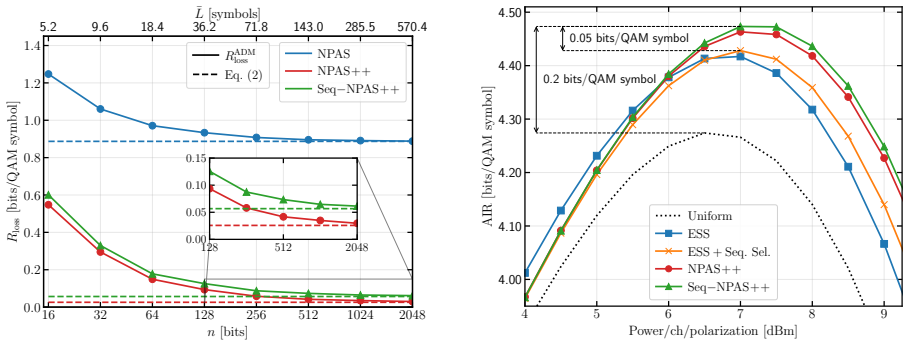
We present the first neural probabilistic amplitude shaping that outperforms existing methods while accounting for all implementation losses, using a block-less, easily implementable sequential autoregressive encoder compatible with arithmetic distribution matching, yielding reduced rate loss and higher achievable information rates.
What carries the argument
The sequential autoregressive neural encoder that produces amplitude sequences on the fly and remains compatible with arithmetic distribution matching.
If this is right
- Rate loss decreases because the encoder avoids block boundaries and fixed-length constraints.
- Achievable information rates increase once all implementation losses are subtracted from the mutual information.
- The encoder integrates with existing arithmetic distribution matching without requiring new hardware blocks.
- Sequential generation allows the shaping to adapt symbol-by-symbol rather than waiting for an entire block.
- The method applies to any modulation format where amplitude probabilities can be learned from channel statistics.
Where Pith is reading between the lines
- The same autoregressive structure could be retrained on-line when channel statistics drift, enabling continuous adaptation.
- Because the encoder is sequential, it may combine naturally with forward error correction that also processes symbols in order.
- Extending the model to jointly shape both amplitude and phase could further raise rates in channels where phase noise is the dominant impairment.
- The reduced rate loss might allow shorter codewords in the outer error-correcting code while keeping the same overall performance.
Load-bearing premise
That the neural encoder can be made block-less and fully compatible with arithmetic distribution matching while truly capturing every implementation loss without introducing hidden overheads.
What would settle it
A side-by-side hardware implementation that measures end-to-end achievable information rate for the neural method versus a conventional block-based PAS system on the same channel, with every coding and quantization loss counted.
Figures
read the original abstract
We present the first neural probabilistic amplitude shaping that outperforms existing methods while accounting for all implementation losses, using a block-less, easily implementable sequential autoregressive encoder compatible with arithmetic distribution matching, yielding reduced rate loss and higher achievable information rates.
Editorial analysis
A structured set of objections, weighed in public.
Referee Report
Summary. The manuscript claims to introduce the first neural probabilistic amplitude shaping (PAS) method that outperforms existing techniques while fully accounting for all implementation losses. It relies on a block-less sequential autoregressive neural encoder that is easily implementable and compatible with arithmetic distribution matching (ADM), yielding reduced rate loss and higher achievable information rates.
Significance. If the architectural and empirical claims hold after full validation, the work could advance practical learned shaping in communications by providing a sequential neural encoder that integrates with established ADM without block constraints, potentially improving finite-length performance and information rates.
major comments (2)
- Abstract: the central claim of outperforming existing methods while accounting for every implementation loss is presented without any supporting derivations, equations, experimental results, error bars, complexity analysis, or overhead measurements, rendering the claim impossible to assess for soundness or reproducibility.
- Abstract: the assertion that the sequential autoregressive encoder is 'easily implementable' and 'fully compatible with arithmetic distribution matching' without hidden overheads or performance trade-offs is a load-bearing assumption that requires concrete implementation details and measurements, none of which are provided.
Simulated Author's Rebuttal
We thank the referee for their review and the opportunity to clarify the manuscript. Below we respond point-by-point to the major comments on the abstract. The abstract is a concise summary; all supporting material appears in the full paper.
read point-by-point responses
-
Referee: [—] Abstract: the central claim of outperforming existing methods while accounting for every implementation loss is presented without any supporting derivations, equations, experimental results, error bars, complexity analysis, or overhead measurements, rendering the claim impossible to assess for soundness or reproducibility.
Authors: The abstract summarizes the paper's main contributions at a high level, as is standard. The supporting derivations, equations, experimental results (including error bars), complexity analysis, and overhead measurements are provided in the full manuscript, specifically in the sections on the sequential autoregressive encoder, the integration with arithmetic distribution matching, the rate-loss analysis, and the numerical evaluation. These elements enable assessment of soundness and reproducibility. revision: no
-
Referee: [—] Abstract: the assertion that the sequential autoregressive encoder is 'easily implementable' and 'fully compatible with arithmetic distribution matching' without hidden overheads or performance trade-offs is a load-bearing assumption that requires concrete implementation details and measurements, none of which are provided.
Authors: The manuscript contains the concrete implementation details, architectural description, and measurements demonstrating compatibility with arithmetic distribution matching and the absence of hidden overheads. These appear in the sections describing the block-less sequential encoder, its training procedure, and the end-to-end performance evaluation that accounts for all implementation aspects. We are prepared to expand any specific subsection if the referee identifies a particular gap. revision: no
Circularity Check
No significant circularity; derivation chain not present in provided text
full rationale
The provided manuscript text consists solely of the abstract, which states an empirical and architectural claim ('first neural probabilistic amplitude shaping that outperforms existing methods while accounting for all implementation losses, using a block-less, easily implementable sequential autoregressive encoder compatible with arithmetic distribution matching') without any equations, derivations, fitted parameters, or self-citations that could form a load-bearing chain. No self-definitional steps, fitted inputs called predictions, or uniqueness theorems are visible. The central result is presented as an empirical outcome rather than a reduction to prior inputs by construction. Per the hard rules, when the paper is self-contained against external benchmarks with no detectable circular steps, the score is 0 and steps remain empty.
Axiom & Free-Parameter Ledger
Reference graph
Works this paper leans on
-
[1]
Bandwidth effi- cient and rate-matched low-density parity-check coded modulation
G. Böcherer, F . Steiner, and P . Schulte, “Bandwidth effi- cient and rate-matched low-density parity-check coded modulation”,IEEE Transactions on Communications, vol. 63, no. 12, pp. 4651–4665, 2015.DOI: 10.1109/ TCOMM.2015.2494016
-
[2]
On shaping gain in the nonlinear fiber-optic channel
R. Dar, M. Feder, A. Mecozzi, and M. Shtaif, “On shaping gain in the nonlinear fiber-optic channel”, in2014 IEEE International Symposium on Information Theory, 2014, pp. 2794–2798.DOI:10.1109/ISIT.2014.6875343
-
[3]
Probabilistic shaping for nonlinearity tolerance
M. T. Askari and L. Lampe, “Probabilistic shaping for nonlinearity tolerance”,Journal of Lightwave Technology, vol. 43, no. 4, pp. 1565–1580, 2025.DOI: 10.1109/JLT. 2024.3521642
work page doi:10.1109/jlt 2025
-
[4]
Introducing enumerative sphere shap- ing for optical communication systems with short block- lengths
A. Amari et al., “Introducing enumerative sphere shap- ing for optical communication systems with short block- lengths”,Journal of Lightwave Technology, vol. 37, no. 23, pp. 5926–5936, 2019.DOI: 10.1109/JLT.2019. 2943938
-
[5]
Probabilistic am- plitude shaping and nonlinearity tolerance: Analysis and sequence selection method
M. T. Askari, L. Lampe, and J. Mitra, “Probabilistic am- plitude shaping and nonlinearity tolerance: Analysis and sequence selection method”,Journal of Lightwave Tech- nology, vol. 41, no. 17, pp. 5503–5517, 2023.DOI: 10. 1109/JLT.2023.3264032
-
[6]
Analysis of nonlinear fiber interactions for finite-length constant-composition se- quences
T. Fehenberger, D. S. Millar, T. Koike-Akino, K. Kojima, K. Parsons, and H. Griesser, “Analysis of nonlinear fiber interactions for finite-length constant-composition se- quences”,Journal of Lightwave Technology, vol. 38, no. 2, pp. 457–465, 2020.DOI: 10 . 1109 / JLT . 2019 . 2937926
2020
-
[7]
New lower bounds on the capacity of optical fiber chan- nels via optimized shaping and detection
M. Secondini, S. Civelli, E. Forestieri, and L. Z. Khan, “New lower bounds on the capacity of optical fiber chan- nels via optimized shaping and detection”,Journal of Lightwave Technology, vol. 40, no. 10, pp. 3197–3209, 2022.DOI:10.1109/JLT.2022.3148322
-
[8]
Sequence- selection-based constellation shaping for nonlinear channels
S. Civelli, E. Forestieri, and M. Secondini, “Sequence- selection-based constellation shaping for nonlinear channels”,Journal of Lightwave Technology, vol. 42, no. 3, pp. 1031–1043, 2024.DOI: 10.1109/JLT.2023. 3332487
-
[9]
Cost-gain analysis of se- quence selection for nonlinearity mitigation
S. Civelli and M. Secondini, “Cost-gain analysis of se- quence selection for nonlinearity mitigation”, inOpti- cal fiber communication conference, Optica Publishing Group, 2025, Tu2F–7.DOI: 10.1364/OFC.2025.Tu2F.7
-
[10]
Arithmetic distribution match- ing
S. Baur and G. Böcherer, “Arithmetic distribution match- ing”, inInternational ITG Conference on Systems, Com- munications and Coding (SGC), 2015, pp. 1–6
2015
-
[11]
Neural prob- abilistic amplitude shaping for nonlinear fiber channels
M. T. Askari, L. Lampe, and A. Ghazisaeidi, “Neural prob- abilistic amplitude shaping for nonlinear fiber channels”, arXiv preprint arXiv:2602.02716, 2026
-
[12]
Neural probabilistic shaping: Joint distribution learning for op- tical fiber communications
M. T. Askari, L. Lampe, and A. Ghazisaeidi, “Neural probabilistic shaping: Joint distribution learning for op- tical fiber communications”, in2025 European Confer- ence on Optical Communications (ECOC), IEEE, 2025, pp. 1–4.DOI:10.1109/ECOC66593.2025.11263051
-
[13]
Joint learning of probabilistic and geometric shaping for coded modulation systems
F . A. Aoudia and J. Hoydis, “Joint learning of probabilistic and geometric shaping for coded modulation systems”, inIEEE Global Communications Conference (Globe- com), 2020, pp. 1–6.DOI: 10 . 1109 / GLOBECOM42002 . 2020.9348032
-
[14]
Categorical reparame- terization with gumbel-softmax
E. Jang, S. Gu, and B. Poole, “Categorical reparame- terization with gumbel-softmax”, inInternational Confer- ence on Learning Representations (ICLR), 2017. [On- line]. Available: https://openreview.net/forum?id= rkE3y85ee
2017
-
[15]
Estimating or Propagating Gradients Through Stochastic Neurons for Conditional Computation
Y . Bengio, N. Léonard, and A. Courville, “Esti- mating or propagating gradients through stochastic neurons for conditional computation”,arXiv preprint arXiv:1308.3432, 2013
work page internal anchor Pith review Pith/arXiv arXiv 2013
-
[16]
Log- likelihood ratio calculation for pilot symbol assisted coded modulation schemes with residual phase noise
P . Neshaastegaran and A. H. Banihashemi, “Log- likelihood ratio calculation for pilot symbol assisted coded modulation schemes with residual phase noise”, IEEE Transactions on Communications, vol. 67, no. 5, pp. 3782–3790, 2019.DOI: 10 . 1109 / TCOMM . 2019 . 2896190
2019
-
[17]
Long short-term memory.Neural Computation, 9(8):1735–1780, 1997
S. Hochreiter and J. Schmidhuber, “Long short-term memory”,Neural Computation, vol. 9, no. 8, pp. 1735– 1780, 1997.DOI:10.1162/neco.1997.9.8.1735
-
[18]
Attention is all you need
A. Vaswani et al., “Attention is all you need”,Advances in neural information processing systems, vol. 30, 2017
2017
-
[19]
Ro- former: Enhanced transformer with rotary position em- bedding
J. Su, M. Ahmed, Y . Lu, S. Pan, W. Bo, and Y . Liu, “Ro- former: Enhanced transformer with rotary position em- bedding”,Neurocomputing, vol. 568, p. 127 063, 2024
2024
-
[20]
GLU Variants Improve Transformer
N. Shazeer, “Glu variants improve transformer”,arXiv preprint arXiv:2002.05202, 2020
work page internal anchor Pith review Pith/arXiv arXiv 2002
-
[21]
Perturbation-based se- quence selection for probabilistic amplitude shaping
M. T. Askari and L. Lampe, “Perturbation-based se- quence selection for probabilistic amplitude shaping”, inEuropean Conference on Optical Communication (ECOC), 2024, pp. 846–849
2024
discussion (0)
Sign in with ORCID, Apple, or X to comment. Anyone can read and Pith papers without signing in.