Taming quantum interference: a route to high electrical conductance in carbon nanotube assemblies
Pith reviewed 2026-06-29 10:54 UTC · model grok-4.3
The pith
Junction architecture controls quantum interference to achieve high conductance in carbon nanotube assemblies
A machine-rendered reading of the paper's core claim, the machinery that carries it, and where it could break.
Core claim
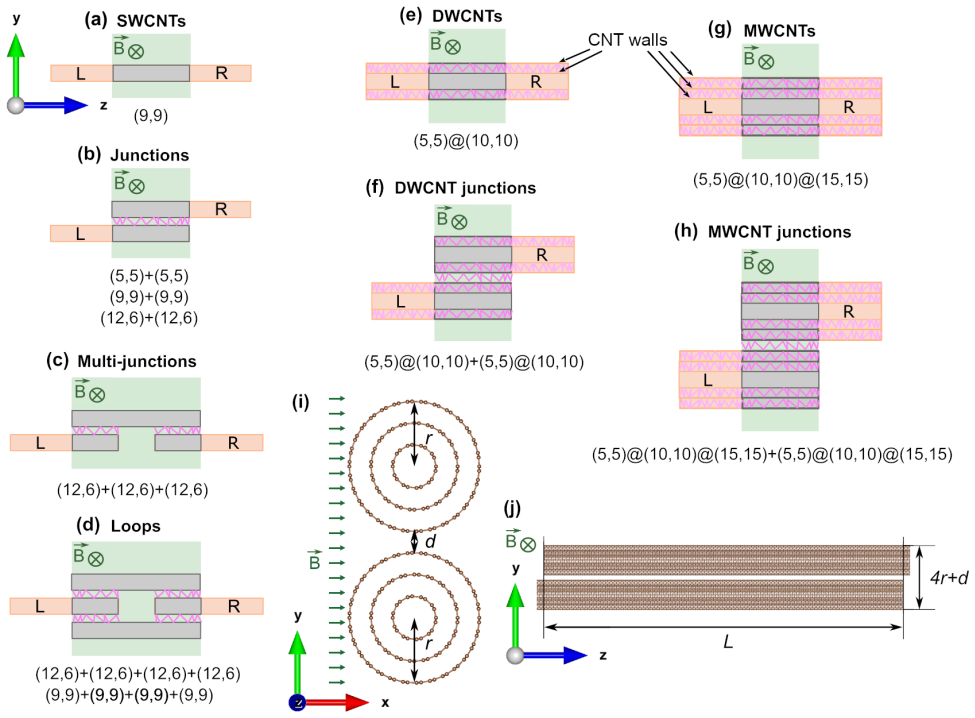
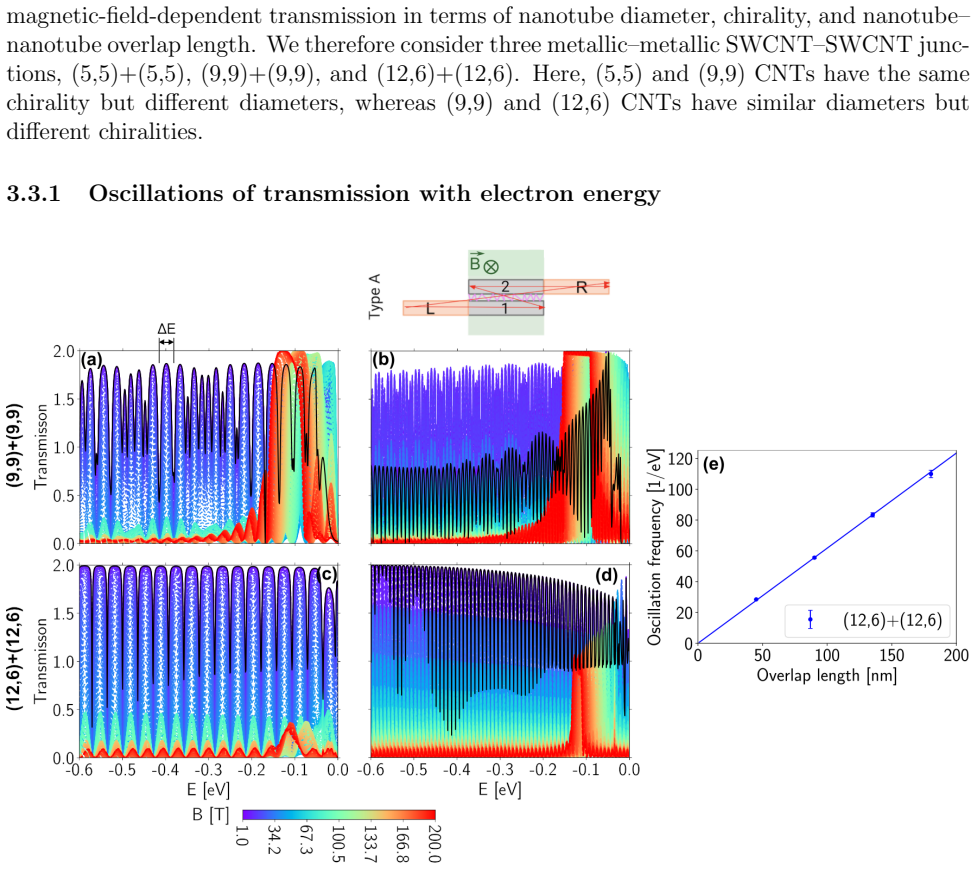
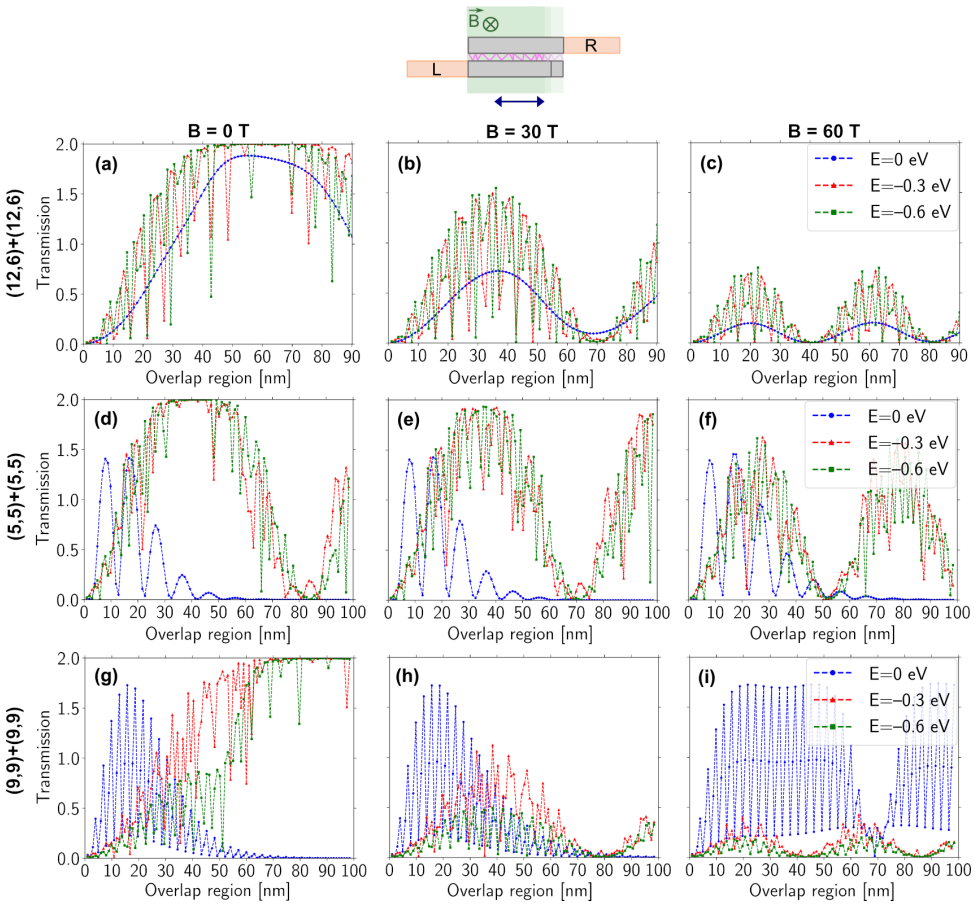
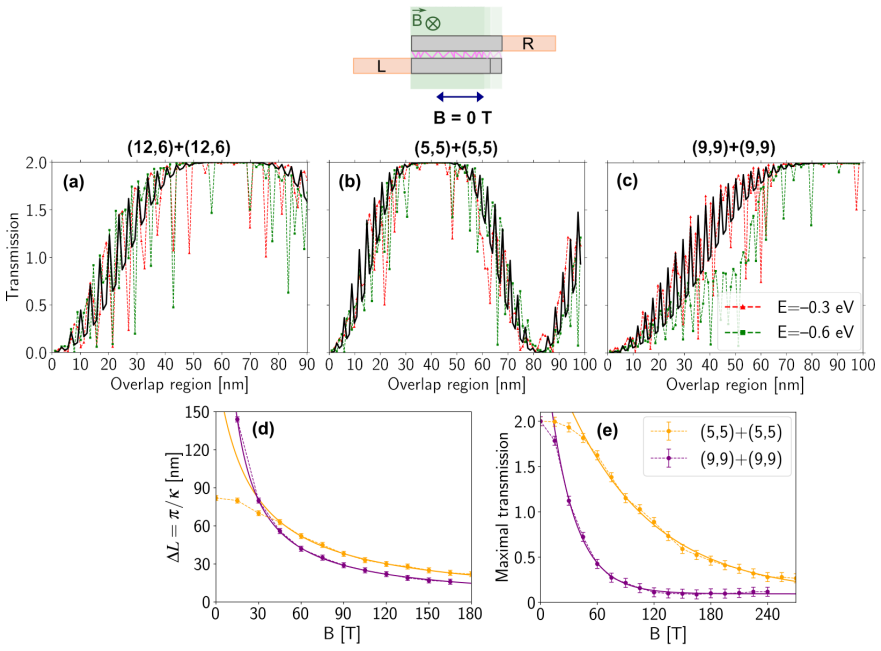
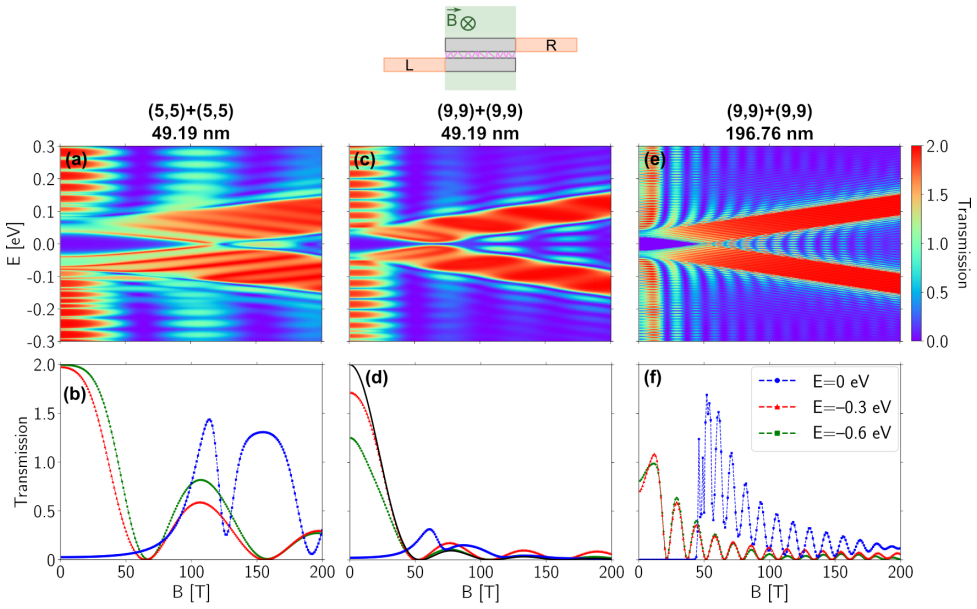
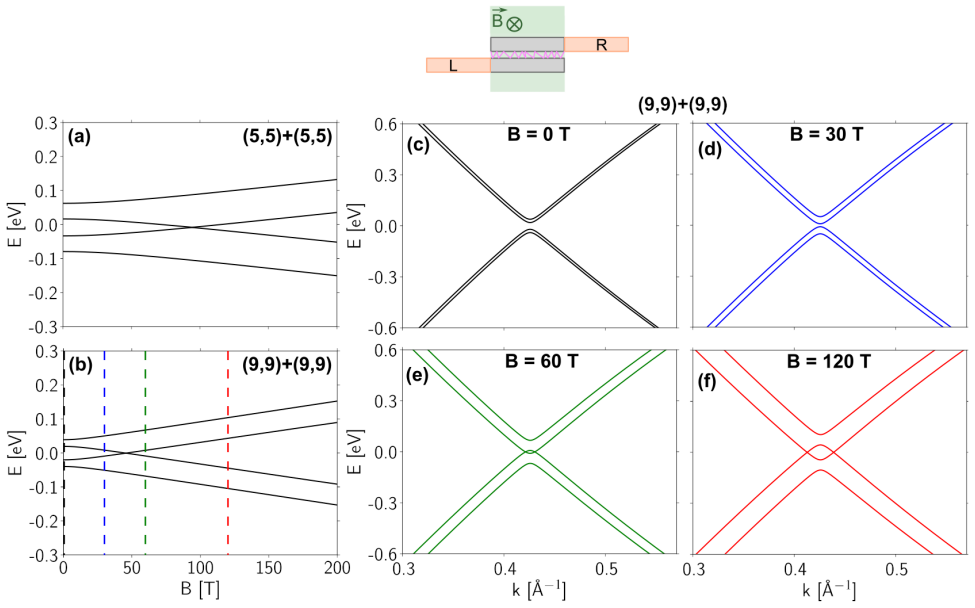
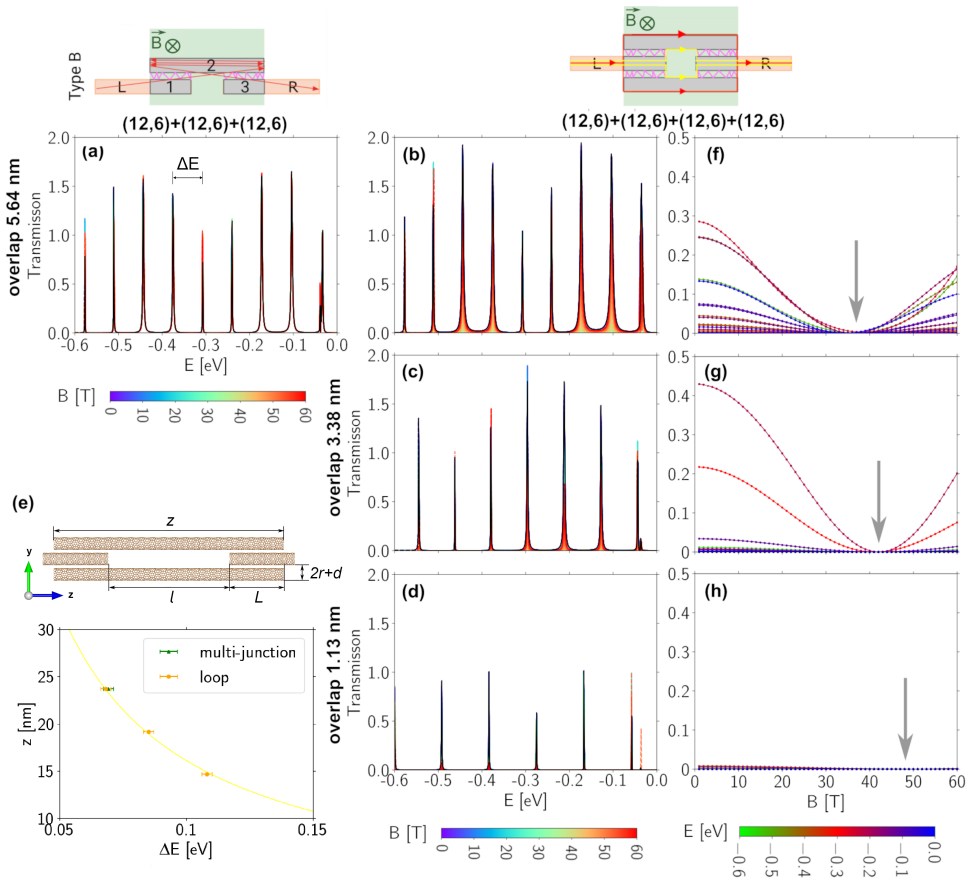
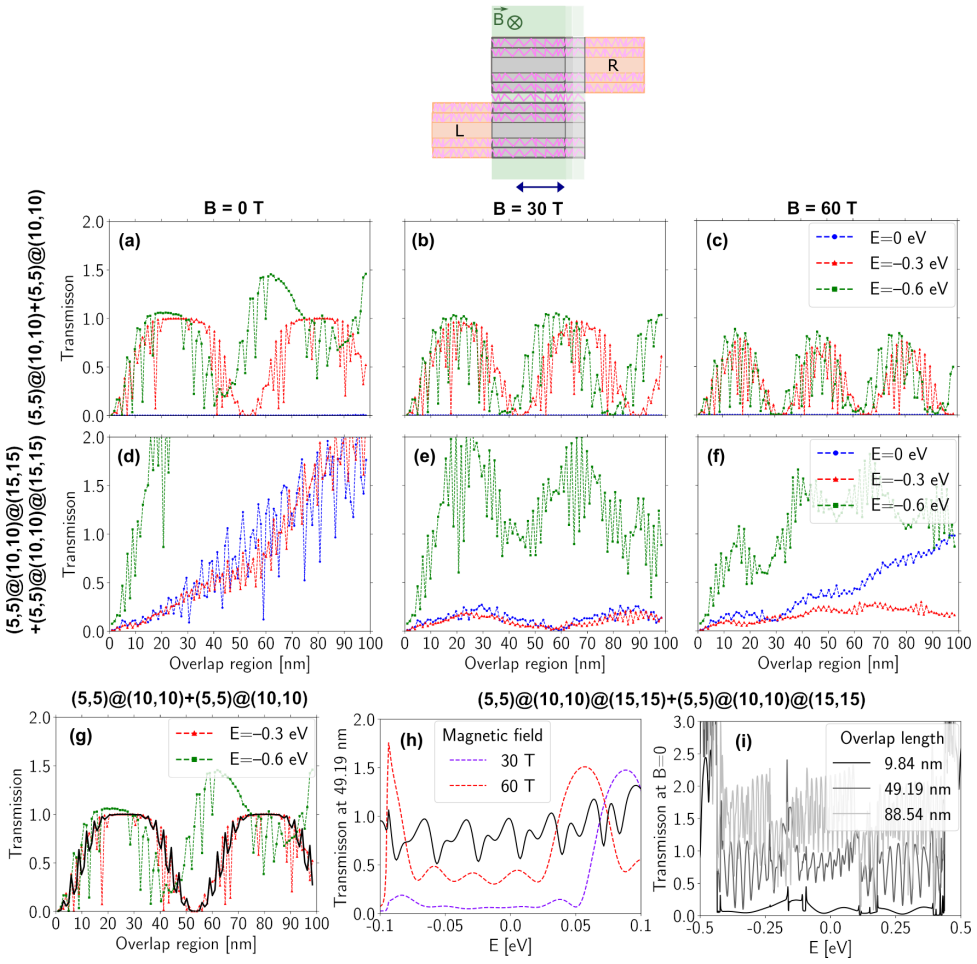
By modeling coherent transport through single and multiple SWCNT contacts as well as DWCNT and TWCNT junctions under perpendicular magnetic fields, the authors show that transmission is shaped by interference effects that depend on junction type: overlap length, doping, and field strength determine high-transmission windows in simple SWCNT junctions, gateway states can enhance conductance when subbands are gapped, magnetic fields can lift blockade, multi-junctions generate resonant filtering, DWCNT junctions remain outer-wall dominated, and TWCNT junctions become multi-channel and more field-sensitive. This framework explains the conductance differences observed between SWCNT and MWCNT fibre
What carries the argument
The electron-waveguide picture for quasi-1D nanoscale junctions, which identifies transport regimes set by overlap length, doping, and magnetic field and interprets CNT-specific effects such as gateway states and field-restored transmission
If this is right
- High-transmission windows in single SWCNT-SWCNT junctions are set mainly by overlap length, doping, and magnetic field.
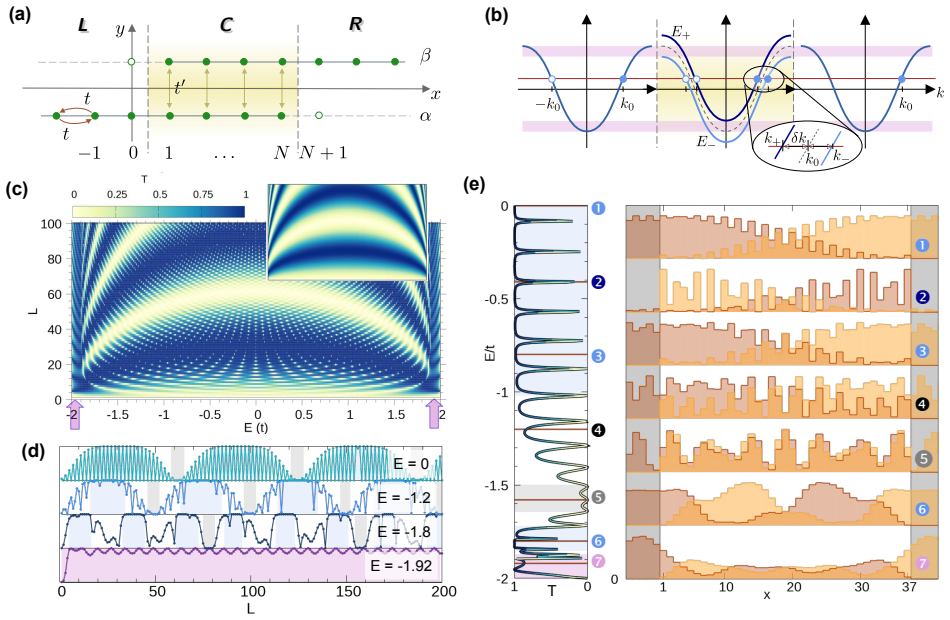
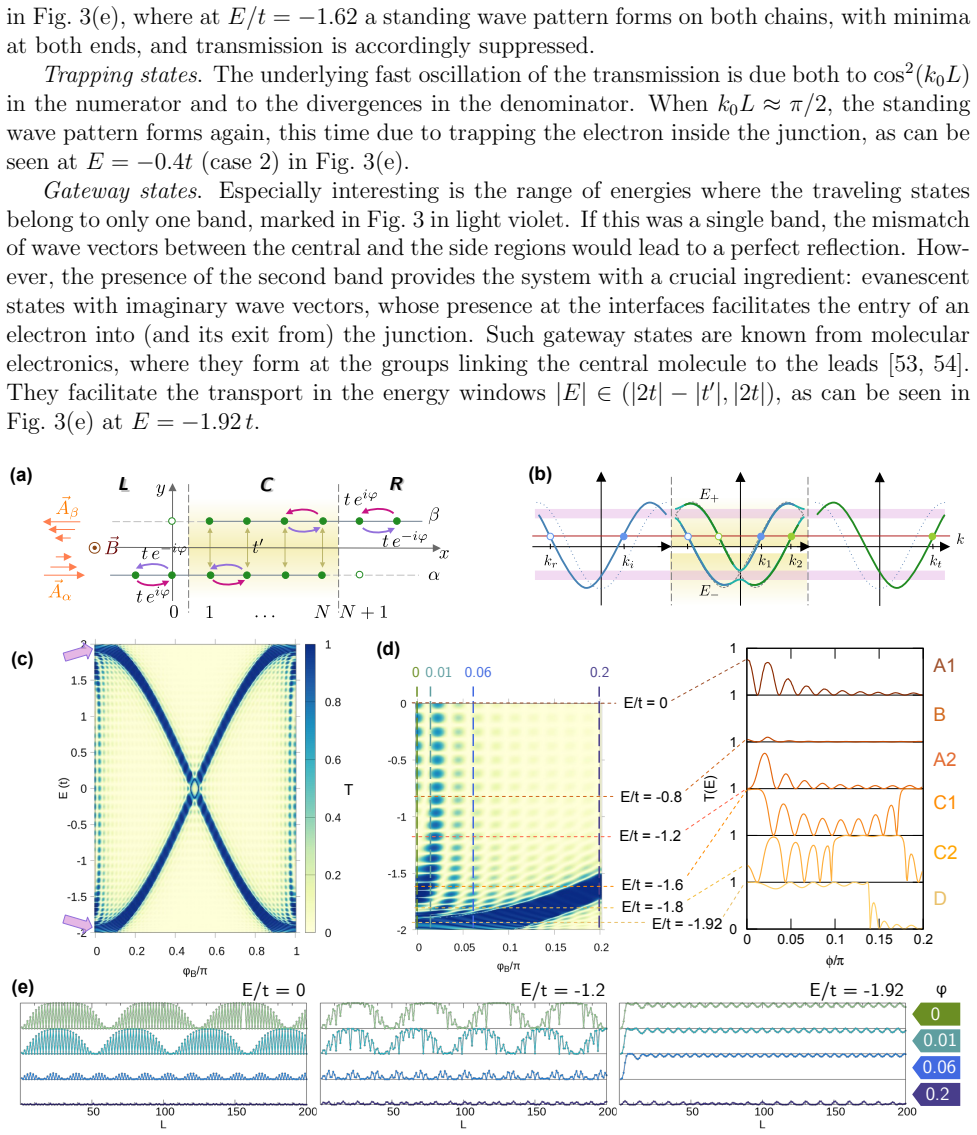
- Gateway states enhance conductance when some CNT subbands are gapped and a magnetic field can restore transmission by lifting an interference blockade.
- Multi-junction architectures generate resonant filtering while additional walls redistribute transmission instead of acting as independent channels.
- DWCNT junctions remain outer-wall dominated and SWCNT-like whereas TWCNT junctions become genuinely multi-channel and more field-sensitive.
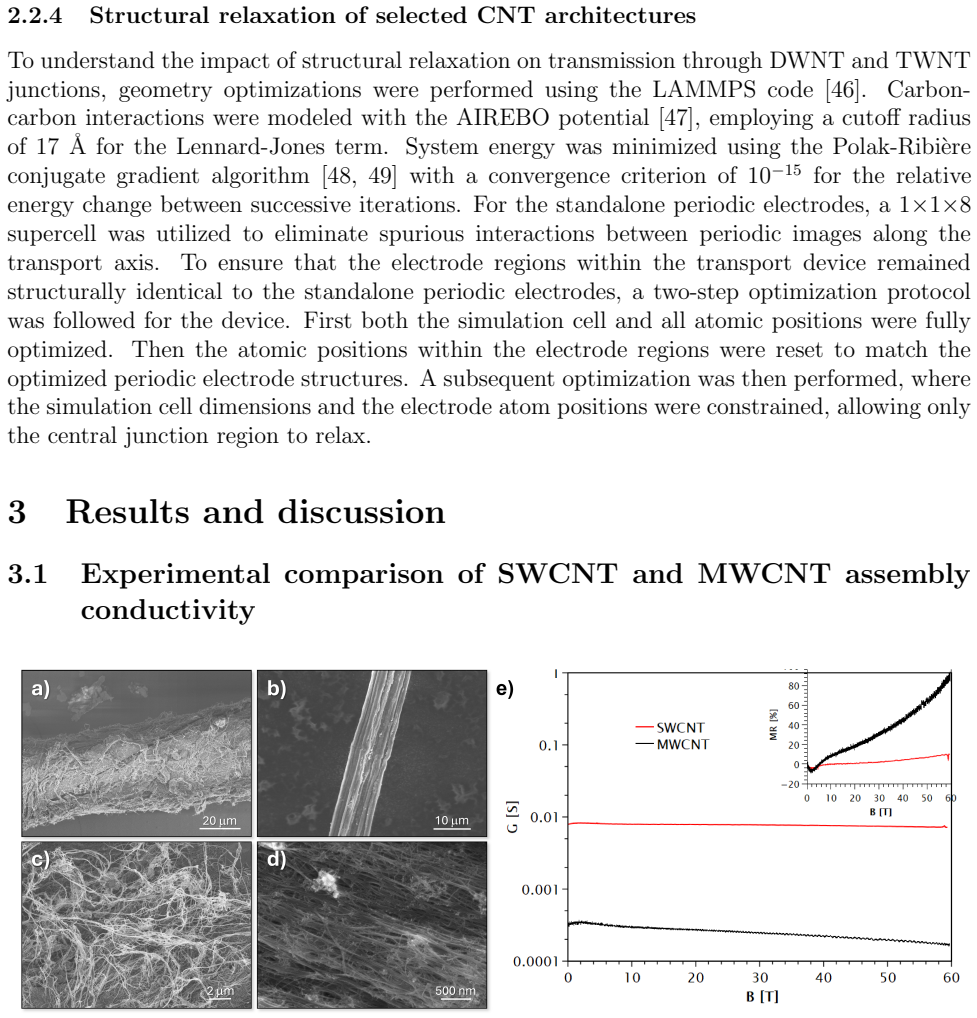
- The calculated behaviors explain the lower and more field-sensitive conductance of MWCNT fibres relative to SWCNT fibres.
Where Pith is reading between the lines
- The selective role of added paths implies that junction complexity could be deliberately engineered for resonant filtering functions in nanoscale interconnects.
- Comparing predictions with measurements on fibres that have deliberately varied junction densities would test whether the idealized junction results scale to macroscopic assemblies.
- The outer-wall dominance in DWCNT versus multi-channel behavior in TWCNT suggests a practical criterion for choosing wall number when field stability is required.
- Similar interference-control strategies may apply to other quasi-one-dimensional conductor networks, such as those formed by nanowires or nanoribbons.
Load-bearing premise
The atomistic tight-binding NEGF calculations performed on idealized, ordered junctions capture the dominant coherent transport physics in real, disordered CNT assemblies.
What would settle it
Measuring the magnetic-field dependence of conductance in SWCNT fibres versus MWCNT fibres that have been engineered with controlled junction overlap lengths and comparing the observed field sensitivity to the predicted higher sensitivity for multi-walled structures.
Figures
read the original abstract
Miniaturized electronics require lightweight conductors that maintain high conductance under demanding conditions. CNT networks are promising candidates, but their transport is governed by inter-nanotube junctions where electron waves interfere. Controlling this interference requires understanding how junction architecture shapes transmission. We explore coherent transport through experimentally relevant junctions, from single and multiple single-walled CNT (SWCNT) contacts to double-walled CNT (DWCNT) and triple-walled CNT (TWCNT) junctions, with atomistic tight-binding non-equilibrium Green's-function calculations, also under a perpendicular magnetic field. We use analytically solvable minimal models to identify transport regimes expected for quasi-1D nanoscale junctions, and an electron-waveguide picture to interpret their CNT-specific manifestations. For single SWCNT--SWCNT junctions, high-transmission windows are set mainly by overlap length, doping and magnetic field. Gateway states can enhance conductance when some CNT subbands are gapped, and in some cases a magnetic field can restore transmission by lifting an interference blockade. In more complex architectures, added paths become selective: multi-junctions generate resonant filtering, while additional walls redistribute transmission instead of acting as independent channels. DWCNT junctions remain outer-wall dominated and SWCNT-like, whereas TWCNT junctions become genuinely multi-channel and more field-sensitive. This explains the lower, more field-sensitive conductance of multi-walled CNT (MWCNT) fibres, in accord with our ultrahigh-field measurements on SWCNT and MWCNT fibres. Ultimately, this work turns microscopic interference mechanisms into design principles for high-conductance, field-stable CNT conductors.
Editorial analysis
A structured set of objections, weighed in public.
Referee Report
Summary. The manuscript uses atomistic tight-binding NEGF calculations on idealized SWCNT, DWCNT and TWCNT junctions (varying overlap length, doping and perpendicular B-field) together with minimal analytically solvable models and an electron-waveguide interpretation to identify transmission regimes. It concludes that interference mechanisms can be turned into design rules for high-conductance, field-stable CNT conductors and that the results explain the lower, more field-sensitive conductance observed in MWCNT fibres versus SWCNT fibres, in accord with the authors' ultrahigh-field measurements.
Significance. If the mapping from single-junction transmission windows to ensemble transport in real disordered fibres can be established, the work would supply concrete microscopic guidance for junction engineering. The absence of any explicit aggregation step (percolation, effective-medium or disordered-network simulation) that demonstrates survival of the reported high-transmission windows under realistic junction statistics, defects and series/parallel paths leaves the central design-principle claim on an unvalidated extrapolation.
major comments (1)
- [Abstract] Abstract (final paragraph) and the corresponding discussion of fibre data: the assertion that the idealized-junction results 'explain' the measured conductance difference between SWCNT and MWCNT fibres and supply 'design principles' for real assemblies requires an explicit link (percolation model, effective-medium theory or ensemble simulation) showing that the identified transmission windows survive random junction statistics, defects and multi-path averaging. No such aggregation calculation is described.
Simulated Author's Rebuttal
We thank the referee for the detailed review and constructive feedback. We address the central concern regarding the link between junction-level results and fibre-scale transport below.
read point-by-point responses
-
Referee: [Abstract] Abstract (final paragraph) and the corresponding discussion of fibre data: the assertion that the idealized-junction results 'explain' the measured conductance difference between SWCNT and MWCNT fibres and supply 'design principles' for real assemblies requires an explicit link (percolation model, effective-medium theory or ensemble simulation) showing that the identified transmission windows survive random junction statistics, defects and multi-path averaging. No such aggregation calculation is described.
Authors: We acknowledge that the manuscript does not contain an explicit aggregation calculation (percolation, effective-medium or disordered-network simulation) that would quantitatively demonstrate survival of the high-transmission windows under realistic junction statistics. Our work is deliberately scoped to the microscopic level: atomistic NEGF calculations on idealized but experimentally relevant junctions, supported by minimal analytic models and an electron-waveguide interpretation. The design principles are therefore formulated as junction-engineering guidelines derived directly from the identified transmission regimes (overlap length, doping, magnetic-field windows, gateway states, and channel redistribution in multi-wall structures). The statement that the results 'explain' the fibre data is qualitative: the TWCNT calculations show that additional walls produce genuinely multi-channel, more field-sensitive transport, in contrast to the outer-wall-dominated, SWCNT-like behavior of DWCNT junctions; this trend is consistent with the lower, more field-sensitive conductance measured in MWCNT versus SWCNT fibres. While a full ensemble simulation would strengthen the extrapolation, it lies outside the present scope and would constitute a separate study. We have therefore not added such a calculation. revision: no
Circularity Check
No significant circularity; computational modeling study with independent derivation chain
full rationale
The paper's core consists of atomistic tight-binding NEGF calculations on idealized SWCNT/DWCNT/TWCNT junctions, supplemented by analytically solvable minimal models and an electron-waveguide interpretation. These steps generate transmission windows, gateway states, and field effects directly from the Hamiltonian and geometry inputs without any fitted parameters being relabeled as predictions. The abstract notes accord with the authors' own ultrahigh-field fibre measurements, but this is presented as consistency check rather than a load-bearing self-citation that defines the result. No self-definitional loops, ansatz smuggling, or renaming of known results appear in the derivation; the mapping from microscopic interference to design principles is generated by the explicit calculations rather than presupposed.
Axiom & Free-Parameter Ledger
axioms (2)
- domain assumption Tight-binding approximation accurately describes low-energy electronic states of CNTs
- domain assumption Coherent transport dominates over incoherent scattering at the junctions studied
Reference graph
Works this paper leans on
-
[1]
Radushkevich and V
L. Radushkevich and V. Lukyanovich. O strukture ugleroda, obrazuyushchegosya pri ter- micheskom razlozhenii okisi ugleroda na zheleznom kontakte. Zhurnal Fizicheskoi Khimii , 26:88–95, 1952
1952
-
[2]
S. Iijima. Helical microtubules of graphitic carbon. Nature, 354:56–58, 1991
1991
-
[3]
M. S. Dresselhaus, G. Dresselhaus, and P. Avouris, editors. Carbon Nanotubes: Synthesis, Structure, Properties, and Applications, volume 80 of Topics in Applied Physics. Springer, 2001
2001
-
[4]
Saito, G
R. Saito, G. Dresselhaus, and M. S. Dresselhaus. Physical Properties of Carbon Nanotubes. Imperial College Press, London, 1998
1998
-
[5]
Z. Tao, Y. Zhao, Y. Wang, and G. Zhang. Recent Advances in Carbon Nanotube Tech- nology: Bridging the Gap from Fundamental Science to Wide Applications. C, 10(3), 2024
2024
-
[6]
K. J. Hughes, K. A. Iyer, R. E. Bird, J. Ivanov, S. Banerjee, G. Georges, and Q. A. Zhou. Review of carbon nanotube research and development: materials and emerging applications. ACS Applied Nano Materials , 7(16):18695–18713, 2024
2024
-
[7]
Popov, Irina V
Andrey M. Popov, Irina V. Lebedeva, Andrey A. Knizhnik, Yurii E. Lozovik, Nikolai A. Poklonski, Andrei I. Siahlo, Sergey A. Vyrko, and Sergey V. Ratkevich. Force and magnetic field sensor based on measurement of tunneling conductance between ends of coaxial carbon nanotubes. Computational Materials Science , 92:84–91, 2014
2014
-
[8]
P. L. McEuen, M. S. Fuhrer, and H. Park. Single-walled carbon nanotube electronics. IEEE Transactions on Nanotechnology, 1(1):78–85, 2002
2002
-
[9]
Laird, Ferdinand Kuemmeth, Gary A
Edward A. Laird, Ferdinand Kuemmeth, Gary A. Steele, Kasper Grove-Rasmussen, Jesper Nyg˚ ard, Karsten Flensberg, and Leo P. Kouwenhoven. Quantum transport in carbon nanotubes. Rev. Mod. Phys., 87:703–764, Jul 2015
2015
-
[10]
Zhang et al
Y. Zhang et al. Selective synthesis of semiconducting swcnts. Nature, 438:201–204, 2005
2005
-
[11]
Y. Tian, A. G. Nasibulin, B. Aitchison, T. Nikitin, J. Pfaler, H. Jiang, Z. Zhu, L. Khri- achtchev, D. P. Brown, and E. I. Kauppinen. Controlled synthesis of single-walled carbon nanotubes in an aerosol reactor. The Journal of Physical Chemistry C , 115:7309–7318, 2011
2011
-
[12]
Nakai, K
Y. Nakai, K. Honda, K. Yanagi, H. Kataura, T. Kato, T. Yamamoto, and Y. Maniwa. Giant seebeck coefficient in semiconducting single-wall carbon nanotube film. Appl. Phys. Express, 7:025103, 2014
2014
-
[13]
Hayashi, Y
D. Hayashi, Y. Nakai, H. Kyakuno, N. Hongo, Y. Miyata, K. Yanagi, and Y. Maniwa. Thermoelectric properties of single-wall carbon nanotube networks. Japanese Journal of Applied Physics, 58:075003, 2019
2019
-
[14]
Hayashi, Y
D. Hayashi, Y. Nakai, H. Kyakuno, Y. Miyata, K. Yanagi, and Y. Maniwa. Temperature dependence of the seebeck coefficient for mixed semiconducting and metallic single-wall carbon nanotube bundles. Appl. Phys. Express , 13:015001, 2020. 47
2020
-
[15]
A. Wang, W. Xing, N. Xu, and Y. Cheng. Carbon Nanotube Interconnect Optimiza- tions With Bayesian Neural Network and Bayesian Optimization. IEEE Transactions on Computer-Aided Design of Integrated Circuits and Systems , 44:4538, 2025
2025
-
[16]
Gabbett, A
C. Gabbett, A. G. Kelly, E. Coleman, L. Doolan, T. Carey, K. Synnatschke, S. Liu, A. Dawson, D. O’Suilleabhain, J. Munuera, E. Caffrey, J. B. Boland, Z. Sofer, G. Ghosh, S. Kinge, L. D. A. Siebbeles, N. Yadav, J. K. Vij, M. A. Aslam, A. Matkovic, and J. N. Coleman. Understanding how junction resistances impact the conduction mechanism in nano-networks. Na...
2024
-
[17]
A. E. Lekawa-Raus, J. S. Bulmer, T. Kulka, M. Marganska, N. Papior, D. G Rickel, F. F. Balakirev, J. A. Majewski, K. Koziol, and K. Z. Milowska. Quantum limits of electronic transport in nanostructured macroscopic conductors. arXiv preprint, 2026
2026
-
[18]
Bourlon, C
B. Bourlon, C. Miko, L. Forr´ o, D. C. Glattli, and A. Bachtold. Determination of the inter- shell conductance in multiwalled carbon nanotubes. Physical Review Letters , 93:176806, 2004
2004
-
[19]
Agrawal, M
S. Agrawal, M. S. Raghuveer, R. Ramprasad, and G. Ramanath. Multishell carrier trans- port in multiwalled carbon nanotubes. IEEE Transactions on Nanotechnology , 6(6):722– 726, 2007
2007
-
[20]
Marganska, D
M. Marganska, D. R. Schmid, A. Dirnaichner, P. L. Stiller, Ch. Strunk, M. Grifoni, and A. K. H¨ uttel. Shaping electron wave functions in a carbon nanotube with a parallel magnetic field. Phys. Rev. Lett., 122:086802, 2019
2019
-
[21]
Localization induced by magnetic fields in carbon nanotubes
Magdalena Marganska, Miriam del Valle, Sung Ho Jhang, Christoph Strunk, and Milena Grifoni. Localization induced by magnetic fields in carbon nanotubes. Phys. Rev. B , 83:193407, 2011
2011
-
[22]
Bulmer, C
J. Bulmer, C. Kovacs, T. Bullard, C. Ebbing, Haugan. T, G. Pokharel, S. D. Wilson, F. F. Balakirev, O. A. Valenzuela, M. A. Susner, D. Turner, P. Fu, T. Kulka, J. Majewski, I. Lebedeva, K. Z. Milowska, A. Lekawa-Raus, and M. Marganska. Competing conduction mechanisms in high performance carbon nanotube fibers. Carbon, 248:121162, 2026
2026
-
[23]
R. M. Sundaram, K. Koziol, and A. H. Windle. Continuous direct spinning of fibers of single-walled carbon nanotubes with metallic chirality. Advanced Materials, 23:5064, 2011
2011
-
[24]
Lekawa-Raus, L
A. Lekawa-Raus, L. Kurzepa, X. Peng, and K. Koziol. Towards the development of carbon nanotube based wires. Carbon, 68:597–609, 2014
2014
-
[25]
Lekawa-Raus, J
A. Lekawa-Raus, J. Patmore, L. Kurzepa, J. Bulmer, and K. Koziol. Electrical properties of carbon nanotube based fibers and their future use in electrical wiring. Advanced Functional Materials, 24(24):3661–3682, 2014
2014
-
[26]
J. S. Bulmer, A. Lekawa-Raus, D. G. Rickel, F. F. Balakirev, and K. K. Koziol. Ex- treme magneto-transport of bulk carbon nanotubes in sorted electronic concentrations and aligned high performance fiber. Scientific Reports, 7:12193, 2017
2017
-
[27]
E. H. Haroz, W. D. Rice, B Y. Lu, S. Ghosh, R. H. Hauge, R. B. Weisman, S. K. Doorn, and J. Kono. Enrichment of armchair carbon nanotubes via density gradient ultracentrifu- gation: Raman spectroscopy evidence. ACS Nano, 4:1955–1962, 2010. 48
1955
-
[28]
A Fagan, C
J. A Fagan, C. Y. Khripin, C. A. Silvera Batista, E. H. Haroz J. R. Simpson, A. R. Hight Walker, and M. Zheng. Isolation of specific small-diameter single-wall carbon nanotube species via aqueous two-phase extraction. Advanced Materials, 26:2800–2804, 2014
2014
-
[29]
Yomogida, T
Y. Yomogida, T. Tanaka, M. Zhang, M. Yudasaka, X. Wei, and H. Kataura. Industrial- scale separation of high-purity single-chirality single-wall carbon nanotubes for biological imaging. Nature Communications, 7:12056, 2016
2016
-
[30]
W. Gao, D. Adinehloo, X. Li, A. Mojibpour, Y. Yomogida, A. Hirano, T. Tanaka, H. Kataura, M. Zheng, V. Perebeinos, and J. Kono. Band structure dependent electronic localization in macroscopic films of single-chirality single-wall carbon nanotubes. Carbon, 183:774, 2021
2021
-
[31]
K. E. Moore and M. Pasquali. Double-walled carbon nanotube processing. Advanced Materials, 27:3107–3128, 2015
2015
-
[32]
Fujisawa, H
K. Fujisawa, H. J. Kim, S. H. Go, H. Muramatsu, T. Hayashi, M. Endo, T. C. Hirschmann, M. S. Dresselhaus, Y. A. Kim, and P. T. Araujo. A review of double-walled and triple- walled carbon nanotube synthesis and applications. Applied Sciences, 6:109, 2016
2016
-
[33]
L. X. Benedict, N. G. Chopra, M. L. Cohen, A. Zettl, S. G. Louie, and V. H. Crespi. Microscopic Determination of the Interlayer Binding Energy in Graphite. Chem. Phys. Lett., 286:490, 1998
1998
-
[34]
Nemec and G
N. Nemec and G. Cuniberti. Hofstadter butterflies of carbon nanotubes: Pseudofractality of the magnetoelectronic spectrum. Phys. Rev. B , 74:165411, 2006
2006
-
[35]
Nanot, W
S. Nanot, W. Escoffier, B. Lassagne, J.-M. Broto, and B. Raquet. Exploring the electronic band structure of individual carbon nanotubes under 60 T. C. R. Physique , 10:268–282, 2009
2009
-
[36]
Hancock, A
Y. Hancock, A. Uppstu, K. Saloriutta, A. Harju, and M. J. Puska. Generalized tight- binding transport model for graphene nanoribbon-based systems. Phys. Rev. B, 81:245402, 2010
2010
-
[37]
Rudolf E. Peierls. Zur Theorie des Diamagnetismus von Leitungselektronen. Zeitschrift f¨ ur Physik, 80:763–791, 1933
1933
-
[38]
Convenient Peierls phase choice for periodic atomistic systems under magnetic field
Alessandro Cresti. Convenient Peierls phase choice for periodic atomistic systems under magnetic field. Phys. Rev. B , 103:045402, Jan 2021
2021
-
[39]
Aharonov and D
Y. Aharonov and D. Bohm. Significance of electromagnetic potentials in the quantum theory. Phys. Rev., 115:485–491, 1959
1959
-
[40]
N. R. Papior, N. Lorente, T. Frederiksen, A. Garc´ ıa, and M. Brandbyge. Improvements on non-equilibrium and transport Green function techniques: The next-generation transiesta. Computer Physics Communications , 212:8–24, 2017
2017
-
[41]
Density-functional method for nonequilibrium electron transport
Mads Brandbyge, Jos´ e-Luis Mozos, Pablo Ordej´ on, Jeremy Taylor, and Kurt Stokbro. Density-functional method for nonequilibrium electron transport. Phys. Rev. B, 65:165401, Mar 2002
2002
-
[42]
sisl: v0.14.0 (software), 2023
Nick Papior. sisl: v0.14.0 (software), 2023. Zenodo software release
2023
-
[43]
Datta, editor
S. Datta, editor. Electronic Transport in Mesoscopic Systems. Cambridge University Press, Cambridge, 1995. 49
1995
-
[44]
J. M. Soler, E. Artacho, J. D. Gale, A. Garc´ ıa, J. Junquera, P. Ordej´ on, and D. S´ anchez- Portal. The SIESTA method for ab initio order-n materials simulation. Journal of Physics: Condensed Matter, 14(11):2745–2779, 2002
2002
-
[45]
Garc´ ıa, N
A. Garc´ ıa, N. Papior, A. Akhtar, E. Artacho, V. Blum, E. Bososni, P. Brandimarte, M. Brandbyge, J. I. Cerda, F. Corsetti, R. Cuadrado, V. Dikan, J. Ferrer, J. Gale, P. Garcia-Fernandez, V. M. Garcia-Suarez, S. Garcia, G. Huhs, S. Illera, R. Korytar, P. Koval, I. Lebedeva, L. Lin, P. Lopez-Tarifa S. G. Mayo, S. Mohr, P. Ordejon, A. Post- nikov, Y. Poulli...
2020
-
[46]
Thompson, H
Aidan P. Thompson, H. Metin Aktulga, Richard Berger, Dan S. Bolintineanu, W. Michael Brown, Paul S. Crozier, Pieter J. in ’t Veld, Axel Kohlmeyer, Stan G. Moore, Trung Dac Nguyen, Ray Shan, Mark J. Stevens, Julien Tranchida, Christian Trott, and Steven J. Plimpton. LAMMPS – a flexible simulation tool for particle-based materials modeling at the atomic, me...
2022
-
[47]
Stuart, Alan B
Steven J. Stuart, Alan B. Tutein, and Judith A. Harrison. A reactive potential for hydro- carbons with intermolecular interactions. J. Chem. Phys. , 112(14):6472–6486, 2000
2000
-
[48]
Polak and G
E. Polak and G. Ribi` ere. Note sur la convergence de m´ ethodes de directions conjugu´ ees. Revue fran¸ caise d’informatique et de recherche op´ erationnelle. S´ erie rouge, 3:35–43, 1969
1969
-
[49]
Press, Saul A
William H. Press, Saul A. Teukolsky, William T. Vetterling, and Brian P. Flannery.Numer- ical Recipes: The Art of Scientific Computing . Cambridge University Press, Cambridge, UK, 3rd edition, 2007
2007
-
[50]
Lepak-Kuc, L
S. Lepak-Kuc, L. Nowicki, A. Lekawa-Raus, and M. Jakubowska. Multifiller carbon nan- otube, graphene, and carbon black composite filaments: A path to versatile electromate- rials. MRS Bulletin , 49(11):1092–1099, 2024
2024
-
[51]
J. Chen, A. Lekawa-Raus, J. Trevarthen, T. Gizewski, D. Lukawski, K. Hazra, S. S. Rahatekar, and K. Koziol. Carbon nanotube films spun from a gas phase reactor for manufacturing carbon nanotube film/carbon fibre epoxy hybrid composites for electrical applications. Carbon, 158:282–90, 2020
2020
-
[52]
Armadillo: An Efficient Framework for Numerical Linear Algebra
Conrad Sanderson and Ryan Curtin. Armadillo: An Efficient Framework for Numerical Linear Algebra. In International Conference on Computer and Automation Engineering , 2025
2025
-
[53]
Christian Joachim and Mark A. Ratner. Molecular electronics: Some views on transport junctions and beyond. Proceedings of the National Academy of Sciences , 102(25):8801– 8808, 2005
2005
-
[54]
O’Brien, Iain Grace, Laurent Bouffier, Simon J
Sara Sangtarash, Andrea Vezzoli, Hatef Sadeghi, Nicol` o Ferri, Harry M. O’Brien, Iain Grace, Laurent Bouffier, Simon J. Higgins, Richard J. Nichols, and Colin J. Lambert. Gateway state-mediated, long-range tunnelling in molecular wires. Nanoscale, 10:3060– 3067, 2018
2018
-
[55]
A. Yariv. Coupled-mode theory for guided-wave optics. IEEE Journal of Quantum Elec- tronics, 9(9):919–933, 1973. 50
1973
-
[56]
Hayashi, Y
D. Hayashi, Y. Nakai, H. Kyakuno, T. Yamamoto, Y. Miyata, K. Yanagi, and Y. Maniwa. Improvement of thermoelectric performance of single-wall carbon nanotubes by heavy dop- ing: Effect of one-dimensional band multiplicity. Applied Physics Express , 9(12):125103, 2016
2016
-
[57]
V. V. Malysheva and A. Onipko. Quantum conductance of achiral graphene ribbons and carbon tubes. Electronic Properties of Solids, 108:126–131, 2009
2009
-
[58]
Kuchment and O
P. Kuchment and O. Post. On the spectra of carbon nano-structures. Communications in Mathematical Physics, 275:805–826, 2007
2007
-
[59]
Dirnaichner, M
A. Dirnaichner, M. del Valle, K. J. G. G¨ otz, F. J. Schupp, N. Paradiso, M. Grifoni, Ch. Strunk, and A. K. H¨ uttel. Secondary electron interference from trigonal warping in clean carbon nanotubes. Phys. Rev. Lett., 117:166804, Oct 2016
2016
-
[60]
Senger, Daniel R
Neda Lotfizadeh, Mitchell J. Senger, Daniel R. McCulley, Ethan D. Minot, and Vikram V. Deshpande. Quantum interferences in ultraclean carbon nanotubes. Phys. Rev. Lett. , 126:216802, May 2021
2021
-
[61]
Puchades, C
I. Puchades, C. C. Lawlor, Ch. M Schauerman, A. R. Bucossi, J. E. Rossi, N. D. Cox, and B. J. Landi. Mechanism of chemical doping in electronic-type-separated single wall carbon nanotubes towards high electrical conductivity. Journal of Materials Chemistry C , 3:10256, 2015
2015
-
[62]
Tripathy and T
S. Tripathy and T. K. Bhattacharyya. Role of inter-tube coupling and quantum interference on electrical transport in carbon nanotube junctions. Physica E: Low-dimensional Systems and Nanostructures, 83:314–321, 2016
2016
-
[63]
Wittemeier, M
N. Wittemeier, M. J. Verstraete, P. Ordejon, and Z. Zanolli. Interference effects in one- dimensional moire crystals. Carbon, 186:416–422, 2022
2022
-
[64]
F. Xu, A. Sadrzadeh, Z. Xu, and B. I. Yakobson. Can carbon nanotube fibers achieve the ultimate conductivity?—coupled-mode analysis for electron transport through the carbon nanotube contact. Journal of Applied Physics , 114:063714, 2013
2013
-
[65]
R. P. Feynman, R. B. Leighton, and M. Sands. The Feynman Lectures on Physics, Volume III. Addison-Wesley, 1965
1965
-
[66]
C. W. J. Beenakker and H. van Houten. Quantum transport in semiconductor nanostruc- tures. In Solid State Physics , volume 44, pages 1–228. Academic Press, 1991
1991
-
[67]
T. Ando. Theory of electronic states and transport in carbon nanotubes. Journal of the Physical Society of Japan , 74:777–817, 2005
2005
-
[68]
Lucci, D
M. Lucci, D. Badoni, V. Corato, I. Ottaviani V. Merlo, G. Salina, M. Cirillo, A. V. Ustinov, and D. Winkler. 1d josephson quantum interference grids: diffraction patterns and dynamics. Journal of Physics D: Applied Physics , 49:065303, 2016
2016
-
[69]
Kim and K
D.-H. Kim and K. J. Chang. Electron transport in telescoping carbon nanotubes. Phys. Rev. B, 66:155402, 2002
2002
-
[70]
Milowska
K.Z. Milowska. Influence of carboxylation on structural and mechanical properties of carbon nanotubes: Composite reinforcement and toxicity reduction perspectives. The Journal of Physical Chemistry C , 119(47):26734–26746, 2015. 51
2015
discussion (0)
Sign in with ORCID, Apple, or X to comment. Anyone can read and Pith papers without signing in.