Robustness of Persuasion to Receiver Preferences
Pith reviewed 2026-06-29 09:26 UTC · model grok-4.3
The pith
Bayesian persuasion is continuous and robust to small preference uncertainty exactly when the two properties coincide, and both hold generically.
A machine-rendered reading of the paper's core claim, the machinery that carries it, and where it could break.
Core claim
We show that continuity holds if and only if robustness holds, and that both notions are generic. Thus, while some instances of Bayesian persuasion are fragile, typical instances are both continuous and robust with respect to a small amount of ignorance.
What carries the argument
The logical equivalence between continuity and robustness under infinitesimal Knightian uncertainty about receiver preferences, together with the genericity of both properties in the space of persuasion problems.
Load-bearing premise
Preference uncertainty is modeled as infinitesimally small, non-probabilistic Knightian uncertainty, with the sender either minimizing regret or maximizing minimum utility.
What would settle it
A concrete Bayesian persuasion instance in which continuity holds but robustness fails, or a demonstration that the set of problems satisfying both properties fails to be dense.
Figures
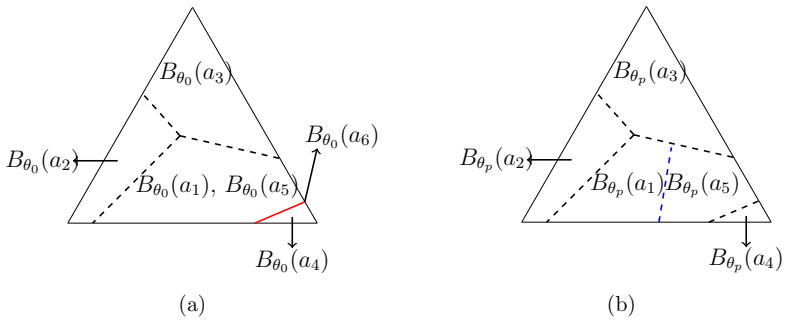
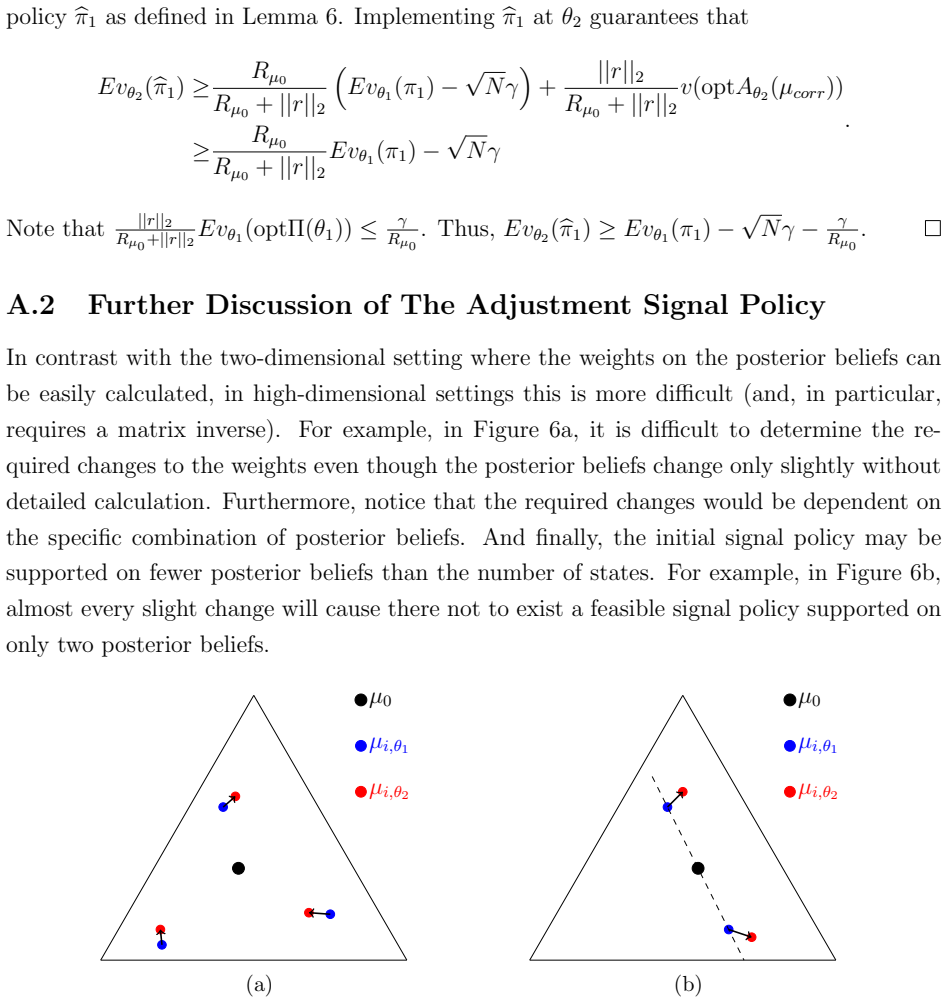
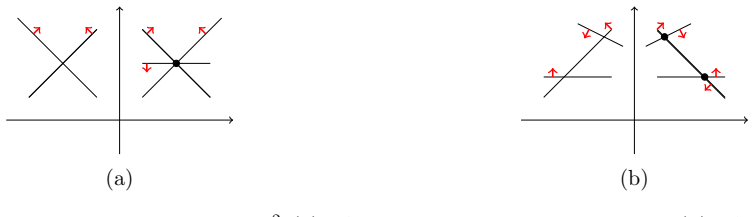
read the original abstract
We study the robustness of Bayesian persuasion to uncertainty about the receiver's preferences. We analyze two conceptually distinct notions: continuity, in which only the modeler lacks precise knowledge, but where the model's predictions are nonetheless accurate; and robustness, in which the sender also lacks precise knowledge, but where the outcome is insensitive to this ignorance. We model preference uncertainty as infinitesimally small, non-probabilistic (Knightian) uncertainty, and the sender's behavior as either minimizing the regret or maximizing the minimum utility. We show that continuity holds if and only if robustness holds, and that both notions are generic. Thus, while some instances of Bayesian persuasion are fragile, typical instances are both continuous and robust with respect to a small amount of ignorance.
Editorial analysis
A structured set of objections, weighed in public.
Referee Report
Summary. The paper claims that in Bayesian persuasion, two notions of robustness to receiver preference uncertainty—continuity (accurate predictions despite modeler ignorance) and robustness (sender outcomes insensitive to sender ignorance)—are equivalent, and that both hold generically, when preference uncertainty is modeled as infinitesimally small Knightian uncertainty and the sender either minimizes regret or maximizes minimum utility. Thus typical instances are both continuous and robust.
Significance. If the equivalence and genericity results hold under the stated assumptions, the paper provides a positive characterization showing that fragility is nongeneric in Bayesian persuasion. This is a clean mathematical contribution; credit is due for establishing the if-and-only-if link and the genericity argument in an appropriate topology on preference spaces.
major comments (1)
- [Introduction and §3 (main result)] The central equivalence and genericity claims are derived under the specific modeling of infinitesimal non-probabilistic uncertainty together with min-regret or max-min sender behavior. The manuscript should explicitly state whether the equivalence is an artifact of this behavioral assumption or holds more broadly; if the former, the scope of the 'typical instances are robust' conclusion needs to be qualified in the introduction and conclusion.
minor comments (2)
- [§2 (model)] Clarify the precise topology used to define 'generic' in the space of receiver preferences; this is essential for interpreting the genericity claim.
- [§2] Ensure that the definitions of continuity and robustness are stated formally before the equivalence theorem, with explicit reference to the sender's objective functions.
Simulated Author's Rebuttal
We thank the referee for the constructive comment on clarifying the scope of our results. We address the point below and will incorporate a minor revision to qualify the claims in the introduction and conclusion.
read point-by-point responses
-
Referee: [Introduction and §3 (main result)] The central equivalence and genericity claims are derived under the specific modeling of infinitesimal non-probabilistic uncertainty together with min-regret or max-min sender behavior. The manuscript should explicitly state whether the equivalence is an artifact of this behavioral assumption or holds more broadly; if the former, the scope of the 'typical instances are robust' conclusion needs to be qualified in the introduction and conclusion.
Authors: The equivalence between continuity and robustness, as well as the genericity result, are derived specifically under infinitesimal Knightian uncertainty together with the sender's min-regret or max-min behavior; these are the modeling choices adopted throughout the analysis. We do not claim the equivalence holds for arbitrary sender objective functions, and we will revise the introduction and conclusion to state this limitation explicitly, qualifying the conclusion that typical instances are both continuous and robust. revision: yes
Circularity Check
No circularity; equivalence is a direct proof under explicit modeling assumptions
full rationale
The paper proves that continuity holds iff robustness holds (and both are generic) by modeling preference uncertainty as infinitesimal Knightian uncertainty with the sender using min-regret or max-min utility. This is a standard mathematical derivation under stated assumptions; the equivalence does not reduce to self-definition, fitted parameters renamed as predictions, or load-bearing self-citations. The modeling choices are declared upfront and are not smuggled in via prior work. The result is self-contained as a theorem in the given framework.
Axiom & Free-Parameter Ledger
axioms (2)
- standard math Standard mathematical definitions of continuity and robustness applied to Bayesian persuasion outcomes.
- domain assumption Sender behavior is either regret minimization or max-min utility under Knightian uncertainty.
Reference graph
Works this paper leans on
-
[1]
Theoretical Economics18(1), 15–36 (2023)
Arieli, I., Babichenko, Y., Smorodinsky, R., Yamashita, T.: Optimal persuasion via bi-pooling. Theoretical Economics18(1), 15–36 (2023)
2023
-
[2]
arXiv preprint arXiv:2302.00281 (2023) 18
Arieli, I., Gradwohl, R., Smorodinsky, R.: Informationally robust cheap-talk. arXiv preprint arXiv:2302.00281 (2023) 18
-
[3]
MIT press (1995)
Aumann, R.J., Maschler, M., Stearns, R.E.: Repeated Games with Incomplete Infor- mation. MIT press (1995)
1995
-
[4]
Games and Economic Behavior136(2022)
Babichenko, Y., Talgam-Cohen, I., Xu, H., Zabarnyi, K.: Regret- minimizing Bayesian persuasion. Games and Economic Behavior136(2022). https://doi.org/10.1016/j.geb.2022.09.001
-
[5]
Artificial Intelligence314(2023)
Castiglioni, M., Celli, A., Marchesi, A., Gatti, N.: Regret minimiza- tion in online Bayesian persuasion: Handling adversarial receiver’s types under full and partial feedback models. Artificial Intelligence314(2023). https://doi.org/10.1016/j.artint.2022.103821
-
[6]
International Journal of Game Theory 50(4), 911–925 (2021)
Diehl, C., Kuzmics, C.: The (non-) robustness of influential cheap talk equilibria when the sender’s preferences are state independent. International Journal of Game Theory 50(4), 911–925 (2021)
2021
-
[7]
American Economic Review: Insights5(1), 111–24 (2023)
Dilm´ e, F.: Robust information transmission. American Economic Review: Insights5(1), 111–24 (2023)
2023
-
[8]
Dworczak, P., Pavan, A.: Preparing for the Worst but Hoping for the Best: Robust (Bayesian) Persuasion. Econometrica90(5) (2022). https://doi.org/10.3982/ecta19107
-
[9]
In: Proceedings of the An- nual ACM-SIAM Symposium on Discrete Algorithms
Feng, Y., Ho, C.J., Tang, W.: Rationality-Robust Information Design: Bayesian Persuasion under Quantal Response. In: Proceedings of the An- nual ACM-SIAM Symposium on Discrete Algorithms. vol. 2024-January (2024). https://doi.org/10.1137/1.9781611977912.19
-
[10]
Mathematical Pro- gramming pp
Gan, J., Han, M., Wu, J., Xu, H.: Robust stackelberg equilibria. Mathematical Pro- gramming pp. 1–41 (2025)
2025
-
[11]
Hu, J., Weng, X.: Robust persuasion of a privately informed receiver. Economic Theory 72(3) (2021). https://doi.org/10.1007/s00199-020-01299-5
-
[12]
Automatica43(10), 1808– 1816 (2007)
Jones, C.N., Kerrigan, E.C., Maciejowski, J.M.: Lexicographic perturbation for multi- parametric linear programming with applications to control. Automatica43(10), 1808– 1816 (2007)
2007
-
[13]
Econo- metrica: Journal of the Econometric Society pp
Kajii, A., Morris, S.: The robustness of equilibria to incomplete information. Econo- metrica: Journal of the Econometric Society pp. 1283–1309 (1997)
1997
-
[14]
Annual Review of Eco- nomics11(2019)
Kamenica, E.: Bayesian Persuasion and Information Design. Annual Review of Eco- nomics11(2019). https://doi.org/10.1146/annurev-economics-080218-025739 19
-
[15]
URLhttps://www.aeaweb.org/articles?id=10.1257/aer.101.6.2590
Kamenica, E., Gentzkow, M.: Bayesian persuasion. American Economic Review101(6) (2011). https://doi.org/10.1257/aer.101.6.2590
-
[16]
Theoretical Economics17(3) (2022)
Kosterina, S.: Persuasion with unknown beliefs. Theoretical Economics17(3) (2022). https://doi.org/10.3982/te4742
-
[17]
In: In- ternational Conference on Learning Representations
Lin, T., Chen, Y.: Generalized principal-agent problem with a learning agent. In: In- ternational Conference on Learning Representations. vol. 2025, pp. 89757–89788 (2025)
2025
-
[18]
Journal of Political Economy130(10), 2705–2730 (2022)
Lipnowski, E., Ravid, D., Shishkin, D.: Persuasion via Weak Institutions. Journal of Political Economy130(10), 2705–2730 (2022)
2022
-
[19]
Journal of Political Economy Microeconomics (2025)
Lipnowski, E., Ravid, D., Shishkin, D.: Perfect bayesian persuasion. Journal of Political Economy Microeconomics (2025). https://doi.org/10.1086/740148,https://doi.org/ 10.1086/740148
-
[20]
Journal of Economic Theory211, 105678 (2023)
Matyskov´ a, L., Montes, A.: Bayesian persuasion with costly infor- mation acquisition. Journal of Economic Theory211, 105678 (2023). https://doi.org/https://doi.org/10.1016/j.jet.2023.105678,https://www. sciencedirect.com/science/article/pii/S0022053123000741
-
[21]
Journal of Economic Theory124(1), 45–78 (2005)
Morris, S., Ui, T.: Generalized potentials and robust sets of equilibria. Journal of Economic Theory124(1), 45–78 (2005)
2005
-
[22]
Journal of the American Statistical Association46(253), 55–67 (1951)
Savage, L.J.: The theory of statistical decision. Journal of the American Statistical Association46(253), 55–67 (1951)
1951
-
[23]
John Wiley & Sons (1998)
Schrijver, A.: Theory of Linear and Integer Programming. John Wiley & Sons (1998)
1998
-
[24]
Steg, J.H., Garashli, E., Greinecker, M., Kuzmics, C.: Robust equilibria in binary cheap-talk games (2023)
2023
-
[25]
Econometrica69(5), 1373–1380 (2001)
Ui, T.: Robust equilibria of potential games. Econometrica69(5), 1373–1380 (2001)
2001
-
[26]
Wilson, R.: Game theoretic approaches to trading processess (in truman bewley, ed., advances in economic theory: Fifth world congress) (1987)
1987
-
[27]
Advances in Neural Information Processing Systems37, 134430–134458 (2024) 20
Yang, K., Zhang, H.: Computational aspects of bayesian persuasion under approximate best response. Advances in Neural Information Processing Systems37, 134430–134458 (2024) 20
2024
-
[28]
In: Proceedings of the 22nd ACM Conference on Economics and Computation
Zu, Y., Iyer, K., Xu, H.: Learning to Persuade on the Fly: Robustness Against Igno- rance. In: Proceedings of the 22nd ACM Conference on Economics and Computation. pp. 927–928 (2021) 21 Appendix A Technical Device: The Adjustment Signal Policy The idea of the technical device dates back at least to Kamenica and Gentzkow [15] (for ex- ample, proof of Propo...
2021
-
[29]
Now he knows that the receiver is indeed ofθ 2, and he knows that there existµ ′ 1 = 0.49 andµ ′ 2 = 0.501, which are very close toµ 1 andµ 2, and satisfyv(µ i, θ) =v(µ i, θ2),∀i≤2
His expected utility here is 1 4 ×1 + 3 4 ×0.97 = 0.9775. Now he knows that the receiver is indeed ofθ 2, and he knows that there existµ ′ 1 = 0.49 andµ ′ 2 = 0.501, which are very close toµ 1 andµ 2, and satisfyv(µ i, θ) =v(µ i, θ2),∀i≤2. If he neither chooses to deduce the new optimal signal policy, nor applies the adjustment signal policy, but just upd...
2000
-
[30]
B Missing Proofs for Section 3.1 We use the following geometrical observation: Lemma 8.LetG={Ω, A, µ 0, uθ0, v}be an arbitrary BP model
However, the adjustment signal policy can bridge different optimal signal policies corresponding to different types without dependence on the optimal concavification. B Missing Proofs for Section 3.1 We use the following geometrical observation: Lemma 8.LetG={Ω, A, µ 0, uθ0, v}be an arbitrary BP model. Then for everyγ >0there existsδ 0 >0such that the fol...
-
[31]
it is purely supported on extreme points
-
[32]
We utilize the following observation
its associated weights are uniquely determined by its supporting extreme points. We utilize the following observation. Lemma 15.For any typeθthere exists an optimal signal policyπthat is a basic signal policy. The proof appears in Section D.5. D.2 Step 1: Pseudo Type and Its properties Compared toθ 0, the pseudo typeθ p has the following properties:
-
[33]
Every action with a lower-dimensional set atθ 0 corresponds to an empty set atθ p
-
[34]
Every action that is stable atθ 0 remains unchanged atθ p
-
[35]
Formally, Lemma 16.LetG θ0 ={Ω, A, µ 0, uθ0, v}be a BP model
Every action with non-empty and full-dimensional set but with duplicates for the receiver is divided by imposing the sender’s least-preferred choice. Formally, Lemma 16.LetG θ0 ={Ω, A, µ 0, uθ0, v}be a BP model. Consider a pseudo typeθ p whose best-reply regions satisfy, for everya∈A, Bθp(a) = ∅,ifa∈A low θ0 Bθ0(a),ifa∈A stable θ0 µ∈B θ0(a) ...
-
[36]
X ω∈Ω v(a, ω)µk j (ω) # ≥ X j≤I k X ω∈Ω v(ak, ω)βk j µk j (ω) = X ω∈Ω v(ak, ω) X j≤I k βk j µk j (ω) = X ω∈Ω v(ak, ω)µk(ω) = max a∈optA(µk)
There exists aγ-adjustmentbπ θ′ ofπ θ′—the optimal signal policy atθ ′—with the fol- lowing properties: Evθ′(πθ′)≤Ev θp(bπθ′) +D(γ)≤Ev θp(optΠ(θp)) +D(γ). Proof.Note thatθ 0 is an interior type of theδ-BP model wrapping it. For anyδ >0 and anyδ-BP model, chooseδ ∗ >0 small enough so that the typeθ ′ defined below belongs to theδ-BP model. Sincev(a, ω)∈[0,...
-
[37]
14For any setBand anyx 0 ∈B, define the linear subspaceL:= span{x−x 0 :x∈B}
Letθ 1 andθ 2 be two types such thatB θ1(a), Bθ2(a)̸=∅, ifmax x∈B∗ θ1(a) miny∈B ∗ θ2(a) ||x− y||2 ≤γ, thenmax x∈Bθ1(a) miny∈Bθ2(a) ||x−y|| 2 ≤(1 + √ N−1)γ. 14For any setBand anyx 0 ∈B, define the linear subspaceL:= span{x−x 0 :x∈B}. The dimension of Bis defined by the linear dimension ofL, dim(B) := dim(L). This definition is independent of the choice of ...
-
[38]
Third,we establish the stability of contracted system
will complete the proof of (1) in Lemma 1. Third,we establish the stability of contracted system. If the original feasible set is nonempty and has propertiesU 1 andU 2, then for everyγ >0 there existsδ 0 >0 such that, whenever the perturbation size is smaller thanδ 0, every point in the original feasible set lies within distanceγof some point in the pertu...
-
[39]
there exists a pointx 1 ∈ {C =,−1x=D =,−1}such that⟨c, x 1⟩< d
-
[40]
If the first one is true, there existsδ 1 such that theδ 1 ball aroundx 1 satisfies that for anyx∈B δ1(x1),⟨c, x⟩< d
there exists a pointx 2 ∈ {C =,−1x=D =,−1}such that⟨c, x 2⟩=d. If the first one is true, there existsδ 1 such that theδ 1 ball aroundx 1 satisfies that for anyx∈B δ1(x1),⟨c, x⟩< d. Notice thatx 1 ∈B δ1(x1)∩ {x|C =,−1x=D =,−1}, and so we have B δ1(x1)∩ {x|C =,−1x=D =,−1}is theδ 1 ball aroundx 1 in the subspace defined by {x|C=,−1x=D =,−1}. Also, B δ1(x1)∩ ...
discussion (0)
Sign in with ORCID, Apple, or X to comment. Anyone can read and Pith papers without signing in.