SC-1 Etching of Niobium and Titanium Nitride Thin Films
Pith reviewed 2026-06-29 11:17 UTC · model grok-4.3
The pith
SC-1 solution etches niobium and titanium nitride thin films at controllable rates with high selectivity.
A machine-rendered reading of the paper's core claim, the machinery that carries it, and where it could break.
Core claim
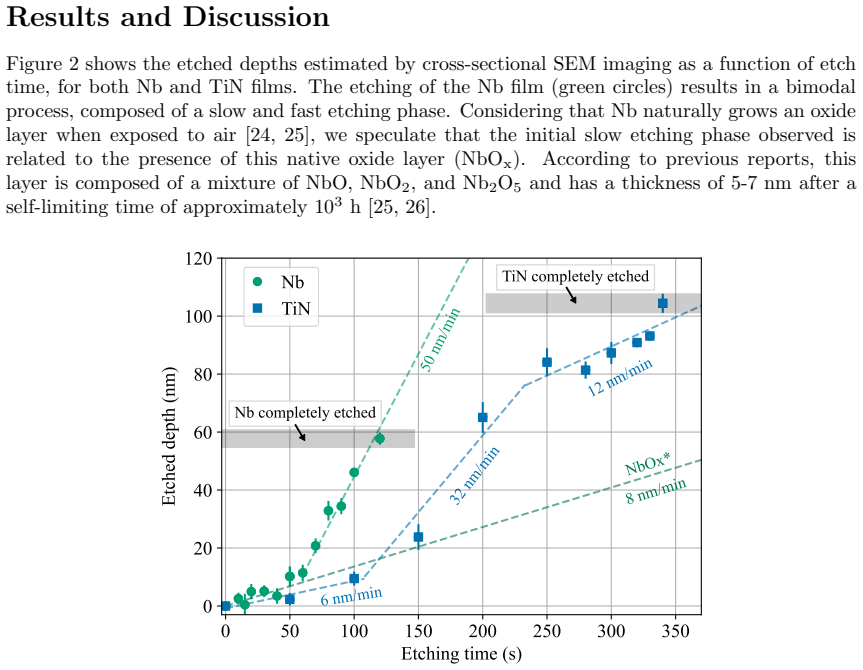
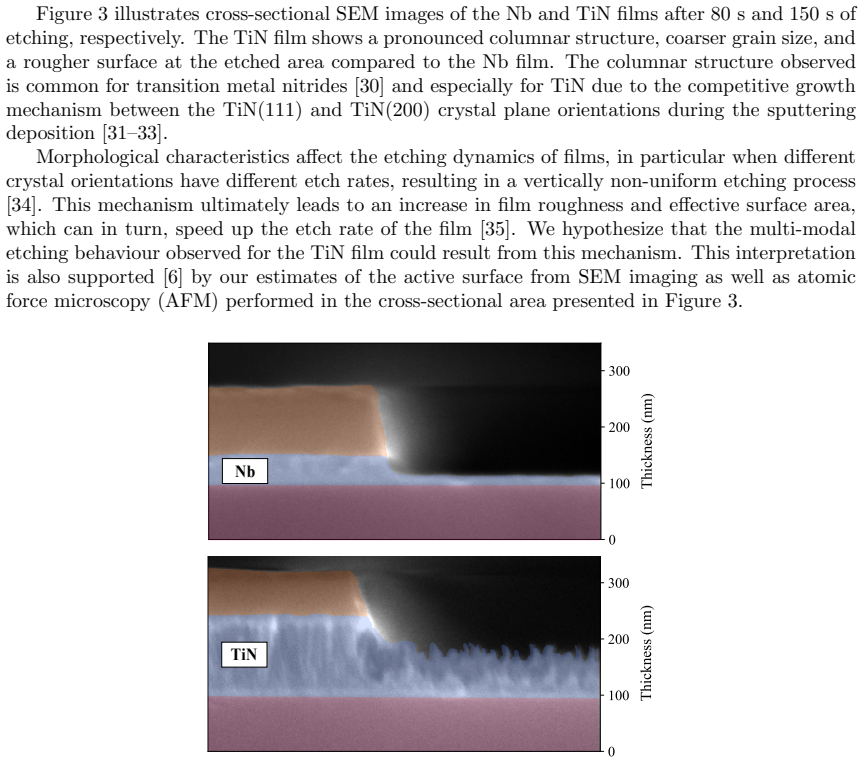
The authors demonstrate a wet etching alternative for the patterning of niobium and titanium nitride thin films using the Standard Cleaning 1 solution. They characterize the etching process through its time-evolution dynamics, supported by scanning-electron and atomic force microscopy assessment of the etched film morphology. The results suggest etch dynamics that are linked to native oxides and film microstructure. Overall, the manageable etch rates, the safe operation and the high material selectivity are attractive for practical use in microelectronics fabrication.
What carries the argument
The SC-1 wet etching process, which removes material through timed chemical reaction with the solution while leaving other layers largely intact.
If this is right
- Etch depth can be set by controlling immersion time because the rate follows a predictable time dependence.
- High selectivity allows removal of the target film while preserving underlying or adjacent layers.
- Absence of plasma reduces collateral damage that can degrade electrical performance in finished devices.
- Safe handling and manageable rates make the process compatible with standard cleanroom workflows.
Where Pith is reading between the lines
- The same solution might pattern related superconducting or barrier films if their native oxides respond similarly.
- Device-scale tests on actual circuit layouts would reveal whether edge profiles meet lithography tolerances.
- Integration with existing cleaning steps could reduce the total number of process modules needed.
Load-bearing premise
The etch rates, selectivity, and surface quality seen in test samples will remain consistent enough for direct use on full device structures without extra tuning.
What would settle it
Fabrication runs on actual device wafers where SC-1 produces uneven removal, undercutting, or residue that prevents working circuits would show the process is not yet ready for practical patterning.
Figures
read the original abstract
Dry etching techniques, ubiquitous in microelectronics fabrication, often result in challenging levels of undesired collateral plasma-induced damage. In this work, we demonstrate a wet etching alternative for the patterning of niobium (Nb) and titanium nitride (TiN) thin films using the Standard Cleaning 1 (SC-1) solution. We characterize the etching process through its time-evolution dynamics, supported by scanning-electron and atomic force microscopy assessment of the etched film morphology. The results suggest etch dynamics that are linked to native oxides and film microstructure. Overall, the manageable etch rates, the safe operation and the high material selectivity are attractive for practical use in microelectronics fabrication.
Editorial analysis
A structured set of objections, weighed in public.
Referee Report
Summary. The manuscript claims to demonstrate SC-1 wet etching as a low-damage alternative to dry etching for patterning Nb and TiN thin films. It reports time-dependent etch behavior characterized by SEM and AFM morphology assessment, links the dynamics to native oxides and film microstructure, and highlights manageable rates, operational safety, and material selectivity as advantages for microelectronics fabrication.
Significance. If the demonstration is supported by reproducible quantitative data, the work would supply a simple, plasma-free patterning route for these superconducting and barrier materials, potentially reducing collateral damage in device fabrication flows. As a modest experimental note rather than a fully validated process, its primary value would lie in process exploration rather than immediate production adoption.
major comments (2)
- [Abstract] Abstract and main text: the central claim of a demonstrated etching process with 'manageable etch rates' and 'high material selectivity' is asserted without any reported numerical etch rates, uncertainties, or selectivity ratios, leaving the practical-utility framing unsupported by visible quantitative evidence.
- [Results] The description of time-evolution dynamics and morphology results lacks error bars, number of replicates, or detailed protocols (solution concentration, temperature, agitation), which are load-bearing for assessing reproducibility of the reported etch behavior.
minor comments (1)
- [Figures] Figure captions should explicitly state scale bars, measurement conditions, and whether images are representative or averaged.
Simulated Author's Rebuttal
We thank the referee for the detailed review and constructive comments on our manuscript. We address each major comment below and will incorporate revisions to strengthen the quantitative support and reproducibility details.
read point-by-point responses
-
Referee: [Abstract] Abstract and main text: the central claim of a demonstrated etching process with 'manageable etch rates' and 'high material selectivity' is asserted without any reported numerical etch rates, uncertainties, or selectivity ratios, leaving the practical-utility framing unsupported by visible quantitative evidence.
Authors: We agree that the claims regarding manageable etch rates and high material selectivity would be better supported by explicit numerical values. In the revised manuscript, we will add the measured etch rates for Nb and TiN (including uncertainties from replicate measurements) and the corresponding selectivity ratios to other materials in the fabrication stack, drawn directly from the experimental data already obtained. revision: yes
-
Referee: [Results] The description of time-evolution dynamics and morphology results lacks error bars, number of replicates, or detailed protocols (solution concentration, temperature, agitation), which are load-bearing for assessing reproducibility of the reported etch behavior.
Authors: The referee correctly identifies that these experimental details are essential. We will revise the Results section to specify the SC-1 solution concentration and preparation, the controlled temperature, the agitation method used, the number of independent replicates for each time point, and to include error bars on all time-evolution and morphology data presented in figures and text. revision: yes
Circularity Check
No significant circularity; purely descriptive experimental report
full rationale
The paper presents an experimental demonstration of SC-1 wet etching for Nb and TiN thin films, reporting time-dependent etch rates, selectivity, and post-etch morphology via SEM/AFM. No equations, derivations, fitted parameters, predictions, or mathematical claims appear anywhere in the text. The central claim is supported directly by the characterization data without any reduction to self-defined quantities, self-citations, or ansatzes. This is a standard empirical materials report with no load-bearing logical steps that could exhibit circularity.
Axiom & Free-Parameter Ledger
Reference graph
Works this paper leans on
-
[1]
Nojiri K 2015Dry Etching Technology for Semiconductors1st ed (Springer)
-
[2]
Sawin H H 1994Microelectronic Engineering2315–21
-
[3]
Lee C G N, Kanarik K J and Gottscho R A 2014Journal of Physics D: Applied Physics47 273001
-
[4]
Eriguchi K 2017Journal of Physics D: Applied Physics50333001
-
[5]
Wang J, Houwman E, Salm C, Nguyen M, Vergeer K and Schmitz J 2017Microelectronic Engineering17713–18
-
[6]
See Supplementary Information for additional data
-
[7]
Kern W and Puotinen D A 1970RCA Review31187–206
-
[8]
Sun X, Mao S, Lu C, Geng D, Li L, Wang G and Zhao C 2024Journal of Materials Science: Materials in Electronics351–7
-
[9]
Wittmer M and Melchior H 1982Thin Solid Films93397–405
-
[10]
Gr¨ onberg L, Kiviranta M, Vesterinen V, Lehtinen J, Simbierowicz S, Luomahaara J, Prunnila M and Hassel J 2017Superconductor Science and Technology30125016
-
[11]
Hott R, Kleiner R, Wolf T and Zwicknagl G 2016Encyclopedia of Applied Physics: Review on Superconducting Materials1st ed (Wiley-VCH)
-
[12]
Bi J, Lin Y, Zhang Q, Liu Z, Zhang Z, Zhang R, Yao X, Chen G, Liu H, Huang Y, Sun Y, Zhang H, Sun Z, Xiao S and Cao Y 2024Nano Letters247451–7457
-
[13]
Zhang T, Bi J, Wang X, Li P, Zhang R, Zhai R, Guo Z, Ning C, Yan K, Zhang S, Peng S, Zhang J, Huang L and Cao Y 2025Physical Review B112045403
-
[14]
Verhaverbeke S and Parker J W 1997MRS Online Proceedings Library477447–458
-
[15]
Deng H, Song Z, Gao R, Xia T, Bao F, Jiang X, Ku H S, Li Z, Ma X, Qin J, Sun H, Tang C, Wang T, Wu F, Yu W, Zhang G, Zhang X, Zhou J, Zhu X, Shi Y, Zhao H H and Deng C 2023Physical Review Applied19024013
-
[16]
Vereecke G, De Coster H, Van Alphen S, Carolan P, Bender H, Willems K, Ragnarsson L ˚A, Van Dorpe P, Horiguchi N and Holsteyns F 2018Microelectronic Engineering20056–61
-
[17]
Burns D W 2011 Mems wet-etch processes and proceduresMEMS Materials and Processes Handbook(Springer) pp 457–665
2011
-
[18]
Liu Y X, Kamei T, Endo K, O’uchi S, Tsukada J, Yamauchi H, Hayashida T, Ishikawa Y, Matsukawa T, Sakamoto K, Ogura A and Masahara M 2009 Nanoscale tin wet etching and its application for finfet fabricationInternational Semiconductor Device Research Symposium (IEEE) pp 1–2
2009
-
[19]
Guti´ errez-Cruz A 2024Josephson Field Effect Transistor Channel FabricationMaster’s thesis Aalto University, Finland 7
-
[20]
Williams K R, Gupta K and Wasilik M 2003Journal of Microelectromechanical Systems12 761–778
-
[21]
Lichtenberger A W, Lea D M and Lloyd F L 1993IEEE Transactions on Applied Supercon- ductivity32191–2196
-
[22]
Walker P and Tarn W H 1991CRC Handbook of Metal Etchants1st ed (CRC Press)
-
[23]
Williams B H 1928Transactions of the Faraday Society24245–255
-
[24]
Lindau I and Spicer W E 1974Journal of Applied Physics453720–3725
-
[25]
Jia X Q, Kang L, Liu X Y, Wang Z H, Jin B B, Mi S B, Chen J, Xu W W and Wu P H 2012 IEEE Transactions on Applied Superconductivity232300704
2012
-
[26]
Verjauw J, Potoˇ cnik A, Mongillo M, Acharya R, Mohiyaddin F, Simion G, Pacco A, Ivanov T, Wan D, Vanleenhove A, Souriau L, Jussot J, Thiam A, Swerts J, Piao X, Couet S, Heyns M, Govoreanu B and Radu I 2021Physical Review Applied16014018
-
[27]
Bakulin A, Chumakova L and Kulkova S 2025Physical Mesomechanics2855–65
-
[28]
Polyakova I G and H¨ ubert T 2001Surface and Coatings Technology14155–61
-
[29]
Chen H Y and Lu F H 2005Journal of Vacuum Science & Technology A231006–1009
-
[30]
Mahieu S, Depla D and De Gryse R 2008 Modelling the growth of transition metal nitrides Journal of Physics: Conference Seriesvol 100 (IOP Publishing) p 082003
2008
-
[31]
Banerjee R, Chandra R and Ayyub P 2002Thin Solid Films40564–72
-
[32]
Isaev A G and Rogozhin A E 2025Russian Microelectronics54265–274
-
[33]
Qi R, Pan L, Feng Y, Wu J, Li W and Wang Z 2020Results in Physics19103416
-
[34]
Fang J, Li C, Liu F, Hou H, Zhang X, Zhang Q, Yang L, Xu C and Song Z 2024Materials Today Communications38108111
-
[35]
Xue H, Zhang Z, Ai J, Li C, Li B, Zhao Y and Wang A 2024Ceramics International50 25978–25987
-
[36]
Grigoras K, Yurttag¨ ul N, Kaikkonen J P, Mannila E T, Eskelinen P, Lozano D P, Li H X, Rommel M, Shiri D, Tiencken N, Simbierowicz S, Ronzani A, H¨ atinen J, Datta D, Vesterinen V, Gr¨ onberg L, Bizn´ arov´ a J, Roudsari A F, Kosen S, Osman A, Prunnila M, Hassel J, Bylander J and Govenius J 2022IEEE Transactions on Quantum Engineering31–10
-
[37]
Kim S, Mohan J, Kim H, Hwang S, Kim N, Jung Y, Sahota A, Kim K, Yu H, Cha P, Young C D, Choi R, Ahn J and Kim J 2020Materials132968 8 Supplementary Information for: SC-1 Etching of Niobium and Titanium Nitride Thin Films S1 Example of challenging selectivity in a dry etching process Reactive ion etching was tested for the patterning of superconducting Nb ...
discussion (0)
Sign in with ORCID, Apple, or X to comment. Anyone can read and Pith papers without signing in.