REVIEW 2 major objections 2 minor 50 references
N thermal light sources with higher-order intensity correlations reduce the LIDAR distance estimation error bound by a factor of N.
Reviewed by Pith at T0; open to challenge. T0 means a machine referee read the full paper against a public rubric. the ladder, T0–T4 →
T0 review · grok-4.3
2026-06-29 11:48 UTC pith:I4OSSB2H
load-bearing objection The paper claims a factor-N reduction in the LIDAR Cramér-Rao bound using N thermal sources plus m-order correlations, but the scattering model that preserves source independence is the part that needs explicit checking. the 2 major comments →
Superradiant LIDAR
The pith
A machine-rendered reading of the paper's core claim, the machinery that carries it, and where it could break.
Core claim
By using N thermal light sources and measuring intensity correlations of order m ≥ 2 instead of m=1, the Cramér-Rao bound on the measurement of the distance of a remote object undercuts that of traditional LIDAR by a factor of N, and can be reduced further with increasing correlation order m. The claim is supported by numerical calculations, exact analytic results for N=2 and N=3, and an approximate closed-form expression valid for any N.
What carries the argument
Measurement of m-th order intensity correlation functions from N independent thermal light sources, which supplies the information used to bound the variance of the distance estimator.
Load-bearing premise
The N thermal light sources remain statistically independent and the superradiance framework applies directly to the remote-object distance estimation scenario when higher-order intensity correlations are measured.
What would settle it
An experiment that illuminates a test object with two independent thermal sources, records both ordinary intensity and second-order intensity correlations, and checks whether the observed variance in the extracted distance is reduced by a factor of two relative to the single-source case.
If this is right
- Distance estimation precision scales linearly with the number of independent thermal sources employed.
- Raising the correlation order m beyond 2 yields further tightening of the bound on top of the factor-N gain.
- The improvement holds for any number of sources once the approximate analytic expression is used.
- The scheme remains within the classical thermal-light regime and does not require nonclassical states.
Where Pith is reading between the lines
- The same correlation-based approach could be examined for estimating other parameters such as object velocity or surface properties.
- Laboratory verification with ordinary thermal sources would directly test whether the predicted scaling survives real detector noise and finite integration time.
- If source independence can be maintained while increasing N, the method supplies a simple route to better performance without raising total optical power.
Editorial analysis
A structured set of objections, weighed in public.
Referee Report
Summary. The manuscript proposes enhancing LIDAR distance estimation by using N independent thermal light sources and measuring m-th order (m≥2) intensity correlations rather than first-order intensity. It claims this yields a Cramér-Rao bound improved by a factor of N relative to conventional LIDAR, with further reduction as m increases. Analytical expressions are provided for N=2 and N=3, a general approximation for arbitrary N, and supporting numerical results.
Significance. If the modeling assumptions hold, the result would provide a concrete route to sensitivity gains in remote ranging that scale with source number and correlation order, leveraging existing concepts from superradiance without added power. The explicit analytical cases for small N constitute a verifiable strength that allows direct inspection of the claimed scaling.
major comments (2)
- [Analytical expressions for N=2,3 and derivation of correlation functions] The central 1/N (and m-dependent) CRB improvement rests on the m-th order correlation functions of the returned light retaining a factorized dependence on the individual source fields, with the distance parameter entering solely via propagation phases. The analytical expressions for N=2 and N=3 must therefore include an explicit expansion demonstrating that all cross-source contributions either vanish or factor correctly under the linear scattering model applied to the total field; without this, the Fisher-information scaling cannot be confirmed.
- [General approximate expression and numerical results] The general approximate expression for arbitrary N is used to support the numerical calculations, yet no error bound or stated regime of validity is supplied. This leaves the extrapolation from the N=2,3 cases to the claimed scaling for large N unquantified.
minor comments (2)
- Notation for the intensity correlation functions and the precise definition of the time-of-flight parameter should be introduced with a single consistent symbol set before the N=2 case is presented.
- The abstract states the improvement factor but does not mention that the result is derived under the assumption of statistically independent sources after scattering; a brief qualifier would improve clarity.
Simulated Author's Rebuttal
We thank the referee for their careful reading of the manuscript and for providing constructive comments. We respond to each major comment below.
read point-by-point responses
-
Referee: The central 1/N (and m-dependent) CRB improvement rests on the m-th order correlation functions of the returned light retaining a factorized dependence on the individual source fields, with the distance parameter entering solely via propagation phases. The analytical expressions for N=2 and N=3 must therefore include an explicit expansion demonstrating that all cross-source contributions either vanish or factor correctly under the linear scattering model applied to the total field; without this, the Fisher-information scaling cannot be confirmed.
Authors: We appreciate the referee's emphasis on the need for explicit verification of the factorization in the correlation functions. Our derivations for N=2 and N=3 are based on the linear scattering model where the total field is the sum of contributions from each source, and the intensity correlations are computed accordingly. However, to address this concern directly, we will include in the revised manuscript an explicit term-by-term expansion for the N=2 and N=3 cases, showing that cross terms either cancel or factorize in a manner that preserves the N-scaling of the Fisher information. This addition will make the derivation more transparent. revision: yes
-
Referee: The general approximate expression for arbitrary N is used to support the numerical calculations, yet no error bound or stated regime of validity is supplied. This leaves the extrapolation from the N=2,3 cases to the claimed scaling for large N unquantified.
Authors: We acknowledge that the manuscript would benefit from a more rigorous characterization of the approximate expression. In the revision, we will add a section detailing the regime of validity of the approximation, including comparisons with the exact results for N=2 and N=3 to quantify the error, and provide bounds on the approximation error as a function of N and m. This will strengthen the support for the scaling claims at larger N. revision: yes
Circularity Check
No circularity in CRB scaling derivation
full rationale
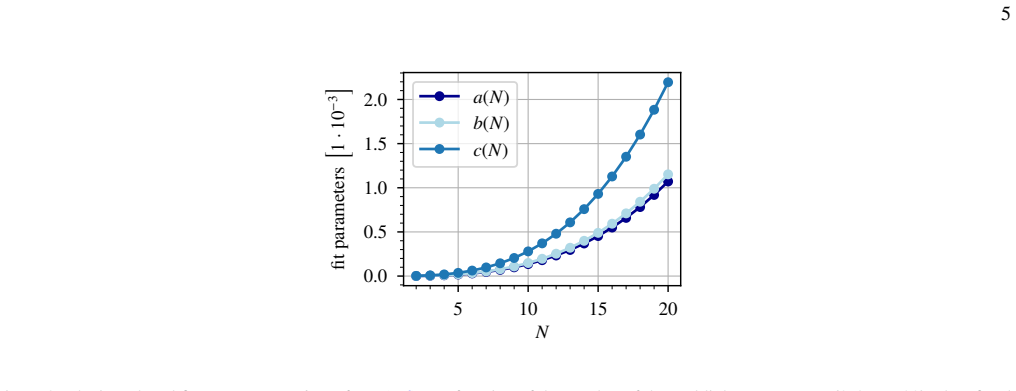
The paper computes the Cramér-Rao bound directly from explicit expressions for the m-th order intensity correlation functions of N independent thermal sources (analytical for N=2,3; approximate for general N). These expressions follow from the standard factorization properties of thermal fields under linear propagation and source independence, which are input assumptions rather than outputs of the derivation. No parameter is fitted to data and then relabeled as a prediction, no self-citation chain justifies the central scaling, and the N-factor improvement is obtained by direct substitution into the Fisher information formula without self-referential reduction.
Axiom & Free-Parameter Ledger
axioms (2)
- domain assumption Thermal light sources are statistically independent.
- standard math Cramér-Rao bound governs the ultimate precision of distance estimation from intensity correlation measurements.
read the original abstract
In recent years, light detection and ranging (LIDAR) has seen a steep rise in the sensitivity of measuring the distances of remote objects. Here, we propose to enhance the sensitivity of LIDAR even further by exploiting Dicke's concept of superradiance, i.e., the collective light emission of statistically independent light sources. By using $N$ thermal light sources (TLS) and measuring intensity correlations of order $m \geq 2$ instead of $m=1$, i.e., the intensity, we show that the Cram\'er-Rao bound on the measurement of the distance of a remote object undercuts that of traditional LIDAR by a factor of $N$, and can be reduced further with increasing correlation order $m$. Our numerical calculations are supported by analytical expressions for the special cases of two and three TLS and a general approximate expression for any number of TLS.
Figures



Reference graph
Works this paper leans on
-
[1]
Jaboyedoff, T
M. Jaboyedoff, T. Oppikofer, A. Abell ´an, M.-H. Derron, A. Loye, R. Metzger, and A. Pedrazzini, Use of lidar in land- slide investigations: a review, Natural Hazards61, 5 (2012)
2012
-
[2]
Rivera, R
G. Rivera, R. Porras, R. Florencia, and J. P. S ´anchez-Sol´ıs, Li- dar applications in precision agriculture for cultivating crops: A review of recent advances, Computers and Electronics in Agri- culture207, 107737 (2023)
2023
-
[3]
W. Liu, Y . Ren, R. Guo, V . W. W. Kong, A. S. P. Hung, F. Zhu, Y . Cai, H. Wu, Y . Zou, and F. Zhang, Slope inspection under dense vegetation using lidar-based quadrotors, Nature Commu- nications16, 7411 (2025)
2025
-
[4]
E. E. Maeda, B. Brede, K. Calders, M. Disney, M. Herold, E. R. Lines, M. H. Nunes, P. Raumonen, M. Rautiainen, N. Saarinen, I. Starck, Y . Su, J. Terschanski, and L. Terryn, Expanding forest research with terrestrial LIDAR technology, Nature Communi- cations16, 8853 (2025)
2025
-
[5]
P. Chen, Z. Zhang, K. Bisson, C. Jamet, P. Di Girolamo, D. Dionisi, Y . Hu, S. Zhang, and D. Pan, Underestimated accel- erated antarctic phytoplankton net primary production in winter over past decade from spaceborne lidar, Nature Communica- tions16, 11430 (2025)
2025
-
[6]
D. J. Yeong, G. Velasco-Hernandez, J. Barry, and J. Walsh, Sen- sor and sensor fusion technology in autonomous vehicles: A review, Sensors21, 10.3390/s21062140 (2021)
-
[7]
H. Song, J. Cho, J. Ha, J. Park, and K. Jo, Panoptic-fusionnet: Camera-lidar fusion-based point cloud panoptic segmentation for autonomous driving, Expert Systems with Applications251, 123950 (2024). 5
2024
-
[8]
A. Ali, M. M. Tawfik, and M. M. Saafan, Cross-dataset late fusion of camera–lidar and radar models for object detection, Scientific Reports16, 879 (2026)
2026
-
[9]
Cohen, E
L. Cohen, E. S. Matekole, Y . Sher, D. Istrati, H. S. Eisen- berg, and J. P. Dowling, Thresholded quantum lidar: Exploit- ing photon-number-resolving detection, Phys. Rev. Lett.123, 203601 (2019)
2019
-
[10]
Z. Li, Y . Han, L. Wu, Z. Zang, M. Dai, S. Y . Set, S. Yamashita, Q. Li, and H. Y . Fu, Towards an ultrafast 3d imaging scanning lidar system: a review, Photon. Res.12, 1709 (2024)
2024
-
[11]
McCarthy, G
A. McCarthy, G. G. Taylor, J. Garcia-Armenta, B. Korzh, D. V . Morozov, A. D. Beyer, R. M. Briggs, J. P. Allmaras, B. Bum- ble, M. Colangelo, D. Zhu, K. K. Berggren, M. D. Shaw, R. H. Hadfield, and G. S. Buller, High-resolution long-distance depth imaging lidar with ultra-low timing jitter superconducting nanowire single-photon detectors, Optica12, 168 (2025)
2025
-
[12]
F. F. Settembrini, A. C. Gungor, A. Forrer, S. A. Fortune, A. Dell’Aquila, P. Padmanabhan, I. E. Opris, M. Sotto, N. Dordevic, Y . Perelman, T. Christen, M. Wang, and R. Nico- laescu, A large-scale coherent 4d imaging sensor, Nature651, 364 (2026)
2026
-
[13]
Riemensberger, A
J. Riemensberger, A. Lukashchuk, M. Karpov, W. Weng, E. Lu- cas, J. Liu, and T. J. Kippenberg, Massively parallel coher- ent laser ranging using a soliton microcomb, Nature581, 164 (2020)
2020
-
[14]
C. S. Sambridge, J. T. Spollard, A. J. Sutton, K. McKenzie, and L. E. Roberts, Detection statistics for coherent rmcw lidar, Opt. Express29, 25945 (2021)
2021
-
[15]
Harris, G
M. Harris, G. N. Pearson, J. M. Vaughan, D. Letalick, and C. Karlsson, The role of laser coherence length in continuous- wave coherent laser radar, Journal of Modern Optics45, 1567 (1998)
1998
-
[16]
M. M. Bayer, X. Li, G. N. Guentchev, R. Torun, J. E. Velazco, and O. Boyraz, Single-shot ranging and velocimetry with a cw lidar far beyond the coherence length of the cw laser, Opt. Ex- press29, 42343 (2021)
2021
-
[17]
Classen, K
A. Classen, K. Ayyer, H. N. Chapman, R. R ¨ohlsberger, and J. von Zanthier, Incoherent diffractive imaging via intensity cor- relations of hard x rays, Phys. Rev. Lett.119, 053401 (2017)
2017
-
[18]
C.-H. Lee, Y . Kim, D.-G. Im, U.-S. Kim, V . Tamma, and Y .- H. Kim, Coherent two-photon lidar with incoherent light, Phys. Rev. Lett.131, 223602 (2023)
2023
-
[19]
G. Qian, X. Xu, S.-A. Zhu, C. Xu, F. Gao, V . V . Yakovlev, X. Liu, S.-Y . Zhu, and D.-W. Wang, Quantum induced coher- ence light detection and ranging, Phys. Rev. Lett.131, 033603 (2023)
2023
-
[20]
L.-C. Liu, C. Wu, W. Li, Y .-A. Chen, X.-P. Shao, F. Wilczek, F. Xu, Q. Zhang, and J.-W. Pan, Active optical intensity inter- ferometry, Phys. Rev. Lett.134, 180201 (2025)
2025
-
[21]
L. E. Estes, L. M. Narducci, and R. A. Tuft, Scattering of light from a rotating ground glass∗, J. Opt. Soc. Am.61, 1301 (1971)
1971
-
[22]
Shih, Quantum imaging, quantum lithography and the uncer- tainty principle, Fortschritte der Physik51, 487 (2003)
Y . Shih, Quantum imaging, quantum lithography and the uncer- tainty principle, Fortschritte der Physik51, 487 (2003)
2003
-
[23]
Valencia, G
A. Valencia, G. Scarcelli, M. D’Angelo, and Y . Shih, Two- photon imaging with thermal light, Phys. Rev. Lett.94, 063601 (2005)
2005
-
[24]
L.-G. Wang, S. Qamar, S.-Y . Zhu, and M. S. Zubairy, Hanbury brown–twiss effect and thermal light ghost imaging: A unified approach, Phys. Rev. A79, 033835 (2009)
2009
-
[25]
M. J. Padgett and R. W. Boyd, An introduction to ghost imag- ing: quantum and classical, Philosophical Transactions of the Royal Society A: Mathematical, Physical and Engineering Sci- ences375, 20160233 (2017)
2017
-
[26]
B. Hoenders, Chapter one - review of a bewildering classi- cal–quantum phenomenon: Ghost imaging, inAdvances in Imaging and Electron Physics, Advances in Imaging and Elec- tron Physics, V ol. 208, edited by P. W. Hawkes (Elsevier, 2018) pp. 1–41
2018
-
[27]
P. K. Tan, X. J. Yeo, A. Z. W. Leow, L. Shen, and C. Kurtsiefer, Practical range sensing with thermal light, Phys. Rev. Appl.20, 014060 (2023)
2023
-
[28]
Staffas, J
T. Staffas, J. Cleveborg, J. Gao, A. W. Elshaari, and V . Zwiller, Thermal light with enhanced oscillating bunching in field- tested photon-counting LIDAR, Nature Communications17, 134 (2025)
2025
-
[29]
Reichert, Q
M. Reichert, Q. Zhuang, and M. Sanz, Heisenberg-limited quantum lidar for joint range and velocity estimation, Phys. Rev. Lett.133, 130801 (2024)
2024
-
[30]
X. Y . Zou, L. J. Wang, and L. Mandel, Induced coherence and indistinguishability in optical interference, Phys. Rev. Lett.67, 318 (1991)
1991
-
[31]
Dertinger, R
T. Dertinger, R. Colyer, G. Iyer, S. Weiss, and J. Enderlein, Fast, background-free, 3d super-resolution optical fluctuation imag- ing (sofi), Proceedings of the National Academy of Sciences 106, 22287 (2009)
2009
-
[32]
Dedecker, G
P. Dedecker, G. C. H. Mo, T. Dertinger, and J. Zhang, Widely accessible method for superresolution fluorescence imaging of living systems, Proceedings of the National Academy of Sci- ences109, 10909 (2012)
2012
-
[33]
Schwartz, J
O. Schwartz, J. M. Levitt, R. Tenne, S. Itzhakov, Z. Deutsch, and D. Oron, Superresolution microscopy with quantum emit- ters, Nano letters13, 5832 (2013)
2013
-
[34]
O. Katz, P. Heidmann, M. Fink, and S. Gigan, Non-invasive single-shot imaging through scattering layers and around cor- ners via speckle correlations, Nature photonics8, 784 (2014)
2014
-
[35]
Classen, J
A. Classen, J. von Zanthier, and G. S. Agarwal, Analysis of super-resolution via 3d structured illumination intensity corre- lation microscopy, Opt. Express26, 27492 (2018)
2018
-
[36]
Oppel, T
S. Oppel, T. B ¨uttner, P. Kok, and J. von Zanthier, Superresolv- ing multiphoton interferences with independent light sources, Phys. Rev. Lett.109, 233603 (2012)
2012
-
[37]
R. H. Dicke, Coherence in spontaneous radiation processes, Phys. Rev.93, 99 (1954)
1954
-
[38]
M. O. Ara ´ujo, I. Kre ˇsi´c, R. Kaiser, and W. Guerin, Superradi- ance in a large and dilute cloud of cold atoms in the linear-optics regime, Phys. Rev. Lett.117, 073002 (2016)
2016
-
[39]
S. J. Masson, I. Ferrier-Barbut, L. A. Orozco, A. Browaeys, and A. Asenjo-Garcia, Many-body signatures of collective decay in atomic chains, Phys. Rev. Lett.125, 263601 (2020)
2020
-
[40]
J. Ren, S. Zhu, and Z. D. Wang, Attaining nearly ideal dicke superradiance in expanded spatial domains, Phys. Rev. Appl. 21, 044053 (2024)
2024
-
[41]
Tong and F
W. Tong and F. Robicheaux, Qualitatively altered driven dicke superradiance in extended systems due to infinitesimal pertur- bations, Phys. Rev. A110, 063701 (2024)
2024
-
[42]
Wiegner, S
R. Wiegner, S. Oppel, D. Bhatti, J. von Zanthier, and G. S. Agarwal, Simulating superradiance from higher-order- intensity-correlation measurements: Single atoms, Phys. Rev. A92, 033832 (2015)
2015
-
[43]
Araneda, D
G. Araneda, D. B. Higginbottom, L. Slodiˇcka, Y . Colombe, and R. Blatt, Interference of single photons emitted by entangled atoms in free space, Phys. Rev. Lett.120, 193603 (2018)
2018
-
[44]
Richter, S
S. Richter, S. Wolf, J. von Zanthier, and F. Schmidt-Kaler, Col- lective photon emission of two correlated atoms in free space, Phys. Rev. Res.5, 013163 (2023)
2023
-
[45]
Oppel, R
S. Oppel, R. Wiegner, G. S. Agarwal, and J. von Zanthier, Di- rectional superradiant emission from statistically independent incoherent nonclassical and classical sources, Phys. Rev. Lett. 6 113, 263606 (2014)
2014
-
[46]
Cao, B.-L
D.-Z. Cao, B.-L. Xu, S.-H. Zhang, and K. Wang, Super- resolving interference without intensity-correlation measure- ment, Phys. Rev. A91, 053853 (2015)
2015
-
[47]
Bhatti, S
D. Bhatti, S. Oppel, R. Wiegner, G. S. Agarwal, and J. von Zan- thier, Simulating dicke-like superradiance with classical light sources, Phys. Rev. A94, 013810 (2016)
2016
-
[48]
R. J. Glauber, The quantum theory of optical coherence, Phys. Rev.130, 2529 (1963)
1963
-
[49]
See Supplemental Material at [URL will be inserted by pub- lisher] for considered correlation functions and their normaliza- tion; detailed description of the Superradiant LIDAR setup; cal- culation of the numerically evaluated expression of the Fisher information; motivation of a lower-bound and fit function ap- proximation of the Fisher information of s...
-
[50]
Li and Y
C. Li and Y . Zhu, Bounds of parameter estimation for interfer- ence signals, Appl. Opt.56, 6867 (2017). 1 Supplemental Material for: Superradiant LIDAR T. Kullick,1 M. Bojer,1 J. von Zanthier,1 and G. S. Agarwal2 1Friedrich-Alexander-Universit¨ at Erlangen-N¨ urnberg, Quantum Optics and Quantum Information, Staudtstr . 1, 91058 Erlangen, Germany 2Institu...
2017
discussion (0)
Sign in with ORCID, Apple, or X to comment. Anyone can read and Pith papers without signing in.