Global magnetic phase diagram and multiple unconventional magnets in NiAs-type compounds
Pith reviewed 2026-06-29 11:10 UTC · model grok-4.3
The pith
NiAs-type compounds support mixed f-wave and g-wave unconventional magnets driven by interlayer coupling.
A machine-rendered reading of the paper's core claim, the machinery that carries it, and where it could break.
Core claim
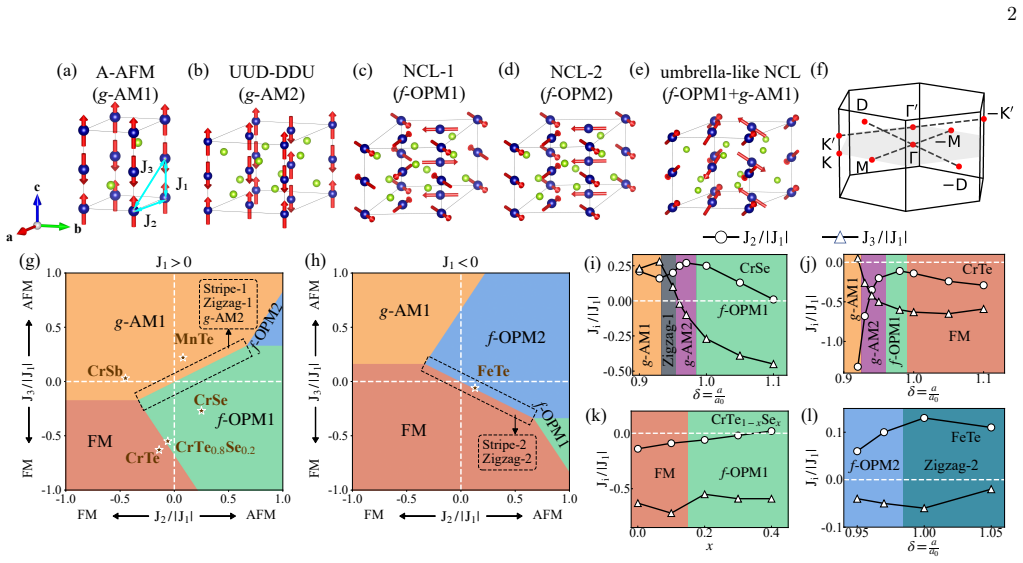
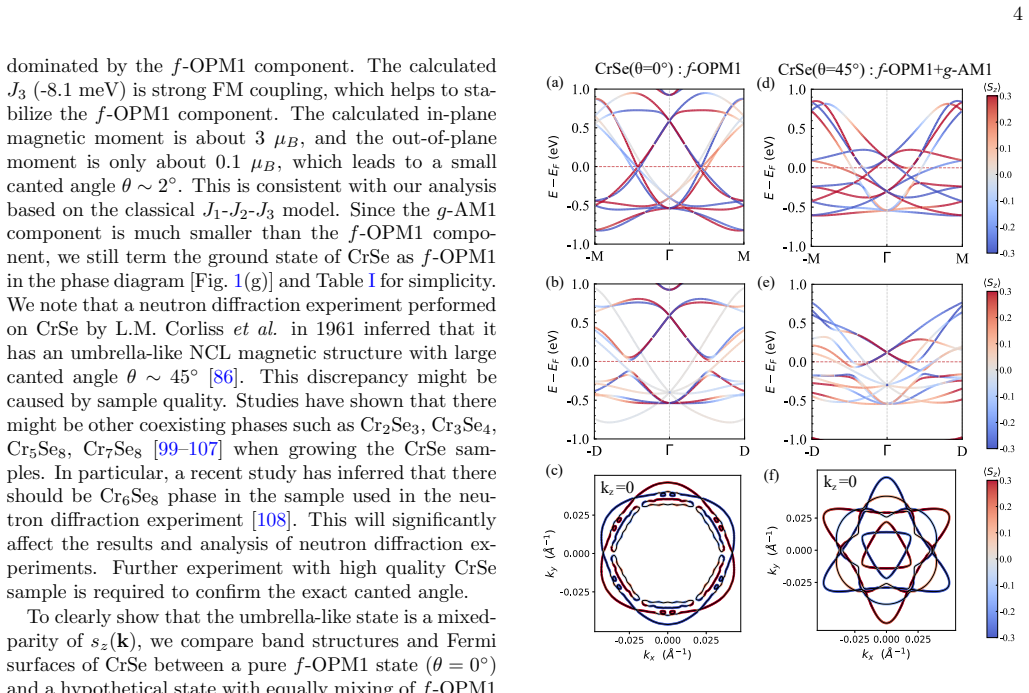
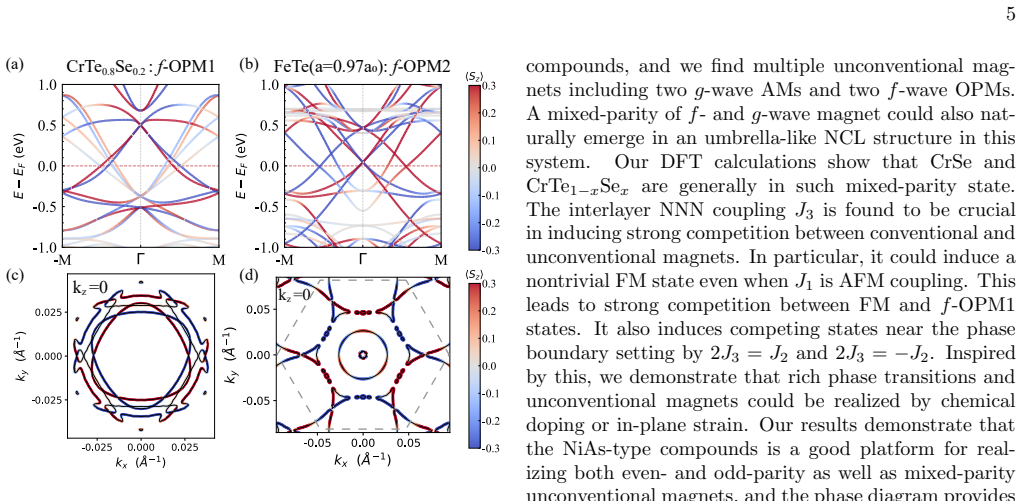
Using a classical J1-J2-J3 Heisenberg model and DFT calculations, the authors construct a global magnetic phase diagram for NiAs-type compounds that reveals an additional g-wave altermagnet state and two f-wave odd-parity magnets. They show that an umbrella-like noncollinear structure naturally hosts a mixed-parity state of f-wave OPM and g-wave AM, which DFT finds to be realized in CrSe and CrTe1-xSex with f-wave dominance. The interlayer next-nearest-neighbor coupling J3 determines the phase boundaries and promotes competition between conventional and unconventional magnets, allowing AM or OPM to be induced in conventional magnets via chemical doping or strain.
What carries the argument
The classical J1-J2-J3 Heisenberg model combined with density functional theory calculations to construct the global magnetic phase diagram for NiAs-type compounds.
If this is right
- An additional g-wave altermagnet state and two f-wave odd-parity magnets appear in the phase diagram.
- A mixed f-wave OPM and g-wave AM state emerges in umbrella-like noncollinear structures.
- CrSe and CrTe1-xSex realize the mixed state with f-wave dominance according to DFT.
- The interlayer next-nearest-neighbor coupling J3 induces strong competition between conventional and unconventional magnets.
- Altermagnets or odd-parity magnets can be realized by applying chemical doping or strain to conventional magnets.
Where Pith is reading between the lines
- The same J3-driven competition may generate mixed-parity states in other layered compounds that share similar interlayer spacing.
- Varying the selenium content in CrTe1-xSex offers a direct experimental knob to cross between different regions of the phase diagram.
- The framework suggests that odd-parity magnets could be stabilized in additional NiAs-family members by modest structural adjustments.
Load-bearing premise
The classical J1-J2-J3 Heisenberg model captures the essential magnetic interactions sufficiently well to produce a reliable global phase diagram for NiAs-type compounds.
What would settle it
Neutron diffraction measurements on CrSe that find a collinear magnetic structure instead of the predicted umbrella-like noncollinear order would falsify the mixed-parity state.
Figures
read the original abstract
NiAs-type compounds such as CrSb and MnTe host $g$-wave altermagnet (AM) state. In order to search other possible unconventional magnets in this system, we present a global magnetic phase diagram based on a classical $J_1$-$J_2$-$J_3$ Heisenberg model and density functional theory (DFT) calculations. We find another $g$-wave AM state and two $f$-wave OPMs in the phase diagram. Intriguingly, we show that a mixed-parity of the $f$-wave OPM and $g$-wave AM state can naturally emerge in an umbrella-like noncollinear magnetic structure. Our DFT calculations show that CrSe and CrTe$_{1-x}$Se$_x$ are generally in such mixing state with dominated $f$-wave component. The interlayer next-nearest-neighbor coupling $J_3$ is shown to be crucial in determining the phase diagram and in inducing strong competition between conventional and unconventional magnets. Inspired by this, we demonstrate that AM or OPM could be realized by applying chemical doping or strain to conventional magnets. Our results provide a guidance for design of both even- and odd-parity as well as mixed-parity unconventional magnets in NiAs-type compounds.
Editorial analysis
A structured set of objections, weighed in public.
Referee Report
Summary. The manuscript constructs a global magnetic phase diagram for NiAs-type compounds using a classical J1-J2-J3 Heisenberg model supplemented by DFT calculations. It identifies additional g-wave altermagnet states and f-wave odd-parity magnets (OPMs), shows that a mixed-parity umbrella structure can emerge naturally, reports that CrSe and CrTe1-xSex realize a mixed state with dominant f-wave character, and argues that the interlayer next-nearest-neighbor coupling J3 is decisive for the competition between conventional and unconventional magnetism. The work further suggests that chemical doping or strain can convert conventional magnets into AM or OPM states.
Significance. If the central modeling assumptions hold, the results supply a concrete design map for both even- and odd-parity as well as mixed-parity unconventional magnets within the NiAs family, with specific predictions for CrSe-based compounds that could be tested experimentally.
major comments (2)
- [Model and phase-diagram construction (abstract and methods)] The global phase diagram, the identification of the g-wave AM and f-wave OPM states, the mixed-parity umbrella structure, and the claim that J3 induces strong competition all rest on the classical J1-J2-J3 Heisenberg model being sufficient. No evidence is supplied that single-ion anisotropy, Dzyaloshinskii-Moriya terms, biquadratic exchange, or J4+ interactions were extracted from the DFT calculations and shown to be small enough not to shift the reported phase boundaries or the stability of the mixed f/g-wave state in CrSe.
- [DFT results on CrSe and CrTe1-xSex] The DFT-based assertion that CrSe and CrTe1-xSex realize a mixed-parity state with dominated f-wave component is presented without reported error estimates, convergence checks, or explicit comparison of the extracted exchange parameters against the classical-model phase boundaries.
Simulated Author's Rebuttal
We thank the referee for the careful reading and constructive comments on our manuscript. We address each major comment below and will revise the manuscript to strengthen the presentation of the model assumptions and DFT analysis.
read point-by-point responses
-
Referee: [Model and phase-diagram construction (abstract and methods)] The global phase diagram, the identification of the g-wave AM and f-wave OPM states, the mixed-parity umbrella structure, and the claim that J3 induces strong competition all rest on the classical J1-J2-J3 Heisenberg model being sufficient. No evidence is supplied that single-ion anisotropy, Dzyaloshinskii-Moriya terms, biquadratic exchange, or J4+ interactions were extracted from the DFT calculations and shown to be small enough not to shift the reported phase boundaries or the stability of the mixed f/g-wave state in CrSe.
Authors: We agree that explicit checks on neglected terms would strengthen the work. The J1-J2-J3 model is the minimal classical Heisenberg Hamiltonian that reproduces the essential competition in NiAs-type compounds, consistent with prior literature. In the revision we will add DFT estimates (for CrSe and a representative conventional magnet) showing that single-ion anisotropy, DM, and biquadratic terms are at least an order of magnitude smaller than the bilinear exchanges; we will also include a symmetry-based discussion of why J4+ contributions are expected to be weak. These additions will confirm that the reported phase boundaries and mixed f/g-wave stability remain robust. revision: yes
-
Referee: [DFT results on CrSe and CrTe1-xSex] The DFT-based assertion that CrSe and CrTe1-xSex realize a mixed-parity state with dominated f-wave component is presented without reported error estimates, convergence checks, or explicit comparison of the extracted exchange parameters against the classical-model phase boundaries.
Authors: We acknowledge that the current manuscript lacks explicit convergence data and error analysis. In the revised version we will add a supplementary section with k-mesh, cutoff, and smearing convergence tests together with estimated uncertainties on the extracted J1, J2, J3 values. We will also overlay the DFT-derived parameter sets for CrSe and CrTe1-xSex (including error bars) directly onto the classical phase diagram to demonstrate that they lie well inside the mixed-parity region and that the dominant f-wave character is preserved within the uncertainty range. revision: yes
Circularity Check
No circularity: phase diagram constructed from independent classical model + DFT inputs
full rationale
The abstract states the global phase diagram is 'based on a classical J1-J2-J3 Heisenberg model and density functional theory (DFT) calculations,' with J3 identified as crucial and DFT used to classify CrSe/CrTe1-xSex states. No quoted step shows a parameter fitted to data then renamed as a prediction, a self-citation chain, or a result defined in terms of itself. The Heisenberg truncation is an explicit modeling choice whose validity is external to the derivation (testable via DFT or experiment), and the reported phases do not reduce to the inputs by construction. This is the normal non-circular case of using an approximate Hamiltonian informed by first-principles calculations.
Axiom & Free-Parameter Ledger
free parameters (1)
- J1, J2, J3 exchange couplings
axioms (1)
- domain assumption Magnetic interactions in NiAs-type compounds are adequately described by a classical J1-J2-J3 Heisenberg model on the relevant lattice.
Reference graph
Works this paper leans on
-
[1]
Y. Noda, K. Ohno, and S. Nakamura, Momentum- dependent band spin splitting in semiconducting MnO2: a density functional calculation, Phys. Chem. Chem. Phys.18, 13294 (2016)
2016
-
[2]
Hayami, Y
S. Hayami, Y. Yanagi, and H. Kusunose, Momentum- dependent spin splitting by collinear antiferromagnetic ordering, Journal of the Physical Society of Japan88, 123702 (2019)
2019
-
[3]
H.-Y. Ma, M. Hu, N. Li, J. Liu, W. Yao, J.-F. Jia, and J. Liu, Multifunctional antiferromagnetic materials with giant piezomagnetism and noncollinear spin cur- rent, Nature Communications12, 2846 (2021)
2021
-
[4]
M. Hu, X. Cheng, Z. Huang, and J. Liu, Catalog of c-paired spin-momentum locking in antiferromagnetic systems, Phys. Rev. X15, 021083 (2025). 6
2025
-
[5]
ˇSmejkal, J
L. ˇSmejkal, J. Sinova, and T. Jungwirth, Emerging re- search landscape of altermagnetism, Phys. Rev. X12, 040501 (2022)
2022
-
[6]
ˇSmejkal, J
L. ˇSmejkal, J. Sinova, and T. Jungwirth, Beyond con- ventional ferromagnetism and antiferromagnetism: A phase with nonrelativistic spin and crystal rotation sym- metry, Phys. Rev. X12, 031042 (2022)
2022
-
[7]
ˇSmejkal, A
L. ˇSmejkal, A. H. MacDonald, J. Sinova, S. Nakatsuji, and T. Jungwirth, Anomalous hall antiferromagnets, Nature Reviews Materials7, 482 (2022)
2022
-
[8]
T. Jungwirth, R. M. Fernandes, J. Sinova, and L. Smejkal, Altermagnets and beyond: Nodal magnetically-ordered phases (2024), arXiv:2409.10034 [cond-mat.mtrl-sci]
-
[9]
Y. Guo, H. Liu, O. Janson, I. C. Fulga, J. van den Brink, and J. I. Facio, Spin-split collinear antiferromagnets: A large-scale ab-initio study, Materials Today Physics32, 100991 (2023)
2023
-
[10]
L. Bai, W. Feng, S. Liu, L. ˇSmejkal, Y. Mokrousov, and Y. Yao, Altermagnetism: Exploring new frontiers in magnetism and spintronics, Advanced Functional Mate- rials34, 2409327 (2024)
2024
-
[11]
P. A. McClarty and J. G. Rau, Landau theory of alter- magnetism, Phys. Rev. Lett.132, 176702 (2024)
2024
-
[12]
Q. Liu, X. Dai, and S. Bl¨ ugel, Different facets of uncon- ventional magnetism, Nature Physics21, 329 (2025)
2025
-
[13]
H. Zhu, J. Li, X. Chen, Y. Yu, and Q. Liu, Magnetic ge- ometry induced quantum geometry and nonlinear trans- ports, Nature Communications16, 4882 (2025)
2025
-
[14]
Gonz´ alez-Hern´ andez, L.ˇSmejkal, K
R. Gonz´ alez-Hern´ andez, L.ˇSmejkal, K. V´ yborn´ y, Y. Ya- hagi, J. Sinova, T. c. v. Jungwirth, and J. ˇZelezn´ y, Efficient electrical spin splitter based on nonrelativis- tic collinear antiferromagnetism, Phys. Rev. Lett.126, 127701 (2021)
2021
-
[15]
ˇSmejkal, A
L. ˇSmejkal, A. B. Hellenes, R. Gonz´ alez-Hern´ andez, J. Sinova, and T. Jungwirth, Giant and tunneling magnetoresistance in unconventional collinear antiferro- magnets with nonrelativistic spin-momentum coupling, Phys. Rev. X12, 011028 (2022)
2022
-
[16]
Zhang, C
R.-W. Zhang, C. Cui, R. Li, J. Duan, L. Li, Z.-M. Yu, and Y. Yao, Predictable gate-field control of spin in al- termagnets with spin-layer coupling, Phys. Rev. Lett. 133, 056401 (2024)
2024
-
[17]
L. Han, X. Fu, R. Peng, X. Cheng, J. Dai, L. Liu, Y. Li, Y. Zhang, W. Zhu, H. Bai, Y. Zhou, S. Liang, C. Chen, Q. Wang, X. Chen, L. Yang, Y. Zhang, C. Song, J. Liu, and F. Pan, Electrical 180°switching of n´ eel vector in spin-splitting antiferromagnet, Science Advances10, eadn0479 (2024)
2024
-
[18]
Z. Zhou, X. Cheng, M. Hu, R. Chu, H. Bai, L. Han, J. Liu, F. Pan, and C. Song, Manipulation of the alter- magnetic order in CrSb via crystal symmetry, Nature 638, 645 (2025)
2025
-
[19]
Zhang, H
Y. Zhang, H. Bai, J. Dai, L. Han, C. Chen, S. Liang, Y. Cao, Y. Zhang, Q. Wang, W. Zhu, F. Pan, and C. Song, Electrical manipulation of spin splitting torque in altermagnetic RuO 2, Nature Communications16, 5646 (2025)
2025
-
[20]
X. Duan, J. Zhang, Z. Zhu, Y. Liu, Z. Zhang, I. ˇZuti´ c, and T. Zhou, Antiferroelectric altermagnets: Antiferro- electricity alters magnets, Phys. Rev. Lett.134, 106801 (2025)
2025
-
[21]
M. Gu, Y. Liu, H. Zhu, K. Yananose, X. Chen, Y. Hu, A. Stroppa, and Q. Liu, Ferroelectric switchable alter- magnetism, Phys. Rev. Lett.134, 106802 (2025)
2025
-
[22]
L. Yu, H. J. Zhao, L. Bellaiche, and Y. Ma, Electri- cally switchable nonrelativistic zeeman spin splittings in collinear antiferromagnets, Phys. Rev. Lett.135, 256704 (2025)
2025
-
[23]
J.-X. Hu, O. Matsyshyn, and J. C. W. Song, Nonlin- ear superconducting magnetoelectric effect, Phys. Rev. Lett.134, 026001 (2025)
2025
-
[24]
Zhu, Z.-Y
D. Zhu, Z.-Y. Zhuang, Z. Wu, and Z. Yan, Topologi- cal superconductivity in two-dimensional altermagnetic metals, Phys. Rev. B108, 184505 (2023)
2023
-
[25]
Sumita, M
S. Sumita, M. Naka, and H. Seo, Fulde-ferrell-larkin- ovchinnikov state induced by antiferromagnetic order inκ-type organic conductors, Phys. Rev. Res.5, 043171 (2023)
2023
-
[26]
Zhang, L.-H
S.-B. Zhang, L.-H. Hu, and T. Neupert, Finite- momentum cooper pairing in proximitized altermag- nets, Nature Communications15, 1801 (2024)
2024
-
[27]
S. A. A. Ghorashi, T. L. Hughes, and J. Cano, Alter- magnetic routes to majorana modes in zero net magne- tization, Phys. Rev. Lett.133, 106601 (2024)
2024
-
[28]
Chakraborty and A
D. Chakraborty and A. M. Black-Schaffer, Zero-field finite-momentum and field-induced superconductivity in altermagnets, Phys. Rev. B110, L060508 (2024)
2024
-
[29]
S. Hong, M. J. Park, and K.-M. Kim, Unconventional p-wave and finite-momentum superconductivity induced by altermagnetism through the formation of bogoliubov fermi surface, Phys. Rev. B111, 054501 (2025)
2025
-
[30]
Mukasa and Y
K. Mukasa and Y. Masaki, Finite-momentum super- conductivity in two-dimensional altermagnets with a rashba-type spin–orbit coupling, Journal of the Phys- ical Society of Japan94, 064705 (2025)
2025
- [31]
-
[32]
W. F. Brinkman and R. J. Elliott, Theory of spin-space groups, Proceedings of the Royal Society of London. A. Mathematical and Physical Sciences294, 343 (1966)
1966
-
[33]
Litvin and W
D. Litvin and W. Opechowski, Spin groups, Physica76, 538 (1974)
1974
-
[34]
P. Liu, J. Li, J. Han, X. Wan, and Q. Liu, Spin-group symmetry in magnetic materials with negligible spin- orbit coupling, Phys. Rev. X12, 021016 (2022)
2022
-
[35]
X. Chen, J. Ren, Y. Zhu, Y. Yu, A. Zhang, P. Liu, J. Li, Y. Liu, C. Li, and Q. Liu, Enumeration and represen- tation theory of spin space groups, Phys. Rev. X14, 031038 (2024)
2024
-
[36]
Jiang, Z
Y. Jiang, Z. Song, T. Zhu, Z. Fang, H. Weng, Z.-X. Liu, J. Yang, and C. Fang, Enumeration of spin-space groups: Toward a complete description of symmetries of magnetic orders, Phys. Rev. X14, 031039 (2024)
2024
-
[37]
Z. Xiao, J. Zhao, Y. Li, R. Shindou, and Z.-D. Song, Spin space groups: Full classification and applications, Phys. Rev. X14, 031037 (2024)
2024
-
[38]
X. Chen, Y. Liu, P. Liu, Y. Yu, J. Ren, J. Li, A. Zhang, and Q. Liu, Unconventional magnons in collinear mag- nets dictated by spin space groups, Nature640, 349 (2025)
2025
- [39]
- [40]
-
[41]
ˇSmejkal, R
L. ˇSmejkal, R. Gonz´ alez-Hern´ andez, T. Jungwirth, and J. Sinova, Crystal time-reversal symmetry breaking and spontaneous hall effect in collinear antiferromagnets, Science Advances6, eaaz8809 (2020)
2020
-
[42]
Z. Feng, X. Zhou, L. ˇSmejkal, L. Wu, Z. Zhu, H. Guo, R. Gonz´ alez-Hern´ andez, X. Wang, H. Yan, P. Qin, X. Zhang, H. Wu, H. Chen, Z. Meng, L. Liu, Z. Xia, J. Sinova, T. Jungwirth, and Z. Liu, An anomalous hall effect in altermagnetic ruthenium dioxide, Nature Elec- tronics5, 735 (2022)
2022
-
[43]
X. Zhou, W. Feng, R.-W. Zhang, L. ˇSmejkal, J. Sinova, Y. Mokrousov, and Y. Yao, Crystal thermal transport in altermagnetic RuO 2, Phys. Rev. Lett.132, 056701 (2024)
2024
-
[44]
Fedchenko, J
O. Fedchenko, J. Min´ ar, A. Akashdeep, S. W. D’Souza, D. Vasilyev, O. Tkach, L. Odenbreit, Q. Nguyen, D. Kutnyakhov, N. Wind, L. Wenthaus, M. Scholz, K. Rossnagel, M. Hoesch, M. Aeschlimann, B. Stadtm¨ uller, M. Kl¨ aui, G. Sch¨ onhense, T. Jungwirth, A. B. Hellenes, G. Jakob, L. ˇSmejkal, J. Sinova, and H.-J. Elmers, Observation of time-reversal symmetr...
2024
- [45]
-
[46]
Chen, Z.-A
H. Chen, Z.-A. Wang, P. Qin, Z. Meng, X. Zhou, X. Wang, L. Liu, G. Zhao, Z. Duan, T. Zhang, J. Liu, D.-F. Shao, C. Jiang, and Z. Liu, Spin-splitting mag- netoresistance in altermagnetic RuO 2 thin films, Ad- vanced Materials37, 2507764 (2025)
2025
-
[47]
Wang, Z.-Y
Y.-C. Wang, Z.-Y. Shen, C.-H. Lin, W.-C. Hsu, Y.-S. Chen, Y.-Y. Chin, A. K. Singh, W.-L. Lee, C.-T. Chen, S.-Y. Huang, and D. Qu, Absence of transport alter- magnetic spin-splitting effect in RuO2, Nano Letters26, 2548 (2026)
2026
-
[48]
Jiang, M
B. Jiang, M. Hu, J. Bai, Z. Song, C. Mu, G. Qu, W. Li, W. Zhu, H. Pi, Z. Wei, Y.-J. Sun, Y. Huang, X. Zheng, Y. Peng, L. He, S. Li, J. Luo, Z. Li, G. Chen, H. Li, H. Weng, and T. Qian, A metallic room-temperature d-wave altermagnet, Nature Physics21, 754 (2025)
2025
-
[49]
Zhang, X
F. Zhang, X. Cheng, Z. Yin, C. Liu, L. Deng, Y. Qiao, Z. Shi, S. Zhang, J. Lin, Z. Liu, M. Ye, Y. Huang, X. Meng, C. Zhang, T. Okuda, K. Shimada, S. Cui, Y. Zhao, G.-H. Cao, S. Qiao, J. Liu, and C. Chen, Crystal-symmetry-paired spin–valley locking in a lay- ered room-temperature metallic altermagnet candidate, Nature Physics21, 760 (2025)
2025
-
[50]
C.-C. Liu, J. Li, J.-Y. Liu, J.-Y. Lu, H.-X. Li, Y. Liu, and G.-H. Cao, Physical properties and first-principles calculations of an altermagnet candidate Cs1−δV2Te2O, Phys. Rev. B112, 224439 (2025)
2025
-
[51]
Z. Wang, S. Yu, X. Cheng, X. Xiao, W. Ma, F. Quan, H. Song, K. Zhang, Y. Zhang, Y. Ma, W. Liu, P. Yadav, X. Shi, Z. Wang, Q. Niu, Y. Gao, B. Xiang, J. Liu, Z. Wang, and X. Chen, Atomic-scale spin sensing of a 2Dd-wave altermagnet via helical tunneling (2025), arXiv:2512.23290 [cond-mat.mes-hall]
- [52]
-
[53]
D. Fu, L. Yang, Y. Shen, K. Xiao, Y. Wang, W. Jiang, Z. Wang, Y. Yao, Q.-K. Xue, and W. Li, Atomic- scale visualization of d-wave altermagnetism (2026), arXiv:2512.24114 [cond-mat.mtrl-sci]
work page internal anchor Pith review Pith/arXiv arXiv 2026
-
[54]
Y. Liu, C.-C. Xu, J.-K. Bao, B.-J. Lv, H. Li, J. Li, Y.- Q. Lin, H.-X. Li, Y.-M. Lu, X.-Y. Zhao, W.-Z. Yang, Z.-Y. Zhang, X.-Y. Chen, W.-H. Jiao, J.-Y. Liu, B.- R. Zhu, and G.-H. Cao, Altermagnetism and room- temperature metal-to-insulator transition in CsCr 2S2O (2026), arXiv:2604.02114 [cond-mat.mtrl-sci]
-
[55]
J. Ding, Z. Jiang, X. Chen, Z. Tao, Z. Liu, T. Li, J. Liu, J. Sun, J. Cheng, J. Liu, Y. Yang, R. Zhang, L. Deng, W. Jing, Y. Huang, Y. Shi, M. Ye, S. Qiao, Y. Wang, Y. Guo, D. Feng, and D. Shen, Large band splitting in g-wave altermagnet CrSb, Phys. Rev. Lett.133, 206401 (2024)
2024
-
[56]
Zeng, M.-Y
M. Zeng, M.-Y. Zhu, Y.-P. Zhu, X.-R. Liu, X.-M. Ma, Y.-J. Hao, P. Liu, G. Qu, Y. Yang, Z. Jiang, K. Yam- agami, M. Arita, X. Zhang, T.-H. Shao, Y. Dai, K. Shi- mada, Z. Liu, M. Ye, Y. Huang, Q. Liu, and C. Liu, Ob- servation of spin splitting in room-temperature metallic antiferromagnet CrSb, Advanced Science11, 2406529 (2024)
2024
-
[57]
Reimers, L
S. Reimers, L. Odenbreit, L. ˇSmejkal, V. N. Strocov, P. Constantinou, A. B. Hellenes, R. Jaeschke Ubiergo, W. H. Campos, V. K. Bharadwaj, A. Chakraborty, T. Denneulin, W. Shi, R. E. Dunin-Borkowski, S. Das, M. Kl¨ aui, J. Sinova, and M. Jourdan, Direct observa- tion of altermagnetic band splitting in CrSb thin films, Nature Communications15, 2116 (2024)
2024
-
[58]
G. Yang, Z. Li, S. Yang, J. Li, H. Zheng, W. Zhu, Z. Pan, Y. Xu, S. Cao, W. Zhao, A. Jana, J. Zhang, M. Ye, Y. Song, L.-H. Hu, L. Yang, J. Fujii, I. Vobornik, M. Shi, H. Yuan, Y. Zhang, Y. Xu, and Y. Liu, Three- dimensional mapping of the altermagnetic spin splitting in CrSb, Nature Communications16, 1442 (2025)
2025
-
[59]
W. Lu, S. Feng, Y. Wang, D. Chen, Z. Lin, X. Liang, S. Liu, W. Feng, K. Yamagami, J. Liu, C. Felser, Q. Wu, and J. Ma, Signature of topological surface bands in altermagnetic weyl semimetal CrSb, Nano Letters25, 7343 (2025)
2025
-
[60]
S. Lee, S. Lee, S. Jung, J. Jung, D. Kim, Y. Lee, B. Seok, J. Kim, B. G. Park, L. ˇSmejkal, C.-J. Kang, and C. Kim, Broken kramers degeneracy in altermag- netic MnTe, Phys. Rev. Lett.132, 036702 (2024)
2024
-
[61]
Krempask´ y, L
J. Krempask´ y, L. ˇSmejkal, S. W. D’Souza, M. Ha- jlaoui, G. Springholz, K. Uhl´ ıˇ rov´ a, F. Alarab, P. C. Constantinou, V. Strocov, D. Usanov, W. R. Pudelko, R. Gonz´ alez-Hern´ andez, A. Birk Hellenes, Z. Jansa, H. Reichlov´ a, Z. ˇSob´ aˇ n, R. D. Gonzalez Betancourt, P. Wadley, J. Sinova, D. Kriegner, J. Min´ ar, J. H. Dil, and T. Jungwirth, Alterm...
2024
-
[62]
Osumi, S
T. Osumi, S. Souma, T. Aoyama, K. Yamauchi, A. Honma, K. Nakayama, T. Takahashi, K. Ohgushi, and T. Sato, Observation of a giant band splitting in altermagnetic MnTe, Phys. Rev. B109, 115102 (2024)
2024
-
[63]
Hajlaoui, S
M. Hajlaoui, S. Wilfred D’Souza, L. ˇSmejkal, D. Krieg- ner, G. Krizman, T. Zakusylo, N. Olszowska, O. Caha, J. Michaliˇ cka, J. S´ anchez-Barriga, A. Marmodoro, 8 K. V´ yborn´ y, A. Ernst, M. Cinchetti, J. Minar, T. Jung- wirth, and G. Springholz, Temperature dependence of relativistic valence band splitting induced by an al- termagnetic phase transition...
2024
-
[64]
Chilcote, A
M. Chilcote, A. R. Mazza, Q. Lu, I. Gray, Q. Tian, Q. Deng, D. Moseley, A.-H. Chen, J. Lapano, J. S. Gard- ner, G. Eres, T. Z. Ward, E. Feng, H. Cao, V. Lauter, M. A. McGuire, R. Hermann, D. Parker, M.-G. Han, A. Kayani, G. Rimal, L. Wu, T. R. Charlton, R. G. Moore, and M. Brahlek, Stoichiometry-induced ferro- magnetism in altermagnetic candidate MnTe, Ad...
2024
-
[65]
O. J. Amin, A. Dal Din, E. Golias, Y. Niu, A. Za- kharov, S. C. Fromage, C. J. B. Fields, S. L. Heywood, R. B. Cousins, F. Maccherozzi, J. Krempask´ y, J. H. Dil, D. Kriegner, B. Kiraly, R. P. Campion, A. W. Rush- forth, K. W. Edmonds, S. S. Dhesi, L. ˇSmejkal, T. Jung- wirth, and P. Wadley, Nanoscale imaging and control of altermagnetism in MnTe, Nature6...
2024
-
[66]
A. B. Hellenes, T. Jungwirth, R. Jaeschke-Ubiergo, A. Chakraborty, J. Sinova, and L.ˇSmejkal, P-wave mag- nets (2024), arXiv:2309.01607 [cond-mat.mes-hall]
work page internal anchor Pith review Pith/arXiv arXiv 2024
-
[67]
Brekke, P
B. Brekke, P. Sukhachov, H. G. Giil, A. Brataas, and J. Linder, Minimal models and transport properties of unconventionalp-wave magnets, Phys. Rev. Lett.133, 236703 (2024)
2024
-
[68]
J. Mitscherling, J. Priessnitz, C. K. Geschner, and L. ˇSmejkal, Microscopic origin ofp-wave magnetism (2026), arXiv:2603.09736 [cond-mat.mes-hall]
-
[69]
Ezawa, Purely electrical detection of the spin- splitting vector inp-wave magnets based on linear and nonlinear conductivities, Phys
M. Ezawa, Purely electrical detection of the spin- splitting vector inp-wave magnets based on linear and nonlinear conductivities, Phys. Rev. B112, 125412 (2025)
2025
-
[70]
Chakraborty, A
A. Chakraborty, A. Birk Hellenes, R. Jaeschke-Ubiergo, T. Jungwirth, L. ˇSmejkal, and J. Sinova, Highly efficient non-relativistic edelstein effect in nodal p-wave magnets, Nature Communications16, 7270 (2025)
2025
-
[71]
N. A. A. Pari, R. Jaeschke-Ubiergo, A. Chakraborty, L. ˇSmejkal, and J. Sinova, Nonrelativistic linear edel- stein effect in helical EuIn 2As2, Phys. Rev. B112, 024404 (2025)
2025
-
[72]
Sukhachov, H
P. Sukhachov, H. G. Giil, B. Brekke, and J. Linder, Co- existence ofp-wave magnetism and superconductivity, Phys. Rev. B111, L220403 (2025)
2025
-
[73]
Fukaya, B
Y. Fukaya, B. Lu, K. Yada, Y. Tanaka, and J. Cayao, Superconducting phenomena in systems with unconven- tional magnets, Journal of Physics: Condensed Matter 37, 313003 (2025)
2025
- [74]
-
[75]
Z.-T. Sun, X. Feng, Y.-M. Xie, B. T. Zhou, J.-X. Hu, and K. T. Law, Pseudo-ising superconductivity induced byp-wave magnetism, Phys. Rev. B112, 214504 (2025)
2025
-
[76]
Maeda, B
K. Maeda, B. Lu, K. Yada, and Y. Tanaka, The- ory of tunneling spectroscopy in unconventional p-wave magnet-superconductor hybrid structures, Journal of the Physical Society of Japan93, 114703 (2024)
2024
-
[77]
K.-M. Kim, G. Sim, and M. J. Park, Topological ising superconductivity in two-dimensional p-wave magnet (2026), arXiv:2605.01686 [cond-mat.str-el]
work page internal anchor Pith review Pith/arXiv arXiv 2026
- [78]
-
[79]
Y. Yu, M. B. Lyngby, T. Shishidou, M. Roig, A. Kreisel, M. Weinert, B. M. Andersen, and D. F. Agterberg, Odd-parity magnetism driven by antiferromagnetic ex- change, Phys. Rev. Lett.135, 046701 (2025)
2025
-
[80]
Q. Song, S. Stavri´ c, P. Barone, A. Droghetti, D. S. An- tonenko, J. W. F. Venderbos, C. A. Occhialini, B. Ilyas, E. Erge¸ cen, N. Gedik, S.-W. Cheong, R. M. Fernandes, S. Picozzi, and R. Comin, Electrical switching of a p- wave magnet , Nature642, 64 (2025)
2025
discussion (0)
Sign in with ORCID, Apple, or X to comment. Anyone can read and Pith papers without signing in.