Can MACE Potentials Accurately Describe Magnetism and Phase Stability in Fe-Ni Alloys? A Systematic Benchmark
Pith reviewed 2026-06-29 11:05 UTC · model grok-4.3
The pith
Targeted SQS training improves MACE accuracy for Fe-Ni structural properties but not for magnetic phase stability.
A machine-rendered reading of the paper's core claim, the machinery that carries it, and where it could break.
Core claim
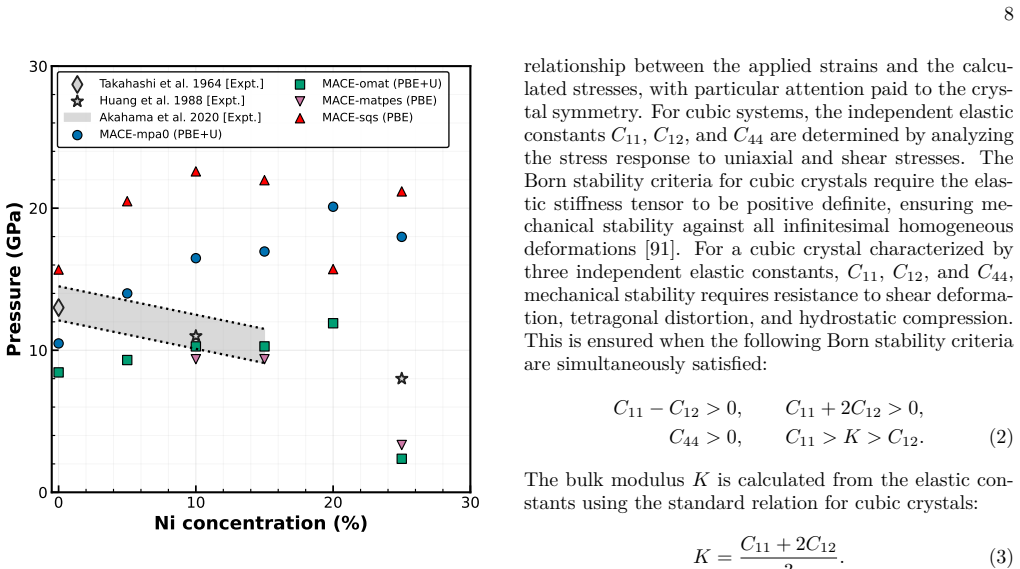
The MACE-sqs potential trained on SQS data for Fe-Ni alloys achieves validation errors of 2.0 meV/atom for energies and 24.3 meV/Å for forces and gives the most consistent agreement with DFT for structural, elastic, and thermal properties across compositions and bcc/fcc structures, yet all MACE models predict an incorrect increase of the bcc-to-hcp transition pressure with Ni content because high-pressure magnetic collapse and magnetoelastic effects remain uncaptured.
What carries the argument
The MACE-sqs model, a message-passing atomic cluster expansion potential trained on spin-polarized PBE DFT data for special quasirandom structures spanning Fe-Ni compositions, bcc and fcc lattices, and volumetric/shear deformations.
If this is right
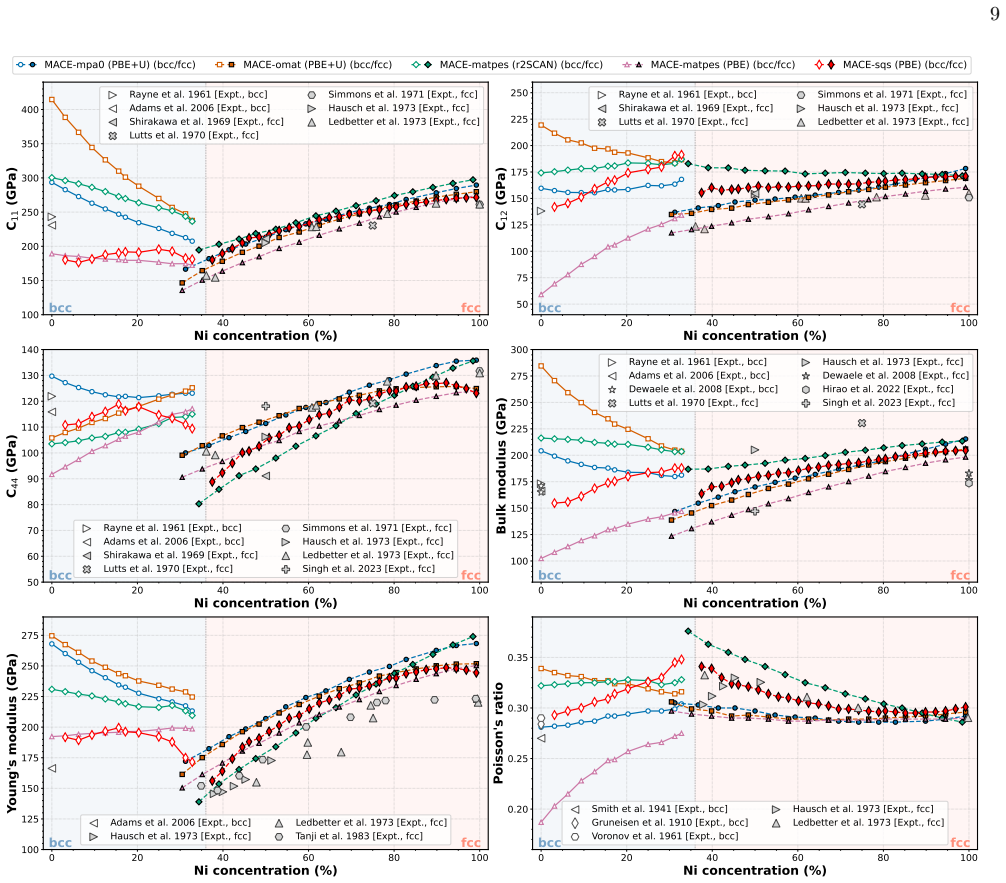
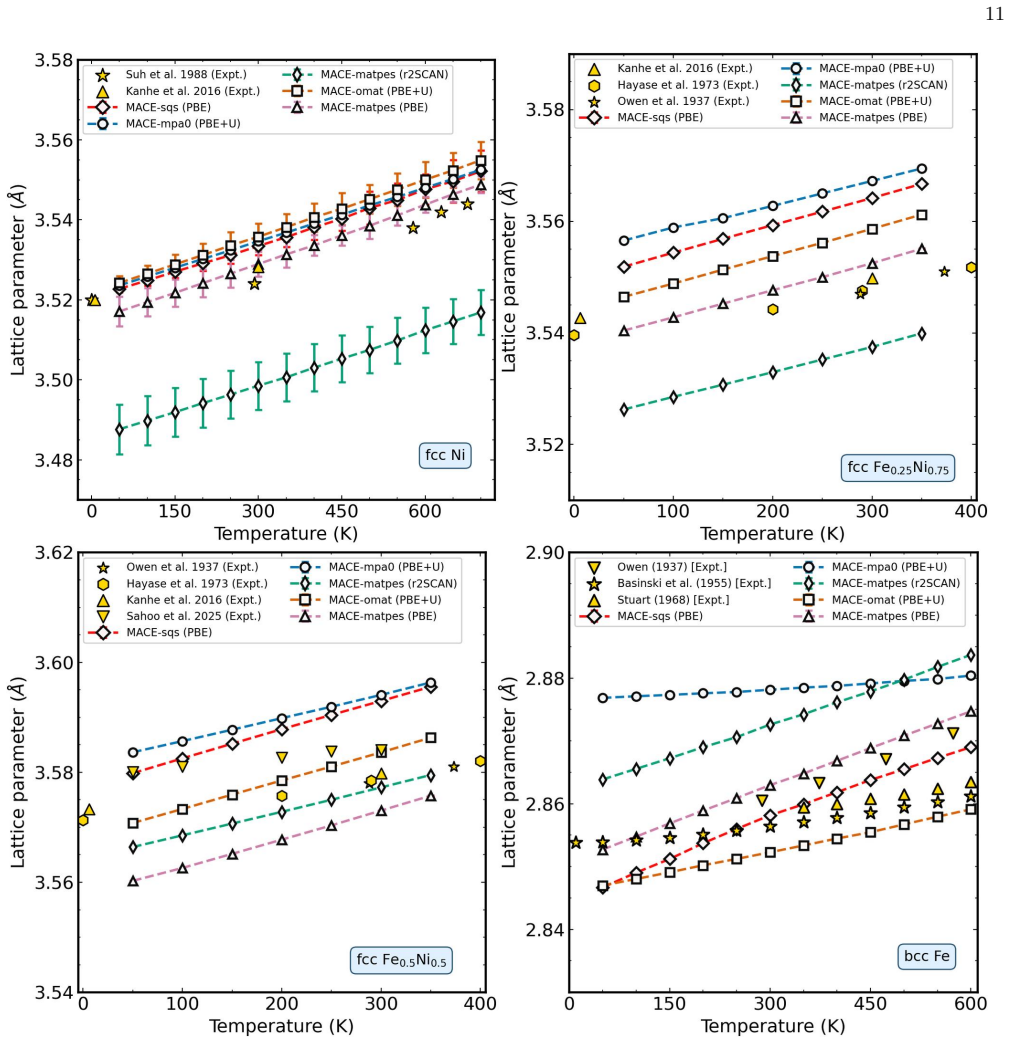
- MACE-sqs outperforms foundation models for equilibrium volumes, elastic constants, and thermal expansion trends in both bcc and fcc Fe-Ni alloys.
- For pure iron the MACE-sqs model predicts a bcc-to-hcp transition pressure closer to experiment than the foundation models.
- All MACE models, including the targeted one, share the same incorrect trend of rising transition pressure with added nickel.
- Targeted SQS-based training improves accuracy for many properties while phase stability under magnetic collapse stays a shared limitation.
Where Pith is reading between the lines
- The same SQS-training strategy could be tested on other binary magnetic alloys such as Fe-Co to check transferability of the accuracy gains.
- Explicit magnetic moment tracking or spin-dependent descriptors may be required in future MACE variants to resolve the magnetic collapse regime.
- Discrepancies in predicted phase boundaries suggest direct validation against high-pressure diamond-anvil cell experiments on composition-series Fe-Ni samples.
Load-bearing premise
Spin-polarized PBE DFT calculations provide a sufficiently accurate and transferable reference for both structural and magnetic properties of Fe-Ni alloys across all compositions and under the high-pressure regime of magnetic collapse.
What would settle it
Experimental measurement of how the bcc-to-hcp transition pressure changes with nickel concentration in Fe-Ni alloys, or comparison of the models against higher-accuracy methods under magnetic collapse conditions.
Figures
read the original abstract
We present a systematic benchmark of MACE potentials for iron-nickel alloys, focusing on structural, elastic, magnetic, and finite-temperature properties relevant to phase stability. The reference dataset comprises spin-polarized PBE density functional theory (DFT) calculations for chemically disordered special quasirandom structures (SQS), spanning compositions, bcc and fcc crystal structures, and volumetric and shear deformations. A system-specific MACE-sqs model trained on this dataset achieves validation errors of 2.0 meV/atom for energies and 24.3 meV/Angstrom for forces. Compared with several MACE foundation models, including models trained with Hubbard U corrections, MACE-sqs gives the most consistent agreement with DFT and experiment for equations of state, equilibrium volumes, elastic constants, and thermal expansion trends in bcc and fcc Fe-Ni alloys. For the bcc-to-hcp transition, MACE-sqs predicts a pure-Fe transition pressure closer to experiment than the tested foundation models, but all models predict an incorrect increase of transition pressure with Ni content. This failure indicates that high-pressure magnetic collapse and composition-dependent magnetoelastic effects are not yet fully captured. Overall, targeted SQS-based training substantially improves the accuracy of MACE potentials for Fe-Ni alloys, while phase stability under magnetic collapse remains a key limitation for future model development.
Editorial analysis
A structured set of objections, weighed in public.
Referee Report
Summary. The paper benchmarks several MACE machine-learning potentials, including foundation models and a custom MACE-sqs model trained on spin-polarized PBE DFT data for chemically disordered SQS structures in bcc and fcc Fe-Ni alloys. It reports that MACE-sqs achieves low validation errors (2.0 meV/atom energies, 24.3 meV/Å forces) and outperforms the foundation models on equations of state, equilibrium volumes, elastic constants, and thermal expansion trends. For the bcc-to-hcp transition, MACE-sqs improves the pure-Fe transition pressure relative to other models but, like all tested models, predicts an increase in transition pressure with Ni content, contrary to experiment; the authors attribute this to inadequate capture of high-pressure magnetic collapse and composition-dependent magnetoelastic coupling. The central conclusion is that targeted SQS training substantially improves accuracy for Fe-Ni while phase stability under magnetic collapse remains a key limitation.
Significance. If the results hold, the work supplies a concrete, reproducible benchmark demonstrating that system-specific training on SQS data measurably improves MACE performance on structural, elastic, and finite-temperature properties of magnetic alloys, while cleanly isolating a failure mode in high-pressure phase stability. The explicit comparison to both DFT references and experiment, together with the identification of missing physics rather than data artifacts, strengthens the utility of the findings for future model development in magnetoelastic systems.
major comments (2)
- [Abstract; bcc-to-hcp transition results] Abstract and the bcc-to-hcp transition discussion: the claim that the incorrect (increasing) trend of transition pressure with Ni content demonstrates that 'high-pressure magnetic collapse and composition-dependent magnetoelastic effects are not yet fully captured' by the MACE models rests on the assumption that spin-polarized PBE supplies the correct target trend. Because the reference dataset is restricted to bcc/fcc SQS structures and volumetric/shear deformations with no hcp or collapsed-moment configurations included, and no direct PBE-computed transition pressures versus composition are reported for comparison with experiment, the attribution risks conflating possible deficiencies of the DFT reference with limitations specific to the ML potentials.
- [Methods (training dataset); Results (phase stability)] Methods and results on model training: while validation errors are reported for MACE-sqs, the manuscript does not quantify how the absence of hcp or high-pressure magnetic data in the training set propagates into the extrapolated transition-pressure predictions, leaving the load-bearing negative conclusion without a direct test of whether the observed discrepancy originates in the MACE architecture or in the underlying PBE reference.
minor comments (2)
- [Abstract; Introduction] The distinction between 'MACE foundation models' and the 'MACE-sqs' model should be stated more explicitly in the abstract and introduction to avoid reader confusion about which models were retrained versus used off-the-shelf.
- [Figures on bcc-hcp transitions] Figure captions for the transition-pressure plots could usefully include the experimental trend line for direct visual comparison.
Simulated Author's Rebuttal
We thank the referee for their thorough review and valuable feedback on our manuscript. We address the major comments point by point below, and have revised the manuscript accordingly where appropriate.
read point-by-point responses
-
Referee: [Abstract; bcc-to-hcp transition results] Abstract and the bcc-to-hcp transition discussion: the claim that the incorrect (increasing) trend of transition pressure with Ni content demonstrates that 'high-pressure magnetic collapse and composition-dependent magnetoelastic effects are not yet fully captured' by the MACE models rests on the assumption that spin-polarized PBE supplies the correct target trend. Because the reference dataset is restricted to bcc/fcc SQS structures and volumetric/shear deformations with no hcp or collapsed-moment configurations included, and no direct PBE-computed transition pressures versus composition are reported for comparison with experiment, the attribution risks conflating possible deficiencies of the DFT reference with limitations specific to the ML potentials.
Authors: We agree with the referee that our training set does not include hcp structures or high-pressure magnetic collapse configurations, and that we have not computed PBE transition pressures for hcp as a function of Ni content. The bcc-to-hcp predictions are therefore extrapolations from the bcc/fcc data. While the models fail to match the experimental trend of decreasing transition pressure with Ni, we cannot rule out that part of the discrepancy arises from the PBE functional itself under these conditions. In the revised manuscript, we will modify the abstract and discussion to state that the models do not reproduce the experimental composition dependence, and that this highlights the challenge in capturing high-pressure magnetoelastic effects, without definitively attributing it solely to the MACE architecture. We will also note the limitation of the training data. revision: partial
-
Referee: [Methods (training dataset); Results (phase stability)] Methods and results on model training: while validation errors are reported for MACE-sqs, the manuscript does not quantify how the absence of hcp or high-pressure magnetic data in the training set propagates into the extrapolated transition-pressure predictions, leaving the load-bearing negative conclusion without a direct test of whether the observed discrepancy originates in the MACE architecture or in the underlying PBE reference.
Authors: We acknowledge that a direct quantification would require additional PBE calculations on hcp structures at varying pressures and compositions to compare against MACE predictions. Such calculations were not performed as the primary focus was on benchmarking within the bcc and fcc phases relevant to the SQS training data. We will add a paragraph in the discussion section explicitly stating this limitation and recommending that future work include hcp and magnetic collapse data to better isolate the source of the discrepancy. revision: partial
Circularity Check
No significant circularity; all performance claims benchmarked to external DFT and experiment.
full rationale
The paper trains MACE models on spin-polarized PBE DFT data for SQS structures and reports validation errors plus comparisons for EOS, volumes, elastic constants, thermal expansion, and bcc-hcp transition pressures. All metrics are direct numerical comparisons to independent external references (DFT calculations and experimental values). No equations reduce a claimed prediction to a fitted parameter by construction, no self-citations are load-bearing for the central claims, and the training/validation split does not create self-definitional loops. The negative finding on transition-pressure trends is presented as a discrepancy with experiment, not as a quantity derived from the model's own inputs.
Axiom & Free-Parameter Ledger
free parameters (1)
- MACE-sqs model parameters
axioms (1)
- domain assumption Spin-polarized PBE DFT provides an adequate reference for magnetic and structural properties of Fe-Ni alloys
Reference graph
Works this paper leans on
-
[1]
Kuwayama, K
Y. Kuwayama, K. Hirose, N. Sata, and Y. Ohishi, Phase relations of iron and iron–nickel alloys up to 300 GPa: Implicationsforcompositionandstructureoftheearth’s inner core, Earth and Planetary Science Letters273, 379 (2008)
2008
-
[2]
W. L. Mao, A. J. Campbell, D. L. Heinz, and G. Shen, PhaserelationsofFe–Nialloysathighpressureandtem- perature, Physics of the Earth and Planetary Interiors 155, 146 (2006)
2006
-
[3]
van Schilfgaarde, I
M. van Schilfgaarde, I. A. Abrikosov, and B. Johansson, Origin of the invar effect in iron–nickel alloys, Nature 400, 46 (1999)
1999
-
[4]
Dubrovinsky, N
L. Dubrovinsky, N. Dubrovinskaia, I. A. Abrikosov, M. Vennström, F. Westman, S. Carlson, M. van Schilf- gaarde, and B. Johansson, Pressure-induced invar effect in Fe-Ni alloys, Phys. Rev. Lett.86, 4851 (2001)
2001
-
[5]
Mushnikov, A
N. Mushnikov, A. Popov, V. Gaviko, A. Protasov, N. Kleinerman, O. Golovnya, and S. Naumov, Pecu- liarities of phase diagram of Fe–Ni system at Ni con- centrations 0 – 20 at.%., Acta Materialia240, 118330 (2022)
2022
-
[6]
A. A. Ahles, J. D. Emery, and D. C. Dunand, Me- chanical properties of meteoritic Fe–Ni alloys for in-situ extraterrestrial structures, Acta Astronautica189, 465 (2021)
2021
-
[7]
Huang, W
E. Huang, W. A. Bassett, and M. S. Weathers, Phase relationships in Fe–Ni alloys at high pressures and tem- peratures,JournalofGeophysicalResearch: SolidEarth 93, 7741 (1988)
1988
-
[8]
Akahama, Y
Y. Akahama, Y. Fujimoto, T. Terai, T. Fukuda, S. Kawaguchi, N. Hirao, Y. Ohishi, and T. Kakeshita, Pressure–composition phase diagram of Fe–Ni alloy, MATERIALS TRANSACTIONS61, 1058 (2020)
2020
-
[9]
Ramakrishna, M
K. Ramakrishna, M. Lokamani, A. Baczewski, J. Vor- berger, and A. Cangi, Electrical conductivity of iron in earth’s core from microscopic ohm’s law, Phys. Rev. B 107, 115131 (2023)
2023
-
[10]
Takahashi and W
T. Takahashi and W. A. Bassett, High-pressure poly- morph of iron, Science145, 483 (1964)
1964
-
[11]
Mathon, F
O. Mathon, F. Baudelet, J. P. Itié, A. Polian, M. d’Astuto, J. C. Chervin, and S. Pascarelli, Dynamics of the magnetic and structuralα−ϵphase transition in iron, Phys. Rev. Lett.93, 255503 (2004)
2004
-
[12]
Ramakrishna, M
K. Ramakrishna, M. Lokamani, A. Baczewski, J. Vor- berger, and A. Cangi, Impact of electronic corre- lations on high-pressure iron: insights from time- dependent density functional theory, Electronic Struc- ture5, 045002 (2023)
2023
-
[13]
Behler and M
J. Behler and M. Parrinello, Generalized neural-network representationofhigh-dimensionalpotential-energysur- faces, Phys. Rev. Lett.98, 146401 (2007)
2007
-
[14]
Behler, Four generations of high-dimensional neu- ral network potentials, Chemical Reviews121, 10037 (2021)
J. Behler, Four generations of high-dimensional neu- ral network potentials, Chemical Reviews121, 10037 (2021)
2021
-
[15]
Thompson, L
A. Thompson, L. Swiler, C. Trott, S. Foiles, and G. Tucker, Spectral neighbor analysis method for auto- mated generation of quantum-accurate interatomic po- tentials, Journal of Computational Physics285, 316 (2015)
2015
-
[16]
Y. Zuo, C. Chen, X. Li, Z. Deng, Y. Chen, J. Behler, G. Csányi, A. V. Shapeev, A. P. Thompson, M. A. Wood, and S. P. Ong, Performance and cost assessment of machine learning interatomic potentials, The Journal of Physical Chemistry A124, 731 (2020)
2020
-
[17]
Nikolov, M
S. Nikolov, M. A. Wood, A. Cangi, J.-B. Maillet, M.- C. Marinica, A. P. Thompson, M. P. Desjarlais, and J. Tranchida, Data-driven magneto-elastic predictions with scalable classical spin-lattice dynamics, npj Com- putational Materials7, 153 (2021)
2021
-
[18]
Nikolov, J
S. Nikolov, J. Tranchida, K. Ramakrishna, M. Loka- mani, A. Cangi, and M. A. Wood, Dissociating the phononic, magneticandelectroniccontributionstother- mal conductivity: a computational study in alpha-iron, Journal of Materials Science57, 10535 (2022)
2022
-
[19]
Nikolov, K
S. Nikolov, K. Ramakrishna, A. Rohskopf, M. Loka- mani, J. Tranchida, J. Carpenter, A. Cangi, and M. A. Wood, Probing iron in earth’s core with molecular-spin dynamics, Proceedings of the National Academy of Sci- ences121, e2408897121 (2024)
2024
-
[20]
A. P. Bartók, M. C. Payne, R. Kondor, and G. Csányi, Gaussian approximation potentials: The accuracy of quantum mechanics, without the electrons, Phys. Rev. Lett.104, 136403 (2010)
2010
-
[21]
Dragoni, T
D. Dragoni, T. D. Daff, G. Csányi, and N. Marzari, Achieving DFT accuracy with a machine-learning inter- atomic potential: Thermomechanics and defects in bcc ferromagnetic iron, Phys. Rev. Mater.2, 013808 (2018)
2018
-
[22]
Shenoy, C
L. Shenoy, C. D. Woodgate, J. B. Staunton, A. P. Bartók, C. S. Becquart, C. Domain, and J. R. Kermode, Collinear-spin machine learned interatomic potential for Fe7Cr2Ni alloy, Phys. Rev. Mater.8, 033804 (2024)
2024
-
[23]
Fellman, J
A. Fellman, J. Byggmästar, F. Granberg, K. Nordlund, and F. Djurabekova, Fast and accurate machine-learned interatomic potentials for large-scale simulations of Cu, Al, and Ni, Phys. Rev. Mater.9, 053807 (2025)
2025
-
[24]
A. V. Shapeev, Moment tensor potentials: A class of systematically improvable interatomic potentials, Mul- tiscale Modeling & Simulation14, 1153 (2016)
2016
-
[25]
I.Novikov, B.Grabowski, F.Körmann,andA.Shapeev, Magnetic moment tensor potentials for collinear spin- polarized materials reproduce different magnetic states of bcc Fe, npj Computational Materials8, 13 (2022)
2022
-
[26]
S. Hao, P. Singh, A. V. Smirnov, D. D. Johnson, D. E. Alman, and M. C. Gao, Developing reliable machine learning interatomic potential for Fe–Cr–Ni austenitic alloys, Journal of Applied Physics138, 085103 (2025)
2025
-
[27]
Drautz, Atomic cluster expansion for accurate and transferable interatomic potentials, Phys
R. Drautz, Atomic cluster expansion for accurate and transferable interatomic potentials, Phys. Rev. B99, 014104 (2019)
2019
-
[28]
Rinaldi, M
M. Rinaldi, M. Mrovec, A. Bochkarev, Y. Lysogorskiy, and R. Drautz, Non-collinear magnetic atomic cluster expansion for iron, npj Computational Materials10, 12 (2024)
2024
-
[29]
C. J. Owen, S. B. Torrisi, Y. Xie, S. Batzner, K. Bystrom, J. Coulter, A. Musaelian, L. Sun, and B. Kozinsky, Complexity of many-body interactions in transition metals via machine-learned force fields from the TM23 data set, npj Computational Materials10, 92 (2024)
2024
-
[30]
Zhang, J
L. Zhang, J. Han, H. Wang, R. Car, and W. E, Deep potential molecular dynamics: A scalable model with the accuracy of quantum mechanics, Phys. Rev. Lett. 14 120, 143001 (2018)
2018
-
[31]
Zhang, H
Y. Zhang, H. Wang, W. Chen, J. Zeng, L. Zhang, H. Wang, and W. E, DP-GEN: A concurrent learn- ing platform for the generation of reliable deep learn- ing based potential energy models, Computer Physics Communications253, 107206 (2020)
2020
-
[32]
X. Gong, Z. Li, A. S. L. S. Pattamatta, T. Wen, and D. J. Srolovitz, An accurate and transferable machine learning interatomic potential for nickel, Communica- tions Materials5, 157 (2024)
2024
-
[33]
E. O. Khazieva, N. M. Chtchelkatchev, N. N. Katkov, and R. E. Ryltsev, Accuracy and limitations of machine- learned interatomic potentials for magnetic systems: A case study on Fe-Cr-C, Phys. Rev. E112, 055302 (2025)
2025
-
[34]
Batzner, A
S. Batzner, A. Musaelian, L. Sun, M. Geiger, J. P. Mailoa, M. Kornbluth, N. Molinari, T. E. Smidt, and B. Kozinsky, E(3)-equivariant graph neural networks for data-efficient and accurate interatomic potentials, Na- ture Communications13, 2453 (2022)
2022
-
[35]
Batatia, D
I. Batatia, D. P. Kovács, G. Simm, C. Ortner, and G. Csányi, MACE: Higher order equivariant message passing neural networks for fast and accurate force fields, inAdvances in Neural Information Processing Systems, Vol. 35, edited by S. Koyejo, S. Mohamed, A. Agarwal, D. Belgrave, K. Cho, and A. Oh (Curran Associates, Inc., 2022) pp. 11423–11436
2022
-
[36]
B. Deng, P. Zhong, K. Jun, J. Riebesell, K. Han, C. J. Bartel, and G. Ceder, Chgnet as a pretrained universal neural network potential for charge-informed atomistic modelling, Nature Machine Intelligence5, 1031 (2023)
2023
-
[37]
Schmidt, H.-C
J. Schmidt, H.-C. Wang, T. F. T. Cerqueira, S. Botti, and M. A. L. Marques, A dataset of 175K stable and metastable materials calculated with the PBEsol and SCAN functionals, Scientific Data9, 64 (2022)
2022
-
[38]
Open Materials 2024 (OMat24) Inorganic Materials Dataset and Models
L. Barroso-Luque, M. Shuaibi, X. Fu, B. M. Wood, M. Dzamba, M. Gao, A. Rizvi, C. L. Zitnick, and Z. W. Ulissi, Open materials 2024 (omat24) inorganic materi- als dataset and models (2024), arXiv:2410.12771 [cond- mat.mtrl-sci]
work page internal anchor Pith review Pith/arXiv arXiv 2024
- [39]
-
[40]
van de Walle, M
A. van de Walle, M. D. Asta, and G. Ceder, The Alloy Theoretic Automated Toolkit: A user guide, Calphad 26, 539 (2002)
2002
-
[41]
van de Walle, P
A. van de Walle, P. Tiwary, M. de Jong, D. Olmsted, M.Asta, A.Dick, D.Shin, Y.Wang, L.-Q.Chen,andZ.- K. Liu, Efficient stochastic generation of special quasir- andom structures, Calphad42, 13 (2013)
2013
-
[42]
J. M. Cowley, Short-range order and long-range order parameters, Phys. Rev.138, A1384 (1965)
1965
-
[43]
J. M. Cowley, An approximate theory of order in alloys, Phys. Rev.77, 669 (1950)
1950
-
[44]
Kresse and J
G. Kresse and J. Hafner, Ab initio molecular dynamics for liquid metals, Phys. Rev. B47, 558 (1993)
1993
-
[45]
Kresse and D
G. Kresse and D. Joubert, From ultrasoft pseudopoten- tials to the projector augmented-wave method, Phys. Rev. B59, 1758 (1999)
1999
-
[46]
Kresse and J
G. Kresse and J. Furthmüller, Efficiency of ab-initio to- tal energy calculations for metals and semiconductors using a plane-wave basis set, Computational Materials Science6, 15 (1996)
1996
-
[47]
G.KresseandJ.Furthmüller,Efficientiterativeschemes forabinitiototal-energycalculationsusingaplane-wave basis set, Phys. Rev. B54, 11169 (1996)
1996
-
[48]
J. P. Perdew, K. Burke, and M. Ernzerhof, Generalized gradient approximation made simple, Phys. Rev. Lett. 77, 3865 (1996)
1996
-
[49]
Tesch and P
R. Tesch and P. M. Kowalski, Hubbarduparameters for transition metals from first principles, Phys. Rev. B 105, 195153 (2022)
2022
-
[50]
Hausoel, M
A. Hausoel, M. Karolak, E. Şaşιoğlu, A. Lichtenstein, K. Held, A. Katanin, A. Toschi, and G. Sangiovanni, Local magnetic moments in iron and nickel at ambient and earth’s core conditions, Nature Communications8, 16062 (2017)
2017
-
[51]
T. D. Warford, F. L. Thiemann, and G. Csányi, Better without U: Impact of selective Hubbard U correction on foundational MLIPs, Machine Learning: Science and Technology 10.1088/2632-2153/ae6be5 (2026)
-
[52]
Xiong, H
W. Xiong, H. Zhang, L. Vitos, and M. Selleby, Magnetic phase diagram of the Fe–Ni system, Acta Materialia59, 521 (2011)
2011
-
[53]
Peschard, Contribution à l’étude des ferro-nickels, Re- vue de Métallurgie22, 490 (1925)
1925
-
[54]
Crangle, G
J. Crangle, G. C. Hallam, and W. Sucksmith, The mag- netization of face-centred cubic and body-centred cubic iron + nickel alloys, Proceedings of the Royal Society of London. Series A. Mathematical and Physical Sciences 272, 119 (1963)
1963
-
[55]
C. S. Tian, D. Qian, D. Wu, R. H. He, Y. Z. Wu, W. X. Tang, L. F. Yin, Y. S. Shi, G. S. Dong, X. F. Jin, X. M. Jiang, F. Q. Liu, H. J. Qian, K. Sun, L. M. Wang, G. Rossi, Z. Q. Qiu, and J. Shi, Body-centered-cubic Ni and its magnetic properties, Phys. Rev. Lett.94, 137210 (2005)
2005
-
[56]
Sumiyama, M
K. Sumiyama, M. Kadono, and Y. Nakamura, Metastable bcc phase in sputtered Fe–Ni alloys, Trans- actions of the Japan institute of metals24, 190 (1983)
1983
-
[57]
Asano, Magnetism ofγFe-Ni invar alloys with low nickel concentration, Journal of the Physical Society of Japan27, 542 (1969)
H. Asano, Magnetism ofγFe-Ni invar alloys with low nickel concentration, Journal of the Physical Society of Japan27, 542 (1969)
1969
-
[58]
Bando, The magnetization of face centered cubic iron-nickel alloys in the vicinity of invar region, Jour- nal of the Physical Society of Japan19, 237 (1964)
Y. Bando, The magnetization of face centered cubic iron-nickel alloys in the vicinity of invar region, Jour- nal of the Physical Society of Japan19, 237 (1964)
1964
-
[59]
Glaubitz, S
B. Glaubitz, S. Buschhorn, F. Brüssing, R. Abrudan, and H. Zabel, Development of magnetic moments in Fe1−xNix-alloys, Journal of Physics: Condensed Mat- ter23, 254210 (2011)
2011
-
[60]
I. A. Tsoukalas and K. G. Melidis, Measurements on the magnetic properties of Fe–Ni alloys, International Journal of Materials Research78, 498 (1987)
1987
-
[61]
Dunaev, and E
V.M.Kalinin, V.A.Kornyakov, O.A.Khomenko, F.N. Dunaev, and E. E. Yurchikov, Mössbauer investigation of iron-nickel invar alloys, Bulletin of the Academy of Sciences of the USSR, Physical Series36, 1420 (1972)
1972
-
[62]
Biewald, Experiment tracking with weights and bi- ases (2020), software available from wandb.com
L. Biewald, Experiment tracking with weights and bi- ases (2020), software available from wandb.com
2020
-
[63]
Riebesell, R
J. Riebesell, R. E. A. Goodall, P. Benner, Y. Chiang, B. Deng, G. Ceder, M. Asta, A. A. Lee, A. Jain, and K. A. Persson, A framework to evaluate machine learn- ing crystal stability predictions, Nature Machine Intel- ligence7, 836 (2025)
2025
-
[64]
Hjorth Larsen, J
A. Hjorth Larsen, J. Jørgen Mortensen, J. Blomqvist, I. E. Castelli, R. Christensen, M. Dułak, J. Friis, M. N. Groves, B. Hammer, C. Hargus, E. D. Hermes, 15 P. C. Jennings, P. Bjerre Jensen, J. Kermode, J. R. Kitchin, E. Leonhard Kolsbjerg, J. Kubal, K. Kaasb- jerg, S. Lysgaard, J. Bergmann Maronsson, T. Max- son, T. Olsen, L. Pastewka, A. Peterson, C. R...
2017
-
[65]
Cohen, J
O. Cohen, J. Riebesell, R. Goodall, A. Kolluru, S. Fall- etta, J. Krause, J. Colindres, G. Ceder, and A. S. Gan- gan, Torchsim: an efficient atomistic simulation engine in pytorch, AI for Science1, 025003 (2025)
2025
-
[66]
Birch, Finite elastic strain of cubic crystals, Phys
F. Birch, Finite elastic strain of cubic crystals, Phys. Rev.71, 809 (1947)
1947
-
[67]
F. D. Murnaghan, The compressibility of media un- der extreme pressures, Proceedings of the National Academy of Sciences30, 244 (1944)
1944
-
[68]
Dewaele, M
A. Dewaele, M. Torrent, P. Loubeyre, and M. Mezouar, Compression curves of transition metals in the mbar range: Experiments and projector augmented-wave cal- culations, Phys. Rev. B78, 104102 (2008)
2008
-
[69]
R. A. Morrison, J. M. Jackson, W. Sturhahn, D. Zhang, and E. Greenberg, Equations of state and anisotropy of Fe-Ni-Si alloys, Journal of Geophysical Research: Solid Earth123, 4647 (2018)
2018
-
[70]
C. Zhou, J. Buchen, V. V. Dobrosavljevic, B. Strozewski, O. S. Pardo, W. Sturhahn, T. Ishii, T. S. Toellner, J. D. Wilding, S. Chariton, B. Kalkan, M. Kunz, and J. M. Jackson, Equation of state of a low-sulfur iron–nickel alloy up to 143 GPa, Physics of the Earth and Planetary Interiors372, 107515 (2026)
2026
-
[71]
Hirao, Y
N. Hirao, Y. Akahama, and Y. Ohishi, Equations of state of iron and nickel to the pressure at the center of the earth, Matter and Radiation at Extremes7, 038403 (2022)
2022
-
[72]
Zwell, D
L. Zwell, D. E. Carnahan, and G. R. Speich, Lattice parameter of ferritic and martensitic Fe-Ni alloys, Met- allurgical Transactions1, 1007 (1970)
1970
-
[73]
Hayase, M
M. Hayase, M. Shiga, and Y. Nakamura, Spontaneous volume magnetostriction and lattice constant of face- centered cubic Fe-Ni and Ni-Cu alloys, Journal of the Physical Society of Japan34, 925 (1973)
1973
-
[74]
M. Acet, H. Zähres, E. F. Wassermann, and W. Pepper- hoff, High-temperature moment-volume instability and anti-invar ofγ-Fe, Phys. Rev. B49, 6012 (1994)
1994
-
[75]
Kądziołka-Gaweł, W
M. Kądziołka-Gaweł, W. Zarek, E. Popiel, and A. Chrobak, The crystal structure and magnetic prop- erties of selected fcc FeNi and Fe40Ni40B20 alloys, Acta Physica Polonica A117(2010)
2010
-
[76]
N. S. Kanhe, A. Kumar, S. Yusuf, A. Nawale, S. Gaik- wad, S. A. Raut, S. Bhoraskar, S. Y. Wu, A. Das, and V. Mathe, Investigation of structural and magnetic properties of thermal plasma-synthesized Fe1−xNix al- loy nanoparticles, Journal of Alloys and Compounds 663, 30 (2016)
2016
-
[77]
Q. Wei, S. A. Gilder, W. Ertel-Ingrisch, F. Guillou, and F. Wilhelm, Magnetism of body-centered cubic Fe–Ni alloys under pressure: Strain-enhanced ferromagnetism at the phase transitions, Journal of Geophysical Re- search: Solid Earth125, e2020JB020922 (2020)
2020
-
[78]
Ekman, B
M. Ekman, B. Sadigh, K. Einarsdotter, and P. Blaha, Ab initio study of the martensitic bcc-hcp transforma- tion in iron, Phys. Rev. B58, 5296 (1998)
1998
-
[79]
J.J.Adams, D.S.Agosta, R.G.Leisure,andH.Ledbet- ter, Elastic constants of monocrystal iron from 3to500k, Journal of Applied Physics100, 113530 (2006)
2006
-
[80]
J. A. Rayne and B. S. Chandrasekhar, Elastic constants of iron from 4.2 to 300°K, Phys. Rev.122, 1714 (1961)
1961
discussion (0)
Sign in with ORCID, Apple, or X to comment. Anyone can read and Pith papers without signing in.