Topological Diagram Analysis of Charmed Baryon Decays with Vector Mesons
Pith reviewed 2026-06-29 11:45 UTC · model grok-4.3
The pith
Tensor-induced form factors A2 and B2 match the size of A1 and B1 in charmed baryon decays to vector mesons.
A machine-rendered reading of the paper's core claim, the machinery that carries it, and where it could break.
Core claim
Within the topological diagram framework for Bc to B V decays, only five independent parameter sets remain after the Korner-Pati-Woo theorem is applied. Fits to data establish that the form factors A2 and B2 generated by the tensor coupling of the vector meson to the octet baryon are comparable in size to A1 and B1, indicating that tensor contributions cannot be neglected. Symmetry relations among channels are derived and used to predict branching fractions that agree with measured modes along with additional observables such as asymmetries and polarizations.
What carries the argument
Topological diagrams for Bc to B V decays, reduced by the Korner-Pati-Woo theorem to five independent parameter sets that encode partial-wave amplitudes and form factors.
If this is right
- Branching fractions for all Bc to B V channels are predicted and most measured modes agree with current data.
- Up-down asymmetries, longitudinal polarizations and observables in subsequent decays can be calculated from the same five parameter sets.
- Symmetry relations among decay channels follow directly from the TDA construction.
Where Pith is reading between the lines
- The extracted tensor form factors can be compared with lattice or quark-model calculations of the same matrix elements.
- If the five-parameter description continues to work, the same reduction may apply to related non-leptonic baryon decays.
- Future high-statistics data can test whether the tensor terms remain comparable across different vector-meson final states.
Load-bearing premise
The Korner-Pati-Woo theorem combined with isospin, U-spin and V-spin symmetries is enough to reduce every contribution to five independent parameter sets without large missing higher-order or non-factorizable effects.
What would settle it
A set of precise branching-fraction measurements in which A2 and B2 turn out much smaller than A1 and B1, or in which several predicted rates deviate significantly from the data.
Figures
read the original abstract
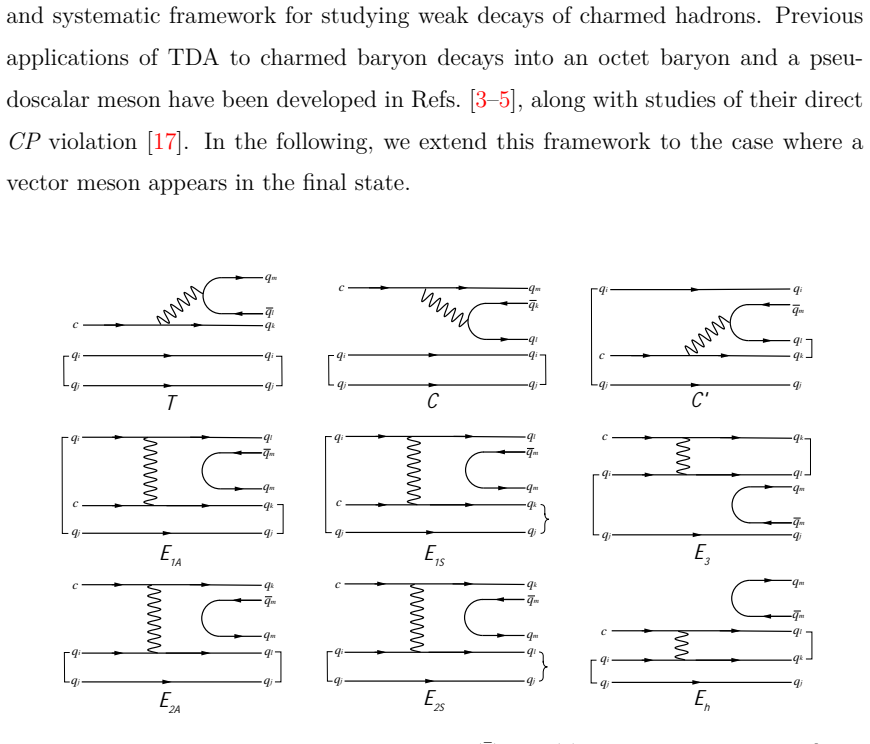
In this work, we further develop the application of the topological diagram approach (TDA) to charmed baryon weak decays $\mathcal{B}_c \to \mathcal{B} V$ with a vector meson in the final state. By incorporating the Korner-Pati-Woo theorem, we show that only five independent sets of TDA parameters are required. Relations among different decay channels arising from isospin, U-spin, and V-spin symmetries are explicitly derived within the TDA framework. Partial wave contributions and form factors associated with different topological diagrams are extracted from global fits to the experimental data. It is found that the form factors $A_2$ and $B_2$ induced from the tensor interaction of the vector mreson with octet baryons are comparable in magnitude to $A_1$ and $B_1$, implying the importance of the tensor coupling in $\mathcal{B}_c \to \mathcal{B} V$ decays. Branching fractions for all $\mathcal{B}_c\to \mathcal{B} V$ channels are predicted, and most measured modes are found to be in good agreement with current data. More physical observables, including up-down asymmetries, longitudinal polarizations as well as observables in the subsequent decays are also predicted. Our results provide a systematic framework for understanding charmed baryon weak decays with vector mesons and can be further tested with future experiments.
Editorial analysis
A structured set of objections, weighed in public.
Referee Report
Summary. The manuscript applies the topological diagram approach (TDA) to charmed baryon weak decays B_c → B V. By incorporating the Korner-Pati-Woo theorem together with isospin, U-spin and V-spin relations, the authors reduce all contributions to five independent TDA parameter sets. Global fits to measured branching fractions are used to extract partial-wave form factors (including tensor-induced A2, B2), which are found comparable in size to A1, B1. Branching fractions, up-down asymmetries, longitudinal polarizations and subsequent-decay observables are then predicted for all channels.
Significance. If the symmetry reduction is valid, the work supplies a compact, symmetry-constrained framework that relates dozens of decay modes through only five parameter sets and yields testable predictions for unmeasured channels and polarization observables. The explicit extraction of tensor form factors and the global-fit methodology constitute concrete, falsifiable outputs that can be confronted with forthcoming LHCb and Belle II data.
major comments (1)
- [Abstract] Abstract: the central claim that A2 and B2 are comparable to A1 and B1 (hence that tensor coupling is important) rests on a global fit performed with only five independent TDA parameter sets after imposition of the Korner-Pati-Woo theorem plus isospin/U-spin/V-spin relations. The manuscript does not quantify possible SU(3) breaking induced by the charm mass or additional non-factorizable topologies; if even one extra independent amplitude is required, the fit can redistribute strength among the partial-wave form factors and change the reported A2/A1 and B2/B1 ratios by O(1) factors.
minor comments (2)
- [Abstract] Abstract: 'vector mreson' is a typographical error and should read 'vector meson'.
- [Abstract] Abstract: the phrase 'B_c to B V decays' should be written consistently as B_c → B V throughout.
Simulated Author's Rebuttal
We thank the referee for the careful reading of the manuscript and for highlighting the importance of assessing the robustness of the extracted form-factor ratios under possible symmetry-breaking effects. We address the single major comment below.
read point-by-point responses
-
Referee: [Abstract] Abstract: the central claim that A2 and B2 are comparable to A1 and B1 (hence that tensor coupling is important) rests on a global fit performed with only five independent TDA parameter sets after imposition of the Korner-Pati-Woo theorem plus isospin/U-spin/V-spin relations. The manuscript does not quantify possible SU(3) breaking induced by the charm mass or additional non-factorizable topologies; if even one extra independent amplitude is required, the fit can redistribute strength among the partial-wave form factors and change the reported A2/A1 and B2/B1 ratios by O(1) factors.
Authors: We agree that the manuscript performs the global fit strictly within the five-parameter framework obtained after applying the Korner-Pati-Woo theorem together with the isospin, U-spin and V-spin relations, and does not supply a separate quantitative estimate of SU(3) breaking induced by the charm mass or of possible additional non-factorizable topologies. The reported comparability of A2 and B2 to A1 and B1 is therefore a result obtained under those symmetry assumptions. To address the concern we will (i) revise the abstract to state that the ratios are extracted within the symmetry-constrained TDA framework and (ii) add a short paragraph in the discussion section that recalls the size of SU(3) breaking observed in related charmed-baryon decays and notes that an extra independent amplitude could in principle alter the ratios by O(1). The current data remain well described by the five-parameter fit, and the framework is readily extendable if future measurements require additional amplitudes. revision: yes
Circularity Check
No significant circularity; TDA reduction and fit are independent of target claims
full rationale
The paper applies the external Korner-Pati-Woo theorem plus isospin/U/V-spin relations to reduce TDA amplitudes to five parameter sets, performs a global fit of those parameters to measured branching fractions, extracts the partial-wave form factors A1/A2/B1/B2 from the fit, and uses the resulting values to predict unmeasured channels and observables. This is a standard data-driven phenomenological procedure; the extracted form-factor ratios are direct outputs of the fit to external data rather than tautological redefinitions, and predictions for unmeasured modes are not forced by construction to equal the fitted inputs. No load-bearing step reduces to a self-citation chain, an ansatz smuggled via citation, or a fitted quantity renamed as an independent prediction. The derivation chain remains self-contained against external benchmarks.
Axiom & Free-Parameter Ledger
free parameters (1)
- five independent sets of TDA parameters
axioms (2)
- domain assumption Korner-Pati-Woo theorem
- domain assumption isospin, U-spin, and V-spin symmetries
Reference graph
Works this paper leans on
-
[1]
1 The original expression of the decay width given in [ 6] is too small by a factor of 2
for the average. 1 The original expression of the decay width given in [ 6] is too small by a factor of 2. 4 The up-down asymmetry of the vector meson with respect to the spin of the charmed baryon is defined as α = 2E2 V Re[(S + D)∗P1] + 4m2 V Re(S∗P2) 2m2 V (|S|2 + |P2|2) + E2 V (|S + D|2 + |P1|2) , (7) and the longitudinal polarization of the final bar...
-
[2]
Modes such as Ξ0 c → Ξ−ρ+ are predicted to exhibit a large up-down asym- metry but a relatively small longitudinal asymmetry, suggesting significant contributions from the A2 and B2 amplitudes
-
[3]
This implies that Re[(S + D)∗P1] and Re(S∗P2) are comparable but opposite in signs
In contrast, modes such as Ξ+ c → Σ+ρ0 are predicted to have a small α but large PL. This implies that Re[(S + D)∗P1] and Re(S∗P2) are comparable but opposite in signs. From Eq. ( 5), one can infer that Re(S∗P2) ∝ − A1B1 and Re[(S + D)∗P1] ∝ A1B1 if A2 and B2 are negligible. Therefore, decays with this type of decay asymmetry will have a small tensor coupling
-
[4]
This pattern can be interpreted as a 18 result of a suppressed interference term Re(S∗P2), which in turn suggests the smallness of either the A1 or B1 form factor
In addition, sizable decay asymmetries, α and PL, are found in certain channels, such as Λ+ c → p K ∗0 and Λ+ c → Σ+ρ0. This pattern can be interpreted as a 18 result of a suppressed interference term Re(S∗P2), which in turn suggests the smallness of either the A1 or B1 form factor. It is interesting to note from Table VII that B(Λ+ c → Σ0ρ+) = B(Λ+ c → Σ...
2026
- [5]
-
[6]
Cheng, Charmed baryon physics circa 2021, Chin
H.-Y. Cheng, Charmed baryon physics circa 2021, Chin. J. Phys. 78, 324 (2022) , arXiv:2109.01216 [hep-ph]
- [7]
- [8]
- [9]
-
[10]
Pakvasa, S
S. Pakvasa, S. P. Rosen, and S. F. Tuan, Parity Violation and Flavor Selection Rules in Charmed Baryon Decays, Phys. Rev. D 42, 3746 (1990)
1990
-
[11]
Cheng and B
H.-Y. Cheng and B. Tseng, Nonleptonic weak decays of charmed baryons, Phys. Rev. D 46, 1042 (1992) , [Erratum: Phys. Rev. D 55, 1697 (1997)]
1992
- [12]
- [13]
- [14]
-
[15]
M. Ablikim et al. (BESIII), Measurements of branching fractions of Λ+ c → Σ0K0 Sπ+ and Λ+ c → Σ0K0 SK+, (2026), arXiv:2602.22754 [hep-ex]
-
[16]
Weak Decays of Doubly Heavy Baryons: the $1/2\to 1/2$ case
W. Wang, F.-S. Yu, and Z.-X. Zhao, Weak decays of doubly heavy baryons: the 1/2 → 1/2 case, Eur. Phys. J. C 77, 781 (2017) , arXiv:1707.02834 [hep-ph]
work page internal anchor Pith review Pith/arXiv arXiv 2017
-
[17]
Singly Cabibbo-suppressed hadronic decays of $\Lambda_c^+$
H.-Y. Cheng, X.-W. Kang, and F. Xu, Singly Cabibbo-suppressed hadronic decays of Λ+ c , Phys. Rev. D 97, 074028 (2018) , arXiv:1801.08625 [hep-ph]
work page internal anchor Pith review Pith/arXiv arXiv 2018
-
[18]
Navas et al
S. Navas et al. (Particle Data Group), Review of particle physics, Phys. Rev. D 110, 030001 (2024)
2024
-
[19]
R. Aaij et al. (LHCb), Measurement of the Ω0 c and Ξ0 c baryon lifetimes using hadronic b-baryon decays, JHEP 09, 157 , arXiv:2506.13334 [hep-ex]
-
[20]
T. M. Aliev, A. Ozpineci, M. Savci, and V. S. Zamiralov, Vector meson-baryon strong coupling contants in light cone QCD sum rules, Phys. Rev. D 80, 016010 (2009) , arXiv:0905.4664 [hep-ph]
work page internal anchor Pith review Pith/arXiv arXiv 2009
- [21]
-
[22]
J. G. Korner, Octet behaviour of single-particle matrix elements ⟨B′|HW |B⟩ and ⟨M ′|HW |M ⟩ using a weak current current quark Hamiltonian, Nucl. Phys. B 25, 282 (1971)
1971
-
[23]
J. C. Pati and C. H. Woo, ∆I = 1/2 rule with fermion quarks, Phys. Rev. D 3, 2920 (1971)
1971
-
[24]
R. Aaij et al. (LHCb), Amplitude analysis of the Ξ+ c → pK−π+ decay and Ξ+ c baryon polarization measurement in semileptonic beauty-hadron decays, Phys. Rev. D 112, 092003 (2025) , arXiv:2508.00492 [hep-ex]
-
[25]
J. M. Link et al. (FOCUS), Measurements of Relative Branching Ratios of Λ+ c Decays into States Containing Σ, Phys. Lett. B 540, 25 (2002) , arXiv:hep-ex/0206013. 27
work page internal anchor Pith review Pith/arXiv arXiv 2002
-
[26]
R. Aaij et al. (LHCb), Amplitude analysis of the Λ+ c pK−π+ decay and Λ+ c baryon polarization measurement in semileptonic beauty hadron decays, Phys. Rev. D 108, 012023 (2023) , arXiv:2208.03262 [hep-ex]
-
[27]
M. Ablikim et al. (BESIII), Amplitude Analysis of Singly Cabibbo-Suppressed Decay + c → pK+K−, (2026), arXiv:2603.08469 [hep-ex]
-
[28]
M. Ablikim et al. (BESIII), Measurement of the branching fractions of the decays Λ+ c →ΛK0 SK+, Λ+ c →ΛK0 Sπ+, and Λ+ c →ΛK∗+, Phys. Rev. D 111, 012014 (2025) , arXiv:2410.16912 [hep-ex]
-
[29]
R. Aaij et al. (LHCb), Search for the rare decay of charmed baryon Λ+ c into the pµ+µ− final state, Phys. Rev. D 110, 052007 (2024) , arXiv:2407.11474 [hep-ex]
- [30]
discussion (0)
Sign in with ORCID, Apple, or X to comment. Anyone can read and Pith papers without signing in.