Electrically driven Rabi dynamics of magnetic-field-induced corner states in a two-dimensional topological insulator
Pith reviewed 2026-06-29 10:57 UTC · model grok-4.3
The pith
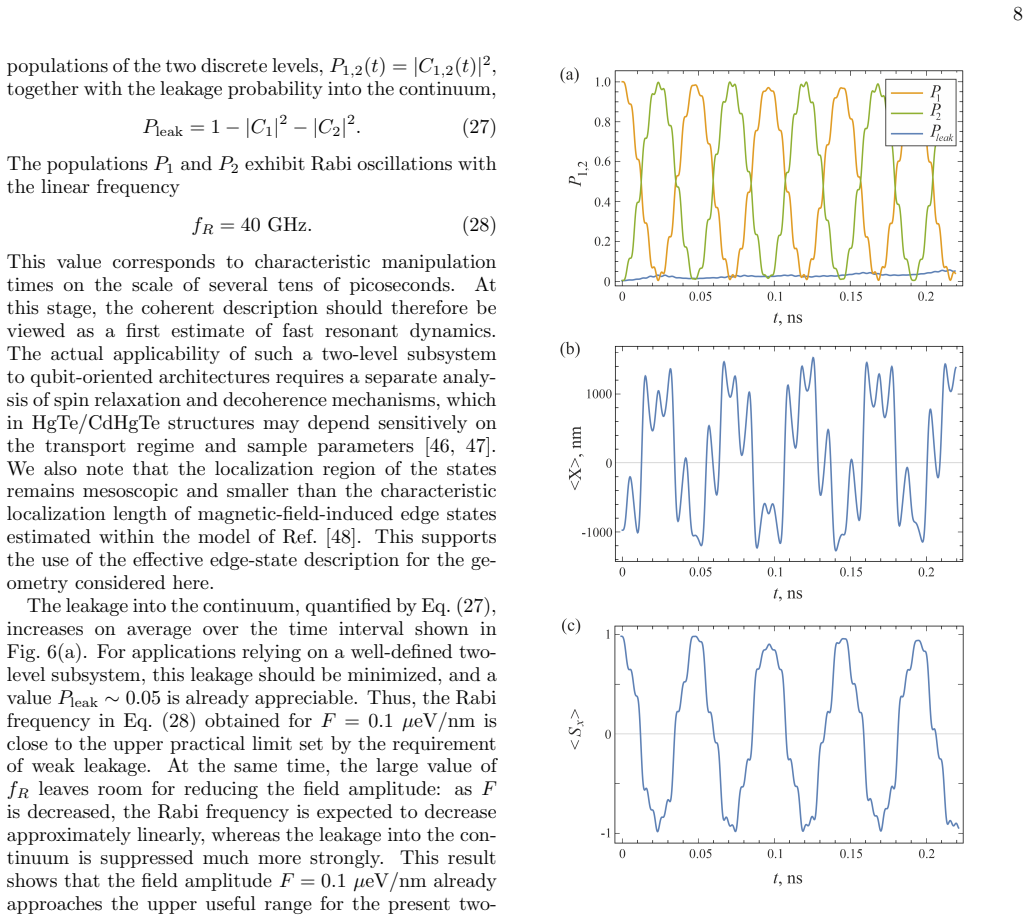
Magnetic-field-induced corner states at kinks in a topological insulator edge form an electrically drivable two-level system that exhibits Rabi oscillations at 20-40 GHz.
A machine-rendered reading of the paper's core claim, the machinery that carries it, and where it could break.
Core claim
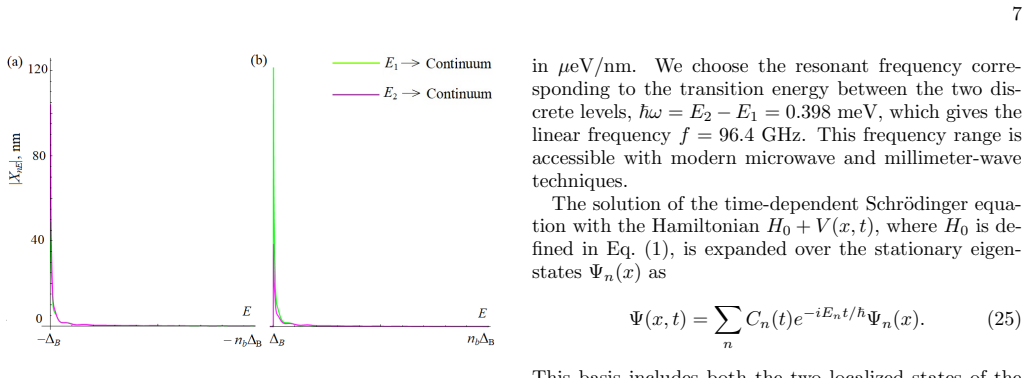
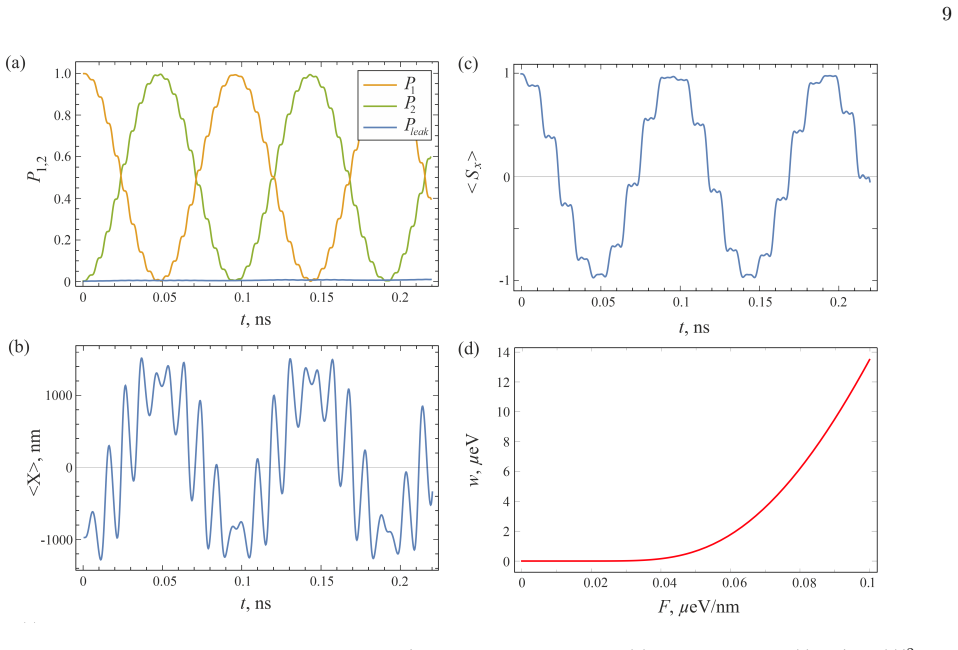
For suitable geometry and magnetic-field direction, two magnetic-field-induced localized states at a double kink form an effective two-level subsystem. Electric-dipole matrix elements allow resonant driving that induces Rabi oscillations with frequencies of 20-40 GHz. The continuum states outside the gap act as a leakage channel whose effect is suppressed by reducing the driving amplitude below the percent level while preserving GHz-scale coherence.
What carries the argument
An edge-state model that includes both the localized in-gap states at the kinks and the continuum states outside the magnetic-field-induced gap, used to calculate dipole matrix elements and solve the time-dependent driven problem.
If this is right
- Rabi oscillations occur with linear frequencies of 20-40 GHz for realistic device parameters.
- Leakage into continuum states falls below the percent level when the driving electric-field amplitude is lowered, while GHz-scale coherent oscillations are retained.
- The geometry and field orientation provide a lithographic route to define and electrically control a two-level system on the helical edge.
Where Pith is reading between the lines
- The same kink geometry could be replicated at multiple locations along a single edge to create addressable arrays of such two-level systems.
- Varying the magnetic-field strength would tune the gap size and therefore the energy splitting between the corner states, offering an additional control knob for resonance frequency.
- The demonstrated suppression of leakage by weaker driving suggests that coherence times could be extended further by operating in the low-amplitude regime and using pulse-shaping techniques.
Load-bearing premise
The edge-state model that includes both the localized levels and the continuum states outside the magnetic-field-induced gap accurately represents the physical system, and suitable geometry plus magnetic-field direction allows two such states to form an effective two-level subsystem.
What would settle it
Observation of coherent Rabi oscillations at 20-40 GHz in a HgTe/CdHgTe double-kink edge geometry under in-plane magnetic field, together with leakage into continuum states dropping below one percent when the driving electric field is reduced while the oscillation frequency remains in the GHz range.
Figures
read the original abstract
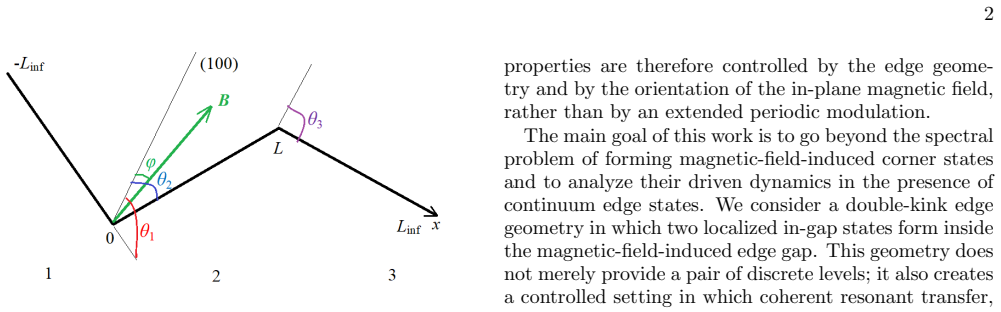
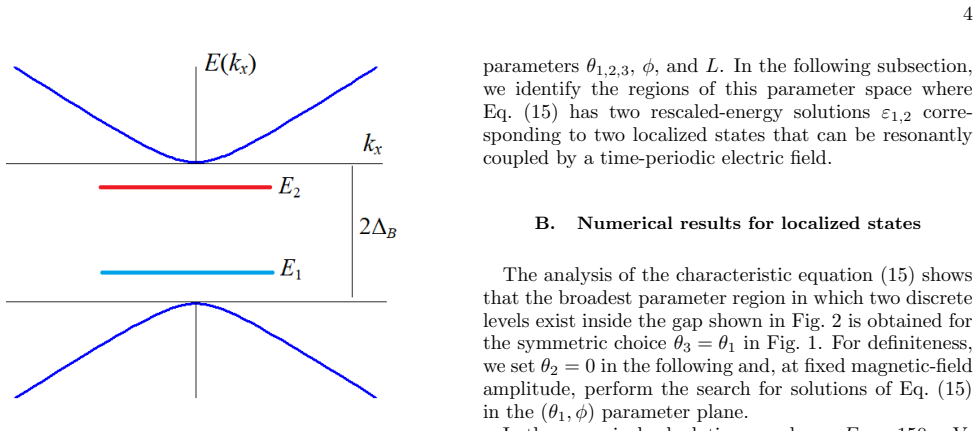
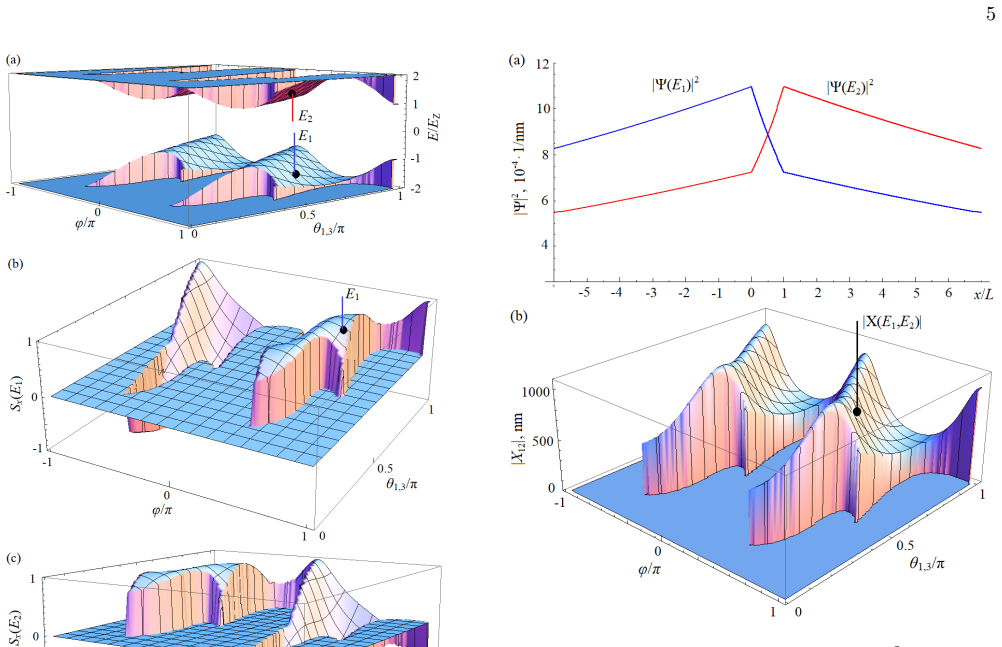
We study coherent electric manipulation of magnetic-field-induced localized states at a double kink of a helical edge in a HgTe/CdHgTe quantum well. An in-plane magnetic field opens a gap in the one-dimensional edge spectrum, while changes in the edge orientation generate localized in-gap states at the kinks. We show that, for suitable geometry and magnetic-field direction, two such states form an effective lithographically defined two-level subsystem. Using an edge-state model that includes both the localized levels and the continuum states outside the magnetic-field-induced gap, we calculate the electric-dipole matrix elements and solve the time-dependent problem under resonant driving. The resulting dynamics exhibits Rabi oscillations with linear frequencies of $20$--$40$~GHz for realistic parameters. We find that the continuum states provide a leakage channel whose strength is strongly controlled by the driving amplitude: reducing the electric field suppresses leakage below the percent level while preserving GHz-scale coherent oscillations. These results establish a route from magnetic-field-induced corner-state physics to electrically driven two-level dynamics in a realistic two-dimensional topological-insulator edge geometry.
Editorial analysis
A structured set of objections, weighed in public.
Referee Report
Summary. The paper studies coherent electric manipulation of magnetic-field-induced localized corner states at double kinks of a helical edge in a HgTe/CdHgTe quantum well. An in-plane magnetic field opens a gap in the edge spectrum, with kinks generating in-gap localized states that can form an effective two-level system for suitable geometry and field direction. Using an edge-state model including both localized levels and discretized continuum states, the authors compute electric-dipole matrix elements, solve the time-dependent Schrödinger equation under resonant driving, and report Rabi oscillations at linear frequencies of 20-40 GHz for realistic parameters, with continuum leakage suppressible below the percent level by lowering the electric-field amplitude.
Significance. If the 1D edge model holds, the work establishes a concrete route to electrically driven coherent dynamics of topologically protected corner states using lithographically defined kinks, with GHz-scale Rabi frequencies and tunable leakage. The explicit inclusion of continuum states and use of realistic material parameters are strengths that make the predictions testable; the approach could inform device designs in 2D topological insulators for quantum information or spintronics applications.
major comments (1)
- [edge-state model and time-dependent solution (as described in abstract and model section)] The headline result on leakage suppression below 1% while preserving GHz Rabi oscillations rests on the assumption that the effective 1D helical-edge Hamiltonian (with localized kink states plus discretized continuum) captures all relevant matrix elements and decay channels under electric driving. This is load-bearing for the central claim, as any omitted coupling to the 2D bulk or higher sub-bands whose amplitude dependence differs from the modeled channel would invalidate the reported separation of timescales. A direct comparison or justification against the full HgTe/CdHgTe Hamiltonian (including finite well width and interface effects) is needed.
minor comments (1)
- [Abstract] The abstract states 'linear frequencies of 20--40 GHz'; clarify whether this refers to the Rabi frequency itself or the driving frequency, and ensure consistent terminology with the main text.
Simulated Author's Rebuttal
We thank the referee for the constructive review and for recognizing the strengths of our approach, including the explicit treatment of continuum states and the use of realistic parameters. We address the major comment on the edge-state model below.
read point-by-point responses
-
Referee: [edge-state model and time-dependent solution (as described in abstract and model section)] The headline result on leakage suppression below 1% while preserving GHz Rabi oscillations rests on the assumption that the effective 1D helical-edge Hamiltonian (with localized kink states plus discretized continuum) captures all relevant matrix elements and decay channels under electric driving. This is load-bearing for the central claim, as any omitted coupling to the 2D bulk or higher sub-bands whose amplitude dependence differs from the modeled channel would invalidate the reported separation of timescales. A direct comparison or justification against the full HgTe/CdHgTe Hamiltonian (including finite well width and interface effects) is needed.
Authors: We agree that the applicability of the effective 1D helical-edge model is central to the reported separation of timescales. This model is obtained by projecting the BHZ Hamiltonian for HgTe/CdHgTe wells onto the helical edge states; it has been validated extensively against both microscopic calculations and experiments for energies near the Dirac point. The in-plane magnetic gap (~ few meV) lies well below the bulk gap (~10 meV), so couplings to the 2D bulk or higher sub-bands remain off-resonant. The electric drive couples to the edge-localized states, and the discretized continuum already incorporates the principal intra-edge decay channels. Finite-well-width and interface effects are absorbed into the renormalized parameters of the effective model, which are taken from established fits to the full Hamiltonian. While a direct numerical comparison with the full 2D Hamiltonian lies outside the present scope, we will add a concise justification paragraph (with key references) in the model section to make this reasoning explicit. revision: partial
Circularity Check
No circularity; results obtained by direct solution of TDSE in effective edge model
full rationale
The derivation proceeds by defining an effective 1D helical-edge Hamiltonian that incorporates both magnetic-field-induced gap, kink-localized states, and discretized continuum; computing electric-dipole matrix elements from the eigenstates of that Hamiltonian; and numerically integrating the time-dependent Schrödinger equation under resonant driving. All reported quantities (Rabi frequencies 20-40 GHz, leakage suppression with reduced drive amplitude) are direct outputs of this calculation using externally chosen realistic parameters. No step reduces to a self-definition, a fitted input relabeled as prediction, or a load-bearing self-citation. The model assumptions are stated explicitly and the results are conditional on the model, satisfying the requirement for a self-contained derivation chain.
Axiom & Free-Parameter Ledger
free parameters (2)
- in-plane magnetic field strength
- electric driving amplitude
axioms (2)
- domain assumption The one-dimensional edge-state model with magnetic-field-induced gap and kink-localized states captures the relevant physics of the HgTe/CdHgTe quantum well
- domain assumption Two localized states form an effective isolated two-level subsystem for appropriate geometry and field direction
Reference graph
Works this paper leans on
-
[1]
M. Z. Hasan and C. L. Kane, Colloquium: Topological insulators, Rev. Mod. Phys. 82, 3045 (2010)
2010
-
[2]
Qi and S.-C
X.-L. Qi and S.-C. Zhang, Topological insulators and su- perconductors, Rev. Mod. Phys. 83, 1057 (2011)
2011
-
[3]
B. A. Bernevig, T. L. Hughes, and S.-C. Zhang, Quantum spin hall effect and topological phase transition in hgte quantum wells, Science 314, 1757 (2006)
2006
-
[4]
K¨ onig, S
M. K¨ onig, S. Wiedmann, C. Br¨ une, A. Roth, H. Buh- mann, L. W. Molenkamp, X.-L. Qi, and S.-C. Zhang, Quantum spin hall insulator state in hgte quantum wells, Science 318, 766 (2007)
2007
-
[5]
S. Wu, V. Fatemi, Q. D. Gibson, K. Watanabe, T. Taniguchi, R. J. Cava, and P. Jarillo-Herrero, Ob- servation of the quantum spin hall effect up to 100 kelvin in a monolayer crystal, Science 359, 76 (2018)
2018
-
[6]
S. S. Krishtopenko and F. Teppe, Quantum spin hall in- sulator with a large bandgap, dirac fermions, and bilayer graphene analog, Sci. Adv. 4, eaap7529 (2018)
2018
-
[7]
Meyer, J
M. Meyer, J. Baumbach, S. Krishtopenko, A. Wolf, M. Emmerling, S. Schmid, M. Kamp, B. Jouault, J.-B. Rodriguez, E. Tournie, T. M¨ uller, R. Thomale, G. Bas- tard, F. Teppe, F. Hartmann, and S. H¨ ofling, Quantum spin hall effect in iii-v semiconductors at elevated tem- peratures: Advancing topological electronics, Sci. Adv. 11, eadz2408 (2025)
2025
-
[8]
W. A. Benalcazar, B. A. Bernevig, and T. L. Hughes, Quantized electric multipole insulators, Science 357, 61 (2017)
2017
-
[9]
W. A. Benalcazar, B. A. Bernevig, and T. L. Hughes, Electric multipole moments, topological multipole mo- ment pumping, and chiral hinge states in crystalline in- sulators, Phys. Rev. B 96, 245115 (2017)
2017
-
[10]
Langbehn, Y
J. Langbehn, Y. Peng, L. Trifunovic, F. von Oppen, and P. W. Brouwer, Reflection-symmetric second-order topo- logical insulators and superconductors, Phys. Rev. Lett. 119, 246401 (2017)
2017
-
[11]
Schindler, A
F. Schindler, A. M. Cook, M. G. Vergniory, Z. Wang, S. S. P. Parkin, B. A. Bernevig, and T. Neupert, Higher- order topological insulators, Sci. Adv. 4, eaat0346 (2018)
2018
-
[12]
Schindler, Z
F. Schindler, Z. Wang, M. G. Vergniory, A. M. Cook, A. Murani, S. Sengupta, A. Yu., Kasumov, R. Deblock, S. Jeon, I. Drozdov, H. Bouchiat, S. Gu´ eron, A. Yazdani, B. A. Bernevig, and T. Neupert, Higher-order topology in bismuth, Nat. Phys. 15, 918 (2018)
2018
-
[13]
Xie, H.-X
B. Xie, H.-X. Wang, X. Zhang, P. Zhan, J.-H. Jiang, M. Lu, and Y. Chen, Higher-order band topology, Nat. Rev. Phys. 3, 520 (2021)
2021
-
[14]
Serra-Garcia, V
M. Serra-Garcia, V. Peri, R. S¨ usstrunk, O. R. Bilal, T. Larsen, L. G. Villanueva, and S. D. Huber, Obser- vation of a phononic quadrupole topological insulator, Nature 555, 342 (2018)
2018
-
[15]
C. W. Peterson, W. A. Benalcazar, T. L. Hughes, and G. Bahl, A quantized microwave quadrupole insulator with topologically protected corner states, Nature 555, 346 (2018)
2018
-
[16]
Chen, W.-M
X.-D. Chen, W.-M. Deng, F.-L. Shi, F.-L. Zhao, M. Chen, and J.-W. Dong, Direct observation of corner states in second-order topological photonic crystal slabs, Phys. Rev. Lett. 122, 233902 (2019)
2019
-
[17]
S. S. Krishtopenko, W. Knap, and F. Teppe, Phase tran- sitions in two tunnel-coupled hgte quantum wells: Bilayer graphene analogy and beyond, Sci. Rep. 6, 30755 (2016). 11
2016
-
[18]
L. S. Bovkun, A. V. Ikonnikov, V. Y. Aleshkin, K. V. Maremyanin, N. N. Mikhailov, S. A. Dvoretskii, S. S. Krishtopenko, F. Teppe, B. A. Piot, M. Potemski, M. Or- lita, and V. I. Gavrilenko, Magnetospectroscopy of dou- ble hgte/cdhgte qws with inverted band structure in high magnetic fields up to 30 t, Opto-electron. Rev. 27, 213 (2019)
2019
-
[19]
A. V. Ikonnikov, S. S. Krishtopenko, L. S. Bovkun, N. N. Mikhailov, S. A. Dvoretskii, B. A. Piot, M. Potemski, M. Orlita, F. Teppe, and V. I. Gavrilenko, Origin of struc- ture inversion asymmetry in double hgte quantum wells, JETP Lett. 116, 547 (2022)
2022
-
[20]
optical gate
L. S. Bovkun, S. S. Krishtopenko, V. Y. Aleshkin, N. N. Mikhailov, S. A. Dvoretsky, F. Teppe, M. Orlita, V. I. Gavrilenko, and A. V. Ikonnikov, Simultaneous observa- tion of the cyclotron resonances of electrons and holes in a hgte/cdhgte double quantum well under “optical gate” effect, JETP Lett. 118, 867 (2023)
2023
-
[21]
S. S. Krishtopenko, A. V. Ikonnikov, B. Jouault, and F. Teppe, Disorder-induced phase transitions in double hgte quantum wells, Phys. Rev. B 111, 045431 (2025)
2025
-
[22]
Ruffenach, S
S. Ruffenach, S. S. Krishtopenko, L. S. Bovkun, A. V. Ikonnikov, M. Marcinkiewicz, C. Consejo, M. Potem- ski, B. Piot, M. Orlita, B. R. Semyagin, M. A. Puty- ato, E. A. Emelyanov, V. V. Preobrazhenskii, W. Knap, F. Gonzalez-Posada, G. Boissier, E. Tourni´ e, F. Teppe, and V. I. Gavrilenko, Magnetoabsorbtion of Dirac fermions in gapless three-layer InAs/Ga...
2017
-
[23]
S. S. Krishtopenko, S. Ruffenach, F. Gonzalez-Posada, G. Boissier, M. Marcinkiewicz, M. A. Fadeev, A. M. Kadykov, V. V. Rumyantsev, S. V. Morozov, V. I. Gavrilenko, C. Consejo, W. Desrat, B. Jouault, W. Knap, E. Tourni´ e, and F. Teppe, Temperature- dependent terahertz spectroscopy of inverted-band three- layer inas/gasb/inas quantum well, Phys. Rev. B 97...
2018
-
[24]
S. S. Krishtopenko, S. Ruffenach, F. Gonzalez-Posada, C. Consejo, W. Desrat, B. Jouault, W. Knap, M. A. Fadeev, A. M. Kadykov, V. V. Rumyantsev, S. V. Mo- rozov, G. Boissier, E. Tourni´ e, V. I. Gavrilenko, and F. Teppe, Terahertz spectroscopy of two-dimensional semimetal in three-layer InAs/GaSb/InAs quantum well, JETP Lett. 109, 96 (2019)
2019
-
[25]
S. S. Krishtopenko, W. Desrat, K. E. Spirin, C. Consejo, S. Ruffenach, F. Gonzalez-Posada, B. Jouault, W. Knap, K. V. Maremyanin, V. I. Gavrilenko, G. Boissier, J. Tor- res, M. Zaknoune, E. Tourni´ e, and F. Teppe, Mass- less dirac fermions in iii-v semiconductor quantum wells, Phys. Rev. B 99, 121405(R) (2019)
2019
-
[26]
Avogadri, S
C. Avogadri, S. Gebert, S. S. Krishtopenko, I. Castillo, C. Consejo, S. Ruffenach, C. Roblin, C. Bray, Y. Krupko, S. Juillaguet, S. Contreras, A. Wolf, F. Hartmann, S. H¨ ofling, G. Boissier, J.-B. Rodriguez, S. Nanot, E. Tourni´ e, F. Teppe, and B. Jouault, Large inverted band gap in strained three-layer inas/gainsb quantum wells, Phys. Rev. Research 4, ...
2022
-
[27]
S. S. Krishtopenko, Higher-order topological insulator in cubic semiconductor quantum wells, Sci. Rep. 11, 21060 (2021)
2021
-
[28]
Ezawa, Topological switch between second-order topological insulators and topological crystalline insula- tors, Phys
M. Ezawa, Topological switch between second-order topological insulators and topological crystalline insula- tors, Phys. Rev. Lett. 121, 116801 (2018)
2018
-
[29]
Y. Ren, Z. Qiao, and Q. Niu, Engineering corner states from two-dimensional topological insulators, Phys. Rev. Lett. 124, 166804 (2020)
2020
-
[30]
C. Chen, Z. Song, J.-Z. Zhao, Z. Chen, Z.-M. Yu, X.-L. Sheng, and S. A. Yang, Universal approach to magnetic second-order topological insulator, Phys. Rev. Lett. 125, 056402 (2020)
2020
-
[31]
S. S. Krishtopenko and F. Teppe, Magnetic field induced corner states in quantum spin hall insulators, Phys. Rev. B (2026), accepted, ArXiv:2303.09260
work page internal anchor Pith review Pith/arXiv arXiv 2026
-
[32]
S. S. Krishtopenko, M. Antezza, and F. Teppe, Disorder- induced phase transition in dirac systems beyond the lin- ear approximation, Phys. Rev. B 101, 205424 (2020)
2020
-
[33]
S. S. Krishtopenko, M. Antezza, and F. Teppe, Disorder- induced topological phase transition in hgcdte crystals, Phys. Rev. B 106, 115203 (2022)
2022
-
[34]
S. S. Krishtopenko, A. V. Ikonnikov, F. Hartmann, S. H¨ ofling, B. Jouault, and F. Teppe, Quasiparticle pic- ture of topological phase transitions induced by interac- tions, Phys. Rev. Research 7, 033116 (2025)
2025
-
[35]
D. V. Khomitsky, K. S. Kabaev, and E. A. Lavrukhina, Spin resonance in a quantum dot at the edge of a topo- logical insulator with the inclusion of continuum states, J. Exp. Theor. Phys. 131, 809 (2020)
2020
-
[36]
D. V. Khomitsky and E. A. Lavrukhina, J. Exp. Theor. Phys. (2026), accepted
2026
-
[37]
R. A. Niyazov, D. N. Aristov, and V. Y. Kachorovskii, Effective hamiltonian of topologically protected qubit in a helical crystal, JETP Lett. 118, 376 (2023)
2023
-
[38]
K¨ onig, H
M. K¨ onig, H. Buhmann, L. W. Molenkamp, T. Hughes, C.-X. Liu, X.-L. Qi, and S.-C. Zhang, The quantum spin hall effect: Theory and experiment, J. Phys. Soc. Jpn. 77, 031007 (2008)
2008
-
[39]
M. V. Durnev and S. A. Tarasenko, Magnetic field effects on edge and bulk states in topological insulators based on hgte/cdhgte quantum wells with strong natural interface inversion asymmetry, Phys. Rev. B 93, 075434 (2016)
2016
-
[40]
S. S. Krishtopenko, A. M. Kadykov, S. Gebert, S. Ruffe- nach, C. Consejo, J. Torres, C. Avogadri, B. Jouault, W. Knap, N. N. Mikhailov, S. A. Dvoretskii, and F. Teppe, Many-particle effects in optical transitions from zero-mode landau levels in hgte quantum wells, Phys. Rev. B 102, 041404(R) (2020)
2020
-
[41]
Ruffenach, S
S. Ruffenach, S. S. Krishtopenko, A. V. Ikonnikov, C. Consejo, J. Torres, X. Baudry, P. Ballet, B. Jouault, and F. Teppe, Many-particle hybridization of optical transitions from zero-mode landau levels in hgte quan- tum wells, Phys. Rev. B 113, L161108 (2026)
2026
-
[42]
Winkler, Spin-Orbit Coupling Effects in Two- Dimensional Electron and Hole Systems (Springer, New York, 2003)
R. Winkler, Spin-Orbit Coupling Effects in Two- Dimensional Electron and Hole Systems (Springer, New York, 2003)
2003
-
[43]
S. S. Krishtopenko and F. Teppe, Realistic picture of he- lical edge states in hgte quantum wells, Phys. Rev. B 97, 165408 (2018)
2018
-
[44]
D. V. Khomitsky, E. A. Lavrukhina, and E. Y. Sherman, Electric dipole spin resonance at shallow donors in quan- tum wires, Phys. Rev. B 99, 014308 (2019)
2019
-
[45]
Khomitsky, E
D. Khomitsky, E. Lavrukhina, and E. Sherman, Spin rotation by resonant electric field in few-level quantum dots: Floquet dynamics and tunneling, Phys. Rev. Ap- plied 14, 014090 (2020)
2020
-
[46]
G. M. Minkov, A. V. Germanenko, O. E. Rut, A. A. Sher- stobitov, S. A. Dvoretski, and N. N. Mikhailov, Weak an- tilocalization in hgte quantum wells with inverted energy spectra, Phys. Rev. B 85, 235312 (2012). 12
2012
-
[47]
A. M. Kadykov, S. S. Krishtopenko, B. Jouault, W. Desrat, W. Knap, S. Ruffenach, C. Consejo, J. Tor- res, S. V. Morozov, N. N. Mikhailov, S. A. Dvoretskii, and F. Teppe, Temperature-induced topological phase transi- tion in hgte quantum wells, Phys. Rev. Lett. 120, 086401 (2018)
2018
-
[48]
D. V. Khomitsky, E. A. Lavrukhina, A. V. Telezhnikov, and M. S. Zholudev, Modeling of landau levels, hall and longitudinal resistance in the topological anderson insu- lator based on hgte/hg 0.3cd0.7te quantum well, Fizika i Tekhnika Poluprovodnikov 59, 337 (2025)
2025
-
[49]
A. M. Perelomov, V. S. Popov, and M. V. Terent’ev, Ionization of atoms in an alternating electric field, JETP 23, 924 (1966)
1966
discussion (0)
Sign in with ORCID, Apple, or X to comment. Anyone can read and Pith papers without signing in.