Trapped-Ion Multiqubit Gates are Compatible with Scalable Quantum Error Correction
Pith reviewed 2026-06-29 11:23 UTC · model grok-4.3
The pith
Multi-qubit gates in trapped-ion systems remain compatible with scalable quantum error correction when realistic noise is included.
A machine-rendered reading of the paper's core claim, the machinery that carries it, and where it could break.
Core claim
By deriving effective error channels from a microscopic model of trapped-ion multi-qubit gates, including phonon heating, motional dephasing, and photon scattering, and applying them to the rotated surface code with realistic parameters, the paper shows that logical error rates decrease with increasing code distance, establishing compatibility with scalable quantum error correction.
What carries the argument
The effective single- and two-qubit error channels derived from the microscopic noise model for multi-qubit gates, which capture phonon heating, motional dephasing, and photon scattering with pair-dependent strengths.
If this is right
- Phonon heating and motional dephasing reduce to effective error channels that act between arbitrary qubit pairs but are weaker on average for uncoupled pairs.
- Photon scattering errors affect only the qubits that participate directly in each gate operation.
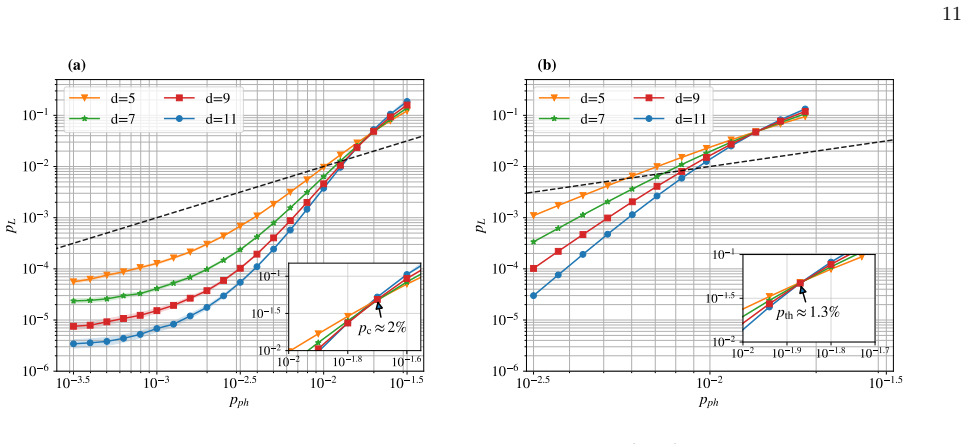
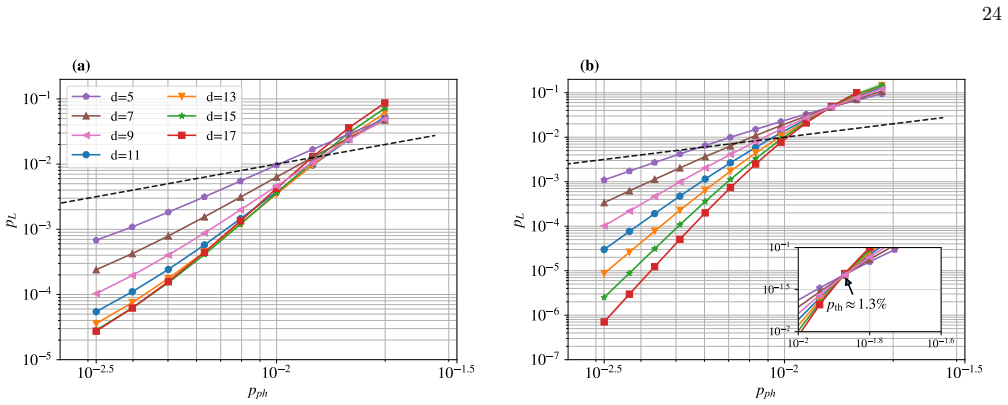
- When all modeled noise sources are assigned experimentally relevant rates, the rotated surface code logical error rate decreases with increasing code distance.
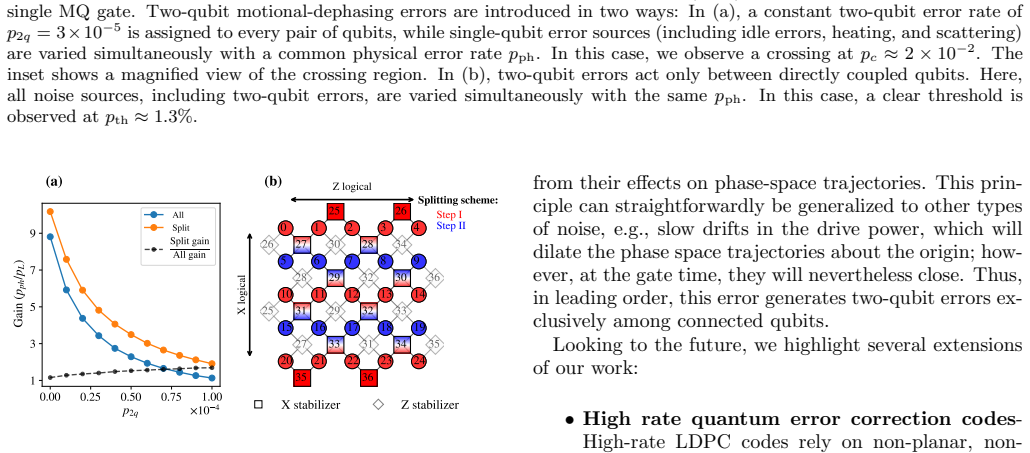
- The combined noise does not introduce correlations that prevent the code from remaining below threshold at larger sizes.
Where Pith is reading between the lines
- The separation of error strengths between coupled and uncoupled pairs suggests that multi-qubit gates could enable lower-overhead logical operations if the weaker cross-talk is confirmed in hardware.
- Similar microscopic modeling could be used to test scalability of other error-correcting codes or trap geometries without requiring changes to the underlying physical noise description.
- Prioritizing reductions in motional dephasing would directly improve the error suppression margins shown for the surface code.
Load-bearing premise
The effective single- and two-qubit error channels derived from the microscopic model accurately represent the dominant physical noise processes across all pairs of qubits, including those not participating in a given gate operation.
What would settle it
An experiment measuring the two-qubit error rate between qubits not participating in a multi-qubit gate and finding it comparable in magnitude to the rate between participating qubits would falsify the model's separation of error strengths.
Figures
read the original abstract
We construct a detailed microscopic noise model for multi-qubit (MQ) gate operations in the context of trapped ion architecture with all-to-all connectivity. We find that phonon heating and motional dephasing are well captured by effective single- and two-qubit error channels that can, in principle, act between arbitrary pairs of qubits. Nevertheless, the median magnitude of two-qubit errors between uncoupled qubits is substantially smaller than that of errors between gate-coupled qubits. Errors associated with photon scattering are shown to solely propagate to qubits participating in gate operations. Lastly, we combine all noise sources, assigned with experimentally relevant parameters, and explore the scalability of a quantum error correction (QEC) scheme based on the rotated surface code, as a function of error rates and code size. Our analysis bridges device-level physics and QEC performance for MQ gates in trapped-ion architectures.
Editorial analysis
A structured set of objections, weighed in public.
Referee Report
Summary. The paper constructs a microscopic noise model for multi-qubit gates in trapped-ion systems with all-to-all connectivity. Phonon heating and motional dephasing are shown to produce effective single- and two-qubit error channels that can act on arbitrary qubit pairs, though the median error magnitude is substantially smaller for uncoupled pairs than for gate-coupled pairs. Photon-scattering errors are localized to participating qubits. All noise sources are combined using experimentally relevant parameters, and the scalability of the rotated surface code is explored as a function of error rates and code distance.
Significance. If the central claim holds, the work provides a concrete bridge between device-level trapped-ion physics and circuit-level QEC performance. It supplies evidence that multi-qubit gates need not preclude threshold behavior in the rotated surface code, which is relevant for hardware roadmaps that rely on such gates for reduced gate count.
major comments (1)
- [QEC scalability exploration (abstract and associated numerical section)] The central scalability claim requires that the full set of derived noise channels—including the nonzero (though smaller) two-qubit errors between arbitrary uncoupled pairs—is inserted into the surface-code circuit simulations. The abstract states that phonon heating and motional dephasing produce channels “that can, in principle, act between arbitrary pairs,” yet it is unclear from the provided description whether the QEC threshold analysis retains these long-range tails or approximates them away. Long-range Pauli errors, even at reduced rates, can induce logical correlations that alter the threshold; this modeling choice is therefore load-bearing.
minor comments (2)
- The abstract refers to “experimentally relevant parameters” without listing the numerical values or their provenance; a table or explicit list in the main text would improve reproducibility.
- Clarify the precise mapping from the microscopic Hamiltonian to the effective Pauli channels (e.g., via Kraus operators or process matrices) so that readers can assess the validity of the channel approximation.
Simulated Author's Rebuttal
We thank the referee for their careful reading and for identifying the need for explicit clarification on the treatment of long-range noise channels in our QEC analysis. We address the major comment below.
read point-by-point responses
-
Referee: [QEC scalability exploration (abstract and associated numerical section)] The central scalability claim requires that the full set of derived noise channels—including the nonzero (though smaller) two-qubit errors between arbitrary uncoupled pairs—is inserted into the surface-code circuit simulations. The abstract states that phonon heating and motional dephasing produce channels “that can, in principle, act between arbitrary pairs,” yet it is unclear from the provided description whether the QEC threshold analysis retains these long-range tails or approximates them away. Long-range Pauli errors, even at reduced rates, can induce logical correlations that alter the threshold; this modeling choice is therefore load-bearing.
Authors: We thank the referee for raising this important modeling point. The surface-code simulations reported in the numerical section were performed with the complete microscopic noise model, including the derived two-qubit error channels acting on all pairs (coupled and uncoupled) at their respective magnitudes. The long-range tails were retained rather than approximated away. We agree that this aspect was not stated with sufficient explicitness, which could lead to the ambiguity noted. We will revise the manuscript to add a clear statement in the numerical methods and results sections confirming that the full set of channels, with their all-to-all structure, was used in the circuit-level simulations. revision: yes
Circularity Check
Derivation chain is self-contained; noise model independent of QEC outcome
full rationale
The paper first builds a microscopic model of phonon heating, motional dephasing and photon scattering for trapped-ion MQ gates, maps these to effective single- and two-qubit channels (with the median long-range error stated as substantially smaller but nonzero), and only then inserts the resulting rates—labeled experimentally relevant—into rotated-surface-code simulations. No equation equates a fitted parameter to a predicted threshold, no self-citation supplies a load-bearing uniqueness theorem, and the effective-channel derivation does not presuppose the scalability conclusion. The chain therefore remains non-circular.
Axiom & Free-Parameter Ledger
free parameters (1)
- experimentally relevant error rates
axioms (1)
- domain assumption Phonon heating and motional dephasing are well captured by effective single- and two-qubit error channels
Reference graph
Works this paper leans on
-
[1]
Single event approximation We assume photon scattering rates are low, relative to the gate time (see App. B). In this limit, noise is mod- eled by stochastic Pauli errors acting on each qubit in- dependently, generating spin depolarization and spin de- phasing channels, described by the application ofσ (k) x,y,z andσ (k) z operators on qubitk, respectivel...
-
[2]
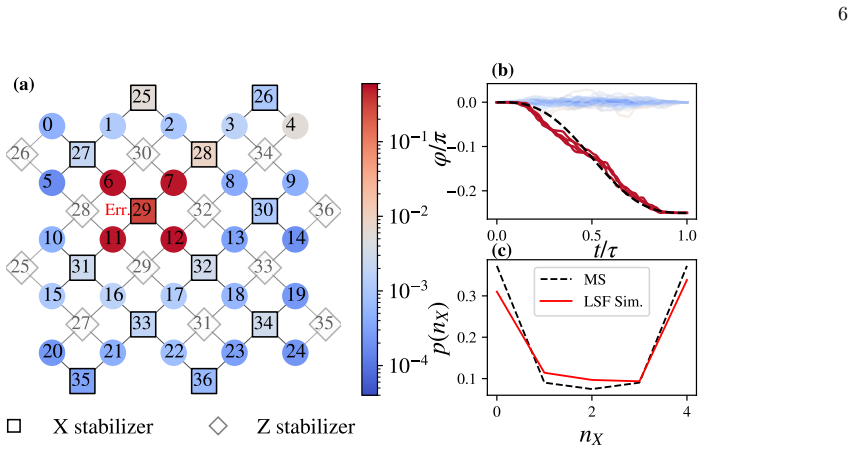
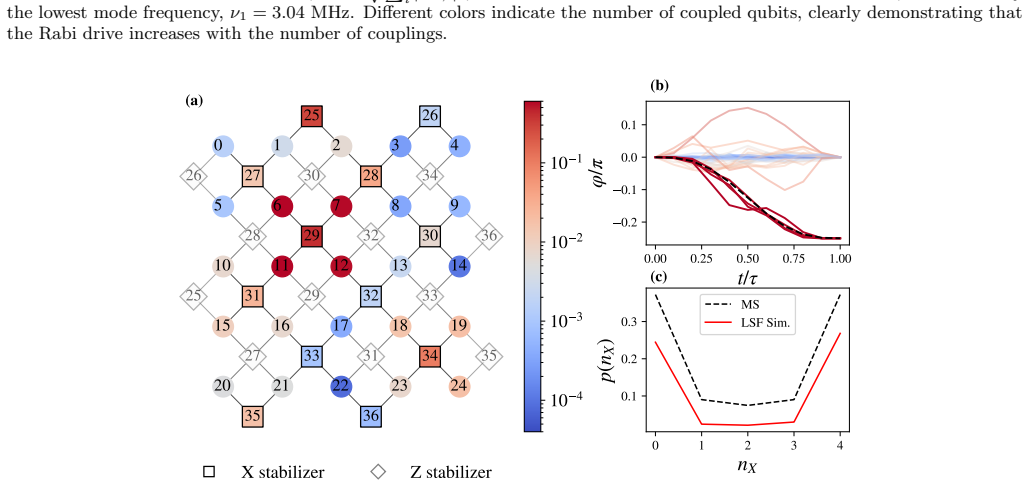
MQ gate errors in surface code syndrome extraction To exemplify the above analysis, we study thed= 5 rotated surface code shown in Fig. 1a. The code param- eters are [n= 25, k= 1, d= 5], requiring 24 stabilizers. All-to-all connectivity allows recycling of ancilla qubits for measuringZandXstabilizers, such that only 12 an- cilla qubits are required (see f...
-
[3]
[48] to account for multiple phonon modes
Motional heating In the following, we generalize the treatment of ther- mal effects in Ref. [48] to account for multiple phonon modes. Intuitively, mode heating generates an excess dis- placement of the phonon modes, disturbing the closure of the phase-space trajectory at the gate time. In leading order this manifests as as residual qubit-phonon coupling,...
-
[4]
The gate error 8 FIG
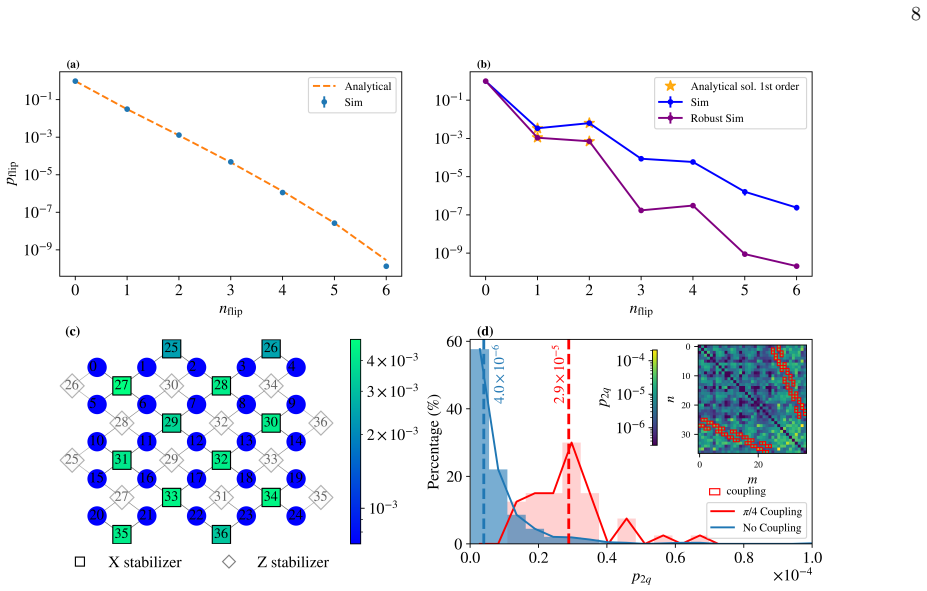
Motional dephasing Fluctuations in the trapping potential cause correlated drifts in the normal modes frequencies. The gate error 8 FIG. 2. Heating and motional dephasing noise analysis. All values of Γ h,Γ s mentioned below are in-line with realistic hardware performances. (a) Bit-flip probabilities induced by heating during a MS gate (N= 6), for Γ hnth ...
-
[5]
Available: https://doi.org/10.48550/arXiv.2510.25838
H. Gharibyan, M. Z. Mullath, N. E. Sherman, V. P. Su, H. Tepanyan, and Y. Zhang, Heuristic quantum advan- tage with peaked circuits (2025), arXiv:2510.25838
-
[6]
Y. Kim, A. Eddins, S. Anand, K. X. Wei, E. Van Den Berg, S. Rosenblatt, and et al., Evidence for the util- ity of quantum computing before fault tolerance, Nature 618, 500 (2023)
2023
-
[7]
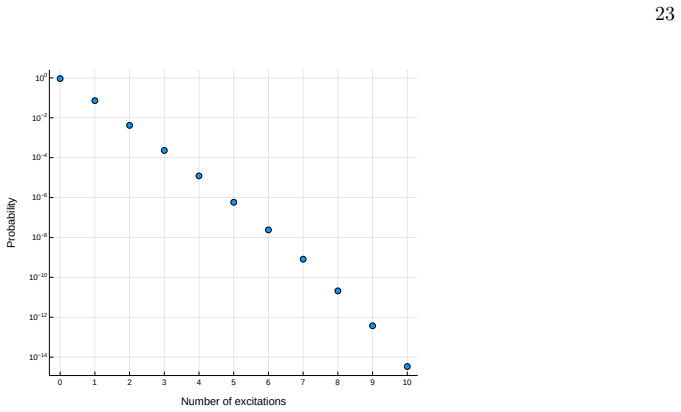
Observation of constructive interference at the edge of quantum ergodicity, Nature646, 825 (2025)
2025
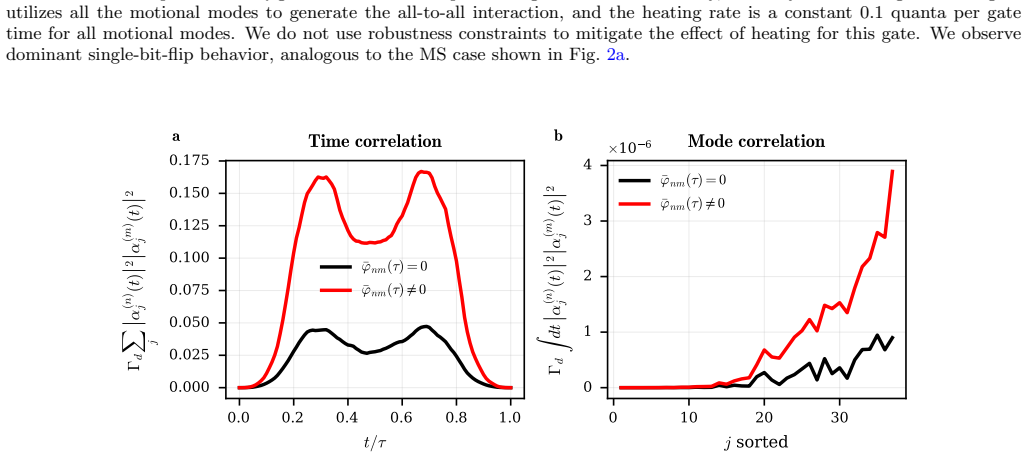
-
[8]
P. Niroula, S. Chakrabarti, S. Kordonowy, N. Kumar, S. Omanakuttan, M. A. Perlin, and et al., Realization of a quantum streaming algorithm on long-lived trapped- ion qubits (2025), arXiv:2511.03689 [quant-ph]
-
[9]
Z. He, D. Amaro, R. Shaydulin, and M. Pistoia, Perfor- mance of quantum approximate optimization with quan- tum error detection, Communications Physics8, 217 (2025)
2025
-
[10]
Fault-Tolerant Quantum Computation With Constant Error Rate
D. Aharonov and M. Ben-Or, Fault-tolerant quan- tum computation with constant error rate (1999), arXiv:quant-ph/9906129 [quant-ph]
work page internal anchor Pith review Pith/arXiv arXiv 1999
-
[11]
P. W. Shor, Scheme for reducing decoherence in quantum computer memory, Physical Review A52, R2493 (1995)
1995
-
[12]
A. M. Steane, Error correcting codes in quantum theory, Physical Review Letters77, 793 (1996)
1996
-
[13]
N. Z. et al., Quantum error correction below the surface code threshold, Nature638, 920 (2024)
2024
-
[14]
Sales Rodriguez, J
P. Sales Rodriguez, J. M. Robinson, P. N. Jepsen, Z. He, C. Duckering, C. Zhao, and et al., Experimental demon- stration of logical magic state distillation, Nature645, 620 (2025)
2025
- [15]
- [16]
-
[17]
Smith, A
M. Smith, A. Leu, K. Miyanishi, M. Gely, and D. Lucas, Single-qubit gates with errors at the 10-7 level, Physical Review Letters134, 230601 (2025)
2025
-
[18]
Grzesiak, R
N. Grzesiak, R. Bl¨ umel, K. Wright, K. M. Beck, N. C. Pisenti, M. Li, and et al., Efficient arbitrary simultane- ously entangling gates on a trapped-ion quantum com- puter, Nature Communications11, 2963 (2020)
2020
-
[19]
Y. Shapira, L. Peleg, D. Schwerdt, J. Nemirovsky, N. Ak- erman, A. Stern, and et al., Fast design and scaling of multi-qubit gates in large-scale trapped-ion quantum computers (2023), arXiv:2307.09566 [quant-ph]
-
[20]
Helios: A 98-qubit trapped-ion quantum computer
A. Ransford, M. Allman, J. Arkinstall, J. Cam- pora III, S. F. Cooper, R. D. Delaney, and et al., He- lios: A 98-qubit trapped-ion quantum computer (2025), arXiv:2511.05465
work page internal anchor Pith review Pith/arXiv arXiv 2025
-
[21]
Schwerdt, Y
D. Schwerdt, Y. Shapira, T. Manovitz, and R. Ozeri, Comparing two-qubit and multiqubit gates within the toric code, Physical Review A105, 022612 (2022)
2022
-
[22]
Bravyi, D
S. Bravyi, D. Maslov, and Y. Nam, Constant-cost imple- mentations of clifford operations and multiply-controlled gates using global interactions, Physical Review Letters 129, 230501 (2022)
2022
-
[23]
J. Nemirovsky, M. Chuchem, and Y. Shapira, Effi- cient compilation of quantum circuits using multi-qubit gates, Quantum Science and Technology 10.1088/2058- 9565/ae36cc (2025)
-
[24]
Baßler, M
P. Baßler, M. Zipper, C. Cedzich, M. Heinrich, P. H. Huber, M. Johanning, and et al., Synthesis of and com- pilation with time-optimal multi-qubit gates, Quantum 7, 984 (2023)
2023
-
[25]
Høyer, Quantum fan-out is powerful, (2005)
P. Høyer, Quantum fan-out is powerful, (2005)
2005
-
[26]
Foxman, N
B. Foxman, N. Parham, F. Vasconcelos, and H. Yuen, Random unitaries in constant (quantum) time, (2025)
2025
-
[27]
Decross, R
M. Decross, R. Haghshenas, M. Liu, E. Rinaldi, J. Gray, Y. Alexeev, and et al., Computational power of random quantum circuits in arbitrary geometries, Physical Re- view X15, 021052 (2025)
2025
-
[28]
Panteleev and G
P. Panteleev and G. Kalachev, Asymptotically good quantum and locally testable classical ldpc codes, Pro- ceedings of the 54th Annual ACM SIGACT Symposium on Theory of Computing , 375 (2021)
2021
-
[29]
K. Wang, Z. Lu, C. Zhang, G. Liu, J. Chen, Y. Wang, and et al., Demonstration of low-overhead quantum error correction codes, Nature Physics22, 308 (2026)
2026
-
[30]
Sheffer, E
Y. Sheffer, E. Berg, and A. Stern, Preparing topological states with finite depth simultaneous commuting gates, Physical Review B111, 115160 (2025)
2025
-
[31]
J. Nemirovsky, L. Peleg, A. B. Kish, and Y. Shapira, Optimal constant-cost implementations of clifford opera- tions using global interactions (2025), arXiv:2510.20730 [quant-ph]
-
[32]
C. J. Ballance, T. P. Harty, N. M. Linke, M. A. Sepiol, and D. M. Lucas, High-fidelity quantum logic gates us- ing trapped-ion hyperfine qubits, Physical Review Let- ters117, 10.1103/PhysRevLett.117.060504 (2016)
-
[33]
R. T. Sutherland, Q. Yu, K. M. Beck, and H. H¨ affner, One-and two-qubit gate infidelities due to motional errors in trapped ions and electrons, Physical Review A105, 022437 (2022)
2022
-
[34]
P. C. Lotshaw, K. D. Battles, B. Gard, G. Buchs, T. S. Humble, and C. D. Herold, Modeling noise in global mølmer-sørensen interactions applied to quantum ap- 13 proximate optimization, Physical Review A107, 062406 (2023)
2023
-
[35]
Ryan-Anderson, J
C. Ryan-Anderson, J. G. Bohnet, K. Lee, D. Gresh, A. Hankin, J. P. Gaebler, and et al., Realization of real- time fault-tolerant quantum error correction, Physical Review X11, 041058 (2021)
2021
-
[36]
C. J. Trout, M. Li, M. Guti´ errez, Y. Wu, S. T. Wang, L. Duan, and et al., Simulating the performance of a distance-3 surface code in a linear ion trap, New Journal of Physics20, 043038 (2018)
2018
-
[37]
F. Liu, G. Tang, L. Duan, and Y. Wu, Performance anal- ysis for crosstalk errors between parallel entangling gates in trapped ion quantum error correction, Physical Review Applied24, 10.1103/c7w3-pxls (2025)
-
[38]
Y. Ma, M. Hanks, E. Gneusheva, and M. S. Kim, Reshap- ing quantum device noise via repetition code circuits, Phys. Rev. Res.7, 033262 (2025)
2025
-
[39]
Ozeri, W
R. Ozeri, W. M. Itano, R. Blakestad, J. Britton, J. Chi- averini, J. D. Jost, and et al., Errors in trapped-ion quan- tum gates due to spontaneous photon scattering, Physical Review A75, 042329 (2007)
2007
-
[40]
Shapira, R
Y. Shapira, R. Shaniv, T. Manovitz, N. Akerman, and R. Ozeri, Robust entanglement gates for trapped-ion qubits (2018)
2018
-
[41]
Shapira, R
Y. Shapira, R. Shaniv, T. Manovitz, N. Akerman, L. Pe- leg, L. Gazit, and et al., Theory of robust multiqubit nonadiabatic gates for trapped ions, Physical Review A 101, 032330 (2020)
2020
-
[42]
Shapira, S
Y. Shapira, S. Cohen, N. Akerman, A. Stern, and R. Ozeri, Robust two-qubit gates for trapped ions using spin-dependent squeezing, Physical Review Letters130, 030602 (2023)
2023
-
[43]
M. Kang, Q. Liang, B. Zhang, S. Huang, Y. Wang, C. Fang, and et al., Batch optimization of frequency- modulated pulses for robust two-qubit gates in ion chains, Physical Review Applied16, 024039 (2021)
2021
-
[44]
A. R. Milne, C. L. Edmunds, C. Hempel, F. Roy, S. Mavadia, and M. J. Biercuk, Phase-modulated entan- gling gates robust to static and time-varying errors, Phys- ical Review Applied13, 024022 (2020)
2020
-
[45]
P. H. Leung, K. A. Landsman, C. Figgatt, N. M. Linke, C. Monroe, and K. R. Brown, Robust 2-qubit gates in a linear ion crystal using a frequency-modulated driving force, Physical Review Letters120, 020501 (2018)
2018
-
[46]
H. Uys, M. J. Biercuk, A. P. VanDevender, C. Ospelkaus, D. Meiser, R. Ozeri, and J. J. Bollinger, Decoherence due to elastic rayleigh scattering, Phys. Rev. Lett.105, 200401 (2010)
2010
-
[47]
Orozco-Ruiz, W
M. Orozco-Ruiz, W. Rehman, and F. Mintert, Generally noise-resilient quantum gates for trapped ions, Physical Review A111, 042404 (2025)
2025
-
[48]
A. G. Fowler and J. M. Martinis, Quantifying the ef- fects of local many-qubit errors and nonlocal two-qubit errors on the surface code, Physical Review A89, 032316 (2014)
2014
-
[49]
Aharonov, A
D. Aharonov, A. Kitaev, and J. Preskill, Fault-tolerant quantum computation with long-range correlated noise, Physical Review Letters96, 050504 (2006)
2006
-
[50]
Sørensen and K
A. Sørensen and K. Mølmer, Quantum computation with ions in thermal motion, Physical Review Letters82, 1971 (1999)
1971
-
[51]
M. Kang, Y. Wang, C. Fang, B. Zhang, O. Khosravani, J. Kim, and et al., Designing filter functions of frequency- modulated pulses for high-fidelity two-qubit gates in ion chains, Physical Review Applied19, 014014 (2023)
2023
-
[52]
Sørensen and K
A. Sørensen and K. Mølmer, Entanglement and quan- tum computation with ions in thermal motion, Physical Review A62, 022311 (2000)
2000
- [53]
-
[54]
Haddadfarshi and F
F. Haddadfarshi and F. Mintert, High fidelity quantum gates of trapped ions in the presence of motional heating, New Journal of Physics18, 123007 (2016)
2016
-
[55]
Schwartzman-Nowik, L
Z. Schwartzman-Nowik, L. Shirizly, and H. Landa, Mod- eling error correction with lindblad dynamics and approx- imate channels, Physical Review A111, 022613 (2025)
2025
-
[56]
Ben Av, Y
E. Ben Av, Y. Shapira, N. Akerman, and R. Ozeri, Di- rect reconstruction of the quantum-master-equation dy- namics of a trapped-ion qubit, Physical Review A101, 062305 (2020)
2020
-
[57]
M. Kang, Y. Zhang, K. R. Brown, and T. Barthel, Non-gaussian phase transition and cascade of insta- bilities in the dissipative quantum rabi model (2026), arXiv:2507.07092 [quant-ph]
work page internal anchor Pith review Pith/arXiv arXiv 2026
-
[58]
Bravyi, M
S. Bravyi, M. Englbrecht, R. K¨ onig, and N. Peard, Cor- recting coherent errors with surface codes, npj Quantum Information4, 55 (2018)
2018
-
[59]
S. J. Beale, J. J. Wallman, M. Guti´ errez, K. R. Brown, and R. Laflamme, Quantum error correction decoheres noise, Physical Review Letters121, 190501 (2018)
2018
-
[60]
Greenbaum and Z
D. Greenbaum and Z. Dutton, Modeling coherent errors in quantum error correction, Quantum Science and Tech- nology3, 015007 (2017)
2017
-
[61]
Langer, R
C. Langer, R. Ozeri, J. D. Jost, J. Chiaverini, B. De- marco, A. Ben-Kish, and et al., Long-lived qubit memory using atomic ions, Physical Review Letters95, 060502 (2005)
2005
- [62]
-
[63]
Brownnutt, M
M. Brownnutt, M. Kumph, P. Rabl, and R. Blatt, Ion- trap measurements of electric-field noise near surfaces, Reviews of Modern Physics87, 1419 (2015)
2015
-
[64]
Johansson, P
J. Johansson, P. Nation, and F. Nori, Qutip: An open- source python framework for the dynamics of open quan- tum systems, Computer Physics Communications183, 1760 (2012)
2012
-
[65]
Z. Jia, S. Huang, M. Kang, K. Sun, R. F. Spivey, J. Kim, and et al., Angle-robust two-qubit gates in a linear ion crystal, Physical Review A107, 032617 (2023)
2023
-
[66]
A. G. Fowler, M. Mariantoni, J. M. Martinis, and A. N. Cleland, Surface codes: Towards practical large-scale quantum computation, Physical Review A86, 032324 (2012)
2012
-
[67]
C. N. Self, M. Benedetti, and D. Amaro, Protecting ex- pressive circuits with a quantum error detection code, Nature Physics20, 219 (2024)
2024
-
[68]
Bravyi, A
S. Bravyi, A. W. Cross, J. M. Gambetta, D. Maslov, P. Rall, and T. J. Yoder, High-threshold and low- overhead fault-tolerant quantum memory, Nature627, 778 (2024)
2024
-
[69]
M. L. Turner, E. T. Campbell, O. Crawford, N. I. Gille- spie, and J. Camps, Scalable decoding protocols for fast transversal logic in the surface code, PRX Quantum7, 010320 (2026)
2026
-
[70]
M. Cain, C. Zhao, H. Zhou, N. Meister, J. P. B. Ataides, 14 A. Jaffe, and et al., Correlated decoding of logical algo- rithms with transversal gates, Physical Review Letters 133, 240602 (2024)
2024
-
[71]
Ye and N
M. Ye and N. Delfosse, Quantum error correction for long chains of trapped ions, Quantum9, 1920 (2025)
1920
-
[72]
Liang, K
Z. Liang, K. Liu, H. Song, and Y.-A. Chen, Generalized toric codes on twisted tori for quantum error correction, PRX Quantum6, 020357 (2025)
2025
-
[73]
N. Delfosse, A. Paetznick, J. Haah, and M. B. Hast- ings, Splitting decoders for correcting hypergraph faults (2023), arXiv:2309.15354 [quant-ph]
-
[74]
Magnus, On the exponential solution of differential equations for a linear operator, Communications on Pure and Applied Mathematics7, 649 (1954)
W. Magnus, On the exponential solution of differential equations for a linear operator, Communications on Pure and Applied Mathematics7, 649 (1954). 15 Appendix A: Multiqubit gate construction In this section, we derive analytical expressions forα (n) j (t) andφ (j) nm(t), which are used in the analytical expressions and numerical calculations appearing i...
1954
-
[75]
Reproducing previous result for MS gate We present two examples demonstrating that our analytical approach to qubit depolarization or dephasing signifi- cantly reduces the numerical overhead, which is otherwise required when solving the full Hilbert space of both spins and phonons via an exact Lindbladian simulation of the density matrix. In Ref. [17] an ...
-
[76]
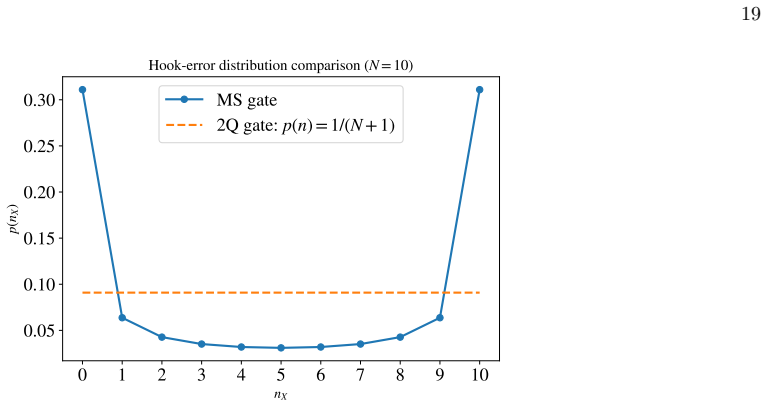
Distribution of Hook Errors Under MS Evolution Assuming MS evolution, with the aboveφ nm(t) and tracing out one of the qubits, defined as the faulty qubit, we can obtain the distribution for the number of propagated spin flips shown in Fig. 1c. The probability to observenflipped qubits is given by p(n) = 1 2π Z 2π 0 du N n sin2n φ(u) cos2N−2n φ(u) . ForN=...
-
[77]
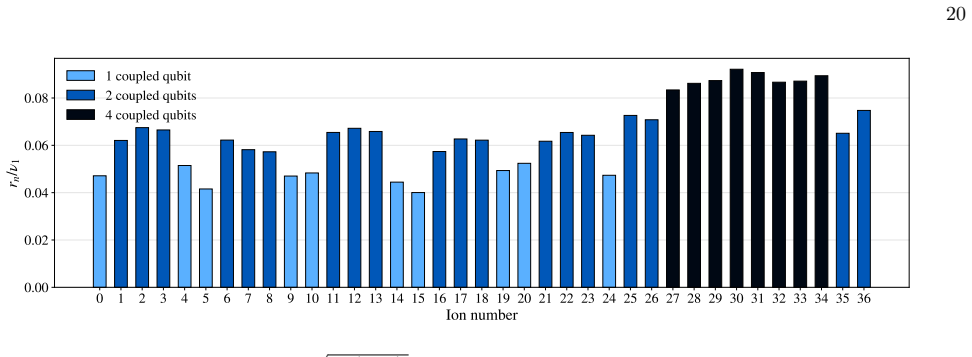
gate parameters Here we provide additional details regarding the MQ gate used to obtain the results in Fig. 1. Our gate design protocol follows Ref. [15]. The gate couples to the radial (transverse) modes of an equidistant crystal of trapped 40Ca+ ions. To implement the desired unitary in Eq. (4), we must satisfy 2Nlinear constraints for each ion: Re X...
-
[78]
IV, error propagation strongly depends on the trajectoryφ nk(t) where{n, k}are disconnected at gate time (φ nk(t=τ) = 0)
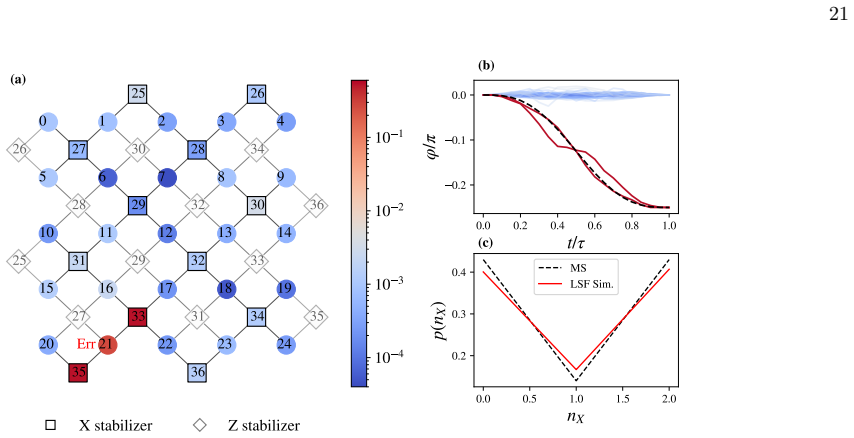
Additional results on error propagation under scattering noise As discussed in Sec. IV, error propagation strongly depends on the trajectoryφ nk(t) where{n, k}are disconnected at gate time (φ nk(t=τ) = 0). In Fig. 7 we present an example of undesired error propagation arising from a large deviation ofφ nk(t) from zero during the trajectory. Note that in F...
-
[79]
Here, we generalize this treatment to MQ gates
Heating in MQ gates In Section IV B, we showed that, for the MS gate, heating events effectively behave as single bit-flip errors. Here, we generalize this treatment to MQ gates. Starting from Eq. (22), and integrating under the initial condition of the motional ground state in thez-basis, we obtain ρx,x′(τ) = 1 2N e− PN n,m=1 Anm(τ)(x n−x′ n)(xm−x′ m),(G...
-
[80]
In particular, we demonstrate how the requirement of generating entanglement between ionsn, mgives rise to stronger correlations in the motional-mode displacements
Motional dephasing in MQ gates In this section, we compare pairs of qubits that are coupled,φ nm(τ) =π/4, with uncoupled pairs for which φnm(τ) = 0. In particular, we demonstrate how the requirement of generating entanglement between ionsn, mgives rise to stronger correlations in the motional-mode displacements. To quantify this effect, we analyze the cor...
discussion (0)
Sign in with ORCID, Apple, or X to comment. Anyone can read and Pith papers without signing in.