Third rank permeability in chiral solids
Pith reviewed 2026-06-29 09:45 UTC · model grok-4.3
The pith
A third-rank permeability term in chiral solids causes emerging fluid to acquire vorticity.
A machine-rendered reading of the paper's core claim, the machinery that carries it, and where it could break.
Core claim
Inclusion of a third-rank permeability tensor term in the constitutive description of fluid flow through chiral solids causes the emergent flow to acquire vorticity, with an associated chiral length scale that can be extracted by multiple methods.
What carries the argument
Third-rank permeability tensor term that couples pressure gradient to an antisymmetric flow component and thereby generates vorticity.
If this is right
- Fluid exiting a chiral solid such as a gyroid acquires vorticity.
- A characteristic length scale tied to chirality governs the strength of the effect.
- The length scale can be determined by several independent methods.
- The third-rank term connects to nonlocal formulations of permeability, elasticity, and piezoelectricity.
Where Pith is reading between the lines
- If the term is measurable, chiral porous media could be engineered to impart controlled swirl to filtered or perfused fluids.
- The same tensor structure may appear in other transport problems involving broken mirror symmetry.
- Granular chiral packs offer a low-cost route to test the predicted length scale experimentally.
Load-bearing premise
A third-rank permeability tensor term is physically relevant and dominant in real chiral solids such as gyroids, rib lattices, and granular assemblies.
What would settle it
Direct measurement of zero vorticity in fluid emerging from a fabricated gyroid or chiral rib lattice under steady pressure-driven flow.
Figures
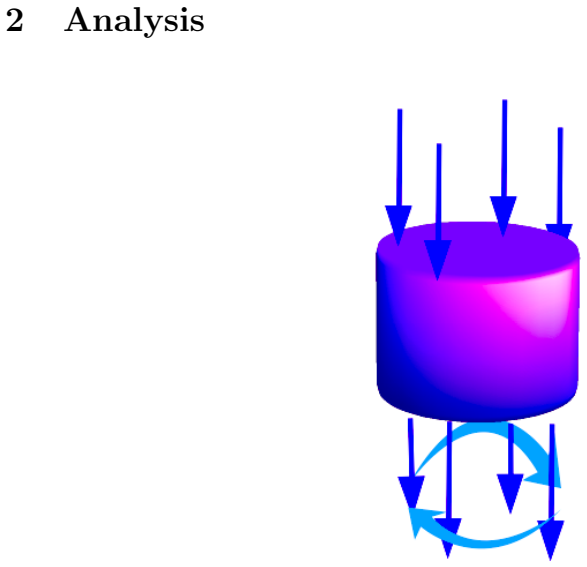
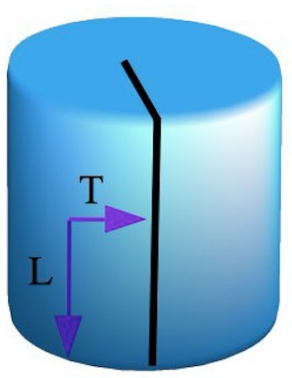
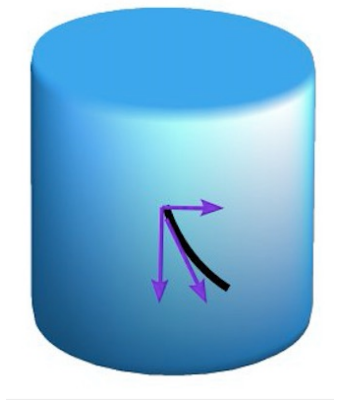
read the original abstract
Effects of a third rank permeability term in chiral solids are studied. Fluid flow through such materials acquires vorticity upon emergence from the material. Materials of interest include chiral surface lattices such as the gyroid, chiral rib lattices, and granular materials comprised of sugar crystals, quartz sand, wheat or beans. A characteristic length scale is associated with the chirality. The length scale can be obtained by several methods. Contacts with nonlocal permeability, elasticity and piezoelectricity are explored.
Editorial analysis
A structured set of objections, weighed in public.
Referee Report
Summary. The manuscript posits the existence of a third-rank permeability tensor permitted by chirality in solids such as gyroids, chiral rib lattices, and granular assemblies. It claims that this term causes fluid outflow to acquire vorticity, introduces an associated chiral length scale obtainable by multiple methods, and draws analogies to nonlocal permeability, elasticity, and piezoelectricity.
Significance. If substantiated, the result would extend Darcy-type descriptions of porous-media flow to include a chiral contribution that generates macroscopic vorticity, potentially relevant to transport in biological and engineered chiral microstructures. The absence of any derivation, symmetry analysis, or order-of-magnitude estimate, however, leaves the physical relevance of the term unestablished for the cited materials.
major comments (3)
- [Abstract] Abstract and opening paragraphs: the central claim that a third-rank permeability term produces observable vorticity rests on the unshown assertion that this tensor survives averaging over the microstructure of gyroids, rib lattices, or granular chiral solids. No homogenization calculation, symmetry-allowed component list, or comparison to the conventional second-rank Darcy permeability is supplied.
- [Abstract] Abstract: the statement that 'a characteristic length scale is associated with the chirality' and 'can be obtained by several methods' is presented without explicit definition, scaling argument, or numerical example that would allow a reader to judge its magnitude relative to pore size or sample thickness.
- [Abstract] Abstract: contacts with nonlocal permeability, elasticity, and piezoelectricity are mentioned but not developed into a concrete mapping or constitutive relation that would demonstrate consistency or predictive power.
Simulated Author's Rebuttal
We thank the referee for their detailed and insightful comments on our manuscript. We address each of the major comments below and will make revisions to strengthen the presentation of our results.
read point-by-point responses
-
Referee: [Abstract] Abstract and opening paragraphs: the central claim that a third-rank permeability term produces observable vorticity rests on the unshown assertion that this tensor survives averaging over the microstructure of gyroids, rib lattices, or granular chiral solids. No homogenization calculation, symmetry-allowed component list, or comparison to the conventional second-rank Darcy permeability is supplied.
Authors: We acknowledge that the manuscript, being a concise exploration of the effects, does not include a full homogenization derivation. However, the third-rank tensor is permitted by the chiral symmetry of the listed materials (gyroids, chiral rib lattices, and granular assemblies of chiral particles). In the revised manuscript, we will include a symmetry analysis listing the allowed components of the third-rank permeability tensor and explain why it does not vanish upon averaging, in contrast to achiral cases. A qualitative comparison to the second-rank Darcy permeability will be added, noting that the chiral term is a higher-order contribution characterized by an intrinsic length scale. Full quantitative homogenization calculations are beyond the scope of this work but could be pursued in follow-up studies. revision: partial
-
Referee: [Abstract] Abstract: the statement that 'a characteristic length scale is associated with the chirality' and 'can be obtained by several methods' is presented without explicit definition, scaling argument, or numerical example that would allow a reader to judge its magnitude relative to pore size or sample thickness.
Authors: We will revise the text to explicitly define the characteristic chiral length scale as the ratio of the magnitude of the third-rank permeability coefficients to those of the second-rank permeability tensor, yielding a quantity with dimensions of length. A scaling argument will be provided, indicating that this length is comparable to the characteristic microstructural length (such as the unit cell size in gyroids or grain diameter in granular media). While specific numerical examples from computation are not included in the current version, we will add an order-of-magnitude estimate based on typical permeability values in porous chiral media to allow readers to assess its relevance relative to sample dimensions. revision: yes
-
Referee: [Abstract] Abstract: contacts with nonlocal permeability, elasticity, and piezoelectricity are mentioned but not developed into a concrete mapping or constitutive relation that would demonstrate consistency or predictive power.
Authors: We will expand the discussion section to develop these analogies more concretely. Specifically, we will map the third-rank permeability term to the third-rank piezoelectric tensor in chiral crystals and to gradient terms in nonlocal elasticity models. A constitutive relation will be outlined showing how the vorticity in the outflow is consistent with the curl-like contributions in these related phenomena, thereby illustrating the predictive framework within the broader context of chiral constitutive laws. revision: yes
Circularity Check
No derivation chain; third-rank term introduced by assumption with no self-referential reduction
full rationale
The manuscript studies consequences of a postulated third-rank permeability term in chiral solids but supplies no derivation of that term from microstructure, no homogenization procedure, and no equations that could reduce to their own inputs. The abstract and description frame the work as exploring effects of an assumed term (including a characteristic length scale obtained by several methods), with contacts to other phenomena noted but without load-bearing self-citations or fitted predictions that collapse by construction. Absence of any explicit derivation chain means no circularity is present; the paper is self-contained as a phenomenological exploration rather than a first-principles derivation.
Axiom & Free-Parameter Ledger
Reference graph
Works this paper leans on
-
[1]
J. F. Nye,Physical Properties of Crystals, Oxford, Clarendon, (1976)
1976
-
[2]
D. R. Lovett,Tensor Properties of Crystals, Adam Hilger, Bristol and Philadelphia, (1989)
1989
-
[3]
Onsager, Reciprocal Relations in Irreversible Processes
L. Onsager, Reciprocal Relations in Irreversible Processes. I. Phys. Rev. 37, 405 (1931)
1931
-
[4]
Onsager, Reciprocal Relations in Irreversible Processes
L. Onsager, Reciprocal Relations in Irreversible Processes. II. Phys. Rev. 38, 2265 (1931)
1931
-
[5]
S.,Theory of Elasticity, Krieger; Malabar, FL, (1983)
Sokolnikoff, I. S.,Theory of Elasticity, Krieger; Malabar, FL, (1983)
1983
-
[6]
Trunov, (1974), Nonlocal piezoelectric effect, Sov
Bursian, E., and N. Trunov, (1974), Nonlocal piezoelectric effect, Sov. Phys. Solid State - Fizika Tverdogo Tela 16(4), 1187-1190
1974
-
[7]
Bursian, E., and O. I. Zaikovskii, (1968), Changes in the curvature of a ferroelectric film due to polarization, Sov. Phys. Solid State - Fizika Tverdogo Tela 10, 1121-1124
1968
-
[8]
Trunov, (1975), Polarization and susceptibility of a ferroelectric sample with a size comparable to the correlation radius, Sov
N. Trunov, (1975), Polarization and susceptibility of a ferroelectric sample with a size comparable to the correlation radius, Sov. Phys. Solid State 17, 760-762
1975
-
[9]
C., Linear theory of nonlocal elasticity and dispersion of plane waves, Int
Eringen, A. C., Linear theory of nonlocal elasticity and dispersion of plane waves, Int. J. Engng Sci, 10, 425-435, 1972
1972
-
[10]
M. E. Mobasher, L. Berger- Vergiat, H. Waisman, Non-local formulation for transport and damage in porous media, Computer Methods in Applied Mechanics and Engineering 324, 654-688 (2017). 7
2017
-
[11]
Cosserat, and F
E. Cosserat, and F. Cosserat,Theorie des Corps Deformables, Hermann et Fils, Paris (1909)
1909
-
[12]
A. C. Eringen, Theory of micropolar elasticity. In Fracture Vol.1, 621-729 (edited by H. Liebowitz), Academic Press, New York (1968)
1968
-
[13]
Park, H. C. and Lakes, R. S., Cosserat micromechanics of human bone: strain redistri- bution by a hydration-sensitive constituent, J. Biomechanics, 19 385-397 (1986)
1986
-
[14]
Nagawa, K
M. Nagawa, K. Arakawa, M. Yamada, Diamond Crystals as Cosserat Continua, phys. stat. sol. (a) 57, 713-718 (1980)
1980
-
[15]
Rueger and R
Z. Rueger and R. S. Lakes, Experimental Cosserat elasticity in open cell polymer foam, Philosophical Magazine, 96 (2), 93-111, (2016)
2016
-
[16]
Rueger and R
Z. Rueger and R. S. Lakes, Cosserat elasticity of negative Poisson’s ratio foam: experi- ment, Smart Materials and Structures,25, 054004 (8pp) (2016)
2016
-
[17]
Rueger and R
Z. Rueger and R. S. Lakes, Strong Cosserat elasticity in a transversely isotropic polymer lattice, Phys. Rev. Lett., 120, 065501 Feb. (2018)
2018
-
[18]
R. S. Lakes, and R. L. Benedict, Noncentrosymmetry in micropolar elasticity. Int. J. of Engng. Sci.20, 1161 (1982)
1982
-
[19]
S., Plesha, M
Ha, C. S., Plesha, M. E., Lakes, R. S., Chiral three-dimensional isotropic lattices with negative Poisson’s ratio, Physica Status Solidi B, 253, (7), 1243-1251 (2016)
2016
-
[20]
Reasa and R
D. Reasa and R. S. Lakes, Chiral elasticity of the gyroid lattice, Phys. Rev. Lett., 125, 205502, (2020)
2020
-
[21]
S., Lakes, R
Ha, C. S., Lakes, R. S., Plesha, M. E., Observation of squeeze twist coupling in a chiral three-dimensional isotropic lattice, Physica Status Solidi B 257, (10), 1900140, (2020)
2020
-
[22]
Gibson, L. J. and Ashby, M. F.,Cellular Solids, Pergamon, Oxford; 2nd Ed., Cambridge (1997)
1997
-
[23]
Soret, De la conductibilite calorifique dans les cristaux
C. Soret, De la conductibilite calorifique dans les cristaux. J. Phys. Theor. Appl.,2(1), 241-259 (1893)
-
[24]
Saret, On the experimental investigation of the rotational coefficients of thermal conductivity, Philosophical Magazine Series 5,37, 226, 338-339, (1894)
Ch. Saret, On the experimental investigation of the rotational coefficients of thermal conductivity, Philosophical Magazine Series 5,37, 226, 338-339, (1894)
-
[25]
R. S. Lakes, Nonclassical heat flow in a passive chiral solid is third rank, not odd, Z. Angew. Math. Phys. (ZAMP) 76: 81 (2025)
2025
-
[26]
Neuhaus, Elastic behavior of spruce wood as a function of moisture content, Holz Roh-Werkst.41(1), 21-25 (1983)
H. Neuhaus, Elastic behavior of spruce wood as a function of moisture content, Holz Roh-Werkst.41(1), 21-25 (1983)
1983
-
[27]
Ozyhar, S
T. Ozyhar, S. Hering, and P. Niemz, Viscoelastic characterization of wood: Time depen- dence of the orthotropic compliance in tension and compression, Journal of Rheology 57(2), 699-717 2013
2013
-
[28]
Hering, D
S. Hering, D. Keunecke, and P. Niemz, Moisture-dependent orthotropic elasticity of beech wood, Wood Sci. Technol.46, 927-938 (2012)
2012
-
[29]
A. C. Pipkin and G. Rogers, Asymmetric relaxation and compliance matrices in linear viscoelasticity, Z. Angew. Math. Phys. (ZAMP),14, 334-343 1963. 8
1963
discussion (0)
Sign in with ORCID, Apple, or X to comment. Anyone can read and Pith papers without signing in.