First-Order Perturbations of Covariant Maxwell Equations in Gravitational Waves
Pith reviewed 2026-06-29 10:41 UTC · model grok-4.3
The pith
Gravitational waves of strain 10^{-21} generate first-order electromagnetic responses at the 10^{-19} level relative to an incident plane wave.
A machine-rendered reading of the paper's core claim, the machinery that carries it, and where it could break.
Core claim
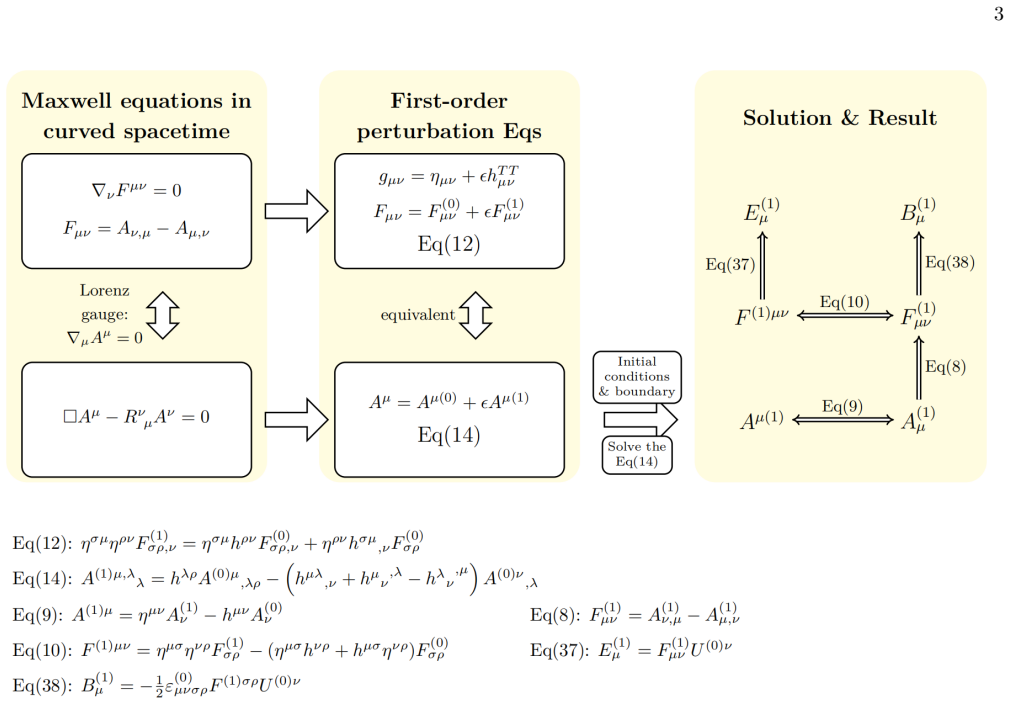
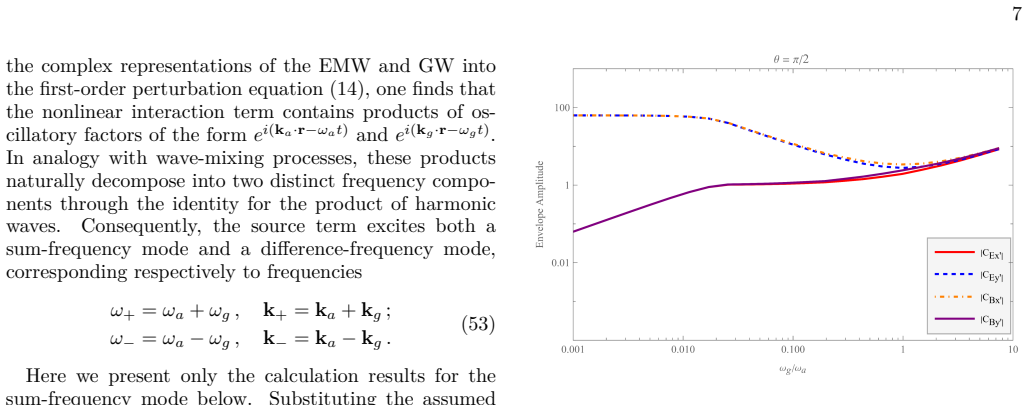
Starting from the covariant Maxwell equations, first-order perturbation equations are derived that govern electromagnetic responses to a gravitational-wave background; these equations are shown to be equivalent when written in terms of the field tensor or the four-potential and to retain residual gauge invariance under the Lorenz gauge. Explicit first-order formulas are obtained for the induced electric and magnetic fields and for the electromagnetic energy-momentum tensor. In the illustrative case of a plane electromagnetic wave interacting with a gravitational wave in the transverse-traceless gauge, the maximum modulus of the coupling coefficient is of order 10^2, establishing that a gravi
What carries the argument
The first-order perturbation equations obtained by linearizing the covariant Maxwell equations in a gravitational-wave background, expressed equivalently through the electromagnetic field tensor and the four-potential.
If this is right
- Explicit expressions for the induced electric and magnetic fields follow directly from the perturbation equations.
- The first-order correction to the electromagnetic energy-momentum tensor can be written in closed form.
- The electromagnetic response scales linearly with the gravitational-wave strain for the plane-wave case.
- The framework supplies a gauge-invariant route to compute the leading interaction between any chosen electromagnetic background and a gravitational wave.
Where Pith is reading between the lines
- The same linearization procedure could be applied to electromagnetic fields that are not plane waves, such as those near compact objects.
- Because the induced amplitude remains many orders of magnitude below current instrumental sensitivities, direct detection of the effect would require either coherent amplification or integration over many wave cycles.
- The method offers a template for treating other linear perturbations, for example electromagnetic fields in the presence of tensor or scalar metric perturbations beyond gravitational waves.
Load-bearing premise
The first-order perturbation expansion remains valid and the transverse-traceless gauge choice for the gravitational wave does not introduce artifacts that change the leading electromagnetic response.
What would settle it
A numerical solution of the full, unexpanded Maxwell equations on a gravitational-wave metric that yields an induced field amplitude differing by more than a factor of a few from the analytic 10^{-19} scaling.
Figures
read the original abstract
We present a systematic theoretical framework for investigating first-order electromagnetic (EM) perturbations induced by gravitational waves (GWs). Beginning with the covariant Maxwell equations, we derive the complete first-order perturbation equations in terms of both the EM field tensor and the four-potential, demonstrating their equivalence alongside the residual gauge invariance under the Lorenz gauge condition. Furthermore, explicit first-order expressions for the induced electric and magnetic fields, as well as the associated EM energy-momentum tensor, are obtained. As an explicit illustration, we analytically evaluate the interaction between a plane EM wave and a GW within the transverse-traceless gauge. By demonstrating that the maximum modulus of the coupling coefficient is on the order of $10^2$, we quantitatively establish that a typical astrophysical GW with a dimensionless strain of $h_0 \sim 10^{-21}$ generates a first-order EM response on the order of $10^{-19}$ relative to the incident field amplitude.
Editorial analysis
A structured set of objections, weighed in public.
Referee Report
Summary. The paper develops a systematic first-order perturbation framework for the covariant Maxwell equations in a gravitational-wave background. It derives the perturbed equations in both the electromagnetic field tensor F_{\mu u} and four-potential A_\mu formulations, demonstrates their equivalence together with residual Lorenz-gauge invariance, obtains explicit expressions for the induced electric and magnetic fields and the perturbed energy-momentum tensor, and applies the formalism to the analytic interaction of a plane electromagnetic wave with a transverse-traceless gravitational wave, reporting a maximum coupling coefficient of order 10^2 that implies a first-order electromagnetic response of order 10^{-19} relative to the incident amplitude for a typical astrophysical strain h_0 ~ 10^{-21}.
Significance. If the central analytic result holds, the work supplies a concrete, parameter-free estimate of the leading electromagnetic response to a gravitational wave, which is useful for assessing the feasibility of electromagnetic signatures in astrophysical or laboratory settings. The explicit demonstration of equivalence between the two formulations and the preservation of Lorenz gauge invariance constitutes a technical strength. The quantitative claim (O(10^2) coupling) is the load-bearing result; its robustness directly determines whether the reported 10^{-19} figure can be regarded as a reliable order-of-magnitude prediction.
major comments (2)
- [plane-wave interaction section / coupling-coefficient derivation] Analytic evaluation of plane-wave interaction (the section containing the explicit solution for the coupling coefficient): the reported maximum modulus of order 10^2 is obtained exclusively within the transverse-traceless gauge for the gravitational wave. The manuscript does not demonstrate that this numerical coefficient is invariant under a change of gravitational-wave gauge or provide an explicit calculation in a non-TT gauge; because an O(1) shift in the coefficient would rescale the claimed 10^{-19} response by the same factor, this constitutes a load-bearing gap for the central quantitative claim.
- [first-order perturbation equations] First-order perturbation equations (the section deriving the perturbed Maxwell system): while equivalence of the F_{\mu u} and A_\mu formulations is shown together with Lorenz-gauge invariance for the electromagnetic sector, the derivation assumes the background metric perturbation remains exactly transverse-traceless at linear order. No explicit check is supplied that residual gauge freedom in the gravitational-wave sector leaves the leading-order electromagnetic response unchanged, which is required to rule out coordinate artifacts in the extracted coupling.
minor comments (2)
- [§§3–4] Notation for the perturbed quantities (throughout §§3–4): the distinction between background and first-order fields is clear, but a short table summarizing the symbols for the zeroth- and first-order electric/magnetic components would improve readability.
- [figure captions] Figure captions (any figures displaying the coupling coefficient or induced fields): the captions should explicitly state the gauge choice used for the gravitational wave and the normalization of the incident electromagnetic wave amplitude.
Simulated Author's Rebuttal
We thank the referee for the careful and constructive review. We address the two major comments point by point below.
read point-by-point responses
-
Referee: [plane-wave interaction section / coupling-coefficient derivation] Analytic evaluation of plane-wave interaction (the section containing the explicit solution for the coupling coefficient): the reported maximum modulus of order 10^2 is obtained exclusively within the transverse-traceless gauge for the gravitational wave. The manuscript does not demonstrate that this numerical coefficient is invariant under a change of gravitational-wave gauge or provide an explicit calculation in a non-TT gauge; because an O(1) shift in the coefficient would rescale the claimed 10^{-19} response by the same factor, this constitutes a load-bearing gap for the central quantitative claim.
Authors: We agree that the explicit evaluation of the coupling coefficient (maximum modulus ~10^2) was performed only in the TT gauge. The general first-order perturbation equations themselves are derived covariantly from the Maxwell equations on a general metric perturbation h_{\mu\nu} and do not invoke the TT condition. The TT gauge is adopted solely for the concrete plane-wave example because it is the standard physical gauge for vacuum gravitational waves. We will revise the manuscript to add a clarifying paragraph noting that, at linear order, physical observables are independent of residual gauge transformations in the gravitational-wave sector (which correspond to coordinate redefinitions), thereby supporting that the reported order-of-magnitude estimate remains robust. A complete explicit recomputation in a non-TT gauge lies outside the present scope. revision: partial
-
Referee: [first-order perturbation equations] First-order perturbation equations (the section deriving the perturbed Maxwell system): while equivalence of the F_{\mu\nu} and A_\mu formulations is shown together with Lorenz-gauge invariance for the electromagnetic sector, the derivation assumes the background metric perturbation remains exactly transverse-traceless at linear order. No explicit check is supplied that residual gauge freedom in the gravitational-wave sector leaves the leading-order electromagnetic response unchanged, which is required to rule out coordinate artifacts in the extracted coupling.
Authors: The first-order equations are obtained directly from the covariant Maxwell equations written on the perturbed metric g_{\mu\nu}=\eta_{\mu\nu}+h_{\mu\nu} without ever imposing the TT condition on h_{\mu\nu}. The TT gauge appears only when the general equations are specialized to the analytic plane-wave interaction. Because the starting point is tensorial and the electromagnetic quantities are constructed from covariant derivatives, the leading-order response is automatically free of coordinate artifacts under residual gauge transformations of the gravitational-wave background. We will insert an explicit statement to this effect in the revised manuscript, together with a short argument confirming that the demonstrated equivalence between the F_{\mu\nu} and A_\mu formulations is preserved under such transformations. revision: yes
Circularity Check
No significant circularity; derivation proceeds from standard covariant Maxwell equations to explicit coupling coefficient
full rationale
The paper starts from the covariant Maxwell equations (standard input), derives the first-order perturbed equations in both F_{\mu\nu} and A_\mu formulations, proves their equivalence and Lorenz-gauge invariance, then analytically solves the plane-wave + TT-gauge GW interaction to extract the coupling coefficient. No step reduces a claimed prediction to a fitted input by construction, no load-bearing self-citation chain is invoked, and the reported O(10^2) maximum modulus is obtained directly from the solved equations rather than presupposed or renamed. The TT gauge is an explicit choice for the illustration, not smuggled in via prior self-work. This is a normal self-contained derivation with independent content.
Axiom & Free-Parameter Ledger
Reference graph
Works this paper leans on
-
[1]
We can now expand the electric field perturbatively, which simplifies to Eµ = FµνU ν 0 : E(0) µ = F (0) µν U (0)ν , ϵ : E(1) µ = F (1) µν U (0)ν . (37) Similarly, the magnetic field perturbation expansion (us- ing ε(1) µνσρ = 0) becomes Bµ = − 1 2 εµνσρ F σρU ν 0 : B(0) µ = − 1 2 ε(0) µνσρ F (0)σρU (0)ν , ϵ : B(1) µ = − 1 2 ε(0) µνσρ F (1)σρU (0)ν . (38) ...
-
[2]
Expressions for CEx′ Ψ1,Ex′ = − iΩ 2ωa , (A3) Ψ2,Ex′ = i(K + Ω) 4ωa (1 + 2 cos θ) , (A4) Ψ3,Ex′ = − i(K − Ω) 4ωa (1 + 2 cos θ) . (A5)
-
[3]
Expressions for CEy ′ Ψ1,Ey ′ = iΩ(ω2 a + ω2 g + ωaΩ cos θ) 2Kω aωg , (A6) Ψ2,Ey ′ = − i(K + Ω)Λ(θ) 4Kω aωg , (A7) Ψ3,Ey ′ = i(K − Ω)Λ(θ) 4Kω aωg . (A8)
-
[4]
Expressions for CBx′ Ψ1,Bx′ = − iΩ(Ω + ωa cos θ) 2ωaωg , (A9) Ψ2,Bx′ = i(K + Ω)Λ(θ) 4Kω aωg , (A10) Ψ3,Bx′ = i(K − Ω)Λ(θ) 4Kω aωg . (A11)
-
[5]
Expressions for CBy ′ Ψ1,By ′ = − iΩ(Ω + 2ωa cos θ) 2Kω a , (A12) Ψ2,By ′ = i(K + Ω) 4ωa (1 + 2 cos θ) , (A13) Ψ3,By ′ = i(K − Ω) 4ωa (1 + 2 cos θ) . (A14)
-
[6]
B. P. e. a. Abbott, Observation of Gravitational Waves from a Binary Black Hole Merger, Phys. Rev. Lett. 116, 061102 (2016) , arXiv:1602.03837 [gr-qc]
work page internal anchor Pith review Pith/arXiv arXiv 2016
-
[7]
On gravitational-wave spectroscopy of massive black holes with the space interferometer LISA
E. Berti, V. Cardoso, and C. M. Will, Gravitational- wave spectroscopy of massive black holes with the space interferometer LISA, Phys. Rev. D 73, 064030 (2006) , arXiv:gr-qc/0512160 [gr-qc]
work page internal anchor Pith review Pith/arXiv arXiv 2006
-
[8]
Danzmann and LISA Study Team, LISA: laser inter- ferometer space antenna for gravitational wave measure- ments, Classical and Quantum Gravity 13, A247 (1996)
K. Danzmann and LISA Study Team, LISA: laser inter- ferometer space antenna for gravitational wave measure- ments, Classical and Quantum Gravity 13, A247 (1996)
1996
-
[9]
Danzmann and A
K. Danzmann and A. Rüdiger, LISA technology - con- cept, status, prospects, Classical and Quantum Gravity 20, S1 (2003)
2003
- [10]
-
[11]
M. e. a. Evans, A Horizon Study for Cosmic Ex- plorer: Science, Observatories, and Community, arXiv e-prints , arXiv:2109.09882 (2021) , arXiv:2109.09882 [astro-ph.IM]
work page internal anchor Pith review Pith/arXiv arXiv 2021
- [12]
-
[13]
M. E. Gertsenshteln, Wave resonance of light and gravi- tational waves, Sov. Phys. JETP 14, 84 (1962)
1962
-
[14]
V. B. Braginskii, L. P. Grishchuk, A. G. Doroshkevich, I. B. Zeldovich, I. D. Novikov, and M. V. Sazhin, Elec- tromagnetic detectors of gravitational waves, Zhurnal Eksperimentalnoi i Teoreticheskoi Fiziki 65, 1729 (1974)
1974
-
[15]
L. P. Grishchuk and M. V. Sazhin, Excitation and de- tection of standing gravitational waves, Zhurnal Eksper- imentalnoi i Teoreticheskoi Fiziki 68, 1569 (1975)
1975
-
[16]
V. B. Braginskii, M. B. Menskii, I. D. Novikov, M. V. Sazhin, I. B. Zeldovich, L. P. Grishchuk, and A. G. Doroshkevich, On the electromagnetic detection of grav- itational waves., General Relativity and Gravitation 11, 407 (1979)
1979
-
[17]
M. B. Mensky, On gravitational-electromagnetic res- onance, arXiv e-prints , arXiv:0712.3721 (2007) , arXiv:0712.3721 [gr-qc]
work page internal anchor Pith review Pith/arXiv arXiv 2007
-
[18]
C. M. Caves, Microwave cavity gravitational radiation detectors, Physics Letters B 80, 323 (1979)
1979
-
[19]
Pegoraro, L
F. Pegoraro, L. A. Radicati, P. Bernard, and E. Picasso, Electromagnetic detector for gravitational waves, Physics Letters A 68, 165 (1978)
1978
-
[20]
Ballantini, P
R. Ballantini, P. Bernard, E. Chiaveri, A. Chincarini, G. Gemme, R. Losito, R. Parodi, and E. Picasso, A detec- tor of high frequency gravitational waves based on cou- pled microwave cavities, Classical and Quantum Gravity 20, 3505 (2003)
2003
-
[21]
A. M. Cruise, An electromagnetic detector for very-high- frequency gravitational waves, Classical and Quantum Gravity 17, 2525 (2000)
2000
- [22]
-
[23]
Zheng and L
H. Zheng and L. F. Wei, Experimental system to detect the electromagnetic response of high-frequency gravita- tional waves, Phys. Rev. D 106, 104003 (2022)
2022
- [24]
-
[25]
F. Li, N. Yang, Z. Fang, R. M. L. Baker, Jr., G. V. Stephenson, and H. Wen, Signal photon flux and back- ground noise in a coupling electromagnetic detecting sys- tem for high-frequency gravitational waves, Phys. Rev. D 80, 064013 (2009) , arXiv:0909.4118 [gr-qc]
work page internal anchor Pith review Pith/arXiv arXiv 2009
-
[26]
Zheng, L
H. Zheng, L. F. Wei, H. Wen, and F. Y. Li, Electro- magnetic response of gravitational waves passing through an alternating magnetic field: A scheme to probe high- frequency gravitational waves, Phys. Rev. D 98, 064028 (2018)
2018
- [27]
-
[28]
H. Wu, X. Fan, and L. Chen, How gravitational waves change photon orbital angular momentum quan- tum states, Phys. Rev. D 112, 124002 (2025) , arXiv:2504.16452 [gr-qc]
work page internal anchor Pith review Pith/arXiv arXiv 2025
-
[29]
Detecting single gravitons withquantumsensing,
G. Tobar, S. K. Manikandan, T. Beitel, and I. Pikovski, Detecting single gravitons with quantum sensing, Na- ture Communications 15, 7229 (2024) , arXiv:2308.15440 [quant-ph]
-
[30]
Schützhold, Stimulated Emission or Absorption of Gravitons by Light, Phys
R. Schützhold, Stimulated Emission or Absorption of Gravitons by Light, Phys. Rev. Lett. 135, 171501 (2025) , arXiv:2502.10221 [gr-qc]
- [31]
-
[32]
A. Kushwaha, S. Malik, and S. Shankaranarayanan, Gertsenshtein-Zel’dovich effect: a plausible explana- tion for fast radio bursts?, MNRAS 527, 4378 (2024) , arXiv:2202.00032 [astro-ph.HE]
-
[33]
W. Hong, Z.-Z. Tao, P. He, and T.-J. Zhang, Theoreti- cal Radio Signals from Radio-band Gravitational Waves Converted from the Neutron Star Magnetic Field, As- trophys. J. 990, 156 (2025) , arXiv:2412.05338 [astro- ph.HE]
- [34]
-
[35]
Boccaletti, V
D. Boccaletti, V. Sabbata, P. Fortini, and C. Gualdi, Conversion of photons into gravitons and vice versa in a static electromagnetic field, Nuovo Cimento B Serie 70, 129 (1970)
1970
- [36]
-
[37]
Gravitational waves and electrodynamics: New perspectives
F. Cabral and F. S. N. Lobo, Gravitational waves and electrodynamics: new perspectives, European Physical Journal C 77, 237 (2017) , arXiv:1603.08157 [gr-qc]
work page internal anchor Pith review Pith/arXiv arXiv 2017
-
[38]
C. G. Tsagas, Electromagnetic fields in curved space- times, Classical and Quantum Gravity 22, 393 (2005) , arXiv:gr-qc/0407080 [astro-ph]
work page internal anchor Pith review Pith/arXiv arXiv 2005
-
[39]
A. Palessandro and T. Rothman, A simple derivation of the Gertsenshtein effect, Physics of the Dark Universe 40, 101187 (2023) , arXiv:2301.02072 [gr-qc]
- [40]
-
[41]
M. Calura and E. Montanari, Exact solution to the ho- mogeneous Maxwell equations in the field of a gravita- tional wave in linearized theory, Classical and Quantum Gravity 16, 643 (1999) , arXiv:gr-qc/9810082 [gr-qc]
work page internal anchor Pith review Pith/arXiv arXiv 1999
- [42]
-
[43]
C. Park and D.-H. Kim, Observation of gravitational waves by light polarization, European Physical Journal C 81, 95 (2021) , arXiv:2012.04243 [gr-qc]
- [44]
-
[45]
F.-Y. Li, M.-X. Tang, and D.-P. Shi, Electromagnetic response of a Gaussian beam to high-frequency relic gravitational waves in quintessential inflationary mod- els, Phys. Rev. D 67, 104008 (2003), arXiv:gr-qc/0306092 [gr-qc]
work page internal anchor Pith review Pith/arXiv arXiv 2003
- [46]
-
[47]
J. C. Ward, An Identity in Quantum Electrodynamics, Physical Review 78, 182 (1950)
1950
-
[48]
Takahashi, On the generalized ward identity, Il Nuovo Cimento 6, 371 (1957)
Y. Takahashi, On the generalized ward identity, Il Nuovo Cimento 6, 371 (1957)
1957
discussion (0)
Sign in with ORCID, Apple, or X to comment. Anyone can read and Pith papers without signing in.