Filtering out Erratic Observables: Wormholes from Gauging Nonlocal Symmetries
Pith reviewed 2026-06-29 11:02 UTC · model grok-4.3
The pith
Gauging nonlocal symmetries generated by monodromy data in two CFTs filters erratic observables while preserving a wormhole Hilbert subspace.
A machine-rendered reading of the paper's core claim, the machinery that carries it, and where it could break.
Core claim
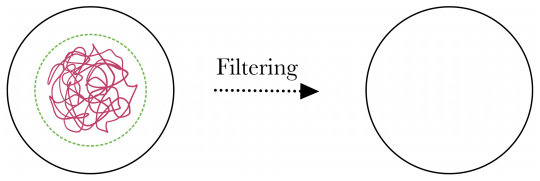
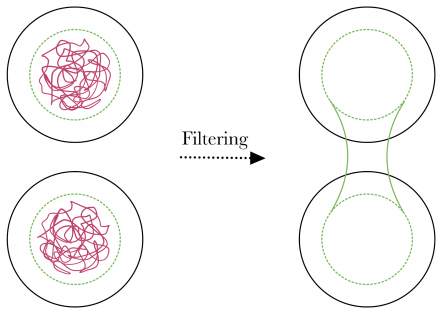
One-sided boundary gravitons are intrinsically incomplete with a nontrivial center in their observable algebra. Completions via asymptotic symmetries yield a commutant given by monodromy data. Gauging the nonlocal symmetries from these data filters erratic observables. For two CFTs this leaves a Hilbert subspace describing wormholes, with the filtered partition function as an ensemble average over entangling quantum gates on the monodromy degrees of freedom.
What carries the argument
Monodromy observable algebra that completes the boundary gravitons and generates nonlocal symmetries lacking local currents; gauging the global part of these symmetries filters the Hilbert space to retain wormhole contributions.
If this is right
- For one CFT, gauging the nonlocal symmetries removes all black hole states.
- The filtered partition function of CFTs exhibits an apparent ensemble averaging.
- The correlation between the erratic observables of two CFTs is preserved and contributes to the filtered partition function as a wormhole term.
- Only positivity-restricted monodromy data is needed to describe Lorentzian multi-boundary wormholes.
- The filtered partition function of two CFTs is an ensemble average over quantum gates entangling the monodromy degrees of freedom.
Where Pith is reading between the lines
- This construction may extend to higher-dimensional holography if analogous nonlocal symmetries can be identified in the dual CFTs.
- It suggests wormholes can arise as a consequence of symmetry gauging rather than purely from summing over geometries in the path integral.
- Solvable CFT models could provide a direct test of whether the ensemble average over entangling gates reproduces known wormhole geometries.
- The entangling gates on monodromy data may link to quantum information interpretations of black hole interiors.
Load-bearing premise
The commutant of the boundary graviton observable algebra is an observable algebra of monodromy data interpreted as an effective description of one-sided black holes, and only the positivity-restricted data is needed to describe Lorentzian multi-boundary wormholes.
What would settle it
An explicit calculation of the gauged partition function for a concrete pair of CFTs that fails to reproduce the wormhole term expected from the gravitational path integral.
Figures
read the original abstract
The wormhole contribution to the gravitational path integral may be interpreted as smooth remnant of correlations among the erratic large-$N$ behaviors of dual CFTs. In this work, we investigate this idea in (2+1)-dimensional gravity. We show that one-sided boundary gravitons are intrinsically incomplete in the sense that the associated observable algebra has a nontrivial center regardless of choices of boundary conditions. Based on asymptotic symmetries, we bootstrap a general Poisson bracket to construct completions of the boundary gravitons. In the simplest completion, the commutant of the boundary graviton observable algebra is given by an observable algebra of monodromy data which we interpret as an effective description of one-sided black holes. We show that, to describe Lorentzian multi-boundary wormholes, only the monodromy data with a positivity restriction is needed. The positivity restriction results in emergent erratic large-$N$ behaviors for some observables. We filter out the erratic observables by restricting to a subspace on which they act trivially. The monodromy observables generate nonlocal symmetries lack of corresponding local currents. We show that gauging the nonlocal symmetries is equivalent to filtering out the erratic observables. For one CFT, gauging the nonlocal symmetries at the quantum level removes all black hole states. Filtering the partition function of CFTs leads to an apparent ensemble averaging. For two CFTs, a Hilbert subspace describing wormholes survives after gauging global part of the nonlocal symmetries. The filtered partition function of the two CFTs is an ensemble average over quantum gates entangling the monodromy degrees of freedom the two CFTs. The correlation between the erratic observables of the two CFTs is preserved, which contributes to the filtered partition function as a wormhole term.
Editorial analysis
A structured set of objections, weighed in public.
Referee Report
Summary. The paper claims that in (2+1)D gravity the observable algebra of one-sided boundary gravitons is incomplete, possessing a nontrivial center independent of boundary conditions. A general Poisson bracket is bootstrapped from asymptotic symmetries to complete the algebra; its commutant is identified with an algebra of monodromy data, interpreted as an effective description of one-sided black holes. Only the positivity-restricted subset of this data is required for Lorentzian multi-boundary wormholes. This restriction produces emergent erratic large-N observables that are filtered by restricting to the subspace on which they act trivially. The monodromy observables generate nonlocal symmetries without local currents; gauging these symmetries is equivalent to the filtering procedure. For a single CFT, gauging removes all black-hole states. For two CFTs, gauging the global part of the nonlocal symmetries leaves a surviving Hilbert subspace whose filtered partition function is an ensemble average over quantum gates that entangle the monodromy degrees of freedom, with the preserved correlations between erratic observables contributing the wormhole term.
Significance. If the central identification of the commutant and the equivalence between gauging and filtering are rigorously established, the work supplies a CFT-side mechanism that derives wormhole contributions directly from the gauging of nonlocal symmetries, thereby linking ensemble averaging to the survival of a wormhole subspace without invoking the gravitational path integral. The bootstrapping of the Poisson bracket and the use of positivity restrictions to select the Lorentzian sector constitute a concrete technical proposal that could be tested against known AdS3 wormhole geometries.
major comments (2)
- [Abstract / Poisson-bracket bootstrap section] Abstract and the section on the Poisson-bracket bootstrap: the claim that a general Poisson bracket can be bootstrapped such that the commutant of the completed boundary-graviton algebra is exactly the monodromy-data algebra is stated without explicit bracket relations, without an independent verification that the center remains nontrivial for arbitrary boundary conditions, and without a check that the positivity restriction selects the correct Lorentzian sector. This identification is load-bearing for every subsequent step (erratic observables, filtering, gauging equivalence, and the two-CFT wormhole term).
- [Section on gauging nonlocal symmetries] The paragraph asserting equivalence between gauging nonlocal symmetries and filtering erratic observables: the manuscript equates the two operations at the quantum level but supplies no explicit operator-level map or Hilbert-space projection that demonstrates the equivalence holds after completion of the algebra.
minor comments (2)
- Notation for the monodromy observables and the positivity restriction should be introduced with a clear definition of the inner product or trace used to impose positivity.
- The manuscript would benefit from an explicit comparison of the filtered two-CFT partition function with known ensemble-averaged expressions in the literature on JT gravity or AdS3 wormholes.
Simulated Author's Rebuttal
We thank the referee for the careful reading and for highlighting the need for greater explicitness in the technical foundations. We address each major comment below and will incorporate the requested clarifications and verifications in a revised manuscript.
read point-by-point responses
-
Referee: [Abstract / Poisson-bracket bootstrap section] Abstract and the section on the Poisson-bracket bootstrap: the claim that a general Poisson bracket can be bootstrapped such that the commutant of the completed boundary-graviton algebra is exactly the monodromy-data algebra is stated without explicit bracket relations, without an independent verification that the center remains nontrivial for arbitrary boundary conditions, and without a check that the positivity restriction selects the correct Lorentzian sector. This identification is load-bearing for every subsequent step (erratic observables, filtering, gauging equivalence, and the two-CFT wormhole term).
Authors: We agree that the bootstrap section requires explicit bracket relations and independent checks to support the central identification. In the revision we will insert the explicit Poisson brackets obtained from the asymptotic symmetry generators, demonstrate that the resulting center is nontrivial for general boundary conditions by varying the fall-off parameters, and add a direct comparison of the positivity-restricted monodromy data against known Lorentzian multi-boundary wormhole solutions in AdS3. These additions will be placed immediately after the bootstrap construction. revision: yes
-
Referee: [Section on gauging nonlocal symmetries] The paragraph asserting equivalence between gauging nonlocal symmetries and filtering erratic observables: the manuscript equates the two operations at the quantum level but supplies no explicit operator-level map or Hilbert-space projection that demonstrates the equivalence holds after completion of the algebra.
Authors: We acknowledge that an explicit operator-level demonstration is currently absent. In the revised manuscript we will supply a concrete map: we define the gauging operation as the projection onto the joint kernel of the nonlocal symmetry generators and show that this coincides with the subspace on which the erratic observables act as the identity. The resulting filtered Hilbert space and partition function will be written explicitly for both the single-CFT and two-CFT cases. revision: yes
Circularity Check
No significant circularity; derivation is a self-contained mathematical construction
full rationale
The paper bootstraps a Poisson bracket from asymptotic symmetries to complete the boundary graviton observable algebra, shows its commutant is a monodromy algebra, selects the positivity-restricted subset as necessary to describe Lorentzian multi-boundary wormholes, establishes equivalence between gauging nonlocal symmetries and filtering erratic observables, and derives that the filtered two-CFT partition function preserves correlations as a wormhole term. No quoted step reduces a claimed prediction or result to an input by definition, fitted parameter, or self-citation chain; the positivity choice is presented as a derived requirement for the target sector rather than an ansatz that encodes the wormhole output in advance. The central identification is offered as a consequence of the bootstrap, making the overall chain independent of the final interpretive label.
Axiom & Free-Parameter Ledger
axioms (2)
- domain assumption One-sided boundary gravitons are intrinsically incomplete: their observable algebra has a nontrivial center regardless of boundary conditions.
- domain assumption Asymptotic symmetries permit bootstrapping a general Poisson bracket that constructs completions of the boundary graviton algebra.
invented entities (2)
-
Monodromy data observables
no independent evidence
-
Nonlocal symmetries generated by monodromy observables
no independent evidence
Reference graph
Works this paper leans on
-
[1]
S. W. Hawking. Breakdown of Predictability in Gravitational Collapse.Phys. Rev. D, 14:2460–2473, 1976
1976
-
[2]
Samir D. Mathur. The Information paradox: A Pedagogical introduction.Class. Quant. Grav., 26:224001, 2009
2009
-
[3]
Black Holes: Com- plementarity or Firewalls?JHEP, 02:062, 2013
Ahmed Almheiri, Donald Marolf, Joseph Polchinski, and James Sully. Black Holes: Com- plementarity or Firewalls?JHEP, 02:062, 2013
2013
-
[4]
Gauge/Gravity Duality and the Black Hole Inte- rior.Phys
Donald Marolf and Joseph Polchinski. Gauge/Gravity Duality and the Black Hole Inte- rior.Phys. Rev. Lett., 111:171301, 2013. 59
2013
-
[5]
Quantum Computation vs
Daniel Harlow and Patrick Hayden. Quantum Computation vs. Firewalls.JHEP, 06:085, 2013
2013
-
[6]
The Typical-State Paradox: Diagnosing Horizons with Complexity
Leonard Susskind. The Typical-State Paradox: Diagnosing Horizons with Complexity. Fortsch. Phys., 64:84–91, 2016
2016
-
[7]
The Complexity of Quantum States and Transformations: From Quan- tum Money to Black Holes
Scott Aaronson. The Complexity of Quantum States and Transformations: From Quan- tum Money to Black Holes. 7 2016
2016
-
[8]
Computational pseudorandomness, the wormhole growth paradox, and constraints on the AdS/CFT duality
Adam Bouland, Bill Fefferman, and Umesh Vazirani. Computational pseudorandomness, the wormhole growth paradox, and constraints on the AdS/CFT duality. 10 2019
2019
-
[9]
Kim, Eugene Tang, and John Preskill
Isaac H. Kim, Eugene Tang, and John Preskill. The ghost in the radiation: robust encodings of the black hole interior (invited paper).JHEP, 06:031, 2020
2020
-
[10]
An Infalling Observer in AdS/CFT.JHEP, 10:212, 2013
Kyriakos Papadodimas and Suvrat Raju. An Infalling Observer in AdS/CFT.JHEP, 10:212, 2013
2013
-
[11]
State-Dependent Bulk-Boundary Maps and Black Hole Complementarity.Phys
Kyriakos Papadodimas and Suvrat Raju. State-Dependent Bulk-Boundary Maps and Black Hole Complementarity.Phys. Rev. D, 89(8):086010, 2014
2014
-
[12]
Netta Engelhardt and Aron C. Wall. Decoding the Apparent Horizon: Coarse-Grained Holographic Entropy.Phys. Rev. Lett., 121(21):211301, 2018
2018
-
[13]
Netta Engelhardt and Aron C. Wall. Coarse Graining Holographic Black Holes.JHEP, 05:160, 2019
2019
-
[14]
From black hole entropy to energy-minimizing states in QFT.Phys
Raphael Bousso, Venkatesa Chandrasekaran, and Arvin Shahbazi-Moghaddam. From black hole entropy to energy-minimizing states in QFT.Phys. Rev. D, 101(4):046001, 2020
2020
-
[15]
Brown, Hrant Gharibyan, Geoff Penington, and Leonard Susskind
Adam R. Brown, Hrant Gharibyan, Geoff Penington, and Leonard Susskind. The Python’s Lunch: geometric obstructions to decoding Hawking radiation.JHEP, 08:121, 2020
2020
-
[16]
Finding pythons in unexpected places.Class
Netta Engelhardt, Geoff Penington, and Arvin Shahbazi-Moghaddam. Finding pythons in unexpected places.Class. Quant. Grav., 39(9):094002, 2022
2022
-
[17]
The black hole interior from non-isometric codes and complexity.JHEP, 06:155, 2024
Chris Akers, Netta Engelhardt, Daniel Harlow, Geoff Penington, and Shreya Vardhan. The black hole interior from non-isometric codes and complexity.JHEP, 06:155, 2024
2024
-
[18]
The LargeNlimit of superconformal field theories and super- gravity.Adv
Juan Martin Maldacena. The LargeNlimit of superconformal field theories and super- gravity.Adv. Theor. Math. Phys., 2:231–252, 1998
1998
-
[19]
S. S. Gubser, Igor R. Klebanov, and Alexander M. Polyakov. Gauge theory correlators from noncritical string theory.Phys. Lett. B, 428:105–114, 1998. 60
1998
-
[20]
Anti de Sitter space and holography.Adv
Edward Witten. Anti de Sitter space and holography.Adv. Theor. Math. Phys., 2:253– 291, 1998
1998
-
[21]
Eternal black holes in anti-de Sitter.JHEP, 04:021, 2003
Juan Martin Maldacena. Eternal black holes in anti-de Sitter.JHEP, 04:021, 2003
2003
-
[22]
Emergent Times in Holographic Du- ality.Phys
Samuel Aaron Wehlau Leutheusser and Hong Liu. Emergent Times in Holographic Du- ality.Phys. Rev. D, 108(8):086020, 2023
2023
-
[23]
Causal connectability between quantum systems and the black hole interior in holographic duality.Phys
Samuel Leutheusser and Hong Liu. Causal connectability between quantum systems and the black hole interior in holographic duality.Phys. Rev. D, 108(8):086019, 2023
2023
-
[24]
Information loss, mixing and emergent type III1 factors.JHEP, 08:111, 2023
Keiichiro Furuya, Nima Lashkari, Mudassir Moosa, and Shoy Ouseph. Information loss, mixing and emergent type III1 factors.JHEP, 08:111, 2023
2023
-
[25]
Algebraic ER=EPR and complexity transfer.JHEP, 07:013, 2024
Netta Engelhardt and Hong Liu. Algebraic ER=EPR and complexity transfer.JHEP, 07:013, 2024
2024
-
[26]
Toward stringy horizons
Elliott Gesteau and Hong Liu. Toward stringy horizons. 8 2024
2024
-
[27]
Towards a holographic description of closed universes
Hong Liu. Towards a holographic description of closed universes. 9 2025
2025
-
[28]
Lecturesonentanglement, vonNeumannalgebras, andemergenceofspacetime
HongLiu. Lecturesonentanglement, vonNeumannalgebras, andemergenceofspacetime. InTheoretical Advanced Study Institute in Elementary Particle Physics 2023: Aspects of Symmetry, 10 2025
2023
-
[29]
Edward Witten.Why does quantum field theory in curved spacetime make sense? And what happens to the algebra of observables in the thermodynamic limit?2022
2022
-
[30]
No ensemble averaging below the black hole threshold.JHEP, 07:143, 2022
Jean-Marc Schlenker and Edward Witten. No ensemble averaging below the black hole threshold.JHEP, 07:143, 2022
2022
-
[31]
Emergent Mixed States for Baby Universes and Black Holes
Jonah Kudler-Flam and Edward Witten. Emergent Mixed States for Baby Universes and Black Holes. 10 2025
2025
-
[32]
Wormholes and Averaging over N
Jonah Kudler-Flam and Edward Witten. Wormholes and Averaging over N. 5 2026
2026
-
[33]
Shenker, and Douglas Stanford
Phil Saad, Stephen H. Shenker, and Douglas Stanford. JT gravity as a matrix integral. 3 2019
2019
-
[34]
Sidney R. Coleman. Black holes as red herrings: Topological fluctuations and the loss of quantum coherence.Nucl. Phys. B, 307:867–882, 1988
1988
-
[35]
Giddings and Andrew Strominger
Steven B. Giddings and Andrew Strominger. Loss of incoherence and determination of coupling constants in quantum gravity.Nucl. Phys. B, 307:854–866, 1988. 61
1988
-
[36]
Cotler, Guy Gur-Ari, Masanori Hanada, Joseph Polchinski, Phil Saad, Stephen H
Jordan S. Cotler, Guy Gur-Ari, Masanori Hanada, Joseph Polchinski, Phil Saad, Stephen H. Shenker, Douglas Stanford, Alexandre Streicher, and Masaki Tezuka. Black Holes and Random Matrices.JHEP, 05:118, 2017. [Erratum: JHEP 09, 002 (2018)]
2017
-
[37]
JT gravity and the ensembles of random matrix theory.Adv
Douglas Stanford and Edward Witten. JT gravity and the ensembles of random matrix theory.Adv. Theor. Math. Phys., 24(6):1475–1680, 2020
2020
-
[38]
Late Time Correlation Functions, Baby Universes, and ETH in JT Gravity
Phil Saad. Late Time Correlation Functions, Baby Universes, and ETH in JT Gravity. 10 2019
2019
-
[39]
Transcending the ensemble: baby universes, space- time wormholes, and the order and disorder of black hole information.JHEP, 08:044, 2020
Donald Marolf and Henry Maxfield. Transcending the ensemble: baby universes, space- time wormholes, and the order and disorder of black hole information.JHEP, 08:044, 2020
2020
-
[40]
Dissecting the ensemble in JT gravity.JHEP, 09:075, 2022
Andreas Blommaert. Dissecting the ensemble in JT gravity.JHEP, 09:075, 2022
2022
-
[41]
A universe field theory for JT gravity.JHEP, 05:118, 2022
Boris Post, Jeremy van der Heijden, and Erik Verlinde. A universe field theory for JT gravity.JHEP, 05:118, 2022
2022
-
[42]
AdS3 gravity and random CFT.JHEP, 04:033, 2021
Jordan Cotler and Kristan Jensen. AdS3 gravity and random CFT.JHEP, 04:033, 2021
2021
-
[43]
Random statistics of OPE coefficients and Euclidean wormholes.Class
Alexandre Belin and Jan de Boer. Random statistics of OPE coefficients and Euclidean wormholes.Class. Quant. Grav., 38(16):164001, 2021
2021
-
[44]
Free partition functions and an averaged holographic duality.JHEP, 01:130, 2021
Nima Afkhami-Jeddi, Henry Cohn, Thomas Hartman, and Amirhossein Tajdini. Free partition functions and an averaged holographic duality.JHEP, 01:130, 2021
2021
-
[45]
Semiclassical 3D gravity as an average of large-c CFTs.JHEP, 12:069, 2022
Jeevan Chandra, Scott Collier, Thomas Hartman, and Alexander Maloney. Semiclassical 3D gravity as an average of large-c CFTs.JHEP, 12:069, 2022
2022
-
[46]
AdS3/RMT2 duality.JHEP, 12:179, 2023
Gabriele Di Ubaldo and Eric Perlmutter. AdS3/RMT2 duality.JHEP, 12:179, 2023
2023
-
[47]
Approximate CFTs and random tensor models.JHEP, 09:163, 2024
Alexandre Belin, Jan de Boer, Daniel Louis Jafferis, Pranjal Nayak, and Julian Sonner. Approximate CFTs and random tensor models.JHEP, 09:163, 2024
2024
-
[48]
Jafferis, Liza Rozenberg, and Gabriel Wong
Daniel L. Jafferis, Liza Rozenberg, and Gabriel Wong. 3d gravity as a random ensemble. JHEP, 02:208, 2025
2025
-
[49]
It from ETH: Multi-interval Entanglement and Replica Wormholes from Large-cBCFT Ensemble
Hao Geng, Ling-Yan Hung, and Yikun Jiang. It from ETH: Multi-interval Entanglement and Replica Wormholes from Large-cBCFT Ensemble. 5 2025
2025
-
[50]
From Baby Universes to Narain Moduli: Topological Boundary Averaging in SymTFTs
Xingyang Yu. From Baby Universes to Narain Moduli: Topological Boundary Averaging in SymTFTs. 5 2026
2026
-
[51]
”Filtering” CFTs at large N: Euclidean Wormholes, Closed Universes, and Black Hole Interiors
Hong Liu. ”Filtering” CFTs at large N: Euclidean Wormholes, Closed Universes, and Black Hole Interiors. 12 2025. 62
2025
-
[52]
The Black hole in three- dimensional space-time.Phys
Maximo Banados, Claudio Teitelboim, and Jorge Zanelli. The Black hole in three- dimensional space-time.Phys. Rev. Lett., 69:1849–1851, 1992
1992
-
[53]
Classical origin of quantum group symmetries in Wess-Zumino- Witten conformal field theory.Commun
Krzysztof Gawedzki. Classical origin of quantum group symmetries in Wess-Zumino- Witten conformal field theory.Commun. Math. Phys., 139:201–214, 1991
1991
-
[54]
Alekseev and Samson L
A. Alekseev and Samson L. Shatashvili. Quantum Groups and WZW Models.Commun. Math. Phys., 133:353–368, 1990
1990
-
[55]
Alekseev, L
A. Alekseev, L. D. Faddeev, M. Semenov-Tian-Shansky, and A. Volkov. The Unraveling of the quantum group structure in the WZNW theory. 1 1991
1991
-
[56]
Mertens and Qi-Feng Wu
Thomas G. Mertens and Qi-Feng Wu. Minimal factorization of Chern-Simons theory – Gravitational anyonic edge modes.SciPost Phys., 20(4):095, 2026
2026
-
[57]
The Stretched horizon and black hole complementarity.Phys
Leonard Susskind, Larus Thorlacius, and John Uglum. The Stretched horizon and black hole complementarity.Phys. Rev. D, 48:3743–3761, 1993
1993
-
[58]
Lowe, Joseph Polchinski, Leonard Susskind, Larus Thorlacius, and John Uglum
David A. Lowe, Joseph Polchinski, Leonard Susskind, Larus Thorlacius, and John Uglum. Black hole complementarity versus locality.Phys. Rev. D, 52:6997–7010, 1995
1995
-
[59]
Mertens, Joan Simón, and Gabriel Wong
Thomas G. Mertens, Joan Simón, and Gabriel Wong. A proposal for 3d quantum gravity and its bulk factorization.JHEP, 06:134, 2023
2023
-
[60]
Black holes and wormholes in (2+1)-dimensions.Class
Stefan Aminneborg, Ingemar Bengtsson, Dieter Brill, Soren Holst, and Peter Peldan. Black holes and wormholes in (2+1)-dimensions.Class. Quant. Grav., 15:627–644, 1998
1998
-
[61]
A Spinning anti-de Sitter wormhole.Class
Stefan Aminneborg, Ingemar Bengtsson, and Soren Holst. A Spinning anti-de Sitter wormhole.Class. Quant. Grav., 16:363–382, 1999
1999
-
[62]
Black holes and wormholes in (2+1)-dimensions.Lect
Dieter Brill. Black holes and wormholes in (2+1)-dimensions.Lect. Notes Phys., 537:143, 2000
2000
-
[63]
Causal properties of ads-isometry groups i: Causal actions and limit sets
Thierry Barbot. Causal properties of ads-isometry groups i: Causal actions and limit sets. 2008
2008
-
[64]
Causal properties of AdS-isometry groups
Thierry Barbot. Causal properties of AdS-isometry groups. II. BTZ multi black-holes. Adv. Theor. Math. Phys., 12(6):1209–1257, 2008
2008
-
[65]
Navarro-Salas and P
J. Navarro-Salas and P. Navarro. A Note on Einstein gravity on AdS(3) and boundary conformal field theory.Phys. Lett. B, 439:262–266, 1998
1998
-
[66]
Three-dimensional quantum geometry and black holes.AIP Conf
Maximo Banados. Three-dimensional quantum geometry and black holes.AIP Conf. Proc., 484(1):147–169, 1999. 63
1999
-
[67]
David Brown and M
J. David Brown and M. Henneaux. Central Charges in the Canonical Realization of Asymptotic Symmetries: An Example from Three-Dimensional Gravity.Commun. Math. Phys., 104:207–226, 1986
1986
-
[68]
Navarro-Salas and P
J. Navarro-Salas and P. Navarro. Virasoro orbits, AdS(3) quantum gravity and entropy. JHEP, 05:009, 1999
1999
-
[69]
Nakatsu, H
T. Nakatsu, H. Umetsu, and N. Yokoi. Three-dimensional black holes and Liouville field theory.Prog. Theor. Phys., 102:867–896, 1999
1999
-
[70]
Compère, Pujian Mao, A
G. Compère, Pujian Mao, A. Seraj, and M. M. Sheikh-Jabbari. Symplectic and Killing symmetries of AdS3 gravity: holographic vs boundary gravitons.JHEP, 01:080, 2016
2016
-
[71]
Coadjoint Orbits of the Virasoro Group.Commun
Edward Witten. Coadjoint Orbits of the Virasoro Group.Commun. Math. Phys., 114:1, 1988
1988
-
[72]
Balog, L
J. Balog, L. Feher, and L. Palla. Coadjoint orbits of the Virasoro algebra and the global Liouville equation.Int. J. Mod. Phys. A, 13:315–362, 1998
1998
-
[73]
Classification of Boundary Gravitons in AdS3 Grav- ity.JHEP, 05:141, 2014
Alan Garbarz and Mauricio Leston. Classification of Boundary Gravitons in AdS3 Grav- ity.JHEP, 05:141, 2014
2014
-
[74]
Local lie algebras.Russian Mathematical Surveys, 31(4):55–75, 1976
Aleksandr Aleksandrovich Kirillov. Local lie algebras.Russian Mathematical Surveys, 31(4):55–75, 1976
1976
-
[75]
Thelocalstructureofpoissonmanifolds.Journal of differential geometry, 18(3):523–557, 1983
AlanWeinstein. Thelocalstructureofpoissonmanifolds.Journal of differential geometry, 18(3):523–557, 1983
1983
-
[76]
American Mathematical Society, 2025
Aleksandr Aleksandrovich Kirillov.Lectures on the orbit method, volume 64. American Mathematical Society, 2025
2025
-
[77]
Achucarro and P
A. Achucarro and P. K. Townsend. A Chern-Simons Action for Three-Dimensional anti- De Sitter Supergravity Theories.Phys. Lett. B, 180:89, 1986
1986
-
[78]
(2+1)-Dimensional Gravity as an Exactly Soluble System.Nucl
Edward Witten. (2+1)-Dimensional Gravity as an Exactly Soluble System.Nucl. Phys. B, 311:46, 1988
1988
-
[79]
The Asymptotic dynamics of three-dimensional Einstein gravity with a negative cosmological constant.Class
Oliver Coussaert, Marc Henneaux, and Peter van Driel. The Asymptotic dynamics of three-dimensional Einstein gravity with a negative cosmological constant.Class. Quant. Grav., 12:2961–2966, 1995
1995
-
[80]
Loop groups.Encyclopedia of Physical Science and Tech- nology, 1:151, 1987
Andrew Pressley and G Segal. Loop groups.Encyclopedia of Physical Science and Tech- nology, 1:151, 1987
1987
discussion (0)
Sign in with ORCID, Apple, or X to comment. Anyone can read and Pith papers without signing in.