A GPU-based Solver for Polarization Dynamics in Ferroelectric Materials
Pith reviewed 2026-06-29 10:43 UTC · model grok-4.3
The pith
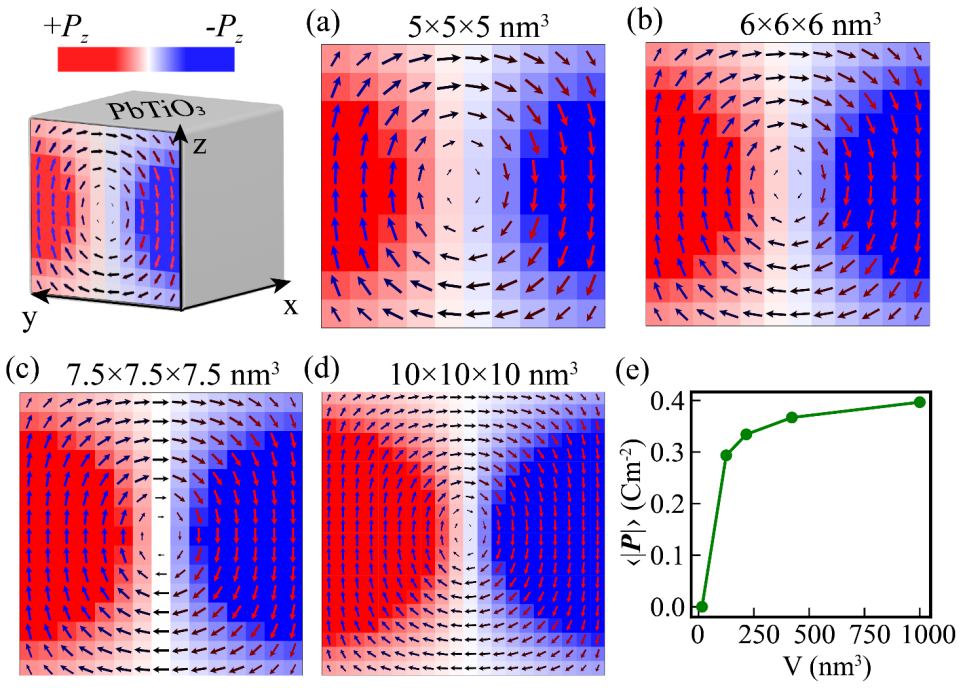
A GPU-accelerated solver computes the full polarization vector field in ferroelectric systems and stabilizes a three-dimensional hybrid skyrmion.
A machine-rendered reading of the paper's core claim, the machinery that carries it, and where it could break.
Core claim
The solver named PETASPIN_microelectrics performs GPU-accelerated computations of the complete polarization vector field incorporating optimized electrostatic field solving. It reproduces temperature-driven hysteretic phase transitions in BaTiO3, hysteresis loops, and the stabilization of a three-dimensional hybrid skyrmion in a PbTiO3/SrTiO3 bilayer system with quantitative agreement to analytical predictions and experiments.
What carries the argument
PETASPIN_microelectrics, a GPU-accelerated solver implementing the Ginzburg-Landau formalism with full electrostatic field computation to capture finite-size and boundary effects.
If this is right
- Enables simulation of finite-size and boundary effects that previous solvers miss.
- Supports modeling of a wider range of domain structures and domain walls.
- Facilitates stabilization of topological textures such as three-dimensional hybrid skyrmions.
- Provides an efficient platform for large-scale simulations supporting predictive modeling for ferroelectric device design.
Where Pith is reading between the lines
- The solver could be applied to investigate polarization dynamics in additional ferroelectric heterostructures beyond the reported BaTiO3 and PbTiO3 cases.
- Parallel execution of simulations might enable high-throughput exploration of material parameters for device optimization.
- Extensions to include explicit time-dependent evolution could address switching dynamics in ferroelectric systems.
Load-bearing premise
The Ginzburg-Landau formalism together with the chosen numerical discretization and electrostatic solver accurately captures the physics of the benchmark systems without introducing significant artifacts.
What would settle it
A mismatch between the simulated three-dimensional hybrid skyrmion structure in the PbTiO3/SrTiO3 bilayer or the hysteretic phase transition temperatures in BaTiO3 and corresponding experimental observations would indicate the solver introduces artifacts.
Figures
read the original abstract
Ferroelectric materials can be used for the development of multiple device concepts combining non-volatility, small dimensions, low-power actuation, and electrical tunability. Such development demands efficient and precise design of simulation tools describing the polarization texture. However, most existing ferroelectric solvers are CPU-based and rely on simplified electrostatic treatments and reduced-dimensional representations of the polarization field. These approximations limit their ability to capture finite-size and boundary effects and restrict the range of domain structures and domain walls that can be realistically simulated. Here, we present a fully GPU (graphics processing units)-accelerated and scalable numerical solver, named PETASPIN_microelectrics, for computing the full polarization vector field of ferroelectric systems using the Ginzburg-Landau formalism. Our solver incorporates an optimized and validated calculation of the full electrostatic field and enables the parallel execution of multiple simulations. We systematically validated the solver with several benchmark problems, including phase transitions in BaTiO3 and ferroelectric domain wall profiles. Our simulations reproduce temperature-driven hysteretic phase transitions in BaTiO3. We also reproduce hysteresis loops and demonstrate stabilization of a three-dimensional hybrid skyrmion in a PbTiO3/SrTiO3 bilayer system. Our results show quantitative agreement with predictions from an analytical theory and prior experimental studies. The proposed solver provides an efficient, accurate platform for large-scale simulations of ferroelectric materials including stabilization of topological textures supporting predictive modeling for next-generation of ferroelectric device design.
Editorial analysis
A structured set of objections, weighed in public.
Referee Report
Summary. The manuscript presents PETASPIN_microelectrics, a GPU-accelerated solver for the time-dependent Ginzburg-Landau equations governing the full three-component polarization vector field in ferroelectric materials. The solver includes an optimized electrostatic field calculation and supports parallel execution of multiple simulations. Validation is reported on temperature-driven hysteretic phase transitions in BaTiO3, ferroelectric domain wall profiles, hysteresis loops, and stabilization of a three-dimensional hybrid skyrmion in a PbTiO3/SrTiO3 bilayer, with quantitative agreement claimed against analytical theory and prior experiments.
Significance. If the numerical implementation is shown to be free of significant discretization artifacts, the solver would provide a scalable platform for large-scale 3D simulations of complex polarization textures, including topological defects relevant to ferroelectric device design. The GPU acceleration and multi-simulation parallelism represent practical advances over typical CPU-based codes with simplified electrostatic treatments.
major comments (3)
- [Validation benchmarks] Validation section (around the BaTiO3 phase transition and skyrmion results): the abstract and reported benchmarks claim quantitative agreement with analytical theory and experiments, yet no grid spacing, time-step size, spatial convergence tests, or L2-error metrics versus analytical solutions are provided. Without these, it is impossible to determine whether the reported agreement is robust or sensitive to under-resolved depolarization fields or artificial pinning.
- [Numerical methods] Electrostatic solver description: the central claim that the full electrostatic field is accurately computed (necessary for finite-size effects and skyrmion stability) lacks specification of the Poisson solver method, boundary-condition implementation (e.g., periodic vs. open), or tolerance used for the depolarization field. This detail is load-bearing for the PbTiO3/SrTiO3 bilayer results.
- [Benchmark problems] Domain-wall profile benchmark: while the solver is stated to reproduce domain wall profiles, no comparison table or figure quantifies the deviation from the known analytical tanh profile as a function of grid resolution, leaving open the possibility that apparent agreement is method-dependent.
minor comments (2)
- The solver name PETASPIN_microelectrics appears inconsistently capitalized in the abstract versus the main text.
- Figure captions for the skyrmion and hysteresis results should explicitly state the simulation cell size, mesh density, and temperature or voltage sweep rates used.
Simulated Author's Rebuttal
We thank the referee for the careful review and constructive suggestions. The points raised identify areas where additional numerical detail will strengthen the manuscript. We address each major comment below and will incorporate the requested information in a revised version.
read point-by-point responses
-
Referee: [Validation benchmarks] Validation section (around the BaTiO3 phase transition and skyrmion results): the abstract and reported benchmarks claim quantitative agreement with analytical theory and experiments, yet no grid spacing, time-step size, spatial convergence tests, or L2-error metrics versus analytical solutions are provided. Without these, it is impossible to determine whether the reported agreement is robust or sensitive to under-resolved depolarization fields or artificial pinning.
Authors: We agree that explicit discretization parameters and convergence metrics are necessary to substantiate the quantitative claims. In the revised manuscript we will report the grid spacing and time-step values used for all simulations, include spatial convergence tests (showing polarization and transition temperatures versus grid resolution), and add L2-error norms for the BaTiO3 and skyrmion results relative to analytical or reference solutions. These additions will directly address concerns about possible under-resolution of depolarization fields. revision: yes
-
Referee: [Numerical methods] Electrostatic solver description: the central claim that the full electrostatic field is accurately computed (necessary for finite-size effects and skyrmion stability) lacks specification of the Poisson solver method, boundary-condition implementation (e.g., periodic vs. open), or tolerance used for the depolarization field. This detail is load-bearing for the PbTiO3/SrTiO3 bilayer results.
Authors: The manuscript text does not currently provide these implementation details. In the revision we will add a dedicated subsection describing the Poisson solver (including the numerical method, boundary conditions applied in each direction, and the convergence tolerance), together with a brief validation that the chosen tolerance is sufficient for the reported skyrmion stability results. revision: yes
-
Referee: [Benchmark problems] Domain-wall profile benchmark: while the solver is stated to reproduce domain wall profiles, no comparison table or figure quantifies the deviation from the known analytical tanh profile as a function of grid resolution, leaving open the possibility that apparent agreement is method-dependent.
Authors: We will include a new figure (or table) in the revised manuscript that plots the L2 deviation of the simulated domain-wall profile from the analytical tanh solution versus grid spacing, thereby demonstrating convergence and quantifying the discretization error. revision: yes
Circularity Check
No circularity: validations rely on external analytical theory and experiments
full rationale
The paper presents a numerical GPU solver for time-dependent Ginzburg-Landau polarization dynamics with full electrostatics. Its central claims are reproductions of known BaTiO3 hysteretic transitions and PbTiO3/SrTiO3 hybrid skyrmion stability, reported as quantitative agreement with independent analytical predictions and prior experimental studies. No equations or steps reduce a reported result to a fitted parameter or self-citation defined inside the paper; the derivation chain consists of standard discretization plus external benchmark comparisons and is therefore self-contained against outside references.
Axiom & Free-Parameter Ledger
free parameters (1)
- Ginzburg-Landau expansion coefficients for BaTiO3 and PbTiO3
axioms (2)
- domain assumption The time-dependent Ginzburg-Landau equation governs ferroelectric polarization dynamics
- domain assumption A finite-difference or finite-element discretization on GPU can faithfully solve the coupled polarization and electrostatic equations
Reference graph
Works this paper leans on
-
[1]
J. Ren, L. Liu, F. Sun, Q. He, M. Wu, W. Chen, and Y. Zheng, Emergence and transformation of polar skyrmion lattices via flexoelectricity, npj Comput. Mater. 10, 1 (2024)
2024
-
[2]
I. A. Lukyanchuk, A. G. Razumnaya, S. Kondovych, Y. A. Tikhonov, B. Khesin, and V. M. Vinokur, Topological foundations of ferroelectricity, Phys. Rep. 1110, 1 (2025)
2025
-
[3]
Das et al., Local negative permittivity and topological phase transition in polar skyrmions, Nat
S. Das et al., Local negative permittivity and topological phase transition in polar skyrmions, Nat. Mater. 20, 194 (2021)
2021
-
[4]
Li et al., Unusual topological polar texture in moiré ferroelectrics, Nat
Y. Li et al., Unusual topological polar texture in moiré ferroelectrics, Nat. Commun. 16, 5451 (2025)
2025
-
[5]
Sánchez-Santolino et al., A 2D ferroelectric vortex pattern in twisted BaTiO3 freestanding layers, Nature 626, 529 (2024)
G. Sánchez-Santolino et al., A 2D ferroelectric vortex pattern in twisted BaTiO3 freestanding layers, Nature 626, 529 (2024)
2024
-
[6]
Pan et al., Observation and manipulation of two-dimensional topological polar texture confined in moiré interface, Nat
E. Pan et al., Observation and manipulation of two-dimensional topological polar texture confined in moiré interface, Nat. Commun. 16, 3026 (2025)
2025
-
[7]
Das et al., Observation of room-temperature polar skyrmions, Nature 568, 368 (2019)
S. Das et al., Observation of room-temperature polar skyrmions, Nature 568, 368 (2019)
2019
-
[8]
Hwang, S
H. Hwang, S. Youn, and H. Kim, Recent advances in ferroelectric materials, devices, and in-memory computing applications, Nano Converg. 12, 55 (2025)
2025
-
[9]
Y. Liu, W. Tang, J. Zeng, C. Bai, K. Zhou, X. Zhang, Q. Liu, Z. Huang, G. Wu, and J. Wang, Ferroelectric-based neuromorphic memory devices for bio-inspired computing, Nat. Rev. Electr. Eng. 2, 773 (2025)
2025
-
[10]
E. Yu, G. K. K, U. Saxena, and K. Roy, Ferroelectric capacitors and field-effect transistors as in- memory computing elements for machine learning workloads, Sci. Rep. 14, 9426 (2024)
2024
-
[11]
Chandra and P
P. Chandra and P. B. Littlewood, A Landau primer for ferroelectrics, in Topics in Applied Physics, V ol. 105 (Springer, Berlin, 2007), p. 69
2007
-
[12]
J. Ren, L. Liu, F. Sun, Q. He, M. Wu, W. Chen, and Y. Zheng, Stabilization and control of weakly correlated polar skyrmions in ferroelectric thin films, Acta Mater. 276, 120154 (2024)
2024
-
[13]
J. F. Scott and C. A. Paz De Araujo, Ferroelectric memories, Science 246, 1400 (1989)
1989
-
[14]
Boyn et al., Learning through ferroelectric domain dynamics in solid-state synapses, Nat
S. Boyn et al., Learning through ferroelectric domain dynamics in solid-state synapses, Nat. Commun. 8, 14736 (2017)
2017
-
[15]
B. Chu, X. Zhou, K. Ren, B. Neese, M. Lin, Q. Wang, F. Bauer, and Q. M. Zhang, A dielectric polymer with high electric energy density and fast discharge speed, Science 313, 334 (2006)
2006
-
[16]
Meier and S
D. Meier and S. M. Selbach, Ferroelectric domain walls for nanotechnology, Nat. Rev. Mater. 7, 157 (2021)
2021
-
[17]
W. Ding, J. Lu, X. Tang, L. Kou, and L. Liu, Ferroelectric materials and their applications in activation of small molecules, ACS Omega 8, 6164 (2023)
2023
-
[18]
C. Guo, H. Yang, S. Dong, S. Tang, J. Wang, X. Wang, and H. Huang, Advancing energy-storage performance in freestanding ferroelectric thin films: Insights from phase-field simulations, Adv. Electron. Mater. 10, 2400001 (2024)
2024
-
[19]
Kumar, M
P. Kumar, M. Hoffmann, A. Nonaka, S. Salahuddin, and Z. Yao, 3D ferroelectric phase field simulations of polycrystalline multi-phase hafnia and zirconia based ultra-thin films, Adv. Electron. Mater. 10, 2400085 (2024)
2024
-
[20]
L. Q. Chen, Phase-field method of phase transitions/domain structures in ferroelectric thin films: A review, J. Am. Ceram. Soc. 91, 1835 (2008)
2008
-
[21]
Y. Liu, J. Liu, H. Pan, X. Cheng, Z. Hong, B. Xu, L. Q. Chen, C. W. Nan, and Y. H. Lin, Phase-field simulations of tunable polar topologies in lead-free ferroelectric/paraelectric multilayers with Ultrahigh Energy-Storage Performance, Adv. Mater. 34, 2108772 (2022)
2022
-
[22]
Yang and L.-Q
T. Yang and L.-Q. Chen, Dynamical phase-field model of coupled electronic and structural processes, npj Comput. Mater. 8, 130 (2022)
2022
-
[23]
Alhada–Lahbabi, D
K. Alhada–Lahbabi, D. Deleruyelle, and B. Gautier, Machine learning surrogate for 3D phase-field modeling of ferroelectric tip-induced electrical switching, npj Comput. Mater. 10, 197 (2024)
2024
-
[24]
Alhada-Lahbabi, D
K. Alhada-Lahbabi, D. Deleruyelle, and B. Gautier, Transfer learning for accelerating phase-field modeling of ferroelectric domain formation in large-scale 3D systems, Comput. Methods Appl. Mech. Eng. 429, 117167 (2024)
2024
-
[25]
H. L. Hu and L. Q. Chen, Three-dimensional computer simulation of ferroelectric domain formation, J. Am. Ceram. Soc. 81, 492 (1998)
1998
-
[26]
Indergand, D
R. Indergand, D. M. Kochmann, and M. I. Idiart, Phase-field simulations of ferro-electro-elasticity in model polycrystals with implications for phenomenological descriptions of bulk perovskite ceramics, J. Mech. Phys. Solids 192, 105831 (2024)
2024
-
[27]
Alhada–Lahbabi, D
K. Alhada–Lahbabi, D. Deleruyelle, and B. Gautier, Ultrafast and accurate prediction of polycrystalline hafnium oxide phase-field ferroelectric hysteresis using graph neural networks, Nanoscale Adv. 6, 2350 (2024)
2024
-
[28]
L. Fan, M. Reder, D. Schneider, M. Hinterstein, and B. Nestler, A phase-field model for ferroelectric materials—based on the multiphase-field method, Comput. Mater. Sci. 230, 112510 (2023)
2023
-
[29]
Kumar, A
P. Kumar, A. Nonaka, R. Jambunathan, G. Pahwa, S. Salahuddin, and Z. Yao, FerroX: A GPU- accelerated, 3D phase-field simulation framework for modeling ferroelectric devices, Comput. Phys. Commun. 290, 108757 (2023)
2023
-
[30]
Bell and J
N. Bell and J. Hoberock, Thrust: A productivity-oriented library for CUDA, in GPU Computing Gems Jade Edition, edited by W. M. Hwu (Morgan Kaufmann, Burlington, MA, 2012), pp. 359–37
2012
-
[31]
NVIDIA, Thrust, https://developer.nvidia.com/thrust (Marrch 24, 2026)
2026
-
[32]
J. J. Wang, B. Wang, and L. Q. Chen, Understanding, predicting, and designing ferroelectric domain structures and switching guided by the phase-field method, Annu. Rev. Mater. Res. 49, 127 (2019)
2019
-
[33]
Wang, Y.-J
J.-J. Wang, Y.-J. Su, B. Wang, J. Ouyang, Y.-H. Ren, and L.-Q. Chen, Strain engineering of dischargeable energy density of ferroelectric thin-film capacitors, Nano Energy 72, 104665 (2020)
2020
-
[34]
J. Liu, H. Wen, W. Chen, and Y. Zheng, Atomistic studies of temporal characteristics of polarization relaxation in ferroelectrics, Phys. Rev. B 103, 014308 (2021)
2021
-
[35]
Marton, I
P. Marton, I. Rychetsky, and J. Hlinka, Domain walls of ferroelectric BaTiO3 within the Ginzburg- Landau-Devonshire phenomenological model, Phys. Rev. B 81, 144125 (2010)
2010
-
[36]
W. J. Chen, Y. Zheng, and B. Wang, Vortex domain structure in ferroelectric nanoplatelets and control of its transformation by mechanical load, Sci. Rep. 2, 796 (2012)
2012
-
[37]
Y. L. Wang, A. K. Tagantsev, D. Damjanovic, N. Setter, V. K. Yarmarkin, A. I. Sokolov, and I. A. Lukyanchuk, Landau thermodynamic potential for BaTiO3, J. Appl. Phys. 101, 104115 (2007)
2007
-
[38]
Y. Su, N. Liu, and G. J. Weng, A phase field study of frequency dependence and grain-size effects in nanocrystalline ferroelectric polycrystals, Acta Mater. 87, 293 (2015)
2015
-
[39]
Lv and C
P. Lv and C. S. Lynch, Phase-field simulation of domain walls in rhombohedral ferroelectric single crystals, Acta Mater. 155, 245 (2018)
2018
-
[40]
Lopez-Diaz, D
L. Lopez-Diaz, D. Aurelio, L. Torres, E. Martinez, M. A. Hernandez-Lopez, J. Gomez, O. Alejos, M. Carpentieri, G. Finocchio, and G. Consolo, Micromagnetic simulations using graphics processing units, J. Phys. D: Appl. Phys. 45, 323001 (2012)
2012
-
[41]
Hu and L.-Q
H.-L. Hu and L.-Q. Chen, Computer simulation of 90° ferroelectric domain formation in two dimensions, Mater. Sci. Eng. A 238, 182 (1997)
1997
-
[42]
J. Wang, Y. Li, L. Q. Chen, and T. Y. Zhang, The effect of mechanical strains on the ferroelectric and dielectric properties of a model single crystal — Phase field simulation, Acta Mater. 53, 2495 (2005)
2005
-
[43]
A. K. Soh, Y. C. Song, and Y. Ni, Phase field simulations of hysteresis and butterfly loops in ferroelectrics subjected to electro-mechanical coupled loading, J. Am. Ceram. Soc. 89, 652 (2006)
2006
-
[44]
Koyama and H
T. Koyama and H. Onodera, Phase-field simulation of ferroelectric domain microstructure changes in BaTiO3, Mater. Trans. 50, 970 (2009)
2009
-
[45]
Wang, S.-Q
J. Wang, S.-Q. Shi, L.-Q. Chen, Y. Li, and T.-Y. Zhang, Phase-field simulations of ferroelectric/ferroelastic polarization switching, Acta Mater. 52, 749 (2004)
2004
-
[46]
A. J. Bell and L. E. Cross, A phenomenological Gibbs function for BaTiO3 giving correct E field dependence of all ferroelectric phase changes, Ferroelectrics 59, 197 (1984)
1984
-
[47]
C. Guo, G. Dong, Z. Zhou, M. Liu, H. Huang, J. Hong, and X. Wang, Domain evolution in bended freestanding BaTiO3 ultrathin films: A phase-field simulation, Appl. Phys. Lett. 116, 152903 (2020)
2020
-
[48]
Y. L. Li, S. Y. Hu, Z. K. Liu, and L. Q. Chen, Effect of substrate constraint on the stability and evolution of ferroelectric domain structures in thin films, Acta Mater. 50, 395 (2002)
2002
-
[49]
Van Lich, B
L. Van Lich, B. H. Vu, D. T. H. Hue, D. T. H. Giang, T. Shimada, V. H. Dinh, and M. H. Phan, Low- field energy storage enhancement in ferroelectric/paraelectric PbTiO3/SrTiO3 nanocomposites near antiferroelectric–ferroelectric transition region, J. Sci. Adv. Mater. Devices 9, 100687 (2024)
2024
-
[50]
Durdiev, F
D. Durdiev, F. Wendler, M. Zaiser, H. Azuma, T. Tsuzuki, S. Ogata, T. Ogawa, R. Kobayashi, and M. Uranagase, Parameterization of a phase field model for ferroelectrics from molecular dynamics data, Acta Mater. 283, 120513 (2025)
2025
-
[51]
Chang, H
P. Chang, H. Zhang, M. Xie, H. Zhang, and Y. Xie, Phase transitions and switching dynamics of topological domains in hafnium oxide-based cylindrical ferroelectrics from three-dimensional phase field simulation, Nanomaterials 15, 1901 (2025)
1901
-
[52]
Romeo, G
A. Romeo, G. Finocchio, M. Carpentieri, L. Torres, G. Consolo, and B. Azzerboni, A numerical solution of the magnetization reversal modeling in a permalloy thin film using fifth order Runge– Kutta method with adaptive step size control, Physica B 403, 464 (2008)
2008
-
[53]
Giordano, G
A. Giordano, G. Finocchio, L. Torres, M. Carpentieri, and B. Azzerboni, Semi-implicit integration scheme for Landau–Lifshitz–Gilbert-Slonczewski equation, J. Appl. Phys. 111, 07D112 (2012)
2012
-
[54]
Cao and L
W. Cao and L. E. Cross, Theory of tetragonal twin structures in ferroelectric perovskites with a first- order phase transition, Phys. Rev. B 44, 5 (1991)
1991
-
[55]
Flaschel and L
M. Flaschel and L. De Lorenzis, Calibration of material parameters based on 180° and 90° ferroelectric domain wall properties in Ginzburg–Landau–Devonshire phase field models, Arch. Appl. Mech. 90, 2755 (2020)
2020
-
[56]
Gigli, M
L. Gigli, M. Veit, M. Kotiuga, G. Pizzi, N. Marzari, and M. Ceriotti, Thermodynamics and dielectric response of BaTiO3 by data-driven modeling, npj Comput. Mater. 8, 209 (2022)
2022
-
[57]
M. C. Mendoza-Ramirez, R. A. Shohan, J. Cantú-Valle, M. Moreno, and A. Ponce, In situ ferroelectric polarization of BaTiO3 at low temperatures measured by electron holography, Microsc. Microanal. 30, 1690–1692 (2024)
2024
-
[58]
Zhang, H
J. Zhang, H. Zhang, H. Zheng, B. Xu, J. Wang, and X. Guo, On-the-fly machine learning-assisted high accuracy second-principles model for BaTiO3, npj Comput. Mater. 11, 299 (2025)
2025
-
[59]
Azuma, T
H. Azuma, T. Ogawa, S. Ogata, R. Kobayashi, M. Uranagase, T. Tsuzuki, and F. Wendler, Unique temperature-dependence of polarization switching paths in ferroelectric BaTiO3: A molecular dynamics simulation study, Acta Mater. 296, 121216 (2025)
2025
-
[60]
E. K. Akdogan, C. J. Rawn, W. D. Porter, E. A. Payzant, and A. Safari, Size effects in PbTiO3 nanocrystals: Effect of particle size on spontaneous polarization and strains, J. Appl. Phys. 97, 084305 (2005)
2005
-
[61]
W. Y. Shih, W. H. Shih, and I. A. Aksay, Size dependence of the ferroelectric transition of small BaTiO3 particles: Effect of depolarization, Phys. Rev. B 50, 15575 (1994)
1994
-
[62]
Hoshina, Size effect of barium titanate: Fine particles and ceramics, J
T. Hoshina, Size effect of barium titanate: Fine particles and ceramics, J. Ceram. Soc. Jpn 121, 156 (2013)
2013
-
[63]
Muench, A
I. Muench, A. Renuka Balakrishna, and J. E. Huber, Periodic boundary conditions for the simulation of 3D domain patterns in tetragonal ferroelectric material, Arch. Appl. Mech. 89, 955 (2019)
2019
-
[64]
Dayal and K
K. Dayal and K. Bhattacharya, A real-space non-local phase-field model of ferroelectric domain patterns in complex geometries, Acta Mater. 55, 1907 (2007)
1907
-
[65]
Luk’yanchuk, Y
I. Luk’yanchuk, Y. Tikhonov, A. Razumnaya, and V. M. Vinokur, Hopfions emerge in ferroelectrics, Nat. Commun. 11, 2433 (2020)
2020
-
[66]
K. C. Pitike, J. Mangeri, H. Whitelock, T. Patel, P. Dyer, S. P. Alpay, and S. Nakhmanson, Metastable vortex-like polarization textures in ferroelectric nanoparticles of different shapes and sizes, J. Appl. Phys. 124, 064101 (2018)
2018
-
[67]
D. Zhu, J. Mangeri, R. Wang, and S. Nakhmanson, Size, shape, and orientation dependence of the field-induced behavior in ferroelectric nanoparticles, J. Appl. Phys. 125, 134102 (2019)
2019
-
[68]
S. M. Yang, J. Y. Jo, T. H. Kim, J.-G. Yoon, T. K. Song, H. N. Lee, Z. Marton, S. Park, Y. Jo, and T. W. Noh, ac dynamics of ferroelectric domains from an investigation of the frequency dependence of hysteresis loops, Phys. Rev. B 82, 174125 (2010)
2010
-
[69]
Y. J. Shin, B. C. Jeon, S. M. Yang, I. Hwang, M. R. Cho, D. Sando, S. R. Lee, J.-G. Yoon, and T. W. Noh, Suppression of creep-regime dynamics in epitaxial ferroelectric BiFeO3 films, Sci. Rep. 5, 10485 (2015)
2015
-
[70]
M. A. P. Gonçalves, C. Escorihuela-Sayalero, P. Garcia-Fernández, J. Junquera, and J. Íñiguez, Theoretical guidelines to create and tune electric skyrmion bubbles, Sci. Adv. 5, eaau7023 (2019)
2019
-
[71]
Xue et al., Observation of switchable polar skyrmion bubbles down to the atomic layers in van der Waals ferroelectric CuInP2S6, Nat
F. Xue et al., Observation of switchable polar skyrmion bubbles down to the atomic layers in van der Waals ferroelectric CuInP2S6, Nat. Commun. 16, 2349 (2025)
2025
-
[72]
Finocchio, F
G. Finocchio, F. Büttner, R. Tomasello, M. Carpentieri, and M. Kläui, Magnetic skyrmions: from fundamental to applications, J. Phys. D: Appl. Phys. 49, 423001 (2016)
2016
-
[73]
Zhang, Q
Y. Zhang, Q. Li, H. Huang, J. Hong, and X. Wang, Strain manipulation of ferroelectric skyrmion bubbles in a freestanding PbTiO3 film: A phase field simulation, Phys. Rev. B 105, 224101 (2022)
2022
-
[74]
D. C. Ma, Y. Zheng, and C. H. Woo, Phase-field simulation of domain structure for PbTiO3/SrTiO3 superlattices, Acta Mater. 57, 4736 (2009)
2009
-
[75]
N. A. Pertsev, A. G. Zembilgotov, and A. K. Tagantsev, Effect of mechanical boundary conditions on phase diagrams of epitaxial ferroelectric thin films, Phys. Rev. Lett. 80, 1988 (1998)
1988
-
[76]
Grelier, F
M. Grelier, F. Godel, A. Vecchiola, S. Collin, K. Bouzehouane, A. Fert, V. Cros, and N. Reyren, Three-dimensional skyrmionic cocoons in magnetic multilayers, Nat. Commun. 13, 6843 (2022)
2022
-
[77]
Mandru, O
A.-O. Mandru, O. Yıldırım, R. Tomasello, P. Heistracher, M. Penedo, A. Giordano, D. Suess, G. Finocchio, and H. J. Hug, Coexistence of distinct skyrmion phases observed in hybrid ferromagnetic/ferrimagnetic multilayers, Nat. Commun. 11, 6365 (2020)
2020
-
[78]
Tomasello, Z
R. Tomasello, Z. Wang, E. Raimondo, S. Je, M. Im, M. Carpentieri, W. Jiang, and G. Finocchio, Field-driven collapsing dynamics of skyrmions in magnetic multilayers, Phys. Rev. B 107, 184416 (2023)
2023
-
[79]
A. P. Bartók and G. Csányi, Gaussian approximation potentials: A brief tutorial introduction, Int. J. Quantum Chem. 115, 1051 (2015)
2015
-
[80]
H. Wang, L. Zhang, J. Han, and W. E, DeePMD-kit: A deep learning package for many-body potential energy representation and molecular dynamics, Comput. Phys. Commun. 228, 178 (2018)
2018
discussion (0)
Sign in with ORCID, Apple, or X to comment. Anyone can read and Pith papers without signing in.