Improving CFT Operators Using Machine Learning
Pith reviewed 2026-06-29 09:37 UTC · model grok-4.3
The pith
Machine learning constructs improved lattice operators with better overlap to continuum CFT primaries.
A machine-rendered reading of the paper's core claim, the machinery that carries it, and where it could break.
Core claim
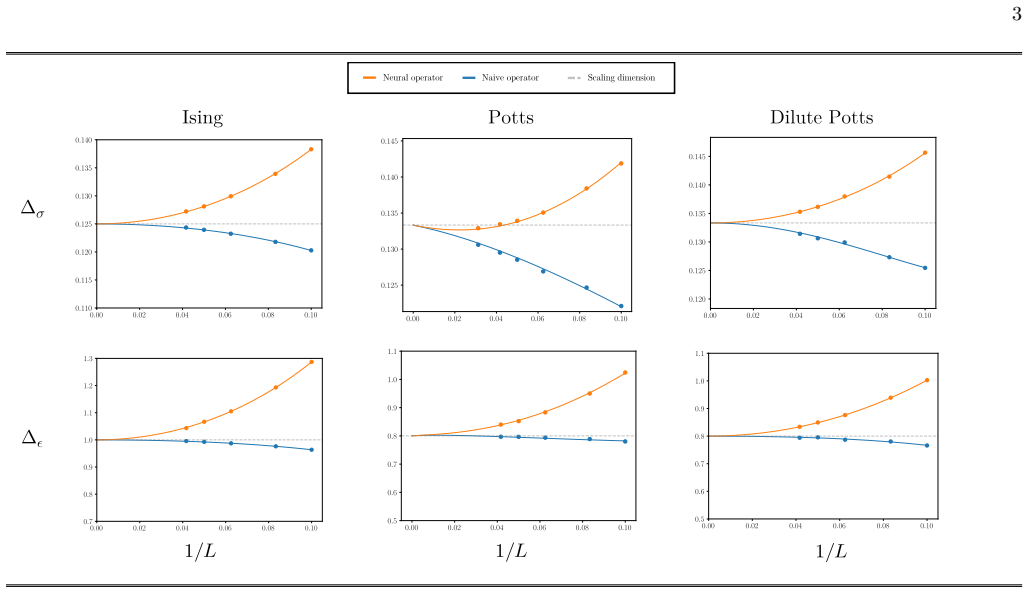
We identify improved lattice representations of leading spin and energy operators in three two-dimensional critical systems: the Ising model, the q = 3 Potts model, and the dilute q = 3 Potts model. In all cases, the resulting operators exhibit reduced corrections to scaling and yield more accurate estimates of scaling dimensions compared to conventional lattice choices.
What carries the argument
A data-driven optimization procedure that constructs lattice operators with enhanced overlap with the corresponding primary operators of the continuum conformal field theory.
If this is right
- The optimized operators reduce corrections to scaling in the Ising, q=3 Potts, and dilute q=3 Potts models.
- Scaling-dimension estimates extracted from lattice data become more accurate than those obtained with standard operator choices.
- Operator improvement addresses a class of finite-size effects distinct from those suppressed by action improvement.
- The method supplies a systematic route to better lattice representations of continuum fields in two-dimensional critical systems.
Where Pith is reading between the lines
- The same optimization could be applied to other observables such as three-point couplings if the overlap criterion is extended accordingly.
- Combining the learned operators with existing action-improvement techniques might produce additive gains in overall accuracy.
- If the procedure generalizes, it offers a route to operator improvement in models where no exact continuum operator expression is known.
Load-bearing premise
The optimization procedure increases genuine overlap with continuum primary operators rather than fitting to the same finite-size artifacts it is meant to suppress.
What would settle it
If the learned operators produce the same magnitude of corrections to scaling as conventional operators when applied to larger lattices or different boundary conditions, the central claim would be falsified.
Figures

read the original abstract
Finite-size effects limit the accuracy with which conformal data can be extracted from lattice simulations of critical systems. While action improvement suppresses some corrections to scaling, it does not address operator-dependent effects arising from imperfect lattice representations of continuum conformal fields. In this work, we propose a data-driven method for improving lattice operators themselves, constructing estimators with enhanced overlap with the corresponding primary operators of the continuum conformal field theory. We identify improved lattice representations of leading spin and energy operators in three two-dimensional critical systems: the Ising model, the q = 3 Potts model, and the dilute q = 3 Potts model. In all cases, the resulting operators exhibit reduced corrections to scaling and yield more accurate estimates of scaling dimensions compared to conventional lattice choices. The code and analysis workflows used to produce these results are made available in an accompanying GitHub repository.
Editorial analysis
A structured set of objections, weighed in public.
Referee Report
Summary. The manuscript proposes a data-driven machine learning procedure to optimize lattice representations of the leading spin and energy operators in three 2D critical models (Ising, q=3 Potts, dilute q=3 Potts). The optimized operators are claimed to have larger overlap with the corresponding continuum CFT primaries, thereby suppressing operator-dependent corrections to scaling and yielding more accurate estimates of scaling dimensions than standard lattice choices. Reproducible code and workflows are provided via GitHub.
Significance. If the central claim holds and the procedure demonstrably increases overlap with continuum primaries rather than fitting finite-size artifacts, the work would offer a practical, generalizable tool for improving the extraction of conformal data from lattice Monte Carlo simulations, complementing existing action-improvement techniques. The public release of code is a clear strength that facilitates independent verification.
major comments (2)
- [§3 (Method) and §4 (Results)] The training procedure is performed exclusively on finite-L Monte Carlo ensembles. No diagnostic is presented that independently confirms increased overlap with the continuum primary (e.g., via three-point function matrix elements or an L→∞ extrapolation of the improvement itself). This leaves open the possibility that the loss is minimized by fitting L-dependent mixing or statistical fluctuations rather than by suppressing operator-dependent corrections to scaling.
- [§4.1–4.3 and associated figures/tables] In the reported scaling-dimension estimates (e.g., for the energy operator in the Ising case), the reduction in corrections to scaling is shown, but the manuscript does not quantify the change in operator overlap or demonstrate that the improvement survives after subtracting the leading irrelevant operator contribution. Without this, the claim that the operators are closer to continuum primaries remains under-supported.
minor comments (2)
- [§3] Notation for the optimized operators and the precise definition of the loss function should be introduced with an equation in §3 to allow readers to reproduce the optimization step without consulting the repository.
- [Figures 2–5] Figure captions should explicitly state the system sizes used for training versus validation and whether error bars include both statistical and systematic uncertainties from the ML procedure.
Simulated Author's Rebuttal
We thank the referee for their careful reading and constructive comments on our manuscript. We address each major comment below and will revise the manuscript accordingly to strengthen the supporting evidence for our claims.
read point-by-point responses
-
Referee: [§3 (Method) and §4 (Results)] The training procedure is performed exclusively on finite-L Monte Carlo ensembles. No diagnostic is presented that independently confirms increased overlap with the continuum primary (e.g., via three-point function matrix elements or an L→∞ extrapolation of the improvement itself). This leaves open the possibility that the loss is minimized by fitting L-dependent mixing or statistical fluctuations rather than by suppressing operator-dependent corrections to scaling.
Authors: We agree that an independent diagnostic would provide stronger confirmation. The loss is explicitly constructed from the L-dependence of two-point correlators to penalize operator-dependent corrections to scaling. In the revised manuscript we will add an explicit L→∞ extrapolation of the fitted correction amplitudes (before and after optimization) to demonstrate that the improvement persists in the continuum limit rather than arising from finite-L artifacts. We will also include a brief discussion of why the chosen loss targets continuum overlap rather than model-specific mixing. revision: yes
-
Referee: [§4.1–4.3 and associated figures/tables] In the reported scaling-dimension estimates (e.g., for the energy operator in the Ising case), the reduction in corrections to scaling is shown, but the manuscript does not quantify the change in operator overlap or demonstrate that the improvement survives after subtracting the leading irrelevant operator contribution. Without this, the claim that the operators are closer to continuum primaries remains under-supported.
Authors: The current manuscript presents the improvement through more accurate scaling-dimension estimates, which serve as indirect evidence of better overlap. We acknowledge that a direct quantification of the overlap change and an explicit subtraction of the leading irrelevant operator would make the claim more robust. In the revision we will add a table reporting the fitted amplitudes of the leading corrections for both standard and optimized operators, and we will show scaling-dimension fits performed after explicitly subtracting the leading irrelevant contribution to confirm that the improvement remains. revision: yes
Circularity Check
No significant circularity; derivation self-contained against benchmarks
full rationale
The paper describes a data-driven ML optimization to construct improved lattice operators for 2D critical models, claiming reduced finite-size corrections and more accurate scaling dimensions versus conventional choices. No equations, self-citations, or load-bearing steps are visible that reduce the central result to a fit or definition by construction. The improvement is presented as an empirical outcome benchmarked externally (scaling dimension accuracy, GitHub code), satisfying the criterion for a self-contained derivation with independent content. No patterns from the enumerated list apply.
Axiom & Free-Parameter Ledger
Reference graph
Works this paper leans on
-
[1]
The corrections to scaling ex- ponents include a non-analytic exponentω= 4/5 from the leading irrelevant operator, and analytic corrections withω= 2,4, . . .. Thedilute Pottsmodel is a variant of the standard q= 3 Potts model, obtained by adding a site-dilution (chemical-potential) term to the Hamiltonian: −βH=K X ⟨i,j⟩ δσi,σj (1−δ σi,0) +D X i δσi,0 whic...
-
[2]
S. e. a. Navas (Particle Data Group Collaboration), Re- view of particle physics, Phys. Rev. D110, 350 (2024)
2024
-
[3]
J. L. Cardy, ed.,Finite-Size Scaling, Current Physics - Sources and Comments, Vol. 2 (North-Holland (Else- vier), Amsterdam; Oxford; New York; Tokyo, 1988)
1988
-
[4]
Nahum, J
A. Nahum, J. T. Chalker, P. Serna, M. Ortu˜ no, and A. M. Somoza, Deconfined quantum criticality, scaling violations, and classical loop models, Phys. Rev. X5, 041048 (2015)
2015
-
[5]
Hasenfratz and F
P. Hasenfratz and F. Niedermayer, Perfect lattice action for asymptotically free theories, Nuclear Physics B414, 785 (1994)
1994
-
[6]
Campostrini, A
M. Campostrini, A. Pelissetto, P. Rossi, and E. Vi- cari, Improved high-temperature expansion and critical equation of state of three-dimensional ising-like systems, Phys. Rev. E60, 3526 (1999)
1999
-
[7]
Hasenbusch, K
M. Hasenbusch, K. Pinn, and S. Vinti, Critical expo- nents of the three-dimensional ising universality class from finite-size scaling with standard and improved ac- tions, Phys. Rev. B59, 11471 (1999)
1999
-
[8]
Segall, S
G. Segall, S. Gazit, and D. Podolsky, Improved actions using the renormalization group, Phys. Rev. B111, 184413 (2025)
2025
-
[9]
M. Hasenbusch, Eliminating leading and subleading cor- rections to scaling in the three-dimensional xy universal- ity class, arXiv:2507.19265 [cond-mat.stat-mech] (2025)
-
[10]
L¨ uscher, Advanced lattice qcd (1998)
M. L¨ uscher, Advanced lattice qcd (1998)
1998
-
[11]
Heatlie, C
G. Heatlie, C. Sachrajda, G. Martinelli, C. Pittori, and G. Rossi, The improvement of hadronic matrix elements in lattice qcd, Nuclear Physics B352, 266 (1991)
1991
-
[12]
A. W. Sandvik, Using operator covariance to disentangle scaling dimensions in lattice models (2025)
2025
-
[13]
Koch-Janusz and Z
M. Koch-Janusz and Z. Ringel, Mutual information, neural networks and the renormalization group, Nature Physics14, 578 (2018)
2018
-
[14]
Gordon, A
A. Gordon, A. Banerjee, M. Koch-Janusz, and Z. Ringel, Relevance in the Renormalization Group and in Informa- tion Theory, Phys. Rev. Lett.126, 240601 (2021)
2021
-
[15]
Oppenheim, M
L. Oppenheim, M. Koch-Janusz, S. Gazit, and Z. Ringel, Machine learning the operator content of the critical self- dual ising-higgs lattice gauge theory, Phys. Rev. Res.6, 043322 (2024)
2024
-
[16]
Symanzik, Continuum limit and improved action in lattice theories: (i)
K. Symanzik, Continuum limit and improved action in lattice theories: (i). principles and phi 4 theory, Nuclear Physics B226, 187 (1983)
1983
-
[17]
Ramos and S
A. Ramos and S. Sint, Symanzik improvement of the gra- dient flow in lattice gauge theories, The European Phys- ical Journal C76, 15 (2016)
2016
-
[18]
J. L. Cardy, Operator content of two-dimensional con- formally invariant theories, Nuclear Physics B270, 186 (1986)
1986
-
[19]
X. Qian, Y. Deng, and H. W. J. Bl¨ ote, Dilute potts model in two dimensions, Phys. Rev. E72, 056132 (2005)
2005
-
[20]
X. Qian, Y. Deng, Y. Liu, W. Guo, and H. W. J. Bl¨ ote, Equivalent-neighbor potts models in two dimen- sions, Phys. Rev. E94, 052103 (2016)
2016
-
[21]
A. W. Sandvik and B. Zhao, Consistent scaling expo- nents at the deconfined quantum-critical point, Chinese Physics Letters37, 057502 (2020)
2020
-
[22]
D. E. G¨ okmen, Z. Ringel, S. D. Huber, and M. Koch- Janusz, Symmetries and phase diagrams with real-space mutual information neural estimation, Phys. Rev. E104, 064106 (2021)
2021
-
[23]
D. E. G¨ okmen, Z. Ringel, S. D. Huber, and M. Koch- Janusz, Statistical Physics through the Lens of Real- Space Mutual Information, Phys. Rev. Lett.127, 240603 (2021)
2021
- [24]
-
[25]
D. Tong, Comments on symmetric mass generation in 2d and 4d, Journal of High Energy Physics2022, 10.1007/jhep07(2022)001 (2022). 6 I. APPENDIX A - DET AILS OF THE RSMI-NE PROCEDURE For each model, we generate Monte Carlo snapshots at criticality for a fixed linear sizeL. From every snapshot we extract a single training example (V, E). The visible regionVi...
discussion (0)
Sign in with ORCID, Apple, or X to comment. Anyone can read and Pith papers without signing in.