Symmetry and integrability in the anyon-Hubbard model
Pith reviewed 2026-06-29 09:01 UTC · model grok-4.3
The pith
Two anyons in the anyon-Hubbard model are integrable only under periodic boundary conditions.
A machine-rendered reading of the paper's core claim, the machinery that carries it, and where it could break.
Core claim
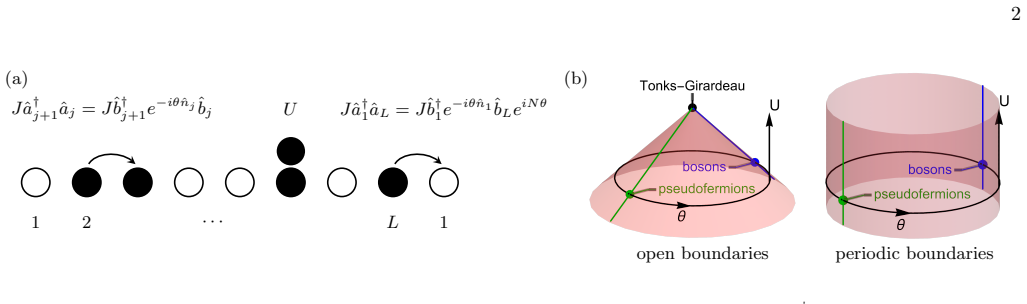
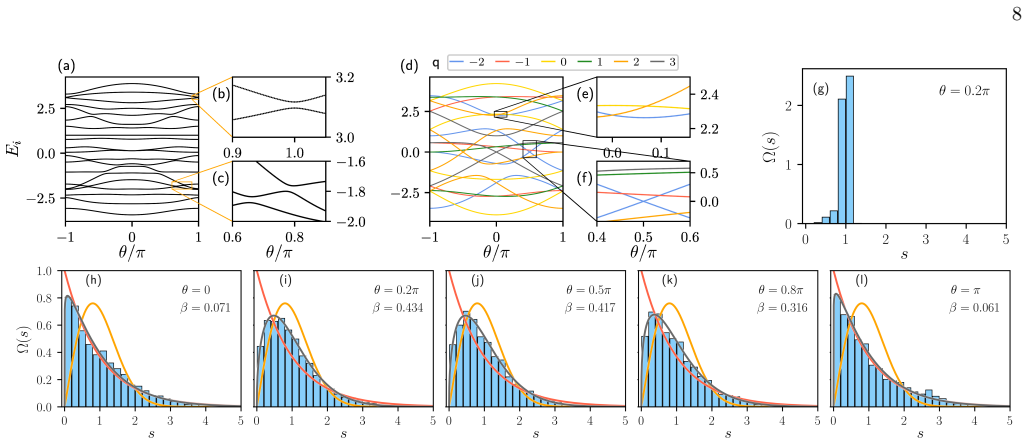
The anyon-Hubbard Hamiltonian of finite length displays a switching between symmetry classes AI, BDI, and CI that depends on system size, particle number, and boundary conditions; two anyons are integrable with periodic boundaries but not with open boundaries; the model admits an exactly solvable doublon state within the continuum and an exact nullspace solution for two noninteracting anyons; all limits, including bosons and pseudofermions, are analyzed for their spectral properties.
What carries the argument
The anyon-Hubbard Hamiltonian with a statistics parameter and either periodic or open boundary conditions, whose symmetries and integrability determine the spectrum.
If this is right
- The spectrum of two anyons under periodic boundaries contains degeneracies fixed by the symmetry class.
- Limits to bosons and to pseudofermions each produce characteristic, fully solvable spectra.
- A doublon bound state remains exactly solvable even when embedded in the scattering continuum.
- The nullspace of two noninteracting anyons admits an exact closed-form solution.
- Symmetry class determines which states are accessible or protected in finite-size systems.
Where Pith is reading between the lines
- The boundary-condition dependence of integrability may allow experiments to switch between chaotic and regular dynamics by changing trap geometry.
- The exact doublon solution could be used as a benchmark for numerical methods applied to larger particle numbers.
- Symmetry switching with particle number suggests that adding more anyons may restore or destroy integrability in a predictable pattern.
Load-bearing premise
The anyon-Hubbard Hamiltonian with the chosen boundary conditions and statistics parameter captures the low-energy physics of the anyons realized in the cold-atom experiments.
What would settle it
Measure the energy spectrum of two anyons in a finite chain: under periodic boundaries the levels must exhibit the degeneracies required by integrability, while under open boundaries those degeneracies must be absent.
Figures
read the original abstract
Recent cold atom experiments have realized one-dimensional anyons and enabled the tuning of 1D~statistics between bosons and fermions. Here, we analyze the symmetries, integrability, and resulting degeneracies of the underlying anyon-Hubbard model of finite length. Our results reveal a switching between symmetry classes AI, BDI, and CI in dependence on system size, particle number, and boundary conditions, and show that two anyons with periodic boundaries are integrable, while two anyons with open boundary conditions are not. We include a comprehensive analysis of all model limits, especially of interacting bosons and pseudofermions and resolve spectral signatures. We additionally reveal an exactly solvable doublon state that hides in the continuum of scattering states and the exact solution of the nullspace of two noninteracting anyons. The uncovered symmetries shape the fundamental properties of the one-dimensional anyons at hand, and the predicted states are accessible in state-of-the-art experiments.
Editorial analysis
A structured set of objections, weighed in public.
Referee Report
Summary. The manuscript analyzes the symmetries, integrability, and degeneracies of the finite-size anyon-Hubbard model. It reports a switching between symmetry classes AI, BDI, and CI that depends on system size, particle number, and boundary conditions. Central results include the integrability of two anyons under periodic boundary conditions (but not open), an exactly solvable doublon state embedded in the scattering continuum, the exact nullspace solution for two noninteracting anyons, and a resolution of spectral signatures across the interacting-boson and pseudofermion limits.
Significance. If the derivations hold, the work supplies concrete, parameter-free results on symmetry-class switching and exact solvability for a model directly tied to recent cold-atom realizations of 1D anyons. The identification of boundary-dependent integrability and hidden exact states offers falsifiable predictions for finite-system spectra and degeneracies that experiments can test.
minor comments (2)
- The abstract states that two anyons with periodic boundaries are integrable while those with open boundaries are not; a brief statement in the main text clarifying whether this distinction survives the two-body reduction or requires the full many-body Hilbert space would aid readability.
- Notation for the statistics parameter and the precise implementation of periodic versus open boundary conditions (e.g., how the anyonic phase is incorporated into the hopping terms) should be introduced once in a dedicated paragraph rather than piecemeal across sections.
Simulated Author's Rebuttal
We thank the referee for the positive summary, significance assessment, and recommendation of minor revision. The report contains no enumerated major comments, so we provide no point-by-point rebuttals below. We remain ready to incorporate any minor clarifications or corrections once they are specified.
Circularity Check
No significant circularity in derivation chain
full rationale
The paper derives symmetry classes (AI/BDI/CI), integrability distinctions (PBC vs OBC for two anyons), and exact solutions (doublon state, nullspace) directly from the anyon-Hubbard Hamiltonian operators, finite-size spectrum, and boundary conditions. These are internal mathematical statements obtained by solving the model's Schrödinger equation and identifying conserved quantities, with no reduction to fitted parameters, self-definitional loops, or load-bearing self-citations. The model limits (bosons, pseudofermions) are analyzed as special cases of the same Hamiltonian without circular renaming or smuggling of ansatze.
Axiom & Free-Parameter Ledger
Reference graph
Works this paper leans on
-
[1]
Im(k 1) = 0 = Im(k2),(67)
-
[2]
Re(k 1),= 0 = Re(k 2),(68)
-
[3]
CUI: Advanced Imaging of Matter
Im(k 1,2),= 0 = Re(k 2,1),(69) 4)k ∗ 1 =k 2.(70) Physically, these choices correspond to different scenarios of bound and dispersive behavior, a distinction that only 11 becomes unambiguous in the thermodynamic limitL→ ∞[62, 64, 114, 130, 132, 133], where the scattering states become continuous and bound states can emerge at the edges of this continuum [6...
2056
-
[4]
J. Kwan, P. Segura, Y. Li, S. Kim, A. V. Gorshkov, A. Eckardt, B. Bakkali-Hassani, and M. Greiner, Real- ization of one-dimensional anyons with arbitrary statis- tical phase, Science386, 1055 (2024)
2024
-
[5]
G. T. Horowitz, Exactly soluble diffeomorphism invari- ant theories, Commun. Math. Phys.125, 417 (1989)
1989
-
[6]
Fr¨ olian, C
A. Fr¨ olian, C. S. Chisholm, E. Neri, C. R. Cabrera, R. Ramos, A. Celi, and L. Tarruell, Realizing a 1D topo- logical gauge theory in an optically dressed BEC, Nature 608, 293 (2022)
2022
- [7]
-
[8]
Y. Zeng, A. Bastianello, S. Dhar, Z. Wang, X. Yu, M. Horvath, G. E. Astrakharchik, Y. Guo, H.-C. N¨ agerl, and M. Landini, Realization of fractional Fermi seas (2026), arXiv:2602.17657 [cond-mat.quant-gas]
work page internal anchor Pith review Pith/arXiv arXiv 2026
-
[9]
B. Bakkali-Hassani, J. Kwan, P. Segura, Y. Li, I. Tes- faye, G. Valent´ ı-Rojas, A. Eckardt, and M. Greiner, Re- vealing Pseudo-Fermionization and Chiral Binding of 14 One-Dimensional Anyons using Adiabatic State Prepa- ration (2026), arXiv:2602.20421 [cond-mat.quant-gas]
-
[10]
C. S. Chisholm, A. Fr¨ olian, E. Neri, R. Ramos, L. Tar- ruell, and A. Celi, Encoding a one-dimensional topo- logical gauge theory in a Raman-coupled Bose-Einstein condensate, Phys. Rev. Res.4, 043088 (2022)
2022
-
[11]
Keilmann, S
T. Keilmann, S. Lanzmich, I. McCulloch, and M. Roncaglia, Statistically induced phase transitions and anyons in 1D optical lattices, Nat. Commun.2, 361 (2011)
2011
-
[12]
Greschner, G
S. Greschner, G. Sun, D. Poletti, and L. Santos, Density-Dependent Synthetic Gauge Fields Using Peri- odically Modulated Interactions, Phys. Rev. Lett.113, 215303 (2014)
2014
-
[13]
Greschner and L
S. Greschner and L. Santos, Anyon Hubbard model in one-dimensional optical lattices, Phys. Rev. Lett.115, 053002 (2015)
2015
-
[14]
Str¨ ater, S
C. Str¨ ater, S. C. L. Srivastava, and A. Eckardt, Floquet Realization and Signatures of One-Dimensional Anyons in an Optical Lattice, Phys. Rev. Lett.117, 205303 (2016)
2016
-
[15]
Greschner, L
S. Greschner, L. Cardarelli, and L. Santos, Probing the exchange statistics of one-dimensional anyon models, Phys. Rev. A97, 053605 (2018)
2018
-
[16]
S. Dhar, B. Wang, M. Horvath, A. Vashisht, Y. Zeng, M. B. Zvonarev, N. Goldman, Y. Guo, M. Landini, and H.-C. N¨ agerl, Observing anyonization of bosons in a quantum gas, Nature642, 53 (2025)
2025
-
[17]
Nagies, B
S. Nagies, B. Wang, A. C. Knapp, A. Eckardt, and N. L. Harshman, Beyond braid statistics: Constructing a lat- tice model for anyons with exchange statistics intrinsic to one dimension, SciPost Phys.16, 086 (2024)
2024
-
[18]
Kundu, Exact Solution of Double delta Function Bose Gas through an Interacting Anyon Gas, Phys
A. Kundu, Exact Solution of Double delta Function Bose Gas through an Interacting Anyon Gas, Phys. Rev. Lett.83, 1275 (1999)
1999
-
[19]
Bonkhoff, K
M. Bonkhoff, K. J¨ agering, S. Eggert, A. Pelster, M. Thorwart, and T. Posske, Bosonic Continuum The- ory of One-Dimensional Lattice Anyons, Phys. Rev. Lett.126, 163201 (2021)
2021
-
[20]
O. I. Patu, V. E. Korepin, and D. V. Averin, Correla- tion functions of one-dimensional Lieb–Liniger anyons, J. Phys. A: Math. Theor.40, 14963 (2007)
2007
-
[21]
M. T. Batchelor, X.-W. Guan, and N. Oelkers, One- Dimensional Interacting Anyon Gas: Low-Energy Prop- erties and Haldane Exclusion Statistics, Phys. Rev. Lett.96, 210402 (2006)
2006
-
[22]
Aglietti, L
U. Aglietti, L. Griguolo, R. Jackiw, S.-Y. Pi, and D. Seminara, Anyons and chiral solitons on a line, Phys. Rev. Lett.77, 4406 (1996)
1996
-
[23]
Posske, B
T. Posske, B. Trauzettel, and M. Thorwart, Second quantization of Leinaas-Myrheim anyons in one dimen- sion and their relation to the Lieb-Liniger model, Phys. Rev. B96, 195422 (2017)
2017
-
[24]
N. L. Harshman and A. C. Knapp, Topological exchange statistics in one dimension, Phys. Rev. A105, 052214 (2022)
2022
-
[25]
Hao and S
Y. Hao and S. Chen, Dynamical properties of hard-core anyons in one-dimensional optical lattices, Phys. Rev. A86, 043631 (2012)
2012
-
[26]
Bonkhoff, K
M. Bonkhoff, K. J¨ agering, S. Hu, A. Pelster, S. Eg- gert, and I. Schneider, Anyonic Phase Transitions in the 1D Extended Hubbard Model with Fractional Statistics, Phys. Rev. Lett.135, 036601 (2025)
2025
-
[27]
N. L. Harshman and A. C. Knapp, Anyons from three- body hard-core interactions in one dimension, Ann. Phys.412, 168003 (2020)
2020
-
[29]
O. W. Greenberg and A. M. L. Messiah, Selection Rules for Parafields and the Absence of Para Particles in Na- ture, Phys. Rev.138, B1155 (1965)
1965
-
[30]
Fredenhagen, K
K. Fredenhagen, K. H. Rehren, and B. Schroer, Supers- election sectors with braid group statistics and exchange algebras - I. General theory, Commun. Math. Phys125, 201 (1989)
1989
-
[31]
Wang and K
Z. Wang and K. R. A. Hazzard, Particle exchange statistics beyond fermions and bosons, Nature637, 314 (2025)
2025
-
[32]
J. M. Leinaas and J. Myrheim, On the theory of identi- cal particles, Nuov. Cim. Soc. Ital. Fis.37B, 1 (1977)
1977
-
[33]
Wilczek, Quantum Mechanics of Fractional-Spin Par- ticles, Phys
F. Wilczek, Quantum Mechanics of Fractional-Spin Par- ticles, Phys. Rev. Lett.49, 957 (1982)
1982
-
[34]
Kitaev, Anyons in an exactly solved model and be- yond, Ann
A. Kitaev, Anyons in an exactly solved model and be- yond, Ann. Phys.321, 2 (2006)
2006
-
[35]
Fractional statistics
F. D. M. Haldane, “Fractional statistics” in arbitrary di- mensions: A generalization of the Pauli principle, Phys. Rev. Lett.67, 937 (1991)
1991
-
[36]
Theel, M
F. Theel, M. Bonkhoff, P. Schmelcher, T. Posske, and N. L. Harshman, Chirally Protected State Manipulation by Tuning One-Dimensional Statistics, Phys. Rev. Lett. 135, 063401 (2025)
2025
-
[37]
Nayak, S
C. Nayak, S. H. Simon, A. Stern, M. Freedman, and S. Das Sarma, Non-Abelian anyons and topologi- cal quantum computation, Rev. Mod. Phys.80, 1083 (2008)
2008
-
[38]
Wigner, Grundlagen der Quantenmechanik, inGrup- pentheorie und ihre Anwendung auf die Quanten- mechanik der Atomspektren, edited by E
E. Wigner, Grundlagen der Quantenmechanik, inGrup- pentheorie und ihre Anwendung auf die Quanten- mechanik der Atomspektren, edited by E. Wigner (Vieweg+Teubner Verlag, Wiesbaden, 1931) pp. 34–43
1931
-
[39]
Cartan, Sur une classe remarquable d’espaces de Rie- mann, Bull
E. Cartan, Sur une classe remarquable d’espaces de Rie- mann, Bull. Soc. Math. Fr.54, 214 (1926)
1926
-
[41]
M. R. Zirnbauer, Particle-hole symmetries in condensed matter, J. Math. Phys.62, 10.1063/5.0035358 (2020)
-
[42]
Bethe, Zur Theorie der Metalle: I
H. Bethe, Zur Theorie der Metalle: I. Eigenwerte und Eigenfunktionen der linearen Atomkette, Z. Phys.71, 205 (1931)
1931
-
[43]
Essler, H
F. Essler, H. Frahm, F. G¨ ohmann, A. Kl¨ umper, and V. Korepin, The One-Dimensional Hubbard model, The One-Dimensional Hubbard Model, Cambridge, UK: Cambridge University Press (2010)
2010
-
[44]
Baxter,Exactly Solved Models in Statistical Mechan- ics(Academic Press, 2016)
R. Baxter,Exactly Solved Models in Statistical Mechan- ics(Academic Press, 2016)
2016
-
[45]
E. H. Lieb, Exact analysis of an interacting bose gas. II. the excitation spectrum, Phys. Rev.130, 1616 (1963)
1963
-
[46]
Solidification
F. D. M. Haldane, “Solidification” in a soluble model of bosons on a one-dimensional lattice: The “Boson- Hubbard chain”, Phys. Lett. A80, 281 (1980)
1980
-
[47]
T. C. Choy, Some exact results for a degenerate Hub- bard model in one dimension, Phys. Lett. A80, 49 (1980)
1980
-
[48]
T. C. Choy and F. D. M. Haldane, Failure of Bethe- Ansatz solutions of generalisations of the Hubbard chain to arbitrary permutation symmetry, Phys. Lett. A90, 15 83 (1982)
1982
-
[49]
A. R. Kolovsky and A. Buchleitner, Quantum chaos in the Bose-Hubbard model, Europhys. Lett.68, 632 (2004)
2004
-
[50]
Kollath, A
C. Kollath, A. M. L¨ auchli, and E. Altman, Quench dy- namics and nonequilibrium phase diagram of the Bose- Hubbard model, Phys. Rev. Lett.98, 180601 (2007)
2007
-
[51]
Kollath, G
C. Kollath, G. Roux, G. Biroli, and A. M. L¨ auchli, Statistical properties of the spectrum of the extended Bose–Hubbard model, J. Stat. Mech.: Theory Exp. 2010(08), P08011
2010
-
[52]
de la Cruz, S
J. de la Cruz, S. Lerma-Hern´ andez, and J. G. Hirsch, Quantum chaos in a system with high degree of symme- tries, Phys. Rev. E102, 032208 (2020)
2020
-
[53]
Russomanno, M
A. Russomanno, M. Fava, and R. Fazio, Nonergodic be- havior of the clean Bose-Hubbard chain, Phys. Rev. B 102, 144302 (2020)
2020
-
[54]
Links, The Yang–Baxter paradox, J
J. Links, The Yang–Baxter paradox, J. Phys. A: Math. Theor.54, 254001 (2021)
2021
-
[55]
Pausch, E
L. Pausch, E. G. Carnio, A. Rodr´ ıguez, and A. Buchleit- ner, Chaos and ergodicity across the energy spectrum of interacting bosons, Phys. Rev. Lett.126, 150601 (2021)
2021
-
[56]
Pausch, A
L. Pausch, A. Buchleitner, E. G. Carnio, and A. Rodr´ ıguez, Optimal route to quantum chaos in the Bose–Hubbard model, J. Phys. A: Math. Theor.55, 324002 (2022)
2022
-
[57]
M. A. Cazalilla, R. Citro, T. Giamarchi, E. Orignac, and M. Rigol, One dimensional bosons: From condensed matter systems to ultracold gases, Rev. Mod. Phys.83, 1405 (2011)
2011
-
[58]
Pitaevskii and S
L. Pitaevskii and S. Stringari,Bose-Einstein Condensa- tion and Superfluidity(Oxford University Press, 2016)
2016
-
[59]
Olshanii, Atomic scattering in the presence of an external confinement and a gas of impenetrable bosons, Phys
M. Olshanii, Atomic scattering in the presence of an external confinement and a gas of impenetrable bosons, Phys. Rev. Lett.81, 938 (1998)
1998
-
[60]
Hofstetter, I
W. Hofstetter, I. Affleck, D. Nelson, and U. Schollw¨ ock, Non-hermitian Luttinger liquids and vortex physics, Eu- rophys. Lett.66, 178 (2004)
2004
-
[61]
Affleck, W
I. Affleck, W. Hofstetter, D. R. Nelson, and U. Schollw¨ ock, Non-hermitian Luttinger liquids and flux line pinning in planar superconductors, J. Stat. Mech.: Theory Exp.2004(10), P10003
2004
-
[62]
Oelkers and J
N. Oelkers and J. Links, Ground-state properties of the attractive one-dimensional Bose-Hubbard model, Phys. Rev. B75, 115119 (2007)
2007
-
[64]
Valiente and D
M. Valiente and D. Petrosyan, Scattering resonances and two-particle bound states of the extended Hub- bard model, J. Phys. B: At. Mol. Opt. Phys.42, 121001 (2009)
2009
-
[66]
C. D. E. Boschi, E. Ercolessi, L. Ferrari, P. Naldesi, F. Ortolani, and L. Taddia, Bound states and expansion dynamics of interacting bosons on a one-dimensional lattice, Phys. Rev. A90, 043606 (2014)
2014
-
[67]
Longhi and G
S. Longhi and G. D. Valle, Tamm–Hubbard surface states in the continuum, J. Phys.: Condens. Matter25, 235601 (2013)
2013
-
[68]
J. Polo, P. Naldesi, A. Minguzzi, and L. Amico, Exact results for persistent currents of two bosons in a ring lattice, Phys. Rev. A101, 043418 (2020)
2020
-
[69]
Y. Li, D. Schneble, and T.-C. Wei, Two-particle states in one-dimensional coupled Bose-Hubbard mod- els, Phys. Rev. A105, 053310 (2022)
2022
-
[70]
Zhang, S
W. Zhang, S. Greschner, E. Fan, T. C. Scott, and Y. Zhang, Ground-state properties of the one- dimensional unconstrained pseudo-anyon Hubbard model, Phys. Rev. A95, 053614 (2017)
2017
-
[71]
Longhi and G
S. Longhi and G. Della Valle, Anyonic Bloch oscilla- tions, Phys. Rev. B85, 165144 (2012)
2012
-
[72]
Longhi and G
S. Longhi and G. D. Valle, Anyons in one-dimensional lattices: A photonic realization, Opt. Lett.37, 2160 (2012)
2012
-
[73]
L. L. Lau and S. Dutta, Quantum walk of two anyons across a statistical boundary, Phys. Rev. Res.4, L012007 (2022)
2022
-
[74]
Zheng, J
C. Zheng, J. Xie, M. Zhang, Y. Chen, and Y. Zhang, Necessity of orthogonal basis vectors for the two-anyon problem in a one-dimensional lattice, Commun. Theor. Phys.76, 125103 (2024)
2024
-
[75]
Bonkhoff, S
M. Bonkhoff, S. B. J¨ ager, I. Schneider, A. Pelster, and S. Eggert, Coherence properties of the repulsive anyon- Hubbard dimer, Phys. Rev. B108, 155134 (2023)
2023
-
[76]
M. R. Zirnbauer, Symmetry classes, inThe Oxford Handbook of Random Matrix Theory, edited by G. Ake- mann, J. Baik, and P. Di Francesco (Oxford University Press, 2015)
2015
-
[77]
Tonks, The complete equation of state of one, two and three-dimensional gases of hard elastic spheres, Phys
L. Tonks, The complete equation of state of one, two and three-dimensional gases of hard elastic spheres, Phys. Rev.50, 955 (1936)
1936
-
[78]
Girardeau, Relationship between systems of impen- etrable bosons and fermions in one dimension, J
M. Girardeau, Relationship between systems of impen- etrable bosons and fermions in one dimension, J. Math. Phys.1, 516 (1960)
1960
-
[80]
F. H. L. Essler, H. Frahm, F. G¨ ohmann, A. Kl¨ umper, and V. E. Korepin,The One-Dimensional Hubbard Model(Cambridge University Press, 2005)
2005
-
[81]
M. T. Batchelor, A. Foerster, X.-W. Guan, J. Links, and H.-Q. Zhou, The quantum inverse scattering method with anyonic grading, J. Phys. A: Math. Theor.41, 465201 (2008)
2008
-
[82]
Kundu, Quantum Integrable 1D anyonic Models: Construction through Braided Yang-Baxter Equation, SIGMA
A. Kundu, Quantum Integrable 1D anyonic Models: Construction through Braided Yang-Baxter Equation, SIGMA. Symmetry, Integrability and Geometry: Meth- ods and Applications6, 080 (2010)
2010
-
[83]
O. I. Pˆ atu, V. E. Korepin, and D. V. Averin, Correla- tion functions of one-dimensional Lieb–Liniger anyons, J. Phys. A: Math. Theor.40, 14963 (2007)
2007
-
[84]
M. T. Batchelor, X.-W. Guan, and J.-S. He, The Bethe ansatz for 1D interacting anyons, J. Stat. Mech.: Theory Exp.2007(03), P03007
2007
-
[85]
Serbyn, D
M. Serbyn, D. A. Abanin, and Z. Papi´ c, Quantum many-body scars and weak breaking of ergodicity, Nat. Phys.17, 675 (2021)
2021
discussion (0)
Sign in with ORCID, Apple, or X to comment. Anyone can read and Pith papers without signing in.