LoRe: Adaptive Interaction-Evaluation Routing with Per-Step Interaction Budgets for Iterative Graph Solvers
Pith reviewed 2026-06-29 14:22 UTC · model grok-4.3
The pith
LoRe routes each iteration's evaluations only to high-conflict or high-uncertainty interactions, extending feasible graph sizes more than threefold while cutting time and memory.
A machine-rendered reading of the paper's core claim, the machinery that carries it, and where it could break.
Core claim
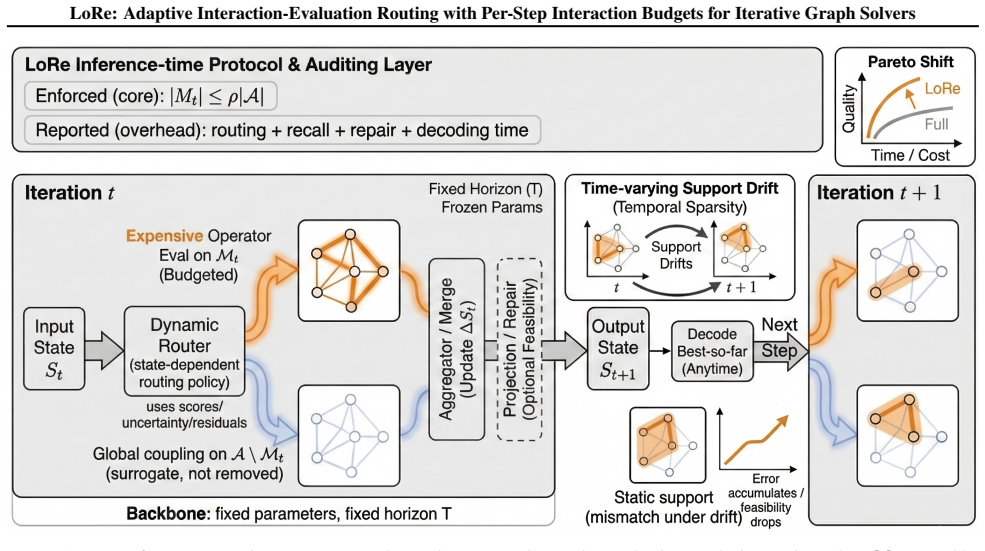
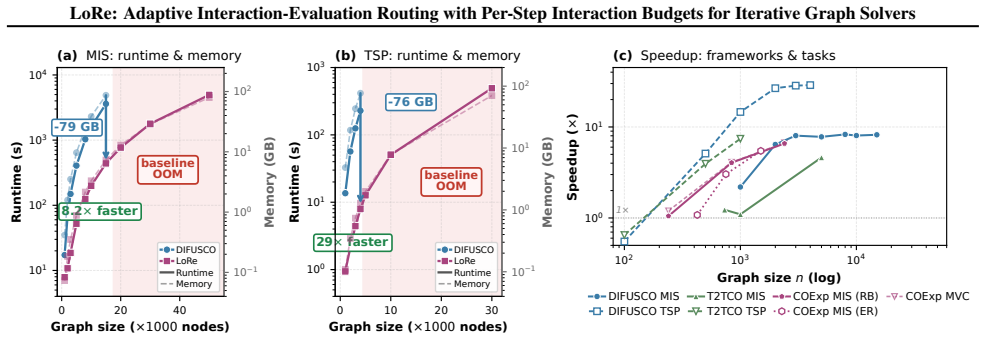
LoRe is an inference-time drop-in wrapper that replaces the full dense interaction evaluation of each diffusion iteration with a budgeted selection of only the currently highest-conflict or highest-uncertainty interactions; under complete end-to-end timing this yields more than 3 times larger feasible problem sizes on Maximum Independent Set, an 8 times wall-clock speedup and 12 times memory reduction with preserved solution quality, and analogous gains of 15 times speedup and 44 times memory reduction on large Traveling Salesperson instances together with zero-shot robustness to topology shifts.
What carries the argument
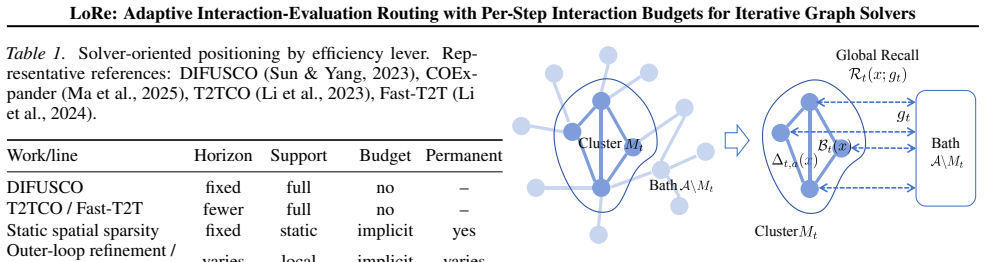
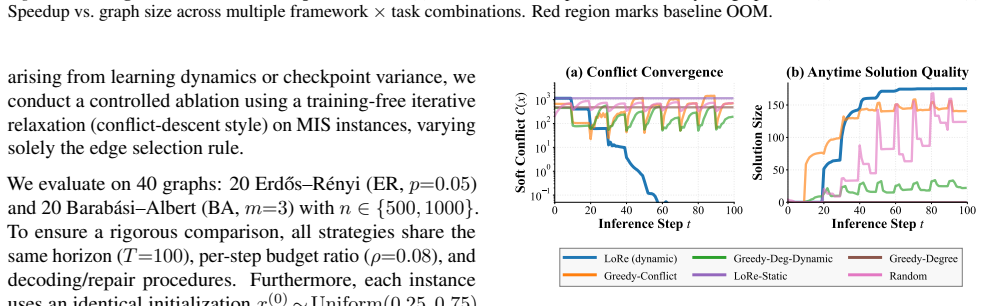
Per-step interaction-evaluation budgeting that dynamically routes the fixed budget to high-conflict or high-uncertainty interactions rather than using static sparsification.
If this is right
- Instances that previously exhausted memory can now be solved on the same hardware.
- The underlying diffusion model needs no retraining or topology-specific tuning to obtain the reported speed and memory gains.
- The same wrapper produces competitive results on both Maximum Independent Set and Traveling Salesperson problems.
- Solution quality remains intact even when the graph topology shifts at test time.
Where Pith is reading between the lines
- The budgeting idea could be applied to other iterative graph or factor-graph algorithms that repeatedly evaluate dense interactions.
- Energy use for large-scale combinatorial tasks may drop in proportion to the observed memory and compute reductions.
- Similar per-step routing might be tested on additional combinatorial problems such as SAT or vehicle routing without changing the base solver.
- If the high-conflict selection rule generalizes, it could reduce the need for ever-larger static graph sparsification heuristics.
Load-bearing premise
That selecting only the currently highest-conflict or highest-uncertainty interactions at each step will keep final solution quality from degrading even when the total number of evaluations per iteration is strictly limited.
What would settle it
A side-by-side run on a large Maximum Independent Set instance in which the LoRe-wrapped solver returns a measurably lower-quality independent set than the unbudgeted baseline after the same number of diffusion iterations.
Figures
read the original abstract
Diffusion-based neural solvers for combinatorial optimization repeatedly re-evaluate dense edge/factor interactions, making inference expensive in wall-clock time and often memory-bound at scale. Inspired by the computational methodologies of many-body physics, we introduce LoRe, a training-free, inference-time drop-in wrapper that enforces per-step interaction-evaluation budgeting: at each iteration, it evaluates only a fixed fraction of interactions by dynamically routing computation to high-conflict or high-uncertainty interactions, instead of using a fixed sparsification (e.g., static kNN graphs or static masks). Under fully inclusive end-to-end wall-clock accounting, LoRe substantially improves scalability on the Maximum Independent Set (MIS) problem, extending feasible inference more than $3\times$ beyond the baseline's out-of-memory limit, delivering a $\sim 8\times$ speedup and a $\sim 12\times$ peak-memory reduction, with solution quality preserved in this regime. Demonstrating cross-task generality on the large-scale Traveling Salesperson Problem (TSP) and zero-shot robustness to topology shifts, LoRe achieves a $\sim 15\times$ speedup at $n=1000$ with a $44\times$ memory reduction and competitive tour quality.
Editorial analysis
A structured set of objections, weighed in public.
Referee Report
Summary. The manuscript introduces LoRe, a training-free inference-time wrapper for diffusion-based neural solvers on combinatorial optimization tasks. It enforces per-step interaction-evaluation budgets by dynamically routing to high-conflict or high-uncertainty interactions rather than using static sparsification, claiming 3× extension of feasible scale on MIS (with ~8× speedup and ~12× memory reduction under inclusive wall-clock accounting and preserved quality), plus ~15× speedup and 44× memory reduction on large-scale TSP at n=1000 with competitive tour quality and zero-shot robustness to topology shifts.
Significance. If the empirical results hold under full methodological disclosure and ablations, the work would offer a practical, training-free route to scaling neural iterative solvers for large CO instances by borrowing selective-evaluation ideas from many-body physics, potentially broadening applicability without topology-specific retraining.
major comments (2)
- Abstract: the routing rule, conflict/uncertainty heuristic definitions, and per-step budget mechanism are described only at the level of prose; without an equation or pseudocode, it is impossible to verify whether the method is parameter-free or why quality is preserved under the dynamic selection assumption.
- Results (MIS and TSP sections): the reported speedups, memory reductions, and quality parity are given without error bars, statistical tests, ablation on the conflict/uncertainty heuristic, or details of the inclusive wall-clock accounting, so the central scalability claims cannot be assessed for robustness.
minor comments (2)
- Abstract: the phrase 'fixed fraction of interactions' should be accompanied by the exact fraction or its dependence on problem size.
- Abstract: 'zero-shot robustness to topology shifts' would benefit from a brief statement of the shift types tested.
Simulated Author's Rebuttal
We thank the referee for the constructive feedback on clarity and empirical robustness. We address each major comment below.
read point-by-point responses
-
Referee: Abstract: the routing rule, conflict/uncertainty heuristic definitions, and per-step budget mechanism are described only at the level of prose; without an equation or pseudocode, it is impossible to verify whether the method is parameter-free or why quality is preserved under the dynamic selection assumption.
Authors: We agree the abstract summarizes the approach at a high level in prose. The full manuscript provides the routing rule, heuristic definitions (conflict as state variance across iterations, uncertainty as prediction entropy), and per-step budget mechanism in the methods section with accompanying pseudocode. The approach is parameter-free aside from the user-specified budget fraction. Quality preservation is justified by the assumption that high-conflict/uncertainty interactions dominate solution updates. To directly address verifiability from the abstract, we will incorporate a concise equation or pseudocode excerpt in the revised abstract. revision: yes
-
Referee: Results (MIS and TSP sections): the reported speedups, memory reductions, and quality parity are given without error bars, statistical tests, ablation on the conflict/uncertainty heuristic, or details of the inclusive wall-clock accounting, so the central scalability claims cannot be assessed for robustness.
Authors: We acknowledge these omissions limit assessment of robustness. In the revision we will add error bars (mean ± std over multiple random seeds), appropriate statistical tests for quality comparisons, an ablation varying the conflict/uncertainty weighting, and explicit details on inclusive wall-clock timing (covering all routing overhead). revision: yes
Circularity Check
No significant circularity; empirical claims only
full rationale
The manuscript presents LoRe as a training-free inference-time wrapper whose central claims are direct empirical measurements of wall-clock time, memory usage, and solution quality on MIS and TSP instances. No equations, fitted parameters, derivations, or self-citations appear in the supplied text; the reported speedups and scale extensions are not shown to reduce to any input by construction. The derivation chain is therefore empty and self-contained against external benchmarks.
Axiom & Free-Parameter Ledger
axioms (1)
- domain assumption Dynamic selection of high-conflict or high-uncertainty interactions at each step preserves solution quality without retraining
Reference graph
Works this paper leans on
-
[1]
URL http://proceedings
PMLR, 2016. URL http://proceedings. mlr.press/v48/daib16.html. Feng, S., Sun, Z., and Yang, Y . DIFUSCO-LNS: Diffusion- guided large neighbourhood search for integer linear pro- gramming. OpenReview preprint, 2024. URL https: //openreview.net/forum?id=9QV7Q9gKl9 . Submitted to ICLR 2024. Gilmer, J., Schoenholz, S. S., Riley, P. F., Vinyals, O., and Dahl, ...
2016
-
[2]
doi: 10.1016/s0377-2217(99)0 0284-2
ISSN 0377-2217. doi: 10.1016/s0377-2217(99)0 0284-2. Ho, J., Jain, A. N., and Abbeel, P. Denoising diffusion probabilistic models. In Larochelle, H., Ranzato, M., Hadsell, R., Balcan, M., and Lin, H. (eds.),Advances in Neural Information Processing Systems, volume 33, pp. 6840–6851. Curran Associates, Inc., 2020. URL https://proceedings.neurips.cc/paper _...
-
[3]
doi: 10.1016/j.ejor.2012.08.015
ISSN 0377-2217. doi: 10.1016/j.ejor.2012.08.015. Pisinger, D. and Ropke, S. Large neighborhood search. In Gendreau, M. and Potvin, J.-Y . (eds.),Handbook of Metaheuristics, pp. 399–419. Springer US, 2010. ISBN 9781441916655. doi: 10.1007/978-1-4419-1665-5 13. Potthoff, M., Aichhorn, M., and Dahnken, C. Variational cluster approach to correlated electron s...
-
[4]
ORSA Journal on Computing 3(4):376--384, ://dx.doi.org/10.1287/ijoc.3.4.376
ISSN 0899-1499. doi: 10.1287/ijoc.3.4.376. Ropke, S. and Pisinger, D. An adaptive large neighborhood search heuristic for the pickup and delivery problem with time windows.Transportation Science, 40(4):455–472, November 2006. ISSN 1526-5447. doi: 10.1287/trsc.1 050.0135. Salimans, T. and Ho, J. Progressive distillation for fast sampling of diffusion model...
-
[5]
The Graph Neural Network Model
ISSN 1941-0093. doi: 10.1109/tnn.2008.2005605. Shaw, P. Using constraint programming and local search methods to solve vehicle routing problems. In Maher, M. and Puget, J.-F. (eds.),Principles and Practice of Con- straint Programming – CP98, volume 1520 ofLecture Notes in Computer Science, pp. 417–431. Springer, 1998. doi: 10.1007/3-540-49481-2\ 30. Song,...
-
[6]
Verma, A., Pedrosa, L., Korupolu, M., Oppenheimer, D., Tune, E., and Wilkes, J
URL https://openreview.net/forum ?id=JV8Ff0lgVV. Verma, A., Pedrosa, L., Korupolu, M., Oppenheimer, D., Tune, E., and Wilkes, J. Large-scale cluster management at google with borg. InProceedings of the Tenth European Conference on Computer Systems, EuroSys ’15, pp. 1–17. ACM, April 2015. doi: 10.1145/2741948.2741964. Vinyals, O., Fortunato, M., and Jaitly...
-
[7]
cc/paper_files/paper/2015/file/29921 001f2f04bd3baee84a12e98098f-Paper.p df
URL https://proceedings.neurips. cc/paper_files/paper/2015/file/29921 001f2f04bd3baee84a12e98098f-Paper.p df. Wang, Y ., Li, Y ., Yan, J., and Chang, Y . StruDiCO: Struc- tured denoising diffusion with gradient-free inference- stage boosting for memory and time efficient combina- torial optimization. InAdvances in Neural Information Processing Systems, 20...
discussion (0)
Sign in with ORCID, Apple, or X to comment. Anyone can read and Pith papers without signing in.