Strongly-coupled hybrid lattice-plasmons in layered cuprates
Pith reviewed 2026-06-29 09:27 UTC · model grok-4.3
The pith
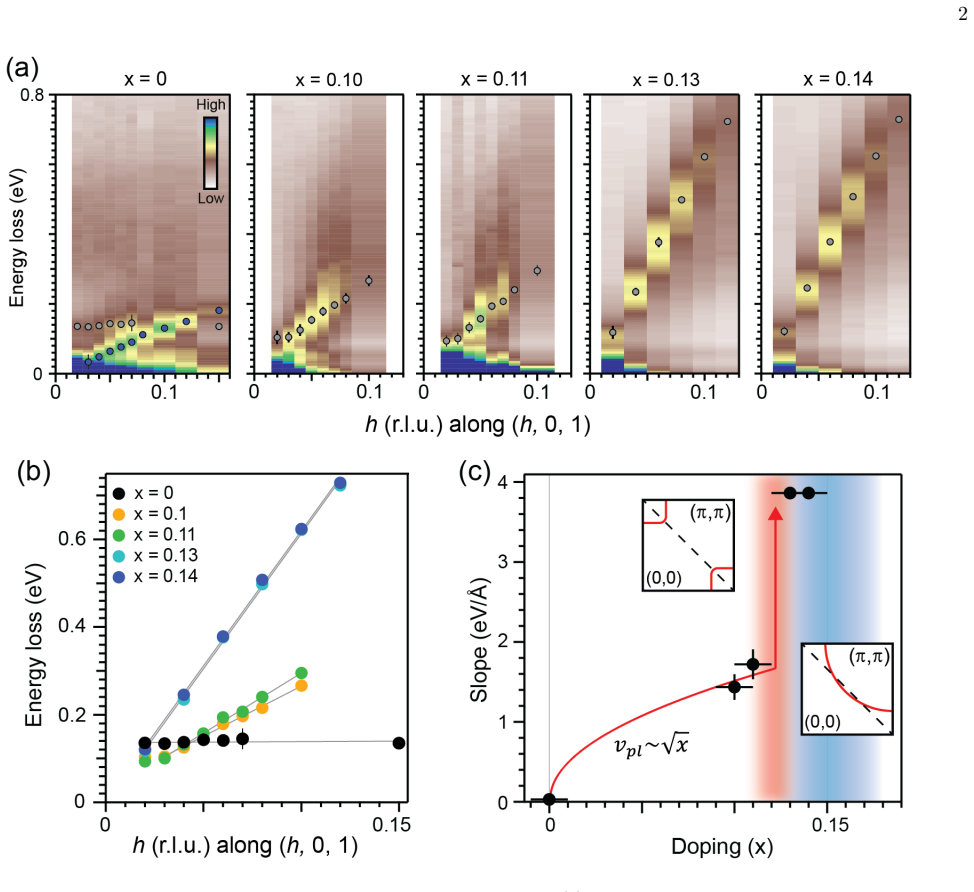
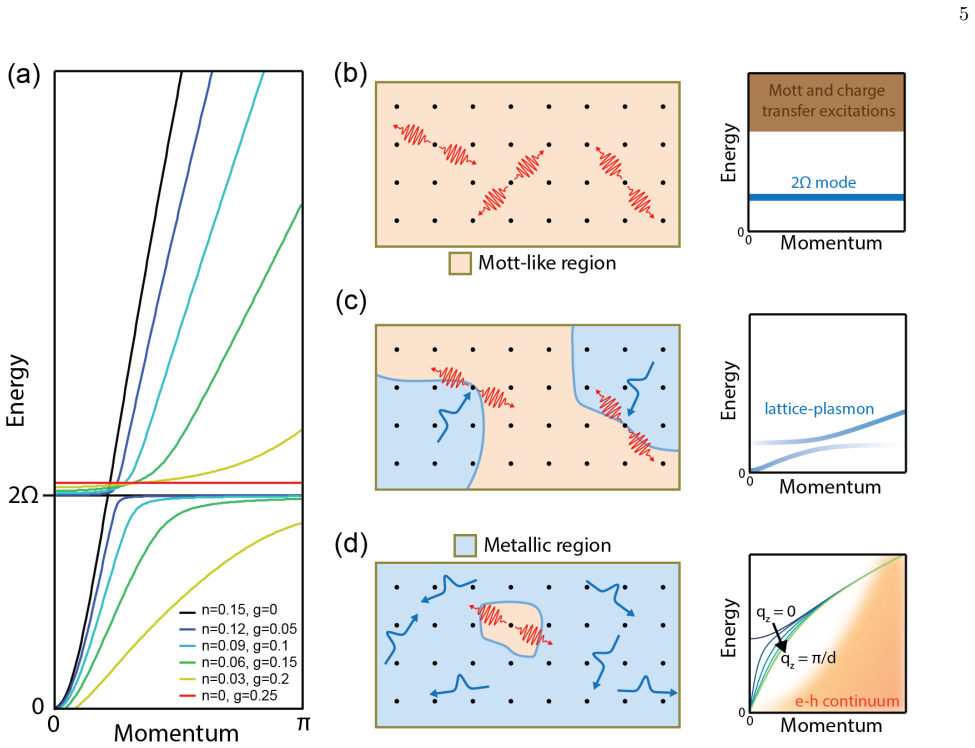
Collective charge excitations in electron-doped cuprates evolve continuously from acoustic plasmons to a dispersionless 139 meV hybrid mode at half filling through lattice coupling.
A machine-rendered reading of the paper's core claim, the machinery that carries it, and where it could break.
Core claim
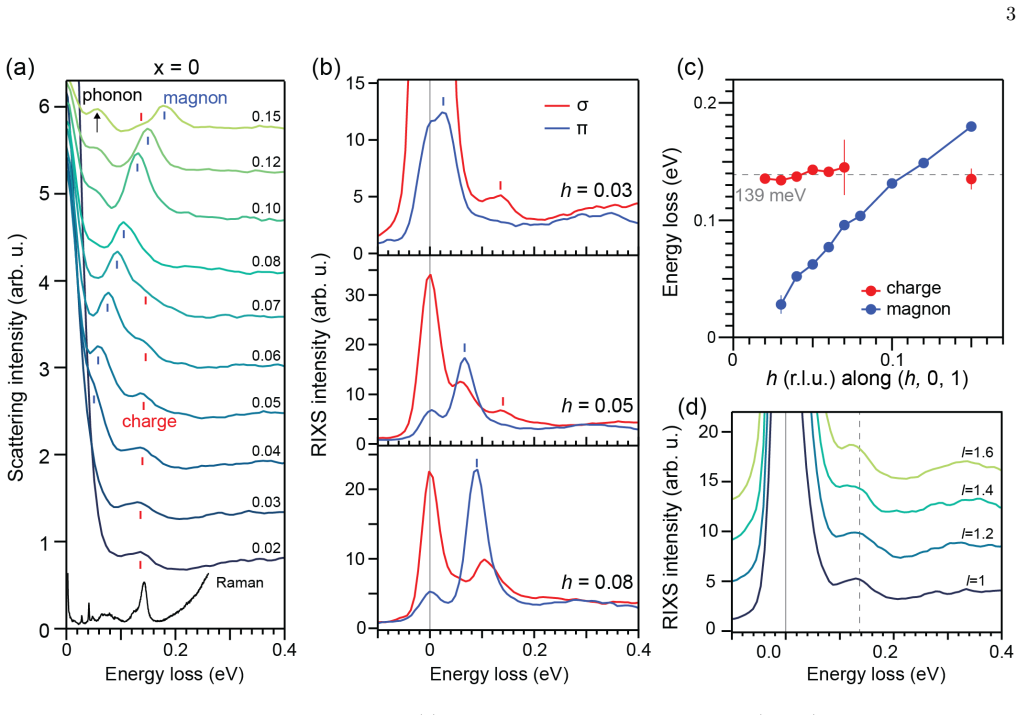
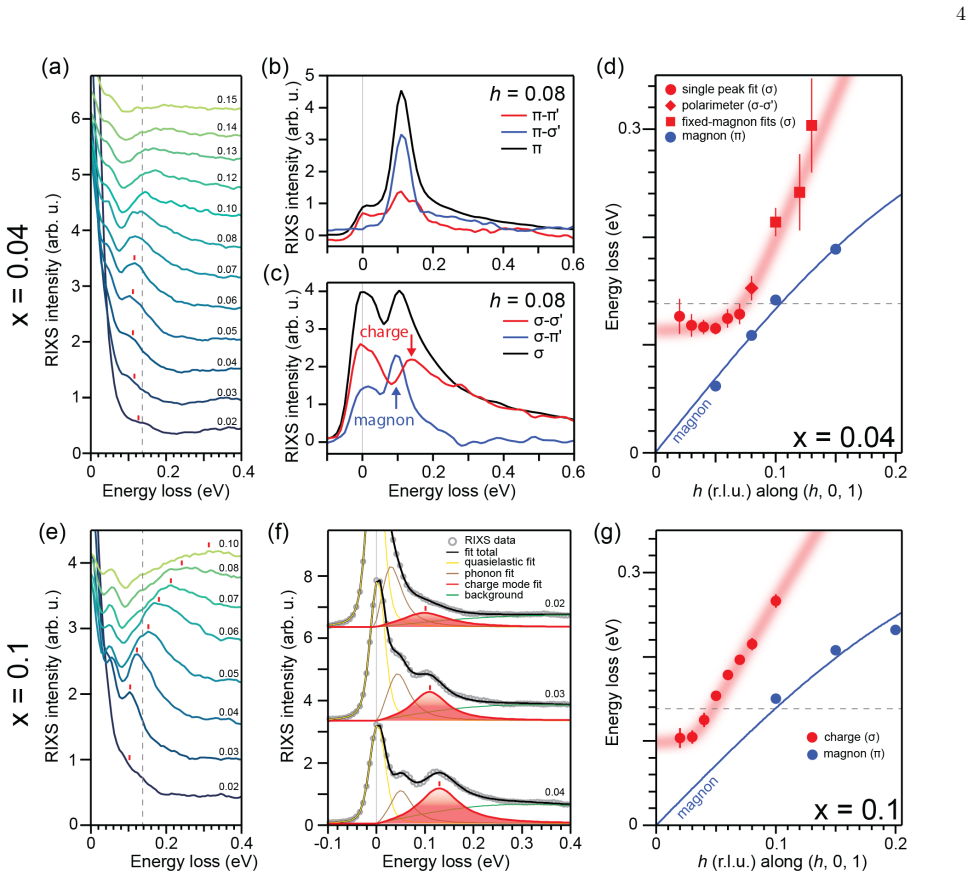
We find a continuous transformation of the low-energy charge response: from an acoustic plasmon in the metallic regime, to a gapped hybrid mode at intermediate doping, and finally to a nearly dispersionless 139 meV excitation at half filling. These results establish a unified picture of collective charge excitations across the phase diagram of electron-doped cuprates, showing that such modes persist across the Mott transition via strong coupling to lattice degrees of freedom.
What carries the argument
The hybrid lattice-plasmon excitation, formed by strong coupling between charge density oscillations and lattice vibrations, which allows the mode to persist from metal to insulator.
If this is right
- The charge response changes smoothly rather than abruptly at the Mott transition.
- The 139 meV mode is consistent with a two-phonon process tied to the oxygen breathing phonon.
- Strong electron-lattice coupling is required for the survival of these excitations in the insulating state.
- This picture applies specifically to electron-doped cuprates but unifies metallic and insulating regimes.
Where Pith is reading between the lines
- If lattice coupling is this strong, it may influence the pairing mechanism for superconductivity in these materials.
- Similar hybrid modes could be sought in other strongly correlated systems like organic conductors or transition metal oxides.
- Isotope substitution experiments could test the phonon involvement by shifting the 139 meV energy.
Load-bearing premise
The 139 meV excitation must be a true hybrid lattice-plasmon or two-phonon mode whose lack of dispersion directly reflects the strong electron-lattice coupling that carries the charge response through the Mott transition.
What would settle it
If the 139 meV peak were found to disperse with momentum or to shift away from twice the phonon energy in higher-resolution measurements, the hybrid mode interpretation would fail.
Figures
read the original abstract
Metallic systems with delocalized valence electrons host collective charge density oscillations known as plasmons. On the other hand, conventional insulators do not have free electrons and the low energy charge degrees of freedom are pinned to the ions. The fate of the collective charge excitations in the intermediate regime is an outstanding question. This problem is especially important for strongly correlated systems such as the layered cuprates, where unconventional superconductivity and other emergent phenomena arise from valence electrons on the border between Mott localization and itinerancy. Using resonant inelastic X-ray scattering, we track this evolution in the prototypical electron-doped cuprate Nd2-xCexCuO4. We find a continuous transformation of the low-energy charge response: from an acoustic plasmon in the metallic regime, to a gapped hybrid mode at intermediate doping, and finally to a nearly dispersionless 139 meV excitation at half filling. Remarkably, the 139 meV excitation has approximately twice the energy of the oxygen breathing phonon responsible for the dispersion kink observed in angle-resolved photoemission spectroscopy, and is consistent with a putative 2-phonon excitation observed in Raman spectroscopy. These results establish a unified picture of collective charge excitations across the phase diagram of electron-doped cuprates, showing that such modes persist across the Mott transition via strong coupling to lattice degrees of freedom and revealing a missing link in the charge dynamics of carrier doped Mott insulators.
Editorial analysis
A structured set of objections, weighed in public.
Referee Report
Summary. The manuscript reports resonant inelastic X-ray scattering (RIXS) measurements tracking the low-energy charge response in the electron-doped cuprate Nd_{2-x}Ce_xCuO_4 across the doping range from metallic to half-filled Mott insulator. It claims a continuous transformation: acoustic plasmon in the metallic regime, gapped hybrid mode at intermediate doping, and a nearly dispersionless 139 meV excitation at half filling. The 139 meV feature is interpreted as a hybrid lattice-plasmon or two-phonon mode (energy ~2× the oxygen breathing phonon, consistent with Raman), establishing that collective charge modes persist across the Mott transition via strong electron-lattice coupling and providing a unified picture of charge dynamics in doped Mott insulators.
Significance. If the data and interpretation hold, the work would offer an experimental bridge between itinerant plasmons and lattice-coupled excitations in the insulating regime of cuprates, with potential implications for understanding electron-phonon coupling near the Mott transition. The continuous doping evolution is a notable observation, but the strength of the 'strong coupling' and 'unified picture' conclusions depends on whether energy matching alone suffices or requires supporting intensity/lineshape analysis.
major comments (2)
- [Abstract and Discussion] Abstract and Discussion: The claim that the 139 meV mode at half filling is a hybrid lattice-plasmon (or two-phonon) excitation whose visibility demonstrates strong electron-lattice coupling surviving the Mott transition rests on energy coincidence with twice the oxygen breathing phonon and Raman consistency. No quantitative RIXS intensity modeling against an electron-phonon Hamiltonian (using ARPES-derived coupling) or explicit checks against dd/multi-magnon backgrounds are described, making the hybrid interpretation interpretive rather than required by the reported data.
- [Results] Results section (doping series): The continuous transformation across doping is asserted, but without reported details on background subtraction procedures, resolution deconvolution, or error analysis on the mode energy/width/intensity, it is unclear whether the gapped-to-dispersionless evolution is robust or sensitive to analysis choices.
minor comments (2)
- [Abstract] The abstract states the 139 meV feature is 'nearly dispersionless' but does not specify the momentum range or fitting method used to establish this; a figure or table quantifying the dispersion slope would strengthen the claim.
- Notation for doping levels (Nd2-xCexCuO4) should be standardized with subscripts throughout for clarity.
Simulated Author's Rebuttal
We thank the referee for their careful reading and constructive comments. We address each major point below and have revised the manuscript to improve clarity on analysis procedures and to qualify the interpretation of the 139 meV mode.
read point-by-point responses
-
Referee: [Abstract and Discussion] Abstract and Discussion: The claim that the 139 meV mode at half filling is a hybrid lattice-plasmon (or two-phonon) excitation whose visibility demonstrates strong electron-lattice coupling surviving the Mott transition rests on energy coincidence with twice the oxygen breathing phonon and Raman consistency. No quantitative RIXS intensity modeling against an electron-phonon Hamiltonian (using ARPES-derived coupling) or explicit checks against dd/multi-magnon backgrounds are described, making the hybrid interpretation interpretive rather than required by the reported data.
Authors: We agree that the hybrid-lattice-plasmon assignment rests on energy coincidence (139 meV ≈ 2 imes oxygen-breathing-phonon energy from ARPES) plus Raman consistency and the continuous doping evolution, rather than on quantitative intensity modeling. In the revised manuscript we have updated the Abstract and Discussion to state explicitly that the interpretation is inferred from these observables and that detailed RIXS intensity calculations against an electron-phonon Hamiltonian are not performed here. We have also added a brief comparison to known dd-excitation energies to exclude that background on energetic grounds. These changes make the interpretive character of the claim transparent without overstating the data. revision: partial
-
Referee: [Results] Results section (doping series): The continuous transformation across doping is asserted, but without reported details on background subtraction procedures, resolution deconvolution, or error analysis on the mode energy/width/intensity, it is unclear whether the gapped-to-dispersionless evolution is robust or sensitive to analysis choices.
Authors: We have expanded the Results section (and added a new Methods subsection) to document the background-subtraction procedure (linear fit to the high-energy tail), the resolution deconvolution (instrumental FWHM of 35 meV), and the error analysis (least-squares uncertainties plus Monte-Carlo noise simulations). Fitted parameters with uncertainties for all doping levels are now tabulated in the supplement, together with representative raw spectra and fits. These additions allow readers to assess the robustness of the reported gapped-to-dispersionless evolution. revision: yes
Circularity Check
No circularity: purely observational RIXS data with interpretive claims
full rationale
The manuscript is an experimental report using resonant inelastic X-ray scattering to map the doping evolution of low-energy charge excitations in Nd2-xCexCuO4. The key observations (acoustic plasmon at high doping, gapped hybrid mode at intermediate doping, dispersionless 139 meV feature at half-filling) are direct spectral features extracted from measured RIXS intensity maps. Identification of the 139 meV mode rests on its energy being approximately twice the oxygen breathing phonon (from prior ARPES) and consistency with Raman reports; this is an energy-matching argument, not a derivation or fit that re-uses the same dataset as both input and output. No equations, ansatze, uniqueness theorems, or self-citations appear in the provided text as load-bearing steps that would reduce any claimed result to a tautology or fitted input. The 'unified picture' and 'strong coupling' language is interpretive commentary on the data, not a mathematical reduction.
Axiom & Free-Parameter Ledger
axioms (1)
- domain assumption Resonant inelastic X-ray scattering measures momentum-resolved charge excitations in cuprates
Reference graph
Works this paper leans on
-
[1]
Pines and D
D. Pines and D. Bohm, hys. Rev.85, 338 (1952)
1952
-
[2]
Martin, A
S. Martin, A. T. Fiory, R. M. Fleming, L. F. Schneemeyer, and J. V. Waszczak, Phys. Rev. B41, 846(R) (1990). 8
1990
-
[3]
S.-D. Chen, M. Hashimoto, Y. He, D. Song, K.-J. Xu, J.- F. He, T. P. Devereaux, H. Eisaki, D.-H. Lu, J. Zaanen, and Z.-X. Shen, Science366, 1099 (2019)
2019
-
[4]
R. L. Greene, P. R. Mandal, N. R. Poniatowski, and T. Sarkar, Ann. Rev. Mod. Phys11, 213 (2020)
2020
-
[5]
Mitrano, A
M. Mitrano, A. A. Husain, S. Vig, A. Kogar, M. S. Rak, S. I. Rubeck, J. Schmalian, B. Uchoa, J. Schneeloch, R. Zhong, G. D. Gu, and P. Abbamonte, Proc. Natl. Acad. Sci.115 (21), 5392 (2018)
2018
-
[6]
J. G. Bednorz and K. A. Muller, Z. Phys. B64, 189 (1986)
1986
-
[7]
Keimer, S
B. Keimer, S. A. Kivelson, M. R. Norman, S. Uchida, and J. Zaanen, Nature518, 179 (2015)
2015
-
[8]
Sachdev, Rev
S. Sachdev, Rev. Mod. Phys.75, 913 (2003)
2003
-
[9]
P. A. Lee, N. Nagaosa, and X.-G. Wen, Rev. Mod. Phys. 78, 17 (2006)
2006
-
[10]
Y. Cao, V. Fatemi, A. Demir, S. Fang, S. L. Tomarken, J. Y. Luo, J. D. Sanchez-Yamagishi, K. Watanabe, T. Taniguchi, E. Kaxiras, R. C. Ashoori, and P. Jarillo- Herrero, Nature556, 80 (2018)
2018
-
[11]
Vignolle, A
B. Vignolle, A. Carrington, R. A. Cooper, M. M. J. French, A. P. Mackenzie, C. Jaudet, D. Vignolles, C. Proust, and N. E. Hussey, Nature455, 952 (2008)
2008
-
[12]
Plat´ e, J
M. Plat´ e, J. D. F. Mottershead, I. S. Elfimov, D. C. Peets, R. Liang, D. A. Bonn, W. N. Hardy, S. Chiuzba- ian, M. Falub, M. Shi, L. Patthey, and A. Damascelli, Phys. Rev. Lett.95, 077001 (2005)
2005
-
[13]
Damascelli, Z
A. Damascelli, Z. Hussain, and Z.-X. Shen, Rev. Mod. Phys.75, 473 (2003)
2003
-
[14]
Hepting, L
M. Hepting, L. Chaix, E. W. Huang, R. Fumagalli, Y. Y. Peng, B. Moritz, K. Kummer, N. B. Brookes, W. C. Lee, M. Hashimoto, T. Sarkar, J.-F. He, C. R. Rotundu, Y. S. Lee, R. L. Greene, L. Braicovich, G. Ghiringhelli, Z. X. Shen, T. P. Devereaux, and W. S. Lee, Nature563, 374 (2018)
2018
-
[15]
Hepting, M
M. Hepting, M. Bejas, A. Nag, H. Yamase, N. Coppola, D. Betto, C. Falter, M. Garcia-Fernandez, S. Agrestini, K.-J. Zhou, M. Minola, C. Sacco, L. Maritato, P. Orgiani, H. Wei, K. Shen, D. Schlom, A. Galdi, A. Greco, and B. Keimer, Phys. Rev. Lett.129, 047001 (2022)
2022
-
[16]
A. Nag, M. Zhu, M. Bejas, J. Li, H. Robarts, H. Yamase, A. Petsch, D. Song, H. Eisaki, A. Walters, M. Garc´ ıa- Fern´ andez, A. Greco, S. Hayden, and K.-J. Zhou, Phys. Rev. Lett.125, 257002 (2020)
2020
-
[17]
A. Nag, L. Zinni, J. Choi, J. Li, S. Tu, A. C. Walters, S. Agrestini, S. M. Hayden, M. Bejas, Z. Lin, H. Yamase, K. Jin, M. Garc´ ıa-Fern´ andez, J. Fink, A. Greco, and K.- J. Zhou, Phys. Rev. Research6, 043184 (2024)
2024
-
[18]
V. Z. Kresin and H. Morawitz, Phys. Rev. B37, 7854 (1988)
1988
-
[19]
Ishii and J
Y. Ishii and J. Ruvalds, Phys. Rev. B48, 3455 (1993)
1993
-
[20]
A. Bill, H. Morawitz, and V. Z. Kresin, Phys. Rev. B68, 144519 (2003)
2003
-
[21]
V. J. Emery and S. A. Kivelson, Nature374, 434 (1995)
1995
-
[22]
J. Lin, J. Yuan, K. Jin, Z. Yin, G. Li, K.-J. Zhou, X. Lu, M. Dantz, T. Schmitt, H. Ding, H. Guo, M. P. M. Dean, and X. Liu, npj Quantum Mater.5, 4 (2020)
2020
-
[23]
Naito, S
M. Naito, S. Karimoto, and A. Tsukada, Supercond. Sci. Technol.15, 1663 (2002)
2002
-
[24]
Hepting, T
M. Hepting, T. D. Boyko, V. Zimmermann, M. Be- jas, Y. E. Suyolcu, P. Puphal, R. J. Green, L. Zinni, J. Kim, D. Casa, M. H. Upton, D. Wong, C. Schulz, M. Bartkowiak, K. Habicht, E. Pomjakushina, G. Cris- tiani, G. Logvenov, M. Minola, H. Yamase, A. Greco, and B. Keimer, Phys. Rev. B107, 214516 (2023)
2023
-
[25]
Krockenberger, J
Y. Krockenberger, J. Kurian, A. Winkler, A. Tsukada, M. Naito, and L. Alff, Phys. Rev. B77, 060505(R) (2008)
2008
-
[26]
N. P. Armitage, P. Fournier, and R. L. Greene, Rev. Mod. Phys.82, 2421 (2010)
2010
-
[27]
K.-J. Xu, Q. Guo, M. Hashimoto, Z.-X. Li, S.-D. Chen, J. He, Y. He, C. Li, M. H. Berntsen, C. R. Rotundu, Y. S. Lee, T. P. Devereaux, A. Rydh, D.-H. Lu, D.-H. Lee, O. Tjernberg, and Z.-X. Shen, Nat. Phys.19, 1834 (2023)
2023
-
[28]
K.-J. Xu, J. He, S.-D. Chen, Y. He, S. N. Abadi, C. R. Rotundu, Y. S. Lee, D.-H. Lu, Q. Guo, O. Tjernberg, T. P. Devereaux, D.-H. Lee, M. Hashimoto, and Z.-X. Shen, Science385, 796 (2024)
2024
-
[29]
See Supplemental Materials at (link to be inserted by publisher)
-
[30]
W. S. Lee, J. J. Lee, E. A. Nowadnick, S. Gerber, W. Tabis, S. W. Huang, V. N. Strocov, E. M. Motoyama, G. Yu, B. Moritz, H. Y. Huang, R. P. Wang, Y. B. Huang, W. B. Wu, C. T. Chen, D. J. Huang, M. Greven, T. Schmitt, Z. X. Shen, and T. P. Devereaux, Nat. Phys. 10, 883 (2014)
2014
-
[31]
S. D. Sarma and E. H. Hwang, Phys. Rev. Lett.102, 206412 (2009)
2009
-
[32]
Dagan, M
Y. Dagan, M. M. Qazibash, C. P. Hill, V. N. Kulkarni, and R. L. Greene, Phys. Rev. Lett.92, 167001 (2004)
2004
-
[33]
Hofman, D
M. Hofman, D. Strauch, U. Schroder, and E. Rampf, J. Phys.: Condens. Matter6, 3669 (1994)
1994
-
[34]
Onose, Y
Y. Onose, Y. Taguchi, K. Ishizaka, and Y. Tokura, Phys. Rev. B69, 024504 (2004)
2004
-
[35]
Sugai, T
S. Sugai, T. Kobayashi, and J. Akimitsu, Phys. Rev. B 40, 2686(R) (1989)
1989
-
[36]
Moritz, S
B. Moritz, S. Johnston, T. P. Devereaux, B. Muschler, W. Prestel, R. Hackl, M. Lambacher, A. Erb, S. Komiya, and Y. Ando, Phys. Rev. B84, 235114 (2011)
2011
-
[37]
M. H. Cohen and J. Ruvals, Phys. Rev. Lett.23, 1378 (1969)
1969
-
[38]
Chelwani, A
N. Chelwani, A. Baum, T. B¨ ohm, M. Opel, F. Venturini, L. Tassini, A. Erb, H. Berger, L. Forr, and R. Hackl, Phys. Rev. B97, 024407 (2018)
2018
-
[39]
S. L. Cooper, G. A. Thomas, A. J. Millis, P. E. Sulewski, J. Orenstein, D. H. Rapkine, S.-W. Cheong, and P. L. Trevor, Phys. Rev. B42, 10785(R) (1990)
1990
-
[40]
K. M. Shen, F. Ronning, D. H. Lu, W. S. Lee, N. J. C. Ingle, W. Meevasana, F. Baumberger, A. Damascelli, N. P. Armitage, L. L. Miller, Y. Kohsaka, M. Azuma, M. Takano, H. Takagi, and Z.-X. Shen, Phys. Rev. Lett. 93, 267002 (2004)
2004
-
[41]
P. W. Anderson, Phys. Rev.109, 1492 (1958)
1958
-
[42]
Onose, Y
Y. Onose, Y. Taguchi, K. Ishizaka, and Y. Tokura, Phys. Rev. Lett.87, 217001 (2001)
2001
-
[43]
Fischer, M
O. Fischer, M. Kugler, I. Maggio-Aprile, C. Berthod, and C. Renner, Rev. Mod. Phys.79, 353 (2007)
2007
-
[44]
R. J. Koch, T. Seyller, and J. A. Schaefer, Phys. Rev. B 82, 201413(R) (2010)
2010
-
[45]
Lanzara, P
A. Lanzara, P. V. Bogdanov, X. J. Zhou, S. A. Kellar, D. L. Feng, E. D. Lu, T. Yoshida, H. Eisaki, A. Fuji- mori, K. Kishio, J.-I. Shimoyama, T. Noda, S. Uchida, Z. Hussain, and Z.-X. Shen, Nature412, 510 (2001)
2001
-
[46]
S. R. Park, D. J. Song, C. S. Leem, C. Kim, C. Kim, B. J. Kim, and H. Eisaki, Phys. Rev. Lett.101, 117006 (2008)
2008
-
[47]
Y. He, M. Hashimoto, D. Song, S.-D. Chen, J. He, I. M. 9 Vishik, B. Moritz, D.-H. Lee, N. Nagaosa, J. Zaanen, T. P. Devereaux, Y. Yoshida, H. Eisaki, D. H. Lu, and Z.-X. Shen, Science362, 62 (2018)
2018
-
[48]
Honerkamp, H
C. Honerkamp, H. C. Fu, and D.-H. Lee, Phys. Rev. Lett. 75, 014503 (2007)
2007
-
[49]
T. Cuk, F. Baumberger, D. H. Lu, N. Ingle, X. J. Zhou, H. Eisaki, N. Kaneko, Z. Hussain, T. P. Devereaux, N. Nagaosa, and Z.-X. Shen, Phys. Rev. Lett.93, 117003 (2004)
2004
-
[50]
T. P. Devereaux, T. Cuk, Z.-X. Shen, and N. Nagaosa, Phys. Rev. Lett.93, 117004 (2004)
2004
discussion (0)
Sign in with ORCID, Apple, or X to comment. Anyone can read and Pith papers without signing in.