Optical and Radar Observations of the February 2025 Falcon 9 Upper-Stage Re-entry
Pith reviewed 2026-06-29 08:56 UTC · model grok-4.3
The pith
Multistatic meteor radar systems detect Falcon 9 upper stage re-entry plasma consistent with optical fragment tracks.
A machine-rendered reading of the paper's core claim, the machinery that carries it, and where it could break.
Core claim
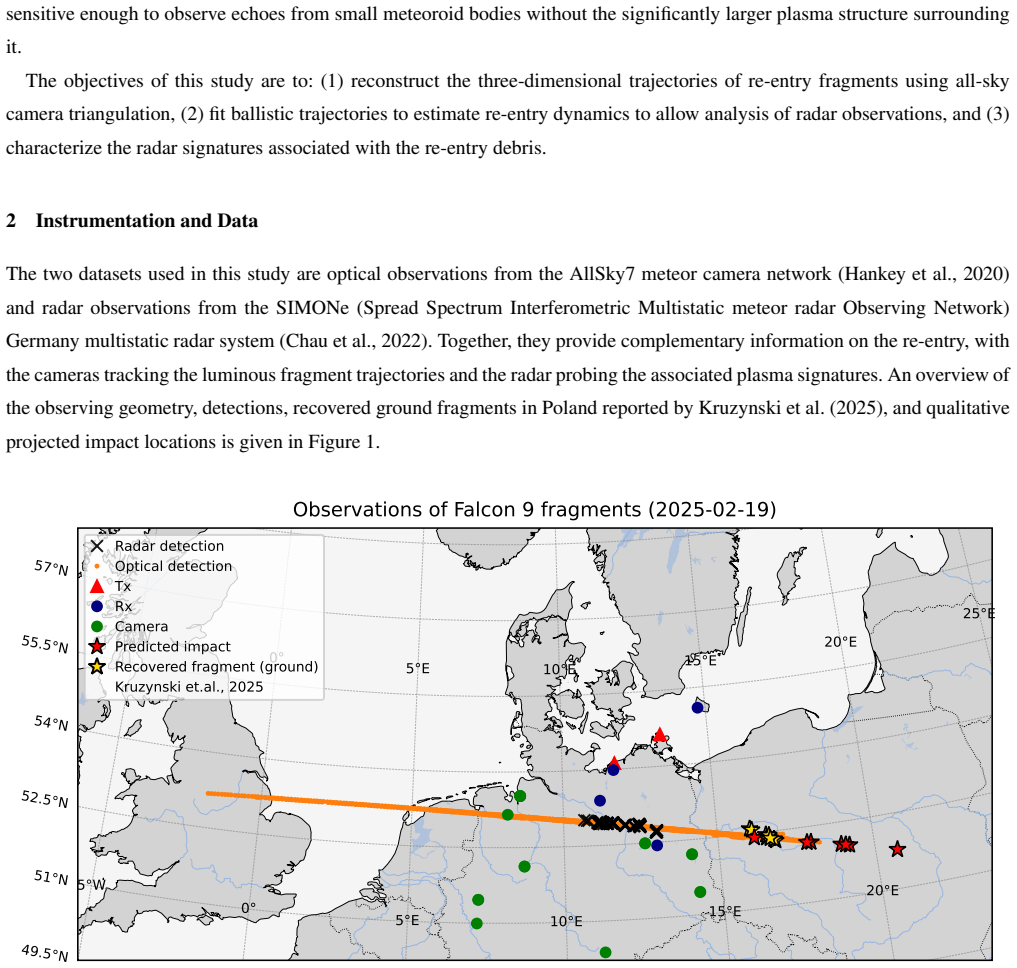
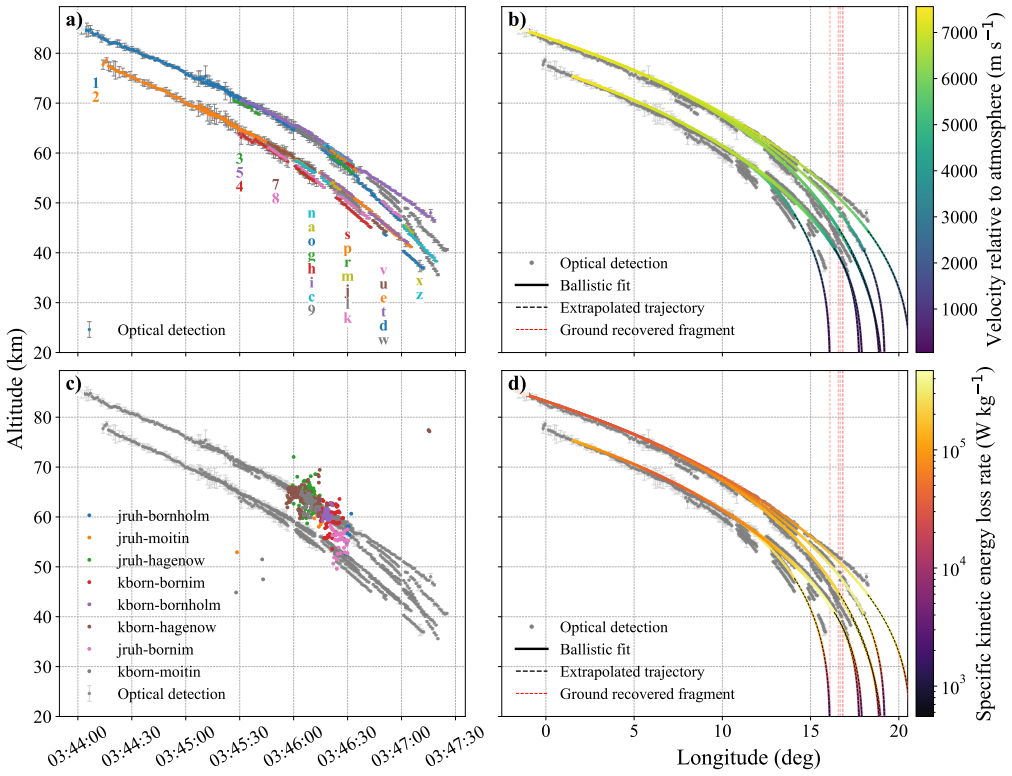
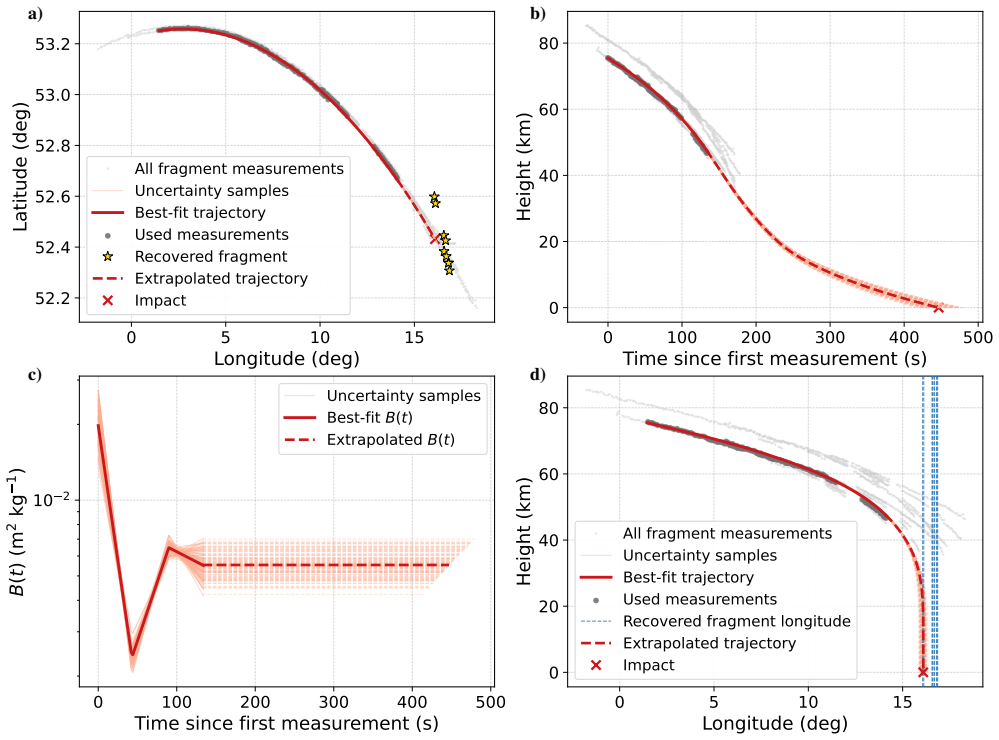
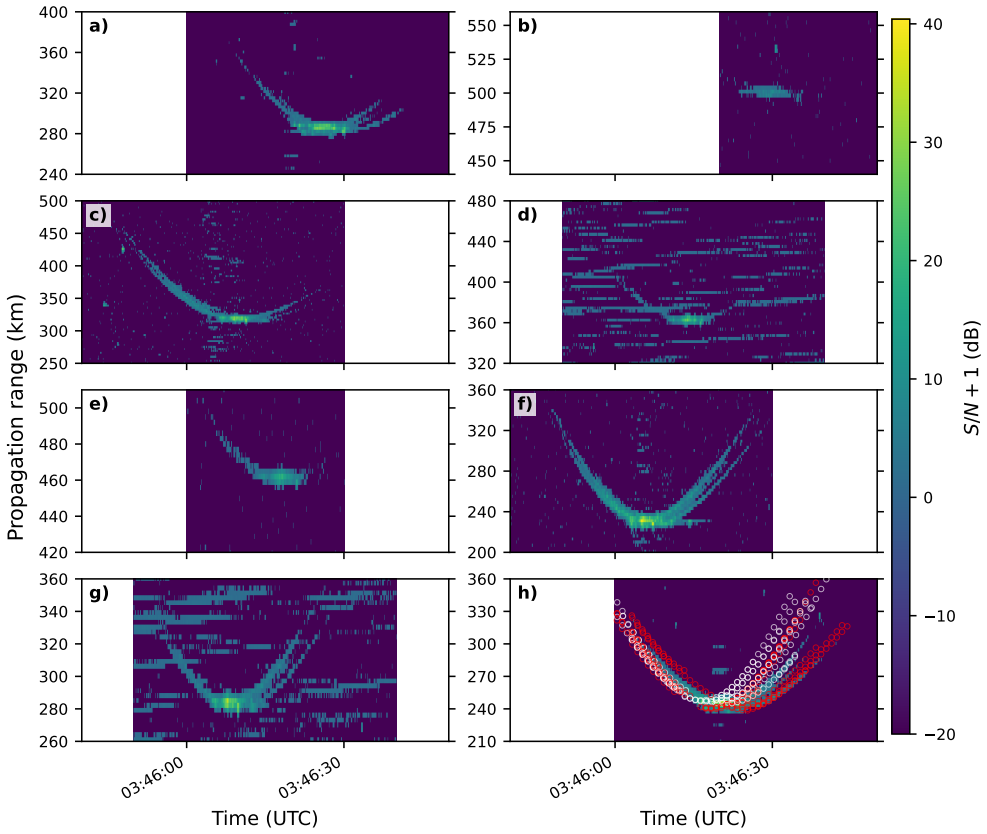
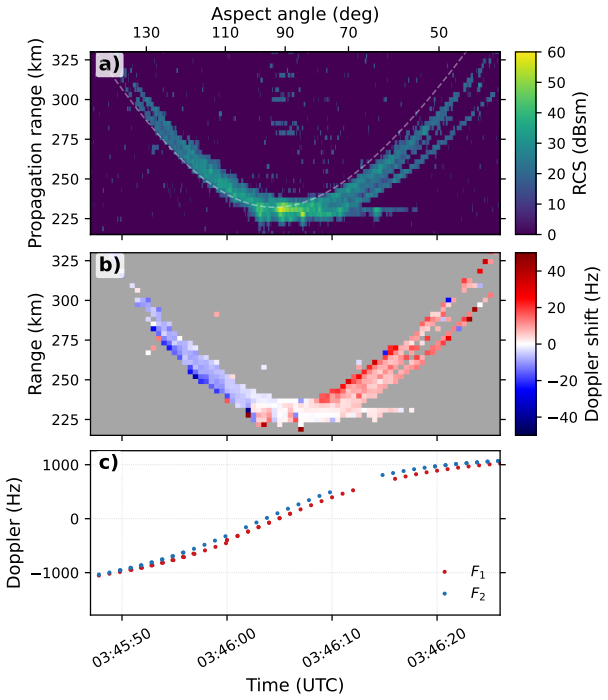
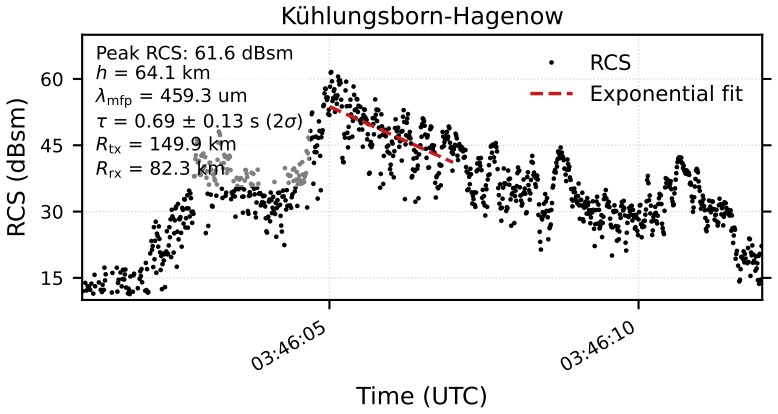
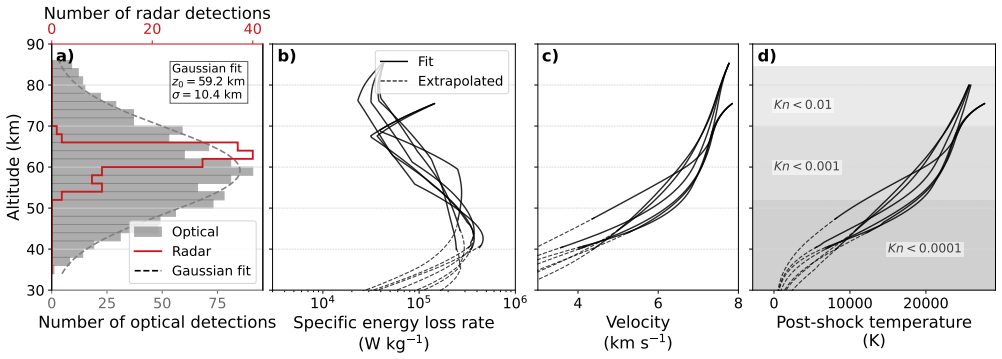
Optical observations from 43 meteor cameras reconstructed 30 fragment trajectories and identified two main fragment families, with the optical detection-height distribution peaking near 60 km. Radar echoes at 55-75 km from the SIMONe Germany system matched the optical positions, showing specular trail echoes from overdense wake plasma with RCS up to 60 dBsm and short-lived non-specular trail echoes with RCS of 20-30 dBsm delayed by 1-2 s. The characteristic decay time of both echo types is about 1 s, and Knudsen numbers indicate continuum-flow conditions with shock-driven plasma production. These observations demonstrate that multistatic meteor radar systems can detect spacecraft re-entries.
What carries the argument
Multistatic radar detection of specular and non-specular trail echoes from re-entry plasma at 55-75 km altitude, cross-checked against optically reconstructed fragment trajectories.
If this is right
- Re-entries of objects smaller than the Falcon 9 upper stage, such as Starlink satellites, may produce detectable radar echoes with similar systems.
- Multistatic meteor radar systems deployed globally can monitor spacecraft re-entries in addition to natural meteors.
- Radar data in the 55-75 km range captures the altitude of maximum kinetic energy loss during re-entry.
- The two identified echo types provide distinct signatures of overdense wake plasma and delayed non-specular trails.
Where Pith is reading between the lines
- Existing global networks of multistatic meteor radars could be repurposed for routine tracking of re-entering space debris without new hardware.
- The technique might enable statistical studies of re-entry plasma production across a range of object sizes and entry angles.
- Expanded coverage could support real-time alerts for the final stages of uncontrolled re-entries.
Load-bearing premise
The radar echoes at 55-75 km are produced by the Falcon 9 re-entry plasma and are correctly associated with the optically observed fragments based solely on broad altitude overlap and positional consistency.
What would settle it
A quantitative analysis showing that radar-derived positions deviate from optically reconstructed fragment locations by more than the combined measurement uncertainties, or independent evidence that the echoes arise from unrelated atmospheric phenomena, would falsify the association.
Figures
read the original abstract
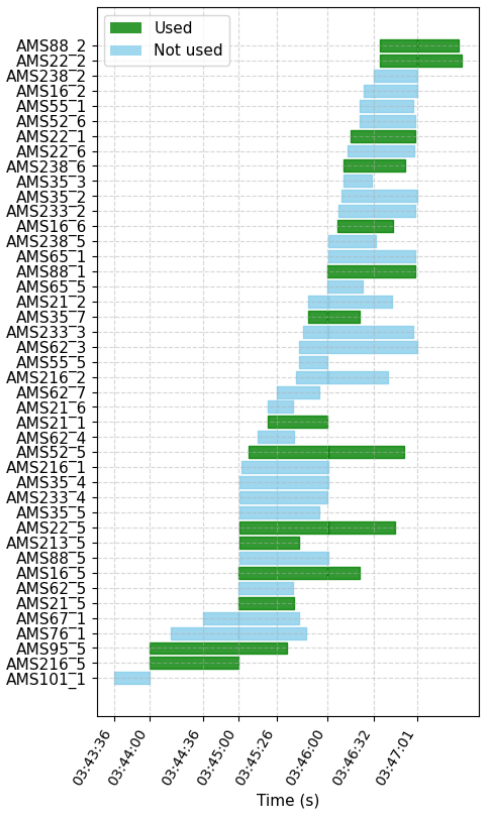
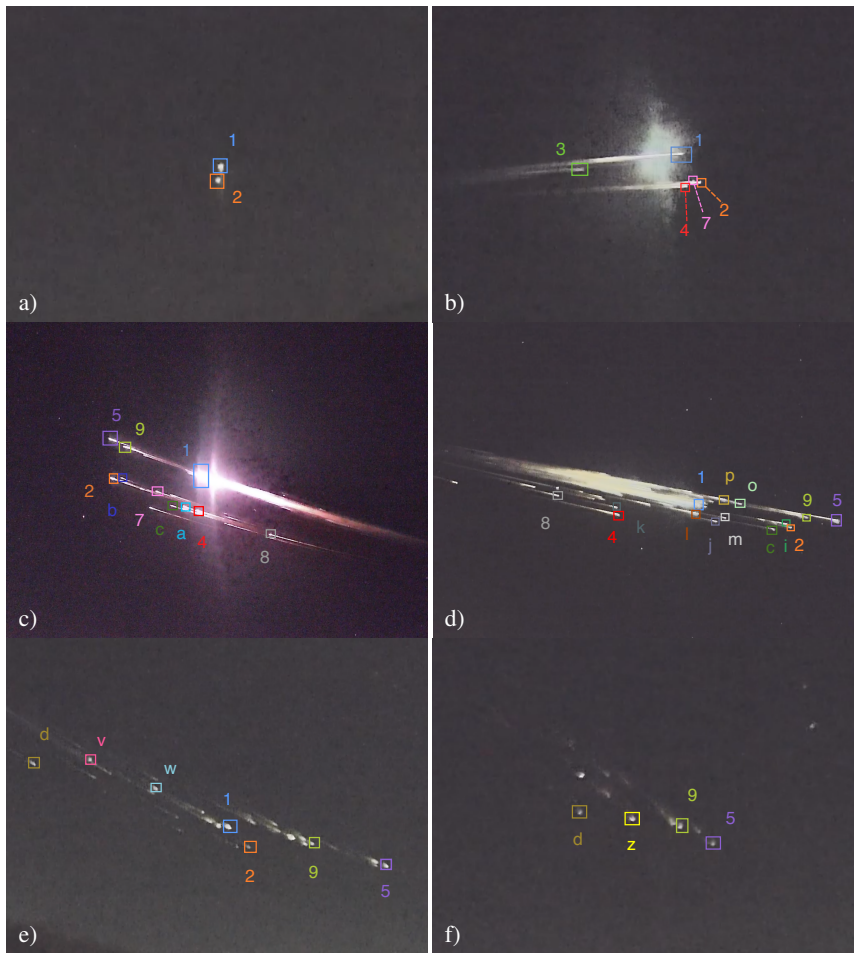
We investigate the February 19, 2025, re-entry of a Falcon 9 upper stage using optical observations from 43 meteor cameras across central Europe together with radar detections of re-entry plasma obtained with the 32.55 MHz SIMONe Germany multistatic radar system. Optical observations of fragment emissions between 85 and 36 km altitude were used to reconstruct 30 fragment trajectories, identify two main fragment families, and fit ballistic trajectories to estimate kinetic energy loss per unit mass. The optical detection-height distribution peaks near 60 km with a standard deviation of 10 km, and both optical and radar signatures occur in the same broad altitude region as the maximum kinetic-energy loss. Radar echoes were detected at altitudes between 55 and 75 km, and the radar-derived positions are consistent with those obtained from optical observations. Two distinct radar echo types associated with the re-entry plasma were identified: (1) specular trail echoes from overdense wake plasma, with radar cross-sections (RCS) of up to 60 dBsm, and (2) short-lived non-specular trail echoes with RCS values of 20--30 dBsm, exhibiting a delay of 1--2 s compared to optical signatures. The characteristic decay time of both echo types is approximately 1 s. In the radar-echo altitude range, the estimated Knudsen numbers for meter-scale fragments are well below unity, consistent with continuum-flow conditions and shock-driven plasma production rather than ordinary meteor-like impact ionization. These serendipitous radar observations demonstrate that the atmospheric re-entry of other spacecraft, including objects smaller than the Falcon 9 upper stage such as Starlink satellites, may likewise be detectable using comparable multistatic meteor radar systems deployed globally.
Editorial analysis
A structured set of objections, weighed in public.
Referee Report
Summary. The paper reports optical observations from 43 meteor cameras across central Europe of the February 19, 2025 Falcon 9 upper-stage re-entry, reconstructing 30 fragment trajectories and identifying two main families with ballistic fits to estimate kinetic energy loss. These are combined with radar detections from the 32.55 MHz SIMONe Germany multistatic system, which recorded echoes at 55-75 km altitudes whose positions are stated to be consistent with the optical data. Two echo types are described (specular overdense trails with RCS up to 60 dBsm and non-specular trails of 20-30 dBsm with 1-2 s delay), both with ~1 s decay times. Knudsen numbers for meter-scale fragments in this altitude range are reported as well below unity, supporting continuum-flow plasma production. The work concludes that comparable global multistatic meteor radars can detect re-entries of smaller objects such as Starlink satellites.
Significance. If the radar-optical association is robust, the result demonstrates that existing multistatic meteor radar networks can serendipitously detect spacecraft re-entry plasma, extending observational capability to smaller objects without new dedicated hardware. The use of real multi-instrument data and the explicit link to continuum-flow conditions at 55-75 km provide a concrete observational benchmark for re-entry plasma signatures.
major comments (3)
- [Abstract] Abstract: The association of the 55-75 km radar echoes with the optically observed fragments rests only on broad altitude overlap (optical peak ~60 km) and an unspecified claim of 'positional consistency,' with no reported trajectory-fit residuals, timing offsets, covariance matrices, or background-rate statistics. This is load-bearing for the headline claim that the echoes originate from re-entry plasma rather than ordinary meteor trails or ionospheric structures.
- [Abstract] Abstract: No error bars, uncertainty estimates, or quantitative validation metrics are supplied for the RCS values (up to 60 dBsm and 20-30 dBsm), the ~1 s decay times, the 1-2 s delay of non-specular echoes, or the Knudsen-number calculations used to argue for continuum-flow conditions. These omissions leave the central observational claims only partially supported.
- [Abstract] Abstract: Data exclusion criteria for both optical trajectories and radar echoes are not described, nor is the procedure for matching the two datasets to the 30 reconstructed fragments. Without these, it is not possible to assess whether the reported consistency is statistically significant or could arise from chance overlap at the relevant altitudes.
minor comments (1)
- [Abstract] Abstract: The phrase 'radar-derived positions are consistent with those obtained from optical observations' should be replaced by a quantitative statement (e.g., mean offset and standard deviation) once the supporting analysis is added.
Simulated Author's Rebuttal
We thank the referee for their thorough review and valuable comments on our manuscript. We address each of the major comments below and indicate the revisions we will make to strengthen the paper.
read point-by-point responses
-
Referee: [Abstract] Abstract: The association of the 55-75 km radar echoes with the optically observed fragments rests only on broad altitude overlap (optical peak ~60 km) and an unspecified claim of 'positional consistency,' with no reported trajectory-fit residuals, timing offsets, covariance matrices, or background-rate statistics. This is load-bearing for the headline claim that the echoes originate from re-entry plasma rather than ordinary meteor trails or ionospheric structures.
Authors: We agree that the current description in the abstract relies on a qualitative statement of consistency. The full manuscript contains detailed trajectory reconstructions from the optical data and position comparisons with radar echoes. To address this, we will revise the abstract and add a new paragraph in the results section providing quantitative measures including trajectory-fit residuals, timing offsets, and a statistical assessment of the association to demonstrate it is not due to chance overlap. revision: yes
-
Referee: [Abstract] Abstract: No error bars, uncertainty estimates, or quantitative validation metrics are supplied for the RCS values (up to 60 dBsm and 20-30 dBsm), the ~1 s decay times, the 1-2 s delay of non-specular echoes, or the Knudsen-number calculations used to argue for continuum-flow conditions. These omissions leave the central observational claims only partially supported.
Authors: We acknowledge that the abstract presents approximate values without uncertainties. The observations allow for estimation of these quantities, and we will include error bars and uncertainty estimates derived from the data variability and measurement precision in the revised abstract and main text. A brief description of the calculation methods for Knudsen numbers will also be added. revision: yes
-
Referee: [Abstract] Abstract: Data exclusion criteria for both optical trajectories and radar echoes are not described, nor is the procedure for matching the two datasets to the 30 reconstructed fragments. Without these, it is not possible to assess whether the reported consistency is statistically significant or could arise from chance overlap at the relevant altitudes.
Authors: The manuscript details the use of 43 meteor cameras for optical trajectories and the SIMONe radar system for echoes, but we agree that explicit criteria and matching procedures are needed for clarity. We will add a methods subsection describing the data exclusion criteria, quality control for trajectories, and the procedure used to associate radar echoes with the 30 optical fragments, including any statistical tests for significance. revision: yes
Circularity Check
Purely observational study; no derivation chain or self-referential elements present
full rationale
The manuscript reports serendipitous optical and radar observations of a known Falcon 9 re-entry event. Trajectory reconstruction and ballistic fitting are standard data-reduction steps applied to measured positions and times; they do not generate a 'prediction' that is then compared back to the same inputs. Radar-echo association rests on altitude overlap and positional consistency, which is an interpretive judgment rather than a mathematical reduction to fitted parameters or self-citations. No equations, uniqueness theorems, or ansatzes are invoked that could create any of the enumerated circularity patterns. The central claim is an empirical demonstration, not a derived result.
Axiom & Free-Parameter Ledger
Reference graph
Works this paper leans on
-
[1]
Chau, J. L. and Clahsen, M.: Empirical Phase Calibration for Multistatic Specular Meteor Radars Using a Beamforming Approach, Radio Science, 54, 60–71, https://doi.org/10.1029/2018RS006741,
-
[2]
Chau, J. L., Urco, J. M., Vierinen, J. P., V olz, R. A., Clahsen, M., Pfeffer, N., and Trautner, J.: Novel specular meteor radar systems using coherent MIMO techniques to study the mesosphere and lower thermosphere, Atmospheric Measurement Techniques, 12, 2113–2127, https://doi.org/10.5194/amt-12-2113-2019,
-
[3]
Chau, J. L., Urco, J. M., Vierinen, J., Harding, B. J., Clahsen, M., Pfeffer, N., Kuyeng, K., Milla, M., and Erickson, P. J.: Multi- static specular meteor radar network in Peru: System description and initial results, Earth and Space Science, 8, e2020EA001 293, https://doi.org/10.1029/2020EA001293,
-
[4]
Chau, J. L., Urco, J. M., Weber, T., and Aweda, J. O.: Atmospheric Radar Imaging Improvements Using Compressed Sensing and MIMO, pp. 369–400, Springer International Publishing, Cham, ISBN 978-3-031-09745-4, https://doi.org/10.1007/978-3-031-09745-4_12,
-
[5]
Close, S., Brown, P., Campbell-Brown, M., Oppenheim, M., and Colestock, P.: Meteor head echo radar data: Mass–velocity selection effects, Icarus, 186, 547–556, https://doi.org/10.1016/j.icarus.2006.09.007,
-
[6]
Cong, Z., Chen, R., and He, Z.: Numerical modeling of EM scattering from plasma sheath: A review, Engineering Analysis with Boundary Elements, 135, 73–92, https://doi.org/10.1016/j.enganabound.2021.11.013,
-
[7]
Emmert, J. T., Jones Jr, M., Siskind, D. E., Drob, D. P., Picone, J. M., Stevens, M. H., Bailey, S. M., Bender, S., Bernath, P. F., Funke, B., Hervig, M. E., and Pérot, K.: NRLMSIS 2.1: An Empirical Model of Nitric Oxide Incorporated Into MSIS, Journal of Geophysical Research: Space Physics, 127, e2022JA030 896, https://doi.org/10.1029/2022JA030896,
-
[8]
Evans, J. S. and Huber, P. W.: Calculated Radio Attenuation Due to Plasma Sheath on Hypersonic Blunt-Nosed Cone, Technical Note NASA TN D-2043, NASA,
2043
-
[9]
Gustavsson, B.: AIDA_tools, https://github.com/BjornG-son/AIDA_tools, GitHub repository, accessed 2026-04-23,
2026
-
[10]
He, X., Gao, C., and Jiang, T.: A Simplified Method for Calculating Spectral Emission of Nonequilibrium Air Plasmas in Hypersonic Shock-Layers, Advances in Aerodynamics, 3, 15, https://doi.org/10.1186/s42774-021-00070-1,
-
[11]
Hersbach, H., Bell, B., Berrisford, P., Hirahara, S., Horányi, A., Muñoz-Sabater, J., Nicolas, J., Peubey, C., Radu, R., Schepers, D., et al.: The ERA5 global reanalysis, Quarterly journal of the royal meteorological society, 146, 1999–2049,
1999
-
[12]
Hersbach, H., Bell, B., Berrisford, P., Biavati, G., Horányi, A., Muñoz Sabater, J., Nicolas, J., Peubey, C., Radu, R., Rozum, I., Schepers, D., Simmons, A., Soci, C., Dee, D., and Thépaut, J.-N.: ERA5 hourly data on pressure levels from 1940 to present, https://doi.org/10.24381/cds.bd0915c6, accessed on 17-05-2026,
-
[13]
P., Grumer, J., Vierinen, J
Hupe, P., Pilger, C., Assink, J., Schneider, S., Näsholm, S. P., Grumer, J., Vierinen, J. P., Knach, D., Morfa, Y ., Wing, R., Gerding, M., and Baumgarten, G.: Seismoacoustic analysis of a Falcon 9 rocket stage re-entry over central Europe on 19 February 2025, manuscript submitted toPure and Applied Geophysics,
2025
-
[14]
Huyghebaert, D., Vierinen, J., Gustavsson, B., Latteck, R., Renkwitz, T., Zecha, M., Stephan, C. C., Conte, J. F., Kastinen, D., Kero, J., and Chau, J. L.: Monitoring of Lower Thermospheric Neutral Density Variations Using Meteor Head Echoes, EGUsphere, 2025, 1–16, https://doi.org/10.5194/egusphere-2025-2323,
-
[15]
Kruzynski, M., Zubowicz, T., Arminski, K., Karawacki, M., Teofilewicz, M., Wnuk, E., Aniol, Z., and Trocki, T.: The February 2025 re-entry event over Poland, in: The Advanced Maui Optical and Space Surveillance (AMOS) Technologies Conference, p. 109,
2025
-
[16]
Lin, S.-C.: Radio echoes from a manned satellite during re-entry, Journal of Geophysical Research, 67, 3851–3870, https://doi.org/10.1029/JZ067i010p03851,
-
[17]
Maloney, C. M., Portmann, R. W., Ross, M. N., and Rosenlof, K. H.: Investigating the Potential Atmospheric Accumulation and Radiative Impact of the Coming Increase in Satellite Reentry Frequency, Journal of Geophysical Research: Atmospheres, 130, e2024JD042 442, https://doi.org/10.1029/2024JD042442,
-
[18]
M., Abou-Ghanem, M., Cziczo, D
Murphy, D. M., Abou-Ghanem, M., Cziczo, D. J., Froyd, K. D., Jacquot, J., Lawler, M. J., Maloney, C., Plane, J. M., Ross, M. N., Schill, G. P., et al.: Metals from spacecraft reentry in stratospheric aerosol particles, Proceedings of the National Academy of Sciences, 120, e2313374 120, https://doi.org/10.1073/pnas.23133741,
-
[19]
Qian, J.-W., Zhang, H.-L., and Xia, M.-Y .: Modelling of Electromagnetic Scattering by a Hypersonic Cone-Like Body in Near Space, International journal of antennas and propagation, 2017, 3049 532,
2017
-
[20]
469–473, IEEE,
Rubin, G., Carney, T., Floyd, J., Henderson, H., Mitchell, J., Siegel, A., and Vila, J.: Airborne radar measurements of the reentry of the Ariane 5 EPC, in: IEEE International Radar Conference, 2005., pp. 469–473, IEEE,
2005
-
[21]
Advances in Space Research , author =
Schulz, L., Glassmeier, K.-H., Herberhold, M., Mitchell, A., Murphy, D. M., Plane, J. M. C., and Plaschke, F.: Space waste: An update of the anthropogenic matter injection into Earth’s atmosphere, Advances in Space Research, 77, 9589–9616, https://doi.org/10.1016/j.asr.2026.03.026,
-
[22]
Turunen, E.: Incoherent scatter radar contributions to high latitude D-region aeronomy, Journal of Atmospheric and Terrestrial Physics, 58, 707–725, https://doi.org/10.1016/0021-9169(95)00069-0,
-
[23]
Optical and VHF Radar Observations of the February 2025 Falcon 9 Upper- Stage Re-entry
Vierinen, J.: Falcon9 data processing, https://github.com/jvierine/falcon9, GitHub repository, accessed 2026-05-25, 2026a. Vierinen, J.: Replication Data for "Optical and VHF Radar Observations of the February 2025 Falcon 9 Upper- Stage Re-entry", https://doi.org/10.5281/zenodo.20070800, 2026b. Vierinen, J., Chau, J. L., Pfeffer, N., Clahsen, M., and Stob...
-
[24]
25 Wing, R., Gerding, M., Plane, J., Morfa, Y ., Urco, J. M., Yamazaki, Y ., Schulz, L., Höffner, J., Mielich, J., Renkwitz, T., et al.: Mea- surement of a Lithium Plume from the Uncontrolled Re-entry of a Falcon 9 Rocket, Communications Earth & Environment, 7, 161, https://doi.org/10.1038/s43247-025-03154-8,
discussion (0)
Sign in with ORCID, Apple, or X to comment. Anyone can read and Pith papers without signing in.