Field-Driven Hybrid Filament Formation Governs Switching in Ta-HfO₂-Pt Memristors
Pith reviewed 2026-06-29 10:35 UTC · model grok-4.3
The pith
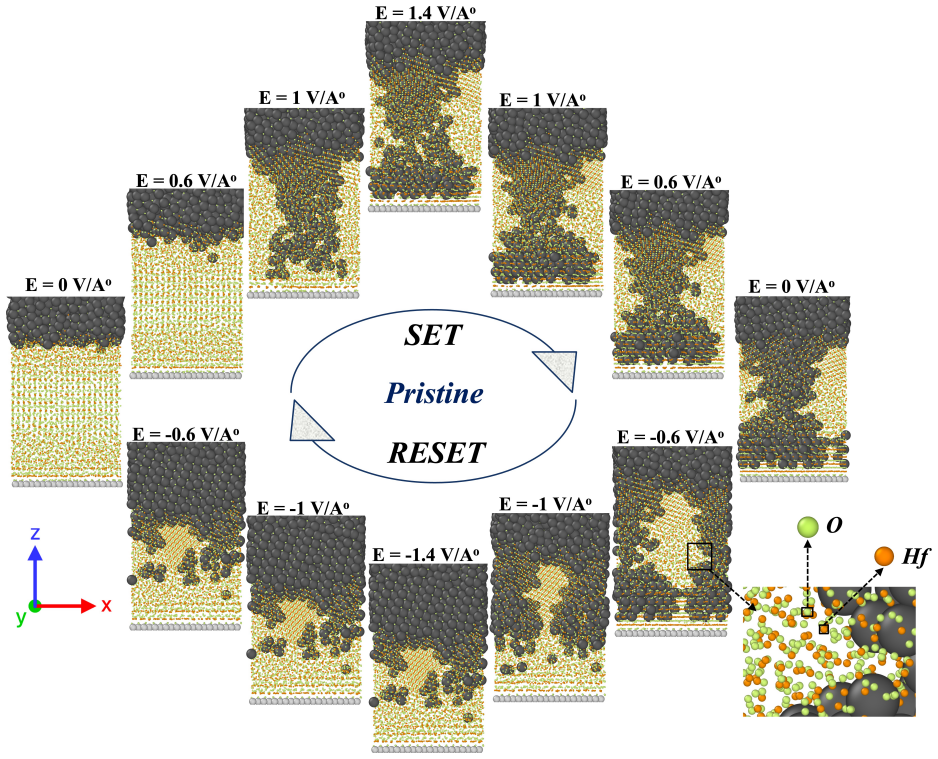
Switching in Ta-HfO₂-Pt memristors is controlled by the formation and rupture of a hybrid filament rich in both Ta cations and oxygen vacancies.
A machine-rendered reading of the paper's core claim, the machinery that carries it, and where it could break.
Core claim
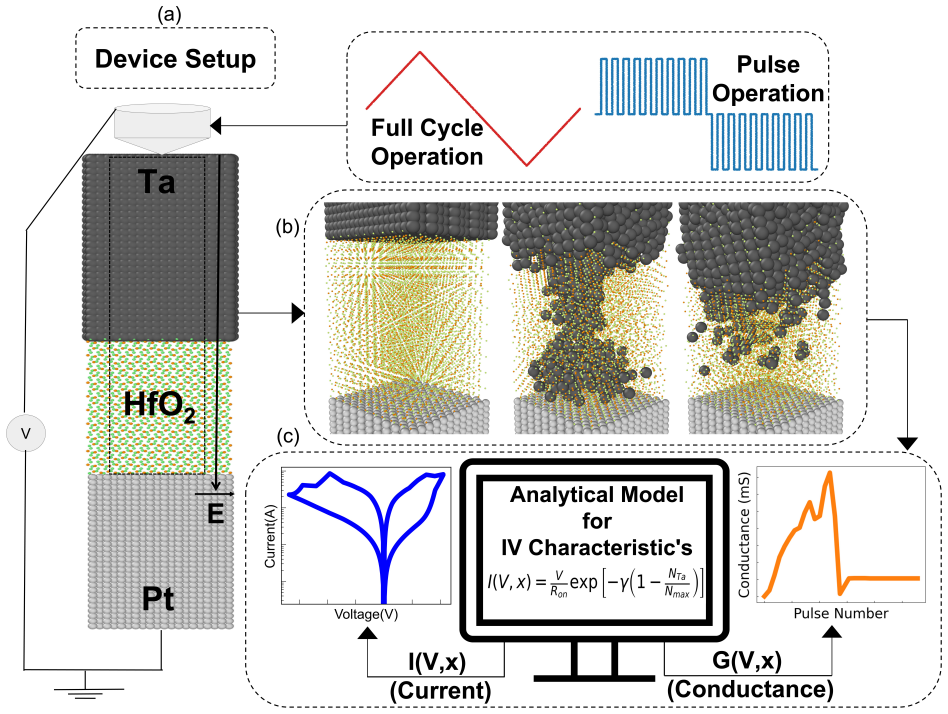
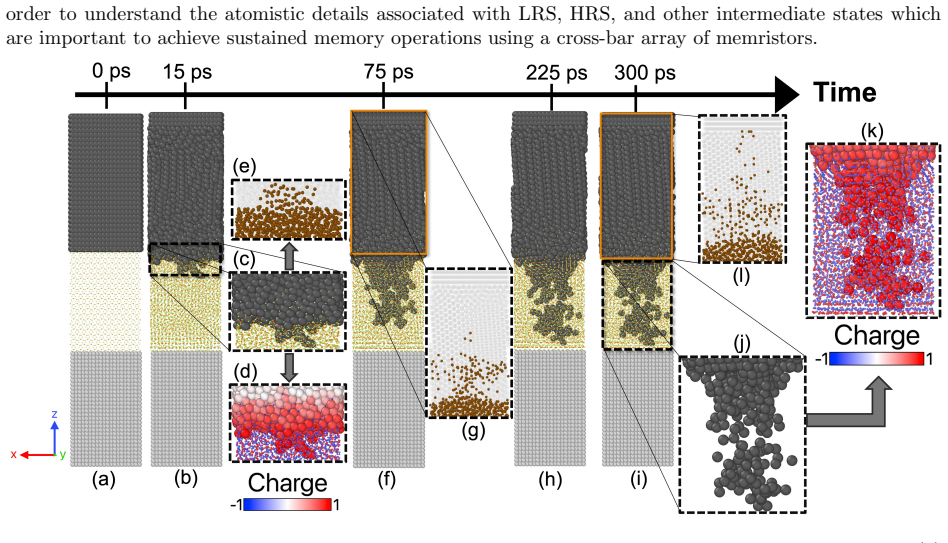
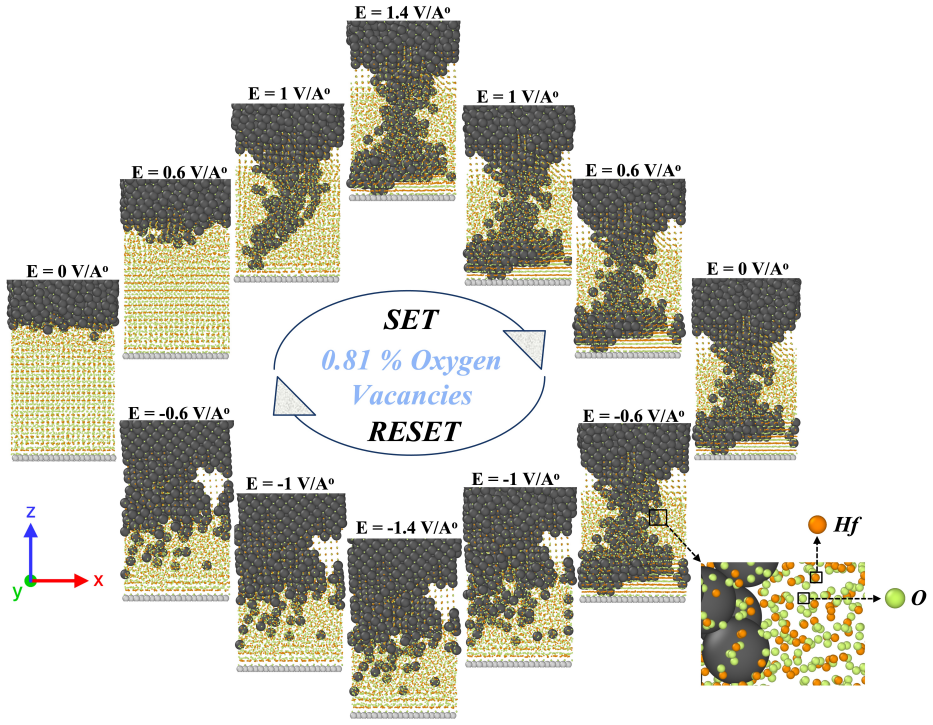
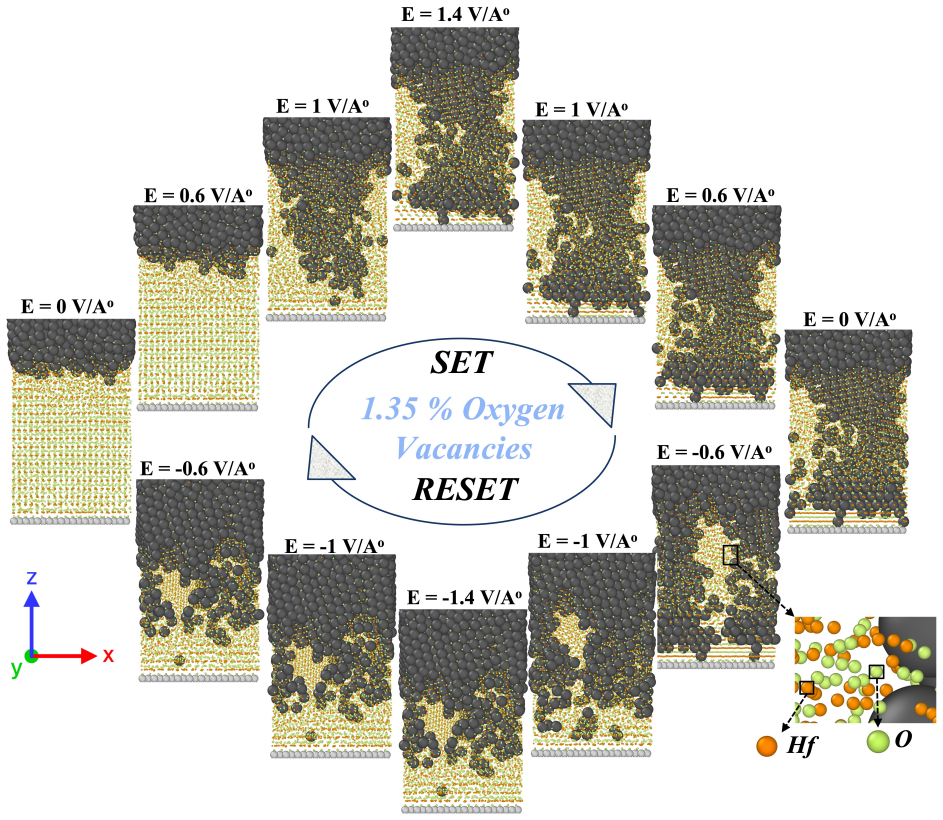
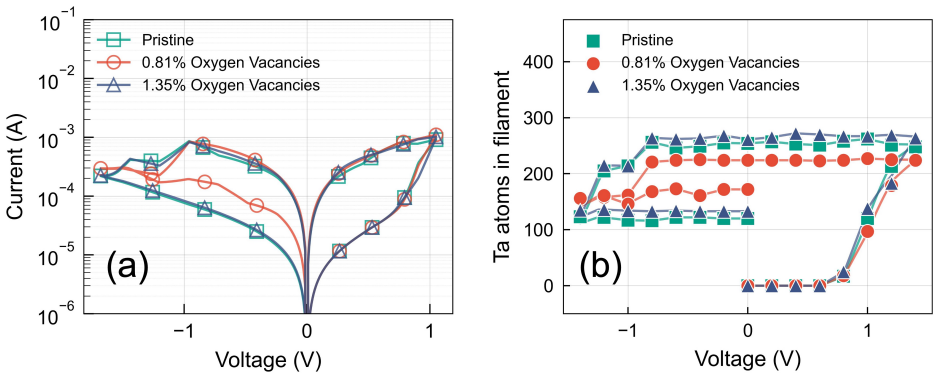
The switching is governed by field-driven formation and rupture of a hybrid Ta-cation-rich, oxygen-deficient filament in HfO₂. Simulations show that varying the initial oxygen vacancy concentrations and spatial configurations within the HfO₂ matrix influences the final morphology and dimensions of the conductive filament.
What carries the argument
Field-driven hybrid Ta-cation and oxygen-deficient filament: the co-formation of a conductive bridge from migrating Ta cations and oxygen vacancies, which carries the switching behavior.
If this is right
- The validated model provides a framework for understanding switching in oxide memristors.
- Designs can be guided to reduce cycle-to-cycle and device-to-device variability in performance.
- Atomistic details of metal cation migration under electric fields are clarified for these devices.
Where Pith is reading between the lines
- Controlling the placement of oxygen vacancies during fabrication could allow tuning of filament dimensions for specific device applications.
- Similar hybrid filaments might operate in other metal-oxide memristor systems beyond Ta-HfO2.
- Accounting for cation diffusion alongside vacancies may improve predictive models for device reliability.
Load-bearing premise
The molecular dynamics simulations with dynamic charge transfer accurately represent the real-world movement of Ta cations and the resulting filament shapes when oxygen vacancies are present in different amounts and positions.
What would settle it
High-resolution imaging or spectroscopy of the filament after switching that shows no significant Ta cation involvement or a purely oxygen-vacancy based structure would contradict the hybrid filament claim.
Figures
read the original abstract
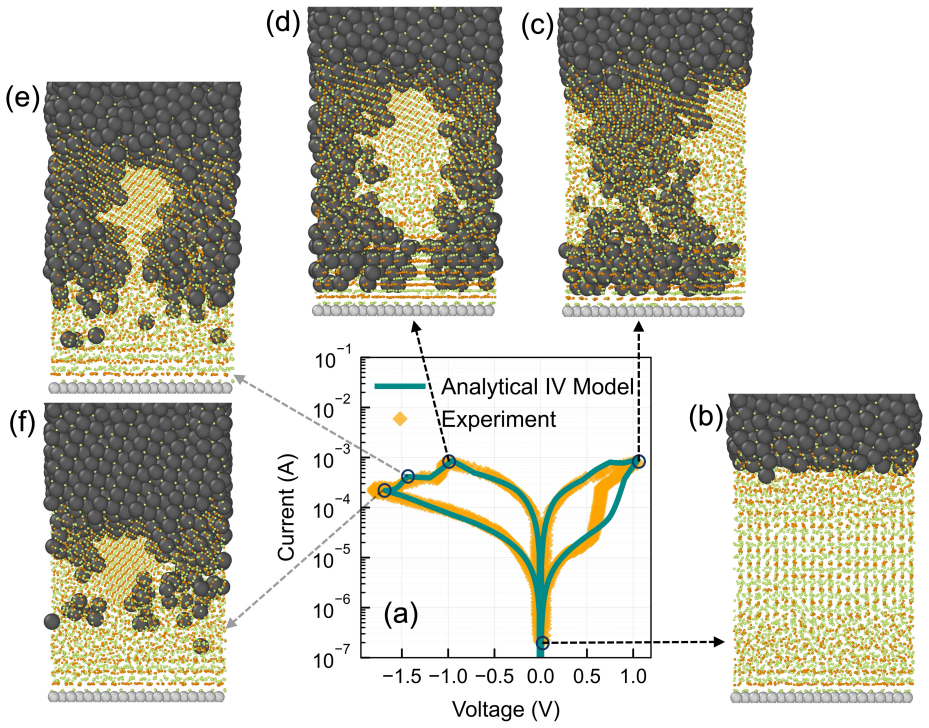
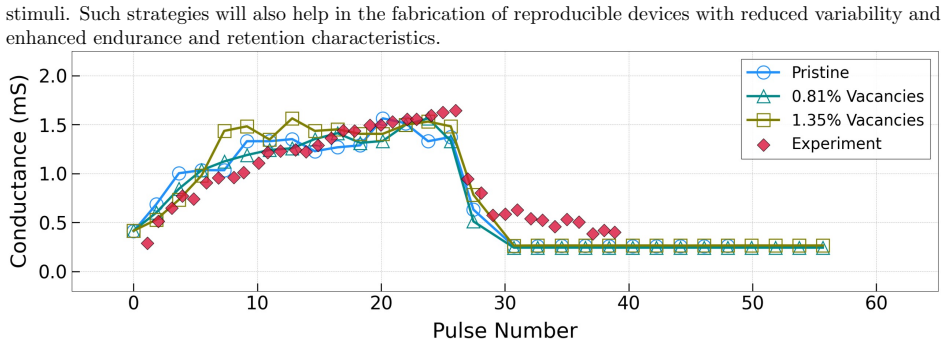
Memristive devices have gained significant attention for their potential in next-generation non-volatile memory and neuromorphic computing architectures. Among emerging candidates, transition metal oxides have proven particularly promising. While the switching mechanism in Ta/HfO$_2$/Pt devices was long attributed solely to oxygen vacancy based filaments, recent experimental evidence suggests a more complex dual-regime: the diffusion of metal cations also contributes to the formation of a conductive bridge. However, the precise atomistic mechanisms governing this metal cation migration remain poorly understood. Additionally, the role of defects such as oxygen vacancies present in the transition metal oxide in determining the final filament size and shape is also not well understood. Here, we employ molecular dynamics (MD) simulations with dynamic charge transfer to provide a detailed analysis of the atomistic mechanisms governing the co-formation of Ta-cation and oxygen-deficient filaments. We clearly show how varying the initial oxygen vacancy concentrations and spatial configurations within the HfO$_2$ matrix influences the final morphology and dimensions of the conductive filament. The switching is governed by field-driven formation and rupture of a hybrid Ta-cation-rich, oxygen-deficient filament in HfO$_2$. Our simulations closely match experiment, validating the model as a robust framework for understanding switching in oxide memristors and guiding designs that reduce cycle-to-cycle and device-to-device variability -- key barriers to high-performance devices.
Editorial analysis
A structured set of objections, weighed in public.
Referee Report
Summary. The manuscript uses molecular dynamics simulations with dynamic charge transfer to analyze switching in Ta/HfO2/Pt memristors. It claims that field-driven co-formation and rupture of a hybrid Ta-cation-rich, oxygen-deficient filament governs the process, that initial oxygen vacancy concentrations and spatial configurations within the HfO2 matrix determine final filament morphology and dimensions, and that the simulations closely match experiment, providing a framework to reduce device variability.
Significance. If the simulations are shown to be quantitatively validated, the work would supply atomistic detail on the dual contribution of metal-cation migration and oxygen vacancies to filament formation, addressing a gap in understanding variability in oxide memristors and offering guidance for device optimization.
major comments (1)
- [Abstract] Abstract: the statement that 'our simulations closely match experiment' is presented without quantitative validation metrics, error analysis, or any description of how the dynamic charge-transfer model was parameterized or benchmarked. This is load-bearing for the central claim of model validation and robustness.
Simulated Author's Rebuttal
We thank the referee for their constructive feedback. We address the single major comment below and agree that revisions to the abstract are warranted to strengthen the presentation of model validation.
read point-by-point responses
-
Referee: [Abstract] Abstract: the statement that 'our simulations closely match experiment' is presented without quantitative validation metrics, error analysis, or any description of how the dynamic charge-transfer model was parameterized or benchmarked. This is load-bearing for the central claim of model validation and robustness.
Authors: We agree that the abstract makes a strong claim without sufficient supporting detail. The main text contains direct comparisons of simulated filament morphology, dimensions, and switching voltages to experimental reports on Ta/HfO2/Pt devices, along with parameterization of the dynamic charge-transfer model against reference Ta-O and Hf-O systems. However, these elements are not referenced in the abstract. In the revised manuscript we will update the abstract to include a concise statement of the key quantitative metrics (filament radius and oxygen deficiency matching within reported experimental ranges) and note the benchmarking procedure, thereby making the validation claim more precise and self-contained. revision: yes
Circularity Check
No significant circularity detected
full rationale
The paper's central claim—that switching is governed by field-driven formation and rupture of a hybrid Ta-cation-rich, oxygen-deficient filament—is presented as a direct conclusion from MD simulations with dynamic charge transfer. These simulations vary initial oxygen vacancy concentrations and spatial configurations to observe effects on filament morphology, with outcomes stated to match experiment. No equations, fitted parameters, or predictions are described that reduce by construction to inputs. No self-citation chains, uniqueness theorems, or ansatzes are invoked as load-bearing elements. The derivation chain is self-contained: simulation results serve as independent evidence for the mechanism without circular reduction to definitions or prior fitted values.
Axiom & Free-Parameter Ledger
Reference graph
Works this paper leans on
-
[1]
Metal oxide- based resistive switching memristors for neuromorphic computing.Journal of Materials Chemistry C 2025,13, 12046–12065
(6) Tian, Q.; Shan, X.; Bian, J.; Cheng, Y.; Zheng, J.; Wang, Z.; Zhao, X.; Xu, H.; Liu, Y. Metal oxide- based resistive switching memristors for neuromorphic computing.Journal of Materials Chemistry C 2025,13, 12046–12065. (7) Nirmal, K. A.; Kumbhar, D. D.; Kesavan, A. V.; Dongale, T. D.; Kim, T. G. Advancements in 2D layered material memristors: unleash...
2025
-
[2]
C.; Akinwande, D
(8) Ge, R.; Wu, X.; Kim, M.; Shi, J.; Sonde, S.; Tao, L.; Zhang, Y.; Lee, J. C.; Akinwande, D. Atomristor: nonvolatile resistance switching in atomic sheets of transition metal dichalcogenides.Nano letters 2018,18, 434–441. (9) Teja Nibhanupudi, S.; Roy, A.; Veksler, D.; Coupin, M.; Matthews, K. C.; Disiena, M.; Ansh; Singh, J. V.; Gearba-Dolocan, I. R.; ...
2018
-
[3]
Picosecond multilevel resistive switching in tantalum oxide thin films.Scientific reports2020,10, 16391
(10) B¨ ottger, U.; von Witzleben, M.; Havel, V.; Fleck, K.; Rana, V.; Waser, R.; Menzel, S. Picosecond multilevel resistive switching in tantalum oxide thin films.Scientific reports2020,10, 16391. (11) Yuan, Z.; Bakhit, B.; Liu, Y.-X.; Sun, Z.; I. Lampronti, G.; Li, X.; Fairclough, S. M.; Tsai, B. K.; Choudhury, A.; Ducati, C., et al. Engineered high end...
2026
-
[4]
W.; Braun, D.; V¨ olkel, L.; Lee, J.; Cruces, S.; Macco, B.; Canto, B., et al
(29) Fa, Y.; Buttberg, M.; Ran, K.; Ahmad, R. W.; Braun, D.; V¨ olkel, L.; Lee, J.; Cruces, S.; Macco, B.; Canto, B., et al. Intermediate Resistive State in Wafer-Scale Vertical MoS2 Memristors Through Lateral Silver Filament Growth for Artificial Synapse Applications.Advanced Functional Materials 2025, e26682. (30) Yan, H.; Zhuang, P.; Li, B.; Ye, T.; Zh...
2025
-
[5]
D.; Hwang, H
(38) Nikam, R. D.; Hwang, H. Atomic threshold switch based on all-2D material heterostructures with ex- cellent control over filament growth and volatility.Advanced Functional Materials2022,32, 2201749. (39) Xie, J.; Yekta, A. E.; Mamun, F. A.; Zhu, K.; Chen, M.; Pazos, S.; Zheng, W.; Zhang, X.; Tongay, S. A.; Li, X., et al. On-chip direct synthesis of bo...
2016
discussion (0)
Sign in with ORCID, Apple, or X to comment. Anyone can read and Pith papers without signing in.