REVIEW 2 major objections 1 minor 4 references
SafeRx-Agent: A Knowledge-Grounded Multi-Agent Framework for Safe and Explainable Medication Recommendation
T0 review · 2 major / 1 minor · reviewed 2026-06-29 · grok-4.3
Pith's one-line read SafeRx-Agent is a multi-agent framework that generates safe, fine-grained medication recommendations using fourth-level ATC codes.
desk verdict The paper defines a new fourth-level ATC medication task and a multi-agent safety framework, but the abstract gives no evidence that the safety step actually catches risks. read the letter →
The pith
A machine-rendered reading of the paper's core claim, the machinery that carries it, and where it could break.
The reading
What carries the argument
The multi-agent framework with knowledge grounding and safety verification for generating fourth-level ATC medication recommendations.
What would settle it
A side-by-side comparison where clinicians review SafeRx-Agent outputs for actual patient visits and identify any missed contraindications or interactions that occurred in reality.
Extended reading notes
Core claim
The paper claims that SafeRx-Agent improves fine-grained medication prediction accuracy while controlling drug interactions, contraindications, and medication set size by using a knowledge-grounded multi-agent framework with patient context, external clinical knowledge, and safety verification on the MIMIC-III and MIMIC-IV datasets.
Load-bearing premise
The multi-agent safety verification reliably identifies unsafe recommendations without missing real risks and that fourth-level ATC granularity meaningfully reduces risk overestimation.
Editorial extensions
If this is right
- Improves accuracy in fine-grained medication prediction.
- Controls for drug interactions and contraindications.
- Produces traceable and explainable medication sets.
- Maintains appropriate medication set sizes.
Reading between the lines
- This method could be adapted to recommend other treatments like procedures or therapies.
- Real-world deployment would require integration with live electronic health records beyond MIMIC data.
- The focus on fourth-level ATC might encourage development of more detailed drug interaction databases.
Signed reviews
Editorial analysis
A structured set of objections, weighed in public.
Referee Report
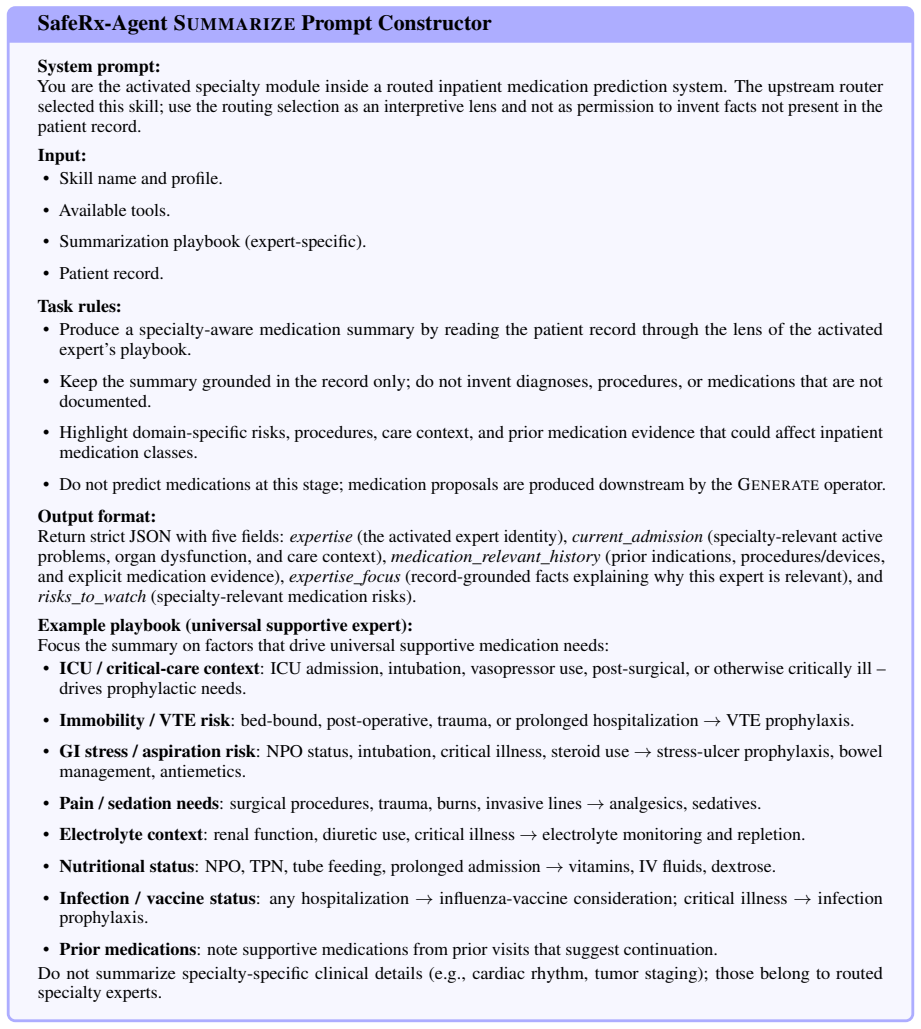
Summary. The manuscript introduces SafeRx-Agent, a knowledge-grounded multi-agent framework for medication recommendation. It targets two challenges: limited evidence grounding in traditional methods and lack of safety verification in LLM agents, plus the use of broad medication categories in benchmarks that can overestimate risk. The work defines a new fine-grained task using fourth-level ATC codes, proposes a multi-agent system that incorporates patient context, external clinical knowledge, and safety verification for traceable recommendations, and reports experimental results on MIMIC-III and MIMIC-IV showing improved fine-grained prediction accuracy while controlling drug interactions, contraindications, and medication set size.
Significance. If the safety verification step can be shown to reliably filter unsafe recommendations, the framework could meaningfully advance safe and explainable LLM-based clinical decision support. The introduction of a fourth-level ATC benchmark is a constructive step toward more realistic safety evaluation in medication recommendation tasks.
major comments (2)
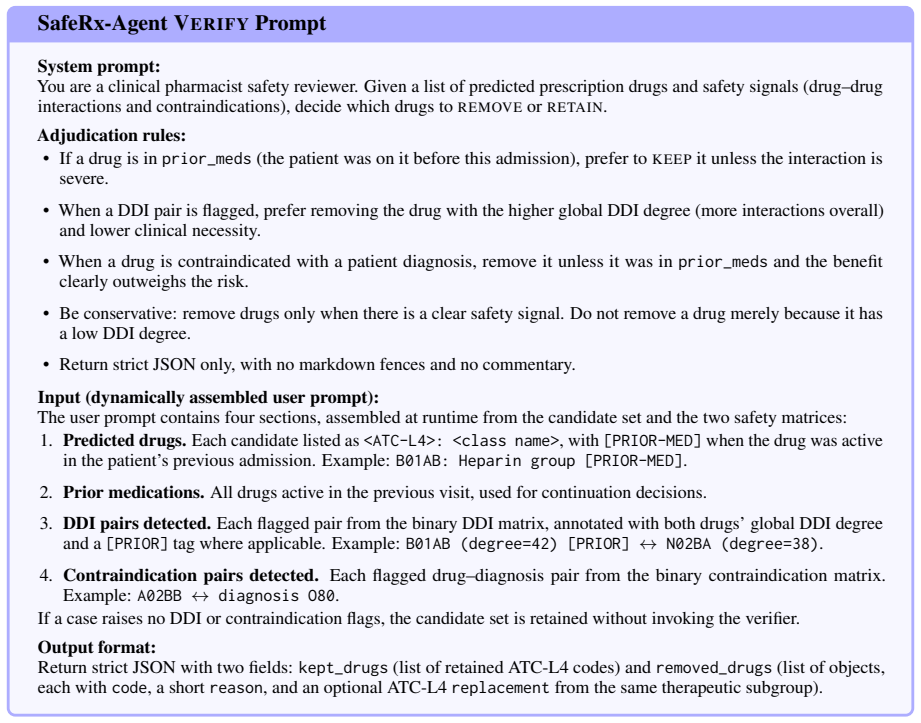
- [Abstract] Abstract (and wherever the safety verification module is described): the central claim that SafeRx-Agent 'controls drug interactions, contraindications' depends on the multi-agent safety verification step reliably identifying unsafe sets. No description of the verification mechanism, no false-negative rates on known contraindications from MIMIC cases, and no comparison against a deterministic drug-interaction database are provided; without these, it is impossible to rule out that accuracy gains arise from uncaught unsafe recommendations.
- [Abstract] Abstract (experimental results paragraph): the reported accuracy improvements on MIMIC-III/IV are presented without reference to baselines, statistical significance tests, error bars, or ablation on the fourth-level ATC granularity versus third-level codes. This makes it difficult to evaluate whether the fine-grained setting materially reduces risk overestimation as claimed.
minor comments (1)
- [Abstract] The abstract would benefit from a one-sentence overview of the multi-agent roles (e.g., which agent performs safety verification) to orient readers before the results claim.
Simulated Author's Rebuttal
We thank the referee for the constructive feedback highlighting the need for greater transparency on the safety verification mechanism and clearer experimental reporting. We address each major comment below.
read point-by-point responses
-
Referee: [Abstract] Abstract (and wherever the safety verification module is described): the central claim that SafeRx-Agent 'controls drug interactions, contraindications' depends on the multi-agent safety verification step reliably identifying unsafe sets. No description of the verification mechanism, no false-negative rates on known contraindications from MIMIC cases, and no comparison against a deterministic drug-interaction database are provided; without these, it is impossible to rule out that accuracy gains arise from uncaught unsafe recommendations.
Authors: We agree the abstract lacks sufficient detail on the verification mechanism. The full manuscript (Section 3.3) describes the multi-agent safety verification process that cross-checks recommendations against patient context and external clinical knowledge bases. To address the concern directly, we will revise the abstract to briefly outline the verification step and add quantitative evaluations: false-negative rates computed on known contraindications extracted from MIMIC cases, plus a head-to-head comparison against a deterministic database such as DrugBank. These additions will appear in a new experimental subsection. revision: yes
-
Referee: [Abstract] Abstract (experimental results paragraph): the reported accuracy improvements on MIMIC-III/IV are presented without reference to baselines, statistical significance tests, error bars, or ablation on the fourth-level ATC granularity versus third-level codes. This makes it difficult to evaluate whether the fine-grained setting materially reduces risk overestimation as claimed.
Authors: The full manuscript already reports baseline comparisons, statistical significance tests, error bars, and ablations contrasting fourth-level versus third-level ATC granularity (Section 4.3 and Appendix). We will update the abstract's experimental paragraph to explicitly reference the baselines, note statistical significance, and highlight the granularity ablation results that support reduced risk overestimation. This is a clarification rather than new analysis. revision: yes
Circularity Check
No circularity: framework proposal with experimental evaluation only
full rationale
The paper introduces a multi-agent framework and a new fine-grained ATC setting, supported by experiments on MIMIC-III/IV. No equations, derivations, parameter fits, or self-citation chains are described that reduce any claim to its own inputs by construction. Claims rest on empirical accuracy and safety metrics rather than any self-referential mathematical step.
Assumptions & free parameters
Cite this review
Pith. "Pith review of SafeRx-Agent: A Knowledge-Grounded Multi-Agent Framework for Safe and Explainable Medication Recommendation." pith.science (2026). https://pith.science/paper/VRXLGW2N
@misc{pith2026260529146,
  author       = {Pith},
  title        = {Pith review of: SafeRx-Agent: A Knowledge-Grounded Multi-Agent Framework for Safe and Explainable Medication Recommendation},
  year         = {2026},
  howpublished = {\url{https://pith.science/paper/VRXLGW2N}},
  note         = {Machine review of arXiv:2605.29146}
}
read the original abstract
Medication recommendation predicts medications for patient visits, but existing methods still face two key challenges. At the model level, traditional drug recommendation methods only predict structured drug codes with limited evidence grounding, while LLM agents can use richer clinical context but may lack safety verification and traceability. At the task level, existing benchmarks often use broad medication categories, which ignore subgroup-level safety differences and can lead to risk overestimation. We introduce the first fine-grained medication recommendation setting based on fourth-level ATC code generation. We propose Safe Prescription Agent (SafeRx-Agent), a knowledge-grounded multi-agent framework that uses patient context, external clinical knowledge, and safety verification to recommend traceable medication sets. Experimental results on MIMIC-III and MIMIC-IV datasets show that SafeRx-Agent improves fine-grained medication prediction accuracy while controlling drug interactions, contraindications, and medication set size.
Figures


Figures from the paper (12 more)






Reference graph
Works this paper leans on
-
[1]
Evaluating large language models for pharma- cotherapy simulations: a mixed-methods study.npj Digital Medicine, 9:355. Dario Garcia-Gasulla, Jordi Bayarri-Planas, Ashwin Ku- mar Gururajan, Enrique Lopez-Cuena, Adrian Tor- mos, Daniel Hinjos, Pablo Bernabeu-Perez, Anna Arias-Duart, Pablo Agustin Martin-Torres, Marta Gonzalez-Mallo, Sergio Alvarez-Napagao, ...
-
[2]
Example:B01AB: Heparin group [PRIOR-MED]
Predicted drugs.Each candidate listed as <ATC-L4>: <class name> , with [PRIOR-MED] when the drug was active in the patient’s previous admission. Example:B01AB: Heparin group [PRIOR-MED]. 2.Prior medications.All drugs active in the previous visit, used for continuation decisions
-
[3]
Example:B01AB (degree=42) [PRIOR]↔N02BA (degree=38)
DDI pairs detected.Each flagged pair from the binary DDI matrix, annotated with both drugs’ global DDI degree and a[PRIOR]tag where applicable. Example:B01AB (degree=42) [PRIOR]↔N02BA (degree=38)
-
[4]
reasoning
Contraindication pairs detected.Each flagged drug–diagnosis pair from the binary contraindication matrix. Example:A02BB↔diagnosis O80. If a case raises no DDI or contraindication flags, the candidate set is retained without invoking the verifier. Output format: Return strict JSON with two fields: kept_drugs (list of retained ATC-L4 codes) and removed_drug...
2026
Reviewed June 29, 2026 · model on record in the stance chip above.
Discussion (0). Continue with ORCID to comment.