Paper Agents, Paper Gains: An Empirical Analysis of DeFi Investment Agents
Pith reviewed 2026-06-29 11:32 UTC · model grok-4.3
The pith
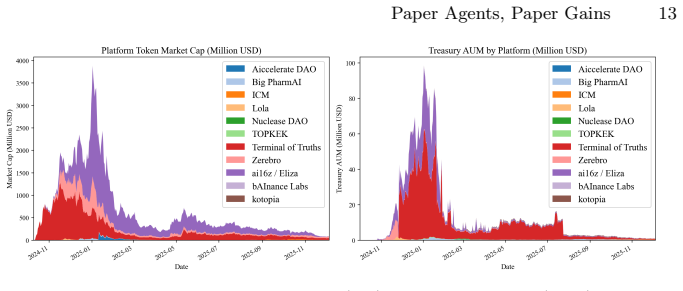
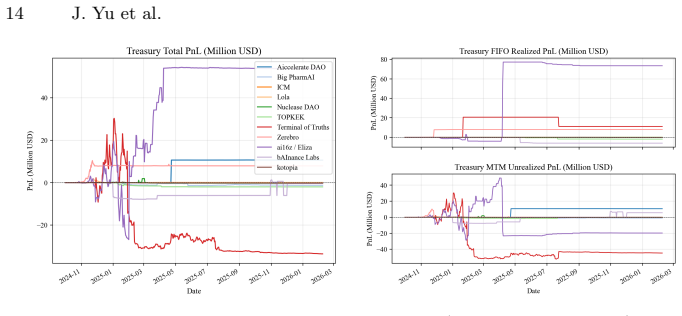
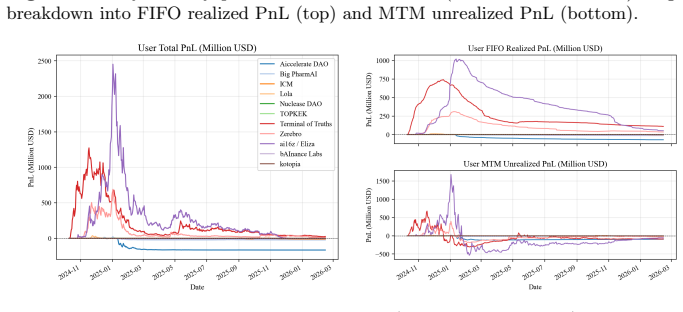
DeFi investment agent treasuries hold over $30M in paper gains while token holders lose $191.7M collectively.
A machine-rendered reading of the paper's core claim, the machinery that carries it, and where it could break.
Core claim
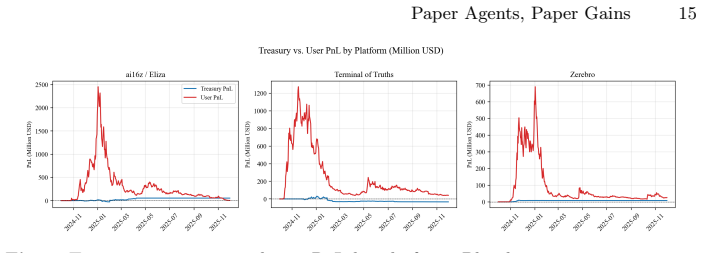
In the sample of 11 Solana-based agent treasuries, agent treasuries retain over USD 30M in paper gains while token holders collectively lost USD 191.7M, with the top 1% of wallets capturing 81.4% of all gains and market-cap-to-AUM ratios exceeding 10,000x. Many projects lack clear evidence of autonomous trade execution, aggregate user gains peaked then fell to net losses, median returns are negative on every platform, and tokens have declined 93% on average from all-time highs.
What carries the argument
Quantitative on-chain performance analysis comparing agent treasury gains to token holder returns across the 11 treasuries, combined with the proposed maturity framework measured on autonomous execution, risk-adjusted profitability, and stakeholder alignment.
If this is right
- Many visible agent deployments appear to be basic API integrations rather than fully autonomous systems.
- Token valuations remain weakly connected to treasury fundamentals, unlike established DeFi protocols.
- User gains across platforms have declined from a peak of $2.4B to net losses with negative median returns.
- The three-dimension maturity framework can be used to measure progress toward investment-grade agent systems.
Where Pith is reading between the lines
- If the gain concentration pattern holds beyond the sample, token-based funding for AI agents may need stronger alignment tools to retain broad participation.
- Repeating the treasury-versus-holder comparison on other chains could reveal whether the observed ratios are Solana-specific or general to early agent markets.
- Community or protocol standards for verifiable autonomy might reduce the number of speculative agents that reach high valuations without demonstrated execution.
Load-bearing premise
The 10 curated projects and 11 Solana treasuries with attributable activity are representative of the broader set of investment-focused agents among the 1,900 surveyed projects.
What would settle it
A larger random sample drawn from the 1,900 projects that shows most deployments executing autonomous trades with aligned returns between treasuries and holders would challenge the reported patterns of limited autonomy and misaligned outcomes.
Figures
read the original abstract
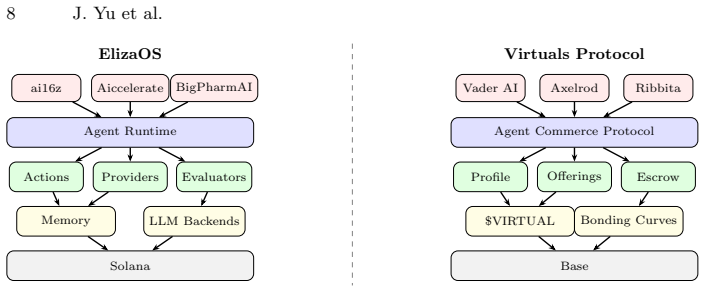
DeFi investment agents, systems that use AI for autonomous on-chain trading, have attained over USD 3 billion in combined token valuations since late 2024. We survey over 1,900 AI-tagged crypto projects, filter to investment-focused agents, and curate 10 representative projects spanning strategy and observability dimensions. We then conduct a deep-dive architectural analysis of two prominent agent frameworks, ElizaOS and Virtuals Protocol, and a quantitative on-chain performance analysis of 11 Solana-based agent treasuries with publicly attributable trading activity, covering 925,323 token holders. We find that current deployments remain early and heterogeneous: (1) in our sample, many projects do not yet provide clear evidence of autonomous trade execution, and developer interviews suggest that many visible deployments remain basic API integrations; (2) agent treasuries retain over USD 30M in paper gains while token holders collectively lost USD 191.7M, with the top 1% of wallets capturing 81.4% of all gains (USD 1.81B); (3) token valuations are weakly connected to treasury fundamentals, with market-cap-to-AUM ratios exceeding 10,000x versus below 1x for established DeFi protocols; and (4) aggregate user gains peaked at USD 2.4B before declining to net losses, with median returns negative on every platform and tokens declining 93% on average from all-time highs. We interpret these outcomes as characteristic of a permissionless, first-generation market in which open infrastructure enables rapid experimentation but also allows naive or speculative agents to launch before robust standards for autonomy, performance, and stakeholder alignment emerge. We therefore propose a maturity framework along three dimensions: autonomous execution, risk-adjusted profitability, and stakeholder alignment, to characterize the gap between current deployments and future investment-grade agent systems.
Editorial analysis
A structured set of objections, weighed in public.
Referee Report
Summary. The paper surveys over 1,900 AI-tagged crypto projects, filters to investment-focused agents, curates 10 representative projects, analyzes two frameworks (ElizaOS and Virtuals Protocol), and performs on-chain analysis of 11 Solana-based agent treasuries (covering 925,323 holders). It reports that many deployments lack clear autonomous execution, agent treasuries hold >USD 30M in paper gains while holders lost USD 191.7M (top 1% capturing 81.4% or USD 1.81B), market-cap-to-AUM ratios exceed 10,000x, aggregate user gains peaked then declined with median negative returns and 93% average token drawdown from ATHs, and proposes a three-dimensional maturity framework (autonomous execution, risk-adjusted profitability, stakeholder alignment).
Significance. If the empirical patterns on treasury vs. holder outcomes, gain concentration, and valuation disconnects generalize beyond the analyzed subset, the work supplies concrete on-chain evidence of misalignment in early DeFi AI agents and a useful diagnostic framework for distinguishing experimental from investment-grade systems. The observational design draws directly from external records and interviews rather than fitted parameters, which strengthens external grounding but limits causal claims.
major comments (2)
- [quantitative on-chain performance analysis of 11 Solana-based agent treasuries] The headline results (USD 30M treasury paper gains vs. USD 191.7M holder losses, top-1% capture of 81.4%, MC/AUM >10,000x) are computed exclusively on the 11 Solana treasuries selected for publicly attributable trading activity. The manuscript notes that many of the 1,900 surveyed projects lack clear evidence of autonomous execution and that visible deployments are often basic API integrations, yet provides no robustness check, random draw of non-attributable treasuries, or comparison to the remaining curated projects to support treating these 11 as representative of investment-focused agents.
- [interpretation and maturity framework proposal] The interpretation that the observed outcomes are 'characteristic of a permissionless, first-generation market' rests on the selected sample without explicit discussion of how the 'publicly attributable trading activity' filter affects generalization; this selection criterion directly shapes the gain/loss disparity and concentration statistics that underwrite the central claim.
minor comments (2)
- [abstract and on-chain analysis] The abstract and methodology description supply aggregate dollar figures and holder counts but do not report error bars, exclusion criteria for the 11 treasuries, or full on-chain query parameters, which would improve reproducibility of the performance metrics.
- [survey and curation section] Clarify the exact criteria used to filter the 1,900 projects down to the 10 curated ones and to the 11 treasuries; a table listing the projects and their inclusion rationale would aid readers.
Simulated Author's Rebuttal
We thank the referee for their constructive comments, which help clarify the scope and limitations of our empirical analysis. We address each major comment below, indicating planned revisions to strengthen the manuscript's transparency on sample selection and generalizability.
read point-by-point responses
-
Referee: [quantitative on-chain performance analysis of 11 Solana-based agent treasuries] The headline results (USD 30M treasury paper gains vs. USD 191.7M holder losses, top-1% capture of 81.4%, MC/AUM >10,000x) are computed exclusively on the 11 Solana treasuries selected for publicly attributable trading activity. The manuscript notes that many of the 1,900 surveyed projects lack clear evidence of autonomous execution and that visible deployments are often basic API integrations, yet provides no robustness check, random draw of non-attributable treasuries, or comparison to the remaining curated projects to support treating these 11 as representative of investment-focused agents.
Authors: We selected the 11 Solana treasuries precisely because they are the subset with publicly attributable trading activity, enabling direct on-chain linkage of treasury performance, holder distributions, and token metrics to specific agents—an essential requirement for the quantitative analysis. The broader survey of 1,900 projects and curation of 10 representative ones already contextualizes that many lack clear autonomous execution. We agree that the manuscript would benefit from greater explicitness on this filter. In revision, we will expand the methods and limitations sections to: (a) detail the selection criteria and why non-attributable treasuries cannot support equivalent analysis, (b) provide a comparison of observable characteristics (e.g., deployment stage, framework usage) between the 11 analyzed treasuries and the remaining curated projects, and (c) include a sensitivity discussion of how the filter may emphasize more visible deployments. A random draw of non-attributable treasuries is not feasible, as they lack identifiable on-chain trading data for performance measurement. revision: partial
-
Referee: [interpretation and maturity framework proposal] The interpretation that the observed outcomes are 'characteristic of a permissionless, first-generation market' rests on the selected sample without explicit discussion of how the 'publicly attributable trading activity' filter affects generalization; this selection criterion directly shapes the gain/loss disparity and concentration statistics that underwrite the central claim.
Authors: The central claims and maturity framework are derived from and scoped to the observable, attributable subset, as these are the deployments where performance data exist. We will revise the interpretation and discussion sections to more explicitly state that the patterns (gain concentration, valuation disconnects, negative median returns) characterize investment-focused agents with detectable on-chain activity, rather than all 1,900 surveyed projects. The framework is presented as a diagnostic tool for distinguishing experimental from investment-grade systems based on these observations, and we will add language clarifying its intended applicability to similar early deployments while noting that broader generalization would require additional data on non-attributable cases. revision: yes
- A random sample or robustness check on non-attributable treasuries cannot be performed, as these lack identifiable trading activity and on-chain data required for the performance metrics.
Circularity Check
No circularity: purely observational empirical analysis
full rationale
The paper reports survey results, on-chain treasury metrics, and interview findings drawn directly from external blockchain records and public project data. No equations, fitted parameters, predictions, or self-citations appear in the provided text; all headline statistics (USD 30M gains, 81.4% concentration, MC/AUM ratios) are computed from the selected 11 treasuries without reduction to internal assumptions or prior author work. The selection criterion is stated explicitly as a data availability filter rather than a derived claim.
Axiom & Free-Parameter Ledger
axioms (1)
- domain assumption The 10 representative projects and 11 treasuries accurately reflect the state of DeFi investment agents.
Forward citations
Cited by 1 Pith paper
-
From Agent Identity to Agent Economy: Measuring the Operational Readiness of ERC-8004 AI Agents
ERC-8004 adoption on Ethereum is registration-heavy with limited metadata, services, reputation, and cross-chain activity, plus high concentration in ownership and feedback networks.
Reference graph
Works this paper leans on
-
[1]
Yu et al
Pantera datboard.https://datboard.panteraresearchlab.xyz/, accessed: 2025- 12-03 20 J. Yu et al
2025
-
[2]
AIXBT: Aixbt.tech – ai-driven crypto market intelligence.https://aixbt.tech/ (2025), accessed: 2025-11-21
2025
-
[3]
AskSurf: Asksurf.ai – crypto’s ultimate ai.https://asksurf.ai/(2025), accessed: 2025-11-21
2025
-
[4]
Axal: Axal: Quick start guide.https://docs.axal.com/getting-started/quick -start/(2025), accessed: 2025-11-21
2025
-
[5]
aixvc.io/(2025), accessed: 2025-11-21
Axelrod, A..: Axr / axelrod by aixvc: Agentic quant fund platform.https://axr. aixvc.io/(2025), accessed: 2025-11-21
2025
-
[6]
In: Future Generation Computer Systems
Bartoletti, M., Carta, S., Cimoli, T., Saia, R.: Dissecting ponzi schemes on ethereum: Identification, analysis, and impact. In: Future Generation Computer Systems. vol. 102, pp. 259–277. Elsevier (2020)
2020
-
[7]
Accessed: 2025-11-21
Bellan, R.: The promise and warning of Truth Terminal, the ai bot that secured $50,000 in bitcoin from marc andreessen.https://techcrunch.com/2024/12/1 9/the-promise-and-warning-of-truth-terminal-the-ai-bot-that-secured -50000-in-bitcoin-from-marc-andreessen/(Dec 2024), techCrunch. Accessed: 2025-11-21
2024
- [8]
-
[9]
Coinbase: Ai16z price.https://www.coinbase.com/price/ai16z(2025), accessed: 2025-09-08
2025
-
[10]
CoinGecko: Top AI agents coins by market cap.https://www.coingecko.com/en /categories/ai-agents(2025), accessed: 2025-11-30
2025
-
[11]
CoinMarketCap: Coinmarketcap (2025),https://coinmarketcap.com, accessed: 2025-09-06
2025
-
[12]
CoinMarketCap: Top solana ecosystem tokens by market capitalization.https: //coinmarketcap.com/view/solana-ecosystem/(Jun 2025), accessed: 2025-06- 25
2025
-
[13]
Conlon, T., Corbet, S., et al.: Memecoin contagion: Irrationality, illicit behaviour, and contagion in rapid memecoin growth. Journal of Behavioral and Experimental Finance50, 101518 (2025).https://doi.org/10.1016/j.jbef.2025.101518, https://doi.org/10.1016/j.jbef.2025.101518
-
[14]
Crypto.com University: What is elizaos?https://crypto.com/es/university/w hat-is-elizaos(2025), accessed: 2025-09-08
2025
-
[15]
In: IEEE S&P (2020)
Daian, P., Goldfeder, S., Kell, T., Li, Y., Zhao, X., Bentov, I., Breidenbach, L., Juels, A.: Flash boys 2.0: Frontrunning in decentralized exchanges, miner ex- tractable value, and consensus instability. In: IEEE S&P (2020)
2020
-
[16]
https://decrypt.co/295717/meet-ai16z-dao-an-ai-based-investment-proje ct-that-aims-to-upend-silicon-valley(2024), accessed: 2026-05-05
Decrypt: Meet ai16z, an AI-based investment DAO inspired by marc andreessen. https://decrypt.co/295717/meet-ai16z-dao-an-ai-based-investment-proje ct-that-aims-to-upend-silicon-valley(2024), accessed: 2026-05-05
2024
-
[17]
Decrypt: AI DAO ai16z becomes elizaos amid branding confusion concerns.https: //decrypt.co/303244/ai-dao-ai16z-becomes-elizaos-amid-branding-confu sion-concerns(2025), accessed: 2026-05-05
2025
-
[18]
Dune Analytics: Dune: Onchain data platform.https://dune.com/(2025), ac- cessed: 2025-02-14
2025
-
[19]
https://dune.com/queries/6697062(2025), accessed: 2025-02-14
Dune Analytics: Platform treasury PnL with FIFO realized and MTM unrealized. https://dune.com/queries/6697062(2025), accessed: 2025-02-14
-
[20]
Dune Analytics: Token daily price snapshots.https://dune.com/queries/66972 97(2025), accessed: 2025-02-14
2025
- [21]
-
[22]
ElizaOS: Elizaos developer documentation: Plugin components.https://docs.e lizaos.ai/plugins/components(2025), accessed: 2025-11-30
2025
-
[23]
ElizaOS: Elizaos plugin registry.https://github.com/elizaos-plugins/regis try(2025), accessed: 2025-11-30
2025
-
[24]
ElizaOS: Elizaos.ai – agentic operating system for ai agents.https://www.elizao s.ai/(2025), accessed: 2025-11-21
2025
-
[25]
ElizaOS: plugin-hyperliquid: Hyperliquid DEX integration for ElizaOS.https: //github.com/elizaos-plugins/plugin-hyperliquid(2025), accessed: 2025-11- 30
2025
-
[26]
ElizaOS: plugin-solana: Core Solana blockchain plugin for ElizaOS.https://gith ub.com/elizaos-plugins/plugin-solana(2025), accessed: 2025-11-30
2025
-
[27]
arXiv preprint arXiv:2601.00523 (2026)
F´ abrega, A., Austgen, J., Breckenridge, S., Yu, J., Zhao, A., Allen, S., Saraf, A., Juels, A.: The CoinAlg bind: Profitability-fairness tradeoffs in collective investment algorithms. arXiv preprint arXiv:2601.00523 (2026)
-
[28]
Fan, T., Yang, Y., Jiang, Y., Zhang, Y., Chen, Y., Huang, C.: AI-Trader: Benchmarking autonomous agents in real-time financial markets. arXiv preprint arXiv:2512.10971 (2025)
-
[29]
Giza: Giza protocol documentation.https://docs.gizaprotocol.ai/(2025), accessed: 2025-11-21
2025
-
[30]
Columbia Law Review (2017)
Ji, M.: Are Robots Good Fiduciaries? Regulating Robo-Advisors Under the In- vestment Advisers Act of 1940. Columbia Law Review (2017)
1940
-
[31]
In: Financial Cryptography and Data Security (FC) (2023)
Kell, T., Cr´ epault, H., Hua, Y., Liu, S., Sun, X., Mudgal, C., Juels, A.: Forsage: Anatomy of a smart-contract pyramid scheme. In: Financial Cryptography and Data Security (FC) (2023)
2023
-
[32]
LLM-Powered Multi-Agent System for Automated Crypto Portfolio Management
Luo, Y., Feng, Y., Xu, J., Tasca, P., Liu, Y.: LLM-powered multi-agent system for automated crypto portfolio management. arXiv preprint arXiv:2501.00826 (2025)
work page internal anchor Pith review Pith/arXiv arXiv 2025
-
[33]
Messari: Crypto fundraising database.https://messari.io/fundraising-data (2025), accessed: 2025-11-30
2025
-
[34]
NoF1: Nof1.ai – project homepage.https://nof1.ai/(2025), accessed: 2025-11-21
2025
-
[35]
Numerai: Numerai crypto – overview.https://docs.numer.ai/numerai-crypto/ crypto-overview(2025), accessed: 2025-11-21
2025
-
[36]
arXiv preprint arXiv:2510.11695 (2025)
Qian, L., Peng, X., Wang, Y., Zhang, V.J., He, H., Smith, H., Han, Y., He, Y., Li, H., Cao, Y., Yu, Y., Lopez-Lira, A., Lu, P., Nie, J.Y., Xiong, G., Huang, J., Ananiadou, S.: When agents trade: Live multi-market trading benchmark for LLM agents. arXiv preprint arXiv:2510.11695 (2025)
-
[37]
In: Proceedings of the 21st ACM internet measurement conference
Qin, K., Zhou, L., Gamito, P., Jovanovic, P., Gervais, A.: An empirical study of defi liquidations: Incentives, risks, and instabilities. In: Proceedings of the 21st ACM internet measurement conference. pp. 336–350 (2021)
2021
-
[38]
In: International conference on financial cryptography and data security
Qin, K., Zhou, L., Livshits, B., Gervais, A.: Attacking the defi ecosystem with flash loans for fun and profit. In: International conference on financial cryptography and data security. pp. 3–32. Springer (2021)
2021
-
[39]
In: 2024 IEEE International Conference on Blockchain and Cryptocurrency (ICBC 2024)
Sharma, T., Potter, Y., Pongmala, K., Wang, H., Miller, A., Song, D., Wang, Y.: Unpacking how decentralized autonomous organizations (daos) work in practice. In: 2024 IEEE International Conference on Blockchain and Cryptocurrency (ICBC 2024). pp. 416–424. Institute of Electrical and Electronics Engineers (IEEE), Dublin, Ireland (2024).https://doi.org/10.1...
-
[40]
Terminal, T.: Truthterminal.wiki – the truth terminal project.https://truthter minal.wiki/(2025), accessed: 2025-11-21
2025
-
[41]
Yu et al
TrueNorth: Truenorth – crypto’s first ai discovery engine.https://www.true-nor th.xyz/(2025), accessed: 2025-11-21 22 J. Yu et al
2025
-
[42]
Virtuals Protocol: Agent commerce protocol: Technical deep dive.https://whit epaper.virtuals.io/about-virtuals/agent-commerce-protocol-acp/technic al-deep-dive(2025), accessed: 2025-11-30
2025
-
[43]
https://whitepaper.virtuals.io/builders- hub/game- framework(2025), accessed: 2025-11-30
Virtuals Protocol: GAME framework: Generative autonomous multimodal entities. https://whitepaper.virtuals.io/builders- hub/game- framework(2025), accessed: 2025-11-30
2025
-
[44]
Virtuals Protocol: GAME Python SDK.https://github.com/game-by-virtual s/game-python(2025), accessed: 2025-11-30
2025
-
[45]
Virtuals Protocol: Virtuals protocol smart contracts.https://github.com/Virtu al-Protocol/protocol-contracts(2025), accessed: 2025-11-30
2025
-
[46]
io/#background(2025), accessed: 2025-06-25
Virtuals Protocol: Virtuals protocol whitepaper.https://whitepaper.virtuals. io/#background(2025), accessed: 2025-06-25
2025
- [47]
-
[48]
In: Proceedings of the 28th USENIX Security Symposium
Xu, J., Livshits, B.: The anatomy of a cryptocurrency pump-and-dump scheme. In: Proceedings of the 28th USENIX Security Symposium. pp. 1609–1625 (2019)
2019
-
[49]
Fingpt: Open-source financial large language models.arXiv preprint arXiv:2306.06031,
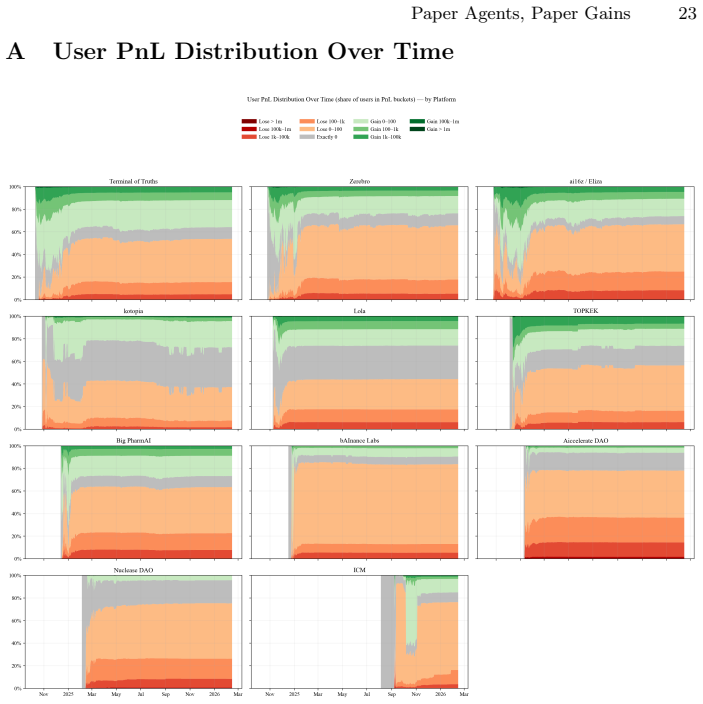
Yang, H., Liu, X.Y., Wang, C.D.: FinGPT: Open-source financial large language models. arXiv preprint arXiv:2306.06031 (2023) Paper Agents, Paper Gains 23 A User PnL Distribution Over Time Fig. 6.User PnL distribution over time by platform. Each subplot shows the share of users in different PnL buckets (from large losses in red to large gains in green, wit...
discussion (0)
Sign in with ORCID, Apple, or X to comment. Anyone can read and Pith papers without signing in.