A Variational Quantum Algorithm for Nonlinear Finite Element Analysis of Hyperelastic Materials
Pith reviewed 2026-06-29 11:09 UTC · model grok-4.3
The pith
A hybrid quantum-classical method uses polynomial approximations to solve nonlinear hyperelastic finite element problems on NISQ devices.
A machine-rendered reading of the paper's core claim, the machinery that carries it, and where it could break.
Core claim
By introducing polynomial approximations of the nonlinear strain energy density, the energy functional of hyperelastic finite element problems becomes compatible with variational quantum algorithms; the resulting hybrid quantum-classical optimization recovers approximate solutions for the one-dimensional NeoHookean bar using both linear and quadratic shape functions and nonhomogeneous boundary data.
What carries the argument
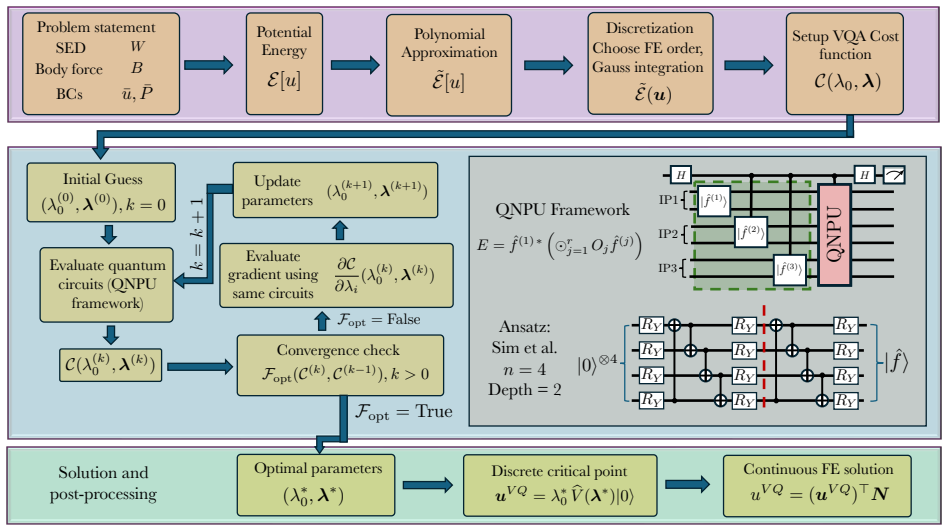
Hybrid variational optimization of a polynomially approximated strain-energy functional evaluated by parameterized quantum circuits on finite-element discretizations of hyperelastic materials.
If this is right
- The method accommodates nonhomogeneous boundary conditions within the variational quantum framework.
- Both first- and second-order finite-element shape functions can be used without breaking compatibility with the quantum circuit representation.
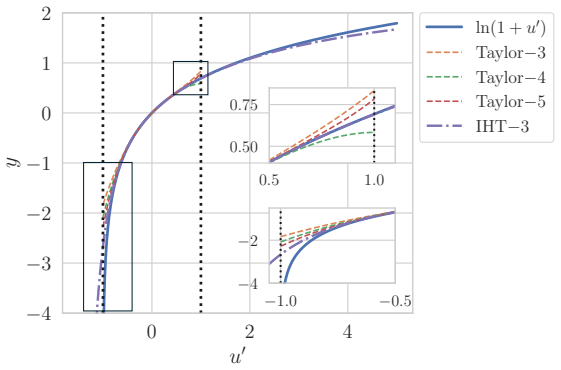
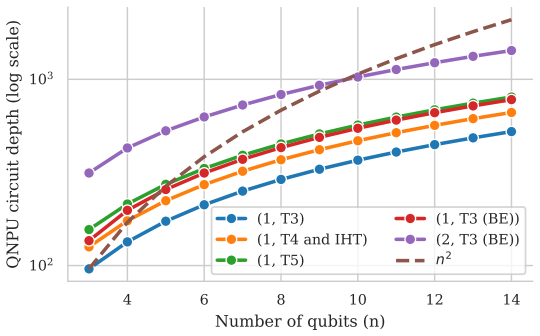
- Accuracy and efficiency vary systematically with the degree of the polynomial approximation to the strain energy.
- The formulation demonstrates practical feasibility on near-term quantum hardware for at least this class of one-dimensional nonlinear problems.
Where Pith is reading between the lines
- If the polynomial approximation technique generalizes without prohibitive growth in circuit depth, similar variational quantum formulations could be attempted for two- and three-dimensional hyperelastic problems.
- The same energy-based reduction might apply to other nonlinear constitutive models whose strain-energy functions admit low-order polynomial fits.
- Scalability tests on larger meshes would reveal whether the hybrid loop remains tractable once the number of degrees of freedom exceeds the capacity of current NISQ devices.
Load-bearing premise
Polynomial approximations of the nonlinear strain energy density remain accurate enough to preserve the essential physics of hyperelasticity.
What would settle it
Numerical comparison of the quantum-optimized nodal displacements against a classical nonlinear finite-element solver for the same 1D NeoHookean bar, with the discrepancy growing beyond a fixed tolerance as the polynomial degree is increased.
Figures
read the original abstract
This manuscript explores a variational quantum formulation for nonlinear elasticity problems arising from hyperelastic material models, targeting near term noisy intermediate scale quantum (NISQ) devices. The approach leverages the potential energy structure of hyperelasticity and employs a hybrid quantum classical framework in which the energy functional is evaluated using parameterized quantum circuits and optimized through classical routines. To enable implementation on current quantum hardware, polynomial approximations of the nonlinear strain energy density are introduced, yielding a representation compatible with variational quantum algorithms. The methodology is demonstrated on a one dimensional NeoHookean material model using finite element discretizations with first and second order shape functions and nonhomogeneous boundary conditions. Numerical experiments investigate the influence of the polynomial approximation order on the accuracy and efficiency of the proposed approach, illustrating its feasibility for near term quantum devices.
Editorial analysis
A structured set of objections, weighed in public.
Referee Report
Summary. The manuscript proposes a hybrid quantum-classical variational algorithm for nonlinear finite element analysis of hyperelastic materials. It approximates the nonlinear strain-energy density by polynomials to enable evaluation on NISQ hardware, then minimizes the resulting energy functional via parameterized quantum circuits and classical optimization. The method is illustrated on a one-dimensional Neo-Hookean bar discretized with linear and quadratic elements subject to non-homogeneous boundary conditions; numerical experiments examine the effect of polynomial order on solution accuracy and computational cost.
Significance. A working demonstration on even a simplified 1D hyperelastic problem would constitute a first step toward quantum-assisted nonlinear mechanics. The polynomial approximation strategy is a concrete technical contribution that preserves the variational structure while remaining compatible with existing VQA primitives. However, the absence of reported error norms, convergence rates, or classical benchmarks in the supplied description limits the immediate significance; if such metrics were added and showed acceptable accuracy, the work would usefully document feasibility for near-term devices.
major comments (2)
- [Abstract, §4] Abstract and §4 (numerical experiments): the feasibility claim rests on numerical experiments that investigate polynomial order, yet no quantitative error metrics (e.g., L2 displacement error, energy error), convergence tables, or direct comparisons against classical FEM solvers are supplied. Without these data the demonstration remains qualitative and does not yet substantiate the accuracy/efficiency statements.
- [§3.2] §3.2 (polynomial approximation): the claim that the polynomial representation “preserves the essential physics” is asserted but not accompanied by an a-priori error bound or a numerical study of how the approximation error propagates into the finite-element solution for the chosen Neo-Hookean model. A concrete bound or at least tabulated residual norms versus polynomial degree would be required to make the approximation step load-bearing rather than heuristic.
minor comments (2)
- [§2] Notation for the strain-energy density W and its polynomial surrogate W_p should be introduced once and used consistently; the current text alternates between symbols without explicit definition.
- [§4] Figure captions for the 1D bar results should state the element type, polynomial degree, and boundary conditions used in each panel to allow immediate comparison with the text.
Simulated Author's Rebuttal
We thank the referee for the detailed and constructive report. We address the two major comments point by point below and will revise the manuscript to incorporate additional quantitative analysis.
read point-by-point responses
-
Referee: [Abstract, §4] Abstract and §4 (numerical experiments): the feasibility claim rests on numerical experiments that investigate polynomial order, yet no quantitative error metrics (e.g., L2 displacement error, energy error), convergence tables, or direct comparisons against classical FEM solvers are supplied. Without these data the demonstration remains qualitative and does not yet substantiate the accuracy/efficiency statements.
Authors: We agree that the current presentation of the numerical results in §4 is primarily qualitative. In the revised manuscript we will add explicit L2 displacement and total-energy error norms, tabulated convergence data versus polynomial degree, and side-by-side comparisons with classical FEM solutions obtained with the same discretizations. These additions will be placed in a new subsection of §4 and referenced from the abstract. revision: yes
-
Referee: [§3.2] §3.2 (polynomial approximation): the claim that the polynomial representation “preserves the essential physics” is asserted but not accompanied by an a-priori error bound or a numerical study of how the approximation error propagates into the finite-element solution for the chosen Neo-Hookean model. A concrete bound or at least tabulated residual norms versus polynomial degree would be required to make the approximation step load-bearing rather than heuristic.
Authors: Section 4 already contains numerical experiments that track solution accuracy as a function of polynomial degree for the Neo-Hookean model. To strengthen the theoretical grounding we will add (i) a short a-priori error estimate based on standard polynomial approximation theory for the strain-energy density and (ii) a table of residual norms (difference between exact and approximated energy density) versus polynomial degree, together with a brief discussion of how these residuals affect the finite-element solution. These items will be inserted into §3.2. revision: yes
Circularity Check
No significant circularity in the derivation chain
full rationale
The paper introduces an explicit polynomial approximation to the nonlinear strain-energy density as a design choice to enable VQA compatibility on NISQ hardware, then demonstrates the resulting hybrid method numerically on a 1D Neo-Hookean bar using standard FEM shape functions and boundary conditions. The central result is a feasibility illustration whose accuracy is assessed by direct comparison to classical solutions; no step equates a fitted parameter to a claimed prediction by construction, no uniqueness theorem is imported from self-citation, and the optimization loop remains a standard VQA-classical FEM hybrid without self-referential reduction.
Axiom & Free-Parameter Ledger
free parameters (1)
- polynomial approximation order
axioms (2)
- domain assumption The hyperelastic potential energy functional can be evaluated to sufficient accuracy by a parameterized quantum circuit
- domain assumption Polynomial truncation of the strain-energy density preserves the essential nonlinear response for the chosen finite-element discretizations
Reference graph
Works this paper leans on
-
[1]
A data compressor for FPGA-based state vector quantum simulators
Kaijie Wei et al. “A data compressor for FPGA-based state vector quantum simulators”. In:Proceedings of the 14th International Symposium on Highly Efficient Accelerators and Reconfigurable Technologies. HEART ’24. Porto, Portugal: Association for Computing Ma- chinery, 2024, pp. 63–70.isbn: 9798400717277.doi:10.1145/3665283.3665293.url:https: //doi.org/10...
-
[2]
A Survey of Important Issues in Quantum Com- puting and Communications
Zebo Yang, Maede Zolanvari, and Raj Jain. “A Survey of Important Issues in Quantum Com- puting and Communications”. In:IEEE Communications Surveys & Tutorials25.2 (2023). A broad survey of architectures, algorithms, and challenges in quantum computing and com- munication., pp. 1059–1100.doi:10.1109/COMST.2023.3241234
-
[3]
Improved Quantum Algorithms for Linear and Nonlinear Differential Equations
Andrew M. Childs, Jin-Peng Liu, and Aaron Ostrander. “Improved Quantum Algorithms for Linear and Nonlinear Differential Equations”. In:Quantum7 (2023). High-level development of quantum algorithms for both linear and nonlinear differential equations., p. 913.doi: 10.22331/q-2023-02-02-913
-
[4]
Giorgio Tosti Balducci et al. “Review and perspectives in quantum computing for partial differential equations in structural mechanics”. In:Frontiers in Mechanical EngineeringVol- ume 8 - 2022 (2022).issn: 2297-3079.doi:10 . 3389 / fmech . 2022 . 914241.url:https : / / www . frontiersin . org / journals / mechanical - engineering / articles / 10 . 3389 / ...
-
[5]
Dominic W. Berry.Quantum algorithm for linear differential equations. arXiv:1701.03684. 2017
work page internal anchor Pith review Pith/arXiv arXiv 2017
-
[6]
Quantum Algorithms for Linear and Nonlinear Differential Equations
Jin-Peng Liu. “Quantum Algorithms for Linear and Nonlinear Differential Equations”. PhD thesis. University of Maryland, 2022
2022
-
[7]
Quantum Algorithm for Linear Systems of Equations
Aram W. Harrow, Avinatan Hassidim, and Seth Lloyd. “Quantum Algorithm for Linear Systems of Equations”. In:Physical Review Letters103.15 (2009), p. 150502.doi:10.1103/ PhysRevLett.103.150502
2009
-
[8]
Seth Lloyd. “Universal Quantum Simulators”. In:Science273.5278 (1996), pp. 1073–1078. doi:10.1126/science.273.5278.1073
-
[9]
Hamiltonian simulation using linear combinations of unitary operations
Dominic W. Berry and Andrew M. Childs. “Hamiltonian simulation using linear combinations of unitary operations”. In:Quantum Information and Computation12 (2012), pp. 29–62
2012
-
[10]
A Grand Unification of Quantum Algorithms
John M. Martyn et al. “A Grand Unification of Quantum Algorithms”. In:PRX Quantum2 (2021), p. 040203.doi:10.1103/PRXQuantum.2.040203
-
[11]
Quantum Algorithms for Systems of Linear Equations Inspired by Adiabatic Quantum Computing
Yigit Suba¸ sı, Rolando D. Somma, and Davide Orsucci. “Quantum Algorithms for Systems of Linear Equations Inspired by Adiabatic Quantum Computing”. In:Physical Review Letters 122.6 (2019), p. 060504.doi:10.1103/PhysRevLett.122.060504
-
[12]
Quantum algorithm and circuit design solving the Poisson equation
Yudong Cao et al. “Quantum algorithm and circuit design solving the Poisson equation”. In: New Journal of Physics15.1 (2013), p. 013021.doi:10.1088/1367-2630/15/1/013021
-
[13]
Quantum algorithms and the finite element method
Ashley Montanaro and Sam Pallister. “Quantum algorithms and the finite element method”. In:Physical Review A93.3 (2016), p. 032324.doi:10.1103/PhysRevA.93.032324
-
[14]
Quantum computing in the nisq era and beyond.Quantum2, 79 (2018)
John Preskill. “Quantum Computing in the NISQ era and beyond”. In:Quantum2 (2018), p. 79.doi:10.22331/q-2018-08-06-79. 32
work page internal anchor Pith review doi:10.22331/q-2018-08-06-79 2018
-
[15]
Noisy intermediate-scale quantum algorithms
Kishor Bharti et al. “Noisy intermediate-scale quantum algorithms”. In:Rev. Mod. Phys.94 (1 Feb. 2022), p. 015004.doi:10.1103/RevModPhys.94.015004.url:https://link.aps. org/doi/10.1103/RevModPhys.94.015004
work page doi:10.1103/revmodphys.94.015004.url:https://link.aps 2022
-
[16]
A variational eigenvalue solver on a photonic quantum processor
Alberto Peruzzo et al. “A variational eigenvalue solver on a photonic quantum processor”. In:Nature Communications5.1 (2014), p. 4213.doi:10.1038/ncomms5213.url:https: //doi.org/10.1038/ncomms5213
-
[17]
Variational Quantum Linear Solver
Carlos Bravo-Prieto et al. “Variational Quantum Linear Solver”. In:Quantum7 (Nov. 2023), p. 1188.doi:10.22331/q-2023-11-22-1188.url:https://doi.org/10.22331/q-2023- 11-22-1188
work page doi:10.22331/q-2023-11-22-1188.url:https://doi.org/10.22331/q-2023- 2023
-
[18]
An implementation of the finite element method in hybrid classical/quantum computers
A. Arora, B. M. Ward, and C. Oskay. “An implementation of the finite element method in hybrid classical/quantum computers”. In:Finite Elements in Analysis and Design248 (2025), p. 104354
2025
-
[19]
Performance Study of Variational Quantum Linear Solver for Linear Elastic Problems
Xiang Rao and Kou Du. “Performance Study of Variational Quantum Linear Solver for Linear Elastic Problems”. In:Computational and Experimental Simulations in Engineering. Ed. by Kun Zhou. Vol. 168. Mechanisms and Machine Science. Cham: Springer, 2024, pp. 80–94. isbn: 978-3-031-68775-4.doi:10.1007/978-3-031-68775-4_6
-
[20]
Divergence-free algorithms for solving nonlinear differential equations on quantum computers
Katsuhiro Endo and Kazuaki Z. Takahashi. “Divergence-free algorithms for solving nonlinear differential equations on quantum computers”. In:Phys. Rev. Res.8 (1 Jan. 2026), p. 013057. doi:10.1103/2hfp-qyz1.url:https://link.aps.org/doi/10.1103/2hfp-qyz1
work page doi:10.1103/2hfp-qyz1.url:https://link.aps.org/doi/10.1103/2hfp-qyz1 2026
-
[21]
A quantum nonlinear solver based on the asymptotic numerical method
Yongchun Xu et al. “A robust quantum nonlinear solver based on the asymptotic numerical method”. In:arXiv preprint arXiv:2412.03939(2024).doi:10.48550/arXiv.2412.03939. url:https://arxiv.org/abs/2412.03939
work page internal anchor Pith review Pith/arXiv arXiv doi:10.48550/arxiv.2412.03939 2024
-
[22]
Variational quantum algorithms for nonlinear problems
Michael Lubasch et al. “Variational quantum algorithms for nonlinear problems”. In:Phys. Rev. A101 (1 Jan. 2020), p. 010301.doi:10.1103/PhysRevA.101.010301.url:https: //link.aps.org/doi/10.1103/PhysRevA.101.010301
-
[23]
Quantum variational solving of nonlinear and multidimensional par- tial differential equations
Abhijat Sarma et al. “Quantum variational solving of nonlinear and multidimensional par- tial differential equations”. In:Phys. Rev. A109 (6 June 2024), p. 062616.doi:10.1103/ PhysRevA.109.062616.url:https://link.aps.org/doi/10.1103/PhysRevA.109.062616
-
[24]
Variational quantum algorithm based on the minimum potential energy for solving the Poisson equation
Yuki Sato et al. “Variational quantum algorithm based on the minimum potential energy for solving the Poisson equation”. In:Phys. Rev. A104 (5 Nov. 2021), p. 052409.doi:10.1103/ PhysRevA.104.052409.url:https://link.aps.org/doi/10.1103/PhysRevA.104.052409
-
[25]
Boundary treatment for variational quantum simulations of partial differ- ential equations on quantum computers
Paul Over et al. “Boundary treatment for variational quantum simulations of partial differ- ential equations on quantum computers”. In:Computers and Fluids288 (2025), p. 106508. issn: 0045-7930.doi:https : / / doi . org / 10 . 1016 / j . compfluid . 2024 . 106508.url: https://www.sciencedirect.com/science/article/pii/S0045793024003396
2025
-
[26]
Quantum time-marching algorithms for solving linear transport problems including boundary conditions
Sergio Bengoechea, Paul Over, and Thomas Rung. “Quantum time-marching algorithms for solving linear transport problems including boundary conditions”. In:arXiv preprint arXiv:2511.04271(2025).doi:10.48550/arXiv.2511.04271. arXiv:2511.04271 [quant-ph]. url:https://arxiv.org/abs/2511.04271
work page internal anchor Pith review Pith/arXiv arXiv doi:10.48550/arxiv.2511.04271 2025
-
[27]
Dover Publications, 1994
Jerrold E Marsden and Thomas JR Hughes.Mathematical Foundations of Elasticity. Dover Publications, 1994. 33
1994
-
[28]
Expressibility and Entangling Ca- pability of Parameterized Quantum Circuits for Hybrid Quantum-Classical Algorithms
Sukin Sim, Peter D. Johnson, and Al´ an Aspuru-Guzik. “Expressibility and Entangling Ca- pability of Parameterized Quantum Circuits for Hybrid Quantum-Classical Algorithms”. In: Advanced Quantum Technologies2.12 (2019), p. 1900070.doi:https://doi.org/10.1002/ qute.201900070. eprint:https://advanced.onlinelibrary.wiley.com/doi/pdf/10. 1002/qute.201900070.u...
2019
-
[29]
Arthur G. Rattew and Patrick Rebentrost.Non-Linear Transformations of Quantum Ampli- tudes: Exponential Improvement, Generalization, and Applications. 2023. arXiv:2309.09839 [quant-ph].url:https://arxiv.org/abs/2309.09839
-
[30]
Stegun.Handbook of Mathematical Functions with Formulas, Graphs, and Mathematical Tables
Milton Abramowitz and Irene A. Stegun.Handbook of Mathematical Functions with Formulas, Graphs, and Mathematical Tables. Vol. 55. Applied Mathematics Series. Washington, D.C.: National Bureau of Standards, 1964
1964
-
[31]
Karel Rektorys.Variational Methods in Mathematics, Science and Engineering. 2nd ed. Dor- drecht: D. Reidel Publishing Company, 1977
1977
-
[32]
Nielsen and Isaac L
Michael A. Nielsen and Isaac L. Chuang.Quantum Computation and Quantum Information: 10th Anniversary Edition. Cambridge, United Kingdom: Cambridge University Press, 2010. isbn: 978-1-107-00217-3
2010
-
[33]
Quantum lower bounds by polynomials
Robert Beals et al. “Quantum lower bounds by polynomials”. In:J. ACM48.4 (July 2001), pp. 778–797.issn: 0004-5411.doi:10.1145/502090.502097.url:https://doi.org/10. 1145/502090.502097
work page doi:10.1145/502090.502097.url:https://doi.org/10 2001
-
[34]
Explicit Quantum Circuits for Block Encodings of Certain Sparse Ma- trices
Daan Camps et al. “Explicit Quantum Circuits for Block Encodings of Certain Sparse Ma- trices”. In:SIAM Journal on Matrix Analysis and Applications45.1 (Mar. 2024).doi:10. 1137/22m1484298
2024
-
[35]
Direct measurement of the quantum wavefunction
Jeff S. Lundeen et al. “Direct measurement of the quantum wavefunction”. In:Nature474.7350 (2011), pp. 188–191.doi:10 . 1038 / nature10120.url:https : / / doi . org / 10 . 1038 / nature10120
2011
-
[36]
Direct measurement of large-scale quantum states via expectation values of non-Hermitian matrices
Eliot Bolduc, Genevieve Gariepy, and Jonathan Leach. “Direct measurement of large-scale quantum states via expectation values of non-Hermitian matrices”. In:Nature Communica- tions7.1 (2016), p. 10439.doi:10.1038/ncomms10439.url:https://doi.org/10.1038/ ncomms10439
work page doi:10.1038/ncomms10439.url:https://doi.org/10.1038/ 2016
-
[37]
Simple quantum algorithm to efficiently prepare sparse states
Debora Ramacciotti, Andreea I. Lefterovici, and Antonio F. Rotundo. “Simple quantum algorithm to efficiently prepare sparse states”. In:Phys. Rev. A110 (3 Sept. 2024), p. 032609. doi:10 . 1103 / PhysRevA . 110 . 032609.url:https : / / link . aps . org / doi / 10 . 1103 / PhysRevA.110.032609
2024
-
[38]
Quantum state preparation via piecewise QSVT
Oliver O’Brien and Christoph S¨ underhauf. “Quantum state preparation via piecewise QSVT”. In:Quantum9 (July 2025), p. 1786.issn: 2521-327X.doi:10.22331/q-2025-07-03-1786. url:https://doi.org/10.22331/q-2025-07-03-1786
-
[39]
Evaluating analytic gradients on quantum hardware
Maria Schuld et al. “Evaluating analytic gradients on quantum hardware”. In:Phys. Rev. A 99 (3 Mar. 2019), p. 032331.doi:10.1103/PhysRevA.99.032331.url:https://link.aps. org/doi/10.1103/PhysRevA.99.032331
work page doi:10.1103/physreva.99.032331.url:https://link.aps 2019
-
[40]
A new approach to variable metric algorithms
R. Fletcher. “A new approach to variable metric algorithms”. In:The Computer Journal13.3 (1970), pp. 317–322
1970
-
[41]
Nocedal and S
J. Nocedal and S. J. Wright.Numerical Optimization. 2nd ed. Springer, 2006. 34
2006
discussion (0)
Sign in with ORCID, Apple, or X to comment. Anyone can read and Pith papers without signing in.