REVIEW 2 minor 54 references
Partial Entropy production of active particles with hidden states in potentials
T0 review · 0 major / 2 minor · reviewed 2026-06-29 · grok-4.3
Pith's one-line read A perturbative framework calculates the partial entropy production of active particles with hidden self-propulsion in generic confining potentials.
desk verdict The paper extends the 2026 PRL perturbative method to hidden self-propulsion and derives a new partial entropy production rate for run-and-tumble particles in harmonic traps while matching the known AOUP result. read the letter →
The pith
A machine-rendered reading of the paper's core claim, the machinery that carries it, and where it could break.
The reading
What carries the argument
The perturbative framework for partial entropy production, extended from the cited PRL paper and applied to the hidden self-propulsion dynamics inside a confining potential.
What would settle it
A direct numerical simulation or exact analytic calculation of the partial entropy production rate for a run-and-tumble particle in a harmonic potential that yields a numerical value different from the perturbative expression derived in the paper.
Extended reading notes
Core claim
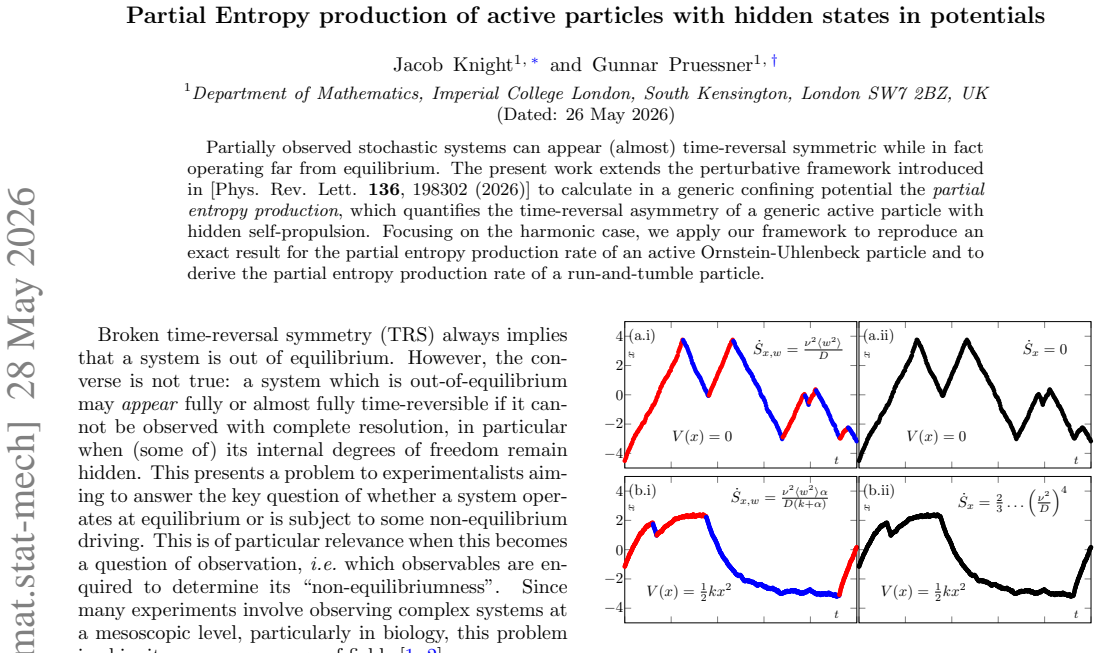
The perturbative framework can be extended to calculate the partial entropy production in a generic confining potential for a generic active particle with hidden self-propulsion, and in the harmonic case it reproduces the exact result for an active Ornstein-Uhlenbeck particle while deriving the rate for a run-and-tumble particle.
Load-bearing premise
The perturbative framework introduced in the 2026 PRL paper remains valid and accurate when applied to active particles with hidden self-propulsion in confining potentials, including the harmonic case.
Editorial extensions
If this is right
- The partial entropy production rate becomes accessible for arbitrary confining potentials through the extended perturbative approach.
- The framework recovers the exact partial entropy production rate for the active Ornstein-Uhlenbeck particle in the harmonic potential.
- An explicit expression for the partial entropy production rate of the run-and-tumble particle is obtained in the harmonic potential.
Reading between the lines
- The same perturbative construction could be tested against simulations of active particles in anharmonic or time-dependent potentials.
- Experimental trajectories of colloidal or biological active particles could be analyzed with this method to bound the hidden propulsion strength without full state reconstruction.
- If the framework generalizes, it may separate the entropy-production contribution of hidden variables from the observed motion in a wider class of partially observed stochastic systems.
Editorial analysis
A structured set of objections, weighed in public.
Referee Report
Summary. The manuscript extends the perturbative framework from Phys. Rev. Lett. 136, 198302 (2026) to compute the partial entropy production rate quantifying time-reversal asymmetry for a generic active particle with hidden self-propulsion in a generic confining potential. In the harmonic potential, the framework is shown to reproduce the known exact result for an active Ornstein-Uhlenbeck particle and to yield a new expression for the run-and-tumble particle.
Significance. If the central extension holds, the work supplies a practical perturbative route to partial entropy production in partially observed active systems, which is relevant for connecting theory to experiments where propulsion is hidden. The explicit reproduction of the exact AOUP result in the harmonic case provides a non-trivial validation that the perturbative construction captures the relevant asymmetry without additional corrections from the hidden-state dynamics or the potential.
minor comments (2)
- The abstract states that the framework 'reproduces an exact result' for AOUP but does not indicate the numerical or analytic tolerance of the match; adding a brief statement or reference to the relevant comparison (e.g., in the harmonic-case section) would strengthen the validation claim.
- Notation for the hidden self-propulsion process (Markov switching rates, observation map) is introduced without an explicit comparison table to the original PRL framework; a short table or paragraph clarifying which elements are carried over unchanged would improve readability.
Simulated Author's Rebuttal
We thank the referee for their positive summary and recommendation of minor revision. No specific major comments were provided in the report, so we have no points requiring point-by-point response. The validation against the exact AOUP result is already included in the manuscript as a non-trivial check.
Circularity Check
Minor self-citation of prior framework, not load-bearing due to exact reproduction benchmark
-
self citation load bearing
[Abstract]
"The present work extends the perturbative framework introduced in [Phys. Rev. Lett. 136, 198302 (2026)] to calculate in a generic confining potential the partial entropy production, which quantifies the time-reversal asymmetry of a generic active particle with hidden self-propulsion. Focusing on the harmonic case, we apply our framework to reproduce an exact result for the partial entropy production rate of an active Ornstein-Uhlenbeck particle and to derive the partial entropy production rate of a run-and-tumble particle."
The load-bearing method originates in a prior paper by the same research group, but the citation is not solely justificatory because the abstract explicitly states that the framework is tested by reproducing an independently known exact result for AOUP.
full rationale
The paper extends a perturbative framework from a 2026 PRL by overlapping authors but validates its application in the harmonic case by reproducing the known exact partial entropy production rate for the active Ornstein-Uhlenbeck particle. This reproduction against an external benchmark provides independent content, so the self-citation is not the sole justification for the central claim or the new RTP derivation. No reductions by construction, fitted inputs renamed as predictions, or ansatzes smuggled via citation are exhibited in the provided text.
Assumptions & free parameters
Cite this review
Pith. "Pith review of Partial Entropy production of active particles with hidden states in potentials." pith.science (2026). https://pith.science/paper/T6MIUVT3
@misc{pith2026260529201,
  author       = {Pith},
  title        = {Pith review of: Partial Entropy production of active particles with hidden states in potentials},
  year         = {2026},
  howpublished = {\url{https://pith.science/paper/T6MIUVT3}},
  note         = {Machine review of arXiv:2605.29201}
}
read the original abstract
Partially observed stochastic systems can appear (almost) time-reversal symmetric while in fact operating far from equilibrium. The present work extends the perturbative framework introduced in [Phys. Rev. Lett. 136, 198302 (2026)] to calculate in a generic confining potential the partial entropy production, which quantifies the time-reversal asymmetry of a generic active particle with hidden self-propulsion. Focusing on the harmonic case, we apply our framework to reproduce an exact result for the partial entropy production rate of an active Ornstein-Uhlenbeck particle and to derive the partial entropy production rate of a run-and-tumble particle.
Figures
Reference graph
Works this paper leans on
-
[1]
Partial Entropy production of active particles with hidden states in potentials
to include the presence of a confining potential. Our approach is to start from a complete description of the fully observable system, represented by joint path proba- bility distributions of the position and self-propulsion of the active particle. We then marginalise over the hid- den self-propulsion, representing the partially observable system through ...
work page Pith review arXiv 2026
-
[2]
Cancellations due to self-propulsion dynamics In this subsection we highlight symmetries and other properties ofw(t) which result in cancellations of terms in Eq. (15). The relevant properties are summarised in Tab. I. We highlight their effects by writing the first four orders in the expansion Eq. (15) explicitly: ˙Sx = lim T→∞ 1 T " ν 2D Z T 0 dt ˙x(t1)...
-
[3]
Cancellations due to spatial dynamics Further cancellations can arise due to properties of ˙x(t) and for specific choices ofV(x). In particular, our demands thatw(t) is in steady state andV(x) constant in time result in a steady state distributionP[x(t)], such that ˙x(t) =d dt x(t) = 0,(17) resulting in the cancellation of the first term at ordern= 1 in E...
-
[4]
Rold´ an, J
´E. Rold´ an, J. Barral, P. Martin, J. M. R. Parrondo, and F. J¨ ulicher, Quantifying entropy production in active fluctuations of the hair-cell bundle from time irreversibil- ity and uncertainty relations, New J. Phys.23, 083013 (2021)
2021
-
[5]
P. E. Harunari, Uncovering nonequilibrium from unre- solved events, Phys. Rev. E110, 024122 (2024)
2024
-
[6]
Dechant, J
A. Dechant, J. Garnier-Brun, and S.-i. Sasa, Thermody- namic Bounds on Correlation Times, Phys. Rev. Lett. 131, 167101 (2023)
2023
-
[7]
M. P. Leighton and D. A. Sivak, Jensen bound for the entropy production rate in stochastic thermodynamics, Phys. Rev. E109, L012101 (2024)
2024
-
[8]
Ito, G.-H
K. Ito, G.-H. Xu, C. Jiang, ´E. Rold´ an, R. A. Rica- Alarc´ on, I. A. Mart´ ınez, and G. Watanabe, Universal re- lations and bounds for fluctuations in quasistatic small heat engines, Commun. Phys.8, 60 (2025)
2025
Show all 54 references
-
[9]
Dieball and A
C. Dieball and A. Godec, Perspective: Time irreversibil- ity in systems observed at coarse resolution, J. Chem. Phys.162, 090901 (2025)
2025
-
[10]
Cocconi, G
L. Cocconi, G. Salbreux, and G. Pruessner, Scaling of entropy production under coarse graining in active dis- 9 ordered media, Phys. Rev. E105, L042601 (2022)
2022
-
[11]
Knight, F
J. Knight, F. Kaveh, and G. Pruessner, Self-propulsion symmetries determine entropy production of active par- ticles with hidden states, Phys. Rev. Lett.136, 198302 (2026)
2026
-
[12]
Mestres, I
P. Mestres, I. A. Martinez, A. Ortiz-Ambriz, R. A. Rica, and E. Roldan, Realization of nonequilibrium thermody- namic processes using external colored noise, Phys. Rev. E90, 032116 (2014)
2014
-
[13]
Di Bello, R
C. Di Bello, R. Majumdar, R. Marathe, R. Metzler, and ´E. Rold´ an, Brownian particle in a poisson-shot-noise ac- tive bath: Exact statistics, effective temperature, and inference, Ann. Phys.536, 2300427 (2024)
2024
-
[14]
Tucci, ´E
G. Tucci, ´E. Rold´ an, A. Gambassi, R. Belousov, F. Berger, R. G. Alonso, and A. J. Hudspeth, Model- ing Active Non-Markovian Oscillations, Phys. Rev. Lett. 129, 030603 (2022)
2022
-
[15]
Tailleur and M
J. Tailleur and M. E. Cates, Statistical mechanics of in- teracting run-and-tumble bacteria, Phys. Rev. Lett.100, 218103 (2008)
2008
-
[16]
M. E. Cates and J. Tailleur, When are active brown- ian particles and run-and-tumble particles equivalent? consequences for motility-induced phase separation, EPL 101, 20010 (2013)
2013
-
[17]
Gaspard, Time-reversed dynamical entropy and irre- versibility in Markovian random processes, J
P. Gaspard, Time-reversed dynamical entropy and irre- versibility in Markovian random processes, J. Stat. Phys. 117, 599 (2004)
2004
-
[18]
Sekimoto, Stochastic energetics (Springer-Verlag, Berlin, Germany, 2012) pp
K. Sekimoto, Stochastic energetics (Springer-Verlag, Berlin, Germany, 2012) pp. I–XVIII, 1–322
2012
-
[19]
Cocconi, R
L. Cocconi, R. Garcia-Millan, Z. Zhen, B. Buturca, and G. Pruessner, Entropy production in exactly solvable sys- tems, Entropy22, 1252 (2020)
2020
-
[20]
U. C. T¨ auber,Critical dynamics(Cambridge University Press, Cambridge, UK, 2014) pp. i–xvi,1–511
2014
-
[22]
See Supplemental Material [url] for technical details, which includes Refs. [40–43]
-
[23]
Martin, J
D. Martin, J. O’Byrne, M. E. Cates, ´E. Fodor, C. Nar- dini, J. Tailleur, and F. van Wijland, Statistical mechan- ics of active Ornstein-Uhlenbeck particles, Phys. Rev. E 103, 032607 (2021)
2021
-
[24]
Szamel, Self-propelled particle in an external poten- tial: Existence of an effective temperature, Phys
G. Szamel, Self-propelled particle in an external poten- tial: Existence of an effective temperature, Phys. Rev. E 90, 012111 (2014)
2014
-
[25]
Fodor, C
E. Fodor, C. Nardini, M. E. Cates, J. Tailleur, P. Visco, and F. van Wijland, How far from equilibrium is active matter?, Phys. Rev. Lett.117, 038103 (2016)
2016
-
[27]
N. G. van Kampen,Stochastic Processes in Physics and Chemistry(Elsevier Science B. V., Amsterdam, The Netherlands, 1992) third impression 2001, enlarged and revised
1992
-
[28]
Dabelow, S
L. Dabelow, S. Bo, and R. Eichhorn, How irreversible are steady-state trajectories of a trapped active particle?, J. Stat. Mech.2021, 033216 (2021)
2021
-
[29]
Dabelow, S
L. Dabelow, S. Bo, and R. Eichhorn, Irreversibility in Ac- tive Matter Systems: Fluctuation Theorem and Mutual Information, Phys. Rev. X9, 021009 (2019)
2019
-
[30]
Caprini, U
L. Caprini, U. M. B. Marconi, A. Puglisi, and A. Vulpi- ani, The entropy production of Ornstein–Uhlenbeck ac- tive particles: A path integral method for correlations, J. Stat. Mech.2019, 053203 (2019)
2019
-
[31]
Garcia-Millan and G
R. Garcia-Millan and G. Pruessner, Run-and-tumble mo- tion in a harmonic potential: Field theory and entropy production, J. Stat. Mech.2021, 063203 (2021)
2021
-
[32]
Pruessner and R
G. Pruessner and R. Garcia-Millan, Field theories of ac- tive particle systems and their entropy production, Rep. Prog. Phys.88, 097601 (2025)
2025
-
[33]
Marcinkiewicz, Sur une propri´ et´ e de la loi de Gauß, Math
J. Marcinkiewicz, Sur une propri´ et´ e de la loi de Gauß, Math. Zeit.44, 612 (1939)
1939
-
[34]
( ˙x(tn) +V ′ (xn)),i.e.the equilibrium,ν= 0, dynamics ofx(t) determining the partial entropy production
Perhaps less reasonably, this would imply no further fac- tor ofνfrom ( ˙x(t1) +V ′ (x1)). . .( ˙x(tn) +V ′ (xn)),i.e.the equilibrium,ν= 0, dynamics ofx(t) determining the partial entropy production
-
[37]
Cardy, Reaction-diffusion processes, inNon- equilibrium Statistical Mechanics and Turbulence, edited by S
J. Cardy, Reaction-diffusion processes, inNon- equilibrium Statistical Mechanics and Turbulence, edited by S. Nazarenko and O. V. Zaboronski (Cam- bridge University Press, Cambridge, UK, 2008) pp. 108–161, London Mathematical Society Lecture Note Series: 355, preprint availabl...
2008
-
[38]
Garcia Millan,Interactions, correlations and collec- tive behaviour in non-equilibrium systems, Ph.D
R. Garcia Millan,Interactions, correlations and collec- tive behaviour in non-equilibrium systems, Ph.D. thesis, Imperial College London, London, UK (2020)
2020
-
[39]
G. A. Pavliotis,Stochastic Processes and Applications: Diffusion Processes, the Fokker-Planck and Langevin Equations, Texts in Applied Mathematics, Vol. 60 (Springer, New York, NY, 2014)
2014
-
[40]
Sch¨ uttler, R
J. Sch¨ uttler, R. Garcia-Millan, M. E. Cates, and S. A. M. Loos, Active particles in moving traps: Minimum work protocols and information efficiency of work extraction, Phys. Rev. E112, 024119 (2025)
2025
-
[41]
Garcia-Millan, J
R. Garcia-Millan, J. Sch¨ uttler, M. E. Cates, and S. A. M. Loos, Optimal closed-loop control of active particles and a minimal information engine, Phys. Rev. Lett.135, 088301 (2025), arXiv:2407.18542
2025
-
[42]
Ghosal and G
A. Ghosal and G. Bisker, Inferring entropy production rate from partially observed Langevin dynamics under coarse-graining, Phys. Chem. Chem. Phys.24, 24021 (2022)
2022
-
[44]
Baule and R
A. Baule and R. Friedrich, Two-point correlation func- tion of the fractional Ornstein-Uhlenbeck process, EPL 79, 60004 (2007)
2007
-
[46]
junctions
J. Knight, Github repository jacob-w- knight/partial epr.git (2026), https://github.com/jacob- w-knight/Partial EPR.git. Partial Entropy production of active particles with hidden states in potentials: Supplementary Material (Dated: 26 May 2026) CONTENTS SI. Ornstein-Uhlenbeck...
2026
-
[47]
Martin, J
D. Martin, J. O’Byrne, M. E. Cates, É. Fodor, C. Nardini, J. Tailleur, and F. van Wijland, Statistical mechanics of active Ornstein-Uhlenbeck particles, Phys. Rev. E103, 032607 (2021)
2021
-
[48]
Bothe and G
M. Bothe and G. Pruessner, Doi-peliti field theory of free active ornstein-uhlenbeck particles, Phys. Rev. E103, 062105 (2021)
2021
-
[49]
G. E. Uhlenbeck and L. S. Ornstein, On the Theory of the Brownian Motion, Phys. Rev.36, 823 (1930)
1930
-
[50]
Baule and R
A. Baule and R. Friedrich, Two-point correlation function of the fractional Ornstein-Uhlenbeck process, EPL79, 60004 (2007)
2007
-
[51]
Garcia-Millan and G
R. Garcia-Millan and G. Pruessner, Run-and-tumble motion in a harmonic potential: Field theory and entropy production, J. Stat. Mech.2021, 063203 (2021)
2021
-
[52]
Doi, Second quantization representation for classical many-particle system, J
M. Doi, Second quantization representation for classical many-particle system, J. Phys. A: Math. Gen.9, 1465 (1976)
1976
-
[53]
Peliti, Path integral approach to birth-death processes on a lattice, J
L. Peliti, Path integral approach to birth-death processes on a lattice, J. Phys. (Paris)46, 1469 (1985)
1985
-
[54]
J.Cardy,Reaction-diffusionprocesses,inNon-equilibrium Statistical Mechanics and Turbulence,editedbyS.Nazarenkoand O. V. Zaboronski (Cambridge University Press, Cambridge, UK, 2008) pp. 108–161, London Mathematical Society Lecture Note Series: 355, preprint available fromhttp:/...
2008
-
[55]
Garcia Millan,Interactions, correlations and collective behaviour in non-equilibrium systems, Ph.D
R. Garcia Millan,Interactions, correlations and collective behaviour in non-equilibrium systems, Ph.D. thesis, Imperial College London, London, UK (2020)
2020
-
[56]
Pruessner and R
G. Pruessner and R. Garcia-Millan, Field theories of active particle systems and their entropy production, Rep. Prog. Phys.88, 097601 (2025)
2025
-
[57]
Supplemental material of [12] available at http://link.aps.org/supplemental/10.1103/xbk2-ggcf
-
[58]
Knight, F
J. Knight, F. Kaveh, and G. Pruessner, Self-propulsion symmetries determine entropy production of active particles with hidden states, Phys. Rev. Lett.136, 198302 (2026)
2026
-
[59]
Wolfram Research, Mathematica, version 13.3 (2023), champaign, IL
I. Wolfram Research, Mathematica, version 13.3 (2023), champaign, IL
2023
-
[60]
Knight, Github repository jacob-w-knight/partial_epr.git (2026), https://github.com/jacob-w-knight/Partial_EPR.git
J. Knight, Github repository jacob-w-knight/partial_epr.git (2026), https://github.com/jacob-w-knight/Partial_EPR.git
2026
Reviewed June 29, 2026 · model on record in the stance chip above.
Discussion (0). Continue with ORCID to comment.