FreeForm: Reduced-Order Deformable Simulation from Particle-Based Skinning Eigenmodes
Pith reviewed 2026-06-29 00:13 UTC · model grok-4.3
The pith
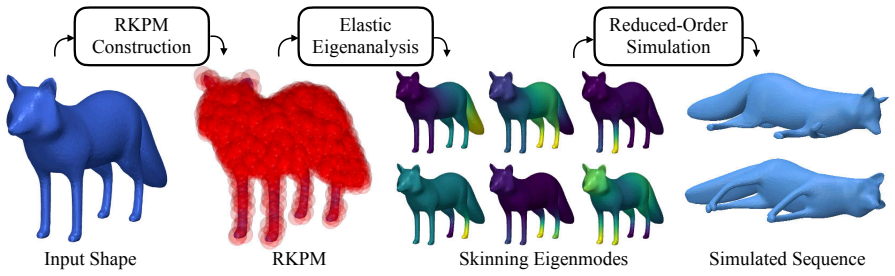
RKPM eigenmodes from elastic energy Hessian build reduced-order skinning weights for mesh-free hyperelastic simulation
A machine-rendered reading of the paper's core claim, the machinery that carries it, and where it could break.
Core claim
By representing the input geometry with Reproducing Kernel Particle Method particles, reduced-order skinning weights can be obtained directly by solving the generalized eigensystem on the Hessian matrix of the elastic energy, producing a mesh-free reduced-order model for hyperelastic elastodynamics that trains faster and matches finite element accuracy more closely than per-shape neural field alternatives.
What carries the argument
Generalized eigensystem on the Hessian of the elastic energy inside the RKPM particle representation, which directly yields the reduced-order skinning weights
If this is right
- Simulation runs directly on non-mesh data such as Gaussian splats without an intermediate meshing step.
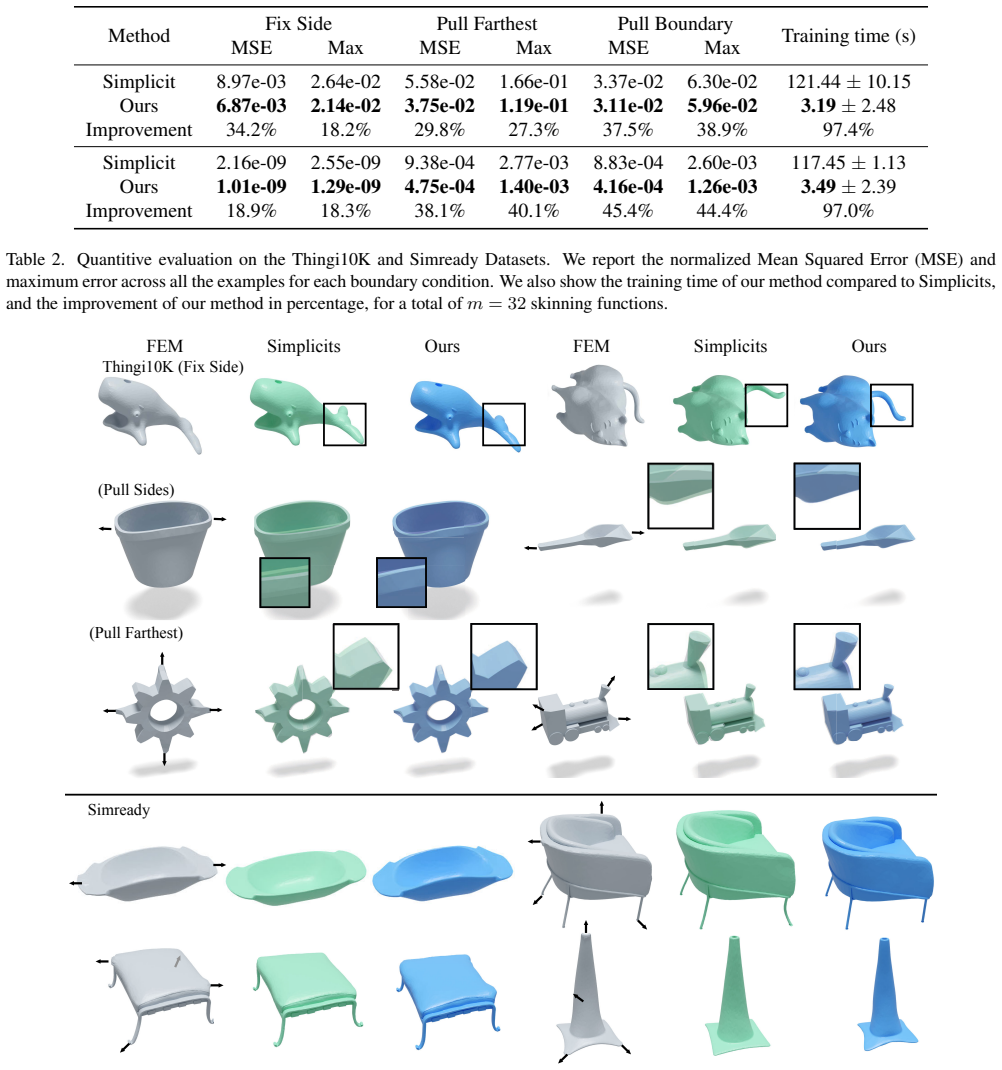
- Training completes approximately 40 times faster than per-shape neural field optimization.
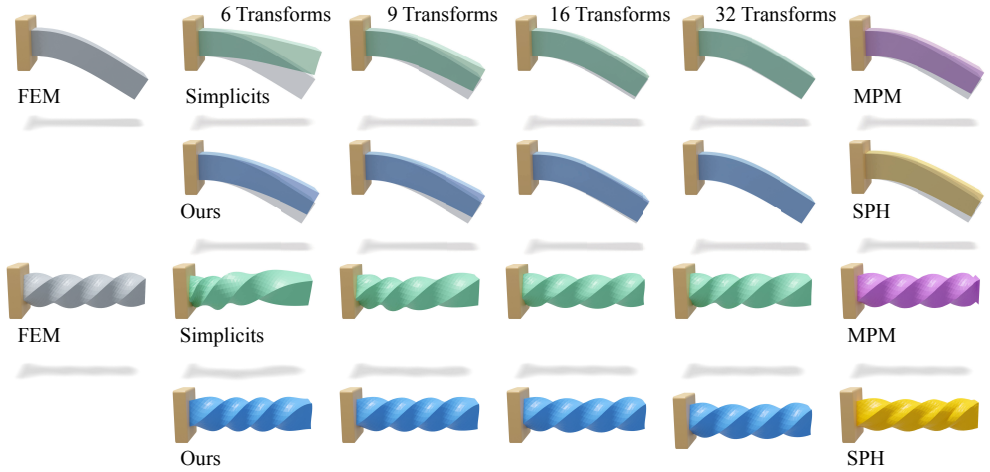
- Simulation error measured against finite element references is lower than that of neural field models.
- The pipeline applies without modification to downstream tasks such as robot simulation.
Where Pith is reading between the lines
- The same eigenmode construction could be attempted with other kernel particle representations provided their elastic energy Hessians remain computable.
- Accuracy under extreme deformations or frictional contact may require additional verification beyond the reported examples.
- The particle basis might reduce asset preparation time when importing scanned or splatted objects into real-time graphics engines.
Load-bearing premise
That the skinning weights obtained from the RKPM elastic energy Hessian will produce stable and accurate reduced dynamics for hyperelastic objects across varied geometries.
What would settle it
A geometry where the reduced simulation driven by these weights shows visibly larger deviation from a converged finite-element reference than a neural-field baseline on the same particle set.
Figures
read the original abstract
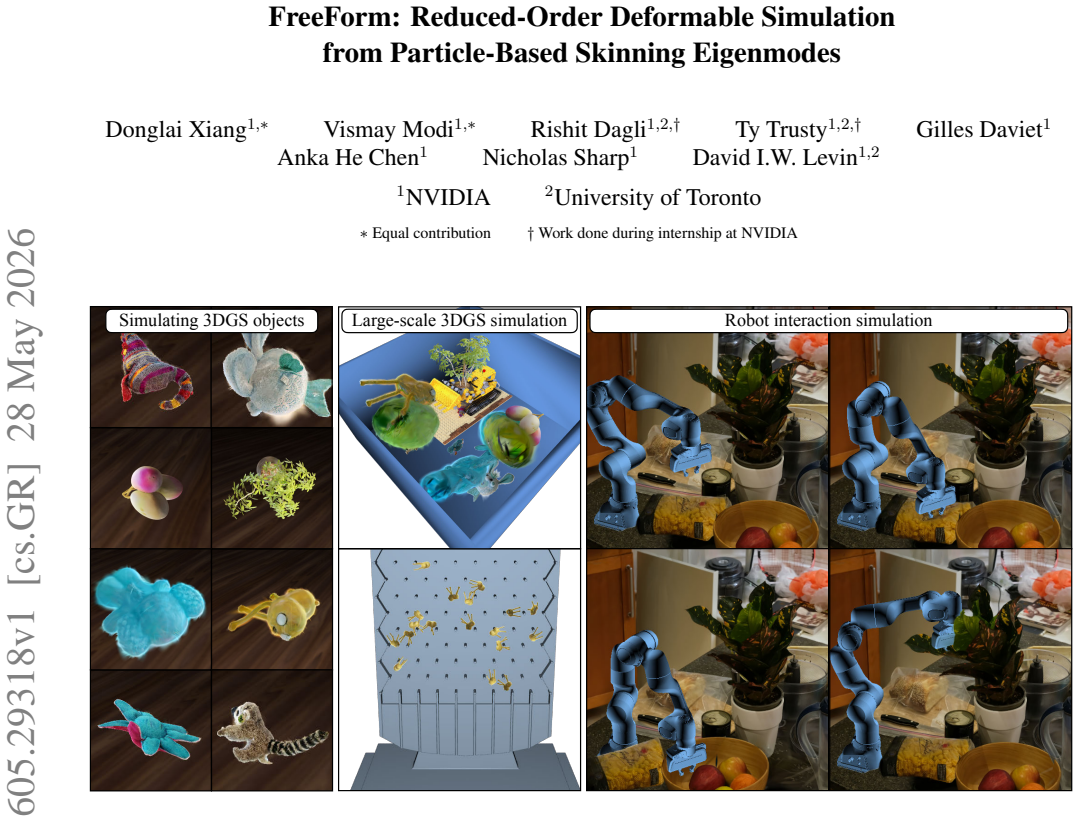
We present a novel formulation for mesh-free, reduced-order simulation of deformable hyperelastic objects. Existing work in reduced-order elastodynamic simulation represents the input geometry by either meshes, which can be difficult to obtain due to challenges in scanning and triangulating complex shapes, or by neural fields that require per-shape optimization. We propose to adopt a Reproducing Kernel Particle Method (RKPM) representation, which enables the construction of reduced-order skinning weights by solving a generalized eigensystem on the Hessian matrix of the elastic energy. We demonstrate that this formulation not only leads to a 40x training speedup compared with the per-shape optimization of neural fields, but also achieves lower simulation error when evaluated against the converged results of finite element method. We show our simulation results on a wide variety of objects in different representations including meshes and Gaussian splats, as well as the application of our method in the downstream task of robot simulation.
Editorial analysis
A structured set of objections, weighed in public.
Referee Report
Summary. The paper presents FreeForm, a mesh-free reduced-order simulation method for hyperelastic deformable objects based on a Reproducing Kernel Particle Method (RKPM) representation. Reduced-order skinning weights are obtained by solving a generalized eigenproblem on the Hessian of the elastic energy at the rest pose. The approach is claimed to yield a 40x training speedup relative to per-shape neural field optimization while producing lower simulation error than converged finite-element results; results are shown for meshes, Gaussian splats, and a robot-simulation downstream task.
Significance. If the fixed rest-pose RKPM subspace remains accurate and stable under the nonlinear constitutive response, the method would supply an efficient, mesh-free alternative to neural reduced-order models and avoid the need for high-quality surface meshes. The particle-based eigenmode construction is a distinctive technical choice that could extend reduced-order techniques to point-cloud and splat representations.
major comments (1)
- [Method / Results] The central claims of 40x speedup and lower FEM error rest on the premise that the linear subspace spanned by the rest-pose Hessian eigenmodes remains adequate once principal stretches exceed the small-strain regime. The manuscript should supply quantitative evidence (error vs. stretch magnitude, or comparison against tangent-stiffness updates) that this fixed basis does not degrade for the demonstrated geometries and deformation ranges.
minor comments (2)
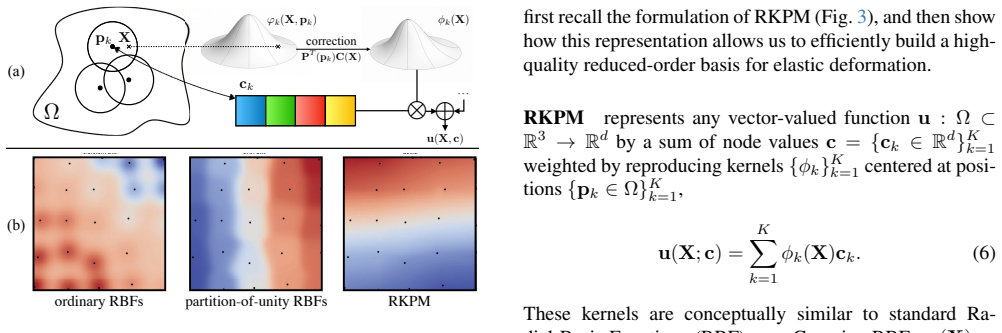
- Clarify the precise definition of the RKPM kernel and the quadrature rule used to assemble the Hessian; these details are needed to reproduce the eigenproblem.
- [Evaluation] The abstract states “lower simulation error” without specifying the norm, the set of test trajectories, or whether the comparison uses the same time-stepping scheme; add these details to the evaluation section.
Simulated Author's Rebuttal
We thank the referee for the careful review and constructive comment. We respond to the major comment below.
read point-by-point responses
-
Referee: [Method / Results] The central claims of 40x speedup and lower FEM error rest on the premise that the linear subspace spanned by the rest-pose Hessian eigenmodes remains adequate once principal stretches exceed the small-strain regime. The manuscript should supply quantitative evidence (error vs. stretch magnitude, or comparison against tangent-stiffness updates) that this fixed basis does not degrade for the demonstrated geometries and deformation ranges.
Authors: We appreciate the referee drawing attention to the range of validity of the fixed rest-pose subspace. The manuscript already reports that FreeForm produces lower error than converged FEM on the tested examples, which encompass both moderate and large deformations across multiple geometries and representations. Nevertheless, we agree that an explicit plot of error versus principal stretch magnitude (and, where feasible, a comparison to a tangent-stiffness-updated basis) would strengthen the central claim. In the revised version we will add such quantitative analysis for the demonstrated cases. revision: yes
Circularity Check
No circularity in provided derivation chain
full rationale
The abstract and claims describe adopting RKPM to enable construction of reduced-order skinning weights via a generalized eigensystem on the elastic energy Hessian, yielding empirical speedup and lower FEM error. No equations, self-citations, fitted parameters renamed as predictions, or self-definitional steps are exhibited that would reduce any claimed result to its inputs by construction. The approach is presented as a standard modal reduction adapted to a particle basis, with performance claims resting on external FEM validation rather than internal redefinition. This is the most common honest non-finding for papers whose central steps remain independent of the target outputs.
Axiom & Free-Parameter Ledger
Reference graph
Works this paper leans on
-
[1]
Physically embodied gaussian splatting: A re- altime correctable world model for robotics
Jad Abou-Chakra, Krishan Rana, Feras Dayoub, and Niko Suenderhauf. Physically embodied gaussian splatting: A re- altime correctable world model for robotics. In8th Annual Conference on Robot Learning, 2024. 2
2024
-
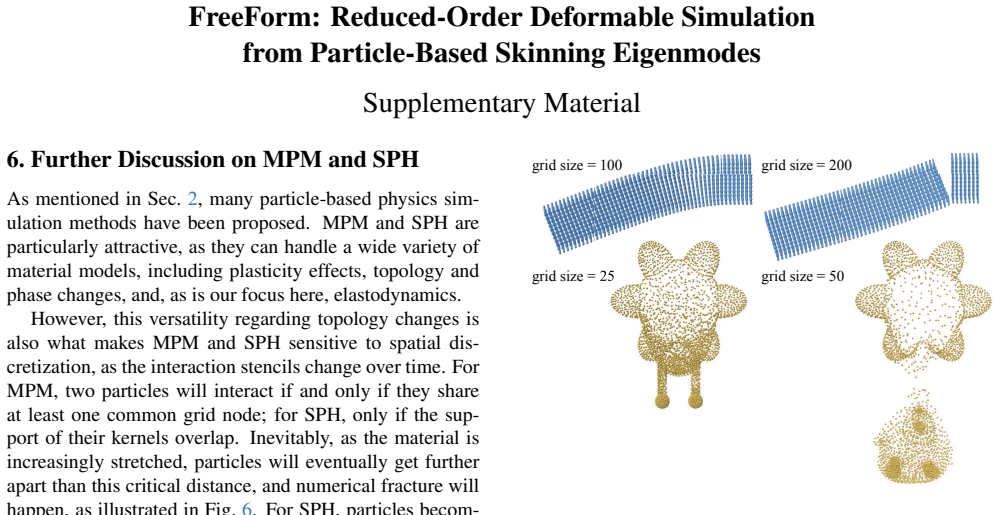
[2]
Jernej Barbic and Doug L. James. Real-time subspace in- tegration for st. venant-kirchhoff deformable models.ACM SIGGRAPH 2005 Papers, 2005. 3
2005
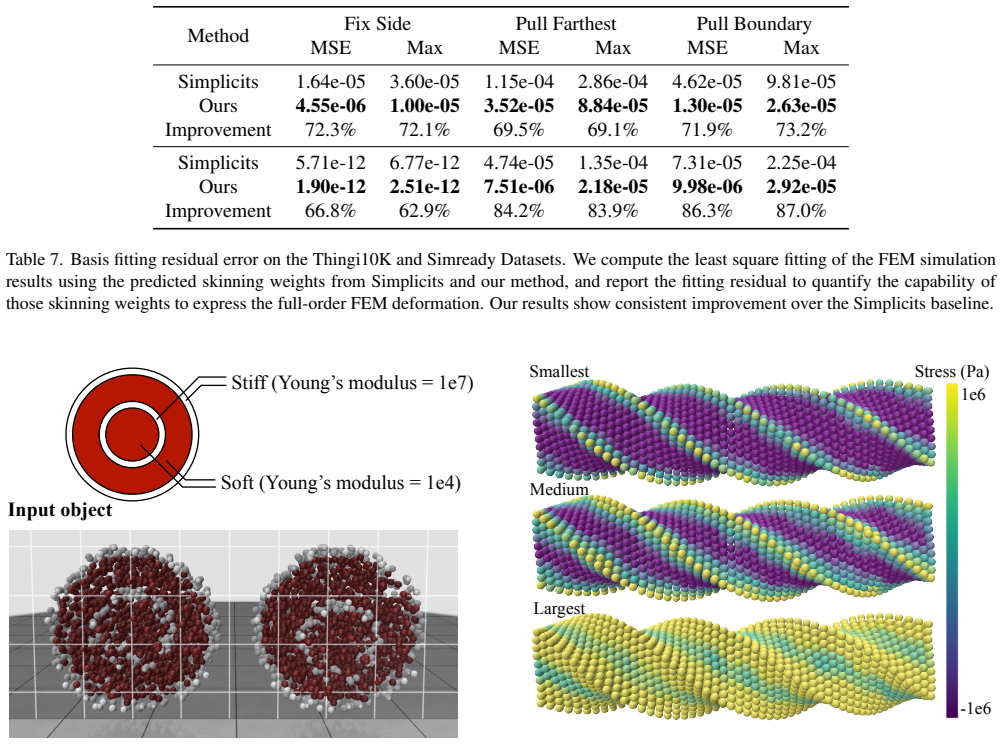
-
[3]
Fast com- plementary dynamics via skinning eigenmodes, 2023
Otman Benchekroun, Jiayi Eris Zhang, Siddhartha Chaud- huri, Eitan Grinspun, Yi Zhou, and Alec Jacobson. Fast com- plementary dynamics via skinning eigenmodes, 2023. 2, 3, 5
2023
-
[4]
Projective dynamics: fusing constraint projections for fast simulation.ACM Transactions on Graph- ics (TOG), 33(4):154, 2014
Sofien Bouaziz, Sebastian Martin, Tiantian Liu, Ladislav Ka- van, and Mark Pauly. Projective dynamics: fusing constraint projections for fast simulation.ACM Transactions on Graph- ics (TOG), 33(4):154, 2014. 2
2014
-
[5]
Hyper-reduced projective dynamics.ACM Trans
Christopher Brandt, Elmar Eisemann, and Klaus Hilde- brandt. Hyper-reduced projective dynamics.ACM Trans. Graph. (Proc. of SIGGRAPH), 37(4):80:1–80:13, 2018. 3
2018
-
[6]
Chiaramonte, Kevin Carlberg, and Eitan Grinspun
Yue Chang, Peter Yichen Chen, Zhecheng Wang, Maur- izio M. Chiaramonte, Kevin Carlberg, and Eitan Grinspun. Licrom: Linear-subspace continuous reduced order model- ing with neural fields, 2023. 3
2023
-
[7]
Shape space spectra
Yue Chang, Otman Benchekroun, Maurizio M Chiaramonte, Peter Yichen Chen, and Eitan Grinspun. Shape space spectra. ACM Transactions on Graphics (TOG), 44(4):1–16, 2025. 3
2025
-
[8]
A moving least square reproduc- ing kernel particle method for unified multiphase continuum simulation.ACM Trans
Xiao-Song Chen, Chen-Feng Li, Geng-Chen Cao, Yun-Tao Jiang, and Shi-Min Hu. A moving least square reproduc- ing kernel particle method for unified multiphase continuum simulation.ACM Trans. Graph., 39(6), 2020. 2
2020
-
[9]
V omp: Predicting vol- umetric mechanical property fields
Rishit Dagli, Donglai Xiang, Vismay Modi, Charles Loop, Clement Fuji Tsang, Anka He Chen, Anita Hu, Gavriel State, David IW Levin, and Maria Shugrina. V omp: Predicting vol- umetric mechanical property fields. InInternational Confer- ence on Learning Representations (ICLR), 2026. 6
2026
-
[10]
Gilles Daviet, Tianchang Shen, Nicholas Sharp, and David I.W. Levin. Neurally integrated finite elements for differentiable elasticity on evolving domains.ACM Trans. Graph., 44(2), 2025. 2
2025
-
[11]
Smoothed parti- cles: a new paradigm for animating highly deformable bod- ies
Mathieu Desbrun and Marie-Paule Cani. Smoothed parti- cles: a new paradigm for animating highly deformable bod- ies. InProceedings of the Eurographics Workshop on Com- puter Animation and Simulation ’96, page 61–76, Berlin, Heidelberg, 1996. Springer-Verlag. 2
1996
-
[12]
Space-Time Adap- tive Simulation of Highly Deformable Substances
Mathieu Desbrun and Marie-Paule Cani. Space-Time Adap- tive Simulation of Highly Deformable Substances. Research Report RR-3829, INRIA, 1999. 2
1999
-
[13]
Robust biharmonic skinning using geometric fields
Ana Dodik, Vincent Sitzmann, Justin Solomon, and Oded Stein. Robust biharmonic skinning using geometric fields. ACM Transactions on Graphics, 2024. 2, 3
2024
-
[14]
A multi-scale model for simulating liquid- fabric interactions.ACM Trans
Yun (Raymond) Fei, Christopher Batty, Eitan Grinspun, and Changxi Zheng. A multi-scale model for simulating liquid- fabric interactions.ACM Trans. Graph., 37(4), 2018. 1
2018
-
[15]
Pie-nerf: Physics-based interac- tive elastodynamics with nerf, 2023
Yutao Feng, Yintong Shang, Xuan Li, Tianjia Shao, Chen- fanfu Jiang, and Yin Yang. Pie-nerf: Physics-based interac- tive elastodynamics with nerf, 2023. 2
2023
-
[16]
Latent-space dynamics for re- duced deformable simulation
Lawson Fulton, Vismay Modi, David Duvenaud, David IW Levin, and Alec Jacobson. Latent-space dynamics for re- duced deformable simulation. InComputer graphics forum, pages 379–391. Wiley Online Library, 2019. 3
2019
-
[17]
Frame-based elastic models.ACM transac- tions on graphics (TOG), 30(2):1–12, 2011
Benjamin Gilles, Guillaume Bousquet, Francois Faure, and Dinesh K Pai. Frame-based elastic models.ACM transac- tions on graphics (TOG), 30(2):1–12, 2011. 3
2011
-
[18]
R. A. Gingold and J. J. Monaghan. Smoothed particle hy- drodynamics: theory and application to non-spherical stars. Monthly Notices of the Royal Astronomical Society, 181(3): 375–389, 1977. 2
1977
-
[19]
Subspace neural physics: Fast data-driven interactive simulation
Daniel Holden, Bang Chi Duong, Sayantan Datta, and Derek Nowrouzezahrai. Subspace neural physics: Fast data-driven interactive simulation. InProceedings of the 18th annual ACM SIGGRAPH/eurographics symposium on computer an- imation, pages 1–12, 2019. 2
2019
-
[20]
Tetrahedral meshing in the wild.ACM Trans
Yixin Hu, Qingnan Zhou, Xifeng Gao, Alec Jacobson, De- nis Zorin, and Daniele Panozzo. Tetrahedral meshing in the wild.ACM Trans. Graph., 37(4):60–1, 2018. 6
2018
-
[21]
The material point method for simulating continuum materials
Chenfanfu Jiang, Craig Schroeder, Joseph Teran, Alexey Stomakhin, and Andrew Selle. The material point method for simulating continuum materials. InACM SIGGRAPH 2016 Courses, New York, NY , USA, 2016. Association for Computing Machinery. 2, 1
2016
-
[22]
Vr-gs: A physical dynamics- aware interactive gaussian splatting system in virtual reality
Ying Jiang, Chang Yu, Tianyi Xie, Xuan Li, Yutao Feng, Huamin Wang, Minchen Li, Henry Lau, Feng Gao, Yin Yang, and Chenfanfu Jiang. Vr-gs: A physical dynamics- aware interactive gaussian splatting system in virtual reality. arXiv preprint arXiv:2401.16663, 2024. 2
-
[23]
3d gaussian splatting for real-time radiance field rendering.ACM Transactions on Graphics, 42 (4), 2023
Bernhard Kerbl, Georgios Kopanas, Thomas Leimk ¨uhler, and George Drettakis. 3d gaussian splatting for real-time radiance field rendering.ACM Transactions on Graphics, 42 (4), 2023. 2
2023
-
[24]
Fast corotated elastic sph solids with implicit zero-energy mode control.Proceedings of the ACM on Com- puter Graphics and Interactive Techniques, 4(3):1–21, 2021
Tassilo Kugelstadt, Jan Bender, Jos ´e Antonio Fern ´andez- Fern´andez, Stefan Rhys Jeske, Fabian L ¨oschner, and An- dreas Longva. Fast corotated elastic sph solids with implicit zero-energy mode control.Proceedings of the ACM on Com- puter Graphics and Interactive Techniques, 4(3):1–21, 2021. 2
2021
-
[25]
Pac-nerf: Physics augmented continuum neural ra- diance fields for geometry-agnostic system identification
Xuan Li, Yi-Ling Qiao, Peter Yichen Chen, Krishna Murthy Jatavallabhula, Ming Lin, Chenfanfu Jiang, and Chuang Gan. Pac-nerf: Physics augmented continuum neural ra- diance fields for geometry-agnostic system identification. InInternational Conference on Learning Representations (ICLR), 2023. 2
2023
-
[26]
Learning Particle Dynamics for Manipulating Rigid Bodies, Deformable Objects, and Fluids
Yunzhu Li, Jiajun Wu, Russ Tedrake, Joshua B Tenenbaum, and Antonio Torralba. Learning particle dynamics for ma- nipulating rigid bodies, deformable objects, and fluids.arXiv preprint arXiv:1810.01566, 2018. 2
work page internal anchor Pith review Pith/arXiv arXiv 2018
-
[27]
Align your gaussians: Text-to-4d with dynamic 3d gaussians and composed diffusion models
Huan Ling, Seung Wook Kim, Antonio Torralba, Sanja Fi- dler, and Karsten Kreis. Align your gaussians: Text-to-4d with dynamic 3d gaussians and composed diffusion models. InProceedings of the IEEE/CVF Conference on Computer Vision and Pattern Recognition, pages 8576–8588, 2024. 2
2024
-
[28]
Reproducing kernel particle methods.International journal for numerical methods in fluids, 20(8-9):1081–1106, 1995
Wing Kam Liu, Sukky Jun, and Yi Fei Zhang. Reproducing kernel particle methods.International journal for numerical methods in fluids, 20(8-9):1081–1106, 1995. 2, 4
1995
-
[29]
Accelerate neural subspace- based reduced-order solver of deformable simulation by lip- schitz optimization.ACM Transactions on Graphics (TOG), 43(6):1–10, 2024
Aoran Lyu, Shixian Zhao, Chuhua Xian, Zhihao Cen, Hong- min Cai, and Guoxin Fang. Accelerate neural subspace- based reduced-order solver of deformable simulation by lip- schitz optimization.ACM Transactions on Graphics (TOG), 43(6):1–10, 2024. 3
2024
-
[30]
Xpbd: position-based simulation of compliant constrained dynamics
Miles Macklin, Matthias M ¨uller, and Nuttapong Chentanez. Xpbd: position-based simulation of compliant constrained dynamics. InProceedings of the 9th International Confer- ence on Motion in Games, pages 49–54, 2016. 2
2016
-
[31]
Unified simulation of elas- tic rods, shells, and solids.ACM Transactions on Graphics (TOG), 29(4):1–10, 2010
Sebastian Martin, Peter Kaufmann, Mario Botsch, Eitan Grinspun, and Markus Gross. Unified simulation of elas- tic rods, shells, and solids.ACM Transactions on Graphics (TOG), 29(4):1–10, 2010. 2
2010
-
[32]
Srinivasan, Matthew Tancik, Jonathan T
Ben Mildenhall, Pratul P. Srinivasan, Matthew Tancik, Jonathan T. Barron, Ravi Ramamoorthi, and Ren Ng. NeRF: Representing scenes as neural radiance fields for view syn- thesis. InThe European Conference on Computer Vision (ECCV), 2020. 2
2020
-
[33]
Simplicits: Mesh-free, geometry-agnostic elastic simulation.ACM Transactions on Graphics (TOG), 43(4):1–11, 2024
Vismay Modi, Nicholas Sharp, Or Perel, Shinjiro Sueda, and David IW Levin. Simplicits: Mesh-free, geometry-agnostic elastic simulation.ACM Transactions on Graphics (TOG), 43(4):1–11, 2024. 2, 3, 5, 6
2024
-
[34]
Simready assets.https : / / developer.nvidia.com/omniverse/simready- assets, 2025
NVIDIA Developer. Simready assets.https : / / developer.nvidia.com/omniverse/simready- assets, 2025. Accessed: 2025-06-13. 6
2025
-
[35]
Learning mesh-based simulation with graph networks
Tobias Pfaff, Meire Fortunato, Alvaro Sanchez-Gonzalez, and Peter Battaglia. Learning mesh-based simulation with graph networks. InInternational Conference on Learning Representations, 2021. 2
2021
-
[36]
Cristian Romero, Dan Casas, Jes ´us P ´erez, and Miguel A. Otaduy. Learning Contact Corrections for Handle-Based Subspace Dynamics.ACM Transactions on Graphics (Proc. of ACM SIGGRAPH), 40(4), 2021. 2
2021
-
[37]
Chiaramonte, and Miguel A
Cristian Romero, Dan Casas, Maurizio M. Chiaramonte, and Miguel A. Otaduy. Contact-centric deformation learning. ACM Transactions on Graphics (Proc. of ACM SIGGRAPH), 41(4), 2022. 2
2022
-
[38]
Black, Bernhard Thomaszewski, Christina Tsalicoglou, and Otmar Hilliges
Boxiang Rong, Artur Grigorev, Wenbo Wang, Michael J. Black, Bernhard Thomaszewski, Christina Tsalicoglou, and Otmar Hilliges. Gaussian garments: Reconstruct- ing simulation-ready clothing with photorealistic appearance from multi-view video, 2024. 2
2024
-
[39]
Data-free learning of reduced-order kinematics
Nicholas Sharp, Cristian Romero, Alec Jacobson, Etienne V ouga, Paul Kry, David IW Levin, and Justin Solomon. Data-free learning of reduced-order kinematics. InACM SIGGRAPH 2023 Conference Proceedings, pages 1–9, 2023. 3
2023
-
[40]
Stable neo-hookean flesh simulation.ACM Transactions on Graphics (TOG), 37(2):12, 2018
Breannan Smith, Fernando De Goes, and Theodore Kim. Stable neo-hookean flesh simulation.ACM Transactions on Graphics (TOG), 37(2):12, 2018. 5
2018
-
[41]
Schreyer
Deborah Sulsky, Shi-Jian Zhou, and Howard L. Schreyer. Application of a particle-in-cell method to solid mechanics. Computer Physics Communications, 87(1):236–252, 1995. Particle Simulation Methods. 2
1995
-
[42]
Elastically deformable models
Demetri Terzopoulos, John Platt, Alan Barr, and Kurt Fleis- cher. Elastically deformable models. InProceedings of the 14th annual conference on Computer graphics and interac- tive techniques, pages 205–214, 1987. 2
1987
-
[43]
Linear subspace design for real-time shape deformation
Yu Wang, Alec Jacobson, Jernej Barbic, and Ladislav Ka- van. Linear subspace design for real-time shape deformation. ACM Trans. Graph., 34(4):57:1–57:11, 2015. 3
2015
-
[44]
A compari- son of linear consistent correction methods for first-order sph derivatives.Proceedings of the ACM on Computer Graphics and Interactive Techniques (SCA), 6(3), 2023
Lukas Westhofen, Stefan Jeske, and Jan Bender. A compari- son of linear consistent correction methods for first-order sph derivatives.Proceedings of the ACM on Computer Graphics and Interactive Techniques (SCA), 6(3), 2023. 2, 1
2023
-
[45]
Whitney, Tatiana Lopez-Guevara, Tobias Pfaff, Yulia Rubanova, Thomas Kipf, Kimberly Stachenfeld, and Kelsey R
William F. Whitney, Tatiana Lopez-Guevara, Tobias Pfaff, Yulia Rubanova, Thomas Kipf, Kimberly Stachenfeld, and Kelsey R. Allen. Learning 3d particle-based simulators from rgb-d videos, 2023. 2
2023
-
[46]
PhysGaussian: Physics-integrated 3d gaussians for generative dynamics
Tianyi Xie, Zeshun Zong, Yuxing Qiu, Xuan Li, Yutao Feng, Yin Yang, and Chenfanfu Jiang. Physgaussian: Physics- integrated 3d gaussians for generative dynamics.arXiv preprint arXiv:2311.12198, 2023. 2
-
[47]
Neural robot dynamics
Jie Xu, Eric Heiden, Iretiayo Akinola, Dieter Fox, Miles Macklin, and Yashraj Narang. Neural robot dynamics. In 9th Annual Conference on Robot Learning, 2025. 2
2025
-
[48]
Expediting precomputation for reduced deformable simulation.ACM Trans
Yin Yang, Dingzeyu Li, Weiwei Xu, Yuan Tian, and Changxi Zheng. Expediting precomputation for reduced deformable simulation.ACM Trans. Graph., 34(6), 2015. 3
2015
-
[49]
Continuum foam: A mate- rial point method for shear-dependent flows.ACM Trans
Yonghao Yue, Breannan Smith, Christopher Batty, Changxi Zheng, and Eitan Grinspun. Continuum foam: A mate- rial point method for shear-dependent flows.ACM Trans. Graph., 34(5), 2015. 2, 1
2015
-
[50]
Feng, Changxi Zheng, Noah Snavely, Jiajun Wu, and William T
Tianyuan Zhang, Hong-Xing Yu, Rundi Wu, Brandon Y . Feng, Changxi Zheng, Noah Snavely, Jiajun Wu, and William T. Freeman. PhysDreamer: Physics-based interac- tion with 3d objects via video generation. InEuropean Con- ference on Computer Vision. Springer, 2024. 2
2024
-
[51]
Reconstruction and simulation of elastic objects with spring- mass 3d gaussians
Licheng Zhong, Hong-Xing Yu, Jiajun Wu, and Yunzhu Li. Reconstruction and simulation of elastic objects with spring- mass 3d gaussians. InEuropean Conference on Computer Vision, pages 407–423. Springer, 2024. 2
2024
-
[52]
Thingi10K: A Dataset of 10,000 3D-Printing Models
Qingnan Zhou and Alec Jacobson. Thingi10k: A dataset of 10,000 3d-printing models.arXiv preprint arXiv:1605.04797, 2016. 6
work page internal anchor Pith review Pith/arXiv arXiv 2016
-
[53]
Neural stress fields for reduced-order elastoplasticity and fracture
Zeshun Zong, Xuan Li, Minchen Li, Maurizio M Chiara- monte, Wojciech Matusik, Eitan Grinspun, Kevin Carlberg, Chenfanfu Jiang, and Peter Yichen Chen. Neural stress fields for reduced-order elastoplasticity and fracture. InSIG- GRAPH Asia 2023 Conference Papers, pages 1–11, 2023. 2 FreeForm: Reduced-Order Deformable Simulation from Particle-Based Skinning ...
2023
-
[54]
2, many particle-based physics sim- ulation methods have been proposed
Further Discussion on MPM and SPH As mentioned in Sec. 2, many particle-based physics sim- ulation methods have been proposed. MPM and SPH are particularly attractive, as they can handle a wide variety of material models, including plasticity effects, topology and phase changes, and, as is our focus here, elastodynamics. However, this versatility regardin...
-
[55]
Implementation Details 7.1. Our Method RKPM construction.Given an input object, our method first constructs a set of RKPM kernels around the object grid size = 100 grid size = 200 grid size = 25 grid size = 25 grid size = 50 Figure 6. The Material Point Method (MPM) is versatile, but presents challenges for deformable body simulation due to the oc- curren...
-
[56]
Con- sider the deformation mapΦ(X,d) =u(X,d) +X, where the displacementu(X,d)is parameterized by RKPM in Eq
Proof of Proposition 1 In this section, we provide a proof of Proposition 1. Con- sider the deformation mapΦ(X,d) =u(X,d) +X, where the displacementu(X,d)is parameterized by RKPM in Eq. (6) and the DoFs are the nodal displacementsd= {dk ∈R 3}K k=1 ={(d x k,d y k,d z k)T }K k=1. Φ(X,d) = Φx(X,d) Φy(X,d) Φz(X,d) = KX k=1 ϕk(X)dk +X, (18) The deforma...
-
[57]
Additional Evaluation and Analysis 9.1. Basis Fitting Residual For reduced-order methods including Simplicits and ours, we also perform a least square fitting of the FEM simulation TestmSimplicits Ours Bend 6 4.54e-06 6.67e-07 9 1.19e-06 4.33e-07 16 5.34e-07 1.40e-07 32 1.93e-075.60e-08 Twist 6 9.41e-05 2.20e-05 9 1.52e-05 5.94e-06 16 5.19e-06 5.83e-07 32...
discussion (0)
Sign in with ORCID, Apple, or X to comment. Anyone can read and Pith papers without signing in.