ODIN: Rest-frame Optical Morphologies and Star Formation Activity of Ly{α} Emitters at z=2.4, 3.1, and 4.5
Pith reviewed 2026-06-29 06:52 UTC · model grok-4.3
The pith
Lyα emitters at z=2.4, 3.1, and 4.5 are smaller and form stars more intensely than typical star-forming galaxies at the same epochs.
A machine-rendered reading of the paper's core claim, the machinery that carries it, and where it could break.
Core claim
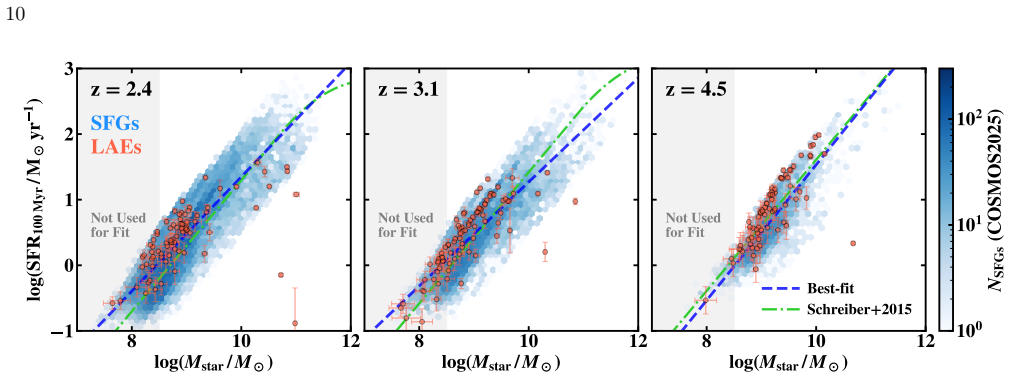
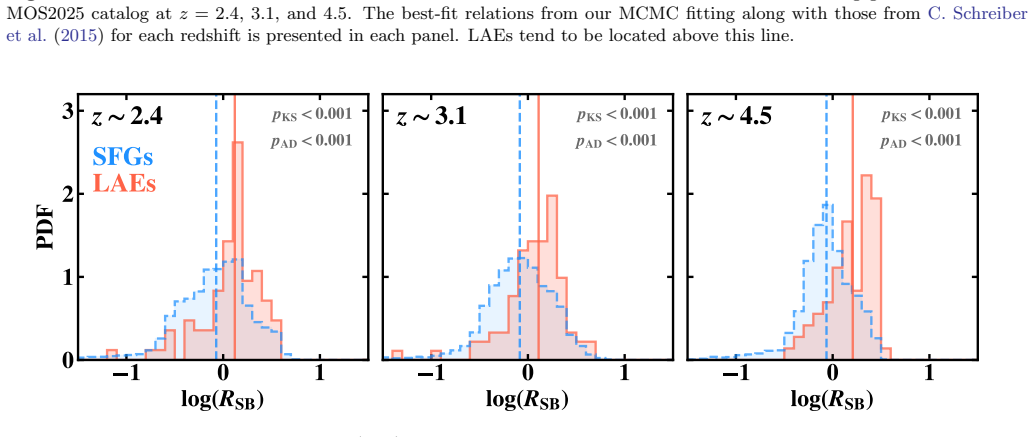
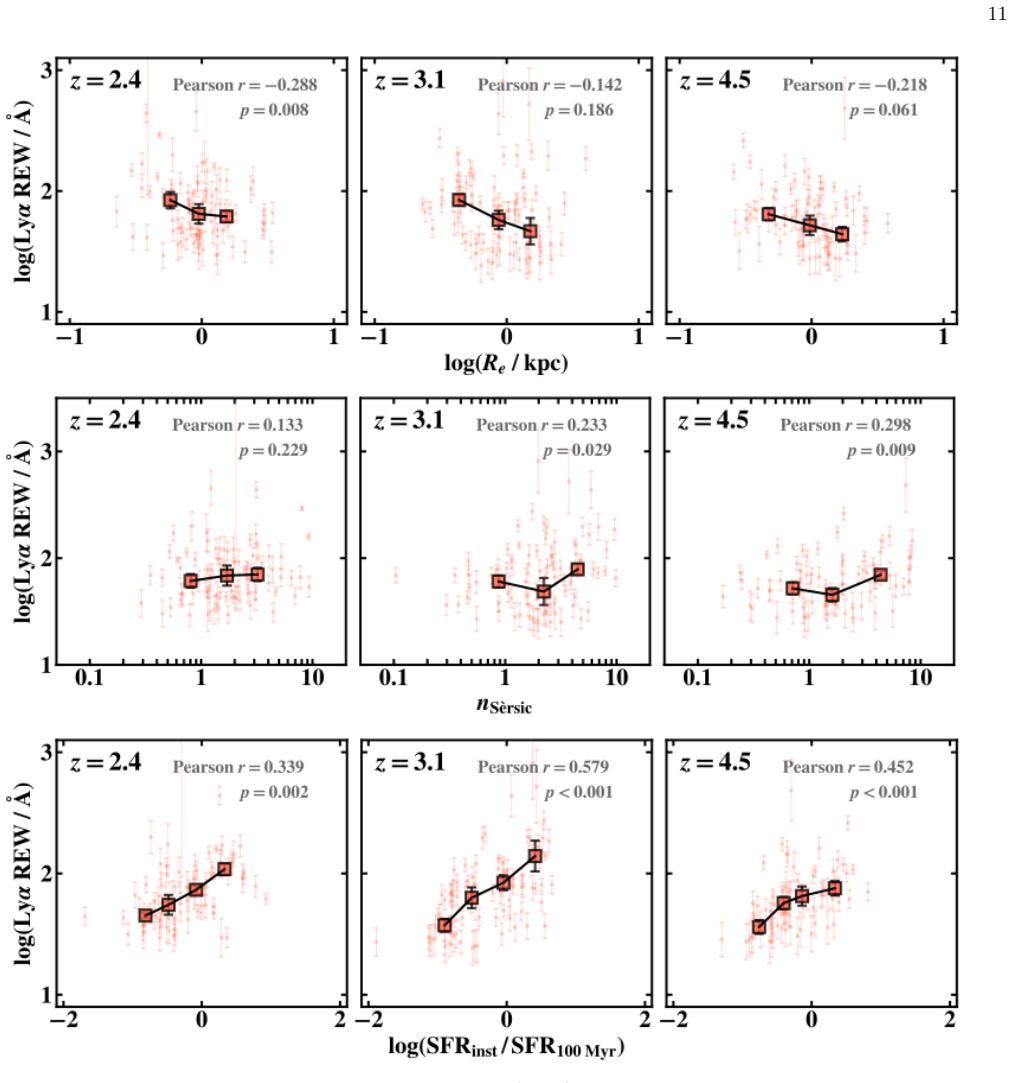
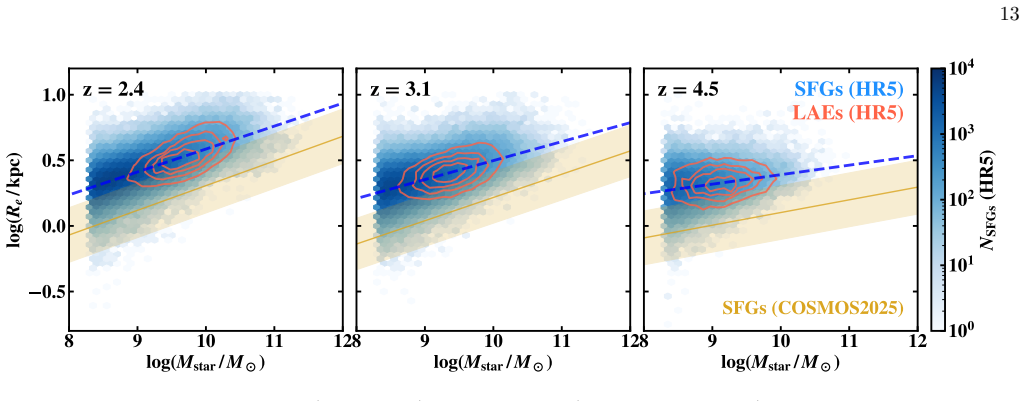
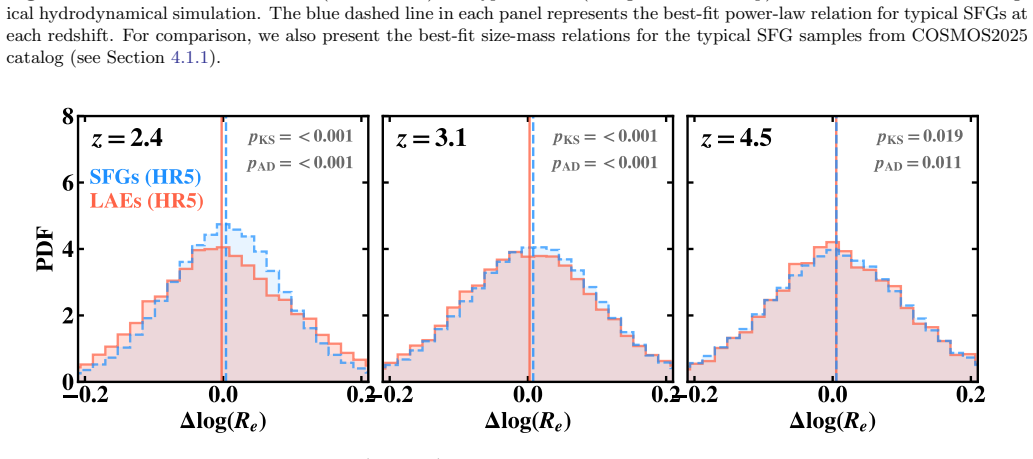
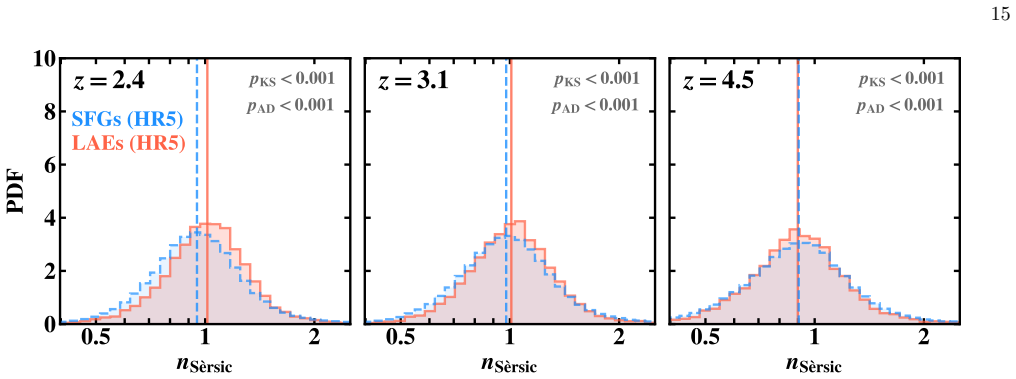
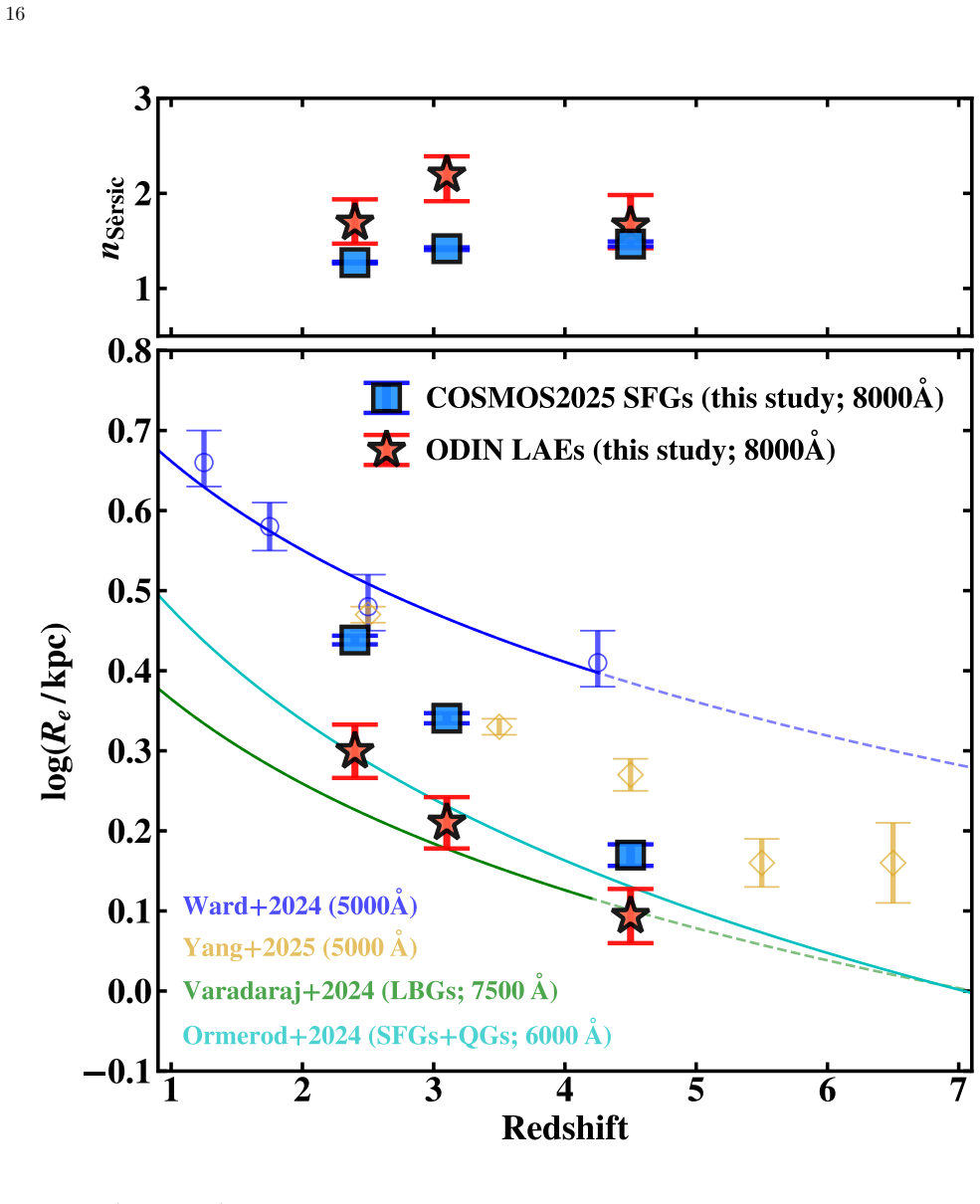
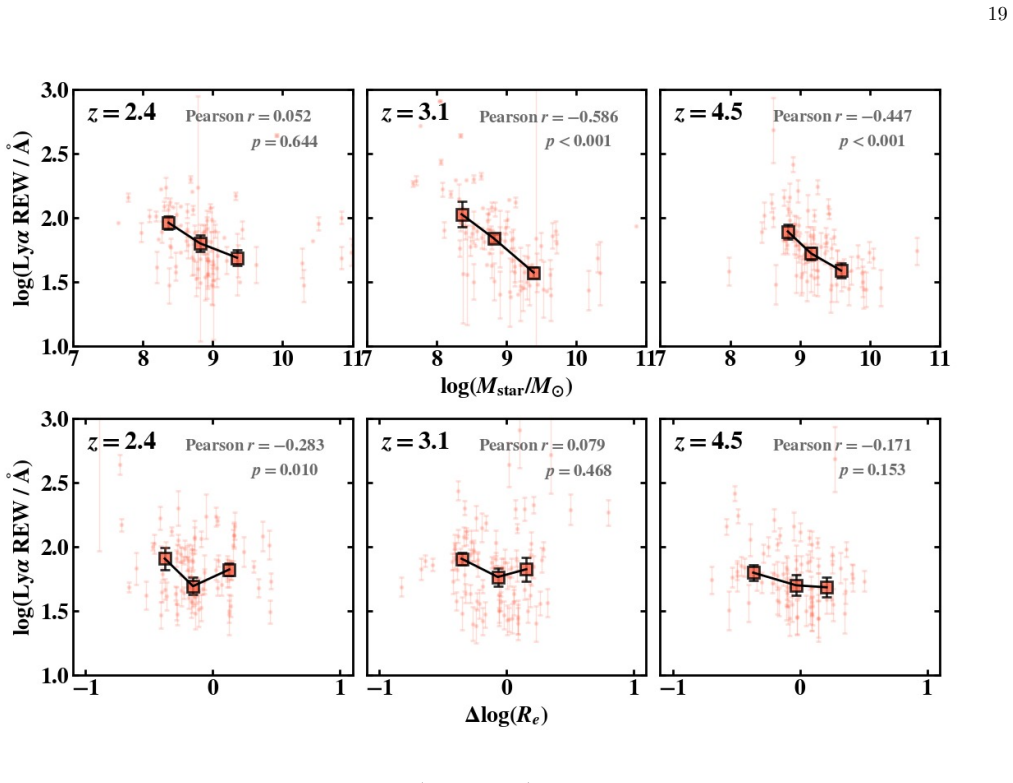
LAEs at z=2.4, 3.1, and 4.5 have smaller rest-frame optical sizes than typical SFGs, with the size difference decreasing at higher redshifts; they exhibit higher star formation rates; and the rest-frame Lyα equivalent width correlates negatively with size, positively with Sersic index, and positively with SFR_inst/SFR_100Myr.
What carries the argument
The size-mass relation together with direct correlations between Lyα equivalent width and structural plus star-formation parameters.
If this is right
- LAEs represent a compact, starbursting subset of the high-redshift galaxy population.
- Stronger Lyα emission traces galaxies that are both smaller and experiencing a recent upturn in star formation.
- The weakening size offset at z=4.5 implies that the distinction between LAEs and typical SFGs narrows at earlier cosmic times.
- Hydrodynamical simulations qualitatively recover the same structural and star-formation trends.
Where Pith is reading between the lines
- If LAEs dominate the ionizing photon budget, their measured compactness and burstiness set lower limits on the escape fraction needed for reionization.
- The observed REW–SFR ratio correlation predicts that bursty star-formation histories are required for detectable Lyα at these redshifts.
- Extending the same size and SFR measurements to z>5 with JWST could test whether the size offset continues to shrink.
Load-bearing premise
The COSMOS2025 comparison sample accurately represents the typical star-forming galaxy population at the same redshifts and stellar masses without significant selection biases in size or SFR measurements.
What would settle it
A mass-matched sample of LAEs and SFGs drawn from an independent deep field that shows no size or SFR difference at any of the three redshifts would falsify the central claim.
Figures
read the original abstract
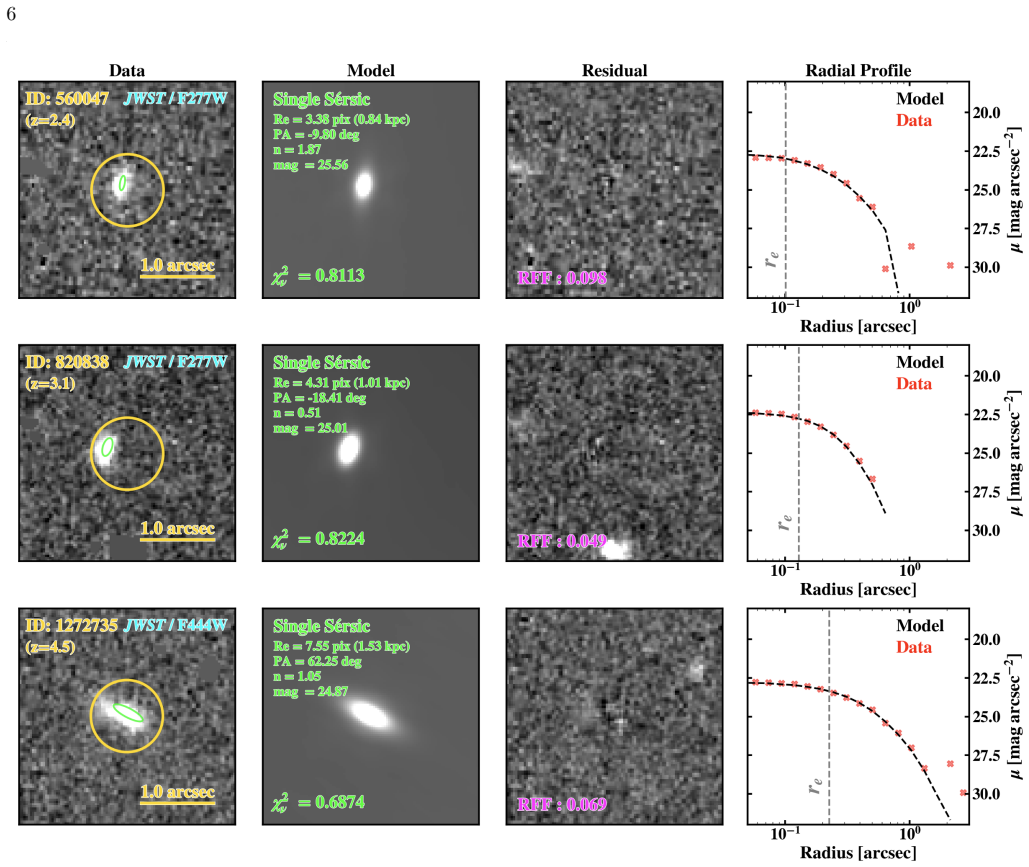
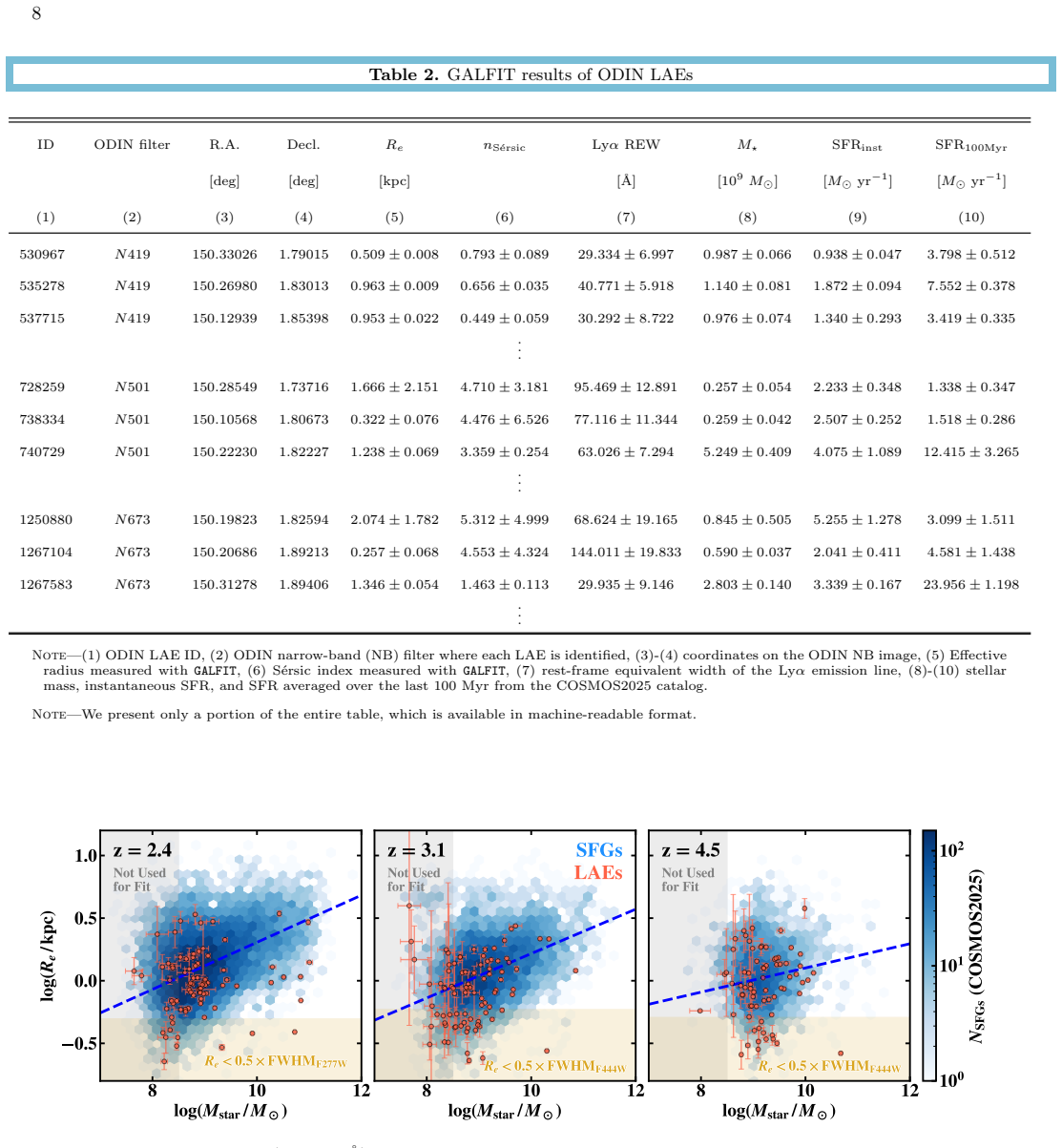
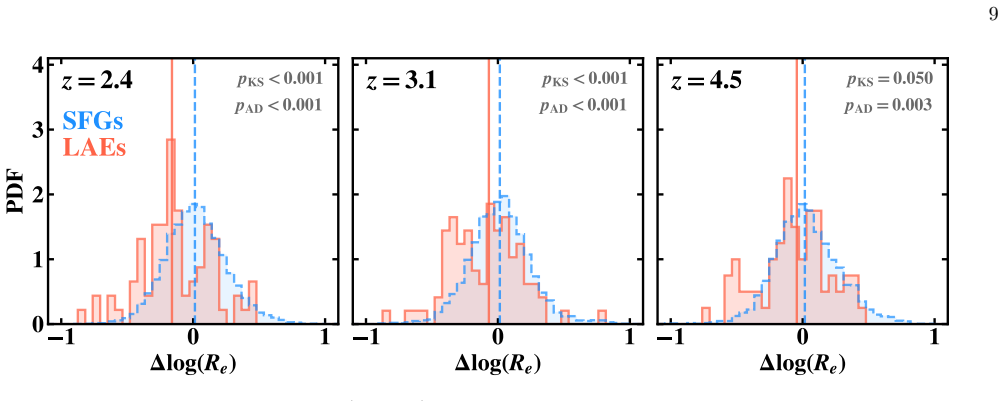
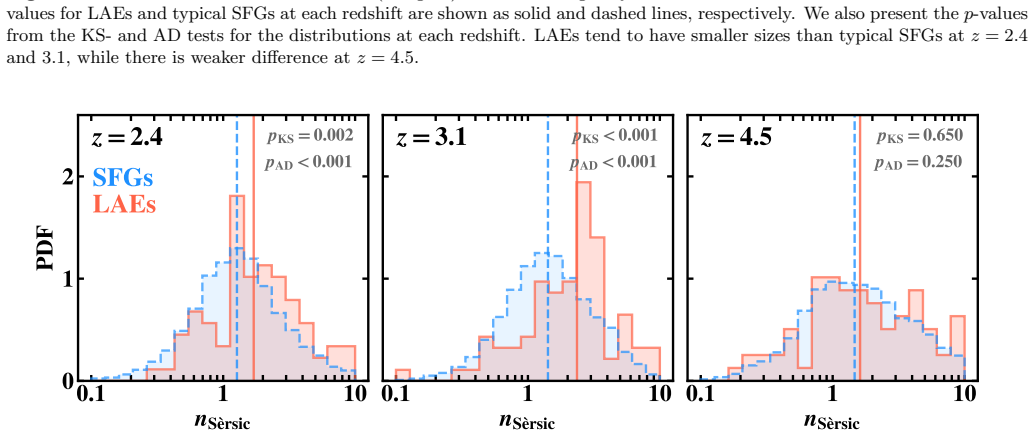
We analyze the rest-frame optical (~8000 {\AA}) morphologies and star formation activity of Ly{\alpha} emitters (LAEs) at redshifts $2.4$, $3.1$, and $4.5$, identified in the ODIN survey. To compare their physical properties with those of other galaxies, we construct a comparison sample of typical star-forming galaxies (SFGs) at similar redshifts from the COSMOS2025 catalog. Using the \textit{JWST}/NIRCam images from the COSMOS-Web survey, we measure the rest-frame optical sizes and S\'ersic indices. We first examine their size-mass relations and find that LAEs at all three redshifts have smaller sizes than typical SFGs, with the size difference decreasing at higher redshifts. We also find that LAEs tend to have larger S\'ersic indices at $z=2.4$ and $3.1$ than typical SFGs, but the difference becomes weaker at $z=4.5$. These trends are qualitatively reproduced in the Horizon Run 5 cosmological hydrodynamical simulation. We then investigate star formation activity and find that LAEs exhibit higher star formation rates than typical SFGs at all redshifts considered. Finally, we examine the connection between Ly{\alpha} emission and galaxy structure, finding that the rest-frame equivalent width (REW) of the Ly{\alpha} emission line has negative and positive correlations with size and S\'ersic index, respectively. In addition, we find a strong positive correlation between the Ly{\alpha} REW and the ratio of the instantaneous star formation rate to that averaged over the last $100\;\mathrm{Myr}$ (i.e., $\mathrm{SFR_{inst}}/\mathrm{SFR_{100 Myr}}$). These results suggest the compact and starbursting nature of LAEs, and provide important constraints on the physical mechanism for the Ly{\alpha} photon escape from galaxies.
Editorial analysis
A structured set of objections, weighed in public.
Referee Report
Summary. The paper analyzes rest-frame optical morphologies and star formation activity of Lyα emitters (LAEs) at z=2.4, 3.1, and 4.5 from the ODIN survey using JWST/NIRCam imaging. It constructs a comparison sample of typical star-forming galaxies (SFGs) from COSMOS2025 at similar redshifts, reports that LAEs have smaller sizes (with the offset decreasing at higher z), higher SFRs, and larger Sersic indices at lower z; it also finds negative correlation of Lyα REW with size and positive correlations with Sersic index and SFR_inst/SFR_100Myr. Trends are compared to the Horizon Run 5 simulation.
Significance. If the comparison sample is shown to be unbiased, the results would provide useful observational constraints on the compact, starbursting conditions associated with strong Lyα emission and photon escape at these redshifts. The JWST-based rest-frame optical size measurements and the simulation comparison are positive features that strengthen the work's contribution to high-z galaxy evolution studies.
major comments (2)
- [§2.2] §2.2 (or equivalent section on sample construction): The COSMOS2025 comparison sample is described only as selected at 'similar redshifts' without explicit details on the stellar-mass matching procedure, UV or mass completeness cuts, or quantitative tests for systematic differences in size or SFR measurements relative to the LAE sample; this selection is load-bearing for the size-mass relation offsets and SFR comparisons reported in §4.1 and §4.2.
- [§4.1] §4.1 (size-mass relations): The reported decrease in size offset with redshift and the Sersic index trends at z=2.4/3.1 vs. z=4.5 rest on the assumption that the COSMOS2025 SFGs accurately represent the parent population at fixed mass; without bias tests or alternative matching (e.g., UV-selected vs. mass-selected), the intrinsic vs. selection-driven nature of the differences cannot be distinguished.
minor comments (2)
- [Figure 3] Figure 3 (or equivalent size-mass plot): Axis labels and legend should explicitly state the mass range and redshift bins used for the comparison to improve clarity.
- [Abstract] The abstract and §1 use 'typical SFGs' without a concise definition; a one-sentence operational definition would aid readers.
Simulated Author's Rebuttal
We thank the referee for the constructive feedback on our manuscript. The comments highlight important aspects of sample construction that require clarification to strengthen the robustness of our comparisons. We address each major comment below and will revise the manuscript accordingly.
read point-by-point responses
-
Referee: [§2.2] §2.2 (or equivalent section on sample construction): The COSMOS2025 comparison sample is described only as selected at 'similar redshifts' without explicit details on the stellar-mass matching procedure, UV or mass completeness cuts, or quantitative tests for systematic differences in size or SFR measurements relative to the LAE sample; this selection is load-bearing for the size-mass relation offsets and SFR comparisons reported in §4.1 and §4.2.
Authors: We agree that the description in §2.2 is insufficiently detailed for a load-bearing aspect of the analysis. In the revised manuscript we will expand this section to specify the stellar-mass matching procedure (galaxies selected within 0.3 dex in log M⋆ at the same redshift), the UV magnitude and stellar-mass completeness cuts applied to ensure both samples probe comparable populations, and quantitative tests (e.g., distribution comparisons of sizes and SFRs) demonstrating no systematic offsets between the LAE and COSMOS2025 samples beyond the intended physical differences. revision: yes
-
Referee: [§4.1] §4.1 (size-mass relations): The reported decrease in size offset with redshift and the Sersic index trends at z=2.4/3.1 vs. z=4.5 rest on the assumption that the COSMOS2025 SFGs accurately represent the parent population at fixed mass; without bias tests or alternative matching (e.g., UV-selected vs. mass-selected), the intrinsic vs. selection-driven nature of the differences cannot be distinguished.
Authors: We acknowledge that additional validation is needed to separate intrinsic differences from possible selection effects. In the revision we will add explicit bias tests, including construction of an alternative UV-selected comparison subsample, and will report whether the size-offset and Sersic trends persist under this alternative matching. We will also note the limitations of a purely mass-selected reference sample. The qualitative agreement with the Horizon Run 5 simulation already provides supporting evidence that the trends are not purely selection-driven, but we agree that the observational tests requested will improve the manuscript. revision: yes
Circularity Check
No circularity: purely observational comparisons with no derivations or self-referential reductions
full rationale
The paper reports direct measurements of rest-frame optical sizes, Sersic indices, and SFRs from JWST/NIRCam imaging and COSMOS2025 catalog data for LAEs and a comparison SFG sample at matching redshifts. No equations, fitted parameters, or model predictions are presented that reduce to inputs by construction. The qualitative mention of Horizon Run 5 trends is external reproduction, not a derivation chain internal to the paper. No self-citations are invoked for uniqueness theorems or ansatzes. The central claims rest on observational data and sample selection, which the skeptic correctly flags as a potential bias issue but which does not constitute circularity under the defined patterns.
Axiom & Free-Parameter Ledger
Reference graph
Works this paper leans on
-
[1]
Ahn, S.-H., Lee, H.-W., & Lee, H. M. 2003, MNRAS, 340, 863, doi: 10.1046/j.1365-8711.2003.06353.x
-
[2]
C., Ilbert, O., Ciesla, L., et al
Arango-Toro, R. C., Ilbert, O., Ciesla, L., et al. 2025, A&A, 696, A159, doi: 10.1051/0004-6361/202452519
-
[3]
2002, MNRAS, 329, 355, doi: 10.1046/j.1365-8711.2002.04988.x
Arnouts, S., Moscardini, L., Vanzella, E., et al. 2002, MNRAS, 329, 355, doi: 10.1046/j.1365-8711.2002.04988.x
-
[4]
2011, in Astronomical Society of the Pacific Conference Series, Vol
Bertin, E. 2011, in Astronomical Society of the Pacific Conference Series, Vol. 442, Astronomical Data Analysis Software and Systems XX, ed. I. N. Evans, A. Accomazzi, D. J. Mink, & A. H. Rots, 435
2011
-
[5]
1996, A&AS, 117, 393, doi: 10.1051/aas:1996164
Bertin, E., & Arnouts, S. 1996, A&AS, 117, 393, doi: 10.1051/aas:1996164
-
[6]
A., Gawiser, E., Gronwall, C., et al
Bond, N. A., Gawiser, E., Gronwall, C., et al. 2009, ApJ, 705, 639, doi: 10.1088/0004-637X/705/1/639
-
[7]
A., Gawiser, E., Guaita, L., et al
Bond, N. A., Gawiser, E., Guaita, L., et al. 2012, ApJ, 753, 95, doi: 10.1088/0004-637X/753/2/95
-
[8]
2019, A&A, 622, A103, doi: 10.1051/0004-6361/201834156
Boquien, M., Burgarella, D., Roehlly, Y., et al. 2019, A&A, 622, A103, doi: 10.1051/0004-6361/201834156
work page internal anchor Pith review doi:10.1051/0004-6361/201834156 2019
-
[9]
Carnall, A. C., Leja, J., Johnson, B. D., et al. 2019, ApJ, 873, 44, doi: 10.3847/1538-4357/ab04a2
-
[10]
Casey, C. M., Kartaltepe, J. S., Drakos, N. E., et al. 2023, ApJ, 954, 31, doi: 10.3847/1538-4357/acc2bc
-
[11]
Davari, R., Ho, L. C., Peng, C. Y., & Huang, S. 2014, ApJ, 787, 69, doi: 10.1088/0004-637X/787/1/69 19 Figure 13.Relation of LyαREW with stellar mass (upper panels), and with the size excess relative to the size-mass relation (lower panels) for ODIN LAEs atz= 2.4, 3.1, and 4.5. While LyαREW has strong correlations with stellar mass, there are only weak re...
-
[12]
Saas-Fee Lecture Notes: Physics of Lyman Alpha Radiative Transfer
Dijkstra, M. 2017, arXiv e-prints, arXiv:1704.03416, doi: 10.48550/arXiv.1704.03416
work page internal anchor Pith review Pith/arXiv arXiv doi:10.48550/arxiv.1704.03416 2017
-
[13]
Dijkstra, M., & Westra, E. 2010, MNRAS, 401, 2343, doi: 10.1111/j.1365-2966.2009.15859.x
-
[14]
Dijkstra, M., & Wyithe, J. S. B. 2012, MNRAS, 419, 3181, doi: 10.1111/j.1365-2966.2011.19958.x
-
[15]
Elbaz, D., Dickinson, M., Hwang, H. S., et al. 2011, A&A, 533, A119, doi: 10.1051/0004-6361/201117239
-
[16]
M., Gawiser, E., Ramakrishnan, V., et al
Firestone, N. M., Gawiser, E., Ramakrishnan, V., et al. 2024, ApJ, 974, 217, doi: 10.3847/1538-4357/ad71c9
-
[17]
Firestone, N. M., Gawiser, E., Iyer, K. G., et al. 2025, ApJL, 986, L8, doi: 10.3847/2041-8213/adbf8c
-
[18]
Foreman-Mackey, D., Hogg, D. W., Lang, D., & Goodman, J. 2013, PASP, 125, 306, doi: 10.1086/670067
-
[19]
Franco, M., Casey, C. M., Koekemoer, A. M., et al. 2025, arXiv e-prints, arXiv:2506.03256, doi: 10.48550/arXiv.2506.03256
-
[20]
Gardner, J. P., Mather, J. C., Abbott, R., et al. 2023, PASP, 135, 068001, doi: 10.1088/1538-3873/acd1b5
-
[21]
2007, ApJ, 671, 278, doi: 10.1086/522955
Gawiser, E., Francke, H., Lai, K., et al. 2007, ApJ, 671, 278, doi: 10.1086/522955
-
[22]
2015, ApJ, 812, 123, doi: 10.1088/0004-637X/812/2/123
Gronke, M., Bull, P., & Dijkstra, M. 2015, ApJ, 812, 123, doi: 10.1088/0004-637X/812/2/123
-
[23]
2010, ApJ, 714, 255, doi: 10.1088/0004-637X/714/1/255
Guaita, L., Gawiser, E., Padilla, N., et al. 2010, ApJ, 714, 255, doi: 10.1088/0004-637X/714/1/255
-
[24]
2011, ApJ, 733, 114, doi: 10.1088/0004-637X/733/2/114
Guaita, L., Acquaviva, V., Padilla, N., et al. 2011, ApJ, 733, 114, doi: 10.1088/0004-637X/733/2/114
-
[25]
Hansen, M., & Oh, S. P. 2006, MNRAS, 367, 979, doi: 10.1111/j.1365-2966.2005.09870.x
-
[26]
2018, ApJ, 864, 145, doi: 10.3847/1538-4357/aad80b
Hao, C.-N., Huang, J.-S., Xia, X., et al. 2018, ApJ, 864, 145, doi: 10.3847/1538-4357/aad80b
-
[27]
W., Hsu, C.-C., Hathi, N., et al
Holwerda, B. W., Hsu, C.-C., Hathi, N., et al. 2024, MNRAS, 529, 1067, doi: 10.1093/mnras/stae316
-
[28]
Hoyos, C., den Brok, M., Verdoes Kleijn, G., et al. 2011, MNRAS, 411, 2439, doi: 10.1111/j.1365-2966.2010.17855.x 20
-
[29]
Hoyos, C., Arag´ on-Salamanca, A., Gray, M. E., et al. 2012, MNRAS, 419, 2703, doi: 10.1111/j.1365-2966.2011.19918.x
-
[30]
Ilbert, O., Arnouts, S., McCracken, H. J., et al. 2006, A&A, 457, 841, doi: 10.1051/0004-6361:20065138
work page internal anchor Pith review doi:10.1051/0004-6361:20065138 2006
-
[31]
Ilbert, O., McCracken, H. J., Le F` evre, O., et al. 2013, A&A, 556, A55, doi: 10.1051/0004-6361/201321100
-
[32]
Im, S. H., Hwang, H. S., Park, J., et al. 2024, ApJ, 972, 196, doi: 10.3847/1538-4357/ad67d2
-
[33]
2024, ApJ, 964, 192, doi: 10.3847/1538-4357/ad2512
Ito, K., Valentino, F., Brammer, G., et al. 2024, ApJ, 964, 192, doi: 10.3847/1538-4357/ad2512
-
[34]
2017, ApJ, 838, 127, doi: 10.3847/1538-4357/aa63f0
Iyer, K., & Gawiser, E. 2017, ApJ, 838, 127, doi: 10.3847/1538-4357/aa63f0
-
[35]
Iyer, K. G., Gawiser, E., Faber, S. M., et al. 2019, ApJ, 879, 116, doi: 10.3847/1538-4357/ab2052
-
[36]
Jones, G. C., Bunker, A. J., Saxena, A., et al. 2025, MNRAS, 536, 2355, doi: 10.1093/mnras/stae2670
-
[37]
2014, MNRAS, 443, 3341, doi: 10.1093/mnras/stu1339
Jose, C., Srianand, R., & Subramanian, K. 2014, MNRAS, 443, 3341, doi: 10.1093/mnras/stu1339
-
[38]
2018, MNRAS, 480, 5140, doi: 10.1093/mnras/sty2214
Kakiichi, K., & Dijkstra, M. 2018, MNRAS, 480, 5140, doi: 10.1093/mnras/sty2214
-
[39]
2021, ApJ, 908, 30, doi: 10.3847/1538-4357/abc2d9
Kakiichi, K., & Gronke, M. 2021, ApJ, 908, 30, doi: 10.3847/1538-4357/abc2d9
-
[40]
2022, A&A, 659, A183, doi: 10.1051/0004-6361/202141900
Kerutt, J., Wisotzki, L., Verhamme, A., et al. 2022, A&A, 659, A183, doi: 10.1051/0004-6361/202141900
-
[41]
2025, arXiv e-prints, arXiv:2501.07548, doi: 10.48550/arXiv.2501.07548
Kim, K., Alavi, A., Snapp-Kolas, C., et al. 2025, arXiv e-prints, arXiv:2501.07548, doi: 10.48550/arXiv.2501.07548
-
[42]
2014, ApJ, 788, 121, doi: 10.1088/0004-637X/788/2/121
Kimm, T., & Cen, R. 2014, ApJ, 788, 121, doi: 10.1088/0004-637X/788/2/121
-
[43]
2016, ApJL, 820, L1, doi: 10.3847/2041-8205/820/1/L1
Kurczynski, P., Gawiser, E., Acquaviva, V., et al. 2016, ApJL, 820, L1, doi: 10.3847/2041-8205/820/1/L1
-
[44]
2018, MNRAS, 474, 5437, doi: 10.1093/mnras/stx3055
Laigle, C., Pichon, C., Arnouts, S., et al. 2018, MNRAS, 474, 5437, doi: 10.1093/mnras/stx3055
-
[45]
Laursen, P., Sommer-Larsen, J., & Andersen, A. C. 2009, ApJ, 704, 1640, doi: 10.1088/0004-637X/704/2/1640
-
[46]
Lee, J., Shin, J., Snaith, O. N., et al. 2021, ApJ, 908, 11, doi: 10.3847/1538-4357/abd08b
-
[47]
Lee, J. H., Park, C., Hwang, H. S., & Kwon, M. 2024, ApJ, 966, 113, doi: 10.3847/1538-4357/ad3448
-
[48]
2014, ApJ, 796, 126, doi: 10.1088/0004-637X/796/2/126
Lee, K.-S., Dey, A., Hong, S., et al. 2014, ApJ, 796, 126, doi: 10.1088/0004-637X/796/2/126
-
[49]
2024, ApJ, 962, 36, doi: 10.3847/1538-4357/ad165e
Lee, K.-S., Gawiser, E., Park, C., et al. 2024, ApJ, 962, 36, doi: 10.3847/1538-4357/ad165e
-
[50]
Speagle, J. S. 2019, ApJ, 876, 3, doi: 10.3847/1538-4357/ab133c
work page internal anchor Pith review doi:10.3847/1538-4357/ab133c 2019
-
[51]
S., Wuyts, S., Huang, J.-S., & Jiang, L
Liu, Y., Dai, Y. S., Wuyts, S., Huang, J.-S., & Jiang, L. 2024, ApJ, 966, 210, doi: 10.3847/1538-4357/ad3822
-
[52]
Malhotra, S., Rhoads, J. E., Finkelstein, S. L., et al. 2012, ApJL, 750, L36, doi: 10.1088/2041-8205/750/2/L36
-
[53]
2024, ApJ, 972, 134, doi: 10.3847/1538-4357/ad5c6a
Martorano, M., van der Wel, A., Baes, M., et al. 2024, ApJ, 972, 134, doi: 10.3847/1538-4357/ad5c6a
-
[54]
A., Treu, T., Dijkstra, M., et al
Mason, C. A., Treu, T., Dijkstra, M., et al. 2018, ApJ, 856, 2, doi: 10.3847/1538-4357/aab0a7
-
[55]
Nedkova, K. V., Rafelski, M., Teplitz, H. I., et al. 2024, ApJ, 970, 188, doi: 10.3847/1538-4357/ad4ede
-
[56]
Neufeld, D. A. 1990, ApJ, 350, 216, doi: 10.1086/168375
-
[57]
2024, ApJL, 963, L38, doi: 10.3847/2041-8213/ad292f
Ning, Y., Cai, Z., Lin, X., et al. 2024, ApJL, 963, L38, doi: 10.3847/2041-8213/ad292f
-
[58]
Ormerod, K., Conselice, C. J., Adams, N. J., et al. 2024, MNRAS, 527, 6110, doi: 10.1093/mnras/stad3597
-
[59]
2005, ApJL, 620, L1, doi: 10.1086/428499
Ouchi, M., Shimasaku, K., Akiyama, M., et al. 2005, ApJL, 620, L1, doi: 10.1086/428499
-
[60]
2015, MNRAS, 447, 786, doi: 10.1093/mnras/stu2447
Pacifici, C., da Cunha, E., Charlot, S., et al. 2015, MNRAS, 447, 786, doi: 10.1093/mnras/stu2447
-
[61]
2022, ApJ, 937, 15, doi: 10.3847/1538-4357/ac85b5
Park, C., Lee, J., Kim, J., et al. 2022, ApJ, 937, 15, doi: 10.3847/1538-4357/ac85b5
-
[62]
Partridge, R. B., & Peebles, P. J. E. 1967, ApJ, 147, 868, doi: 10.1086/149079
-
[63]
2018, MNRAS, 476, 5479, doi: 10.1093/mnras/sty281
Paulino-Afonso, A., Sobral, D., Ribeiro, B., et al. 2018, MNRAS, 476, 5479, doi: 10.1093/mnras/sty281
-
[64]
Peng, C. Y., Ho, L. C., Impey, C. D., & Rix, H.-W. 2002, AJ, 124, 266, doi: 10.1086/340952
work page internal anchor Pith review doi:10.1086/340952 2002
-
[65]
Peng, C. Y., Ho, L. C., Impey, C. D., & Rix, H.-W. 2010, AJ, 139, 2097, doi: 10.1088/0004-6256/139/6/2097 P´ erez-Mart´ ınez, J. M., Kodama, T., Koyama, Y., et al. 2024, MNRAS, 527, 10221, doi: 10.1093/mnras/stad3805
work page internal anchor Pith review doi:10.1088/0004-6256/139/6/2097 2010
-
[66]
D., Sivaramakrishnan, A., Lajoie, C.-P., et al
Perrin, M. D., Sivaramakrishnan, A., Lajoie, C.-P., et al. 2014, in Society of Photo-Optical Instrumentation Engineers (SPIE) Conference Series, Vol. 9143, Space Telescopes and Instrumentation 2014: Optical, Infrared, and Millimeter Wave, ed. J. M. Oschmann, Jr., M. Clampin, G. G. Fazio, & H. A. MacEwen, 91433X, doi: 10.1117/12.2056689
-
[67]
1976, ApJL, 210, L53, doi: 10.1086/18230110.1086/182253 Planck Collaboration, Ade, P
Petrosian, V. 1976, ApJL, 210, L53, doi: 10.1086/18230110.1086/182253 Planck Collaboration, Ade, P. A. R., Aghanim, N., et al. 2016, A&A, 594, A13, doi: 10.1051/0004-6361/201525830
-
[68]
Ramakrishnan, V., Lee, K.-S., Artale, M. C., et al. 2024, ApJ, 977, 119, doi: 10.3847/1538-4357/ad83cb
-
[69]
Reddy, N. A., Pettini, M., Steidel, C. C., et al. 2012, ApJ, 754, 25, doi: 10.1088/0004-637X/754/1/25
-
[70]
2015, A&A, 575, A74, doi: 10.1051/0004-6361/201425017
Schreiber, C., Pannella, M., Elbaz, D., et al. 2015, A&A, 575, A74, doi: 10.1051/0004-6361/201425017
-
[71]
2007, ApJS, 172, 1, doi: 10.1086/516585
Scoville, N., Aussel, H., Brusa, M., et al. 2007, ApJS, 172, 1, doi: 10.1086/516585
-
[72]
2026, arXiv e-prints, arXiv:2603.15825, doi: 10.48550/arXiv.2603.15825 21 S´ ersic, J
Seo, E., Song, H., Guaita, L., et al. 2026, arXiv e-prints, arXiv:2603.15825, doi: 10.48550/arXiv.2603.15825 21 S´ ersic, J. L. 1963, Boletin de la Asociacion Argentina de Astronomia La Plata Argentina, 6, 41
-
[73]
2015, MNRAS, 448, 666, doi: 10.1093/mnras/stv051
Shimakawa, R., Kodama, T., Tadaki, K.-i., et al. 2015, MNRAS, 448, 666, doi: 10.1093/mnras/stv051
-
[74]
2025, arXiv e-prints, arXiv:2506.03242, doi: 10.48550/arXiv.2506.03242
Shimizu, S., Kashikawa, N., Kikuta, S., et al. 2025, arXiv e-prints, arXiv:2506.03242, doi: 10.48550/arXiv.2506.03242
-
[75]
Shuntov, M., Akins, H. B., Paquereau, L., et al. 2025, arXiv e-prints, arXiv:2506.03243, doi: 10.48550/arXiv.2506.03243
-
[76]
2023, MNRAS, 523, 5468, doi: 10.1093/mnras/stad1749
Simmonds, C., Tacchella, S., Maseda, M., et al. 2023, MNRAS, 523, 5468, doi: 10.1093/mnras/stad1749
-
[77]
Simmonds, C., Tacchella, S., Curtis-Lake, W. M. E., et al. 2025, MNRAS, doi: 10.1093/mnras/staf1950
-
[78]
Skelton, R. E., Whitaker, K. E., Momcheva, I. G., et al. 2014, ApJS, 214, 24, doi: 10.1088/0067-0049/214/2/24
-
[79]
2019, MNRAS, 484, 39, doi: 10.1093/mnras/sty3483
Smith, A., Ma, X., Bromm, V., et al. 2019, MNRAS, 484, 39, doi: 10.1093/mnras/sty3483
-
[80]
2019, A&A, 623, A157, doi: 10.1051/0004-6361/201833075
Sobral, D., & Matthee, J. 2019, A&A, 623, A157, doi: 10.1051/0004-6361/201833075
discussion (0)
Sign in with ORCID, Apple, or X to comment. Anyone can read and Pith papers without signing in.