Bayesian constraints on the transport coefficients η/s and zeta/s from spin polarization in relativisitic heavy-ion collisions
Pith reviewed 2026-06-29 00:49 UTC · model grok-4.3
The pith
Incorporating Lambda hyperon spin polarization alongside bulk data shifts the Bayesian posterior for bulk viscosity to entropy ratio toward larger values in heavy-ion collisions.
A machine-rendered reading of the paper's core claim, the machinery that carries it, and where it could break.
Core claim
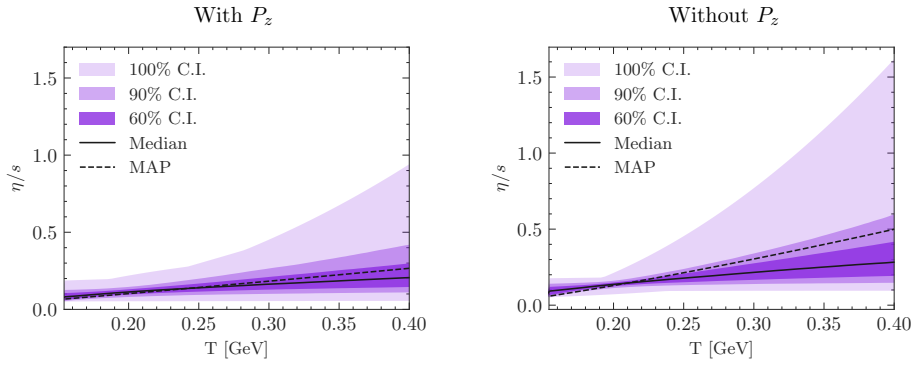
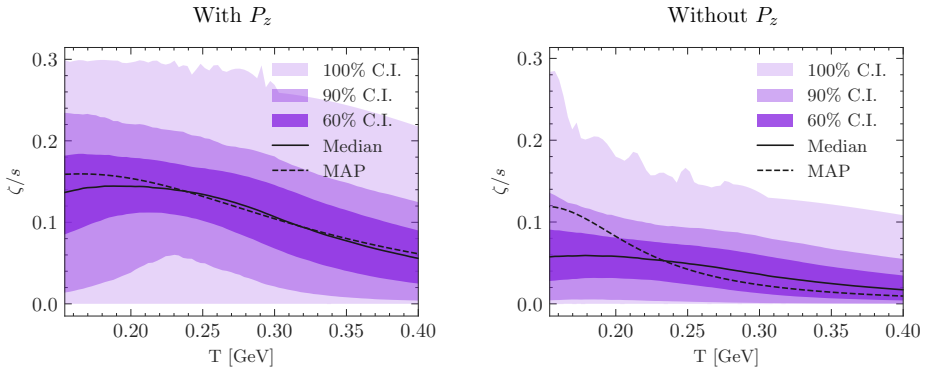
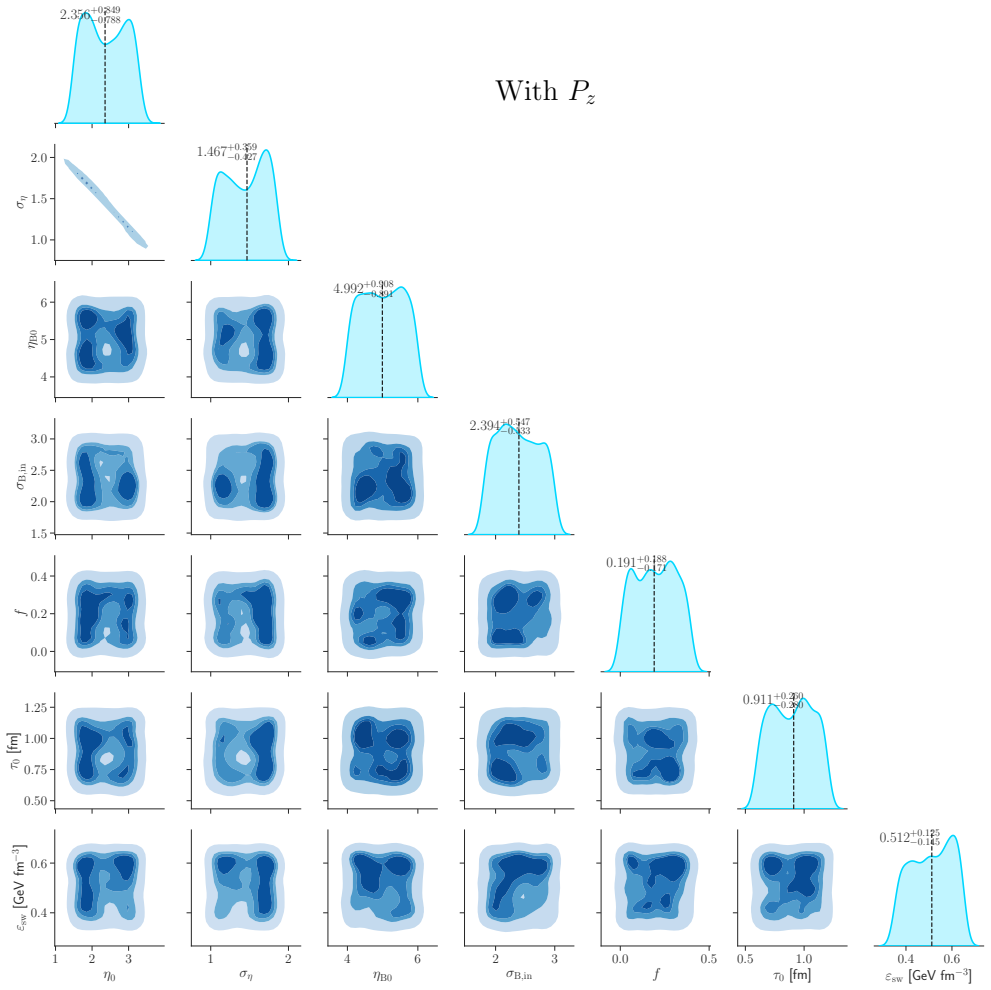
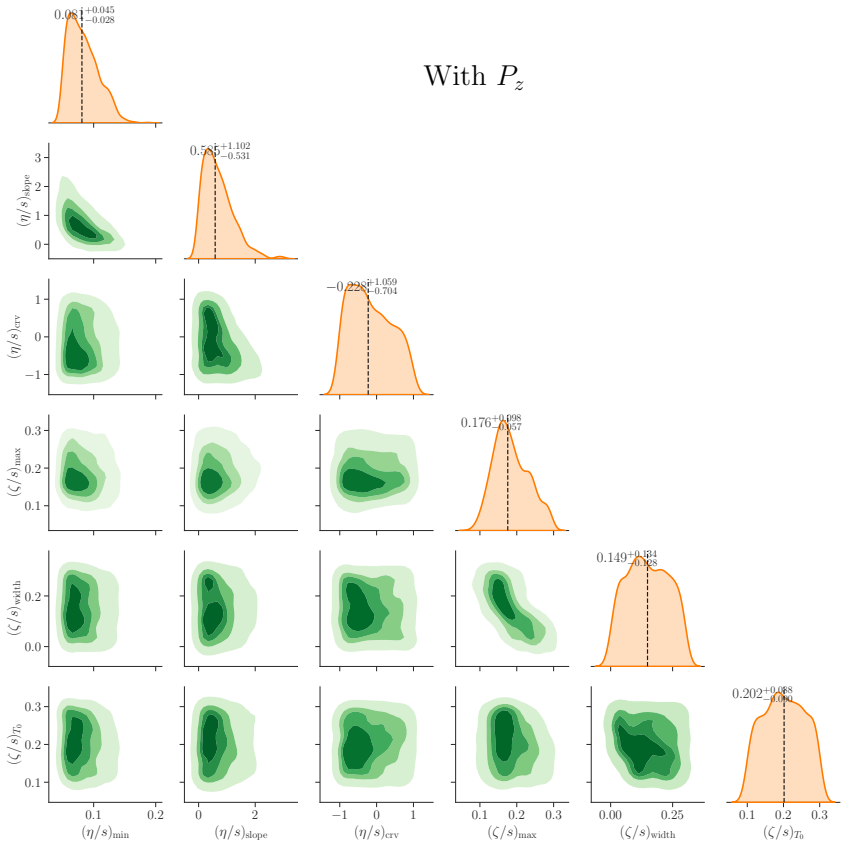
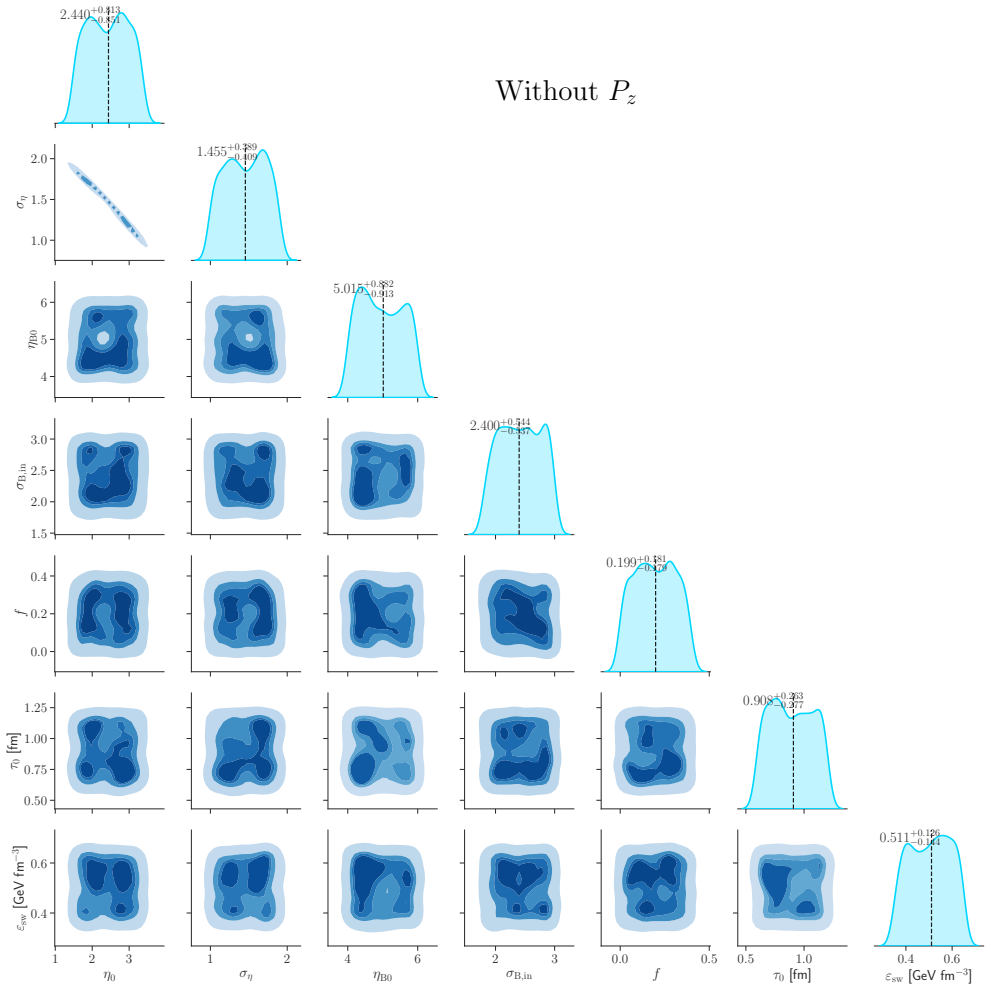
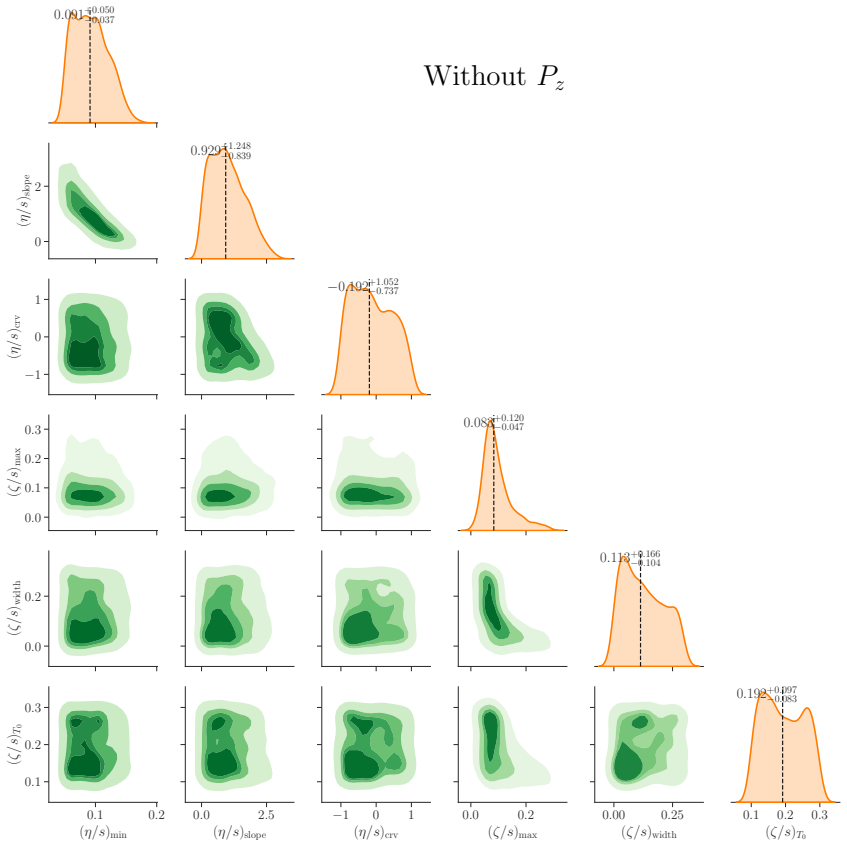
By performing Bayesian inference on eta/s and zeta/s after adding the longitudinal spin polarization of Lambda hyperons to conventional bulk measurements in Pb+Pb collisions at sqrt(s_NN)=5.02 TeV, the posterior distribution of zeta/s shifts toward larger values while eta/s stays largely unchanged, although the separation does not reach statistical significance at the 68 percent credibility level.
What carries the argument
Bayesian inference that combines bulk hadronic observables with longitudinal spin polarization observables to update the posteriors on eta/s and zeta/s.
If this is right
- Spin polarization supplies complementary information on vorticity and space-time evolution that is not fully captured by momentum distributions alone.
- Future Bayesian extractions of transport coefficients should include spin polarization data to obtain more complete constraints.
- The current analysis framework already demonstrates that spin observables can be incorporated systematically alongside bulk data.
- Higher-precision polarization measurements would be needed to achieve a statistically significant separation between the two posteriors.
Where Pith is reading between the lines
- Extending the same analysis to other polarized particles or different beam energies could test whether the upward shift in zeta/s persists.
- Reducing theoretical uncertainties in the hydrodynamic modeling of freeze-out would allow a cleaner test of whether the shift is physical.
- The method opens a route to joint constraints on viscosity and initial-state vorticity that were previously treated separately.
Load-bearing premise
The hydrodynamic evolution and spin-polarization calculation accurately translate the chosen viscosity parametrization into predicted Lambda polarization without dominant unaccounted systematic biases from freeze-out or other modeling choices.
What would settle it
A new measurement of Lambda polarization in the same collisions whose central value and uncertainty match the predictions from the bulk-only posterior without requiring higher zeta/s.
Figures
read the original abstract
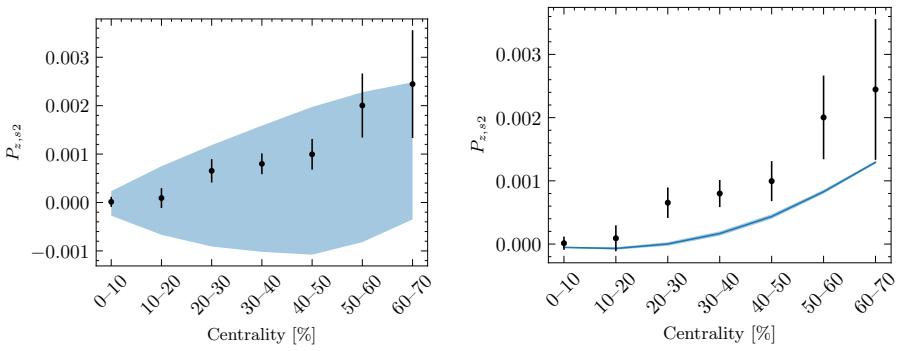
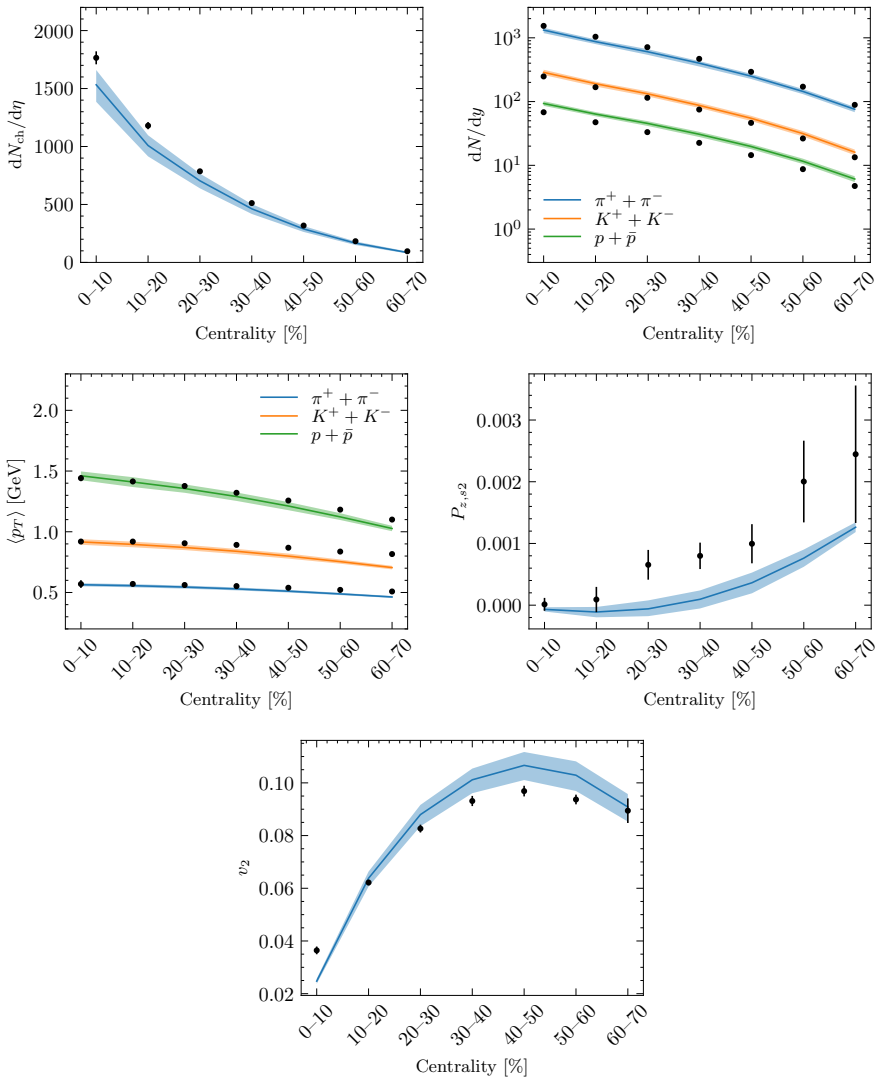
Bayesian analyses in the context of relativistic heavy-ion collisions have so far relied almost exclusively on bulk hadronic observables constructed from momentum degrees of freedom to constrain the transport properties of the quark-gluon plasma. In this work, we perform the Bayesian inference after incorporating the longitudinal spin polarization of $\Lambda$ hyperons alongside conventional bulk measurements in Pb+Pb collisions at $\sqrt{s_{NN}}=5.02$ TeV to constrain the shear and bulk viscosity to entropy density ratios, $\eta/s$ and $\zeta/s$. We demonstrate that the inclusion of spin polarization, which provides complementary sensitivity to the space-time structure and vorticity of the medium, shifts the posterior distribution of $\zeta/s$ toward larger values, although current uncertainties do not allow a statistically significant separation at the 68% credibility level. Nevertheless, the results establish spin polarization as a valuable probe in quantitative studies of QGP transport properties and indicate that it should be incorporated in comprehensive and systematically constrained Bayesian extractions of the medium's dynamical parameters.
Editorial analysis
A structured set of objections, weighed in public.
Referee Report
Summary. The manuscript performs a Bayesian analysis constraining the shear and bulk viscosity ratios η/s and ζ/s of the quark-gluon plasma. It augments conventional bulk hadronic observables from Pb+Pb collisions at √s_NN=5.02 TeV with longitudinal spin polarization of Λ hyperons, demonstrating that the added observable shifts the posterior for ζ/s toward larger values while remaining consistent within 68% credibility intervals, and concludes that spin polarization provides useful complementary sensitivity to the medium's space-time structure and vorticity.
Significance. If the hydrodynamic-to-polarization mapping holds, the work establishes spin polarization as a viable additional constraint in Bayesian extractions of QGP transport coefficients, potentially improving robustness against model assumptions in future studies.
minor comments (1)
- [Title] Title: 'relativisitic' is a typographical error and should read 'relativistic'.
Simulated Author's Rebuttal
We thank the referee for the careful review of our manuscript and for recommending minor revision. The referee's summary accurately reflects the scope and conclusions of our Bayesian analysis, which demonstrates that the inclusion of Λ hyperon longitudinal spin polarization alongside bulk observables shifts the posterior for ζ/s toward larger values while remaining consistent within the 68% credibility interval.
Circularity Check
No significant circularity in Bayesian update
full rationale
The paper performs a standard Bayesian inference that updates the posterior on η/s and ζ/s by adding Λ spin polarization data to the likelihood alongside bulk observables. The reported shift in the ζ/s posterior is the direct mathematical outcome of including the new observable's sensitivity in the likelihood function, which is the intended purpose of the analysis rather than a definitional reduction or self-referential fit. No load-bearing self-citations, ansatz smuggling, or uniqueness theorems from prior author work are quoted or required in the abstract-level description. The central claim remains self-contained against external benchmarks of the hydrodynamic and polarization modeling.
Axiom & Free-Parameter Ledger
Reference graph
Works this paper leans on
-
[1]
C. Gale, S. Jeon, B. Schenke, P. Tribedy, and R. Venugopalan, Event-by-event anisotropic flow in heavy-ion collisions from combined yang-mills and viscous fluid dynamics, Phys. Rev. Lett.110, 012302 (2013)
2013
-
[2]
Collective flow and viscosity in relativistic heavy-ion collisions
U. Heinz and R. Snellings, Collective flow and viscosity in relativistic heavy-ion collisions, Ann. Rev. Nucl. Part. Sci.63, 123 (2013), arXiv:1301.2826 [nucl-th]
work page internal anchor Pith review Pith/arXiv arXiv 2013
-
[3]
Niemi, K
H. Niemi, K. J. Eskola, and R. Paatelainen, Event-by-event fluctuations in a perturbative qcd + saturation + hydrodynamics model: Determining qcd matter shear viscosity in ultrarela- tivistic heavy-ion collisions, Phys. Rev. C93, 024907 (2016). 30
2016
-
[4]
P. K. Kovtun, D. T. Son, and A. O. Starinets, Viscosity in strongly interacting quantum field theories from black hole physics, Phys. Rev. Lett.94, 111601 (2005)
2005
-
[5]
Temperature dependence of shear viscosity of $SU(3)$--gluodynamics within lattice simulation
N. Astrakhantsev, V. Braguta, and A. Kotov, Temperature dependence of shear viscosity of SU(3)–gluodynamics within lattice simulation, JHEP04, 101, arXiv:1701.02266 [hep-lat]
work page internal anchor Pith review Pith/arXiv arXiv
-
[6]
Altenkort, A
L. Altenkort, A. M. Eller, A. Francis, O. Kaczmarek, L. Mazur, G. D. Moore, and H.-T. Shu, Viscosity of pure-glue qcd from the lattice, Phys. Rev. D108, 014503 (2023)
2023
-
[7]
J. E. Bernhard, J. S. Moreland, S. A. Bass, J. Liu, and U. Heinz, Applying bayesian parameter estimation to relativistic heavy-ion collisions: Simultaneous characterization of the initial state and quark-gluon plasma medium, Phys. Rev. C94, 024907 (2016)
2016
-
[8]
J. E. Bernhard, J. S. Moreland, and S. A. Bass, Bayesian estimation of the specific shear and bulk viscosity of quark–gluon plasma, Nature Phys.15, 1113 (2019)
2019
-
[9]
Everettet al.(JETSCAPE Collaboration), Multisystem bayesian constraints on the trans- port coefficients of qcd matter, Phys
D. Everettet al.(JETSCAPE Collaboration), Multisystem bayesian constraints on the trans- port coefficients of qcd matter, Phys. Rev. C103, 054904 (2021)
2021
-
[10]
J. E. Parkkila, A. Onnerstad, and D. J. Kim, Bayesian estimation of the specific shear and bulk viscosity of the quark-gluon plasma with additional flow harmonic observables, Phys. Rev. C104, 054904 (2021)
2021
-
[11]
G. Nijs, W. van der Schee, U. G¨ ursoy, and R. Snellings, Bayesian analysis of heavy ion collisions with the heavy ion computational framework trajectum, Phys. Rev. C103, 054909 (2021)
2021
-
[12]
L. Vermunt, Y. Seemann, A. Dubla, S. Floerchinger, E. Grossi, A. Kirchner, S. Masciocchi, and I. Selyuzhenkov, Mapping properties of the quark gluon plasma in Pb-Pb and Xe-Xe collisions at energies available at the CERN Large Hadron Collider, Phys. Rev. C108, 064908 (2023), arXiv:2308.16722 [hep-ph]
-
[13]
S. A. Jahan, H. Roch, and C. Shen, Bayesian analysis of (3+1)D relativistic nuclear dynamics with the rhic beam energy scan data, Phys. Rev. C110, 054905 (2024)
2024
-
[14]
G¨ otz, I
N. G¨ otz, I. Karpenko, and H. Elfner, Bayesian analysis of a (3 + 1)D hybrid approach with initial conditions from hadronic transport, Phys. Rev. C112, 014910 (2025)
2025
-
[15]
Global $\Lambda$ hyperon polarization in nuclear collisions: evidence for the most vortical fluid
L. Adamczyket al.(STAR), Global Λ hyperon polarization in nuclear collisions: evidence for the most vortical fluid, Nature548, 62 (2017), arXiv:1701.06657 [nucl-ex]
work page internal anchor Pith review Pith/arXiv arXiv 2017
-
[16]
F. Becattini and M. A. Lisa, Polarization and Vorticity in the Quark–Gluon Plasma, Ann. Rev. Nucl. Part. Sci.70, 395 (2020), arXiv:2003.03640 [nucl-ex]. 31
-
[17]
Becattini, Spin and polarization: a new direction in relativistic heavy ion physics, Rept
F. Becattini, Spin and polarization: a new direction in relativistic heavy ion physics, Rept. Prog. Phys.85, 122301 (2022), arXiv:2204.01144 [nucl-th]
-
[18]
W.-B. Dong, X.-L. Sheng, Y.-L. Yin, and Q. Wang, Global polarization and spin alignment in heavy-ion collisions: past, present and future, PoSSPIN2023, 229 (2024), arXiv:2401.15576 [nucl-th]
-
[19]
F. Becattini, M. Buzzegoli, T. Niida, S. Pu, A.-H. Tang, and Q. Wang, Spin polarization in relativistic heavy-ion collisions, Int. J. Mod. Phys. E33, 2430006 (2024), arXiv:2402.04540 [nucl-th]
-
[20]
S. K. Singh and J. Alam, Suppression of spin polarization as an indicator of QCD critical point, Eur. Phys. J. C83, 585 (2023)
2023
-
[21]
A. Palermo, E. Grossi, I. Karpenko, and F. Becattini, Λ polarization in very high energy heavy ion collisions as a probe of the quark–gluon plasma formation and properties, Eur. Phys. J. C 84, 920 (2024), arXiv:2404.14295 [nucl-th]
-
[22]
Wei, Impact of spin polarization on transport and thermodynamic coefficients, Phys
D.-X. Wei, Impact of spin polarization on transport and thermodynamic coefficients, Phys. Rev. C112, 064921 (2025)
2025
-
[23]
G. S. Denicol, H. Niemi, E. Molnar, and D. H. Rischke, Derivation of transient relativistic fluid dynamics from the Boltzmann equation, Phys. Rev. D85, 114047 (2012), [Erratum: Phys.Rev.D 91, 039902 (2015)], arXiv:1202.4551 [nucl-th]
work page internal anchor Pith review Pith/arXiv arXiv 2012
-
[24]
G. S. Denicol, S. Jeon, and C. Gale, Transport coefficients of bulk viscous pressure in the 14-moment approximation, Phys. Rev. C90, 024912 (2014)
2014
-
[25]
Moln´ ar, H
E. Moln´ ar, H. Niemi, G. S. Denicol, and D. H. Rischke, Relative importance of second-order terms in relativistic dissipative fluid dynamics, Phys. Rev. D89, 074010 (2014)
2014
-
[26]
Monnai, B
A. Monnai, B. Schenke, and C. Shen, Equation of state at finite densities for qcd matter in nuclear collisions, Phys. Rev. C100, 024907 (2019)
2019
-
[27]
The equation of state in (2+1)-flavor QCD
A. Bazavovet al.(HotQCD), Equation of state in ( 2+1 )-flavor QCD, Phys. Rev. D90, 094503 (2014), arXiv:1407.6387 [hep-lat]
work page internal anchor Pith review Pith/arXiv arXiv 2014
-
[28]
A. Bazavovet al.(HotQCD), Fluctuations and Correlations of net baryon number, electric charge, and strangeness: A comparison of lattice QCD results with the hadron resonance gas model, Phys. Rev. D86, 034509 (2012), arXiv:1203.0784 [hep-lat]
work page internal anchor Pith review Pith/arXiv arXiv 2012
-
[29]
H. T. Ding, S. Mukherjee, H. Ohno, P. Petreczky, and H. P. Schadler, Diagonal and off- diagonal quark number susceptibilities at high temperatures, Phys. Rev. D92, 074043 (2015), 32 arXiv:1507.06637 [hep-lat]
work page internal anchor Pith review Pith/arXiv arXiv 2015
-
[30]
The QCD Equation of State to $\mathcal{O}(\mu_B^6)$ from Lattice QCD
A. Bazavovet al., The QCD Equation of State toO(µ 6 B) from Lattice QCD, Phys. Rev. D 95, 054504 (2017), arXiv:1701.04325 [hep-lat]. [31]https://sites.google.com/view/qcdneos/
work page internal anchor Pith review Pith/arXiv arXiv 2017
-
[31]
C. Shen and S. Alzhrani, Collision-geometry-based 3D initial condition for relativistic heavy- ion collisions, Phys. Rev. C102, 014909 (2020), arXiv:2003.05852 [nucl-th]
-
[32]
S. Ryu, V. Jupic, and C. Shen, Probing early-time longitudinal dynamics with the Λ hyperon’s spin polarization in relativistic heavy-ion collisions, Phys. Rev. C104, 054908 (2021)
2021
-
[33]
G. S. Denicol, C. Gale, S. Jeon, A. Monnai, B. Schenke, and C. Shen, Net baryon diffusion in fluid dynamic simulations of relativistic heavy-ion collisions, Phys. Rev. C98, 034916 (2018), arXiv:1804.10557 [nucl-th]
work page internal anchor Pith review Pith/arXiv arXiv 2018
-
[34]
Huovinen and H
P. Huovinen and H. Petersen, Particlization in hybrid models, The European Physical Journal A48, 171 (2012)
2012
-
[35]
I. A. Karpenko, P. Huovinen, H. Petersen, and M. Bleicher, Estimation of the shear viscosity at finite net-baryon density fromA+Acollision data at √sNN = 7.7−200 GeV, Phys. Rev. C91, 064901 (2015), arXiv:1502.01978 [nucl-th]
work page internal anchor Pith review Pith/arXiv arXiv 2015
-
[36]
Sch¨ afer, I
A. Sch¨ afer, I. Karpenko, X.-Y. Wu, J. Hammelmann, and H. Elfner, Particle production in a hybrid approach for a beam energy scan of au+au/pb+pb collisions between √sNN = 4.3 gev and √sNN = 200.0 gev, The European Physical Journal A58, 230 (2022). [38]https://github.com/smash-transport/smash-hadron-sampler
2022
-
[37]
Weilet al., Particle production and equilibrium properties within a new hadron transport approach for heavy-ion collisions, Phys
J. Weilet al., Particle production and equilibrium properties within a new hadron transport approach for heavy-ion collisions, Phys. Rev. C94, 054905 (2016)
2016
-
[38]
Wergieluket al., smash-transport/smash: Smash-3.1 (2024)
A. Wergieluket al., smash-transport/smash: Smash-3.1 (2024)
2024
-
[39]
A study of vorticity formation in high energy nuclear collisions
F. Becattini, G. Inghirami, V. Rolando, A. Beraudo, L. Del Zanna, A. De Pace, M. Nardi, G. Pagliara, and V. Chandra, A study of vorticity formation in high energy nuclear collisions, Eur. Phys. J. C75, 406 (2015), [Erratum: Eur.Phys.J.C 78, 354 (2018)], arXiv:1501.04468 [nucl-th]. 33
work page internal anchor Pith review Pith/arXiv arXiv 2015
-
[40]
F. Becattini, M. Buzzegoli, and A. Palermo, Spin-thermal shear coupling in a relativistic fluid, Phys. Lett. B820, 136519 (2021), arXiv:2103.10917 [nucl-th]
- [41]
- [42]
-
[43]
Adamet al.(ALICE Collaboration), Centrality dependence of the charged-particle multi- plicity density at midrapidity in pb-pb collisions at √sN N = 5.02 TeV, Phys
J. Adamet al.(ALICE Collaboration), Centrality dependence of the charged-particle multi- plicity density at midrapidity in pb-pb collisions at √sN N = 5.02 TeV, Phys. Rev. Lett.116, 222302 (2016)
2016
-
[44]
Acharyaet al.(ALICE Collaboration), Production of charged pions, kaons, and (anti- )protons in pb-pb and inelasticppcollisions at √sN N = 5.02 tev, Phys
S. Acharyaet al.(ALICE Collaboration), Production of charged pions, kaons, and (anti- )protons in pb-pb and inelasticppcollisions at √sN N = 5.02 tev, Phys. Rev. C101, 044907 (2020)
2020
-
[45]
Adamet al.(The ALICE Collaboration), Anisotropic flow of charged particles in pb-pb collisions at √sN N = 5.02 TeV, Phys
J. Adamet al.(The ALICE Collaboration), Anisotropic flow of charged particles in pb-pb collisions at √sN N = 5.02 TeV, Phys. Rev. Lett.116, 132302 (2016)
2016
-
[46]
Acharyaet al.(ALICE Collaboration), Polarization of Λ and Λ hyperons along the beam direction in pb-pb collisions at √sN N = 5.02 TeV, Phys
S. Acharyaet al.(ALICE Collaboration), Polarization of Λ and Λ hyperons along the beam direction in pb-pb collisions at √sN N = 5.02 TeV, Phys. Rev. Lett.128, 172005 (2022)
2022
-
[47]
Ollitrault, A
J.-Y. Ollitrault, A. M. Poskanzer, and S. A. Voloshin, Effect of flow fluctuations and nonflow on elliptic flow methods, Phys. Rev. C80, 014904 (2009)
2009
-
[48]
J. S. Moreland, J. E. Bernhard, and S. A. Bass, Alternative ansatz to wounded nucleon and binary collision scaling in high-energy nuclear collisions, Phys. Rev. C92, 011901(R) (2015). [51]https://github.com/Duke-QCD/trento
2015
- [49]
-
[50]
S. K. Singh and J.-e. Alam, Effects of the qcd critical point on the spectra and flow coefficients of hadrons, Phys. Rev. D107, 074042 (2023)
2023
-
[51]
D. H. Rischke, S. Bernard, and J. A. Maruhn, Relativistic hydrodynamics for heavy-ion col- lisions. i. general aspects and expansion into vacuum, Nuclear Physics A595, 346 (1995)
1995
-
[52]
A 3+1 dimensional viscous hydrodynamic code for relativistic heavy ion collisions
I. Karpenko, P. Huovinen, and M. Bleicher, A 3+1 dimensional viscous hydrodynamic code for relativistic heavy ion collisions, Comput. Phys. Commun.185, 3016 (2014), arXiv:1312.4160 34 [nucl-th]. [56]https://github.com/yukarpenko/vhlle/tree/stable_ebe. [57]https://www.openmp.org/
work page internal anchor Pith review Pith/arXiv arXiv 2014
-
[53]
Sapna, S. K. Singh, and D. Wagner, Spin polarization of Λ hyperons from dissipative spin hydrodynamics, Phys. Rev. C112, 054902 (2025)
2025
-
[54]
M. Stein, Large sample properties of simulations using latin hypercube sampling, Technomet- rics29, 143 (1987), https://www.tandfonline.com/doi/pdf/10.1080/00401706.1987.10488205
-
[55]
Carnell, lhs, https://github.com/bertcarnell/lhs
R. Carnell, lhs, https://github.com/bertcarnell/lhs
-
[56]
Pedregosa, G
F. Pedregosa, G. Varoquaux, A. Gramfort, V. Michel, B. Thirion, O. Grisel, M. Blondel, P. Prettenhofer, R. Weiss, V. Dubourg, J. Vanderplas, A. Passos, D. Cournapeau, M. Brucher, M. Perrot, and ´Edouard Duchesnay, Scikit-learn: Machine learning in python, Journal of Machine Learning Research12, 2825 (2011)
2011
-
[57]
GPy, GPy: A gaussian process framework in python,http://github.com/SheffieldML/GPy (2014)
2014
-
[58]
J. E. Bernhard,Bayesian parameter estimation for relativistic heavy-ion collisions, Ph.D. thesis, Duke U. (2018), arXiv:1804.06469 [nucl-th]
work page internal anchor Pith review Pith/arXiv arXiv 2018
-
[59]
Hastie, R
T. Hastie, R. Tibshirani, and J. Friedman,The Elements of Statistical Learning: Data Mining, Inference, and Prediction, 2nd ed. (Springer, New York, 2009)
2009
-
[60]
Foreman-Mackey, D
D. Foreman-Mackey, D. W. Hogg, D. Lang, and J. Goodman, emcee: The mcmc hammer, Publications of the Astronomical Society of the Pacific125, 306 (2013)
2013
-
[61]
W. D. Vousden, W. M. Farr, and I. Mandel, Dynamic temperature selection for parallel tempering in markov chain monte carlo simulations, Monthly Notices of the Royal Astronomical Society455, 1919 (2015), https://academic.oup.com/mnras/article- pdf/455/2/1919/18514064/stv2422.pdf. 35
1919
discussion (0)
Sign in with ORCID, Apple, or X to comment. Anyone can read and Pith papers without signing in.