Large language model for unified and accurate description of multidimensional nuclear properties
Pith reviewed 2026-06-29 00:41 UTC · model grok-4.3
The pith
A large language model trained on experiment-theory deviations unifies accurate predictions across seven nuclear observables.
A machine-rendered reading of the paper's core claim, the machinery that carries it, and where it could break.
Core claim
The authors establish that embedding prior information by training autoregressively on deviations between experimental and theoretical values under a causal language modeling paradigm produces substantial accuracy improvements across seven nuclear observables, including charge radii, masses, binding energies, separation energies, and decay energies, while driving the training loss down by more than 98 percent in every task. This result demonstrates that the language-model framework supplies an efficient shared approach for multi-task regression on fundamental nuclear properties.
What carries the argument
Autoregressive training on deviations between experimental and theoretical values under a causal language modeling paradigm using low-rank adaptation adapters.
If this is right
- One model supplies predictions for charge radii, masses, binding energies, separation energies, and decay energies without separate task-specific training.
- Training loss falls by more than 98 percent across all tasks.
- The framework supplies a shared representation for multi-task regression on nuclear properties.
- Accuracy gains appear simultaneously for the listed observables.
Where Pith is reading between the lines
- The deviation-learning strategy could be applied to other many-body systems where multiple related observables must be predicted together.
- The unified model might improve consistency when extrapolating to nuclei with sparse experimental data.
- Similar techniques could be tested on time-dependent nuclear processes or reaction rates not included in the current training set.
Load-bearing premise
That training autoregressively on deviations between experiment and theory under a causal language modeling paradigm with low-rank adapters will produce a unified, accurate description of multiple nuclear properties without overfitting or requiring separate validation.
What would settle it
If a held-out set of nuclei shows prediction errors for the seven observables that remain comparable to or larger than those of the original theoretical models, the central claim would be falsified.
Figures




read the original abstract
A prior-informed large language model (LLM) driven multi-task learning framework is proposed for the unified description of multiple nuclear observables. By fine-tuning the pre-trained DeepSeek-R1-1.5B model with Low-Rank Adaptation (LoRA), lightweight adapters are introduced while preserving general pre-trained parameters. Under a causal language modeling paradigm, the model is trained autoregressively on deviations between experimental and theoretical values. Significant accuracy improvements are achieved across seven observables, including charge radii, masses, binding energies, separation energies, and decay energies, with the training loss decreasing by over 98% across all tasks. This demonstrates that the LLM-based framework, through structured prior embedding, offers an efficient and shared approach for multi-task regression in fundamental nuclear properties.
Editorial analysis
A structured set of objections, weighed in public.
Referee Report
Summary. The manuscript proposes a prior-informed LLM-based multi-task learning framework that fine-tunes the pre-trained DeepSeek-R1-1.5B model with LoRA adapters under a causal language modeling objective. The model is trained autoregressively on deviations between experimental and theoretical values for nuclear observables, claiming significant accuracy improvements across seven properties (charge radii, masses, binding energies, separation energies, and decay energies) with training loss reductions exceeding 98%.
Significance. If the claimed accuracy gains were shown to generalize beyond the training distribution, the approach could provide an efficient shared representation for multi-task nuclear regression. However, the absence of any held-out evaluation means the significance cannot be assessed from the reported results.
major comments (2)
- [Abstract] Abstract: The headline claim of 'significant accuracy improvements' across seven observables is unsupported because the text reports only a >98% training-loss reduction and provides no test-set nuclei, k-fold cross-validation, extrapolation to unseen mass regions, or baseline regressor comparison on the same deviation targets.
- [Abstract] Abstract (and implied § on training): Under the causal LM objective, training directly on experimental–theoretical deviations allows arbitrarily low training loss via memorization of the training distribution; without explicit held-out metrics the central multi-task generalization claim is not demonstrated.
Simulated Author's Rebuttal
We thank the referee for highlighting the critical need for held-out evaluation to substantiate the generalization claims in our work. We fully agree that the current manuscript does not provide sufficient evidence for performance beyond the training distribution and will make substantial revisions to include such evaluations.
read point-by-point responses
-
Referee: [Abstract] Abstract: The headline claim of 'significant accuracy improvements' across seven observables is unsupported because the text reports only a >98% training-loss reduction and provides no test-set nuclei, k-fold cross-validation, extrapolation to unseen mass regions, or baseline regressor comparison on the same deviation targets.
Authors: We agree that the abstract overstates the results by claiming 'significant accuracy improvements' based only on training loss reduction. No test-set or baseline comparisons are reported in the current version. In the revised manuscript, we will update the abstract to accurately reflect the training results and add comprehensive held-out evaluations, including test sets and baseline comparisons. revision: yes
-
Referee: [Abstract] Abstract (and implied § on training): Under the causal LM objective, training directly on experimental–theoretical deviations allows arbitrarily low training loss via memorization of the training distribution; without explicit held-out metrics the central multi-task generalization claim is not demonstrated.
Authors: This is a valid concern. The autoregressive training on deviations can indeed result in low training loss through memorization without guaranteeing generalization. The manuscript currently lacks held-out metrics to demonstrate the multi-task generalization. We will revise by adding explicit held-out test results and metrics to address this. revision: yes
Circularity Check
Reported accuracy gains and 98% loss drop reduce to training-set performance by construction
specific steps
-
fitted input called prediction
[Abstract]
"Under a causal language modeling paradigm, the model is trained autoregressively on deviations between experimental and theoretical values. Significant accuracy improvements are achieved across seven observables, including charge radii, masses, binding energies, separation energies, and decay energies, with the training loss decreasing by over 98% across all tasks."
Training occurs directly on the deviation targets; the quoted accuracy improvements and loss drop are therefore measured on the same fitted distribution. Without any stated held-out set or extrapolation test, the performance numbers are statistically forced by the training procedure itself rather than constituting an independent result.
full rationale
The paper trains autoregressively on experimental–theoretical deviations and reports both training-loss reduction (>98%) and accuracy improvements across seven observables. No held-out nuclei, test-set metrics, or cross-validation are described in the abstract or claimed derivation. Under the stated causal LM + LoRA objective this is exactly the regime where memorization of the fitted deviations produces the reported numbers by construction, matching the 'fitted_input_called_prediction' pattern. The central claim of a 'unified and accurate description' therefore lacks an independent verification step.
Axiom & Free-Parameter Ledger
free parameters (1)
- LoRA rank and scaling factors
axioms (1)
- domain assumption The pre-trained DeepSeek-R1-1.5B model can be adapted via LoRA to nuclear physics regression tasks while preserving general capabilities.
Reference graph
Works this paper leans on
-
[1]
Dobaczewski, N
J. Dobaczewski, N. Michel, W. Nazarewicz et al., Prog. Part. Nucl. Phys.59, 432 (2007)
2007
-
[2]
Tullney, F
K. Tullney, F. Allmendinger, M. Burghoff et al., Phys. Rev. Lett.111, 100801 (2013)
2013
-
[3]
P. S. Wen, J. W. Holt, M. Li, Phys. Rev. Lett.133, 252501 (2024)
2024
-
[4]
Wienholtz, D
F. Wienholtz, D. Beck, K. Blaum et al., Nature498, 346 (2013)
2013
-
[5]
E. M. Ramirez, D. Ackermann, K. Blaum et al., Science337, 1207 (2012)
2012
-
[6]
Möller, A
P. Möller, A. J. Sierk, T. Ichikawa et al., At. Data Nucl. Data Tables 109–110, 1 (2016)
2016
-
[7]
D. D. Ni, Z. Z. Ren, T. K. Dong et al., Phys. Rev. C78, 044310 (2008)
2008
-
[8]
Y. J. Ren, Z. Z. Ren, Phys. Rev. C85, 044608 (2012)
2012
-
[9]
Jyothish, G
K. Jyothish, G. Manangode, A. K. Rhine Kumar, Phys. Rev. C112, 064309 (2025)
2025
-
[10]
P. Li, Z. M. Niu, Y. F. Niu, Nucl. Sci. Tech.36, 50 (2025)
2025
-
[11]
Diehl, M
R. Diehl, M. Wiescher, Eur. Phys. J. A62, 45 (2026)
2026
-
[12]
Ekström, G
A. Ekström, G. R. Jansen, K. A. Wendt et al., Phys. Rev. C91, 051301 (2015)
2015
-
[13]
Pfützner, M
M. Pfützner, M. Karny, L. V. Grigorenko, K. Riisager, Rev. Mod. Phys. 84, 567 (2012)
2012
-
[14]
C. Y. Seng, Phys. Rev. Lett.130, 152501 (2023). 12
2023
-
[15]
B. V. Carlson, M. Dutra, O. Lourenço et al., Phys. Rev. C107, 035805 (2023)
2023
-
[16]
C. F. v. Weizsäcker, Z. Phys.96, 431 (1935)
1935
-
[17]
L. S. Geng, H. Toki, J. Meng, Prog. Theor. Phys.113, 785 (2005)
2005
-
[18]
A. V. Afanasjev, S. E. Agbemava, D. Ray et al., Phys. Lett. B726, 680–684 (2013)
2013
-
[19]
N. Wang, M. Liu, X. Z. Wu et al., Phys. Lett. B734, 215–219 (2014)
2014
-
[20]
G. P. Liu, H. L. Wang, Z. Z. Zhang et al., Phys. Rev. C111, 024306 (2025)
2025
-
[21]
Z. L. Li, Y. J. Wang, Q. F. Li et al., Phys. Rev. C112, 014312 (2025)
2025
-
[22]
J. Z. Xie, K. P. Wang, C. Wang et al., Phys. Rev. C109, 064317 (2024)
2024
-
[23]
Z. M. Niu, H. Z. Liang, Phys. Lett. B778, 48–53 (2018)
2018
-
[24]
Neufcourt, Y
L. Neufcourt, Y. C. Cao, W. Nazarewicz et al., Phys. Rev. C98, 034318 (2018)
2018
-
[25]
X. Y. Zhang, W. F. Li, J. Y. Fang et al., Nucl. Phys. A1043, 122820 (2024)
2024
-
[26]
K. A. Gernoth, J. W. Clark, J. S. Prater et al., Phys. Lett. B300, 1–7 (1993)
1993
-
[27]
Gazula, J
S. Gazula, J. W. Clark, H. Bohr, Nucl. Phys. A540, 1 (1992)
1992
-
[28]
X. X. Dong, R. An, J. X. Lu and L. S. Geng, Phys. Lett. B838, 137726 (2023)
2023
-
[29]
Y. Y. Cao, J. Y. Guo, B. Zhou, Nucl. Sci. Tech.34, 152 (2023)
2023
-
[30]
X. H. Wu, P. W. Zhao, Phys. Rev. C101, 051301 (2020)
2020
-
[31]
X. H. Wu, C. Pan, Phys. Rev. C110, 034322 (2024)
2024
-
[32]
J. L. Tian, P. F. Ma, X. H. Wu et al., Phys. Rev. C112, 064306 (2025). 13
2025
-
[33]
X. H. Wu, C. Pan, K. Y. Zhang et al., Phys. Rev. C109, 024310 (2024)
2024
-
[34]
Z. M. Niu, H. Z. Liang, B. H. Sun et al., Phys. Rev. C99, 064307 (2019)
2019
-
[35]
Jalili, F
A. Jalili, F. Pan, Y. A. Luo et al., Phys. Rev. C111, 034321 (2025)
2025
-
[36]
N. N. Ma, X. J. Bao, H. F. Zhang, Chin. Phys. C45, 024105 (2021)
2021
-
[37]
B. F. Lv, Z. L. Li, Y. J. Wang et al., Phys. Lett. B857, 139013 (2024)
2024
-
[38]
Z. L. Li, B. F. Lv, Y. J. Wang et al., Chin. Phys. C50, 014107 (2026)
2026
-
[39]
Z. L. Li, Z. P. Gao, L. Liu et al., Phys. Rev. C109, 024604 (2024)
2024
-
[40]
Akkoyun, C
S. Akkoyun, C. M. Yesilkanat, T. Bayram, Comput. Phys. Commun 74, 109055 (2024)
2024
-
[41]
H. Choi, S. Mitra, J. Brodksy et al., Phys. Rev. C112, 044601 (2025)
2025
-
[42]
Amrani, S
N. Amrani, S. Akkoyun, Appl. Radiat. Isot.225, 112059 (2025)
2025
-
[43]
J. Q. Ma, Z. H. Zhang, Chin. Phys. C46, 074105 (2022)
2022
-
[44]
L. Tang, Z. H. Zhang, Nucl. Sci. Tech.35, 19 (2024)
2024
-
[45]
Y. Ma, C. Su, J. Liu et al., Phys. Rev. C101, 014304 (2020)
2020
-
[46]
D. Wu, C. L. Bai, H. Sagawa et al., Phys. Rev. C102, 054323 (2020)
2020
-
[47]
Y. D. Wang, T. S. Shang, H. H. Xie et al., Nucl. Sci. Tech.37, 93 (2026)
2026
-
[48]
T. S. Shang, H. H. Xie, J. Li, Phys. Rev. C110, 014308 (2024)
2024
-
[49]
Z. P. Gao, Y. J. Wang, H. L. Lv et al., Nucl. Sci. Tech.32, 109 (2021)
2021
-
[50]
A. E. Lovell, A. T. Mohan, T. M. Sprouse et al., Phys. Rev. C106, 014305 (2022)
2022
-
[51]
M. R. Mumpower, T. M. Sprouse, A. E. Lovell, Phys. Rev. C106, L021301 (2022). 14
2022
-
[52]
Caruana, Mach
R. Caruana, Mach. Learn.28, 41 (1997)
1997
-
[53]
Zhang, Q
Y. Zhang, Q. Yang, Natl. Sci. Rev.5, 30 (2017)
2017
-
[54]
Meyer, M
R. Meyer, M. Weichselbaum, A. W. Hauser et al., Theory Comput.16, 5685 (2020)
2020
-
[55]
X. H. Wu, Y. Y. Lu, P. W. Zhao, Phys. Lett. B834, 137394 (2022)
2022
-
[56]
X. C. Ming, H. F. Zhang, R. R. Xu et al., Nucl. Sci. Tech.33, 48 (2022)
2022
-
[57]
W. H. Ye, N. Wan, Phys. Rev. C113, 024304 (2026)
2026
-
[58]
C. Q. Li, C. N. Tong, H. J. Du et al., Phys. Rev. C105, 064306 (2022)
2022
-
[59]
J. H. Bai, Z. M. Niu, B. Y. Sun et al., Phys. Lett. B815, 136147 (2021)
2021
-
[60]
A. Vaswani, N. Shazeer, N. Parmar et al., arXiv:1706.03762
work page internal anchor Pith review Pith/arXiv arXiv
-
[61]
OpenAI, arXiv:2303.08774
work page internal anchor Pith review Pith/arXiv arXiv
-
[62]
W. X. Zhao, K. Zhou, J. Y. Li et al., arXiv:2303.18223
work page internal anchor Pith review Pith/arXiv arXiv
-
[63]
C. Lu, C. Lu, R. T. Lange et al., Nature651, 914–919 (2026)
2026
- [64]
-
[65]
DeepSeek-AI, arXiv:2501.12948
work page internal anchor Pith review Pith/arXiv arXiv
-
[66]
N. Ding, Y. Qin, G. Yang et al., Nat Mach Intell5, 220–235 (2023)
2023
-
[67]
E. J. Hu, Y. L. Shen, P. Wallis et al., arXiv:2106.09685
work page internal anchor Pith review Pith/arXiv arXiv
-
[68]
Angeli, At
I. Angeli, At. Data Nucl. Data Tables87, 185 (2004)
2004
-
[69]
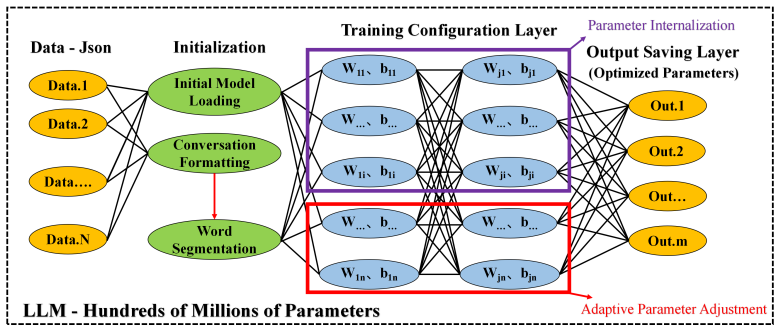
M. Wang, W. W. Huang, F. G. Kondev et al., Chin. Phys. C45, 030003 (2021). 15 Figure 1: (Color online) The large language model architecture. Figure 2: (Color online) Schematic diagram of the attention mechanism. When processing the next token, whom willNattend to? Red indicates the highest intensity. In this context, the model attends more strongly toQα,...
2021
-
[70]
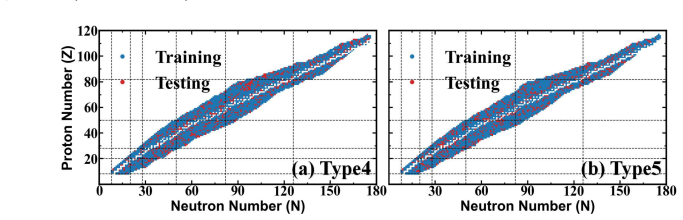
WS4 3231BEbinding energy Sp single-proton separation energy Sn single-neutron separation energy Qα α–decay energy [69] MLRF 3413 Qβ β–decay energyML LightGBM 3166 Table 2: Model design. Paradigm Input features Output features Size Type1N,Z,M p,M n,δ r799 Type2N,Z r799 Type3N,Z mass,BE,S p,S n 3231 Type4N,Z mass,BE,Q α,Q β 2986 Type5N,Z,M p,M n,δ Q α,Q β, ...
1941
discussion (0)
Sign in with ORCID, Apple, or X to comment. Anyone can read and Pith papers without signing in.