Model-free estimation in scattering analysis of microscopy
Pith reviewed 2026-06-29 00:11 UTC · model grok-4.3
The pith
A model-free probabilistic method estimates mean squared displacement directly from microscopy video intensities without tracking particles.
A machine-rendered reading of the paper's core claim, the machinery that carries it, and where it could break.
Core claim
MF-AIUQ estimates the MSD values by the marginal maximum likelihood estimator based on the relationship between the intermediate scattering function and the MSD derived from the cumulant theorem, with the likelihood approximated by a subset of Fourier-transformed intensities equally spaced at the logarithmic values of Fourier basis functions and lag time points.
What carries the argument
Marginal maximum likelihood estimation on a logarithmically spaced subset of Fourier intensities derived from the ISF-MSD relationship via the cumulant theorem.
If this is right
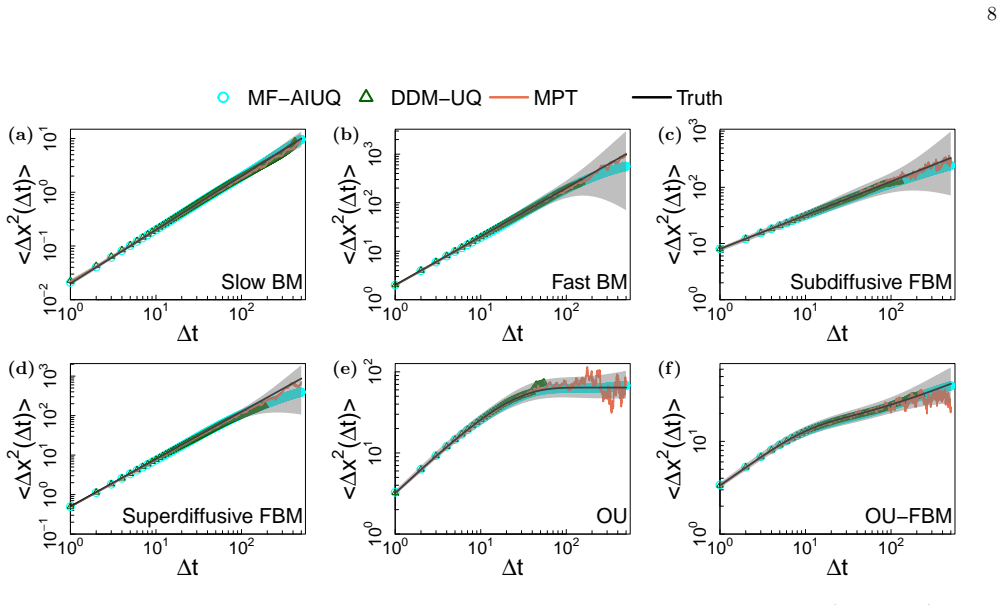
- MF-AIUQ produces smooth and stable MSD estimates over the full lag time range across multiple stochastic processes in simulations.
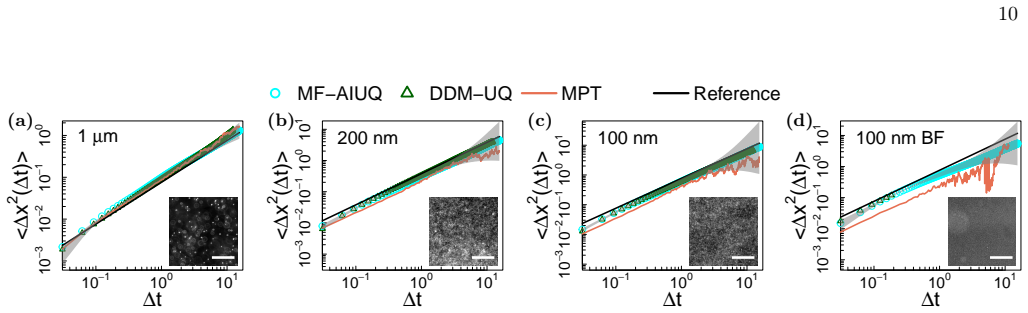
- The estimates remain reliable in optically dense bright-field settings for Newtonian fluids where tracking struggles.
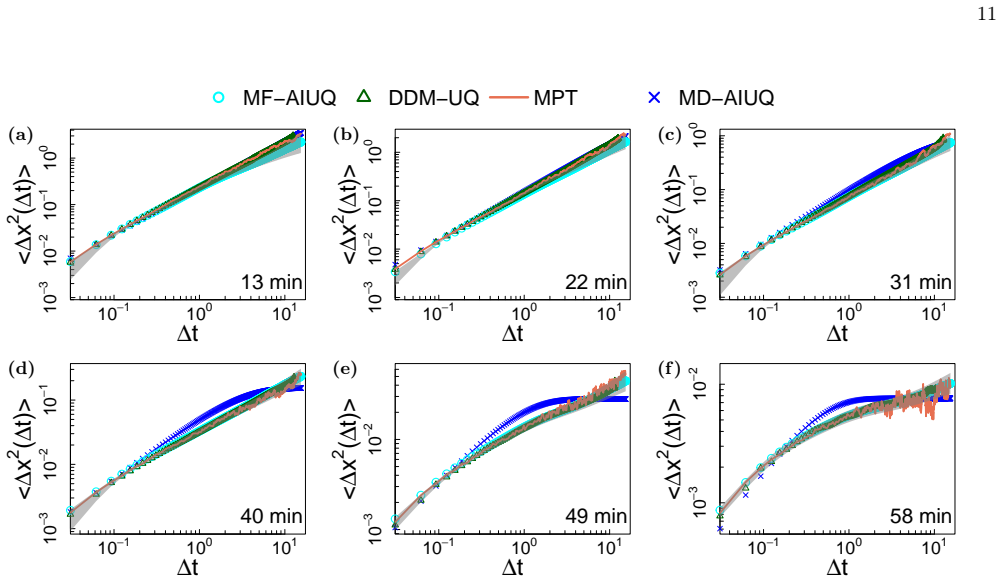
- The method tracks evolving MSD shapes during gelation without requiring a fixed parametric form.
- It supports modulus estimation from viscoelastic biopolymers such as snail mucin when parametric models are unavailable.
- It functions as a complementary tool precisely when particle tracking is unreliable or unverifiable.
Where Pith is reading between the lines
- The log-space smoothness property could be exploited to create reduced-order models for other correlation-function analyses in scattering experiments.
- Hybrid pipelines that blend MF-AIUQ with partial tracking data might improve robustness in samples containing both resolvable and unresolvable particles.
- The reduced input set suggests the approach could scale to real-time processing of high-frame-rate videos by lowering the number of required Fourier evaluations.
- Because no parametric MSD shape is imposed, the estimator may reveal unexpected functional forms in systems whose dynamics are not yet classified.
Load-bearing premise
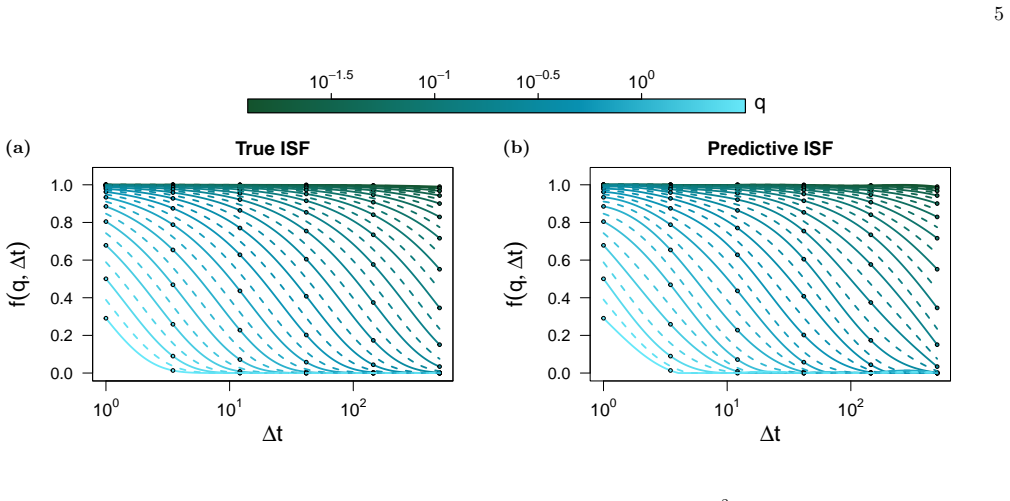
The intermediate scattering function is smooth enough in the logarithmic space of Fourier basis functions and lag time points that its information content is captured by a small equally spaced subset.
What would settle it
If MF-AIUQ applied to simulated data with known non-smooth ISF in log space produces MSD estimates that deviate markedly from the ground truth across lag times, the approximation would be shown insufficient.
Figures
read the original abstract
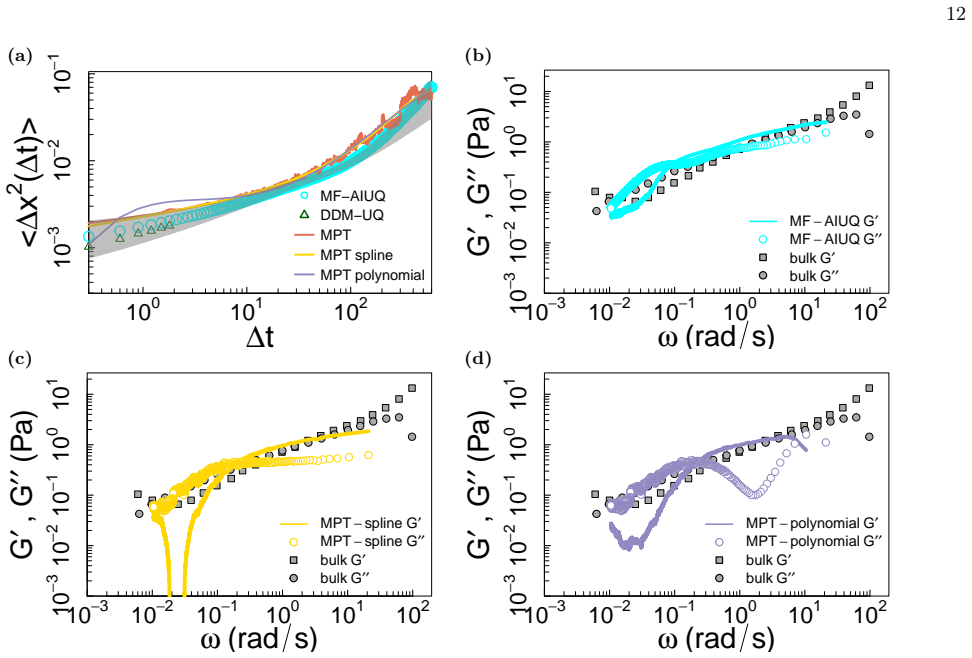
The mean squared displacement (MSD) of particles or probes is commonly estimated from microscopy videos using particle tracking approaches, which rely on tuning parameters manually, and are often unstable over the entire lag time range, especially in dense or low-contrast situations. In this work, we propose model-free ab initio uncertainty quantification (MF-AIUQ), a model-free method for scattering analysis of microscopy video based on a probabilistic framework, which estimates MSD without isolating particles and linking their trajectories. Based on the relationship between the intermediate scattering function (ISF) and the MSD derived from the cumulant theorem, MF-AIUQ estimates the MSD values by the marginal maximum likelihood estimator. To reduce the computational cost, the likelihood function is approximated by a subset of Fourier-transformed intensities. These intensities are equally spaced at the logarithmic values of Fourier basis functions and lag time points. We found that the ISF is smooth in this logarithmic input space, and the information of the ISF can be captured by this subset of inputs. We examine the method through simulation studies covering several representative stochastic processes and three experimental systems: a Newtonian fluid for evaluating performance in optically dense and bright-field settings, a gelation system with an evolving MSD shape, and snail mucin, a viscoelastic biopolymer, for modulus estimation. Across these studies, MF-AIUQ provides smooth and stable MSD estimates over the full lag time range and serves as a useful complementary approach in settings where particle tracking is unreliable or a parametric model of MSD is unavailable or unverifiable.
Editorial analysis
A structured set of objections, weighed in public.
Referee Report
Summary. The manuscript proposes MF-AIUQ, a model-free method for estimating mean squared displacement (MSD) directly from microscopy video intensities. It uses the cumulant theorem to relate the intermediate scattering function (ISF) to MSD, applies a marginal maximum likelihood estimator, and approximates the likelihood via an equally spaced subset of Fourier-transformed intensities in logarithmic wave-vector and lag-time coordinates, justified by an empirical observation of ISF smoothness in that space. The method is examined on simulations of representative stochastic processes and three experimental systems (Newtonian fluid, gelation, snail mucin), with the claim that it yields smooth, stable MSD estimates over the full lag range and serves as a useful complement when particle tracking is unreliable or parametric MSD models are unavailable.
Significance. If the central approximation and validation hold, the work offers a practical, model-free alternative for scattering-based MSD estimation in challenging microscopy regimes, potentially reducing reliance on manual tuning or unverifiable parametric forms.
major comments (2)
- [Abstract] Abstract: the performance claim of 'smooth and stable MSD estimates' across simulations and three experimental systems is not supported by any quantitative error metrics, bias/variance analysis, or baseline comparisons (e.g., against particle tracking or parametric fits); this absence directly weakens assessment of the method's reliability.
- [Abstract] Abstract (method description): the likelihood approximation by a logarithmic subset of Fourier intensities rests on the statement that 'the ISF is smooth in this logarithmic input space' and that 'the information of the ISF can be captured by this subset'; no theoretical guarantee, sensitivity analysis, or test for ISFs containing localized features (oscillations, sharp transitions) is supplied, which is load-bearing for the model-free estimator's correctness on arbitrary processes.
Simulated Author's Rebuttal
We thank the referee for the constructive feedback on our manuscript. We address each major comment below, indicating where revisions will be made to improve clarity and support for our claims.
read point-by-point responses
-
Referee: [Abstract] Abstract: the performance claim of 'smooth and stable MSD estimates' across simulations and three experimental systems is not supported by any quantitative error metrics, bias/variance analysis, or baseline comparisons (e.g., against particle tracking or parametric fits); this absence directly weakens assessment of the method's reliability.
Authors: We agree that the abstract's qualitative description of 'smooth and stable' estimates would be strengthened by quantitative support. The manuscript presents results via visual inspection of MSD curves from simulations (with known ground-truth processes) and experiments, but does not include explicit metrics such as MSE, bias/variance estimates, or direct numerical comparisons to particle tracking or parametric methods in the main text or abstract. We will revise the abstract to temper the claim and add quantitative analyses (e.g., error metrics on simulated data and baseline comparisons where feasible) in a new subsection or supplement. revision: yes
-
Referee: [Abstract] Abstract (method description): the likelihood approximation by a logarithmic subset of Fourier intensities rests on the statement that 'the ISF is smooth in this logarithmic input space' and that 'the information of the ISF can be captured by this subset'; no theoretical guarantee, sensitivity analysis, or test for ISFs containing localized features (oscillations, sharp transitions) is supplied, which is load-bearing for the model-free estimator's correctness on arbitrary processes.
Authors: The subset selection is justified by the empirical observation, stated in the manuscript, that the ISF appears smooth in logarithmic coordinates for the processes examined, allowing the marginal likelihood to be approximated without substantial loss of information. No theoretical guarantee is claimed or provided, as the approach prioritizes practicality for model-free estimation. The simulation studies include several representative processes, but we acknowledge the absence of dedicated sensitivity tests for localized features such as oscillations or sharp transitions. We will add such tests in the revision to evaluate robustness on synthetic ISFs with these characteristics. revision: partial
Circularity Check
No significant circularity; derivation relies on external theorem and standard MLE
full rationale
The paper derives MSD estimates from the cumulant theorem relating ISF to MSD (an external result), applies marginal maximum likelihood estimation (standard statistical procedure), and approximates the likelihood by log-spaced subsampling of Fourier intensities. The justification for subsampling is an empirical observation that 'the ISF is smooth in this logarithmic input space,' presented as a finding rather than a definitional or fitted assumption that forces the output. No equations reduce by construction to their inputs, no self-citations are load-bearing, and no ansatz or uniqueness claim is smuggled in. The central claim of stable model-free estimates therefore rests on independent components and does not tautologically reproduce its inputs.
Axiom & Free-Parameter Ledger
axioms (2)
- domain assumption Relationship between the intermediate scattering function (ISF) and the MSD derived from the cumulant theorem
- domain assumption ISF is sufficiently smooth in logarithmic Fourier-basis and lag-time coordinates that a small equally spaced subset captures its information
Reference graph
Works this paper leans on
-
[1]
:q 2 j′ 1,1 +q 2 j′ 2,2 =q 2 j } forj= 1, ..., J, which contains the indices of thejth ‘ring’oftheFourier-transformedquantitywithamplitude qj = 2πj ∆xmin √ N, with∆x min being the length of a pixel in one coordinate. For a microscopy image with a square field of view,J=⌈ √ N /2⌉ −1with⌈ √ N /2⌉being the smallest integer larger than or equal to √ N /2. Den...
-
[2]
T. G. Mason and D. A. Weitz, Optical measurements of frequency-dependent linear viscoelastic moduli of com- plex fluids, Physical review letters74, 1250 (1995)
1995
-
[3]
X.Michalet,Meansquaredisplacementanalysisofsingle- particle trajectories with localization error: Brown- ian motion in an isotropic medium, Physical Review E—Statistical, Nonlinear, and Soft Matter Physics82, 041914 (2010)
2010
-
[4]
A. J. Berglund, Statistics of camera-based single-particle tracking, Physical Review E—Statistical, Nonlinear, and Soft Matter Physics82, 011917 (2010)
2010
-
[5]
H. Qian, M. P. Sheetz, and E. L. Elson, Single particle tracking.analysisofdiffusionandflowintwo-dimensional systems, Biophysical journal60, 910 (1991)
1991
-
[6]
M. Gu, Y. He, X. Liu, and Y. Luo, Ab initio uncertainty quantification in scattering analysis of microscopy, Phys- ical Review E110, 034601 (2024)
2024
-
[7]
J. C. Crocker and D. G. Grier, Methods of digital video microscopy for colloidal studies, J. Colloid Interface Sci. 179, 298 (1996)
1996
-
[8]
M. J. Saxton and K. Jacobson, Single-particle tracking: applications to membrane dynamics, Annual review of biophysics and biomolecular structure26, 373 (1997)
1997
-
[9]
T. G. Mason, K. Ganesan, J. H. van Zanten, D. Wirtz, and S. C. Kuo, Particle tracking microrheology of com- plex fluids, Phys. Rev. Lett.79, 3282 (1997)
1997
-
[10]
Y. Luo, J. Chen, M. Gu, and Y. Luo, Optimizing gelation time for cell shape control through active learning, Soft Matter21, 970 (2025)
2025
-
[11]
Zaccarelli and W
E. Zaccarelli and W. C. Poon, Colloidal glasses and gels: The interplay of bonding and caging, Proceedings of the National Academy of Sciences106, 15203 (2009)
2009
-
[12]
Pickrahn, B
K. Pickrahn, B. Rajaram, and A. Mohraz, Relation- ship between microstructure, dynamics, and rheology in polymer-bridging colloidal gels, Langmuir26, 2392 (2010)
2010
-
[13]
J. A. McGlynn, N. Wu, and K. M. Schultz, Multiple par- ticle tracking microrheological characterization: Funda- mentals, emerging techniques and applications, Journal of Applied Physics127(2020)
2020
-
[14]
Chenouard, I
N. Chenouard, I. Smal, F. De Chaumont, M. Maška, I. F. Sbalzarini, Y. Gong, J. Cardinale, C. Carthel, S. Coraluppi, M. Winter,et al., Objective comparison of particle tracking methods, Nature methods11, 281 (2014)
2014
-
[15]
Savin and P
T. Savin and P. S. Doyle, Static and dynamic errors in particle tracking microrheology, Biophysical journal88, 623 (2005)
2005
-
[16]
Cerbino and V
R. Cerbino and V. Trappe, Differential dynamic mi- croscopy: probing wave vector dependent dynamics with a microscope, Physical review letters100, 188102 (2008)
2008
-
[17]
Giavazzi, D
F. Giavazzi, D. Brogioli, V. Trappe, T. Bellini, and R. Cerbino, Scattering information obtained by opti- 14 cal microscopy: differential dynamic microscopy and be- yond, Physical Review E—Statistical, Nonlinear, and Soft Matter Physics80, 031403 (2009)
2009
-
[18]
Lattuada, F
E. Lattuada, F. Krautgasser, M. Lavaud, F. Giavazzi, and R. Cerbino, The hitchhiker’s guide to differential dy- namic microscopy, The Journal of Chemical Physics163 (2025)
2025
-
[19]
Guidolin, C
C. Guidolin, C. Heim, N. B. Adams, P. Baaske, V. Ron- delli, R. Cerbino, and F. Giavazzi, Protein sizing with dif- ferential dynamic microscopy, Macromolecules56, 8290 (2023)
2023
-
[20]
M. S. Safari, M. A. Vorontsova, R. Poling-Skutvik, P. G. Vekilov, and J. C. Conrad, Differential dynamic mi- croscopy of weakly scattering and polydisperse protein- rich clusters, Physical Review E92, 042712 (2015)
2015
-
[21]
G. Lee, G. Leech, M. J. Rust, M. Das, R. J. McGorty, J. L. Ross, and R. M. Robertson-Anderson, Myosin- driven actin-microtubule networks exhibit self-organized contractile dynamics, Science Advances7, eabe4334 (2021)
2021
-
[22]
Giavazzi, G
F. Giavazzi, G. Savorana, A. Vailati, and R. Cerbino, Structure and dynamics of concentration fluctuations in a non-equilibrium dense colloidal suspension, Soft Matter 12, 6588 (2016)
2016
-
[23]
M. S. Safari, R. Poling-Skutvik, P. G. Vekilov, and J. C. Conrad, Differential dynamic microscopy of bidisperse colloidal suspensions, npj Microgravity3, 21 (2017)
2017
-
[24]
Dhakal, A
S. Dhakal, A. D. Adedeji, A. Aravindan, and S. Moro- zova, Differential dynamic microscopy of polymer hydro- gels,MacromolecularChemistryandPhysics227,e00458 (2026)
2026
-
[25]
L. G. Wilson, V. A. Martinez, J. Schwarz-Linek, J. Tailleur, G. Bryant, P. Pusey, and W. C. Poon, Differ- ential dynamic microscopy of bacterial motility, Physical review letters106, 018101 (2011)
2011
-
[26]
V. A. Martinez, R. Besseling, O. A. Croze, J. Tailleur, M. Reufer, J. Schwarz-Linek, L. G. Wilson, M. A. Bees, and W. C. Poon, Differential dynamic microscopy: a high-throughput method for characterizing the motility of microorganisms, Biophysical journal103, 1637 (2012)
2012
-
[27]
A. V. Bayles, T. M. Squires, and M. E. Helgeson, Probe microrheology without particle tracking by differential dynamic microscopy, Rheologica Acta56, 863 (2017)
2017
-
[28]
M. Gu, Y. Luo, Y. He, M. E. Helgeson, and M. T. Valen- tine, Uncertainty quantification and estimation in differ- ential dynamic microscopy, Phys. Rev. E104, 034610 (2021)
2021
-
[29]
D. E. Koppel, Analysis of macromolecular polydisper- sity in intensity correlation spectroscopy: the method of cumulants, The Journal of Chemical Physics57, 4814 (1972)
1972
-
[30]
Gohberg and A
I. Gohberg and A. Semencul, On the inversion of fi- nite toeplitz matrices and their continuous analogs, Mat. issled2, 201 (1972)
1972
-
[31]
G. S. Ammar and W. B. Gragg, Superfast solution of real positive definite toeplitz systems, SIAM Journal on Matrix Analysis and Applications9, 61 (1988)
1988
-
[32]
Y. He, X. Liu, and M. Gu,AIUQ: Ab Initio Uncertainty Quantification(2026), R package version 0.5.4
2026
-
[33]
J. W. Cooley and J. W. Tukey, An algorithm for the ma- chine calculation of complex fourier series, Mathematics of computation19, 297 (1965)
1965
-
[34]
Nijboer and A
B. Nijboer and A. Rahman, Time expansion of correla- tion functions and the theory of slow neutron scattering, Physica32, 415 (1966)
1966
-
[35]
Brown, P
G. Brown, P. A. Rikvold, M. Sutton, and M. Grant, Speckle from phase-ordering systems, Physical Review E 56, 6601 (1997)
1997
-
[36]
Ling,Superfast Inference for Stationary Gaussian Processes in Particle Tracking Microrheology, Ph.D
Y. Ling,Superfast Inference for Stationary Gaussian Processes in Particle Tracking Microrheology, Ph.D. the- sis, University of Waterloo (2019)
2019
-
[37]
I. T. Jolliffe,Principal component analysis for special types of data(Springer, 2002)
2002
-
[38]
M. Gu, X. Wang, and J. O. Berger, Robust Gaussian stochastic process emulation, Annals of Statistics46, 3038 (2018)
2018
-
[39]
Gu, Jointly robust prior for Gaussian stochastic pro- cess in emulation, calibration and variable selection, Bayesian Analysis14(2018)
M. Gu, Jointly robust prior for Gaussian stochastic pro- cess in emulation, calibration and variable selection, Bayesian Analysis14(2018)
2018
-
[40]
M. Gu, J. Palomo, and J. O. Berger, RobustGaSP: Ro- bust Gaussian Stochastic Process Emulation in R, The R Journal11, 112 (2019)
2019
-
[41]
D. C. Liu and J. Nocedal, On the limited memory bfgs method for large scale optimization, Mathematical pro- gramming45, 503 (1989)
1989
-
[42]
T. G. Mason, Estimating the viscoelastic moduli of com- plex fluids using the generalized stokes–einstein equation, Rheologica acta39, 371 (2000)
2000
-
[43]
B. R. Dasgupta, S.-Y. Tee, J. C. Crocker, B. Frisken, and D. Weitz, Microrheology of polyethylene oxide using dif- fusing wave spectroscopy and single scattering, Physical review E65, 051505 (2002)
2002
-
[44]
C. H. Reinsch, Smoothing by spline functions, Nu- merische mathematik10, 177 (1967)
1967
-
[45]
Edera, D
P. Edera, D. Bergamini, V. Trappe, F. Giavazzi, and R. Cerbino, Differential dynamic microscopy microrhe- ology of soft materials: A tracking-free determination of the frequency-dependent loss and storage moduli, Phys- ical Review Materials1, 073804 (2017)
2017
-
[46]
T. H. Larsen and E. M. Furst, Microrheology of the liquid-solid transition during gelation, Phys. Rev. Lett. 100, 146001 (2008)
2008
-
[47]
Parrish, K
E. Parrish, K. A. Rose, M. Cargnello, C. B. Murray, D. Lee, and R. J. Composto, Nanoparticle diffusion dur- ing gelation of tetra poly (ethylene glycol) provides in- sight into nanoscale structural evolution, Soft Matter16, 2256 (2020)
2020
-
[48]
K. R. Lennon, G. H. McKinley, and J. W. Swan, A data- driven method for automated data superposition with applications in soft matter science, Data-Centric Engi- neering4, e13 (2023)
2023
-
[49]
T. Deng, D. Gao, X. Song, Z. Zhou, L. Zhou, M. Tao, Z. Jiang, L. Yang, L. Luo, A. Zhou,et al., A natural biological adhesive from snail mucus for wound repair, Nature communications14, 396 (2023)
2023
-
[50]
McDermott, A
M. McDermott, A. R. Cerullo, J. Parziale, E. Achrak, S. Sultana, J. Ferd, S. Samad, W. Deng, A. B. Braun- schweig, and M. Holford, Advancing discovery of snail mucins function and application, Frontiers in bioengi- neering and biotechnology9, 734023 (2021)
2021
-
[51]
K. V. Mardia and R. J. Marshall, Maximum likelihood estimation of models for residual covariance in spatial regression, Biometrika71, 135 (1984)
1984
-
[52]
Ling and M
Y. Ling and M. Lysy,SuperGauss: Superfast Likelihood Inference for Stationary Gaussian Time Series(2022), r package version 2.0.3
2022
-
[53]
C. E. Rasmussen,Gaussian processes for machine learn- ing(MIT Press, 2006). 15 Appendix A: Simulation for Isotropic Processes The six simulated videos in Section V are generated based on the simulation introduced in Appendix A and also in Ref. [5]. Form= 1, . . . , Mandk= 1, . . . , n, let x(m)(tk) = x(m) 1 (tk), x (m) 2 (tk) denote the 2D location of par...
2006
discussion (0)
Sign in with ORCID, Apple, or X to comment. Anyone can read and Pith papers without signing in.