SkillBrew: Multi-Objective Curation of Skill Banks for LLM Agents
Pith reviewed 2026-06-29 07:53 UTC · model grok-4.3
The pith
Skill banks for LLM agents improve when curated as a multi-objective optimization problem instead of growing as append-only lists.
A machine-rendered reading of the paper's core claim, the machinery that carries it, and where it could break.
Core claim
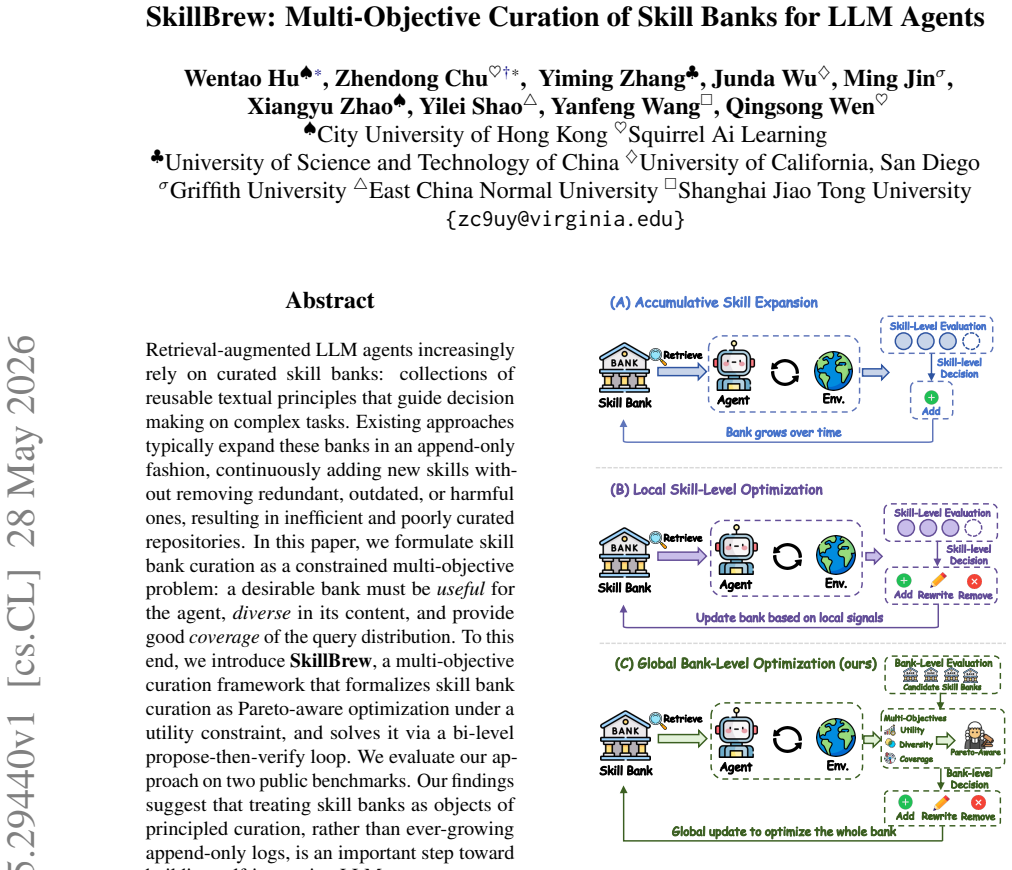
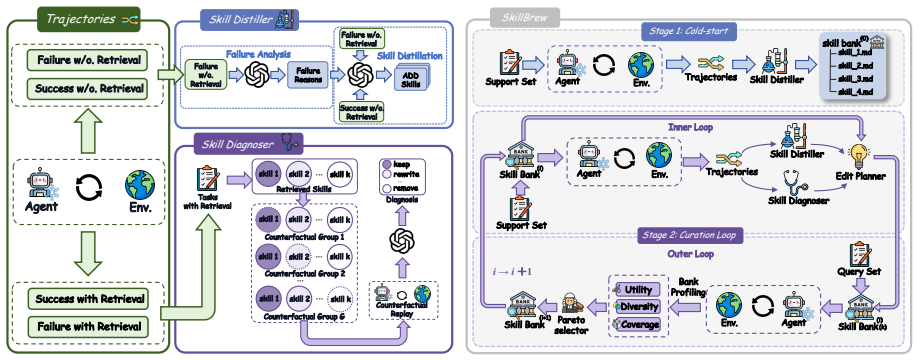
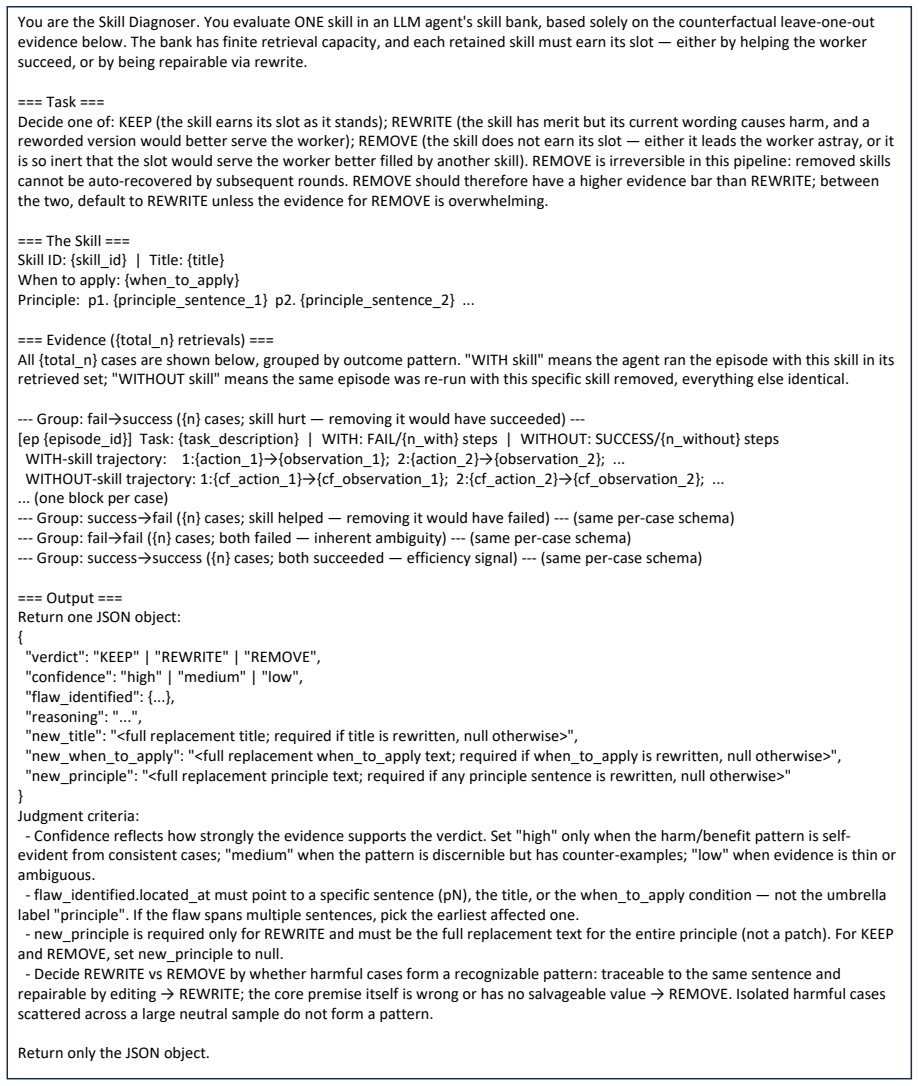
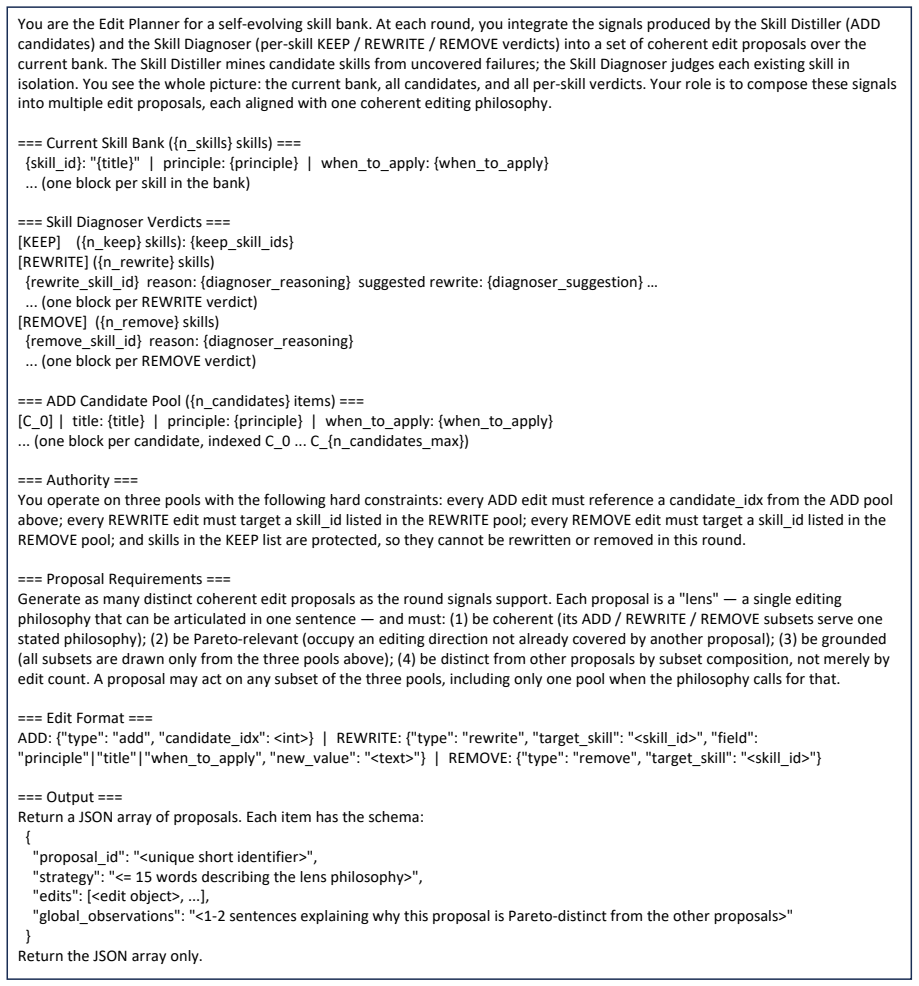
SkillBrew formalizes skill bank curation as a constrained multi-objective problem requiring usefulness, diversity, and coverage of the query distribution. It solves the problem through Pareto-aware optimization under a utility constraint using a bi-level propose-then-verify loop. Evaluation on two public benchmarks indicates that the resulting banks outperform those produced by append-only accumulation.
What carries the argument
the bi-level propose-then-verify loop performing Pareto-aware optimization under a utility constraint
If this is right
- Agents equipped with curated banks remove redundant, outdated, or harmful skills and thereby reduce retrieval overhead.
- The multi-objective formulation prevents any single criterion from dominating the retained set of skills.
- Periodic re-application of the curation process supports ongoing adaptation as task distributions shift.
- Benchmark results indicate measurable gains in agent efficiency when banks are maintained rather than merely extended.
Where Pith is reading between the lines
- The same curation logic could be applied to other growing agent memory structures such as experience buffers or tool registries.
- If the verification step can be approximated with cheaper proxies, the loop becomes feasible for agents running in real time.
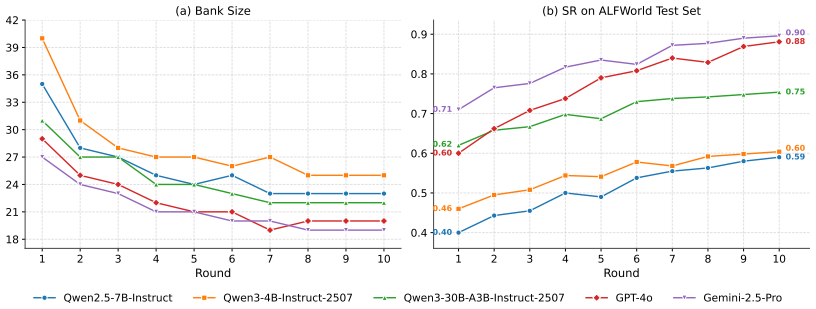
- Over repeated cycles the method might produce skill banks whose size stabilizes rather than expanding without bound.
- Cross-agent sharing of curated banks could accelerate collective improvement if the optimization respects privacy constraints.
Load-bearing premise
The criteria of usefulness, diversity, and coverage can be jointly optimized by the bi-level loop without the verification step introducing unaccounted biases or failing to scale.
What would settle it
A controlled comparison on a large agent workload where the bi-level curation loop produces no measurable gain in task success rate or introduces detectable bias relative to simple append-only addition would falsify the central claim.
Figures
read the original abstract
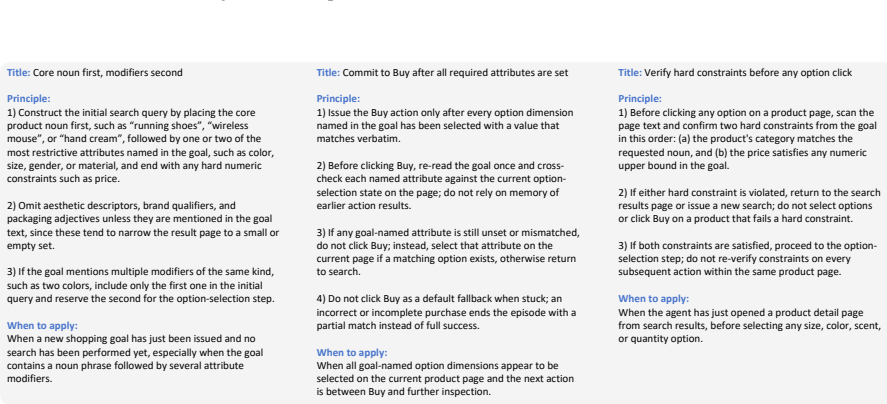
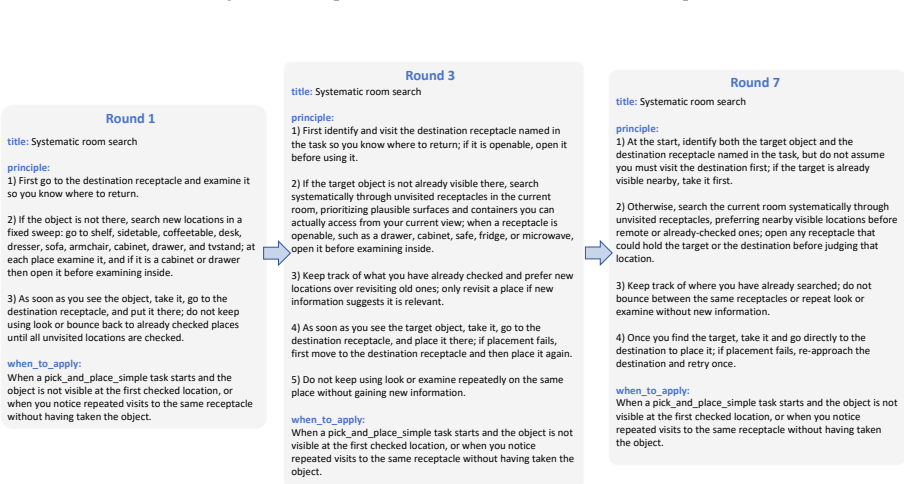
Retrieval-augmented LLM agents increasingly rely on curated skill banks: collections of reusable textual principles that guide decision making on complex tasks. Existing approaches typically expand these banks in an append-only fashion, continuously adding new skills without removing redundant, outdated, or harmful ones, resulting in inefficient and poorly curated repositories. In this paper, we formulate the skill bank curation as a constrained multi-objective problem: a desirable bank must be useful for the agent, diverse in its content, and provide good coverage of the query distribution. To this end, we introduce SkillBrew, a multi-objective curation framework that formalizes skill bank curation as Pareto-aware optimization under a utility constraint, and solves it via a bi-level propose-then-verify loop. We evaluate our approach on two public benchmarks. Our findings suggest that treating skill banks as objects of principled curation, rather than ever-growing append-only logs, is an important step toward building self-improving LLM agents.
Editorial analysis
A structured set of objections, weighed in public.
Referee Report
Summary. The paper claims that skill banks for retrieval-augmented LLM agents are typically expanded in an append-only manner, leading to inefficiency, and formulates their curation as a constrained multi-objective optimization problem (usefulness, diversity, coverage) solved by SkillBrew via a bi-level propose-then-verify loop under Pareto-aware optimization with a utility constraint. Evaluation on two public benchmarks is reported, supporting the conclusion that principled curation (rather than append-only logs) is an important step toward self-improving LLM agents.
Significance. If the bi-level loop produces measurably superior banks on the stated criteria without unaccounted biases or scalability failures, the work would offer a practical advance in managing reusable skills for LLM agents, moving the field from ad-hoc accumulation toward explicit optimization.
major comments (1)
- [Abstract] Abstract: the description states the multi-objective formulation and bi-level loop at a high level but supplies no equations, pseudocode, or implementation details for the propose-then-verify procedure or the Pareto-aware utility constraint. This absence is load-bearing because the central claim that the method yields better banks rests on the loop successfully balancing the three objectives without introducing verification biases.
Simulated Author's Rebuttal
We thank the referee for their feedback. We address the single major comment below.
read point-by-point responses
-
Referee: [Abstract] Abstract: the description states the multi-objective formulation and bi-level loop at a high level but supplies no equations, pseudocode, or implementation details for the propose-then-verify procedure or the Pareto-aware utility constraint. This absence is load-bearing because the central claim that the method yields better banks rests on the loop successfully balancing the three objectives without introducing verification biases.
Authors: We agree the abstract is high-level and contains no equations or pseudocode. This is conventional for abstracts to preserve conciseness and readability. The full multi-objective formulation (usefulness, diversity, coverage), the Pareto-aware utility constraint, the bi-level propose-then-verify procedure, equations, and pseudocode (Algorithm 1) are presented in detail in Sections 3 and 4 of the manuscript. The evaluations on the two public benchmarks, including ablations, support that the loop balances the objectives; the verify stage is explicitly designed to reduce verification biases, with supporting analysis in the paper. To address the concern directly, we will revise the abstract to include a brief, high-level reference to the bi-level loop and constraint while remaining within length limits. revision: yes
Circularity Check
No significant circularity detected
full rationale
The paper frames skill-bank curation as a constrained multi-objective optimization problem solved by a bi-level propose-then-verify procedure and evaluates the resulting banks on two public benchmarks. No load-bearing step reduces by construction to fitted parameters, self-citations, or prior ansatzes from the same authors; the central claim follows from the stated formulation and empirical results without any quoted equation or derivation that is equivalent to its inputs by definition. The derivation chain is therefore self-contained against external benchmarks.
Axiom & Free-Parameter Ledger
Reference graph
Works this paper leans on
-
[1]
Trace2skill: Distill trajectory-local lessons into transferable agent skills.arXiv preprint arXiv:2603.25158. OpenAI. 2026. Introducing GPT-5.4. https:// openai.com/index/introducing-gpt-5-4/. Stephen Robertson and Hugo Zaragoza. 2009.The prob- abilistic relevance framework: BM25 and beyond, volume 4. Now Publishers Inc. Noah Shinn, Federico Cassano, Ashw...
work page internal anchor Pith review Pith/arXiv arXiv 2026
-
[2]
SkillRL: Evolving Agents via Recursive Skill-Augmented Reinforcement Learning
Skillrl: Evolving agents via recursive skill- augmented reinforcement learning.arXiv preprint arXiv:2602.08234. 9 An Yang, Anfeng Li, Baosong Yang, Beichen Zhang, Binyuan Hui, Bo Zheng, Bowen Yu, Chang Gao, Chengen Huang, Chenxu Lv, and 1 others
work page internal anchor Pith review Pith/arXiv arXiv
-
[3]
Qwen3 technical report.arXiv preprint arXiv:2505.09388. Shunyu Yao, Howard Chen, John Yang, and Karthik Narasimhan. 2022a. Webshop: Towards scalable real-world web interaction with grounded language agents.Advances in Neural Information Processing Systems, 35:20744–20757. Shunyu Yao, Jeffrey Zhao, Dian Yu, Nan Du, Izhak Shafran, Karthik Narasimhan, and Yu...
work page internal anchor Pith review Pith/arXiv arXiv 2026
discussion (0)
Sign in with ORCID, Apple, or X to comment. Anyone can read and Pith papers without signing in.