REVIEW 2 major objections 46 references
At a van Hove singularity the dc shear viscosity scales linearly with temperature while conductivity follows the Boltzmann result.
Reviewed by Pith at T0; open to challenge. T0 means a machine referee read the full paper against a public rubric. the ladder, T0–T4 →
T0 review · grok-4.3
2026-06-29 05:48 UTC pith:D4VRX5VT
load-bearing objection The viscosity scaling result rests on the fermion sharp peak approximation that the paper states breaks down in the dirty critical limit. the 2 major comments →
Shear Viscosity at the van Hove singularity
The pith
A machine-rendered reading of the paper's core claim, the machinery that carries it, and where it could break.
Core claim
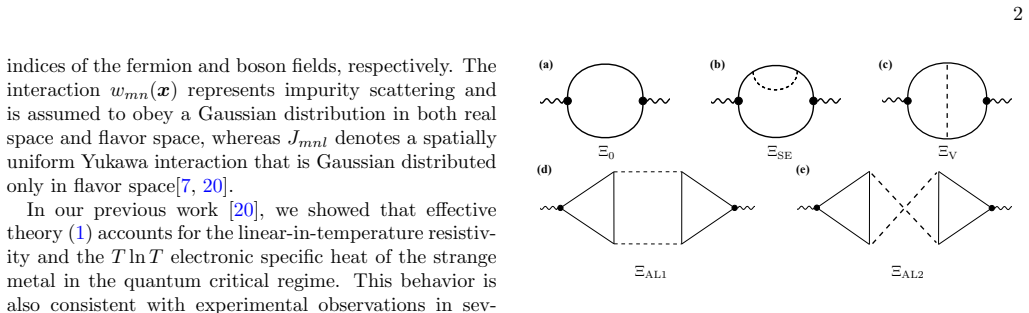
Using the diagrammatic Kubo formalism the authors show that at the van Hove singularity the conductivity agrees with the Boltzmann result, yet the dc shear viscosity scales as T and the real part of the optical shear viscosity scales as (|Ω|^{3/2} + T^{3/2})/Ω². Under the fermion sharp peak approximation the leading Feynman diagrams reduce to the Boltzmann equation, but the diagrammatic method remains reliable in the dirty critical limit where that approximation fails.
What carries the argument
Diagrammatic Kubo formalism for critical transport coefficients at the van Hove singularity, which reduces to the Boltzmann equation only under the fermion sharp peak approximation.
Load-bearing premise
The fermion sharp peak approximation remains valid enough that leading diagrams reduce to the Boltzmann equation.
What would settle it
A measurement of dc shear viscosity at a van Hove singularity in a strange-metal candidate that does not scale linearly with temperature.
If this is right
- Dc shear viscosity scales linearly with temperature rather than following Boltzmann predictions.
- Optical shear viscosity follows the specific form Re[η(Ω)] ∼ (|Ω|^{3/2} + T^{3/2})/Ω².
- Conductivity remains consistent with the Boltzmann result even when viscosity does not.
- The same critical model yields testable predictions for both optical and dc shear viscosities.
Where Pith is reading between the lines
- Shear-viscosity measurements could distinguish regimes where semiclassical transport holds from those where it fails near van Hove points.
- The same diagrammatic approach may reveal similar discrepancies for other transport coefficients when fermion broadening dominates.
- Candidate materials with van Hove singularities near the Fermi level offer direct experimental tests of the predicted scalings.
Editorial analysis
A structured set of objections, weighed in public.
Referee Report
Summary. The manuscript computes several critical transport coefficients at a van Hove singularity using diagrammatic Kubo formalism. It reports that conductivity agrees with the Boltzmann result, while the dc shear viscosity shows qualitatively different scaling: Re[η(Ω)] ∼ (|Ω|^{3/2} + T^{3/2})/Ω² and Re[η(Ω=0)] ∼ T. These results are obtained under the fermion sharp peak approximation, which the abstract states strictly breaks down in the dirty critical limit; the same critical model is said to also account for strange metal behavior and yields experimentally testable predictions for optical and dc shear viscosities.
Significance. If the viscosity results can be established beyond the noted approximation, the work would supply concrete, falsifiable predictions distinguishing Kubo from Boltzmann transport in strongly correlated critical systems, providing an additional experimental handle on the validity of the underlying model for strange metals.
major comments (2)
- [Abstract] Abstract: The headline claim of qualitatively different dc shear viscosity behavior (Re[η(Ω=0)] ∼ T and the optical form) is derived under the fermion sharp peak approximation. The manuscript itself states that this approximation 'strictly breaks down in the dirty critical limit'—the precise regime in which the deviation from Boltzmann is asserted—yet no controlled expansion or alternative calculation outside the approximation is provided for the viscosity channel.
- [Abstract] Abstract: The assertion that 'the diagrammatic Kubo results are more reliable' rests on demonstrating reduction of leading Feynman diagrams to the Boltzmann equation inside the fermion sharp peak approximation. This internal consistency does not establish reliability in the dirty critical limit where the approximation fails, leaving the central distinction for viscosity without independent support.
Simulated Author's Rebuttal
We thank the referee for their careful reading of our manuscript and for highlighting important points regarding the scope of our approximations. We address each major comment below and agree that revisions to the abstract are necessary to clarify the limitations.
read point-by-point responses
-
Referee: [Abstract] Abstract: The headline claim of qualitatively different dc shear viscosity behavior (Re[η(Ω=0)] ∼ T and the optical form) is derived under the fermion sharp peak approximation. The manuscript itself states that this approximation 'strictly breaks down in the dirty critical limit'—the precise regime in which the deviation from Boltzmann is asserted—yet no controlled expansion or alternative calculation outside the approximation is provided for the viscosity channel.
Authors: We fully acknowledge that our calculations are performed within the fermion sharp peak approximation, which the manuscript explicitly states breaks down in the dirty critical limit. The reported scalings for the shear viscosity are derived under this approximation. We do not provide a controlled expansion beyond it, as this would require a different theoretical framework. To address the concern, we will revise the abstract to state more clearly that the predictions apply within the fermion sharp peak approximation and note the breakdown in the dirty critical limit. revision: yes
-
Referee: [Abstract] Abstract: The assertion that 'the diagrammatic Kubo results are more reliable' rests on demonstrating reduction of leading Feynman diagrams to the Boltzmann equation inside the fermion sharp peak approximation. This internal consistency does not establish reliability in the dirty critical limit where the approximation fails, leaving the central distinction for viscosity without independent support.
Authors: The claim of greater reliability is based on the fact that, within the approximation, the Kubo formalism reproduces the Boltzmann result for conductivity, serving as a consistency check. We agree that this does not extend to establishing reliability in the regime where the approximation fails. We will revise the abstract to qualify or remove the statement about the diagrammatic Kubo results being more reliable in the dirty critical limit. revision: yes
- Developing a controlled calculation of the viscosity outside the fermion sharp peak approximation.
Circularity Check
Viscosity expressions derived from same critical model fitted to strange metal data
specific steps
-
fitted input called prediction
[Abstract]
"The same critical model, which can also account for strange metal, makes experimentally testable predictions for the optical and dc shear viscosities, Re[η(Ω)]∼(|Ω|^{3/2}+T^{3/2})/Ω² and Re[η(Ω=0)]∼T"
The critical model is the same one previously used to fit strange-metal phenomenology; the viscosity expressions are therefore outputs of the already-fitted parameters and not independent derivations.
full rationale
The paper presents Re[η(Ω)] and Re[η(0)] as predictions from a diagrammatic Kubo calculation under the fermion sharp peak approximation. However, the abstract explicitly ties the result to 'the same critical model, which can also account for strange metal', indicating that model parameters are calibrated on strange-metal observables. This makes the viscosity formulas a direct output of the fitted model rather than an independent first-principles derivation outside the fitted regime. The approximation is also stated to break down precisely in the dirty critical limit where the qualitative deviation is claimed, but no external benchmark or controlled expansion is supplied to support the result beyond the fit.
Axiom & Free-Parameter Ledger
free parameters (1)
- critical model parameters for strange metal
axioms (1)
- domain assumption fermion sharp peak approximation
read the original abstract
The applicability of the semiclassical Boltzmann transport theory is fundamentally challenged in strongly correlated systems where quasiparticle excitations are ill-defined. When the fermion spectral broadening becomes much larger than the boson broadening, the Boltzmann approach to transport is not always valid, particularly in the dirty limit of the critical regime. Using a diagrammatic Kubo formalism, we compute several critical transport coefficients at a van Hove singularity and show that, while the conductivity happens to agree with the Boltzmann result, the dc shear viscosity exhibits qualitatively different behavior. The diagrammatic Kubo results are more reliable because, under the fermion sharp peak approximation--an assumption that strictly breaks down in the dirty critical limit--we demonstrate that the leading order Feynman diagrams reduce to the Boltzmann equation. The same critical model, which can also account for strange metal, makes experimentally testable predictions for the optical and dc shear viscosities, ${\rm Re}[\eta(\Omega)]\sim (|\Omega|^{3/2}+T^{3/2})/\Omega^2$ and ${\rm Re}[\eta(\Omega=0)]\sim T$, providing further opportunities to assess the validity of our theoretical framework.
Figures

Reference graph
Works this paper leans on
-
[1]
Therefore, we infer that the finite temperature shear viscosity is given by Re[η(T≫ |Ω|)]∼N 3/2|J|3T 3/2/N′1/2Ω2
and satisfies the expected Ω/Tscaling relations in the quantum critical regime [26]. Therefore, we infer that the finite temperature shear viscosity is given by Re[η(T≫ |Ω|)]∼N 3/2|J|3T 3/2/N′1/2Ω2. Combining with Eqs.(6), we obtain the optical shear viscosity in the quantum critical regime, given by Re[η(Ω, T)]∼ N3/2|J|3 N ′1/2 |Ω|3/2 +T 3/2 Ω2 .(9) wher...
-
[2]
Rammer and H
J. Rammer and H. Smith, Rev. Mod. Phys.58, 323 (1986)
1986
-
[3]
D. L. Maslov and A. V. Chubukov, Reports on Progress in Physics80, 026503 (2016)
2016
-
[4]
Holstein, Annals of Physics29, 410 (1964)
T. Holstein, Annals of Physics29, 410 (1964)
1964
-
[5]
P. S. Riseborough, Phys. Rev. B27, 5775 (1983)
1983
-
[6]
Farid and E
A.-K. Farid and E. G. Mishchenko, Phys. Rev. Lett.97, 096604 (2006)
2006
-
[7]
H. v. L¨ ohneysen, A. Rosch, M. Vojta, and P. W¨ olfle, Rev. Mod. Phys.79, 1015 (2007)
2007
-
[8]
A. A. Patel, H. Guo, I. Esterlis, and S. Sachdev, Science 381, 790 (2023)
2023
-
[9]
R. L. Greene, P. R. Mandal, N. R. Poniatowski, and T. Sarkar, Annual Review of Condensed Matter Physics 11, 213 (2020)
2020
-
[10]
Y. Cao, D. Chowdhury, D. Rodan-Legrain, O. Rubies- Bigorda, K. Watanabe, T. Taniguchi, T. Senthil, and P. Jarillo-Herrero, Phys. Rev. Lett.124, 076801 (2020)
2020
-
[11]
L. D. Landau and E. M. Lifshitz,Course of theoretical physics(Elsevier, 2013)
2013
-
[12]
Thuillier, S
D. Thuillier, S. Ghosh, B. J. Ramshaw, and T. Scaffidi, Phys. Rev. Lett.135, 146302 (2025)
2025
-
[13]
Zaanen, Science351, 1026 (2016)
J. Zaanen, Science351, 1026 (2016)
2016
-
[14]
Tomadin, G
A. Tomadin, G. Vignale, and M. Polini, Phys. Rev. Lett. 113, 235901 (2014)
2014
-
[15]
D. A. Bandurin, I. Torre, R. K. Kumar, M. B. Shalom, A. Tomadin, A. Principi, G. H. Auton, E. Khestanova, K. S. Novoselov, I. V. Grigorieva, L. A. Ponomarenko, A. K. Geim, and M. Polini, Science351, 1055 (2016)
2016
-
[16]
Crossno, J
J. Crossno, J. K. Shi, K. Wang, X. Liu, A. Harzheim, A. Lucas, S. Sachdev, P. Kim, T. Taniguchi, K. Watan- abe, T. A. Ohki, and K. C. Fong, Science351, 1058 (2016)
2016
-
[17]
Levitov and G
L. Levitov and G. Falkovich, Nature Physics12, 672 (2016)
2016
-
[18]
Lupien, W
C. Lupien, W. A. MacFarlane, C. Proust, L. Taillefer, Z. Q. Mao, and Y. Maeno, Phys. Rev. Lett.86, 5986 (2001)
2001
-
[19]
Mravlje, M
J. Mravlje, M. Aichhorn, T. Miyake, K. Haule, G. Kotliar, and A. Georges, Phys. Rev. Lett.106, 096401 (2011)
2011
-
[20]
Non-fermi liquid quasiparticles in strain-tuned sr2ruo4,
A. Hunter, C. Putzke, F. B. Kugler, S. Beck, E. Cappelli, F. Margot, M. Straub, Y. Alexanian, J. Teyssier, A. de la Torre, K. W. Plumb, M. D. Watson, T. K. Kim, C. Ca- cho, N. C. Plumb, M. Shi, M. Radovic, J. Osiecki, C. Pol- ley, D. A. Sokolov, A. P. Mackenzie, E. Berg, A. Georges, P. J. W. Moll, A. Tamai, and F. Baumberger, “Non-fermi liquid quasipartic...
-
[21]
Strange metal at the lifshitz transition,
Y.-H. Xing, W.-M. Liu, and X.-T. Zhang, “Strange metal at the lifshitz transition,” (2025), arXiv:2407.02270 [cond-mat.str-el]
-
[22]
L. Wei, Q. Xu, Y. He, Q. Li, Y. Huang, W. Zhu, K. Watanabe, T. Taniguchi, M. Claassen, D. A. Rhodes, D. M. Kennes, L. Xian, A. Rubio, and L. Wang, Proceedings of the National Academy of Sciences121, e2321665121 (2024)
2024
-
[23]
Ghiotto, E.-M
A. Ghiotto, E.-M. Shih, G. S. S. G. Pereira, D. A. Rhodes, B. Kim, J. Zang, A. J. Millis, K. Watanabe, T. Taniguchi, J. C. Hone, L. Wang, C. R. Dean, and A. N. Pasupathy, Nature597, 345 (2021)
2021
-
[24]
E. E. Aldape, T. Cookmeyer, A. A. Patel, and E. Alt- man, Phys. Rev. B105, 235111 (2022)
2022
-
[25]
Jaoui, I
A. Jaoui, I. Das, G. Di Battista, J. D´ ıez-M´ erida, X. Lu, K. Watanabe, T. Taniguchi, H. Ishizuka, L. Levitov, and D. K. Efetov, Nature Physics18, 633 (2022)
2022
-
[26]
C. H. Mousatov, E. Berg, and S. A. Hartnoll, Pro- 9 ceedings of the National Academy of Sciences117, 2852 (2020)
2020
-
[27]
Gindikin and A
Y. Gindikin and A. V. Chubukov, Phys. Rev. B109, 115156 (2024)
2024
-
[28]
R. E. Prange and L. P. Kadanoff, Phys. Rev.134, A566 (1964)
1964
-
[29]
P. B. Allen, Phys. Rev. B92, 054305 (2015)
2015
-
[30]
H. Guo, A. A. Patel, I. Esterlis, and S. Sachdev, Phys. Rev. B106, 115151 (2022)
2022
-
[31]
Abrikosov,Fundamentals of the Theory of Metals
A. Abrikosov,Fundamentals of the Theory of Metals
-
[32]
S. Li, P. Sharma, A. Levchenko, and D. L. Maslov, Phys. Rev. B108, 235125 (2023)
2023
-
[33]
Rosch and P
A. Rosch and P. C. Howell, Phys. Rev. B72, 104510 (2005)
2005
-
[34]
At the VHS, the group velocity is linear in momentum
For the conductivity in the extra channel, one need con- sider the current-current correlation function, in which the deformation potentialt k is replaced by the group velocityv k. At the VHS, the group velocity is linear in momentum. As a result, the dc conductivity can be obtained by directly replacing thep 4 factor in the nu- merator of Eq.(13) withp 2...
-
[35]
Peierls, Annalen der Physik395, 1055 (1929)
R. Peierls, Annalen der Physik395, 1055 (1929)
1929
-
[36]
Y.-M. Wu, Z. Wu, and H. Yao, Phys. Rev. Lett.130, 126001 (2023)
2023
-
[37]
Wang and A
Y. Wang and A. V. Chubukov, Phys. Rev. Lett.110, 127001 (2013)
2013
-
[38]
Ye and A
M. Ye and A. V. Chubukov, Phys. Rev. B100, 035135 (2019)
2019
-
[39]
C. M. Varma, Phys. Rev. Lett.83, 3538 (1999)
1999
-
[40]
Benhabib, A
S. Benhabib, A. Sacuto, M. Civelli, I. Paul, M. Cazayous, Y. Gallais, M.-A. M´ easson, R. D. Zhong, J. Schneeloch, G. D. Gu, D. Colson, and A. Forget, Phys. Rev. Lett. 114, 147001 (2015)
2015
-
[41]
Doiron-Leyraud, O
N. Doiron-Leyraud, O. Cyr-Choini` ere, S. Badoux, A. Ataei, C. Collignon, A. Gourgout, S. Dufour- Beaus´ ejour, F. Tafti, F. Lalibert´ e, M.-E. Boulanger, et al., Nature communications8, 2044 (2017)
2044
-
[42]
J. Yuan, Q. Chen, K. Jiang, Z. Feng, Z. Lin, H. Yu, G. He, J. Zhang, X. Jiang, X. Zhang,et al., Nature602, 431 (2022)
2022
-
[43]
Jiang, M
X. Jiang, M. Qin, X. Wei, L. Xu, J. Ke, H. Zhu, R. Zhang, Z. Zhao, Q. Liang, Z. Wei,et al., Nature Physics19, 365 (2023)
2023
-
[44]
P. A. Lee, Phys. Rev. B104, 035140 (2021)
2021
-
[45]
Effect of fluctuations on the properties of a superconductor above the criti- cal temperature,
L. G. Aslamazov and A. I. Larkin, “Effect of fluctuations on the properties of a superconductor above the criti- cal temperature,” in30 Years of the Landau Institute — Selected Papers, pp. 23–28
-
[46]
D. L. Maslov, V. I. Yudson, and A. V. Chubukov, Phys. Rev. Lett.106, 106403 (2011)
2011
discussion (0)
Sign in with ORCID, Apple, or X to comment. Anyone can read and Pith papers without signing in.