Time-Domain Deep Learning for Pairwise Identification of Strongly Lensed Gravitational-Wave Candidates
Pith reviewed 2026-06-29 06:14 UTC · model grok-4.3
The pith
A Siamese 1D residual network classifies strongly lensed gravitational-wave pairs directly from whitened time-domain strain segments.
A machine-rendered reading of the paper's core claim, the machinery that carries it, and where it could break.
Core claim
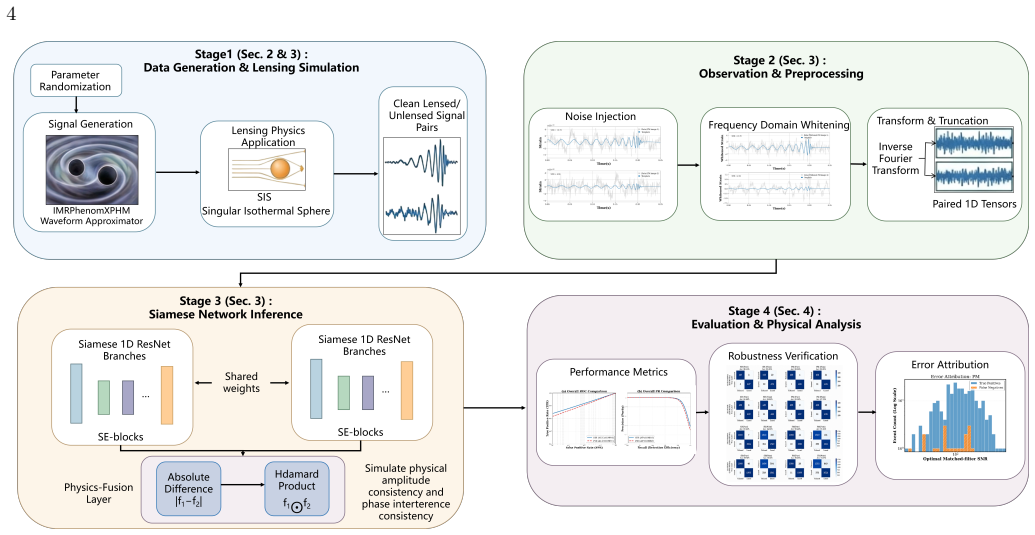
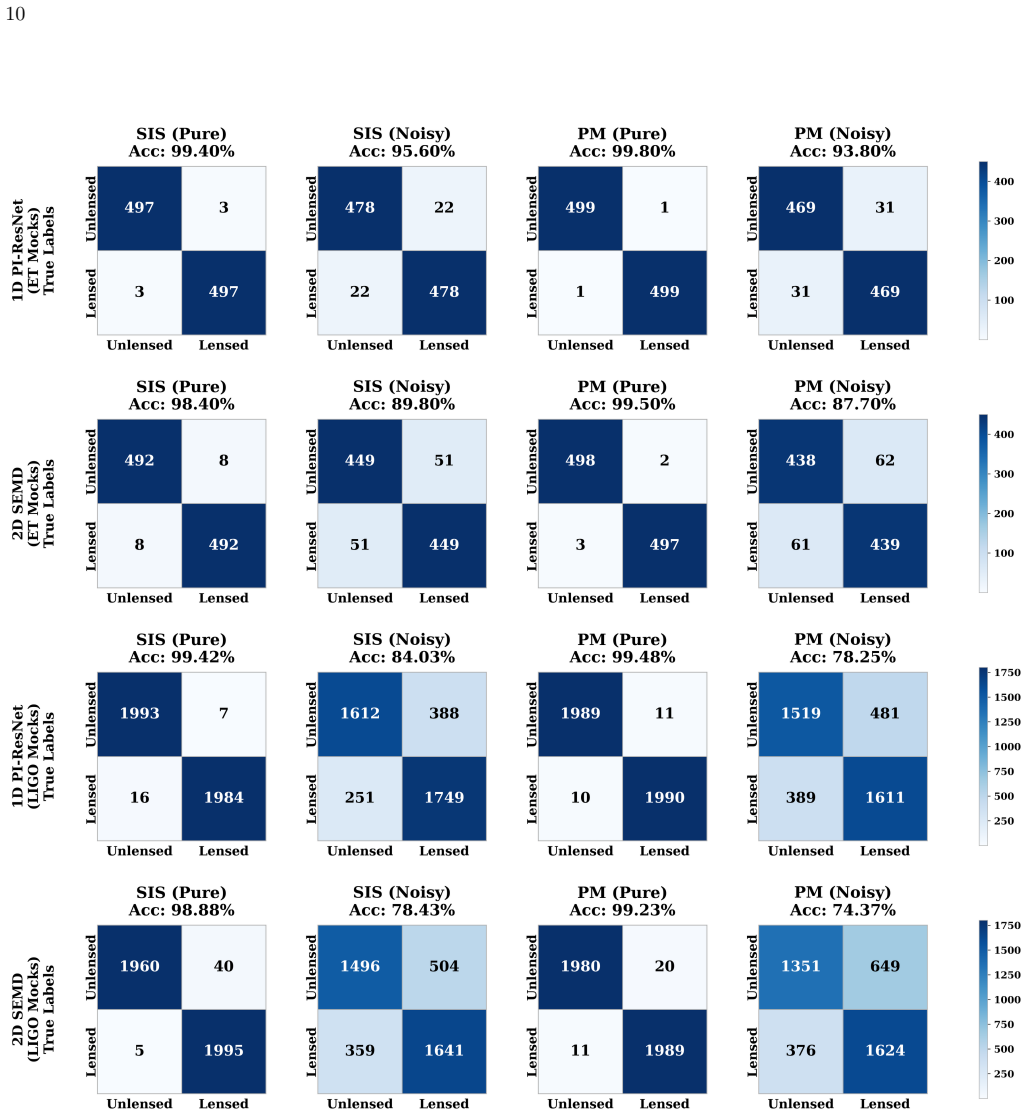
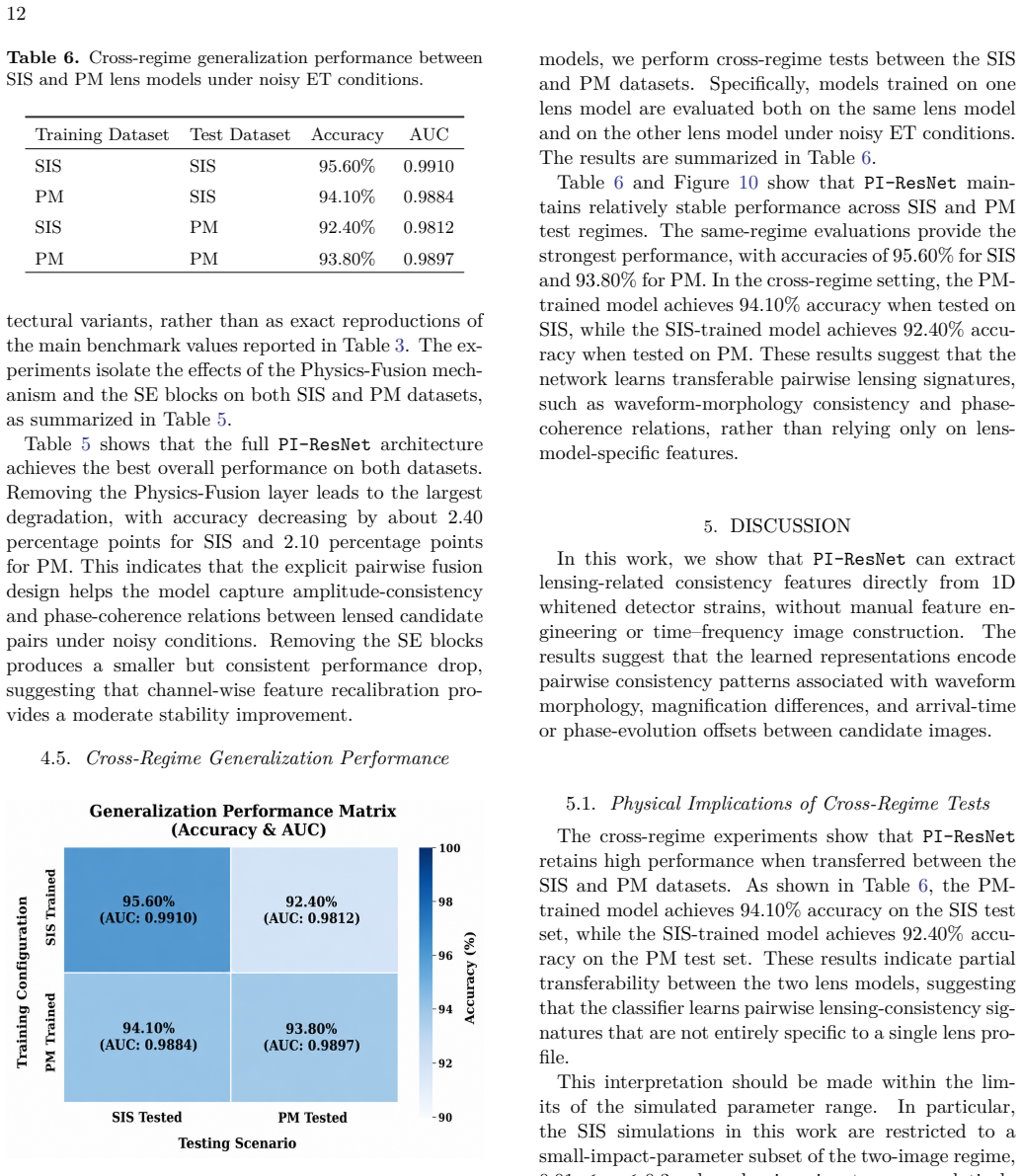
PI-ResNet encodes pairs of whitened strain segments through a shared residual backbone with Squeeze-and-Excitation modules; the embeddings are compared via absolute differences and Hadamard products to decide whether the pair is lensed. On simulated data the network reaches 95.60 percent accuracy for singular-isothermal-sphere lenses and 93.80 percent for point-mass lenses under Einstein Telescope design noise, while retaining 84.03 percent and 78.25 percent accuracy under simulated LIGO H1-L1 Gaussian noise.
What carries the argument
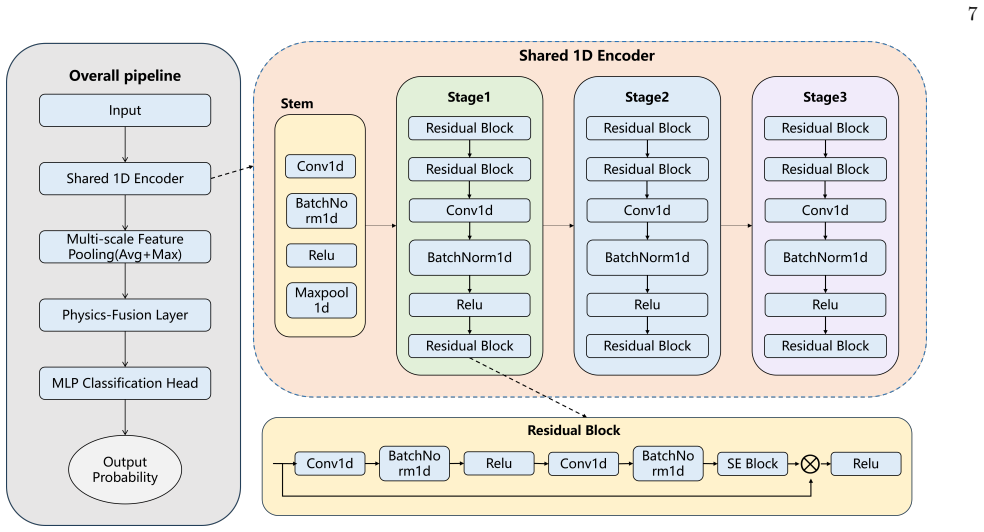
PI-ResNet: a Siamese one-dimensional residual network whose shared backbone with Squeeze-and-Excitation modules encodes two strain segments, after which absolute feature differences and Hadamard products produce the classification score.
If this is right
- Exhaustive Bayesian pair comparisons can be restricted to a much smaller set of candidates flagged by the network.
- Avoiding the intermediate time-frequency image step removes one layer of computational cost from the prescreening pipeline.
- The same architecture can be retrained on signals from different lens models without changing the input representation.
- The reported gap between ET and LIGO performance points to the value of domain-adaptation techniques before deployment on real detectors.
Where Pith is reading between the lines
- If the accuracy holds on real data, the method could scale to catalogs containing thousands of events without proportional growth in compute.
- The time-domain formulation may transfer to other pairwise GW tasks such as coincidence searches across detector networks.
- Extending the training set to include waveforms with higher-order modes or precession would test whether the learned features remain robust.
Load-bearing premise
Performance measured on simulated binary-black-hole signals lensed by point-mass or singular-isothermal-sphere models and injected into idealized detector noise will translate to real detector data containing unknown noise features and more complex lensing.
What would settle it
A large drop in classification accuracy when the trained model is applied to actual LIGO strain data containing real glitches or to signals lensed by mass distributions more complex than point-mass or SIS would falsify the claim of practical utility.
Figures
read the original abstract
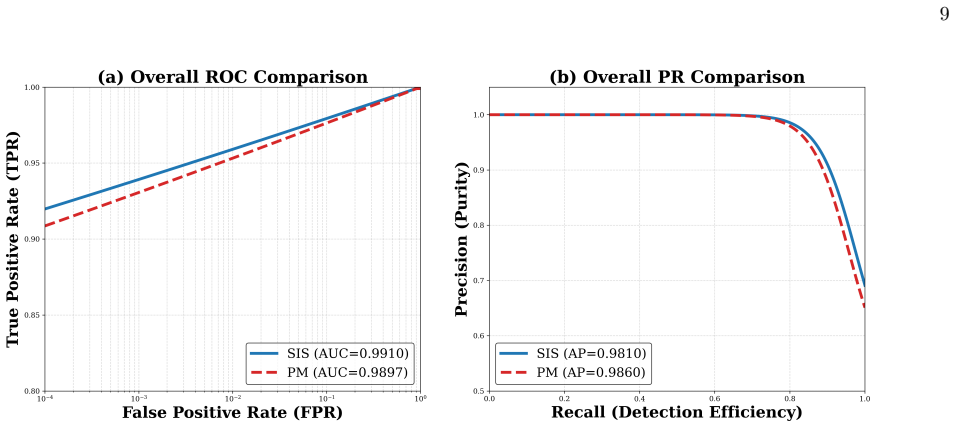
As gravitational wave (GW) catalogs continue to expand, exhaustive Bayesian comparisons of candidate event pairs become increasingly computationally expensive, which motivates the development of fast prescreening methods for strongly lensed GW searches. We formulate lensed-pair identification as a binary verification problem using two preprocessed strain segments. To address this task, we propose Physics-Inspired ResNet (PI-ResNet), a Siamese one-dimensional residual network for pairwise GW candidate classification. Unlike spectrogram-based prescreening approaches, PI-ResNet operates directly on whitened time-domain strain data and avoids an intermediate time--frequency image representation. A shared residual backbone with Squeeze-and-Excitation (SE) modules encodes the two input segments, and the paired embeddings are compared through absolute feature differences and Hadamard-product interactions. We train and evaluate the model using simulated GW signals from binary black hole mergers lensed by point-mass (PM) and singular isothermal sphere (SIS) lenses, injected into simulated LIGO and Einstein Telescope (ET) detector noise. Under ET design noise, PI-ResNet achieves accuracies of $95.60\%$ for SIS lenses and $93.80\%$ for PM lenses, while maintaining $84.03\%$ and $78.25\%$ accuracy under simulated LIGO H1--L1 Gaussian noise. These results suggest that direct learning from 1D strain data provides an efficient and physically motivated preselection statistic for candidate lensed GW pairs, while also indicating the need for detector-domain adaptation.
Editorial analysis
A structured set of objections, weighed in public.
Referee Report
Summary. The manuscript presents Physics-Inspired ResNet (PI-ResNet), a Siamese 1D residual network with Squeeze-and-Excitation modules, for binary classification of whether pairs of gravitational-wave strain segments are strongly lensed. The model is trained and tested on simulated binary black hole signals lensed by point-mass and singular isothermal sphere models, injected into stationary Gaussian noise for LIGO and Einstein Telescope detectors. It reports accuracies of 95.60% (SIS) and 93.80% (PM) under ET noise, and 84.03% and 78.25% under LIGO H1-L1 noise, positioning the method as an efficient prescreening tool for lensed GW candidate pairs.
Significance. If the reported performance holds under more realistic conditions, the approach could significantly reduce the computational burden of searching for strongly lensed GW events by providing a fast, direct time-domain prescreening statistic that avoids exhaustive Bayesian parameter estimation for all pairs. The avoidance of time-frequency representations and the use of physics-inspired architecture are positive aspects. The work highlights the potential of deep learning for GW data analysis but is currently limited by its simulation scope.
major comments (2)
- [Abstract] Abstract: The central performance claims (95.60% SIS and 93.80% PM under ET design noise; 84.03% and 78.25% under LIGO H1-L1) are presented without error bars, details on the train/validation/test data splits, or information on hyperparameter search, which are necessary to evaluate the reliability of these figures for the prescreening application.
- [Abstract] Abstract: The evaluation uses only stationary Gaussian noise and the simplest analytic lens models (PM and SIS); no results are shown for non-stationary noise features, glitches, or more complex lensing (e.g., NFW profiles or substructure), which is load-bearing for the claim that the method supplies a reliable prescreening statistic for real searches, especially given the paper's own note on the need for detector-domain adaptation.
minor comments (2)
- The manuscript would benefit from including a table summarizing the accuracies with standard deviations across multiple runs or cross-validation folds.
- Clarify the exact preprocessing steps for whitening the strain data and the precise architecture details (e.g., number of residual blocks, SE module placement) in the methods section.
Simulated Author's Rebuttal
We thank the referee for their constructive comments, which help clarify the scope and presentation of our results. We provide point-by-point responses below and indicate the revisions planned for the manuscript.
read point-by-point responses
-
Referee: [Abstract] Abstract: The central performance claims (95.60% SIS and 93.80% PM under ET design noise; 84.03% and 78.25% under LIGO H1-L1) are presented without error bars, details on the train/validation/test data splits, or information on hyperparameter search, which are necessary to evaluate the reliability of these figures for the prescreening application.
Authors: We agree that the abstract would be strengthened by including these details. The full manuscript already reports the data splits, hyperparameter optimization procedure, and repeated training runs in the Methods section. In the revision we will add a concise summary of the train/validation/test split ratios, note that hyperparameters were selected via grid search with cross-validation, and include error bars (standard deviation across independent runs) on the quoted accuracies. revision: yes
-
Referee: [Abstract] Abstract: The evaluation uses only stationary Gaussian noise and the simplest analytic lens models (PM and SIS); no results are shown for non-stationary noise features, glitches, or more complex lensing (e.g., NFW profiles or substructure), which is load-bearing for the claim that the method supplies a reliable prescreening statistic for real searches, especially given the paper's own note on the need for detector-domain adaptation.
Authors: We acknowledge this limitation of the current study. The manuscript already states that the results are obtained under stationary Gaussian noise and simple lens models and explicitly notes the need for detector-domain adaptation. In the revision we will (i) temper the abstract language to describe the reported figures as performance on idealized simulations, (ii) expand the discussion section with an explicit limitations paragraph, and (iii) add forward-looking statements about planned extensions to non-stationary noise, glitches, and more complex lens profiles. Demonstrating performance on those more realistic cases lies outside the scope of the present work, which focuses on establishing a baseline time-domain approach. revision: partial
Circularity Check
No circularity; empirical ML performance on independent simulations
full rationale
The paper trains and evaluates PI-ResNet on simulated BBH signals lensed by PM/SIS models and injected into stationary Gaussian noise. Reported accuracies (e.g., 95.60% SIS under ET noise) are standard test-set metrics on held-out simulations generated independently of the model weights. No equations, self-citations, or ansatzes reduce these numbers to the training inputs by construction. The derivation chain consists of standard supervised learning steps with no load-bearing self-referential steps.
Axiom & Free-Parameter Ledger
axioms (2)
- domain assumption Simulated binary-black-hole signals lensed by point-mass or singular-isothermal-sphere models and injected into Gaussian detector noise are sufficiently representative of real observations for the purpose of measuring classification accuracy.
- domain assumption A neural network trained to distinguish lensed from unlensed pairs on simulated data will produce a useful prescreening statistic on real data.
Reference graph
Works this paper leans on
-
[1]
2015, Classical and quantum gravity, 32, 074001
Aasi, J., Abbott, B., Abbott, R., et al. 2015, Classical and quantum gravity, 32, 074001
2015
-
[2]
P., Abbott, R., Abbott, T
Abbott, B. P., Abbott, R., Abbott, T. D., et al. 2016, Physical review letters, 116, 061102
2016
-
[3]
P., Abbott, R., Abbott, T., et al
Abbott, B. P., Abbott, R., Abbott, T., et al. 2019, Physical Review X, 9, 031040 14
2019
-
[4]
Abbott, R., Abbott, T. D., Abraham, S., et al. 2021, The Astrophysical Journal, 923, 14, doi: 10.3847/1538-4357/ac23db
-
[5]
2023, arXiv preprint arXiv:2304.08393
Abbott, R., Abe, H., Acernese, F., et al. 2023, arXiv preprint arXiv:2304.08393
-
[6]
Ashton, G., Hübner, M., Lasky, P. D., et al. 2019, Astrophysical Journal Supplement, 241, 27, doi: 10.3847/1538-4365/ab06fc Astropy Collaboration. 2022, Astrophysical Journal, 935, 167, doi: 10.3847/1538-4357/ac7c74
-
[7]
2017, Physical Review D, 95, 063512
Baker, T., & Trodden, M. 2017, Physical Review D, 95, 063512
2017
-
[8]
1993, Advances in neural information processing systems, 6
Bromley, J., Guyon, I., LeCun, Y., Säckinger, E., & Shah, R. 1993, Advances in neural information processing systems, 6
1993
-
[9]
2025, IEEE Transactions on Pattern Analysis and Machine Intelligence, 47, 6531
Cevher, V. 2025, IEEE Transactions on Pattern Analysis and Machine Intelligence, 47, 6531
2025
-
[10]
2020, Machine Learning: Science and Technology, 2, 011002
Cuoco, E., Powell, J., Cavaglià, M., et al. 2020, Machine Learning: Science and Technology, 2, 011002
2020
-
[11]
Cutler, C., & Flanagan, E. E. 1994, Phys. Rev. D, 49, 2658, doi: 10.1103/PhysRevD.49.2658
-
[12]
2018, Physical Review D, 98, 104029
Dai, L., Li, S.-S., Zackay, B., Mao, S., & Lu, Y. 2018, Physical Review D, 98, 104029
2018
-
[13]
Deguchi, S., & Watson, W. D. 1986, Astrophysical Journal, Part 1 (ISSN 0004-637X), vol. 307, Aug. 1, 1986, p. 30-37., 307, 30
1986
-
[14]
2005, in Relativistic Gravity Research With Emphasis on Experiments and Observations: Proceedings of the 81 WE-Heraeus-Seminar Held at the Physikzentrum, Bad
Ehlers, J., & Schneider, P. 2005, in Relativistic Gravity Research With Emphasis on Experiments and Observations: Proceedings of the 81 WE-Heraeus-Seminar Held at the Physikzentrum, Bad
2005
-
[15]
Honnef, Germany 2–6 September 1991, Springer, 1–45
1991
-
[16]
2018, Physical Review D, 97, 044039
George, D., & Huerta, E. 2018, Physical Review D, 97, 044039
2018
-
[17]
J., & Ajith, P
Goyal, S., Kapadia, S. J., & Ajith, P. 2021, Physical Review D, 104, 124057
2021
-
[18]
Hannuksela, O. A., Haris, K., Ng, K. K. Y., et al. 2019, Astrophys. J. Lett., 874, L2, doi: 10.3847/2041-8213/ab0c0f
-
[19]
Identifying strongly lensed gravitational wave signals from binary black hole mergers
Ajith, P. 2018, arXiv preprint arXiv:1807.07062
work page internal anchor Pith review Pith/arXiv arXiv 2018
-
[20]
2018, in Proceedings of the IEEE conference on computer vision and pattern recognition, 7132–7141
Hu, J., Shen, L., & Sun, G. 2018, in Proceedings of the IEEE conference on computer vision and pattern recognition, 7132–7141
2018
-
[21]
A., Haris, K., & Van Den Broeck, C
Janquart, J., Hannuksela, O. A., Haris, K., & Van Den Broeck, C. 2021, Monthly Notices of the Royal Astronomical Society, 506, 5430
2021
-
[22]
2019, PhRvD, 100, 024059, doi: 10.1103/PhysRevD.100.024059
Khan, S., Chatziioannou, K., Hannam, M., & Ohme, F. 2019, PhRvD, 100, 024059, doi: 10.1103/PhysRevD.100.024059
-
[23]
Kim, K., Lee, J., Yuen, R. S. H., Hannuksela, O. A., & Li, T. G. F. 2021, Astrophys. J., 915, 119, doi: 10.3847/1538-4357/ac0143
-
[24]
2026, The Astrophysical Journal Supplement Series, 283, 31, doi: 10.3847/1538-4365/ae4340
Li, D., Liu, T., Liu, A., et al. 2026, The Astrophysical Journal Supplement Series, 283, 31, doi: 10.3847/1538-4365/ae4340
-
[25]
2018, MNRAS, 476, 2220, doi: 10.1093/mnras/sty411 38
Li, S.-S., Mao, S., Zhao, Y., & Lu, Y. 2018, Mon. Not. R. Astron. Soc., 476, 2220, doi: 10.1093/mnras/sty411
-
[26]
Liao, K., Fan, X.-L., Ding, X., Biesiada, M., & Zhu, Z.-H. 2017, Nat. Commun., 8, 1148, doi: 10.1038/s41467-017-01152-9
-
[27]
2024, Monthly Notices of the Royal Astronomical Society, 535, 990
Magare, S., More, A., & Choudhary, S. 2024, Monthly Notices of the Royal Astronomical Society, 535, 990
2024
-
[28]
2017, Physical Review D, 95, 042001
Messick, C., Blackburn, K., Brady, P., et al. 2017, Physical Review D, 95, 042001
2017
-
[29]
Ohanian, H. C. 1974, International Journal of Theoretical Physics, 9, 425
1974
-
[30]
A., & Li, T
Pagano, G., Hannuksela, O. A., & Li, T. G. 2020, Astronomy & Astrophysics, 643, A167
2020
-
[31]
Harry, I. W. 2020, Monthly Notices of the Royal Astronomical Society, 495, 3740 Planck Collaboration. 2020, Astronomy & Astrophysics, 641, A6, doi: 10.1051/0004-6361/201833910
-
[32]
2021, PhRvD, 103, 104056, doi: 10.1103/PhysRevD.103.104056 Pürrer, M., Hannam, M., & Ohme, F
Pratten, G., García-Quirós, C., Colleoni, M., et al. 2021, PhRvD, 103, 104056, doi: 10.1103/PhysRevD.103.104056
-
[33]
2010, Classical and Quantum Gravity, 27, 194002
Punturo, M., Abernathy, M., Acernese, F., et al. 2010, Classical and Quantum Gravity, 27, 194002
2010
-
[34]
Cosmic Explorer: The U.S. Contribution to Gravitational-Wave Astronomy beyond LIGO
Reitze, D., Adhikari, R. X., Ballmer, S., et al. 2019, arXiv preprint arXiv:1907.04833
work page internal anchor Pith review Pith/arXiv arXiv 2019
-
[35]
Sachdev, S., Caudill, S., Fong, H., et al. 2019, arXiv preprint arXiv:1901.08580
work page internal anchor Pith review Pith/arXiv arXiv 2019
-
[36]
2010, Physical review letters, 105, 251101
Sereno, M., Sesana, A., Bleuler, A., et al. 2010, Physical review letters, 105, 251101
2010
-
[37]
Very Deep Convolutional Networks for Large-Scale Image Recognition
Simonyan, K., & Zisserman, A. 2014, CoRR, abs/1409.1556. https://api.semanticscholar.org/CorpusID:14124313
work page internal anchor Pith review Pith/arXiv arXiv 2014
-
[38]
2003, ApJ, 595, 1039, doi: 10.1086/377430
Takahashi, R., & Nakamura, T. 2003, Astrophys. J., 595, 1039, doi: 10.1086/377430
-
[39]
A., Nitz, A
Usman, S. A., Nitz, A. H., Harry, I. W., et al. 2016, Classical and Quantum Gravity, 33, 215004
2016
discussion (0)
Sign in with ORCID, Apple, or X to comment. Anyone can read and Pith papers without signing in.