Quantum transitions of vector vortex light in gravitational waves
Pith reviewed 2026-06-29 06:49 UTC · model grok-4.3
The pith
Gravitational waves induce fourteen quantum transition channels in vector vortex light states.
A machine-rendered reading of the paper's core claim, the machinery that carries it, and where it could break.
Core claim
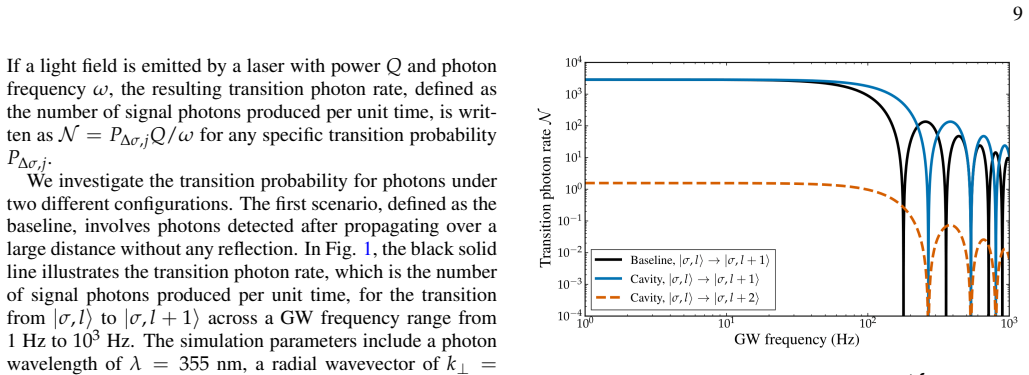
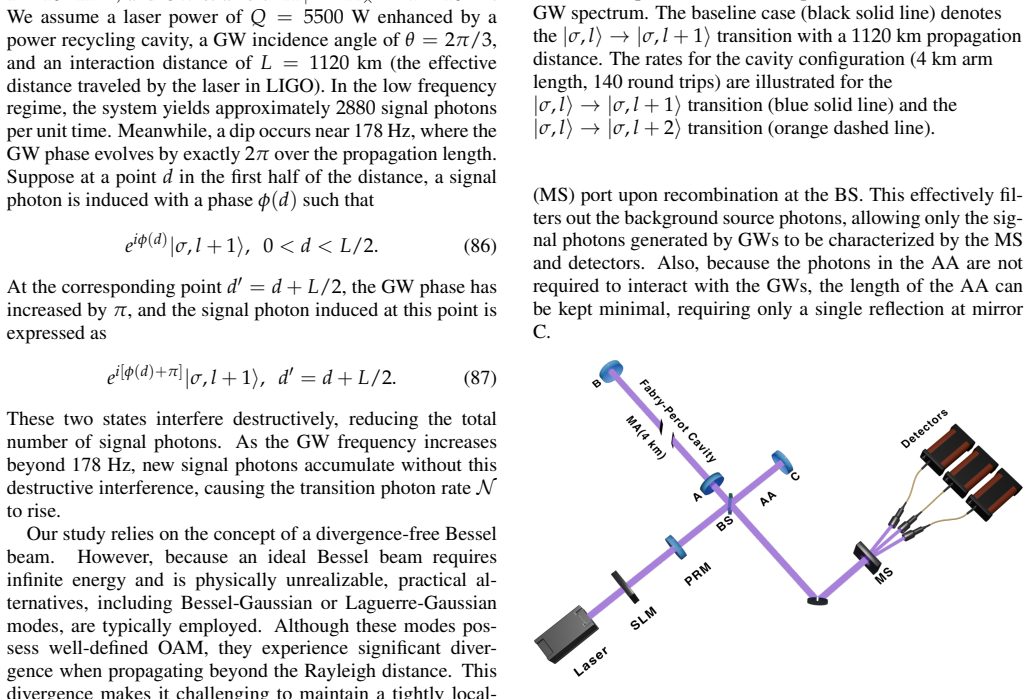
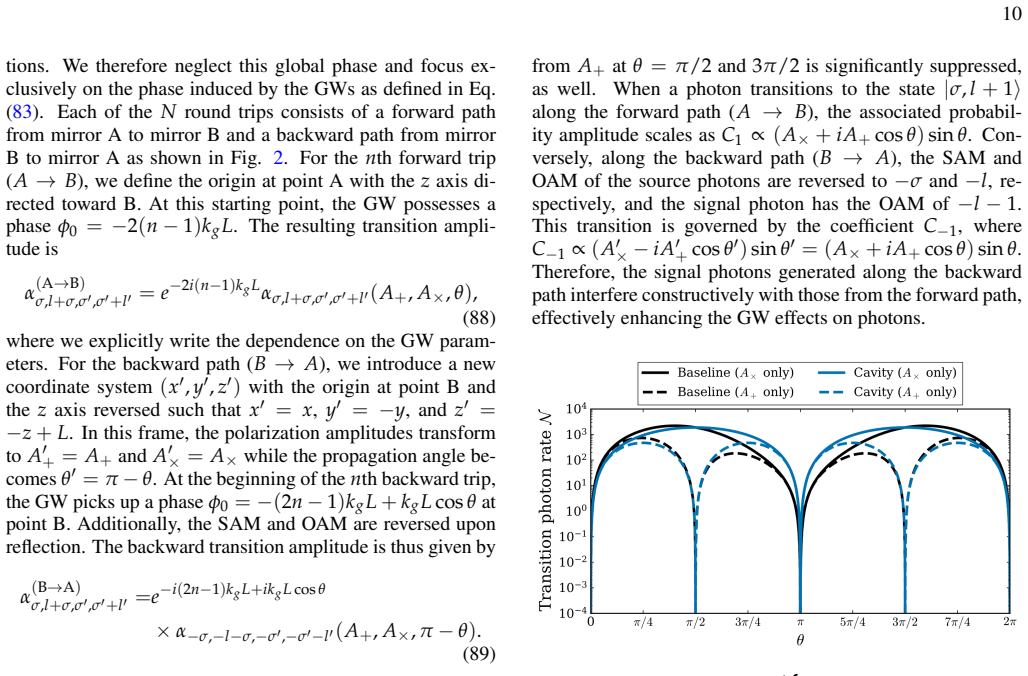
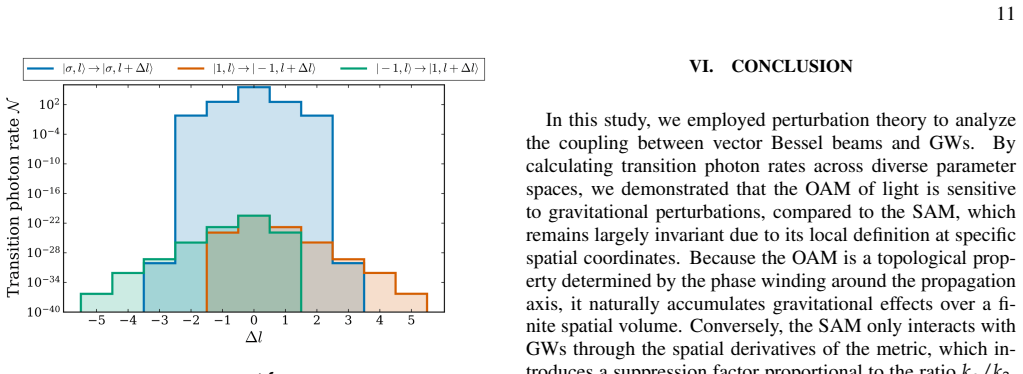
Gravitational waves induce fourteen different quantum transition channels across orbital angular momentum l and spin angular momentum σ, mapping initial states |σ, l⟩ to |σ + Δσ, l + j − Δσ⟩ where Δσ ∈ {−2, 0, 2} and j ∈ {−3, …, 3}. Among these, the SAM-conserving OAM transitions |σ, l⟩ → |σ, l ± 1⟩ provide the most viable mechanism for experimental detection, while spin-flip transitions are heavily suppressed. Reversal of SAM produces an asymmetric shift in the OAM channels. The resulting transition amplitudes support a cavity-based gravitational-wave detector that registers quantum state changes rather than macroscopic displacements.
What carries the argument
The fourteen quantum transition channels that map photon states |σ, l⟩ to |σ + Δσ, l + j − Δσ⟩ under the gravitational-wave perturbation.
Load-bearing premise
First-order perturbation theory on the quantized electromagnetic field in a gravitational-wave background captures the dominant transition amplitudes without higher-order terms or environmental couplings becoming significant.
What would settle it
A laboratory measurement of the transition rate from a chosen |σ, l⟩ state to |σ, l + 1⟩ (or l − 1) in a controlled gravitational-wave-like field that differs substantially from the calculated probability would falsify the central prediction.
Figures
read the original abstract
We develop a theoretical framework to describe the full interaction between vector vortex light fields and gravitational waves (GWs). Using perturbation theory and the canonical quantization of the electromagnetic field, we calculate the quantum transition probabilities of vector Bessel beams propagating through GWs. We demonstrate that GWs induce fourteen different quantum transition channels across orbital angular momentum (OAM) $l$ and spin angular momentum (SAM) $\sigma$, mapping initial states $\ket{\sigma,l}$ to $\ket{\sigma+\Delta \sigma,l+j-\Delta \sigma}$, where $\Delta\sigma \in \{-2, 0, 2\}$ represents the change in SAM and $j \in \{-3, \dots, 3\}$ denotes the change in total angular momentum. Among these channels, SAM-conserving transitions between OAM states, specifically $\ket{\sigma, l}\rightarrow \ket{\sigma, l\pm 1}$, provide the most viable mechanism for experimental detection. Conversely, spin-flip transitions are shown to be heavily suppressed relative to OAM transitions. Additionally, the reversal of SAM induces an asymmetric shift in the OAM transition channels, reflecting the underlying coupling between SAM and OAM during the gravitational interaction. Based on these transition channels, we propose a new cavity-based GW detection configuration. By relying on quantum transitions rather than macroscopic arm-length changes, this scheme is inherently insensitive to displacement-based disturbances like seismic noise, offering a new paradigm and frequency bands for GW observation.
Editorial analysis
A structured set of objections, weighed in public.
Referee Report
Summary. The manuscript develops a theoretical framework for the interaction of vector vortex light (vector Bessel beams) with gravitational waves via canonical quantization of the electromagnetic field and first-order perturbation theory. It reports that GWs induce exactly fourteen quantum transition channels, mapping initial states |σ, l⟩ to |σ + Δσ, l + j − Δσ⟩ with Δσ ∈ {−2, 0, 2} and j ∈ {−3, …, 3}, identifies the SAM-conserving OAM transitions |σ, l⟩ → |σ, l ± 1⟩ as the most viable for experimental detection, shows that spin-flip transitions are heavily suppressed, notes an asymmetric OAM shift upon SAM reversal, and proposes a cavity-based GW detector relying on these quantum transitions rather than classical arm-length changes.
Significance. If the first-order transition amplitudes are correctly derived and the perturbation regime is valid, the work supplies concrete, falsifiable predictions for fourteen channels together with a new quantum-optical paradigm for GW detection that is claimed to be insensitive to seismic and other displacement noise, potentially opening new frequency bands. The explicit channel mappings and the asserted suppression of spin-flip relative to OAM transitions constitute specific, testable content.
major comments (2)
- [Abstract (perturbation-theory paragraph) and the section deriving the transition probabilities] The central claim of exactly fourteen first-order transition channels (with the stated Δσ and j ranges and the asserted dominance of SAM-conserving OAM transitions) rests entirely on the first-order perturbation calculation of the interaction Hamiltonian obtained from canonical quantization in a linearized GW background. The manuscript does not discuss the regime of validity of this approximation, in particular whether second-order processes or metric back-reaction remain negligible for the long interaction times and realistic GW strains envisaged in the proposed cavity setup; this directly affects both the channel count and the experimental-viability conclusion.
- [Abstract and the calculation section] No explicit form of the interaction Hamiltonian, matrix elements, or numerical verification of the fourteen-channel count is supplied; without these the support for the mapping |σ, l⟩ → |σ + Δσ, l + j − Δσ⟩ and the suppression of spin-flip channels cannot be assessed.
minor comments (2)
- [Introduction / formalism section] Notation for the states is introduced as |σ, l⟩ but the precise normalization and mode functions for the vector Bessel beams are not restated in the main text, making it harder to reproduce the matrix elements.
- [Abstract] The abstract states that the reversal of SAM induces an asymmetric shift in the OAM channels; this asymmetry should be illustrated with an explicit example (e.g., for a specific initial |σ, l⟩) to clarify the effect.
Simulated Author's Rebuttal
We thank the referee for the careful reading and constructive comments on our manuscript. We respond to each major comment below, indicating the revisions we will implement.
read point-by-point responses
-
Referee: The central claim of exactly fourteen first-order transition channels (with the stated Δσ and j ranges and the asserted dominance of SAM-conserving OAM transitions) rests entirely on the first-order perturbation calculation of the interaction Hamiltonian obtained from canonical quantization in a linearized GW background. The manuscript does not discuss the regime of validity of this approximation, in particular whether second-order processes or metric back-reaction remain negligible for the long interaction times and realistic GW strains envisaged in the proposed cavity setup; this directly affects both the channel count and the experimental-viability conclusion.
Authors: We agree that the manuscript lacks an explicit discussion of the validity regime for the first-order approximation. In the revised version we will add a dedicated subsection deriving the conditions under which second-order contributions and metric back-reaction remain negligible. This will include order-of-magnitude estimates for realistic GW strains (h ∼ 10^{-21}) and cavity interaction times, confirming that the fourteen-channel count and the relative suppression of spin-flip transitions remain valid within the stated parameter range. revision: yes
-
Referee: No explicit form of the interaction Hamiltonian, matrix elements, or numerical verification of the fourteen-channel count is supplied; without these the support for the mapping |σ, l⟩ → |σ + Δσ, l + j − Δσ⟩ and the suppression of spin-flip channels cannot be assessed.
Authors: The interaction Hamiltonian is obtained in the calculation section via canonical quantization of the electromagnetic field in the linearized GW metric, and the transition amplitudes follow from first-order time-dependent perturbation theory. To allow direct verification, the revised manuscript will include the explicit form of the interaction Hamiltonian, the relevant matrix elements between vector Bessel modes, and a table that enumerates all fourteen allowed channels together with their leading-order amplitudes. This addition will make the mapping and the suppression of spin-flip channels fully transparent. revision: yes
Circularity Check
Derivation from canonical quantization and perturbation theory is self-contained with no reductions to inputs
full rationale
The paper computes transition channels and probabilities via perturbation theory applied to the canonically quantized electromagnetic field in a linearized gravitational-wave background. The fourteen channels (with explicit Δσ ∈ {-2,0,2} and j ∈ {-3..3} mappings) and the relative suppression of spin-flip versus SAM-conserving OAM transitions are presented as calculated outcomes of that interaction Hamiltonian, not as fitted parameters, self-defined quantities, or results imported solely via self-citation. No equations or steps in the provided abstract reduce the claimed predictions to the inputs by construction, and the framework is independent of external benchmarks or prior author-specific uniqueness theorems.
Axiom & Free-Parameter Ledger
Reference graph
Works this paper leans on
-
[1]
T. L. S. Collaboration, J. Aasi, B. P. Abbott, et al., Advanced ligo, Classical and Quantum Gravity32, 074001 (2015)
2015
-
[2]
Acernese, M
F. Acernese, M. Agathos, K. Agatsuma, et al., Advanced virgo: a second-generation interferometric gravitational wave detec- tor, Classical and Quantum Gravity32, 024001 (2014)
2014
-
[3]
M. Tse, H. Yu, N. Kijbunchoo, et al., Quantum-enhanced ad- vanced ligo detectors in the era of gravitational-wave astron- omy, Phys. Rev. Lett.123, 231107 (2019)
2019
-
[4]
Allen, M
L. Allen, M. W. Beijersbergen, R. Spreeuw, and J. Woerdman, Orbital angular momentum of light and the transformation of laguerre-gaussian laser modes, Phys. Rev. A45, 8185 (1992)
1992
-
[5]
G. F. Calvo, A. Pic ´on, and E. Bagan, Quantum field theory of photons with orbital angular momentum, Phys. Rev. A73, 013805 (2006)
2006
-
[6]
A. Mair, A. Vaziri, G. Weihs, and A. Zeilinger, Entanglement of the orbital angular momentum states of photons, Nature412, 313 (2001)
2001
-
[7]
Molina-Terriza, J
G. Molina-Terriza, J. P. Torres, and L. Torner, Management of the angular momentum of light: preparation of photons in mul- tidimensional vector states of angular momentum, Phys. Rev. Lett.88, 013601 (2001)
2001
-
[8]
Leach, M
J. Leach, M. J. Padgett, S. M. Barnett, S. Franke-Arnold, and J. Courtial, Measuring the orbital angular momentum of a single photon, Phys. Rev. Lett.88, 257901 (2002)
2002
-
[9]
Vaziri, G
A. Vaziri, G. Weihs, and A. Zeilinger, Experimental two- photon, three-dimensional entanglement for quantum commu- nication, Phys. Rev. Lett.89, 240401 (2002)
2002
-
[10]
Vaziri, J.-W
A. Vaziri, J.-W. Pan, T. Jennewein, G. Weihs, and A. Zeilinger, Concentration of higher dimensional entanglement: qutrits of photon orbital angular momentum, Phys. Rev. Lett.91, 227902 (2003)
2003
-
[11]
Allen, M
L. Allen, M. Padgett, and M. Babiker, Iv the orbital angular momentum of light, Prog. Opt.39, 291 (1999)
1999
-
[12]
Y . S. Kivshar and E. A. Ostrovskaya, Optical vortices folding and twisting waves of light, Optics and photonics news12, 24 (2001)
2001
-
[13]
Molina-Terriza, J
G. Molina-Terriza, J. P. Torres, and L. Torner, Twisted photons, Nature Phys.3, 305 (2007)
2007
-
[14]
A. M. Yao and M. J. Padgett, Orbital angular momentum: ori- gins, behavior and applications, Adv. Opt. Photonics3, 161 (2011)
2011
-
[15]
Molina-Terriza, E
G. Molina-Terriza, E. M. Wright, and L. Torner, Propagation and control of noncanonical optical vortices, Opt. Lett.26, 163 (2001)
2001
-
[16]
Chelkowski, S
S. Chelkowski, S. Hild, and A. Freise, Prospects of higher-order laguerre-gauss modes in future gravitational wave detectors, Phys. Rev. D79, 122002 (2009)
2009
-
[17]
Granata, C
M. Granata, C. Buy, R. Ward, and M. Barsuglia, Higher-order laguerre-gauss mode generation and interferometry for gravita- tional wave detectors, Phys. Rev. Lett.105, 231102 (2010)
2010
-
[18]
Q. Wu, W. Zhu, and L. Feng, Testing the wave-particle duality of gravitational wave using the spin-orbital-hall effect of struc- tured light, Universe8, 535 (2022)
2022
-
[19]
H. Wu, X. Fan, and L. Chen, How gravitational fluctuations degrade the high-dimensional spatial entanglement, Phys. Rev. D106, 045023 (2022)
2022
-
[20]
Atonga, K
E. Atonga, K. Martineau, R. Aboushelbaya, A. Barrau, M. von der Leyen, S. Howard, A. James, J. Lee, C. Lin, H. Mar- tin, I. Ouatu, R. Paddock, R. Ruskov, R. Timmis, and P. Nor- reys, Gravitational waves from high-power twisted light, Phys. Rev. D110, 044023 (2024)
2024
-
[21]
H. Wu, X. Fan, and L. Chen, How gravitational waves change photon orbital angular momentum quantum states, Phys. Rev. D112, 124002 (2025)
2025
- [22]
-
[23]
G. F. Quinteiro, C. T. Schmiegelow, D. E. Reiter, and T. Kuhn, Reexamination of bessel beams: A generalized scheme to de- rive optical vortices, Phys. Rev. A99, 023845 (2019)
2019
-
[24]
A. Nisbet, Hertzian electromagnetic potentials and associated gauge transformations, Proceedings of the Royal Society of London. A. Mathematical and Physical Sciences231, 250 (1955), https://royalsocietypublishing.org/rspa/article- pdf/231/1185/250/998179/rspa.1955.0170.pdf
-
[25]
A. Nisbet, Electromagnetic potentials in a heterogeneous non-conducting medium, Proceedings of the Royal Society of London. A. Mathematical and Physical Sciences240, 375 (1957), https://royalsocietypublishing.org/rspa/article- pdf/240/1222/375/50298/rspa.1957.0092.pdf
-
[26]
J ´auregui and S
R. J ´auregui and S. Hacyan, Quantum-mechanical properties of bessel beams, Phys. Rev. A71, 033411 (2005)
2005
-
[27]
Collett, Field guide to polarization, V ol
E. Collett, Field guide to polarization, V ol. 15 (SPIE Press, Bellingham, W A, 2005)
2005
-
[28]
A. T. O’Neil, I. MacVicar, L. Allen, and M. J. Padgett, Intrinsic and extrinsic nature of the orbital angular momentum of a light beam, Phys. Rev. Lett.88, 053601 (2002)
2002
-
[29]
M. E. Peskin, An introduction to quantum field theory (CRC press, 2018)
2018
-
[30]
M. O. Scully and M. S. Zubairy, Quantum optics (Cambridge university press, Cambridge, England, 1997)
1997
-
[31]
L.-P. Yang, F. Khosravi, and Z. Jacob, Quantum field theory for spin operator of the photon, Phys. Rev. Res.4, 023165 (2022)
2022
-
[32]
S. M. Barnett, L. Allen, R. P. Cameron, C. R. Gilson, M. J. Padgett, F. C. Speirits, and A. M. Yao, On the natures of the spin and orbital parts of optical angular momentum, J. Opt.18, 064004 (2016)
2016
-
[33]
K. Y . Bliokh, M. A. Alonso, E. A. Ostrovskaya, and A. Aiello, Angular momenta and spin-orbit interaction of nonparaxial light in free space, Phys. Rev. A82, 063825 (2010)
2010
-
[34]
K. Y . Bliokh, F. J. Rodr´ıguez-Fortu˜no, F. Nori, and A. V . Zayats, Spin–orbit interactions of light, Nature Photonics9, 796 (2015)
2015
-
[35]
J. J. Sakurai and J. Napolitano, Modern quantum mechanics (Cambridge University Press, 2020)
2020
-
[36]
Exirifard, E
Q. Exirifard, E. Culf, and E. Karimi, Towards communication in a curved spacetime geometry, Commun. Phys.4, 1 (2021)
2021
-
[37]
C. W. Misner, K. S. Thorne, and J. A. Wheeler, Gravitation (Macmillan, London, 1973)
1973
-
[38]
D. L. Andrews, Symmetry and quantum features in optical vor- tices, Symmetry13, 1368 (2021)
2021
-
[39]
B. S. DeWitt, Quantum field theory in curved spacetime, Phys. Rep.19, 295 (1975)
1975
-
[40]
D. G. Duffy, Green’s functions with applications (Chapman and Hall/CRC, 2015)
2015
-
[41]
Carneiro and K
F. Carneiro and K. Abbasi, Gravitational energy creation in the sandwich pp-waves collision, Classical and Quantum Gravity 42, 105008 (2025)
2025
-
[42]
Chakraborty and P
T. Chakraborty and P. Majumdar, Particle creation in a linear gravitational wave background, Phys. Rev. D110, L021701 (2024)
2024
-
[43]
Gibbons, Quantized fields propagating in plane-wave space- times, Commun.Math
G. Gibbons, Quantized fields propagating in plane-wave space- times, Commun.Math. Phys.45, 191 (1975)
1975
-
[44]
N. D. Birrell and P. C. W. Davies, 14 Quantum fields in curved space (Cambridge university press, 1984)
1984
-
[45]
Portales-Oliva and A
F. Portales-Oliva and A. G. S. Landulfo, Classical and quan- tum reconciliation of electromagnetic radiation: Vector un- ruh modes and zero-rindler-energy photons, Phys. Rev. D106, 065002 (2022)
2022
-
[46]
Takagi, Vacuum noise and stress induced by uniform accelerationhawking-unruh effect in rindler manifold of arbi- trary dimension, Prog
S. Takagi, Vacuum noise and stress induced by uniform accelerationhawking-unruh effect in rindler manifold of arbi- trary dimension, Prog. Theor. Phys. Suppl.88, 1 (1986)
1986
-
[47]
Gbur and R
G. Gbur and R. K. Tyson, V ortex beam propagation through atmospheric turbulence and topological charge conservation, J. Opt. Soc. Am. A25, 225 (2008)
2008
-
[48]
E. E. Flanagan and S. A. Hughes, The basics of gravitational wave theory, New J. Phys.7, 204 (2005)
2005
-
[49]
Y . Shen, X. Wang, Z. Xie, C. Min, X. Fu, Q. Liu, M. Gong, and X. Yuan, Optical vortices 30 years on: Oam manipulation from topological charge to multiple singularities, Light Sci. Appl.8, 90 (2019)
2019
-
[50]
Pitkin, S
M. Pitkin, S. Reid, S. Rowan, and J. Hough, Gravitational wave detection by interferometry (ground and space), Living Rev. Relativity14, 1 (2011)
2011
-
[51]
D. W. Lozier, Nist digital library of mathematical functions, Annals of Mathematics and Artificial Intelligence38, 105 (2003)
2003
-
[52]
F. W. Olver,NIST handbook of mathematical functions hardback and CD-ROM (Cambridge university press, 2010)
2010
discussion (0)
Sign in with ORCID, Apple, or X to comment. Anyone can read and Pith papers without signing in.