Battery-Sim-Agent: Leveraging LLM-Agent for Inverse Battery Parameter Estimation
Pith reviewed 2026-06-29 07:57 UTC · model grok-4.3
The pith
An LLM agent estimates battery parameters more accurately than Bayesian optimization by reasoning over simulator feedback.
A machine-rendered reading of the paper's core claim, the machinery that carries it, and where it could break.
Core claim
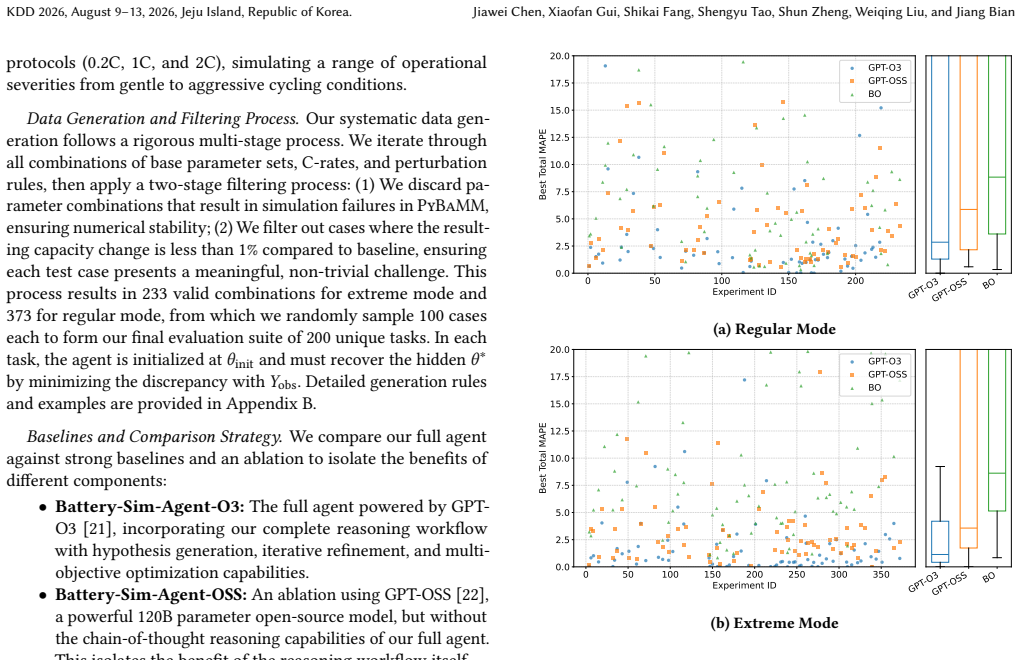
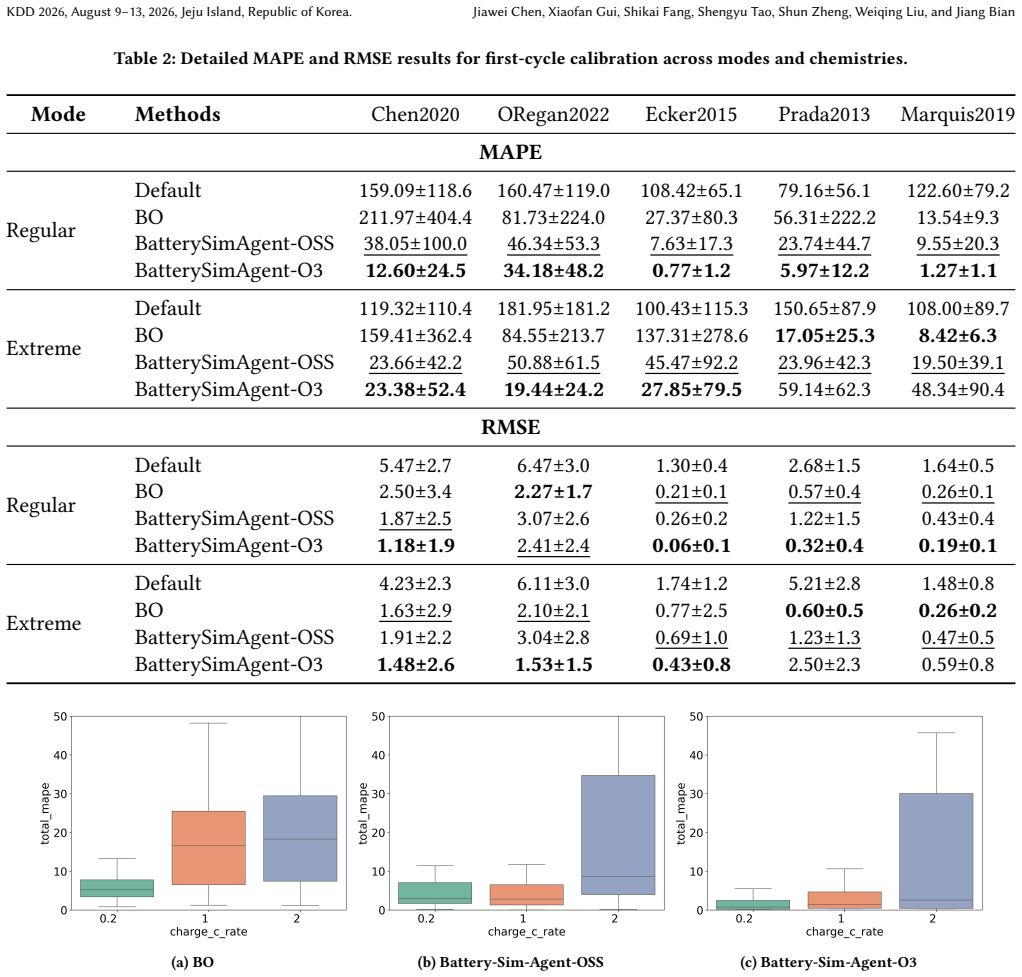
Battery-Sim-Agent reframes the inverse parameter estimation task as closed-loop reasoning: an LLM agent receives rich simulator feedback, constructs physically grounded hypotheses to explain observed discrepancies, and issues structured parameter updates that progressively reduce error, outperforming Bayesian optimization and related BBO methods across a constructed benchmark suite of varied battery chemistries and operating regimes.
What carries the argument
The LLM agent that interprets multi-modal simulator feedback and generates hypothesis-driven parameter updates in a closed loop.
If this is right
- Accurate parameters obtained this way produce digital twins that better match real battery behavior under diverse conditions.
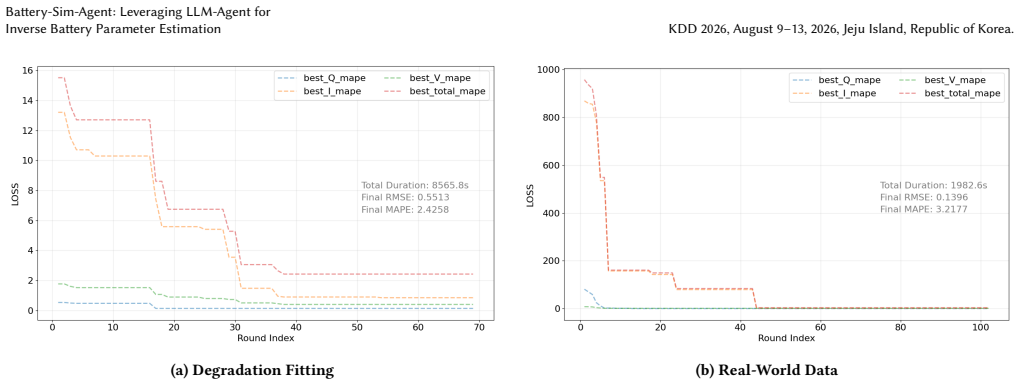
- The same reasoning loop extends to long-horizon degradation modeling tasks that traditional optimizers handle poorly.
- The framework works directly on real-world battery measurement datasets without requiring chemistry-specific retraining.
- Replacing blind search with hypothesis generation reduces the number of simulator calls needed to reach usable accuracy.
Where Pith is reading between the lines
- Similar agent loops could be tested on other inverse problems that combine expensive simulators with partial physical knowledge.
- The approach suggests a route to hybrid systems where an LLM proposes candidate updates that a conventional optimizer then refines.
- If the reasoning step generalizes, it could lower the barrier for non-experts to calibrate complex physics models.
Load-bearing premise
The LLM already holds enough pre-trained knowledge to turn simulator outputs into reliable physical hypotheses and parameter suggestions without hallucination or extra training.
What would settle it
Run the agent on a simulator with known ground-truth parameters and measure whether final estimated values converge to those known values within a stated tolerance after a fixed number of iterations.
Figures

read the original abstract
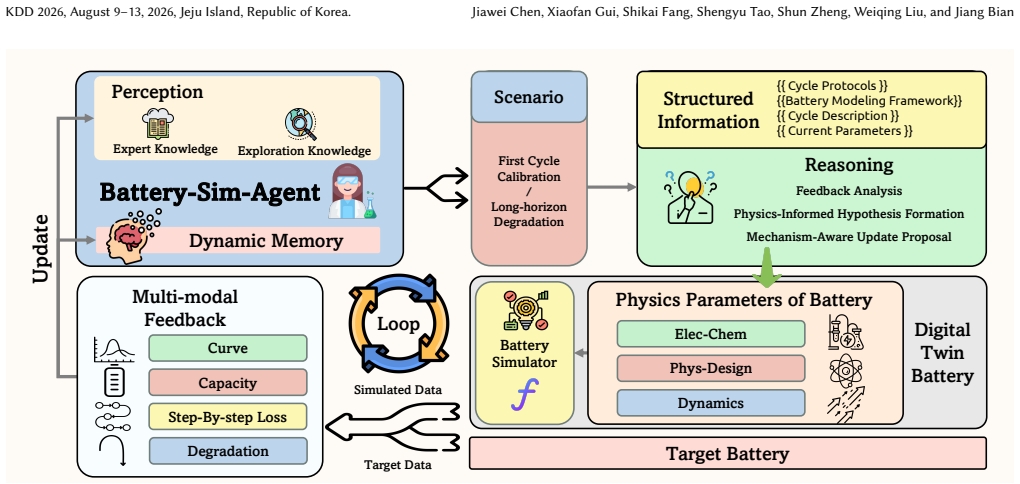
Parameterizing high-fidelity "digital twins" of batteries is a critical yet challenging inverse problem that hinders the pace of battery innovation. Prevailing methods formulate this as a black-box optimization (BBO) task, employing algorithms that are sample-inefficient and blind to the underlying physics. In this work, we introduce a new paradigm that reframes the inverse problem as a reasoning task, and present Battery-Sim-Agent, the first framework to deploy a Large Language Model (LLM) agent in a closed loop with a high-fidelity battery simulator. The agent mimics a human scientist's workflow: it interprets rich, multi-modal feedback from the simulator, forms physically-grounded hypotheses to explain discrepancies, and proposes structured parameter updates. On a systematically constructed benchmark suite spanning diverse battery chemistries, operating conditions, and difficulty levels, our agent significantly outperforms strong BBO baselines like Bayesian optimization in identifying accurate parameters. We further demonstrate the framework's capability in complex long-horizon degradation fitting tasks and validate its practical applicability on real-world battery datasets. Our results highlight the promise of LLM-agents as reasoning-based optimizers for scientific discovery and battery parameter estimation.
Editorial analysis
A structured set of objections, weighed in public.
Referee Report
Summary. The manuscript introduces Battery-Sim-Agent, an LLM-agent framework that operates in closed loop with a high-fidelity battery simulator to solve the inverse parameter estimation problem for battery digital twins. The agent interprets multi-modal simulator feedback, generates physically-grounded hypotheses, and proposes structured parameter updates. The central claim is that this reasoning-based approach significantly outperforms strong black-box optimization baselines such as Bayesian optimization on a systematically constructed benchmark spanning diverse chemistries, conditions, and difficulty levels, while also handling long-horizon degradation fitting and real-world datasets.
Significance. If the performance claims are substantiated with quantitative evidence, the work could mark a meaningful shift from sample-inefficient BBO methods toward agentic, physics-informed reasoning for scientific inverse problems. The conceptual reframing and use of simulator feedback are potentially valuable contributions to both battery modeling and LLM-agent applications in domain-specific optimization.
major comments (3)
- [Abstract] Abstract: the claim that the agent 'significantly outperforms strong BBO baselines like Bayesian optimization' is presented without any quantitative metrics, error values, success rates, or tabulated comparisons, rendering the central empirical claim unverifiable from the provided text.
- [Abstract] The manuscript supplies no methodological details on benchmark construction, parameter spaces, success metrics, controls for LLM stochasticity, or exclusion criteria, which are load-bearing for assessing whether the reported outperformance is robust.
- [Abstract] No discussion or ablation addresses the weakest assumption that the base LLM can reliably interpret multi-modal feedback and generate physically-grounded updates without hallucination or domain-specific fine-tuning.
Simulated Author's Rebuttal
We thank the referee for their constructive feedback. We address each major comment below, clarifying where details appear in the manuscript and indicating revisions to strengthen the abstract and related sections.
read point-by-point responses
-
Referee: [Abstract] Abstract: the claim that the agent 'significantly outperforms strong BBO baselines like Bayesian optimization' is presented without any quantitative metrics, error values, success rates, or tabulated comparisons, rendering the central empirical claim unverifiable from the provided text.
Authors: We agree that the abstract would be strengthened by including key quantitative indicators. The full manuscript reports these metrics (including mean parameter error, success rates, and direct comparisons to Bayesian optimization) in the Experiments section and associated tables. We will revise the abstract to incorporate representative quantitative results while respecting length constraints. revision: yes
-
Referee: [Abstract] The manuscript supplies no methodological details on benchmark construction, parameter spaces, success metrics, controls for LLM stochasticity, or exclusion criteria, which are load-bearing for assessing whether the reported outperformance is robust.
Authors: Detailed descriptions of benchmark construction, parameter spaces, success metrics, and controls for stochasticity (multiple independent runs with varied seeds) are provided in the Methods and Experimental Setup sections, with additional controls noted in the supplementary material. To improve self-containment of the abstract, we will add a concise summary of the benchmark suite and primary success criteria. revision: partial
-
Referee: [Abstract] No discussion or ablation addresses the weakest assumption that the base LLM can reliably interpret multi-modal feedback and generate physically-grounded updates without hallucination or domain-specific fine-tuning.
Authors: This observation is correct; the manuscript does not contain an explicit ablation on LLM reliability or hallucination rates. We will add a dedicated paragraph in the Discussion and Limitations sections addressing this assumption, including observed failure modes from the experiments and plans for future verification steps or lightweight fine-tuning. revision: yes
Circularity Check
No significant circularity; empirical framework with no derivations or self-referential reductions
full rationale
The paper introduces an LLM-agent framework for inverse battery parameter estimation and claims empirical outperformance versus BBO baselines on a constructed benchmark. No equations, derivations, or fitted parameters are presented in the provided text. The central claim rests on external comparison to independent baselines rather than any self-definition, self-citation chain, or renaming of known results. The benchmark and success metrics are described as systematically constructed but are not shown to reduce to quantities defined by the method itself. This is a standard non-circular empirical contribution.
Axiom & Free-Parameter Ledger
axioms (1)
- domain assumption LLM can interpret rich, multi-modal feedback from the simulator, form physically-grounded hypotheses to explain discrepancies, and propose structured parameter updates
Reference graph
Works this paper leans on
-
[1]
iMOE: Prediction of Second-Life Battery Degradation Trajectory Using Interpretable Mixture of Experts.Nature Communications(2026)
2026. iMOE: Prediction of Second-Life Battery Degradation Trajectory Using Interpretable Mixture of Experts.Nature Communications(2026). https://www. nature.com/articles/s41467-026-69369-1
2026
-
[2]
Attia, Eric Moch, and Patrick K
Peter M. Attia, Eric Moch, and Patrick K. Herring. 2025. Challenges and Op- portunities for High-Quality Battery Production at Scale. 16, 1 (2025), 611. doi:10.1038/s41467-025-55861-7
-
[3]
Robert S. Balog and Ali Davoudi. 2013. Batteries, Battery Management , and Battery Charging Technology. InTransportation Technologies for Sustainability. Springer, New York, NY, 122–157. doi:10.1007/978-1-4614-5844-9_822
-
[4]
S Blaifi, S Moulahoum, I Colak, and W Merrouche. 2016. An enhanced dynamic model of battery using genetic algorithm suitable for photovoltaic applications. Applied Energy169 (2016), 888–898
2016
-
[5]
Dhammika Widanage, and Emma Kendrick
Chang-Hui Chen, Ferran Brosa Planella, Kieran O’Regan, Dominika Gastol, W. Dhammika Widanage, and Emma Kendrick. 2020. Development of Ex- perimental Techniques for Parameterization of Multi-scale Lithium-ion Bat- tery Models.Journal of The Electrochemical Society167, 8 (may 2020), 080534. doi:10.1149/1945-7111/ab9050
-
[6]
Marc Doyle, Thomas F Fuller, and John Newman. 1993. Modeling of galvanos- tatic charge and discharge of the lithium/polymer/insertion cell.Journal of the Electrochemical society140, 6 (1993), 1526
1993
-
[7]
Madeleine Ecker, Stefan Käbitz, Izaro Laresgoiti, and Dirk Uwe Sauer. 2015. Parameterization of a Physico-Chemical Model of a Lithium-Ion Battery: II. Model Validation.Journal of The Electrochemical Society162, 9 (June 2015), A1849. doi:10.1149/2.0541509jes
-
[8]
Madeleine Ecker, Thi Kim Dung Tran, Philipp Dechent, Stefan Käbitz, Alexander Warnecke, and Dirk Uwe Sauer. 2015. Parameterization of a Physico-Chemical Model of a Lithium-Ion Battery: I. Determination of Parameters.Journal of The Electrochemical Society162, 9 (June 2015), A1836. doi:10.1149/2.0551509jes
-
[9]
Gopinath, S
R. Gopinath, S. Santhanagopalan, and Richard D. Braatz. 2016. An Inverse Method for Estimating the Electrochemical Parameters of Lithium-Ion Batteries.Journal of The Electrochemical Society163, 14 (2016), A3045–A3054
2016
-
[10]
Ahmad Hamdan, Cosmas Daudu, Adefunke Fabuyide, Emmanuel Etukudoh, and Sedat Sonko. 2024. Next-Generation Batteries and U.S. Energy Storage: A Comprehensive Review: Scrutinizing Advancements in Battery Technology, Their Role in Renewable Energy, and Grid Stability. 21 (2024), 1984–1998. doi:10. 30574/wjarr.2024.21.1.0256
2024
-
[11]
Nikolaus Hansen, Youhei Akimoto, and Petr Baudis. 2019. CMA-ES/pycma on Github. Zenodo, DOI:10.5281/zenodo.2559634. doi:10.5281/zenodo.2559634
-
[12]
Wei He, Nicholas Williard, Michael Osterman, and Michael Pecht. 2011. Prognos- tics of Lithium-Ion Batteries Based on Dempster–Shafer Theory and the Bayesian Monte Carlo Method.Journal of Power Sources196, 23 (Dec. 2011), 10314–10321. doi:10.1016/j.jpowsour.2011.08.040
-
[13]
Ming Hu, Chenglong Ma, Wei Li, Wanghan Xu, Jiamin Wu, Jucheng Hu, Tianbin Li, Guohang Zhuang, Jiaqi Liu, Yingzhou Lu, Ying Chen, Chaoyang Zhang, Cheng Tan, Jie Ying, Guocheng Wu, Shujian Gao, Pengcheng Chen, Jiashi Lin, Haitao Wu, Lulu Chen, Fengxiang Wang, Yuanyuan Zhang, Xiangyu Zhao, Feilong Tang, Encheng Su, Junzhi Ning, Xinyao Liu, Ye Du, Changkai Ji...
-
[14]
Benben Jiang, Marc D Berliner, Kun Lai, Patrick A Asinger, Hongbo Zhao, Patrick K Herring, Martin Z Bazant, and Richard D Braatz. 2022. Fast charging design for Lithium-ion batteries via Bayesian optimization.Applied Energy307 (2022), 118244
2022
- [15]
-
[16]
Dirk Magnor and Dirk Uwe Sauer. 2016. Optimization of PV battery systems using genetic algorithms.Energy Procedia99 (2016), 332–340
2016
-
[17]
Marquis, Valentin Sulzer, Robert Timms, Colin P
Scott G. Marquis, Valentin Sulzer, Robert Timms, Colin P. Please, and S. Jon Chapman. 2019. An Asymptotic Derivation of a Single Particle Model with Electrolyte.Journal of The Electrochemical Society166, 15 (Nov. 2019), A3693. doi:10.1149/2.0341915jes
-
[18]
Sean Memery, Mirella Lapata, and Kartic Subr. 2024.SimLM: Can Language Models Infer Parameters of Physical Systems?arXiv:2312.14215 [cs] doi:10.48550/ arXiv.2312.14215
-
[19]
Bo Ni and Markus J Buehler. 2024. MechAgents: Large language model multi- agent collaborations can solve mechanics problems, generate new data, and integrate knowledge.Extreme Mechanics Letters67 (2024), 102131
2024
-
[20]
Miles Olson, Elizabeth Santorella, Louis C. Tiao, Sait Cakmak, David Eriksson, Mia Garrard, Sam Daulton, Maximilian Balandat, Eytan Bakshy, Elena Kashtelyan, Zhiyuan Jerry Lin, Sebastian Ament, Bernard Beckerman, Eric Onofrey, Paschal Igusti, Cristian Lara, Benjamin Letham, Cesar Cardoso, Shiyun Sunny Shen, Andy Chenyuan Lin, and Matthew Grange. 2025. Ax:...
2025
-
[21]
OpenAI. 2025. OpenAI o3 and o4-mini System Card. https://cdn.openai.com/ pdf/2221c875-02dc-4789-800b-e7758f3722c1/o3-and-o4-mini-system-card.pdf
2025
-
[22]
OpenAI, Sandhini Agarwal, Lama Ahmad, Jason Ai, Sam Altman, Andy Apple- baum, Edwin Arbus, Rahul K. Arora, Yu Bai, Bowen Baker, Haiming Bao, Boaz Barak, Ally Bennett, Tyler Bertao, Nivedita Brett, Eugene Brevdo, Greg Brockman, Sebastien Bubeck, Che Chang, Kai Chen, Mark Chen, Enoch Cheung, Aidan Clark, Dan Cook, Marat Dukhan, Casey Dvorak, Kevin Fives, Vl...
work page internal anchor Pith review Pith/arXiv arXiv doi:10.48550/arxiv.2508.10925 2025
-
[24]
Wendy Pantoja, Jaime Andres Perez-Taborda, and Alba Avila. 2022. Tug-of-War in the Selection of Materials for Battery Technologies.Batteries8, 9 (Sept. 2022),
2022
-
[25]
doi:10.3390/batteries8090105
-
[26]
Prada, D
E. Prada, D. Di Domenico, Y. Creff, J. Bernard, V. Sauvant-Moynot, and F. Huet
-
[27]
A Simplified Electrochemical and Thermal Aging Model of LiFePO4- Graphite Li-ion Batteries: Power and Capacity Fade Simulations.Journal of The Electrochemical Society160, 4 (Feb. 2013), A616. doi:10.1149/2.053304jes
-
[28]
Prasad, A
K. Prasad, A. Rahimian, and M. Fowler. 2015. Inverse parameter determination in the development of an optimized lithium iron phosphate–Graphite battery discharge model.Journal of Power Sources273 (2015), 1348–1359
2015
-
[30]
Ana-Irina Stroe, Daniel-Loan Stroe, Vaclav Knap, Maciej Swierczynski, and Remus Teodorescu. 2018. Accelerated Lifetime Testing of High Power Lithium Titanate Oxide Batteries. In2018 IEEE Energy Conversion Congress and Exposition (ECCE). 3857–3863. doi:10.1109/ECCE.2018.8557416
-
[31]
Subramanian and Richard D
Venkat R. Subramanian and Richard D. Braatz. 2013. Modeling and Simulation of Lithium-Ion Batteries from a Systems Engineering Perspective.Journal of The Electrochemical Society160, 4 (2013), R93–R108
2013
-
[32]
Marquis, Robert Timms, Martin Robinson, and S
Valentin Sulzer, Scott G. Marquis, Robert Timms, Martin Robinson, and S. Jon Chapman. 2021. PyBaMM: Python Battery Mathematical Modelling.Journal of Open Research Software9, 1 (2021), 14
2021
- [33]
-
[34]
Xizhe Wang and Benben Jiang. 2023. Multi-objective optimization for fast charg- ing design of lithium-ion batteries using constrained Bayesian optimization. Journal of Power Sources584 (2023), 233602
2023
- [35]
-
[36]
Mengsong Wu, YaFei Wang, Yidong Ming, Yuqi An, Yuwei Wan, Wenliang Chen, Binbin Lin, Yuqiang Li, Tong Xie, and Dongzhan Zhou. 2025. ChemAgent: Enhancing LLMs for Chemistry and Materials Science through Tree-Search Based Tool Learning.arXiv preprint arXiv:2506.07551(2025). Battery-Sim-Agent: Leveraging LLM-Agent for Inverse Battery Parameter Estimation KDD...
-
[37]
Yinjiao Xing, Eden W. M. Ma, Kwok-Leung Tsui, and Michael Pecht. 2013. An Ensemble Model for Predicting the Remaining Useful Performance of Lithium-Ion Batteries.Microelectronics Reliability53, 6 (June 2013), 811–820. doi:10.1016/j. microrel.2012.12.003
work page doi:10.1016/j 2013
-
[38]
Wenjie Xu, Masaki Adachi, Colin N. Jones, and Michael A. Osborne. 2024.Principled Bayesian Optimisation in Collaboration with Human Experts. arXiv:2410.10452 [cs] doi:10.48550/arXiv.2410.10452
-
[39]
Han Zhang, Xiaofan Gui, Shun Zheng, Ziheng Lu, Yuqi Li, and Jiang Bian. 2024. BatteryML: An Open-source Platform for Machine Learning on Battery Degrada- tion. InThe Twelfth International Conference on Learning Representations
2024
-
[40]
Liqiang Zhang, Lixin Wang, Gareth Hinds, Chao Lyu, Jun Zheng, and Junfu Li
-
[41]
Multi-objective optimization of lithium-ion battery model using genetic algorithm approach.Journal of Power Sources270 (2014), 367–378
2014
-
[42]
ground truth
Wenhua Zuo, Huihuo Zheng, Tanjin He, Venkatram Vishwanath, Maria KY Chan, Rick L Stevens, Khalil Amine, and Gui-Liang Xu. 2025. Large language models for batteries.Joule9, 8 (2025). A Reproducibility statement We have taken several measures to ensure the reproducibility of our results. All experiments were conducted with fixed random seeds, and key experi...
2025
-
[43]
• A higher SEI solvent diffusivity (SEI_solvent_diffusivity_m2_s-1) increases the degradation rate and magnitude
generally results in larger initial capacity and impedance decay, with a downward-convex curve. • A higher SEI solvent diffusivity (SEI_solvent_diffusivity_m2_s-1) increases the degradation rate and magnitude. • A higher EC diffusivity (EC_diffusivity_m2_s-1) accelerates the degradation rate and results in a downward-convex curve. • A higher initial SEI t...
2007
discussion (0)
Sign in with ORCID, Apple, or X to comment. Anyone can read and Pith papers without signing in.