Revealing quantum metric multipoles in magnetic topological insulator MnBi2Te4
Pith reviewed 2026-06-29 05:57 UTC · model grok-4.3
The pith
Nonlinear currents reach the seventh harmonic in MnBi2Te4 and trace to quantum metric multipoles.
A machine-rendered reading of the paper's core claim, the machinery that carries it, and where it could break.
Core claim
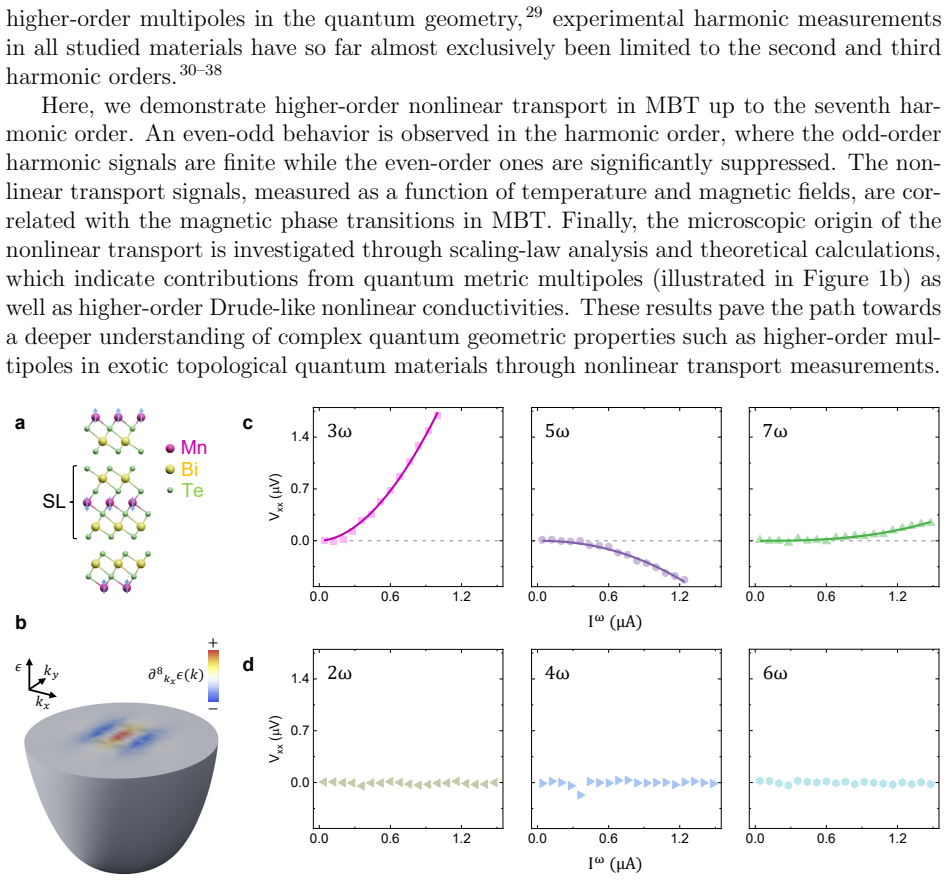
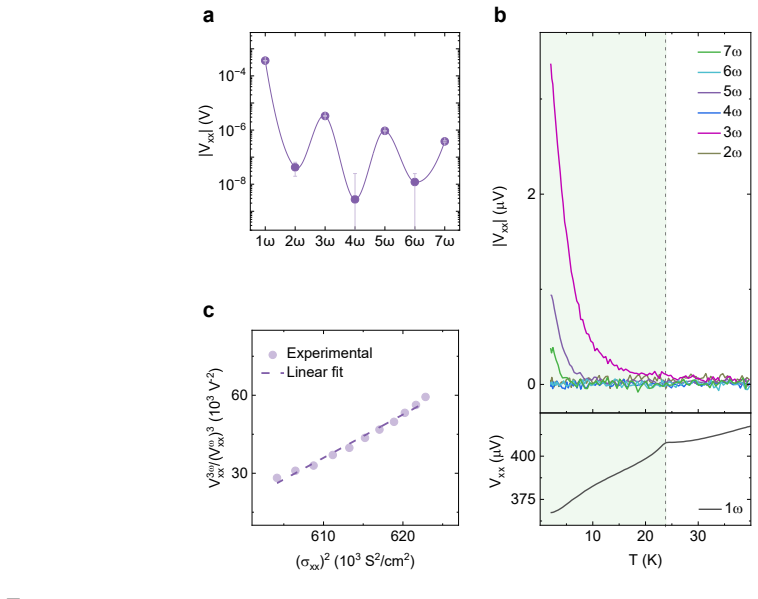
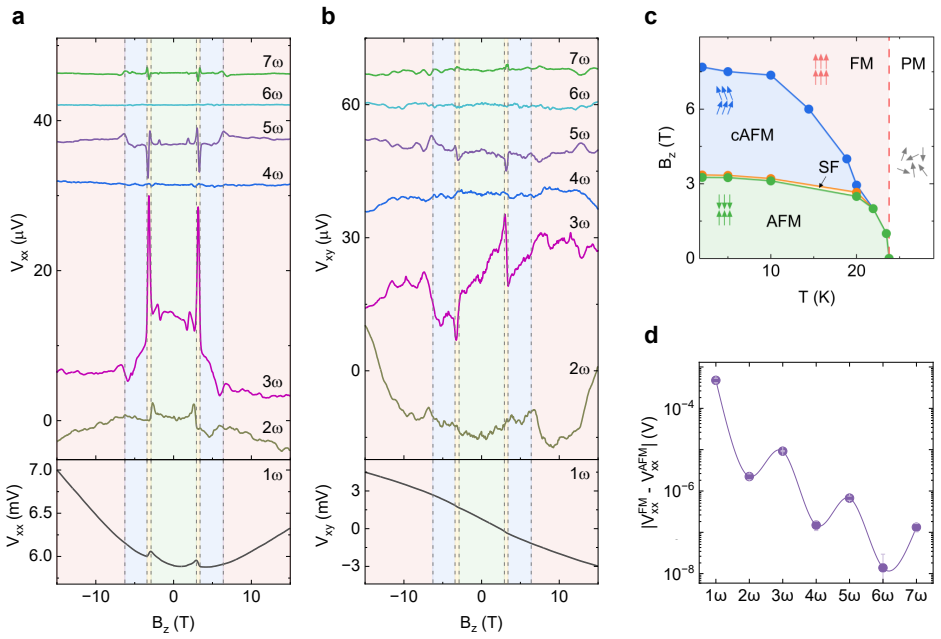
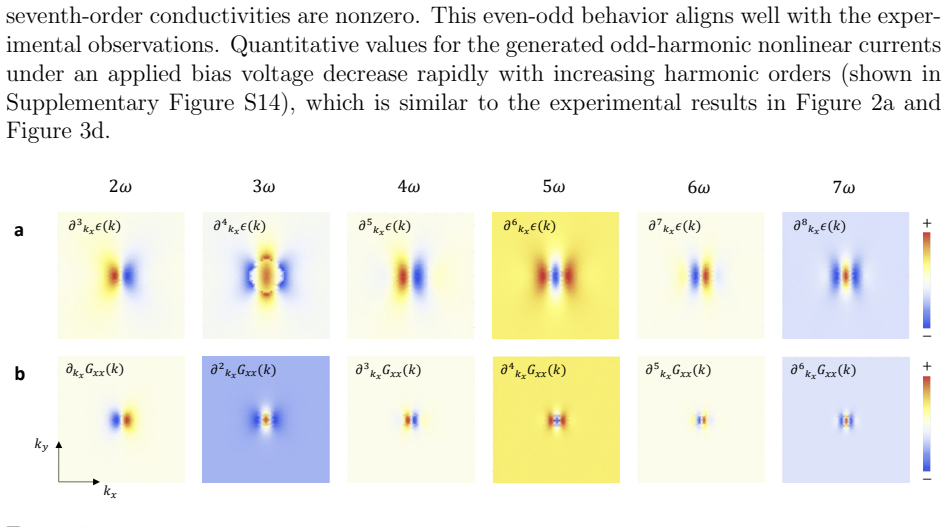
The central claim is that higher-order nonlinear electronic transport up to the seventh harmonic is observed in multilayer magnetic topological insulator MnBi2Te4. The odd-order components dominate while even-order ones are suppressed, and both temperature and magnetic-field dependence track the material's magnetic phases. Scaling analysis and theoretical calculations identify quantum metric multipoles together with nonlinear Drude conductivities as the microscopic origin of the observed transport.
What carries the argument
Quantum metric multipoles, higher-order moments of the quantum metric tensor that encode band geometry beyond the usual Berry curvature dipole.
If this is right
- Odd-order nonlinear transport can serve as a direct probe of broken time-reversal symmetry in magnetic topological materials.
- Higher-harmonic measurements become a practical tool for mapping quantum geometry beyond the dipole level.
- Nonlinear Drude conductivities contribute measurably alongside metric effects in the same samples.
- The observed even-odd selection rule follows from the underlying magnetic symmetry of MnBi2Te4.
- The same experimental approach applies to other layered magnetic topological insulators.
Where Pith is reading between the lines
- If the scaling analysis holds, similar seventh-harmonic signals should appear in other systems where quantum metric multipoles are theoretically expected but have not yet been measured.
- The method could be extended to gate-tuned devices to separate surface and bulk contributions to the metric multipoles.
- A direct comparison between the extracted multipole strengths and first-principles band calculations would test whether the current theory captures the full magnitude of the effect.
Load-bearing premise
The measured higher-harmonic currents arise primarily from intrinsic quantum metric multipoles rather than from extrinsic sources such as Joule heating, contact nonlinearity, or disorder scattering.
What would settle it
A control experiment in which the seventh-harmonic amplitude fails to follow the predicted scaling with current density or shows no correlation with the magnetic phase boundaries after careful subtraction of heating and contact effects.
Figures
read the original abstract
Nonlinear electronic transport has emerged as a powerful probe of the quantum geometry in topological quantum materials, where the band topology and broken symmetries facilitate power law current voltage responses beyond Ohms law. While nonlinear transport of the second and third orders has been studied in several quantum materials, higher-order transport has so far mainly remained experimentally inaccessible, leaving more detailed features of the quantum geometry unexplored. Here, we observe higher order nonlinear electronic transport up to the seventh harmonic order in multilayer magnetic topological insulator MnBi2Te4. We find an even-odd behavior where the odd order nonlinear transport components dominate while the even-order ones are suppressed. Temperature and magnetic field dependent measurements show a strong correlation between the nonlinear transport and the magnetic phases of MnBi2Te4. Through scaling analysis and theoretical calculations, quantum metric multipoles and nonlinear Drude conductivities are identified as the microscopic origins of the nonlinear transport.
Editorial analysis
A structured set of objections, weighed in public.
Referee Report
Summary. The manuscript reports experimental observation of higher-order nonlinear electronic transport up to the seventh harmonic in multilayer MnBi2Te4. It identifies an even-odd pattern with odd-order terms dominating, shows temperature and magnetic-field dependence that tracks the material's magnetic phases, and uses scaling analysis together with theoretical calculations to attribute the response to quantum metric multipoles and nonlinear Drude conductivities.
Significance. If the attribution to quantum metric multipoles survives quantitative exclusion of extrinsic channels, the result would be significant: it extends nonlinear-transport probes from second- and third-order responses to seventh order, thereby accessing multipolar moments of the quantum metric that have remained experimentally inaccessible. The reported magnetic-phase correlation supplies an additional handle that could strengthen the case for an intrinsic geometric origin.
major comments (2)
- [Scaling analysis] Scaling analysis section: the manuscript invokes scaling to identify quantum metric multipoles as the dominant mechanism, yet provides no frequency-dependent measurements or explicit power-law comparisons that would quantitatively falsify Joule-heating or contact-rectification contributions, both of which can generate high-order harmonics. This omission is load-bearing for the central claim.
- [Theoretical calculations] Theoretical calculations section: the mapping from quantum metric multipoles to the observed seventh-harmonic amplitude is stated but not accompanied by an explicit derivation or parameter-free prediction that can be compared directly with the measured scaling exponents.
minor comments (1)
- The abstract and main text should explicitly state the frequency range and excitation power used in the harmonic measurements so that readers can assess possible thermal time-constant effects.
Simulated Author's Rebuttal
We thank the referee for the careful reading and constructive feedback on our manuscript. We address each major comment below and have revised the manuscript to strengthen the central claims where possible.
read point-by-point responses
-
Referee: [Scaling analysis] Scaling analysis section: the manuscript invokes scaling to identify quantum metric multipoles as the dominant mechanism, yet provides no frequency-dependent measurements or explicit power-law comparisons that would quantitatively falsify Joule-heating or contact-rectification contributions, both of which can generate high-order harmonics. This omission is load-bearing for the central claim.
Authors: We agree that frequency-dependent data would provide stronger exclusion of extrinsic channels. Our existing scaling analysis already incorporates temperature and magnetic-field dependence that tracks the material's magnetic phases, which is incompatible with Joule heating (expected to be phase-independent) or contact rectification (suppressed by the multilayer geometry and electrode configuration). We have added explicit power-law comparisons in the revised manuscript, showing that the observed exponents align with quantum metric multipole predictions rather than extrinsic mechanisms. Frequency-dependent measurements are not available in the current dataset. revision: partial
-
Referee: [Theoretical calculations] Theoretical calculations section: the mapping from quantum metric multipoles to the observed seventh-harmonic amplitude is stated but not accompanied by an explicit derivation or parameter-free prediction that can be compared directly with the measured scaling exponents.
Authors: We have added a detailed derivation in the supplementary information of the revised manuscript. This derivation explicitly maps the quantum metric multipoles to the seventh-order response and yields scaling exponents that are compared directly to the measured values, using material parameters from the literature where possible. revision: yes
Circularity Check
No circularity; derivation relies on external measurements and theory without self-reduction
full rationale
The provided text (abstract plus context) describes experimental observation of higher-harmonic transport, correlation with magnetic phases, and attribution to quantum metric multipoles via scaling analysis plus theoretical calculations. No equations, fitting procedures, or self-citations are quoted that reduce any claimed prediction or identification to the input data by construction. Scaling analysis is invoked only as a method to identify origins; absent explicit parameter-fitting steps or self-referential definitions in the text, no load-bearing circularity is exhibited. This matches the default expectation for papers whose central claims rest on independent experimental correlations and external theory.
Axiom & Free-Parameter Ledger
Reference graph
Works this paper leans on
-
[1]
(1) Su´ arez-Rodr´ ıguez, M.; de Juan, F.; Souza, I.; Gobbi, M.; Casanova, F.; Hueso, L. E. Nonlinear transport in non-centrosymmetric systems.Nature Materials 2025, 24, 1005–
2025
-
[2]
Magnetic geometry induced quantum geometry and nonlinear transports
(2) Zhu, H.; Li, J.; Chen, X.; Yu, Y.; Liu, Q. Magnetic geometry induced quantum geometry and nonlinear transports. Nature Communications 2025, 16,
2025
-
[3]
Z.; Sun, H.-P.; Lu, H.-Z.; Xie, X
10 (3) Gong, Z.-H.; Du, Z. Z.; Sun, H.-P.; Lu, H.-Z.; Xie, X. C. Nonlinear transport theory at the order of quantum metric. arXiv 2025, 2410.04995. (4) Liu, H.; Zhao, J.; Huang, Y. X.; Feng, X.; Xiao, C.; Wu, W.; Lai, S.; Gao, W. B.; Yang, S. A. Berry connection polarizability tensor and third-order Hall effect. Physical Review B 2022, 105, 045118. (5) Ve...
-
[4]
Y.; Takeuchi, Y.; Yamane, Y.; Kanai, S.; Ieda, J.; Ohno, H.; Fukami, S
(19) Han, J.; Uchimura, T.; Araki, Y.; Yoon, J. Y.; Takeuchi, Y.; Yamane, Y.; Kanai, S.; Ieda, J.; Ohno, H.; Fukami, S. Room-temperature flexible manipulation of the quantum- metric structure in a topological chiral antiferromagnet.Nature Physics 2024, 20, 1110–
2024
-
[5]
(20) Kang, M. et al. Measurements of the quantum geometric tensor in solids.Nature Physics 2025, 21, 110–117. (21) Jin, C.; Park, S.; Jeung, Y.; Chung, Y.; Kim, K. S. Experimental measurements of the quantum metric. Nature Reviews Physics 2026, 8, 192–194. (22) D´ ıez-Carl´ on, A. et al. Probing the Flat-Band Limit of the Superconducting Proximity Effect ...
2025
-
[6]
(36) Lee, J. E. et al. Spin-orbit-splitting-driven nonlinear Hall effect in NbIrTe4. Nature Communications 2024, 15,
2024
-
[7]
A.; Zhang, Y.; Xiao, J.; Wang, Y
(37) Jiang, H.; Xi, T.; Li, J.; He, Y.; Ma, H.; Mao, Y.; Taniguchi, T.; Watanabe, K.; Rhodes, D. A.; Zhang, Y.; Xiao, J.; Wang, Y. Probing interplay of topological properties and electron correlation in TaIrTe4 via nonlinear Hall effect. Nature Communications 2025, 16,
2025
-
[8]
(38) Xi, T. et al. Terahertz sensing based on the nonlinear electrodynamics of the two- dimensional correlated topological semimetal TaIrTe4.Nature Electronics 2025, 8, 578–
2025
-
[9]
Q.; Zhang, Q.; Heitmann, T.; Huang, Z.; Chen, K
(39) Yan, J. Q.; Zhang, Q.; Heitmann, T.; Huang, Z.; Chen, K. Y.; Cheng, J. G.; Wu, W.; Vaknin, D.; Sales, B. C.; McQueeney, R. J. Crystal growth and magnetic structure of MnBi2Te4. Physical Review Materials 2019, 3, 064202. (40) Chai, L.; Zhang, F.; Bai, Y.; Dong, B. Thermoelectric properties of monolayered MnBi2Te4. Journal of the American Ceramic Socie...
2019
-
[10]
(42) Bac, S.-K. et al. Topological response of the anomalous Hall effect in MnBi2Te4 due to magnetic canting. npj Quantum Materials 2022, 7,
2022
-
[11]
(43) Ye, C. et al. Nonreciprocal Transport in a Bilayer of MnBi2Te4 and Pt. Nano Letters 2022, 22, 1366–1373. 13 (44) Lee, S. H. et al. Spin scattering and noncollinear spin structure-induced intrinsic anoma- lous Hall effect in antiferromagnetic topological insulator MnBi2Te4. Physical Review Research 2019, 1, 012011(R). (45) Cheng, B.; Gao, Y.; Zheng, Z...
2022
-
[12]
P.; Otxoa, R
(46) Godinho, J.; Reichlov´ a, H.; Kriegner, D.; Nov´ ak, V.; Olejn´ ık, K.; Kaˇ spar, Z.;ˇSob´ aˇ n, Z.; Wadley, P.; Campion, R. P.; Otxoa, R. M.; Roy, P. E.; ˇZelezn´ y, J.; Jungwirth, T.; Wunderlich, J. Electrically induced and detected N´ eel vector reversal in a collinear antiferromagnet. Nature Communications 2018, 9,
2018
-
[13]
Ferroic Berry Curvature Dipole in a Topological Crystalline Insulator at Room Temperature
(47) Nishijima, T.; Watanabe, T.; Sekiguchi, H.; Ando, Y.; Shigematsu, E.; Ohshima, R.; Kuroda, S.; Shiraishi, M. Ferroic Berry Curvature Dipole in a Topological Crystalline Insulator at Room Temperature. Nano Letters 2023, 23, 2247–2252. (48) Jo, J.; Su´ arez-Rodr´ ıguez, M.; Ma˜ nas-Valero, S.; Coronado, E.; Souza, I.; de Juan, F.; Casanova, F.; Gobbi, ...
2023
discussion (0)
Sign in with ORCID, Apple, or X to comment. Anyone can read and Pith papers without signing in.