Thermodynamics in symmetry-improved Cornwall-Jackiw-Tomboulis formalism: application to the low-energy effective theory of QCD
Pith reviewed 2026-06-29 06:34 UTC · model grok-4.3
The pith
Different pressure prescriptions in symmetry-improved 2PI formalism produce stable global thermodynamics for low-energy QCD effective theory.
A machine-rendered reading of the paper's core claim, the machinery that carries it, and where it could break.
Core claim
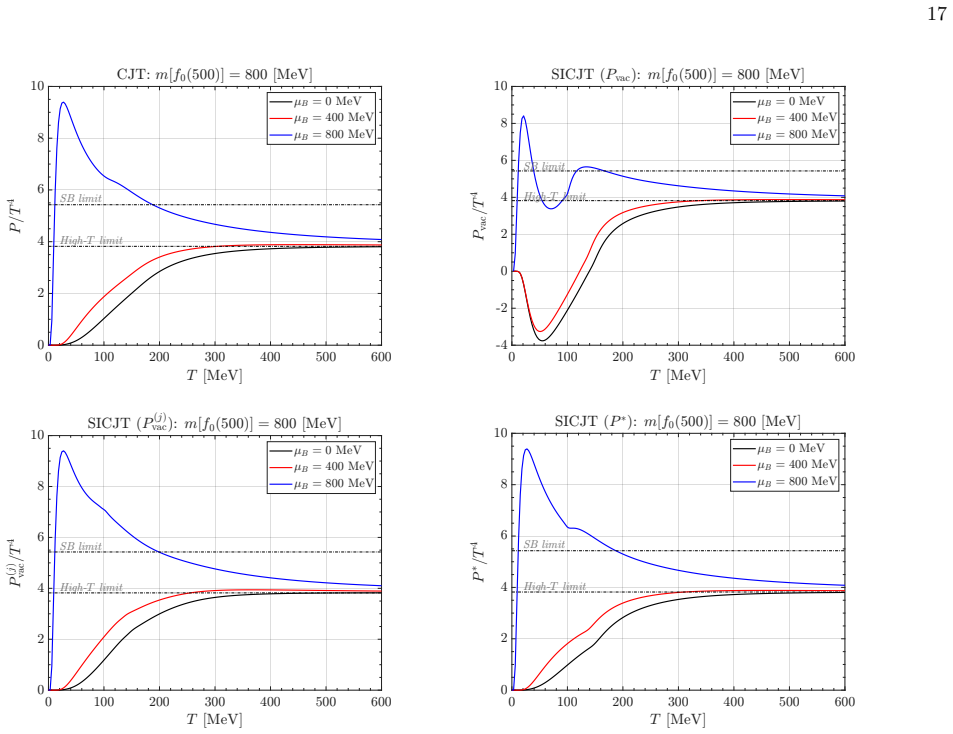
In the symmetry-improved Cornwall-Jackiw-Tomboulis formalism, auxiliary sources that restore Ward-Takahashi identities are fixed self-consistently by the equilibrium state; several pressure definitions (vacuum-subtracted, source-matched, and pulled-back) then yield a globally stable thermodynamic structure, while quantitative differences remain localized near the chiral crossover and first-order transition when applied to the three-flavor linear sigma model with quarks.
What carries the argument
Symmetry-improved 2PI effective action with auxiliary sources fixed self-consistently by the equilibrium state, together with alternative pressure prescriptions that remove or match the explicit source-induced energy shift.
If this is right
- The equation of state and trace anomaly remain largely insensitive to the choice of pressure prescription away from the transition region.
- Isentropic trajectories and adiabatic sound velocity exhibit global stability across the different prescriptions.
- Quantitative differences between prescriptions concentrate near the crossover and first-order transition region.
- The construction supplies a practical framework for building thermodynamically consistent observables in symmetry-improved 2PI approaches.
Where Pith is reading between the lines
- The same pressure-prescription strategy could be tested in other low-energy models that include finite baryon density.
- Direct comparison of the prescription-dependent quantities near the transition with lattice QCD data would provide a concrete test of the localized differences.
- The approach may reduce ambiguities when thermodynamic observables are extracted from other truncated 2PI calculations that employ auxiliary sources.
Load-bearing premise
The auxiliary sources can be fixed self-consistently by the equilibrium state in a manner that permits thermodynamically consistent pressure definitions without introducing uncontrolled artifacts in the equation of state or derived quantities.
What would settle it
A computation that finds large discrepancies between the different pressure prescriptions in the pressure, trace anomaly, or sound velocity at temperatures well above or below the transition region would falsify the claim of global stability.
Figures

read the original abstract
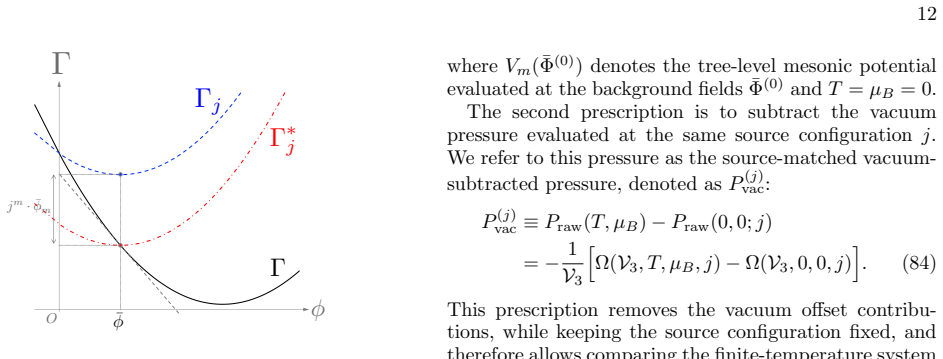
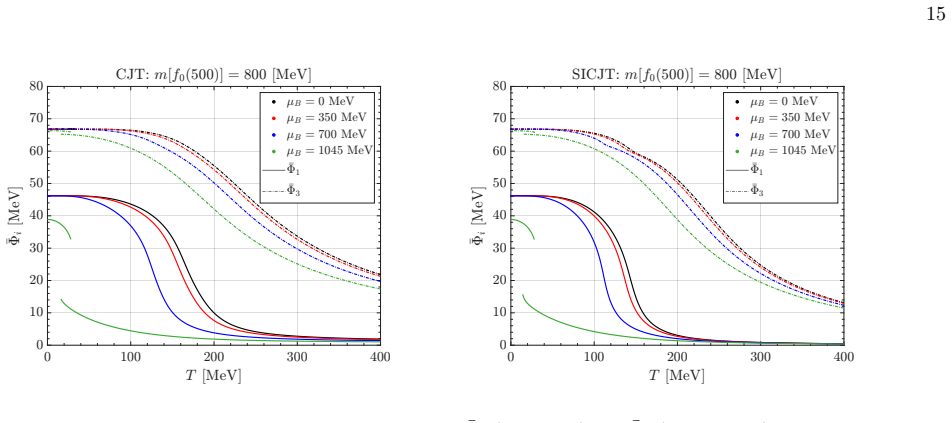
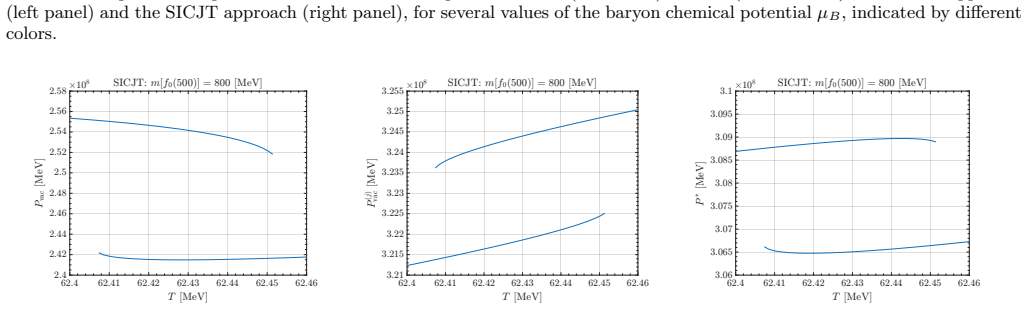
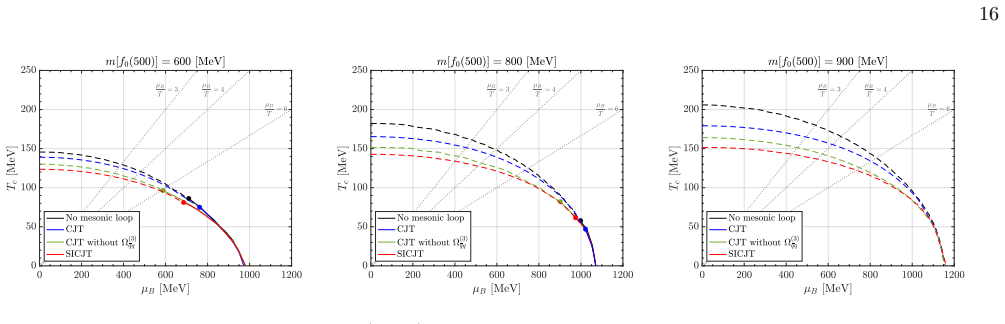
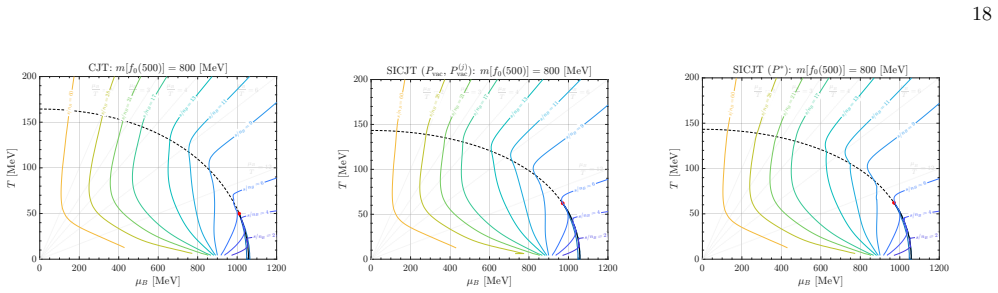
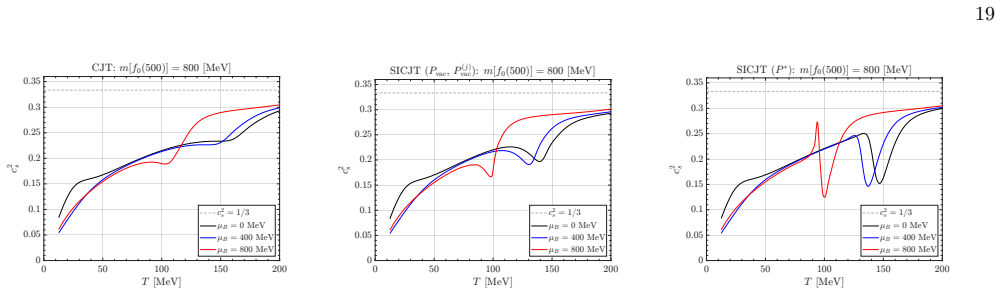
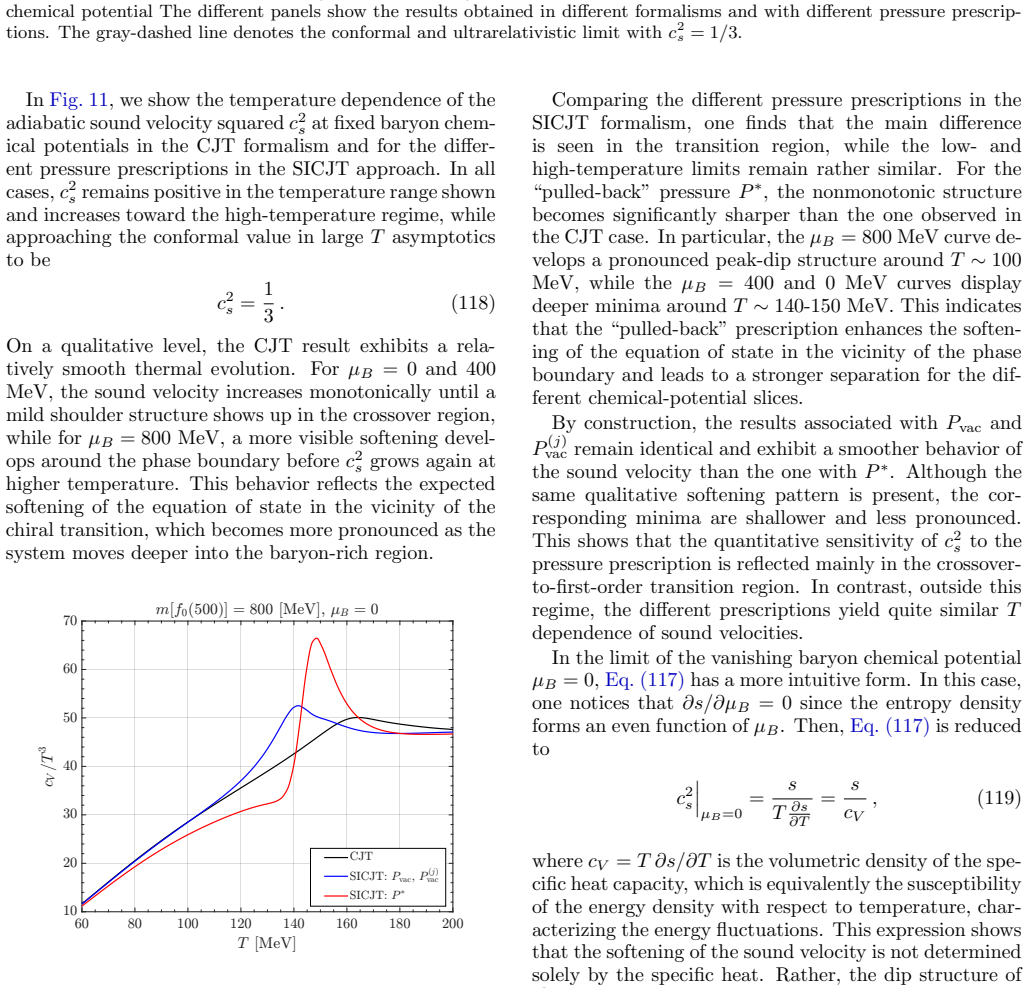
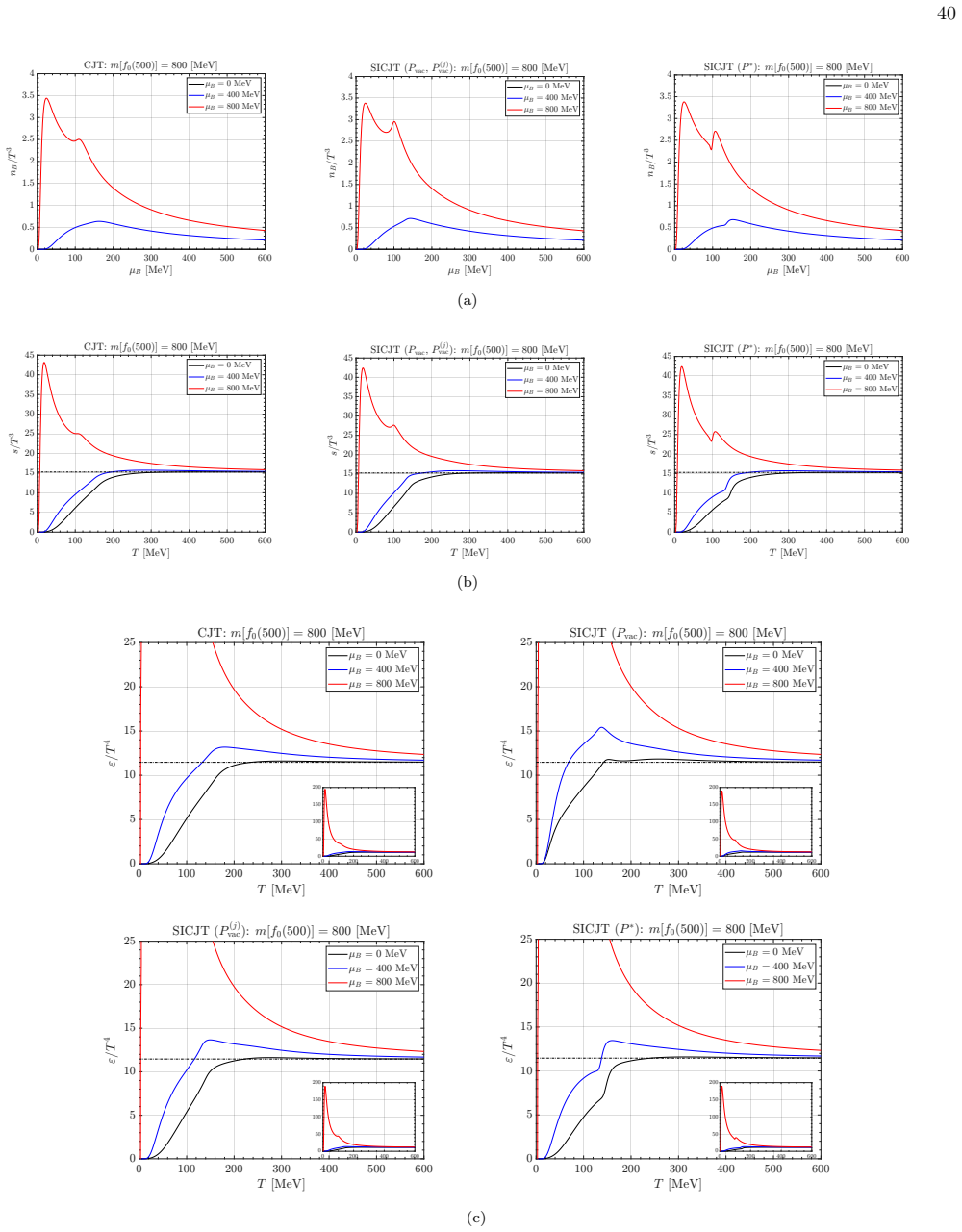
We study the thermodynamics of the symmetry-improved Cornwall-Jackiw-Tomboulis (SICJT) formalism and apply it to a low-energy effective theory of QCD. In the symmetry-improved formulation, Ward-Takahashi identities are restored by auxiliary sources whose values are fixed self-consistently by the equilibrium state. While this construction improves the symmetry properties of the loop-wise truncated two-particle-irreducible (2PI) theory, it also makes the thermodynamic interpretation of the pressure nontrivial. We formulate several pressure prescriptions, including the conventional vacuum-subtracted pressure, a source-matched subtraction, and a pulled-back pressure in which the explicit source-induced energy shift is removed. Using the three-flavor linear sigma model with quarks, we analyze the equation of state, isentropic trajectories, adiabatic sound velocity, and trace anomaly across the chiral transition. We find that the global thermodynamic structure is stable under the different prescriptions, while quantitative differences are concentrated near the crossover and first-order transition region. These results establish a practical framework for constructing thermodynamically consistent observables in symmetry-improved 2PI approaches.
Editorial analysis
A structured set of objections, weighed in public.
Referee Report
Summary. The manuscript develops thermodynamic observables within the symmetry-improved Cornwall-Jackiw-Tomboulis (SICJT) formalism, where auxiliary sources are fixed self-consistently to restore Ward-Takahashi identities in a loop-truncated 2PI theory. Applied to the three-flavor linear sigma model with quarks, it defines three pressure prescriptions (conventional vacuum subtraction, source-matched subtraction, and pulled-back pressure removing explicit source-induced shifts) and numerically compares the resulting equation of state, isentropic trajectories, adiabatic sound velocity, and trace anomaly across the chiral crossover and first-order transition region. The central result is that the global thermodynamic structure remains stable under these prescriptions, with quantitative differences localized near the transition.
Significance. If the reported stability holds, the work supplies a concrete, practical route to thermodynamically consistent observables in symmetry-improved 2PI effective theories of QCD. The explicit self-consistent implementation of auxiliary-source fixing and the direct numerical comparison of three distinct pressure definitions constitute a clear methodological advance; the finding that global features (EOS, isentropes, sound speed, trace anomaly) are insensitive to the choice of prescription while local differences remain confined to the transition region strengthens in applying such frameworks to finite-temperature QCD studies.
minor comments (2)
- [§3] §3 (pressure prescriptions): the explicit expressions for the three pressure definitions are given, but the relation between the pulled-back pressure and the conventional vacuum subtraction could be stated more compactly, perhaps as a single equation showing the subtracted source term.
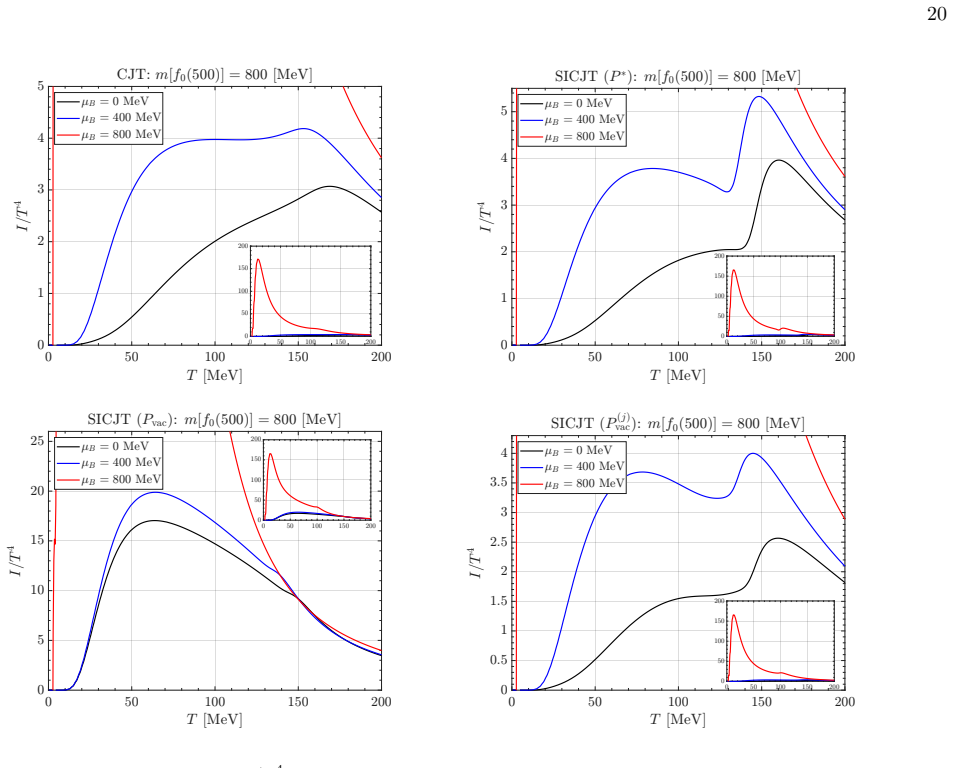
- [Figure 4] Figure 4 (trace anomaly): the legend and axis labels are clear, yet the inset zooming on the first-order transition region would benefit from an explicit statement of the temperature range displayed.
Simulated Author's Rebuttal
We thank the referee for the positive assessment of our manuscript, the clear summary of its contributions, and the recommendation for minor revision. No specific major comments are provided in the report, so we have no point-by-point responses to address. We will incorporate minor revisions as appropriate in the next version.
Circularity Check
No significant circularity; thermodynamic stability is a numerical result
full rationale
The paper defines auxiliary sources via self-consistent solution of the equilibrium equations in the symmetry-improved 2PI framework, then explicitly constructs and numerically compares three distinct pressure prescriptions (vacuum-subtracted, source-matched, pulled-back) inside the three-flavor linear sigma model. The central claim—that global thermodynamic quantities remain stable while differences localize near the transition—is obtained by direct evaluation of the equation of state, isentropes, sound velocity and trace anomaly across those prescriptions. No step equates a fitted parameter to a prediction by construction, no uniqueness theorem is imported from prior self-citation, and no ansatz is smuggled; the reported stability is an independent numerical outcome of the model dynamics and the chosen subtraction schemes.
Axiom & Free-Parameter Ledger
Reference graph
Works this paper leans on
-
[1]
write newline
" write newline "" before.all 'output.state := FUNCTION blank.sep after.quote 'output.state := FUNCTION fin.entry output.state after.quoted.block = 'skip 'add.period if write newline FUNCTION new.block output.state before.all = 'skip output.state after.quote = after.quoted.block 'output.state := after.block 'output.state := if if FUNCTION new.sentence out...
-
[2]
D. Boyanovsky, H. J. de Vega and D. J. Schwarz, Phase transitions in the early and the present universe , https://doi.org/10.1146/annurev.nucl.56.080805.140539 Ann. Rev. Nucl. Part. Sci. 56 (2006) 441 [ https://arxiv.org/abs/hep-ph/0602002 hep-ph/0602002 ]
-
[3]
A. Addazi, T. Lundberg, A. Marcian \`o , R. Pasechnik and M. S umbera, Cosmology from Strong Interactions , https://doi.org/10.3390/universe8090451 Universe 8 (2022) 451 [ https://arxiv.org/abs/2204.02950 2204.02950 ]
-
[4]
E. S. Fraga, A. Kurkela and A. Vuorinen, Neutron star structure from QCD , https://doi.org/10.1140/epja/i2016-16049-6 Eur. Phys. J. A 52 (2016) 49 [ https://arxiv.org/abs/1508.05019 1508.05019 ]
work page internal anchor Pith review Pith/arXiv arXiv doi:10.1140/epja/i2016-16049-6 2016
-
[5]
K. Fukushima, QCD phase diagram and astrophysical implications , https://doi.org/10.1016/j.jspc.2025.100066 J. Subatomic Part. Cosmol. 3 (2025) 100066 [ https://arxiv.org/abs/2501.01907 2501.01907 ]
-
[6]
P. Foka and M. A. Janik, An overview of experimental results from ultra-relativistic heavy-ion collisions at the CERN LHC: Bulk properties and dynamical evolution , https://doi.org/10.1016/j.revip.2016.11.002 Rev. Phys. 1 (2016) 154 [ https://arxiv.org/abs/1702.07233 1702.07233 ]
work page internal anchor Pith review Pith/arXiv arXiv doi:10.1016/j.revip.2016.11.002 2016
-
[7]
K. Fukushima, B. Mohanty and N. Xu, Little-Bang and Femto-Nova in Nucleus-Nucleus Collisions , https://doi.org/10.1007/s43673-021-00002-7 AAPPS Bull. 31 (2021) 1 [ https://arxiv.org/abs/2009.03006 2009.03006 ]
-
[8]
M. A. Stephanov, K. Rajagopal and E. V. Shuryak, Signatures of the tricritical point in QCD , https://doi.org/10.1103/PhysRevLett.81.4816 Phys. Rev. Lett. 81 (1998) 4816 [ https://arxiv.org/abs/hep-ph/9806219 hep-ph/9806219 ]
work page internal anchor Pith review Pith/arXiv arXiv doi:10.1103/physrevlett.81.4816 1998
-
[9]
M. A. Stephanov, Non-Gaussian fluctuations near the QCD critical point , https://doi.org/10.1103/PhysRevLett.102.032301 Phys. Rev. Lett. 102 (2009) 032301 [ https://arxiv.org/abs/0809.3450 0809.3450 ]
work page internal anchor Pith review Pith/arXiv arXiv doi:10.1103/physrevlett.102.032301 2009
-
[10]
M. Stephanov, QCD critical point: Recent developments , https://doi.org/10.1051/epjconf/202431400042 EPJ Web Conf. 314 (2024) 00042 [ https://arxiv.org/abs/2410.02861 2410.02861 ]
-
[11]
S. Borsanyi, G. Endrodi, Z. Fodor, S. D. Katz, S. Krieg, C. Ratti et al., QCD equation of state at nonzero chemical potential: continuum results with physical quark masses at order mu^2 , https://doi.org/10.1007/JHEP08(2012)053 JHEP 08 (2012) 053 [ https://arxiv.org/abs/1204.6710 1204.6710 ]
work page internal anchor Pith review Pith/arXiv arXiv doi:10.1007/jhep08(2012)053 2012
-
[12]
Full result for the QCD equation of state with 2+1 flavors
S. Borsanyi, Z. Fodor, C. Hoelbling, S. D. Katz, S. Krieg and K. K. Szabo, Full result for the QCD equation of state with 2+1 flavors , https://doi.org/10.1016/j.physletb.2014.01.007 Phys. Lett. B 730 (2014) 99 [ https://arxiv.org/abs/1309.5258 1309.5258 ]
work page internal anchor Pith review Pith/arXiv arXiv doi:10.1016/j.physletb.2014.01.007 2014
-
[13]
The equation of state in (2+1)-flavor QCD
HotQCD collaboration, A. Bazavov et al., Equation of state in ( 2+1 )-flavor QCD , https://doi.org/10.1103/PhysRevD.90.094503 Phys. Rev. D 90 (2014) 094503 [ https://arxiv.org/abs/1407.6387 1407.6387 ]
work page internal anchor Pith review Pith/arXiv arXiv doi:10.1103/physrevd.90.094503 2014
-
[14]
HotQCD collaboration, A. Bazavov et al., Chiral crossover in QCD at zero and non-zero chemical potentials , https://doi.org/10.1016/j.physletb.2019.05.013 Phys. Lett. B 795 (2019) 15 [ https://arxiv.org/abs/1812.08235 1812.08235 ]
-
[15]
K. Nagata, Finite-density lattice QCD and sign problem: Current status and open problems , https://doi.org/10.1016/j.ppnp.2022.103991 Prog. Part. Nucl. Phys. 127 (2022) 103991 [ https://arxiv.org/abs/2108.12423 2108.12423 ]
-
[16]
The phase diagram of dense QCD
K. Fukushima and T. Hatsuda, The phase diagram of dense QCD , https://doi.org/10.1088/0034-4885/74/1/014001 Rept. Prog. Phys. 74 (2011) 014001 [ https://arxiv.org/abs/1005.4814 1005.4814 ]
work page internal anchor Pith review Pith/arXiv arXiv doi:10.1088/0034-4885/74/1/014001 2011
-
[17]
Renormalization group consistency and low-energy effective theories
J. Braun, M. Leonhardt and J. M. Pawlowski, Renormalization group consistency and low-energy effective theories , https://doi.org/10.21468/SciPostPhys.6.5.056 SciPost Phys. 6 (2019) 056 [ https://arxiv.org/abs/1806.04432 1806.04432 ]
work page internal anchor Pith review Pith/arXiv arXiv doi:10.21468/scipostphys.6.5.056 2019
-
[18]
Functional renormalization group study of the Quark-Meson model with $\omega$ meson
H. Zhang, D. Hou, T. Kojo and B. Qin, Functional renormalization group study of the quark-meson model with meson , https://doi.org/10.1103/PhysRevD.96.114029 Phys. Rev. D 96 (2017) 114029 [ https://arxiv.org/abs/1709.05654 1709.05654 ]
work page internal anchor Pith review Pith/arXiv arXiv doi:10.1103/physrevd.96.114029 2017
-
[19]
M. Osman, D. Hou, W. Wang and H. Zhang, Functional renormalization group study of the quark-meson model with and vector mesons , https://doi.org/10.1140/epjc/s10052-025-14493-3 Eur. Phys. J. C 85 (2025) 804 [ https://arxiv.org/abs/2402.15474 2402.15474 ]
-
[20]
Thermodynamic phases and mesonic fluctuations in a chiral nucleon-meson model
M. Drews, T. Hell, B. Klein and W. Weise, Thermodynamic phases and mesonic fluctuations in a chiral nucleon-meson model , https://doi.org/10.1103/PhysRevD.88.096011 Phys. Rev. D 88 (2013) 096011 [ https://arxiv.org/abs/1308.5596 1308.5596 ]
work page internal anchor Pith review Pith/arXiv arXiv doi:10.1103/physrevd.88.096011 2013
-
[21]
W.-j. Fu, J. M. Pawlowski and F. Rennecke, Strangeness Neutrality and QCD Thermodynamics , https://doi.org/10.21468/SciPostPhysCore.2.1.002 SciPost Phys. Core 2 (2020) 002 [ https://arxiv.org/abs/1808.00410 1808.00410 ]
-
[22]
H. Hansen, R. Stiele and P. Costa, Quark and Polyakov-loop correlations in effective models at zero and nonvanishing density , https://doi.org/10.1103/PhysRevD.101.094001 Phys. Rev. D 101 (2020) 094001 [ https://arxiv.org/abs/1904.08965 1904.08965 ]
-
[23]
J. O. Andersen and M. Strickland, Resummation in hot field theories , https://doi.org/10.1016/j.aop.2004.09.017 Annals Phys. 317 (2005) 281 [ https://arxiv.org/abs/hep-ph/0404164 hep-ph/0404164 ]
work page internal anchor Pith review Pith/arXiv arXiv doi:10.1016/j.aop.2004.09.017 2004
-
[24]
Thermal Resummation and Phase Transitions
D. Curtin, P. Meade and H. Ramani, Thermal Resummation and Phase Transitions , https://doi.org/10.1140/epjc/s10052-018-6268-0 Eur. Phys. J. C 78 (2018) 787 [ https://arxiv.org/abs/1612.00466 1612.00466 ]
work page internal anchor Pith review Pith/arXiv arXiv doi:10.1140/epjc/s10052-018-6268-0 2018
-
[25]
L. Niemi, P. Schicho and T. V. I. Tenkanen, Singlet-assisted electroweak phase transition at two loops , https://doi.org/10.1103/PhysRevD.103.115035 Phys. Rev. D 103 (2021) 115035 [ https://arxiv.org/abs/2103.07467 2103.07467 ]
-
[26]
J. M. Cornwall, R. Jackiw and E. Tomboulis, Effective Action for Composite Operators , https://doi.org/10.1103/PhysRevD.10.2428 Phys. Rev. D 10 (1974) 2428
-
[27]
G. Baym, Selfconsistent approximation in many body systems , https://doi.org/10.1103/PhysRev.127.1391 Phys. Rev. 127 (1962) 1391
-
[28]
Linear sigma model and chiral symmetry at finite temperature
N. Petropoulos, Linear sigma model and chiral symmetry at finite temperature , https://doi.org/10.1088/0954-3899/25/11/305 J. Phys. G 25 (1999) 2225 [ https://arxiv.org/abs/hep-ph/9807331 hep-ph/9807331 ]
work page internal anchor Pith review Pith/arXiv arXiv doi:10.1088/0954-3899/25/11/305 1999
-
[29]
J. T. Lenaghan and D. H. Rischke, The O(N) model at finite temperature: Renormalization of the gap equations in Hartree and large N approximation , https://doi.org/10.1088/0954-3899/26/4/309 J. Phys. G 26 (2000) 431 [ https://arxiv.org/abs/nucl-th/9901049 nucl-th/9901049 ]
work page internal anchor Pith review Pith/arXiv arXiv doi:10.1088/0954-3899/26/4/309 2000
-
[30]
J. T. Lenaghan, D. H. Rischke and J. Schaffner-Bielich, Chiral symmetry restoration at nonzero temperature in the SU(3)(r) x SU(3)(l) linear sigma model , https://doi.org/10.1103/PhysRevD.62.085008 Phys. Rev. D 62 (2000) 085008 [ https://arxiv.org/abs/nucl-th/0004006 nucl-th/0004006 ]
work page internal anchor Pith review Pith/arXiv arXiv doi:10.1103/physrevd.62.085008 2000
-
[31]
Chiral symmetry restoration in linear sigma models with different numbers of quark flavors
D. Roder, J. Ruppert and D. H. Rischke, Chiral symmetry restoration in linear sigma models with different numbers of quark flavors , https://doi.org/10.1103/PhysRevD.68.016003 Phys. Rev. D 68 (2003) 016003 [ https://arxiv.org/abs/nucl-th/0301085 nucl-th/0301085 ]
work page internal anchor Pith review Pith/arXiv arXiv doi:10.1103/physrevd.68.016003 2003
-
[32]
Symmetry Improved CJT Effective Action
A. Pilaftsis and D. Teresi, Symmetry Improved CJT Effective Action , https://doi.org/10.1016/j.nuclphysb.2013.06.004 Nucl. Phys. B 874 (2013) 594 [ https://arxiv.org/abs/1305.3221 1305.3221 ]
work page internal anchor Pith review Pith/arXiv arXiv doi:10.1016/j.nuclphysb.2013.06.004 2013
-
[33]
On the symmetry improved CJT formalism in the $O(4)$ linear sigma model
H. Mao, On the symmetry improved CJT formalism in the O(4) linear sigma model , https://doi.org/10.1016/j.nuclphysa.2014.02.011 Nucl. Phys. A 925 (2014) 185 [ https://arxiv.org/abs/1305.4329 1305.4329 ]
work page internal anchor Pith review Pith/arXiv arXiv doi:10.1016/j.nuclphysa.2014.02.011 2014
-
[34]
Symmetry-Improved 2PI Approach to the Goldstone-Boson IR Problem of the SM Effective Potential
A. Pilaftsis and D. Teresi, Symmetry-Improved 2PI Approach to the Goldstone-Boson IR Problem of the SM Effective Potential , https://doi.org/10.1016/j.nuclphysb.2016.03.018 Nucl. Phys. B 906 (2016) 381 [ https://arxiv.org/abs/1511.05347 1511.05347 ]
work page internal anchor Pith review Pith/arXiv arXiv doi:10.1016/j.nuclphysb.2016.03.018 2016
-
[35]
Constraining the effective action by a method of external sources
B. Garbrecht and P. Millington, Constraining the effective action by a method of external sources , https://doi.org/10.1016/j.nuclphysb.2016.02.022 Nucl. Phys. B 906 (2016) 105 [ https://arxiv.org/abs/1509.07847 1509.07847 ]
work page internal anchor Pith review Pith/arXiv arXiv doi:10.1016/j.nuclphysb.2016.02.022 2016
-
[36]
M. Kobayashi and T. Maskawa, Chiral symmetry and eta-x mixing , https://doi.org/10.1143/PTP.44.1422 Prog. Theor. Phys. 44 (1970) 1422
-
[37]
M. Kobayashi, H. Kondo and T. Maskawa, Symmetry breaking of the chiral u(3) x u(3) and the quark model , https://doi.org/10.1143/PTP.45.1955 Prog. Theor. Phys. 45 (1971) 1955
-
[38]
G. 't Hooft, Symmetry Breaking Through Bell-Jackiw Anomalies , https://doi.org/10.1103/PhysRevLett.37.8 Phys. Rev. Lett. 37 (1976) 8
-
[39]
G. 't Hooft, Computation of the Quantum Effects Due to a Four-Dimensional Pseudoparticle , https://doi.org/10.1103/PhysRevD.14.3432 Phys. Rev. D 14 (1976) 3432
-
[40]
A. A. Osipov and B. Hiller, Path integral bosonization of the 't Hooft determinant: fluctuations and multiple vacua , https://doi.org/10.1016/S0370-2693(02)02041-5 Phys. Lett. B 539 (2002) 76 [ https://arxiv.org/abs/hep-ph/0204182 hep-ph/0204182 ]
work page internal anchor Pith review Pith/arXiv arXiv doi:10.1016/s0370-2693(02)02041-5 2002
-
[41]
A. A. Osipov and B. Hiller, Path integral bosonization of the 't Hooft determinant: Quasiclassical corrections , https://doi.org/10.1140/epjc/s2004-01779-3 Eur. Phys. J. C 35 (2004) 223 [ https://arxiv.org/abs/hep-th/0307035 hep-th/0307035 ]
work page internal anchor Pith review Pith/arXiv arXiv doi:10.1140/epjc/s2004-01779-3 2004
-
[42]
A. A. Osipov, B. Hiller, J. Moreira and A. H. Blin, Stationary phase corrections in the process of bosonization of multi-quark interactions , https://doi.org/10.1140/epjc/s2006-02488-7 Eur. Phys. J. C 46 (2006) 225 [ https://arxiv.org/abs/hep-ph/0601074 hep-ph/0601074 ]
work page internal anchor Pith review Pith/arXiv arXiv doi:10.1140/epjc/s2006-02488-7 2006
-
[43]
J.-P. Blaizot, J. M. Pawlowski and U. Reinosa, Functional renormalization group and 2PI effective action formalism , https://doi.org/10.1016/j.aop.2021.168549 Annals Phys. 431 (2021) 168549 [ https://arxiv.org/abs/2102.13628 2102.13628 ]
-
[44]
J. I. Kapusta and C. Gale, Finite-temperature field theory: Principles and applications , Cambridge Monographs on Mathematical Physics. Cambridge University Press, 2011, 10.1017/CBO9780511535130 https://doi.org/10.1017/CBO9780511535130
-
[45]
The three-flavor chiral phase structure in hot and dense QCD matter
B.-J. Schaefer and M. Wagner, The Three-flavor chiral phase structure in hot and dense QCD matter , https://doi.org/10.1103/PhysRevD.79.014018 Phys. Rev. D 79 (2009) 014018 [ https://arxiv.org/abs/0808.1491 0808.1491 ]
work page internal anchor Pith review Pith/arXiv arXiv doi:10.1103/physrevd.79.014018 2009
-
[46]
Exact evolution equation for the effective potential
C. Wetterich, Exact evolution equation for the effective potential , https://doi.org/10.1016/0370-2693(93)90726-X Phys. Lett. B 301 (1993) 90 [ https://arxiv.org/abs/1710.05815 1710.05815 ]
work page internal anchor Pith review Pith/arXiv arXiv doi:10.1016/0370-2693(93)90726-x 1993
- [47]
-
[48]
Chiral Phase Transition within Effective Models with Constituent Quarks
O. Scavenius, A. Mocsy, I. N. Mishustin and D. H. Rischke, Chiral phase transition within effective models with constituent quarks , https://doi.org/10.1103/PhysRevC.64.045202 Phys. Rev. C 64 (2001) 045202 [ https://arxiv.org/abs/nucl-th/0007030 nucl-th/0007030 ]
work page internal anchor Pith review Pith/arXiv arXiv doi:10.1103/physrevc.64.045202 2001
-
[49]
M. Kawaguchi, S. Matsuzaki and A. Tomiya, Analysis of nonperturbative flavor violation at chiral crossover criticality in QCD , https://doi.org/10.1103/PhysRevD.103.054034 Phys. Rev. D 103 (2021) 054034 [ https://arxiv.org/abs/2005.07003 2005.07003 ]
-
[50]
T. D. . Cohen, Functional integrals for QCD at nonzero chemical potential and zero density , https://doi.org/10.1103/PhysRevLett.91.222001 Phys. Rev. Lett. 91 (2003) 222001 [ https://arxiv.org/abs/hep-ph/0307089 hep-ph/0307089 ]
work page internal anchor Pith review Pith/arXiv arXiv doi:10.1103/physrevlett.91.222001 2003
-
[51]
W.-j. Fu, J. M. Pawlowski, F. Rennecke and B.-J. Schaefer, Baryon number fluctuations at finite temperature and density , https://doi.org/10.1103/PhysRevD.94.116020 Phys. Rev. D 94 (2016) 116020 [ https://arxiv.org/abs/1608.04302 1608.04302 ]
work page internal anchor Pith review Pith/arXiv arXiv doi:10.1103/physrevd.94.116020 2016
-
[52]
W.-j. Fu, J. M. Pawlowski and F. Rennecke, QCD phase structure at finite temperature and density , https://doi.org/10.1103/PhysRevD.101.054032 Phys. Rev. D 101 (2020) 054032 [ https://arxiv.org/abs/1909.02991 1909.02991 ]
-
[53]
H. Mao, J. Jin and M. Huang, Phase diagram and thermodynamics of the Polyakov linear sigma model with three quark flavors , https://doi.org/10.1088/0954-3899/37/3/035001 J. Phys. G 37 (2010) 035001 [ https://arxiv.org/abs/0906.1324 0906.1324 ]
work page internal anchor Pith review Pith/arXiv arXiv doi:10.1088/0954-3899/37/3/035001 2010
-
[54]
D. Blaschke and D. Ebert, Variational path-integral approach to back-reactions of composite mesons in the Nambu Jona-Lasinio model , https://doi.org/10.1016/j.nuclphysb.2017.06.013 Nucl. Phys. B 921 (2017) 753 [ https://arxiv.org/abs/1703.08964 1703.08964 ]
work page internal anchor Pith review Pith/arXiv arXiv doi:10.1016/j.nuclphysb.2017.06.013 2017
-
[55]
F. Rennecke and R. D. Pisarski, Moat Regimes in QCD and their Signatures in Heavy-Ion Collisions , https://doi.org/10.22323/1.400.0016 PoS CPOD2021 (2022) 016 [ https://arxiv.org/abs/2110.02625 2110.02625 ]
-
[56]
W.-j. Fu, J. M. Pawlowski, R. D. Pisarski, F. Rennecke, R. Wen and S. Yin, QCD moat regime and its real-time properties , https://doi.org/10.1103/PhysRevD.111.094026 Phys. Rev. D 111 (2025) 094026 [ https://arxiv.org/abs/2412.15949 2412.15949 ]
discussion (0)
Sign in with ORCID, Apple, or X to comment. Anyone can read and Pith papers without signing in.