Low-Magnification SEM May Suffice: Interpretable Deep Learning for Multi-Scale Fracture-Cause Classification in Zirconia-Toughened Alumina
Pith reviewed 2026-06-29 08:08 UTC · model grok-4.3
The pith
An interpretable vision transformer classifies fracture causes in zirconia-toughened alumina from low-magnification SEM images at accuracy comparable to high magnification.
A machine-rendered reading of the paper's core claim, the machinery that carries it, and where it could break.
Core claim
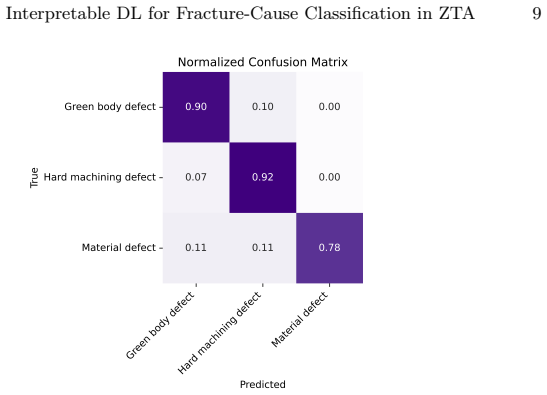
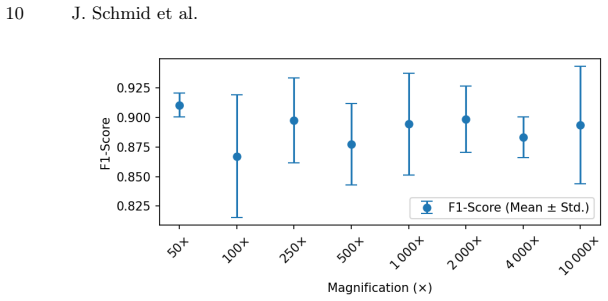
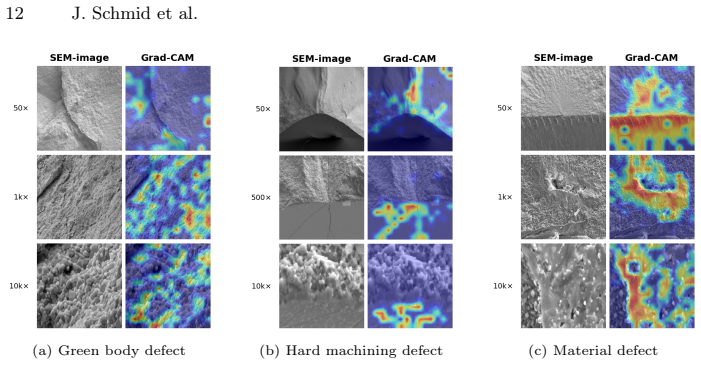
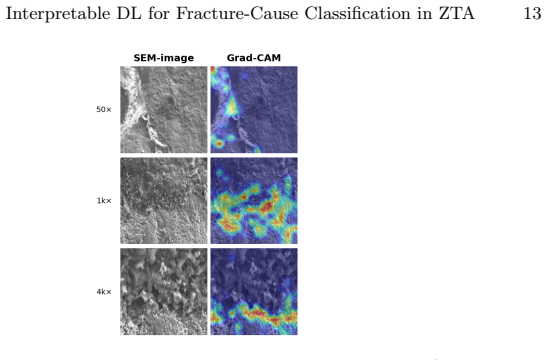
The authors claim that macro-scale features already encode sufficient diagnostic signal for fracture-cause classification, as a fine-tuned vision transformer achieves 0.907 accuracy and 0.888 macro-F1 under severe imbalance in stratified five-fold cross-validation on 8,493 images. Performance at 50x magnification is comparable to that at 1k-10kx magnification. Grad-CAM attributions consistently localise on canonical cues including mirrors, hackles, pores, and machining marks, aligning with established fractographic criteria.
What carries the argument
The fine-tuned vision transformer with Grad-CAM attributions applied to multi-scale SEM images for three-category fracture-cause classification.
If this is right
- Low-magnification SEM imaging can serve as a viable pre-screening step in fractographic workflows for ceramic implants.
- The interpretable model outputs align with established expert criteria for identifying defect origins along the manufacturing chain.
- Automated classification reduces time and subjectivity compared with purely manual high-magnification inspection.
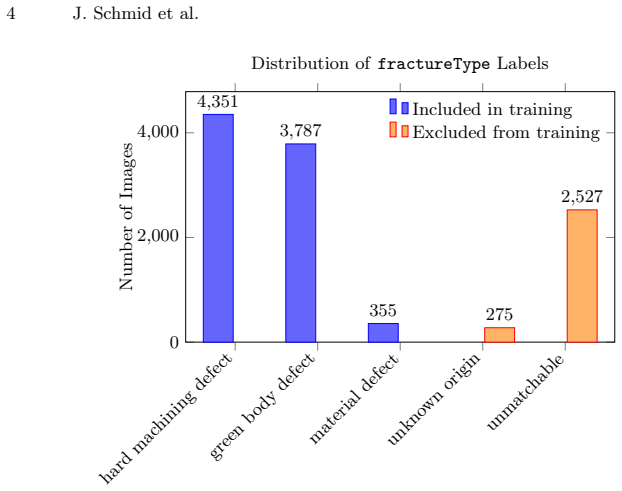
- The approach maintains performance despite severe class imbalance in a five-year production dataset.
- A two-stage leakage audit confirms that reported metrics reflect genuine generalisation rather than specimen overlap.
Where Pith is reading between the lines
- The same macro-feature approach could be tested on fracture images from other brittle materials to check whether low-magnification signals remain diagnostic.
- Integration into production lines might allow routine low-mag scans to flag samples for targeted high-mag review.
- If the model generalises, it could help standardise classification when different experts or labs examine the same implants.
- A follow-up experiment could compare the current results against optical microscopy at similar low magnifications.
Load-bearing premise
The three defect categories are consistently and accurately annotated by experts across the dataset, and the stratified cross-validation plus perceptual-hash audit fully prevents specimen leakage.
What would settle it
A new collection of SEM images in which expert re-annotation shows frequent disagreements on the three defect labels, or in which model accuracy at 50x drops substantially below accuracy at higher magnifications, would challenge the claim.
Figures
read the original abstract
Reliable identification of fracture origins in alumina matrix composite hip and knee implants is critical for quality assurance and patient safety, yet current fractographic workflows are time-consuming, partly subjective, and reliant on high-magnification scanning electron microscopy (SEM). We present an interpretable vision-transformer (ViT) workflow for automated classification of fracture causes in an alumina matrix composite (BIOLOX delta, CeramTec GmbH) widely used in total joint replacements. A dataset of 8,493 SEM images (50x-10,000x) was curated from five years of in-production burst and proof tests and annotated into three defect categories defined along the manufacturing chain: green body, hard machining, and material defects. Under severe class imbalance, the fine-tuned ViT reached an accuracy of 0.907 and a macro-F1 of 0.888 in stratified five-fold cross-validation, with a two-stage perceptual-hash/SSIM leakage audit confirming negligible specimen overlap. Notably, performance at low magnification (50x) was comparable to that at high magnification (1k-10kx), indicating that macro-scale features - mirror geometry and hackle line fields - already encode sufficient diagnostic signal. Grad-CAM attributions consistently localised on canonical fractographic cues (mirrors, hackles, pores, machining marks), aligning with established fractographic criteria. Together, these results position interpretable ViTs as a complementary tool for ceramic-implant quality assurance, enabling low-magnification pre-screening and reducing reliance on time-intensive high-magnification inspection.
Editorial analysis
A structured set of objections, weighed in public.
Referee Report
Summary. The manuscript presents a fine-tuned Vision Transformer (ViT) workflow for classifying fracture origins in SEM images of zirconia-toughened alumina (BIOLOX delta) into three manufacturing-related defect categories (green body, hard machining, material defects). From a curated set of 8,493 images spanning 50x–10,000x magnification, the model achieves 0.907 accuracy and 0.888 macro-F1 under stratified 5-fold cross-validation after a two-stage perceptual-hash/SSIM leakage audit. The central claim is that performance at low magnification (50x) is comparable to high magnifications (1k–10kx), implying that macro-scale fractographic features suffice for diagnosis; Grad-CAM attributions are shown to localize on canonical cues such as mirrors, hackles, and machining marks.
Significance. If the low-magnification comparison is shown to arise from low-mag-only training and evaluation, the result would have clear practical value for accelerating quality-assurance workflows in ceramic implant manufacturing by reducing dependence on high-magnification SEM. The explicit leakage audit and alignment of attributions with established fractographic criteria are methodological strengths for an applied empirical study.
major comments (3)
- [Abstract] Abstract: the headline claim that 'performance at low magnification (50x) was comparable to that at high magnification (1k-10kx)' is only diagnostic of macro-scale sufficiency if the ViT was trained and evaluated exclusively on the 50x subset. The abstract provides no information on whether separate low-mag-only training runs were performed or whether the reported 50x numbers come from a model trained on the pooled multi-scale dataset; this distinction is load-bearing for the central claim.
- [Abstract] Abstract / implied Results: no architecture details (ViT variant, patch size, fine-tuning strategy), training hyperparameters, class distribution counts, or per-class metrics are supplied. Without these, it is impossible to assess whether the reported accuracy and macro-F1 under severe imbalance reflect genuine generalization or are artifacts of the training protocol.
- [Abstract] Abstract: the leakage audit is described only qualitatively ('negligible specimen overlap'). Quantitative results (number of near-duplicates detected, SSIM thresholds, fold-wise overlap statistics) are required to evaluate whether the stratified CV truly prevents specimen-level leakage across the five-year production dataset.
minor comments (1)
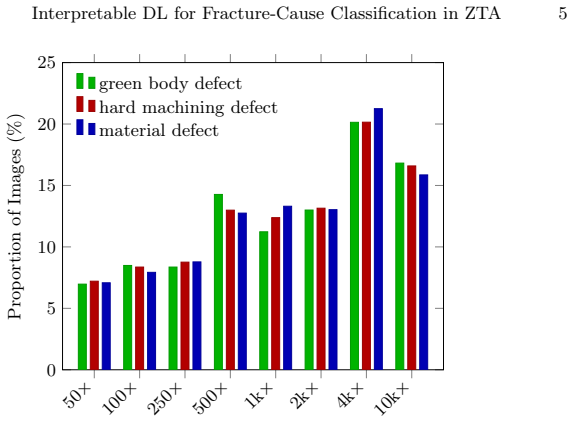
- [Abstract] The abstract would benefit from a brief statement of the number of images per magnification bin and per class to allow readers to contextualize the reported metrics.
Simulated Author's Rebuttal
We thank the referee for the careful reading and constructive comments on the abstract. We address each major point below and will revise the manuscript to improve clarity and completeness.
read point-by-point responses
-
Referee: [Abstract] Abstract: the headline claim that 'performance at low magnification (50x) was comparable to that at high magnification (1k-10kx)' is only diagnostic of macro-scale sufficiency if the ViT was trained and evaluated exclusively on the 50x subset. The abstract provides no information on whether separate low-mag-only training runs were performed or whether the reported 50x numbers come from a model trained on the pooled multi-scale dataset; this distinction is load-bearing for the central claim.
Authors: We agree that the training protocol must be stated explicitly for the claim to be diagnostic. The 50x results were obtained from models trained and evaluated exclusively on the 50x subset (separate from the pooled multi-scale runs), as described in the experimental protocol and results sections of the full manuscript. We will revise the abstract to state this directly. revision: yes
-
Referee: [Abstract] Abstract / implied Results: no architecture details (ViT variant, patch size, fine-tuning strategy), training hyperparameters, class distribution counts, or per-class metrics are supplied. Without these, it is impossible to assess whether the reported accuracy and macro-F1 under severe imbalance reflect genuine generalization or are artifacts of the training protocol.
Authors: The abstract is kept concise per journal norms, but the full manuscript supplies the ViT variant, patch size, fine-tuning protocol, hyperparameters, class counts, and per-class metrics. We will add a short clause to the abstract summarizing the key architecture and note the location of the remaining details. revision: partial
-
Referee: [Abstract] Abstract: the leakage audit is described only qualitatively ('negligible specimen overlap'). Quantitative results (number of near-duplicates detected, SSIM thresholds, fold-wise overlap statistics) are required to evaluate whether the stratified CV truly prevents specimen-level leakage across the five-year production dataset.
Authors: We accept that quantitative audit statistics strengthen the description. The Methods section already records the perceptual-hash and SSIM thresholds together with the number of near-duplicates removed; we will insert the specific counts and fold-wise overlap figures into the revised abstract. revision: yes
Circularity Check
No circularity: purely empirical ML classification with cross-validation
full rationale
The paper reports empirical performance metrics (accuracy 0.907, macro-F1 0.888) from stratified 5-fold cross-validation on a curated dataset of 8493 images, with a perceptual-hash/SSIM leakage audit. No equations, derivations, fitted parameters renamed as predictions, or self-citation chains appear in the provided text. The low-magnification claim is an empirical observation from the same CV setup rather than a constructed reduction. The work is self-contained against external benchmarks.
Axiom & Free-Parameter Ledger
Reference graph
Works this paper leans on
-
[1]
Optuna: A Next-generation Hyperparameter Optimization Framework
Akiba, T., Sano, S., Yanase, T., Ohta, T., Koyama, M.: Optuna: A Next-generation Hyperparameter Optimization Framework (Jul 2019). https://doi.org/10.48550/ arXiv.1907.10902
work page internal anchor Pith review Pith/arXiv arXiv 2019
-
[2]
Al-Hajjar, M., Fisher, J., Tipper, J.L., Williams, S., Jennings, L.M.: Wear of 36- mm BIOLOX®delta ceramic-on-ceramic bearing in total hip replacements under edge loading conditions. Proceedings of the Institution of Mechanical Engineers, Part H: Journal of Engineering in Medicine227(5), 535–542 (May 2013). https: //doi.org/10.1177/0954411912474613
-
[3]
https://doi.org/ 10.48550/arXiv.2410.04440
Alaa, T., Kotb, M., Zakaria, A., Diab, M., Gomaa, W.: Automated Detection of Defects on Metal Surfaces using Vision Transformers (Oct 2024). https://doi.org/ 10.48550/arXiv.2410.04440
-
[4]
Bastidas-Rodriguez, M.X., Polania, L., Gruson, A., Prieto-Ortiz, F.: Deep learn- ing for fractographic classification in metallic materials. Engineering Failure Analy- sis113,104532(2020).https://doi.org/https://doi.org/10.1016/j.engfailanal.2020. 104532, https://www.sciencedirect.com/science/article/pii/S1350630720300364
-
[5]
Seminars in Arthroplasty22(4), 264–270 (Dec 2011)
Bergschmidt, P., Kluess, D., Zietz, C., Finze, S., Bader, R., Mittelmeier, W.: Composite Ceramics in Total Knee Arthroplasty: Two-Year Experience in Clin- ical Application. Seminars in Arthroplasty22(4), 264–270 (Dec 2011). https: //doi.org/10.1053/j.sart.2011.10.001
-
[6]
https: //doi.org/10.48550/arXiv.2307.11496
Coates, P., Breitinger, F.: Identifying document similarity using a fast estimation of the Levenshtein Distance based on compression and signatures (Jul 2023). https: //doi.org/10.48550/arXiv.2307.11496
-
[7]
In: 2025 36th Annual SEMI Advanced Semiconductor Manufacturing Con- ference (ASMC)
Huang, C.F.F., Sieg, K., Karlinksy, L., Flores, N., Sheraw, R., Zhang, X.: Semi- conductor SEM Image Defect Classification Using Supervised and Semi-Supervised Learning with Vision Transformers : Topic/category: Defect Inspection and Reduc- tion. In: 2025 36th Annual SEMI Advanced Semiconductor Manufacturing Con- ference (ASMC). pp. 1–5 (May 2025). https:...
-
[8]
PyTorch: An Imperative Style, High-Performance Deep Learning Library
Paszke, A., Gross, S., Massa, F., Lerer, A., Bradbury, J., Chanan, G., Killeen, T., Lin, Z., Gimelshein, N., Antiga, L., Desmaison, A., Köpf, A., Yang, E., DeVito, Z., Raison, M., Tejani, A., Chilamkurthy, S., Steiner, B., Fang, L., Bai, J., Chintala, S.: PyTorch: An Imperative Style, High-Performance Deep Learning Library (Dec 2019). https://doi.org/10.4...
work page internal anchor Pith review Pith/arXiv arXiv doi:10.48550/arxiv.1912.01703 2019
-
[9]
Ceramic Transactions199, 163–190 (Jun 2007)
Quinn, G.: Guidelines for Measuring Fracture Mirrors. Ceramic Transactions199, 163–190 (Jun 2007). https://doi.org/10.1002/9781118144152.ch14
-
[10]
Quinn, G.D.: Fractography of Ceramics and Glasses. NIST Special Publication 960-16e3, National Institute of Standards and Technology, Gaithersburg, MD, 3 edn.(2020).https://doi.org/10.6028/NIST.SP.960-16e3,https://nvlpubs.nist.gov/ nistpubs/specialpublications/NIST.SP.960-16e3.pdf
-
[11]
Rumala, D.J.: How you split matters: Data leakage and subject characteristics studies in longitudinal brain mri analysis. In: Wesarg, S., Puyol Antón, E., Baxter, J.S.H., Erdt, M., Drechsler, K., Oyarzun Laura, C., Freiman, M., Chen, Y., Rekik, I., Eagleson, R., Feragen, A., King, A.P., Cheplygina, V., Ganz-Benjaminsen, M., Ferrante, E., Glocker, B., Moye...
2023
-
[12]
Schmies, L., Hemmleb, M., Bettge, D.: Relevant input data for crack fea- ture segmentation with deep learning on sem imagery and topography data. 16 J. Schmid et al. Engineering Failure Analysis156, 107814 (2024). https://doi.org/https: //doi.org/10.1016/j.engfailanal.2023.107814, https://www.sciencedirect.com/ science/article/pii/S1350630723007689
-
[13]
Grad-cam: Visual explanations from deep networks via gradient-based localization,
Selvaraju, R.R., Cogswell, M., Das, A., Vedantam, R., Parikh, D., Batra, D.: Grad- CAM: Visual Explanations from Deep Networks via Gradient-based Localization. International Journal of Computer Vision128(2), 336–359 (Feb 2020). https:// doi.org/10.1007/s11263-019-01228-7
-
[14]
In: Ninth International Conference on Document Analysis and Recognition (ICDAR 2007), vol
Smith, R.: An Overview of the Tesseract OCR Engine. In: Ninth International Conference on Document Analysis and Recognition (ICDAR 2007). vol. 2, pp. 629–633 (Sep 2007). https://doi.org/10.1109/ICDAR.2007.4376991
-
[15]
Tang, K., Zhang, P., Zhao, Y., Zhong, Z.: Deep learning-based semantic segmenta- tion for morphological fractography. Engineering Fracture Mechanics303, 110149 (2024).https://doi.org/https://doi.org/10.1016/j.engfracmech.2024.110149,https: //www.sciencedirect.com/science/article/pii/S0013794424003126
-
[16]
Tsopanidis, S., Moreno, R.H., Osovski, S.: Toward quantitative fractography us- ing convolutional neural networks. Engineering Fracture Mechanics231, 106992 (2020).https://doi.org/https://doi.org/10.1016/j.engfracmech.2020.106992,https: //www.sciencedirect.com/science/article/pii/S0013794419315401
-
[17]
Annals of Joint5(0) (Apr 2020)
de Villiers, D., Richards, L., Tuke, M., Collins, S.: Ceramic resurfacing: The future and challenges. Annals of Joint5(0) (Apr 2020). https://doi.org/10.21037/aoj. 2019.12.11
-
[18]
IEEE Transactions on Image Processing 13(4), 600–612 (Apr 2004)
Wang, Z., Bovik, A., Sheikh, H., Simoncelli, E.: Image quality assessment: From error visibility to structural similarity. IEEE Transactions on Image Processing 13(4), 600–612 (Apr 2004). https://doi.org/10.1109/TIP.2003.819861
-
[19]
https://doi.org/10.48550/arXiv.2501.18637
Whitman, S.E., Latypov, M.I.: Machine learning of microstructure–property rela- tionships in materials with robust features from foundational vision transformers (Jan 2025). https://doi.org/10.48550/arXiv.2501.18637
-
[20]
Zenodo (Feb 2023)
Wightman, R., Raw, N., Soare, A., Arora, A., Ha, C., Reich, C., Guan, F., Kaczmarzyk, J., MrT23, Mike, SeeFun, Contrastive, Rizin, M., Hyeongchan Kim, Kertész, C., Dushyant Mehta, Cucurull, G., Kushajveer Singh, Hankyul, Tat- sunami, Y., Lavin, A., Juntang Zhuang, Hollemans, M., Rashad, M., Sameni, S., Shults, V., Lucain, Wang, X., Yonghye Kwon, Uchida, Y...
2023
-
[21]
Github (2019)
Yadan, O.: Hydra - A framework for elegantly configuring complex applications. Github (2019)
2019
-
[22]
Orthopedics41(6), e880–e883 (Nov 2018)
Yoon, B.H., Park, I.K.: Atraumatic Fracture of the BIOLOX delta Ceramic Liner in Well-Fixed Total Hip Implants. Orthopedics41(6), e880–e883 (Nov 2018). https: //doi.org/10.3928/01477447-20180815-07
discussion (0)
Sign in with ORCID, Apple, or X to comment. Anyone can read and Pith papers without signing in.