A Calibrated Bayesian Search for Potential Chemical Technosignatures in Polluted White Dwarf
Pith reviewed 2026-06-29 00:47 UTC · model grok-4.3
The pith
Bayesian comparison of meteorite and white dwarf abundances finds siderophile-enriched compositions uncommon.
A machine-rendered reading of the paper's core claim, the machinery that carries it, and where it could break.
Core claim
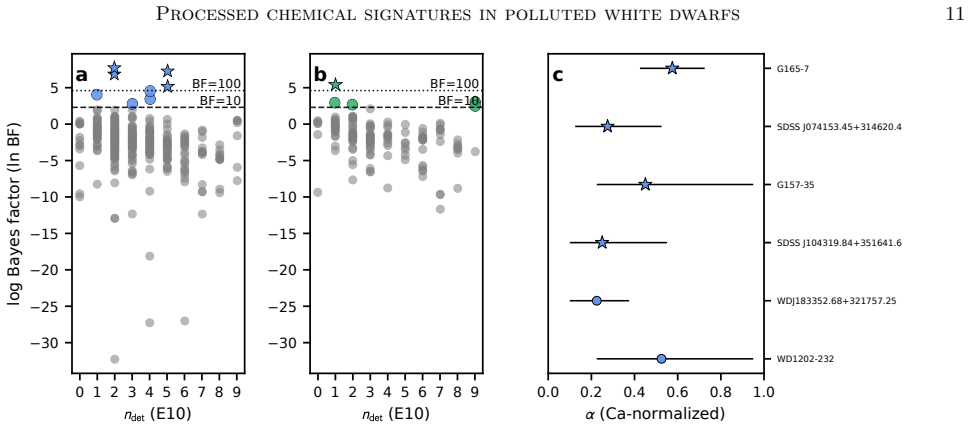
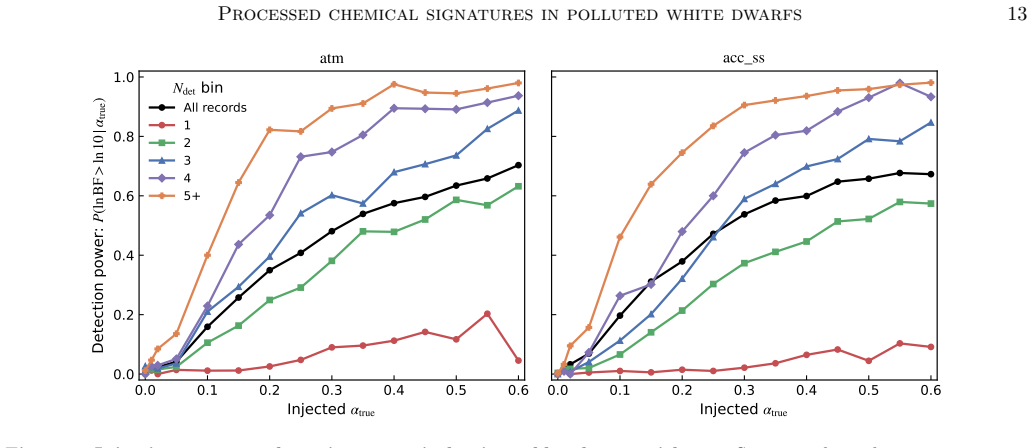
We present a meteorite-calibrated Bayesian framework for searching archival abundance records for chemical technosignatures by comparing the evidence for natural material alone versus a mixture with a fixed siderophile-enriched template parameterised by a Ca-normalized mixing fraction alpha. Strong support for the processed template is uncommon: in the photospheric compilation 8/697 records have BF > 10 and in the diffusion-adjusted steady-state subset 6/148 have BF > 10. We report the highest-evidence candidate records and infer the fraction of records detectably favoring the mixture model, with posterior medians pi-tilde = 0.011 (atm) and pi-tilde = 0.041 (acc ss).
What carries the argument
The Bayes factor comparing a multi-modal natural-composition model fit to 3493 meteorite analyses against a two-component mixture model that adds a fixed siderophile-enriched template via mixing fraction alpha.
If this is right
- Strong support for the processed template occurs in fewer than 5 percent of records in the tested data sets.
- Decisive discrimination between natural and mixture models requires greater than or equal to 5 detected elements.
- For the siderophile template, support is strongest in exact five-element panels that include Fe, Mg, Cr, and Ti together with Ni, Si, or Na.
- The framework constrains the detectable incidence of this processed-composition class and identifies data requirements for future multi-element surveys.
Where Pith is reading between the lines
- The same calibrated comparison could be rerun with alternative processed templates that emphasize different element groups.
- Expanded samples with uniform multi-element coverage would tighten the upper limit on the incidence fraction.
- If future observations increase the typical number of measured elements per star, the method's ability to flag candidates would improve without changing the template.
Load-bearing premise
The fixed siderophile-enriched template serves as a valid proxy for an idealized processed composition that would count as a technosignature, and the meteorite sample adequately spans the natural compositions that pollute white dwarfs.
What would settle it
A new survey of white dwarfs with at least five detected elements that yields more than 10 percent of records with Bayes factors above 10 would indicate a higher incidence than the reported posterior medians.
Figures
read the original abstract
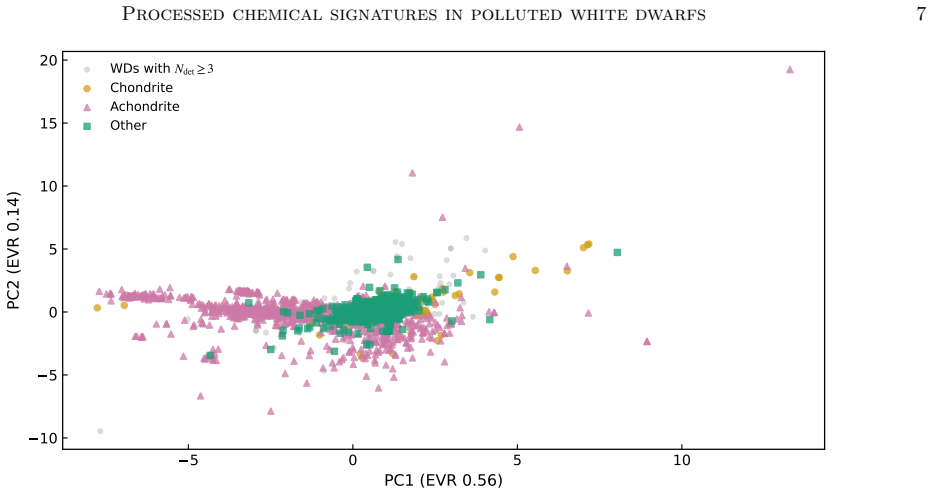
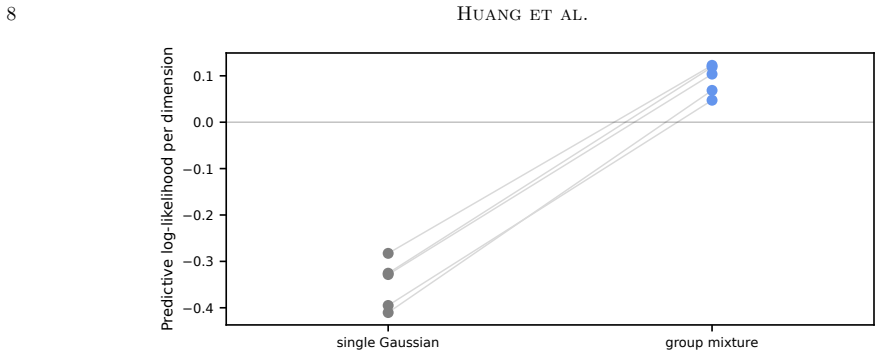
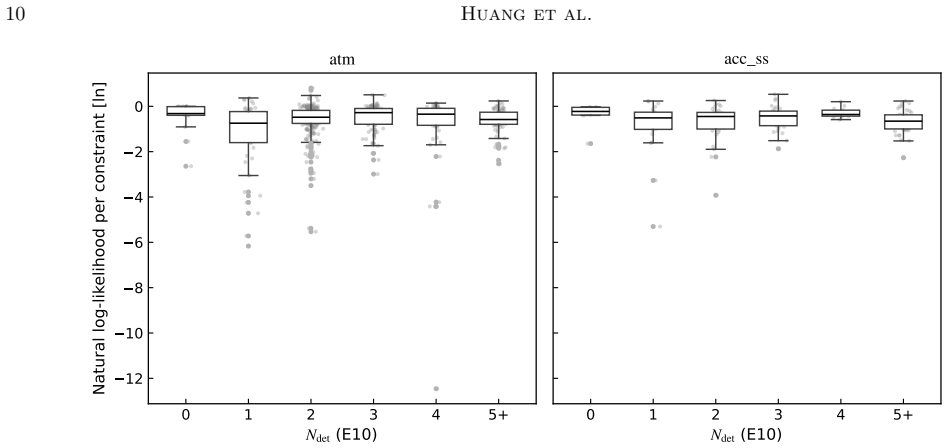
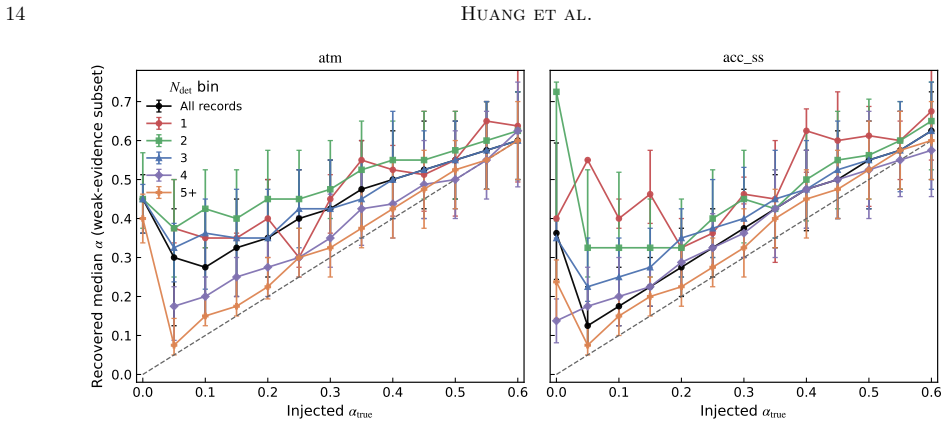
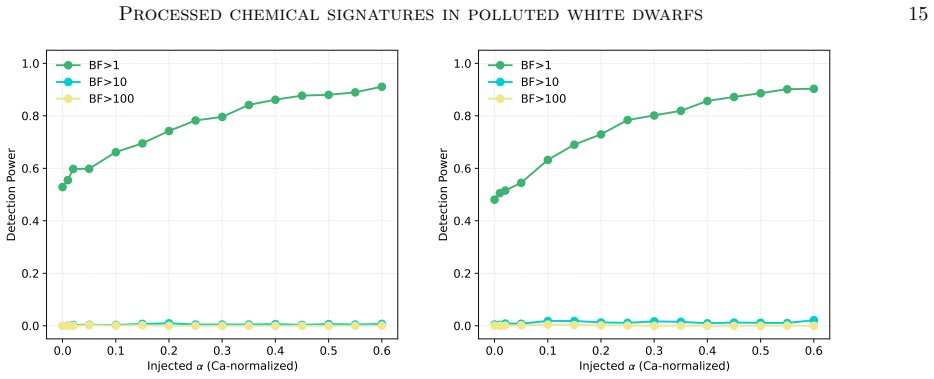
We present a meteorite-calibrated Bayesian framework for searching archival abundance records for chemical technosignatures--operationally, compositional patterns better explained by an idealised "processed" template (endmember) than by the empirical distribution of natural rocks. We fit a multi-modal natural-composition reference using 3,493 whole-rock meteorite analyses, and for each of 697 star-paper abundance sets--spanning at least 397 distinct objects once Gaia-designated repeats are consolidated--we compare the Bayesian evidence for (i) natural material and (ii) a mixture of natural material with a fixed siderophile-enriched template, parameterised by a Ca-normalized mixing fraction alpha. Strong support for the processed template is uncommon: in the photospheric compilation (atm) 8/697 records have BF > 10 (4/697 have BF > 100), and in the diffusion-adjusted steady-state subset (acc ss; 148 records spanning at least 94 objects) 6/148 have BF > 10. We report the highest-evidence candidate records and infer the fraction of records detectably favoring the mixture model, with posterior medians pi-tilde = 0.011 (atm) and pi-tilde = 0.041 (acc ss). We calibrate the analysis with end-to-end injection-recovery experiments matched to each record's coverage and censoring. The calibration shows that discrimination is driven mainly by chemical information, typically requires greater-than-or-similar-to 5 detected elements for decisive support, and--for the siderophile template--is strongest for exact five-element panels that include Fe, Mg, Cr, and Ti together with Ni, Si, or Na. These results constrain the detectable incidence of the tested processed-composition class in current data and set observational requirements for future multi-element surveys and expanded template families.
Editorial analysis
A structured set of objections, weighed in public.
Referee Report
Summary. The paper introduces a meteorite-calibrated Bayesian framework to search for chemical technosignatures in 697 archival white dwarf photospheric abundance records (and a 148-record steady-state subset). It fits a multi-modal natural-composition model to 3,493 meteorite analyses and compares Bayesian evidence for that model versus a mixture with a fixed siderophile-enriched template (parameterized by mixing fraction alpha), reporting that strong support (BF > 10) occurs in only 8/697 and 6/148 cases, with inferred incidence fractions pi-tilde of 0.011 and 0.041. End-to-end injection-recovery tests calibrate the method's power as a function of detected elements and specific element panels.
Significance. If the chosen template and meteorite reference distribution are representative, the low reported incidence provides a quantitative, calibrated constraint on the detectable fraction of processed-composition technosignatures in existing WD data and identifies observational requirements (typically >=5 elements, specific siderophile panels) for future surveys. The explicit injection-recovery calibration is a methodological strength that allows direct assessment of detection thresholds.
major comments (2)
- [Abstract, methods] Abstract and methods: the central incidence claims (pi-tilde = 0.011/0.041 and the BF>10 counts) rest on the assumption that the multi-modal fit to the 3,493 meteorite analyses fully spans the natural abundance distribution relevant to WD pollutants and that the fixed siderophile-enriched template is an appropriate proxy for any processed technosignature. No explicit test is shown that compositions outside this meteorite sample (e.g., non-solar-system differentiation products) would not produce comparable or higher evidence for the mixture model, which directly affects whether the reported fractions can be interpreted as incidence limits.
- [Methods] Methods (injection-recovery section): the calibration demonstrates method power given the chosen models but does not address model completeness; if plausible natural or artificial compositions lie outside the meteorite multi-modal distribution or the fixed template, the BF values and pi-tilde posteriors are conditional on an untested assumption and cannot be taken as unconditional constraints on technosignature incidence.
minor comments (2)
- [Methods] The exact numerical definition and construction of the siderophile-enriched template (e.g., which elements and abundance ratios) should be stated explicitly, ideally with a table or equation, to allow independent reproduction.
- [Data] Consolidation of Gaia-designated repeats to arrive at 'at least 397 distinct objects' should be detailed with a clear count of unique objects per subset.
Simulated Author's Rebuttal
We thank the referee for their constructive comments. We address each major comment below and agree that the results are conditional on the chosen models. We will revise the manuscript to make this conditionality more explicit without altering the numerical results or analysis.
read point-by-point responses
-
Referee: [Abstract, methods] Abstract and methods: the central incidence claims (pi-tilde = 0.011/0.041 and the BF>10 counts) rest on the assumption that the multi-modal fit to the 3,493 meteorite analyses fully spans the natural abundance distribution relevant to WD pollutants and that the fixed siderophile-enriched template is an appropriate proxy for any processed technosignature. No explicit test is shown that compositions outside this meteorite sample (e.g., non-solar-system differentiation products) would not produce comparable or higher evidence for the mixture model, which directly affects whether the reported fractions can be interpreted as incidence limits.
Authors: The 3,493 meteorite analyses provide an empirical distribution spanning undifferentiated chondrites and differentiated achondrites, irons, and stony-irons, representing the broadest available proxy for natural solar-system compositions relevant to white-dwarf pollutants. We do not assert that this distribution exhausts every possible natural abundance pattern in the universe. The siderophile-enriched template is presented as one specific hypothesis for a processed endmember. We accept that unrepresented compositions could in principle alter evidence ratios. The revised manuscript will add explicit language in the abstract, methods, and discussion stating that the reported incidence fractions and BF counts apply to detectable support for this template relative to the meteorite-calibrated natural model. The original text already qualifies the results as constraining 'the tested processed-composition class'; the revision strengthens this framing. revision: yes
-
Referee: [Methods] Methods (injection-recovery section): the calibration demonstrates method power given the chosen models but does not address model completeness; if plausible natural or artificial compositions lie outside the meteorite multi-modal distribution or the fixed template, the BF values and pi-tilde posteriors are conditional on an untested assumption and cannot be taken as unconditional constraints on technosignature incidence.
Authors: The injection-recovery experiments calibrate detection power and false-positive rates under the fitted meteorite model and fixed template; they do not claim to validate model completeness. The Bayesian comparison is inherently between the two specified hypotheses. We will revise the methods and discussion to state more prominently that the pi-tilde posteriors and BF thresholds are conditional on these models. This does not require changes to the calibration procedure or reported values but clarifies that the incidence limits are framework-specific rather than unconditional. revision: yes
Circularity Check
No circularity: results derive from external meteorite data and per-record evidence ratios, not self-definition or fitted inputs renamed as predictions
full rationale
The paper fits a multi-modal natural-composition model to 3,493 external meteorite analyses, then for each of 697 WD records computes the Bayes factor between that natural model and a mixture with a fixed siderophile template. The reported counts (8/697 with BF>10), fractions, and posterior medians pi-tilde = 0.011/0.041 are direct outputs of these per-record comparisons, calibrated by injection-recovery experiments that test the chosen models on the data. No step reduces a claimed prediction to a quantity defined by the paper's own fitted parameters, no self-citation is load-bearing for the incidence claim, and the template and meteorite fit are treated as external inputs rather than derived from the WD results themselves. This matches the default non-circular case.
Axiom & Free-Parameter Ledger
free parameters (2)
- alpha
- pi-tilde =
0.011 (atm), 0.041 (acc ss)
axioms (2)
- domain assumption Meteorite whole-rock analyses represent the empirical distribution of natural rock compositions relevant to white dwarf pollution.
- domain assumption Bayesian evidence comparison between natural and mixture models is valid for the censored abundance data.
invented entities (1)
-
siderophile-enriched template
no independent evidence
Reference graph
Works this paper leans on
-
[1]
2021, Metals, 11, 1052, doi: 10.3390/met11071052 Astromaterials Data System
Astafurov, S., & Astafurova, E. 2021, Metals, 11, 1052, doi: 10.3390/met11071052 Astromaterials Data System. 2025, Astromat Synthesis,, https://search.astromat.org/
-
[2]
Buchan, A. M., Bonsor, A., Rogers, L. K., et al. 2024, Monthly Notices of the Royal Astronomical Society, 532, 2705, doi: 10.1093/mnras/stae1608
-
[3]
2017, in Astronomical Society of the Pacific Conference Series, Vol
Dufour, P., Blouin, S., Coutu, S., et al. 2017, in Astronomical Society of the Pacific Conference Series, Vol. 509, 20th European White Dwarf Workshop, ed. P.-E. Tremblay, B. G”ansicke, & T. Marsh (Astronomical Society of the Pacific), 3–8
2017
-
[4]
2016, New Astronomy Reviews, 71, 9, doi: 10.1016/j.newar.2016.03.001 G”ansicke, B
Farihi, J. 2016, New Astronomy Reviews, 71, 9, doi: 10.1016/j.newar.2016.03.001 G”ansicke, B. T., Marsh, T. R., Southworth, J., &
-
[5]
2006, Science, 314, 1908, doi: 10.1126/science.1135033
Rebassa-Mansergas, A. 2006, Science, 314, 1908, doi: 10.1126/science.1135033
-
[6]
Hezel, D. C., Lehnert, K. A., Elangovan, P., et al. 2025, Meteoritics & Planetary Science, 60, 143, doi: 10.1111/maps.14293
-
[7]
2003, The Astrophysical Journal Letters, 584, L91, doi: 10.1086/374036
Jura, M. 2003, The Astrophysical Journal Letters, 584, L91, doi: 10.1086/374036
-
[8]
Jura, M., & Young, E. D. 2014, Annual Review of Earth and Planetary Sciences, 42, 45, doi: 10.1146/annurev-earth-060313-054740
-
[9]
Kass, R. E., & Raftery, A. E. 1995, Journal of the American Statistical Association, 90, 773, doi: 10.1080/01621459.1995.10476572
-
[10]
2011, The Astrophysical Journal, 741, 64, doi: 10.1088/0004-637X/741/1/64
Klein, B., Jura, M., Koester, D., & Zuckerman, B. 2011, The Astrophysical Journal, 741, 64, doi: 10.1088/0004-637X/741/1/64
-
[11]
2009, Astronomy & Astrophysics, 498, 517, doi: 10.1051/0004-6361/200811468 Le Losq, C., Valentine, A
Koester, D. 2009, Astronomy & Astrophysics, 498, 517, doi: 10.1051/0004-6361/200811468 Le Losq, C., Valentine, A. P., Mysen, B. O., & Neuville, D. R. 2021, Geochimica et Cosmochimica Acta, 314, 27, doi: 10.1016/j.gca.2021.08.023
-
[12]
W., Gonz´ alez Abad, G., & Loeb, A
Lin, H. W., Gonz´ alez Abad, G., & Loeb, A. 2014, The Astrophysical Journal Letters, 792, L7, doi: 10.1088/2041-8205/792/1/L7
-
[13]
Mitchell, T. J., & Beauchamp, J. J. 1988, Journal of the American Statistical Association, 83, 1023, doi: 10.1080/01621459.1988.10478694 NASA Technosignatures Workshop Participants. 2018, NASA and the Search for Technosignatures: A Report from the NASA Technosignatures Workshop, doi: 10.48550/arXiv.1812.08681 Semiz, ˙I., & O˘ gur, S. 2015, Dyson Spheres a...
-
[14]
2023, Monthly Notices of the Royal Astronomical Society, 526, 3815, doi: 10.1093/mnras/stad2867
Swan, A., Farihi, J., Melis, C., et al. 2023, Monthly Notices of the Royal Astronomical Society, 526, 3815, doi: 10.1093/mnras/stad2867
-
[15]
2001, Annual Review of Astronomy and Astrophysics, 39, 511, doi: 10.1146/annurev.astro.39.1.511
Tarter, J. 2001, Annual Review of Astronomy and Astrophysics, 39, 511, doi: 10.1146/annurev.astro.39.1.511
-
[16]
2008, Contemporary Physics, 49, 71, doi: 10.1080/00107510802066753
Trotta, R. 2008, Contemporary Physics, 49, 71, doi: 10.1080/00107510802066753
-
[17]
Williams, J., G”ansicke, B. T., Swan, A., et al. 2024, Astronomy & Astrophysics, 691, A352, doi: 10.1051/0004-6361/202450509
-
[18]
2022, Journal of Sustainable Metallurgy, 8, 37, doi: 10.1007/s40831-022-00501-3
Zhao, K., Gao, F., & Yang, Q. 2022, Journal of Sustainable Metallurgy, 8, 37, doi: 10.1007/s40831-022-00501-3
-
[19]
2007, The Astrophysical Journal, 671, 872, doi: 10.1086/522223
Jura, M. 2007, The Astrophysical Journal, 671, 872, doi: 10.1086/522223
-
[20]
Zuckerman, B., Koester, D., Reid, I. N., & H”unsch, M. 2003, The Astrophysical Journal, 596, 477, doi: 10.1086/377492
discussion (0)
Sign in with ORCID, Apple, or X to comment. Anyone can read and Pith papers without signing in.